

HUMBOLDT TODAY with John Kennedy O’Connor | May 17, 2023
LoCO Staff / Wednesday, May 17, 2023 @ 4:29 p.m. / Humboldt Today
Today’s newscast! Press play above, read below, take the poll even further below.
FURTHER READING:
- Samoa Cookhouse Closes Temporarily for Major Renovation to Create Hostel Rentals, Cabins, Dog Park and Picnic Area
- Anticipating Big Economic Growth, Board of Supervisors Explores the Idea of Impact Fees for New Development. Plus: Preserving Public Access, and More
- Kamome Foundation Delegation to Celebrate Mural’s Arrival in Rikuzentakata
- With ‘Chalk Talk,’ an Unknown Author Addresses Eureka’s Homelessness Issues One Word at a Time
HUMBOLDT TODAY can be viewed on LoCO’s homepage each night starting at 6 p.m.
BOOKED
Yesterday: 2 felonies, 10 misdemeanors, 0 infractions
JUDGED
Humboldt County Superior Court Calendar: Yesterday
CHP REPORTS
No current incidents
ELSEWHERE
RHBB: Amazon Warehouse Seen as Potential Revenue Lifeline in Tight County Budget
RHBB: This Valentine’s Day, Keep the Love Flowing — Not the Outages, says PG&E
Anticipating Big Economic Growth, Board of Supervisors Explores the Idea of Impact Fees for New Development. Plus: Preserving Public Access, and More
Isabella Vanderheiden / Wednesday, May 17, 2023 @ 12:46 p.m. / Local Government , Offshore Wind
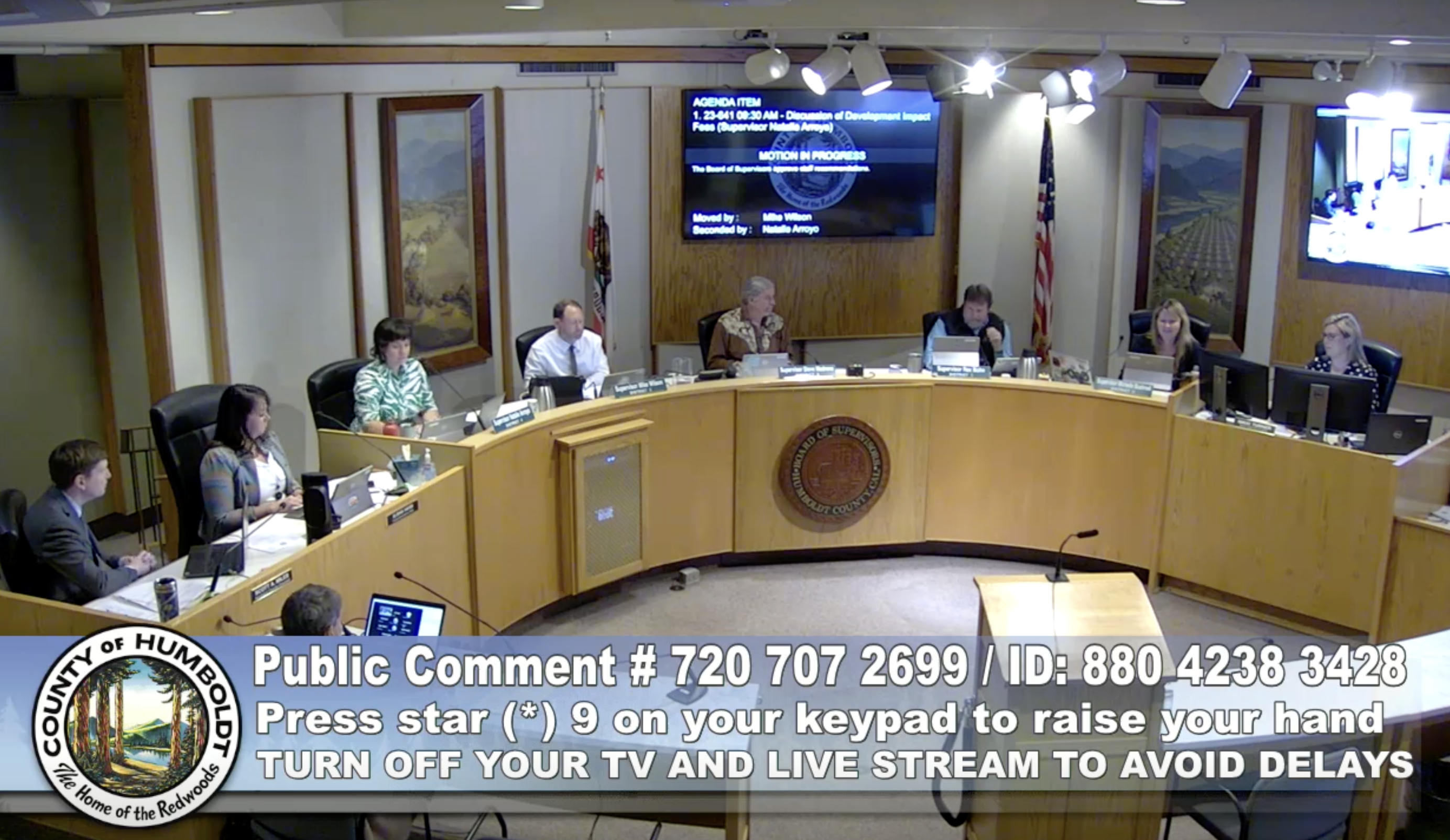
Screenshot of Tuesday’s Humboldt County Board of Supervisors meeting.
###
As several major projects move steadily ahead throughout the Humboldt Bay region, county officials are looking for ways to offset potential impacts associated with future development. The Humboldt County Board of Supervisors, prompted by Fourth District Supervisor Natalie Arroyo, revisited the topic of development impact fees during Tuesday’s meeting as a strategy to better accommodate incoming residents.
In a nutshell, development impact fees are fees that are imposed on specific projects to mitigate costs associated with new or additional public facilities – including fire and public safety, parks and transportation – that are needed to serve those developments. They must be based on the impact of new development and the cost of providing additional facilities or improvements.
Humboldt County is the only county in California that does not have development impact fees, largely due to the county’s historically low growth rate, but that may be about to change.
Cal Poly Humboldt is rapidly expanding to accommodate its increasing student population. Nordic Aquafarms is furthering its plans to build a land-based fish farm on the Samoa Peninsula. Crowley Wind Services is working with the Harbor District to build a full-service terminal on Humboldt Bay to support a 200-square-mile offshore wind development off the North Coast. There are also a couple of high-speed fiber optic lines being built in the region that will feed into a big data center in Arcata. And then, of course, there will be all the new housing that will be needed to support these big projects.
As developments move forward, the county and local municipalities can expect even more pressure on existing public resources and facilities. That’s where development impact fees come in.
Planning and Building Director John Ford noted that, while the county doesn’t have a development impact fee program per se, the costs are applied and accounted for throughout the development process. Ford used the North McKay Ranch Subdivision as an example.
“In that particular case, the [Environmental Impact Report] EIR identified that there were traffic impacts that needed to be addressed,” he explained. “The way a traffic fee would work – as applied to that [project] – is that the county would have done a nexus study to identify what the cumulative impacts are needed to implement the development allowed by the General Plan, and … identify a list of improvements that are needed to address those impacts and then to identify fees associated to implement them in that particular case.”
While development impact fees tend to add to the cost of a building permit, Ford noted that developers would be able to calculate their costs up front instead of going through the EIR process “to understand what their fees are.”
Second District Supervisor Michelle Bushnell asked how development impact fees would affect rural, unincorporated communities. Ford said it would depend on the community and the improvements needed to mitigate the impacts of a specific development.
“The downside, frankly, is that when your growth rate is slow and the amount of money coming in from fees isn’t sufficient to fund the improvements … the money gets returned [to the developer],” he said. “It’s really not applied very much in the rural areas. We just don’t see that kind of growth that the more populous counties do where they’ll build a new town in the middle of nowhere with 10,000 people. That’s not the kind of growth that we see.”
First District Supervisor Rex Bohn said he had contacted a few local housing developers ahead of Tuesday’s meeting and said they were “very concerned” about the prospect of the county implementing development impact fees.
“I’m not saying this is a bad idea [or] something that shouldn’t be looked at … but do we reach out enough and talk to the people that are actually going to be affected?” he asked. “The people that are going to be here tomorrow … to build houses into the future because we’re losing those. … I don’t think it’s great idea, but I’m not against it.”
Bohn recommended county staff look into the item further before moving forward. Fifth District Supervisor and Board Chair Steve Madrone noted that the item did not require any immediate action from the board, adding that staff’s recommendation would direct staff to conduct more research on the subject and bring a recommendation back to the board with a scope of work and cost estimate.
Third District Supervisor Mike Wilson said he would support a continuance of the discussion but also expressed his support for the implementation of development impact fees, noting that “it’s not just about the up front cost.”
“It is about the sort of the pain of paying up front for infrastructure and services, but we also have to remember all the folks that live in the community that … will use and utilize – and require, really – the services and infrastructure associated with fees like this,” he said. “We’re lacking in that space. I would also add that recreational districts are really popular and have been for a long time. There have been fees around that because they bring needed and really very popular infrastructure to communities and neighborhoods that are actually valuable to people’s property values and public safety.”
Returning to Bohn’s previous comment, Arroyo noted that she completely agreed that extensive outreach would be essential to implementing a development impact fee program but said, “I view this very much as a slow burn item.”
“I see this as something … that could would take quite a while to implement because there would need to be a lot of underlying study and analysis,” she said. “We would need to really understand to what type of development this applies and what kinds of improvements we’d be seeking to fund with the development impact fees. … It would be good to confer with our counterparts in the cities to understand what their appetite is for this and … [if there are] potentially other community services that can be funded.”
Returning to the subject of increased building costs, Bushnell said she would like to know more about how development impact fees would affect rural communities in comparison to cities, but said she wouldn’t be in favor of an additional fee that would serve “as a deterrent to building homes.”
Bushnell also asked Ford how the additional research would impact staffing in his department. “A lot of it depends on the board’s action on the budget in terms of what our staffing is gonna look like,” he said.
Speaking during public comment, Dave Watson, a representative of the Humboldt Builders Exchange, said he generally agreed with Bohn’s concerns surrounding increasing building costs but expressed support for Arroyo’s idea of streamlining the process to make it easier for development along the way.
“That’s absolutely fantastic, but I think the real fear is that it’s going to end up costing more money,” he said. “We’ll establish a secondary bureaucracy. We’re going to add more steps and the [EIRs] and all the other mitigation are still going to need to happen. It’s hard to see this as a net positive but I’m absolutely going to participate in any way that we can.”
After a bit of additional discussion, Wilson made a motion to move forward with staff’s recommendation to conduct more research on the item. The motion passed in a 4-1 vote, with Bushnell dissenting.
Public River Access at Fisher Road
The Board of Supervisors also received an informational report from staff regarding public access to the Van Duzen River via Fisher Road near Hydesville.
Local residents and avid fishermen have used Fisher Road to access the Van Duzen River for decades, but a change in the river’s course a few years back left a near-vertical cliff along the bank, making river access more difficult. The river access point also requires trespassing on private property, though the county has asserted a common-law dedication through public use and maintenance.
The property owners, Kelly and Shelby Patton, asked the county to give up the southern portion of the road late last year to prevent the public from using it as a river access point. The matter was listed on the board’s Dec. 20 agenda but the meeting was canceled in response to the magnitude 6.4 earthquake that rocked the entire county.
Members of the Humboldt County Fish and Game Advisory Commission have pushed back against the property owners’ request to vacate the road, arguing that the public has a right to access the Van Duzen River.
“California’s Constitution of 1879, laws, and judicial decisions have established public rights to access the state’s navigable waters, as well as tidelands, submerged lands, streams, lake, bays, and estuaries,” according to an Apr. 18 letter from the commission. “These resources are held in ‘public trust’ for current ad future generations. The public trust doctrine was established to ensure that government officials protect these sovereign lands for the use and enjoyment of the public, free from the obstruction of interference of private landowners.”
Before taking questions from supervisors, a lawyer from the county counsel’s office advised board members to keep their questions focused on public access rather than Fisher Road specifically. Similarly, Madrone reminded the board several times throughout the discussion that the item at hand was an informational report and did not require any additional direction from the board.
Speaking during public comment, Alicia Hamann, representing Friends of the Eel River and the Great Redwood Trail Coalition, advocated for continued public access to the river.
“You’ve heard from many community members who value this relatively rare point of access on the Van Duzen River and many of those people also have used this road to access the river for decades,” Hamann said. “I want to focus right now on reminding the board that about 30 years ago, the supervisors proudly protected public river access, even going as far as litigating to preserve public access at Odd Fellows Park Road, about a mile east of Fisher Road, as referenced in our letter.”
Hamman added that the court’s ruling established that the Van Duzen was a navigable waterway, adding that the public had a right to use the river and the riverbed up to the high watermark.
Speaking on behalf of the Humboldt Trails Council, Bruce Silvey emphasized the importance of the county securing and maintaining public access to Fisher Road, which will eventually intersect with the proposed Great Redwood Trail.
“The river access, at this point, is the only access along the Carlotta Branch Trail and the trails council believes that having a clear river access point will have an important impact on the number of people using the trail,” Silvey said. “The more people who use the trail, the safer the users feel and the less unwanted activities will occur on the trail. Also, there’s added benefit of a healthier and happier community with increased trail use in the county.”
Steve Rosenburg, a retired attorney and a fisherman, added that the public has a right to use the river access point under the California Constitution and case law.
“The end of [Fisher] Road has been used – until a few years ago – for over 75 years continuously despite the fact it’s been in private property ownership in the last several years,” he said. “The public has a permanent right, by this long-established use, to not only require the county to continue the county road in effect [but] also, the public has a right to use the private property’s narrow strip of land for access to the river bar as it has for 75 years.”
Rosenburg acknowledged the issue of dumping and illegal camping on the river bar but maintained that “there’s a way to handle that through enforcement, key access,” and other strategies.
Kelly Patton, one of the property owners, maintained that “there is no deeded right-of-way all the way down Fisher Road,” adding that he had former Second District Supervisor Estelle Fennell and a representative with Fish and Wildlife at his property some years ago to look at the road.
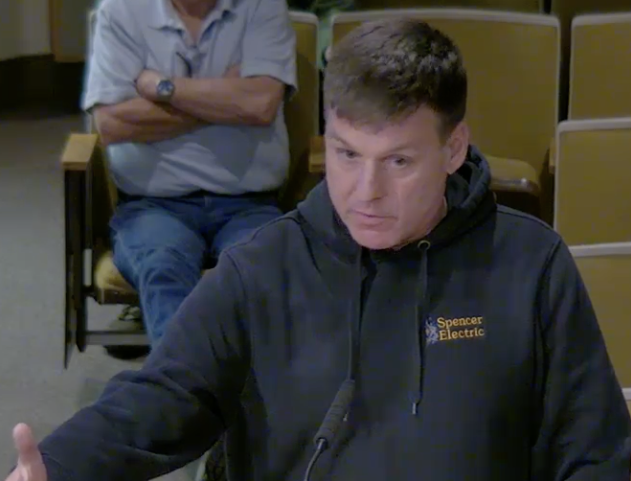
Patton | Screenshot
“They pulled all the armor out of the bank that had been there 35-plus years and protected that parking lot,” he said. “Basically, we argued about [the] process of what them pulling the armor out was going to do to the access. They told me I was a fool and said I didn’t know what I was talking about. The first winter, about five years ago, it washes all out and gets blocked off. And not by our doing. I did everything I could to keep it open. But we’re not going to give up more land or give up part of our fields to give new access to the county.”
Patton added that there are several other river access points in the area.
His wife, Shelby, criticized the Fish and Game Advisory Commission and others for “being outraged about things they don’t know” and for failing to consider the other side of the story.
“If people don’t choose to find out what the truth is and what property law is, we’re going to continue to repeat and repeat these issues,” she said. “I can definitely tell you, in this particular case, if [the Fish and Game Advisory Commission or Rosenburg] had just approached us personally [and] respectfully, we might not be in the same situation we’re in right now.”
Turning back to the board for discussion, Wilson acknowledged the “variety of opinions around public access,” but said that the county, as a public trust agency, is obligated to “public trust responsibilities with relation to access to public trust resources throughout the county.”
Wilson made a motion to receive and file the report, which was seconded by Arroyo. The motion passed 5-0.
###
Other notable bits from Tuesday’s meeting:
- The County Administrative Office requested the board pull an item from the consent calendar to further discuss a $4.5 million bid to repave the parking lot at the California Redwood Coast-Humboldt County Airport. To meet requirements set by the Federal Aviation Administration (FAA), the county is required to open the public bidding process before receiving the FAA grant funding. The winning bidder will be selected shortly after bids open on May 31, and a separate item will be brought to the board to enter into a contract with the winning bidder. The county will be reimbursed in full for costs associated with the project.
- The board met in closed session to discuss anticipated litigation from former Deputy County Counsel Cathie Childs who asserts that she was wrongfully terminated by the county last fall. The CAO did not report any action on the matter.
- The board adjourned in memory of local artist and activist Richard Evans, who passed away earlier this year.
Samoa Cookhouse Closes Temporarily for Major Renovation to Create Hostel Rentals, Cabins, Dog Park and Picnic Area
LoCO Staff / Wednesday, May 17, 2023 @ 10:29 a.m. / News
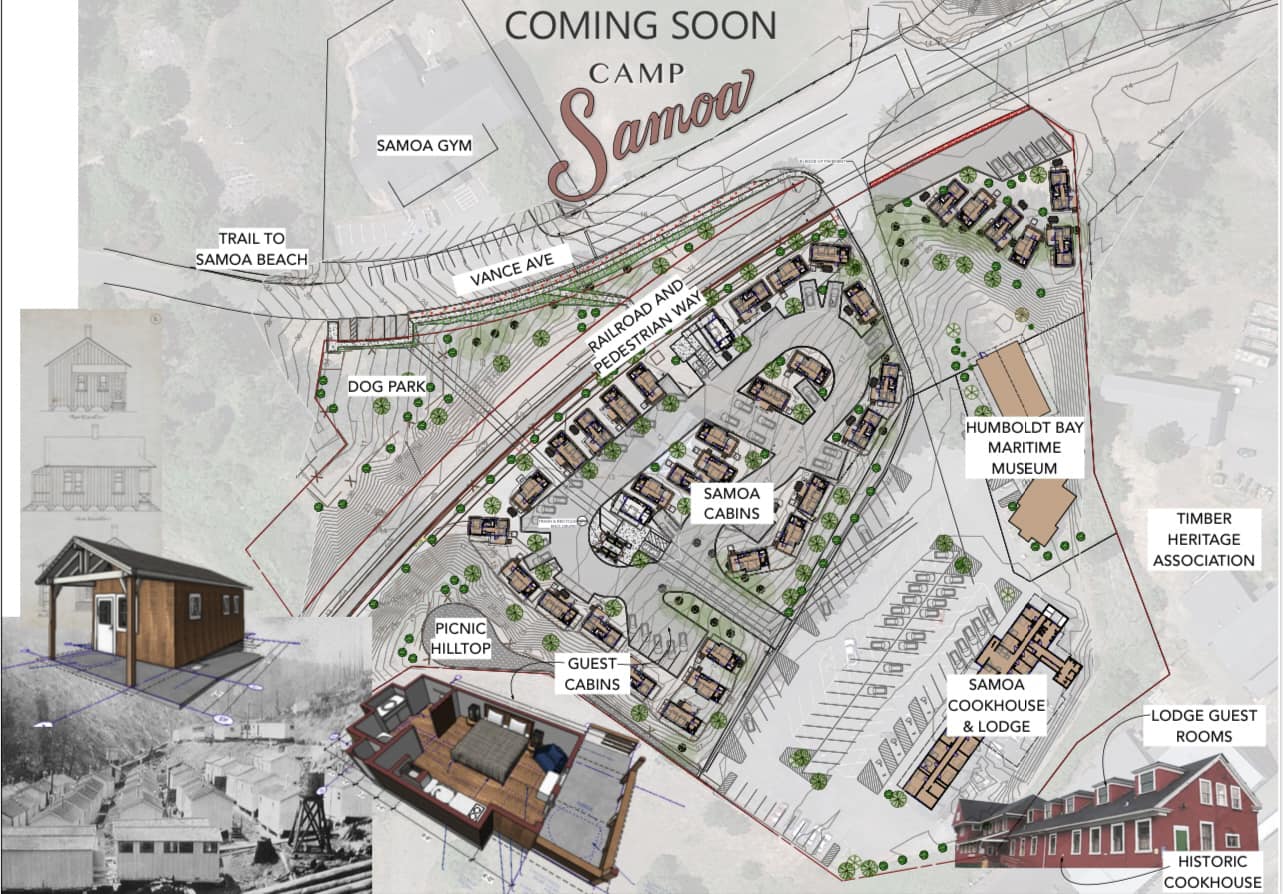
Plans for the renovated Samoa Cookhouse grounds. | Click here for larger image.
###
Press release issued by Danco on behalf of the Samoa Cookhouse:
We are thrilled to announce the upcoming renovation of one of the most historic and last-standing Cookhouse restaurants in the Western United States. We are confident that this renovation will enhance the experience for our guests and ensure that the Samoa Cookhouse continues to be a beloved destination for years to come.
Since 1890, the Samoa Cookhouse has long been known for its distinctive character, and we are committed to preserving that character while also making necessary updates to ensure that the space is comfortable, functional, and welcoming for all guests.
The renovation will be a significant undertaking, with a focus on preserving the restaurant’s historic character while also updating the space to meet the needs of modern restaurants.
Major improvements will involve adding eighteen rentable hostel rooms upstairs and one fully accessible ADA unit on the main floor, outdoor seating areas, and adding thirty-six cabins below the Samoa Cookhouse which can be rented for family gatherings and events.
We are aware that the renovation of the Samoa Cookhouse means you will have to wait to eat our famous french toast and delicious fried chicken, but we know you will understand that this renovation is necessary to improve and provide you with an even better dining experience in the future.
Thank you for your continued support and enthusiasm for this project. We appreciate your patience and loyalty, and we look forward to welcoming you back once the renovation is complete.
The Samoa Cookhouse
California Has Tried to Cut the Cost of Insulin for Years. Why It Might Finally Succeed
Kristen Hwang / Wednesday, May 17, 2023 @ 7:53 a.m. / Sacramento

Photo by Mykenzie Johnson on Unsplash.
The high cost of insulin has been a niggling thorn in the side of regulators and patients for decades: Prices for the 100-year-old drug have increased more than 600% in the past 20 years, and stories of patients rationing doses abound. Even the most conservative economists point to it as an example of a market gone sour.
Despite repeated efforts at the federal and state level to rein in the cost of pharmaceuticals, prices go up each year, growing quicker than any other health care service and routinely outpacing the rate of inflation.
This year, California is poised to do something different to cut the cost of insulin, attacking the problem on three fronts. And if it works for insulin prices, it could work for other drugs:
- Lawmakers have introduced a bevy of bills targeting out-of-pocket insulin costs. They have also advanced legislation ensuring cost savings for all drugs get passed down to patients;
- Attorney General Rob Bonta is suing the nation’s largest insulin manufacturers and pharmaceutical benefit managers for driving up the cost of the life-saving drug, alleging unfair business practices;
- And Gov. Gavin Newsom recently announced a $50 million state contract with generic drug company Civica Rx to manufacture three types of cheap biosimilar — or generic — insulin for diabetic Californians.
This three-pronged approach isn’t perfect — measures like the ones suggested by lawmakers this year have failed several times — but legislators are hopeful the resources of usual opponents will be divided among the state’s other efforts. Health economists and patient advocates believe the state’s lawsuit will lift the veil on opaque pricing tactics for the first time nationwide, potentially shifting how industry players behave.
“It’s good the state of California is using its power as a purchaser, a regulator (and) a litigator to try to address this issue,” said Anthony Wright, executive director of Health Access California, a consumer advocacy group that routinely sponsors health care affordability measures. “This is such a multi-faceted problem that it requires a lot of different solutions.”
Insulin: The poster child for a broken market
So who’s to blame for the skyrocketing cost of pharmaceutical drugs? Ask any number of industry players and you’ll get stuck in an endless loop of finger pointing. Manufacturers blame insurers and intermediaries known as pharmaceutical benefit managers for exploiting profit models. Those groups in turn blame manufacturers for setting high prices to begin with. In the end, the patient pays.
“There are no heroes in health care,” said Kevin Schulman, a professor of medicine and operations, information and technology at Stanford University. Schulman sits on the scientific advisory board for Civica Rx.
In California, between 2017 and 2021, state-regulated health plans increased spending on prescription drugs by more than 22%, or $2.1 billion, according to a recent price transparency report. By comparison, medical expenses increased 18.4% during the same time period. Prior to the COVID-19 pandemic, medical expenses had increased just 8.2% while drug spending increased 14.4%.
For many people with health insurance, increasing pharmaceutical prices are obscured because insurance picks up a majority of the tab. However, people who are uninsured or who have not hit their annual deductible pay the full drug price out-of-pocket.
The cost of insulin has become the consistent linchpin of these drug price discussions. Some people with diabetes — approximately 37 million in the United States and about 3 million in California — need insulin to regulate their blood sugar. Without it they will die.
“There are no heroes in health care.”
— Kevin Schulman, professor of medicine and operations, information and technology at Stanford University
Until very recently, the average list price of insulin increased about 11% annually, with some common brands exceeding $400 per vial. Actions by the federal government to impose out-of-pocket price caps and penalize manufacturers that raise prices faster than the rate of inflation spurred the three largest insulin manufacturers to drop prices to $35 earlier this year. However, during a U.S. Senate committee hearing last week, executives from Novo Nordisk and Sanofi would not commit to keeping prices that low.
“We’ve seen a little bit of a collapse these last few weeks…this will provide some relief, but at the end of the day the thing we don’t know is how (pharmaceutical benefit managers) are going to respond to these cuts,” Schulman, who researches the pharmaceutical market, said. “In theory, they have no interest in supporting these low-cost products.”
Why wouldn’t these intermediaries support low cost drugs? The answer lies in a complex and convoluted system of rebates that drug companies pay pharmaceutical benefit managers. Pharmaceutical benefit managers control the list of drugs that health insurance plans cover, also known as a formulary. Consolidation has resulted in three companies — CVS Caremark, Express Scripts and OptumRx — representing more than 80% of the market. To incentivize benefit managers and insurers to cover their products, manufacturers offer them a cut of the sale price, or a rebate.
The trade group representing pharmaceutical benefit managers claims more than 90% of these rebates, also known as discounts, are passed on to insurers to help lower the cost of health insurance premiums. But researchers say without regulation mandating transparency, it’s impossible to know who exactly keeps the rebates and how they’re used.
Erin Trish, an associate professor of pharmaceutical and health economics at the University of Southern California, said what results is a competitive market where prices for many drugs are driven higher rather than lower.
“It creates incentive for these (pharmaceutical benefit managers), who are making money as a share of the list price of the drug, to negotiate for drugs that have higher list prices with bigger discounts rather than lower prices,” Trish said.
It also results in a system where the sickest patients — those who use the most prescription drugs — subsidize the cost of insurance for everyone else, which is the opposite of how insurance typically works.
In a study analyzing financial reports from 13 of the largest drug manufacturers, Schulman found that from 2011 to 2019, manufacturers went from sharing nearly 30% of their annual revenue with pharmaceutical benefit managers to more than 67% in the form of rebates and other discounts. In fact, with insulin, as prices have gone up, manufacturers’ profits have decreased.
Pharmaceutical benefit managers disagree that they are the bad actors in this equation. In a statement reacting to California’s insulin manufacturing deal, the Pharmaceutical Care Management Association said assertions that pharmaceutical benefit managers are responsible for increased prices are “just not true.”
“We applaud any move to lower high drug prices, recognizing that these are the root cause of gaps in prescription drug affordability, including for insulins,” the statement said. “The savings pharmacy benefit companies negotiate with drug companies are used to either lower health insurance premiums or prices at the pharmacy counter, usually a combination of both.”
Bill Head, assistant vice president of state affairs for the Pharmaceutical Care Management Association, said his members’ job is to lower costs for health insurers. Manufacturers, not pharmaceutical benefit managers, control the prices, he said.
“We will always go with whatever the lowest net cost to the payor is, so if (manufacturers) want to just lower the cost and make it more attractive, great,” Head said. “If that’s what’s going to save the payor, the health plan…or the employer money…that’s where we’ll go.”
Can California get around the middlemen?
Tackling the market distortions will take action at the federal level, but in many ways California’s new deal to manufacture its own insulin and other generic drugs circumvents the problem and may influence how industry players behave.
“We have already done something to disrupt the market,” Dr. Mark Ghaly, state secretary of health and human services, told CalMatters. “What we’re doing is starting to take some of the price games away that are traditionally played.”
Civica Rx will produce for the state three of the most commonly used insulins, interchangeable with the brand name drugs Lantus, Humalog and Novolog. Patients will be able to purchase them out-of-pocket for $30 per vial, far less than brand name equivalents, at pharmacies throughout the state, according to the Department of Health Care Access and Information, the regulatory body overseeing the initiative. The state has set an aggressive target of making the first vials available by 2024, although Allan Coukell, Civica senior vice president of public policy, told CalMatters it can’t control how quickly the FDA will approve the drug.
Wright, with Health Access California, said this strategy applies unusual pressure to the pharmaceutical market. As both a purchaser representing nearly 3.2 million diabetic adults and a manufacturer, the state has different motivations than shareholders do.
“A typical investor is not going to put up the money to develop a new generic for fear of being undercut,” Wright said. “The state of California has a different incentive. If we don’t sell a vial we get the savings as a purchaser. We also have the public policy goal to try and bring down the costs for everybody.”
But it doesn’t entirely dampen the influence of middlemen in the distribution supply chain. The same manufacturers that make brand name insulin have also sold lower-priced generic insulins for years, but by and large patients have not switched to them.
“What we’re doing is starting to take some of the price games away that are traditionally played.”
— Dr. Mark Ghaly, state Secretary of Health and Human Services
In 2021, the state’s prescription drug cost transparency report showed generic insulins were not among the top 25 most commonly prescribed generic drugs. In contrast, excluding COVID-19 vaccines, Humulin, a fast-acting insulin, was the most commonly prescribed brand name drug that year. Other brand name insulins ranked fourth, fifth and eighteenth on the list of top 25 most commonly prescribed brand name drugs.
Brand name drugs accounted for only 10.2% of all prescriptions that year but made up 20.8% of spending, according to the report. Health plans spent the second-most amount of money on Humalog, another fast-acting insulin, among the top 25 most costly brand name drugs in 2021. Other brand name insulins ranked fourth, seventh and nineteenth.
The reason lower-cost generic insulins aren’t more commonly prescribed: Manufacturers don’t offer rebates for them, which means intermediaries and health plans can’t profit, said Neeraj Sood, a health economist and professor at the USC Price School of Public Policy.
The state will have to find a way to entice middlemen and health plans to cover its cheaper insulin or else patients with insurance won’t necessarily benefit, Sood said. Of the more than 3 million adult diabetics in California, only about 95,500 are uninsured and use insulin, according to the state Department of Health Care Access and Information.
The department refused to make anyone available for an interview and asked for emailed questions. According to an unattributed statement from the department, Civica will be responsible for distributing the state’s insulin and will “engage with major wholesalers, retail pharmacies and health plans.”
Medi-Cal, the state insurance program for low-income Californians, will conduct a “fiscal analysis” to determine whether the drug will be covered for enrollees, said Anthony Cava, spokesperson for the Department of Health Care Services.
It’s unclear whether California can mandate that private insurers cover state-produced insulins, but Civica Vice President Coukell said the company is confident most health plans will cover its insulin.
“Health insurance is not monolithic,” Coukell said. “There may be some that continue to pursue rebates, but there are other plans that are going to go for the lowest net cost, and our strategy is a lowest net cost strategy.”
According to Head, with the Pharmaceutical Care Management Association, that strategy aligns with his industry’s goals.
“Any time there’s more competition, any time there’s somebody who’s driving down the cost in the brands, from our members’ standpoint, that’s always a good thing,” Head said.
Mary Ellen Grant, a spokesperson for the California Association of Health Plans, said the plans “strongly support” the use of lower-cost alternatives and “look forward to the opportunity to provide a lower cost version to their members when it becomes available.”
Other state strategies
In the meantime, other state leaders are trying to lower costs through litigation and direct regulation.
The lawsuit filed by Attorney General Bonta alleges the nation’s three largest insulin manufacturers and pharmaceutical benefits managers have engaged in unfair and illegal business practices to artificially increase prices. Five other states have filed similar lawsuits. Researchers and policymakers hope that legal action will shed light on how backroom price deals are made and help drive down consumer costs.
And a bill brought forward by Sen. Steven Bradford, a Democrat from Gardena, proposes requiring health plans to use at least 90% of rebates passed down from pharmaceutical benefit managers to cut what consumers pay at the pharmacy.
The bill, which is sponsored by a coalition of patient advocacy groups and drug manufacturers, has been quietly killed in committee three times in the past three years, with health insurers and pharmaceutical benefit managers opposed. The controversy stems from the proposal’s potential to increase insurance premiums for all enrollees by $200 million annually, according to a fiscal analysis from the non-partisan California Health Benefits Review Program. Attempts to do the same thing at the federal level have also failed out of fear of increasing insurance costs, although several states have implemented similar mandates.
Le Ondra Clark Harvey, executive director of the California Access Coalition, which is sponsoring the bill, said claims of increased health care costs are misleading. The $200 million represents just a 0.3% premium increase, Clark Harvey said, and the same report estimates patients with brand name prescriptions would save upwards of $70 million collectively.
“There will be an increase but not a significant one,” Clark Harvey said. “We’re not trying to beat up on health insurers and pharmaceutical benefit managers — we think that everyone has a role. But in this particular scenario, there has been what can be described as a loophole or cushion for them to collect this extra money after they’ve negotiated.”
In opposition, health plans and their intermediaries argue that “cushion” is exactly what helps them keep premiums down.
“(Point-of-sale) rebates won’t help the majority of patients who use generics or lower-cost brands and instead will lead to an increase in everyone’s premiums,” Head said during a recent Senate health committee hearing.
###
CalMatters.org is a nonprofit, nonpartisan media venture explaining California policies and politics.
Families of Men Shot by California Cops Lose Faith in New Accountability Law as Reviews Drag On
Nigel Duara / Wednesday, May 17, 2023 @ 7:44 a.m. / Sacramento

Pam Holland holds a photo of her later son Shane Earl Holland in her living room in Tehachapi on April 20, 2023. Photo by Larry Valenzuela, CalMatters/CatchLight Local
Three men in dark suits knocked on Pam Holland’s door one night last June. They told her that her son was dead, shot to death in a neighboring county by a sheriff’s deputy. The shooting, they said, was being investigated under a new California law that requires the state Justice Department step in when a police officer kills an unarmed person.
Pam Holland hoped the investigation would be quick and fair. Her father had been a Kern County Sheriff’s reserve deputy. She grew up around cops. She thought she could trust them — but she also believed that police agencies protect their own.
“I was like, wow, that’s awesome, this is great, they’re going to take it out of the hands of the local cops, who would instantly feel anger toward my son without even knowing anything,” she said.
But an investigation that the Justice Department officers told Holland would take eight months is quickly approaching 12. Now, she is among several Californians whose family members were killed by the police in the past two years and just want the state investigations to end.
The Justice Department opened the program in 2021 to carry out a law enforcement accountability law that gained traction after a Minneapolis police officer murdered George Floyd. Attorney General Rob Bonta, who co-authored the law when he was in the Legislature, pledged that the investigations under the law created by Assembly Bill 1506 would be completed within a year. But some police shooting reviews have already stretched 18 months or more.
The oldest unresolved police shooting case is from August 2021, more than 21 months ago.
While the investigations proceed, the families and their legal teams have as much or as little information as the rest of the public and they cannot push forward with lawsuits against the policing agencies.
“I am at the point where I believe families have to pay a visit to Bonta in Sacramento,” said Jonathan Hernandez, a Santa Ana city council member whose cousin was shot to death in September 2021. “All of us, every family who’s waiting for 1506 investigations, if he doesn’t give us a response, we will give him a response.”
Bonta, the elected head of the Justice Department, refused to answer questions about delays in the investigations. His office responded to questions with an unsigned email.
“I feel for the families having to patiently wait, but rest assured, independent investigations for civilian deaths by law enforcement is vital in demanding more transparency and accountability.”
— Assemblymember Kevin McCarty, Democrat from Sacramento
The length of the Justice Department investigations leads to other impacts: District attorneys cannot develop police shooting cases to decide whether criminal charges against the officer or officers are merited until the Justice Department’s review is over.
In Holland’s case in San Bernardino County, the sheriff’s office said it could not issue a final verdict on its officer’s conduct while the state review is underway – an interpretation of the law that the Justice Department denied in a written statement to CalMatters.
The department “has no policy prohibiting a local law enforcement agency from completing its administrative investigation while our investigation is proceeding,” unnamed representatives for the Justice Department wrote.
In the meantime, the deputy who shot Holland is back on patrol duty.
Bonta’s predecessor, fellow Democrat Xavier Becerra, initially opposed the bill that led to the state’s role in police shooting reviews. Becerra argued at the time it would be too costly for the Justice Department, which is under the attorney general, to take on a responsibility that normally fell to local district attorneys.
One issue is money. The Justice Department asked for $26 million to pay for the new shooting investigation teams. The Legislature allotted half of that, about $13 million.
Becerra complained about that discrepancy to the bill’s author, Democratic Assemblymember Kevin McCarty of Sacramento.
The $13 million budget allocation “is significantly lower than our estimates and not enough resources to stand up professional teams to perform these new investigative and prosecutorial duties,” Becerra wrote to McCarty in January 2021. “As a result, the (Justice Department) will have limited capacity to implement this bill, short of redirecting resources from other essential, mandated work, which could compromise those operations.”
Now, the length of the state investigations is “longer than average” for police shooting cases, said California District Attorneys Association CEO Greg Totten, a former Ventura County prosecutor. He added that every case is different.
Prosecutors “try to move the cases as quickly as we can, but they’re not always straightforward,” Totten said.
Bonta’s office in the unsigned statement acknowledged the slower-than-expected pace of the investigations.
“As you know, the California Department of Justice requested more funding than we ultimately received to carry out our AB 1506 work, and we’ve had to adapt and make it work,” the statement read.
“This does sometimes mean that investigations may take longer to complete than they would with additional funding and resources, but we owe it to the families involved as well as our communities to ensure that each case is done right, and supported by a thorough, fair, and comprehensive investigation.”
McCarty said in a statement last week that the slow pace of investigations is a result of thorough work.
“It’s been slow to roll out and implement, but I still have confidence in the program — as it’s better to be right than to be fast,” McCarty said in a statement emailed to CalMatters.
“I feel for the families having to patiently wait, but rest assured, independent investigations for civilian deaths by law enforcement is vital in demanding more transparency and accountability.”
Pam Holland’s son, Shane, was an intravenous drug user with a litany of arrests and jail sentences. He had outstanding warrants and he ran from the police. She knows how all this looks. But she hoped the state, with its $13 million annual budget for police shooting investigations, would at least provide a dispassionate, thorough resolution.
Now?
“I wish they would have never gotten involved.”
A shooting on a desert highway
On a dark street in a San Bernardino County exurb, Shane Earl Holland gave a fake name to a sheriff’s deputy and ran.
Holland, 35, was a passenger in a car pulled over by San Bernardino County Sheriff’s deputy Justin Lopez about 2:30 a.m. one day last June. Holland had outstanding warrants. Lopez yelled at him to stop running and get on the ground. Holland replied several times, “I’ll shoot you.”
Lopez, according to audio from his tape recorder obtained by CalMatters, chased Holland on foot for one minute and 17 seconds, then fired six shots, killing him. Moments later, Lopez’s sergeant arrived at the scene.
“You good?,” asked the sergeant, whose name has not been released by the sheriff’s department.
“I’m good,” Lopez said, still breathing hard from the chase.
“Where’s his gun,” the sergeant replied. “Did he have a gun?”
“I don’t know,” Lopez said. “He said he was going to shoot.”

Pam Holland holds a program from her son’s funeral while sitting in her home in Tehachapi on April 20, 2023. Photo by Larry Valenzuela, CalMatters/CatchLight Local
Pam Holland first heard that recording in January – a recording her daughter obtained from the Justice Department with a public records request.
“Honestly, like if there was no audio recordings, if I didn’t hear the audio recording, I would not believe the story,” she said. “If I didn’t hear it for my own self and they told me, well, you know, he said he was going to shoot, I wouldn’t believe it.”
On the recording, Lopez and his sergeant briefly discuss the injuries to Shane Holland’s body, mentioning that they can see his skull. She wants to know if he suffered.
Holland’s family has been assigned an advocate, who works for the Justice Department. Holland and two of her daughters sometimes do an imitation of the advocate’s frustrating responses to their questions: “‘I’m sorry, we can’t tell you that,’ ” they mimicked in chorus during an interview at Holland’s Tehapachi apartment.
“He killed my kid. But he’s running in the dark, chasing someone who says, I’m going to shoot you. That’s not okay.”
— Pam Holland, mother of Shane Earl Holland
Holland has questions about the night of the shooting. Why did the deputy chase the car’s passenger, leaving the driver to his own devices? Were her son’s pants falling off like they usually were? Did he have his hand at his waistband to hold them up as he ran? Did it look like he was reaching for a gun?
“I waver between thinking the cop needs to suffer, go to prison himself, to feeling bad for him,” she said. “And that makes me wonder what the hell’s wrong with me. He killed my kid. But he’s running in the dark, chasing someone who says, I’m going to shoot you. That’s not okay.”
When should police chase on foot?
Ed Obayashi, a former Plumas County Sheriff’s deputy who is now a nationally recognized expert in police use-of-force cases, also has questions about the shooting. CalMatters shared the tape recording of the shooting with him.
He broke the deputy’s decision-making into two parts: Why chase Holland, and why fire shots?
“Officers, it’s embedded in their DNA to chase,” Obayashi said. “That’s why we’re cops.”
But state and federal courts have held that simple fleeing is not a reason for a police officer to detain a person, said Obayashi, who also has a law degree.
Lopez, the deputy, told the driver that he had a reflective coating on his license plate, making it hard to read. Obayashi said he doesn’t understand what threat Holland posed to the officer when he fled.
“A physical threat, that hardly exists here because he’s running away,” Obayashi said. “And it’s inherently dangerous to be chasing anyone during the day, much less at night.”
“There is a skill associated with investigating not only officer-involved shootings, but just shootings in general, that the Attorney General’s office doesn’t have.”
— Brian Marvel, president of the Peace Officers Research Association of California
The San Bernardino County Sheriff’s Department has a policy for vehicle pursuits, but not pursuits on foot. In emailed responses to CalMatters’ questions, department spokesperson Mara Rodriguez said the department relies on guidance from the California Commission on Peace Officer Standards and Training, or POST.
The POST guidelines – which are merely suggestions and not mandatory – call foot pursuits “one of the most dangerous and unpredictable situations for officers.” They say an officer should have observed criminal activity before starting a chase.
“I just don’t see the legal justification for this shooting,” Obayashi said. “Fleeing alone is not a good reason to chase. Matter of fact, that’s no reason at all.”
But when Holland threatened Lopez, Obayashi said, his fate was sealed.
“I’m not taking that chance, if he’s saying he’s going to shoot,” Obayashi said. “It’s very easy for someone to pull out a gun and spray bullets behind them. The individual made a distinct threat and the deputy’s thinking, oh shit, this guy is going for a gun.”

Pam Holland stands in the doorway of her apartment in Tehachapi on April 20, 2023. Photo by Larry Valenzuela, CalMatters/CatchLight Local
For the deputy, the ramifications of using deadly force will be compounded by investigations by the San Bernardino County Sheriff’s Department, the local district attorney’s office and the Justice Department, said Brian Marvel, president of the Peace Officers Research Association of California.
“That adds up to a lot,” Marvel said. “Having to wait long periods of time and going through that is, it’s pretty rough. I think anybody under any circumstances having to wait those types of time frames, (it) takes a toll on your psyche, it takes a toll on your health and it’s difficult to get through.”
Marvel said it’s not surprising that the Justice Department investigations are taking a long time – the people doing the investigations are still learning to conduct them at this level.
“I think what you’re dealing with now is, you have an Attorney General’s office that has never done this before,” Marvel said. “So, in essence, you’re having to train up special agents to do officer-involved shootings. There is a skill associated with investigating not only officer-involved shootings, but just shootings in general, that the Attorney General’s office doesn’t have.”
Councilmember watched his cousin’s death
Another family who lost faith waiting for the Justice Department’s investigation has long roots in Orange County. Hernandez, the Santa Ana city councilmember, watched from behind a police barricade as officers shot his cousin, Brandon Lopez, 22 times after a police chase in Anaheim on Sept. 28, 2021.
Lopez, 33, had three outstanding warrants and was driving a stolen car that crashed at a construction site. During an hours-long standoff, police shouted commands to him, telling him to surrender. In a video presentation of dispatcher audio and body camera footage prepared by the Anaheim Police Department, police said Lopez was “smoking narcotics” inside the car and refused to leave.
Santa Ana police handed over the standoff to the Anaheim Police Department. Soon after, Anaheim Police officers fired a flashbang grenade and tear gas canister into the car. Lopez emerged from the car’s backseat moments later.
The officers called out that Lopez had a gun. Police fired multiple rounds, and Lopez is shown in the video falling to the ground. He died at the scene. He was unarmed.
“What they called a standoff was a public execution of an unarmed man,” Hernandez said. “The days of lynching have gone away and have evolved into the modern day police shooting.”
Hernandez ran in 2020 against an incumbent former Orange County Sheriff’s deputy on a police reform platform. He won by 9 percentage points.
At the scene before the shooting, body camera footage shows the councilmember in a T-shirt and shorts, asking to speak with his cousin and telling an officer he’s worried because “cops kill people every day.”
The officer responds: “People kill people every day.”
“Absolutely,” Hernandez said, “but you’ll get away with it.”
CalMatters requested raw footage, interviews and relevant documents associated with the Lopez shooting from the Anaheim Police Department in September. The department denied the request, citing the ongoing investigation.
When the Justice Department took control of the investigation, Hernandez said he was hopeful it would avoid the local politics of Santa Ana and Orange County. Unlike Holland’s family, Hernandez said his relatives do not think well of the police. He and Lopez’s mother, Johanna, told CalMatters they refused to speak with the local cops after the shooting.
“You cannot trust the people who just murdered your loved one to properly investigate each other,” Hernandez said.
Now, because of the delay, he wonders whether he and his family can trust the Justice Department.

Pam Holland holds a photo of her late son as her two daughters, Solana Roberts and Reymi Updike stand by her, in front of her home in Tehachapi on April 20, 2023. Photo by Larry Valenzuela, CalMatters/CatchLight Local
###
CalMatters.org is a nonprofit, nonpartisan media venture explaining California policies and politics.
OBITUARY: Dennis William Eugene Ganfield, 1972-2023
LoCO Staff / Wednesday, May 17, 2023 @ 6:56 a.m. / Obits

Dennis William Eugene Ganfield (Denny), age 51, unexpectedly went home to be with his Lord and Savior, Jesus Christ, on May 5, 2023. He was born in Arcata on March 1, 1972 to Dennis and Phyllis Ganfield. Denny was an active child who loved growing up in the small town of Mckinleyville, where there were always friends and family close by. A few years later he became a big brother and protector of his little sister, Brandy. He learned to hunt and fish alongside his dad, grandpas and uncles.
Sports time was also family time, where his biggest fan, his mother, could be seen and heard cheering him on! From a young age it was evident that Denny was athletically gifted. All through his youth he dominated on the soccer fields, baseball fields, basketball courts and especially on the football field. It was on the gridiron where Denny found his true passion. When he entered Mckinleyville High School in 1986 he went to work polishing his skills at the wide receiver position. It didn’t take him long to establish himself as a prolific wide receiver. Throughout his varsity years he struck fear into the heart of HDN Big Four and Little Five defensive backfields. Denny established himself as the premier wide receiver of the HDN his senior year while helping his team shatter records and write themselves in the CIF state record books. Denny was a team player who worked tirelessly on and off the field. Denny and his teammates were honored for their undefeated North Coast Section Championship season by being inducted into the Mckinleyville High School hall of fame.
After high school and working locally, Denny enlisted into the US Army in 1993. Upon graduating from basic training in South Carolina he was stationed at Fort Bliss, Texas, where he became a certified Vehicle Mechanic and achieved the rank of Specialist. During his time in service he would be awarded the National Defense Service Medal, Army Good Conduct Medal, Army Service Ribbon and Expert Marksmanship Qualification Badge with Rifle Bar. During his time in Texas he was blessed with his two boys, Kyle and Dennis Jr. Ganfield.
Denny later returned to his roots in Humboldt County, where he was employed as a mill worker, and always found time to head to the outdoors where he continued to hunt and fish. He loved his children and showed them the beautiful nature that Humboldt County has to offer and was very proud of the men they are today.
Denny always had a special place in his heart for his sister, Brandy, and her children, Chase and Jovie. He cherished being a part of and watching his nephew and niece grow up. He loved his mom’s home cooking and drinking a cold beer over long talks with his dad.
Later on in life, he found purpose and meaning in his Christian faith. He was baptized as an adult and attended Church on a regular basis.
Denny left us too soon and will be deeply missed. Rest in peace in God’s care, we will be reunited in Heaven.
Dennis is survived by his sons, Kyle and Dennis Jr. Ganfield, and their mother, Patricia Coria; grandchildren, Matthew Anthony Ganfield and Kaylee Grace Ganfield; his parents, Dennis and Phyllis Ganfield; his sister, Brandy Eskra, and her children, Chase Evenson and Jovie Fischer; aunts, Donna (and her son Tommy), Sandra Weeks, Lois Crawford, and great-aunt Bonnie Benjamin; uncles, Marvin (and Peggy) Ganfield, Robert Ganfield, Bob Reynolds, and numerous cousins and lifelong friends.
He was preceded in death by maternal grandparents, William and Audrey Reynolds; paternal grandparents, Marvin and Thelma Ganfield; his brother-in-law and great buddy, Scott Eskra; aunts, Sheryl Whitaker, Jean Van Epps, Sharron Sandal, and Bonnie Kay Reynolds; uncles, David, Darrell, and Roger Ganfield, Mel Peterson, Bill Reynolds, and Thomas White; and cousins, Cherie Reynolds and Winter White.
We invite family and friends to attend a gravesite memorial in honor of Denny on Saturday, May 27 at 12 p.m. at Greenwood Cemetery, which is located at 1757 J Street in Arcata. After the memorial, we would be honored to have you join us at the Arcata Veterans Memorial Building, located at 1425 J Street in Arcata.
###
The obituary above was submitted on behalf of Denny Ganfield’s loved ones. The Lost Coast Outpost runs obituaries of Humboldt County residents at no charge. See guidelines here. Email news@lostcoastoutpost.com.
HUMBOLDT TODAY with John Kennedy O’Connor | May 16, 2023
LoCO Staff / Tuesday, May 16, 2023 @ 5:48 p.m. / Humboldt Today
FURTHER READING:
- Eureka Woman Dies at Moonstone Beach One Day After Graduating From Nursing School
- OUT of the SCRUM! Meet the 18-Year-Old Arcata Native Whose College Rugby Team Just Won Nationals
- Body of 44-Year-Old Man Recovered After His Boat Was Swept Out Of Klamath River Mouth
- Fishing and Conservation Groups Sue PG&E Alleging Harm to Salmon and Steelhead on the Eel River
- State Senate Will Host Hearing on Offshore Wind and the Fishing Industry Tomorrow, McGuire’s Office Announces
HUMBOLDT TODAY can be viewed on LoCO’s homepage each night starting at 6 p.m.


