

RWE, the German Company Planning Offshore Wind Development Here, Announces $10K Annual Donation to Food for People
LoCO Staff / Wednesday, May 10, 2023 @ 10:17 a.m. / Community Services , Energy , Offshore Wind

Food for People’s Eureka Choice Pantry. | Photo via Facebook.
###
###
Press release from RWE:
RWE has partnered with Humboldt County’s designated food bank, Food for People, to deliver more than 5,200 meals to local residents through an annual donation of $10,000. Food for People has been supporting communities in Humboldt for nearly 45 years, working to eliminate hunger and improve the health and well-being of the community through access to healthy and nutritious foods, community education, and advocacy. Food for People supports more than 16,000 individuals across Humboldt County every month.
“Partnerships with organizations like Food for People empower communities to access the resources they need most,” said Sam Eaton, CEO RWE Offshore Wind Holdings. “This is an early step RWE can take to support decades of good work already underway and champion this cause for years to come.”
Food for People operates a total of 18 programs, each of which is designed to address the needs of those who are experiencing hunger and food insecurity. Their onsite Eureka Choice Pantry, one of 18 in Food for People’s network, provides income-eligible community members access to healthy and nutritious foods. This system emphasizes choices, allowing people to shop through their selection process, rather than receiving pre-packaged bags. The choice system helps families go home with the foods that they need and like while leaving behind items that they will not use, so none goes to waste.
“So many are suffering in our community due to the rising costs of food and other necessities and we have seen the need for our service increase dramatically as pandemic era food assistance programs come to an end,” said Carly Robbins, Development Director of the Food for People Food Bank in Humboldt County. “We understand the long-term consequences of hunger and poor nutrition and thanks to the generous support from RWE we can continue our commitment to creating a stronger and healthier Humboldt County.”
“RWE is demonstrating a strong commitment to our community through its ongoing support of Food for People, an organization that reaches and supports a large number of Humboldt County residents,” said Nancy Olsen, President and CEO, Greater Eureka Chamber of Commerce. “This early action shows the kind of community partner RWE strives to be as they begin to develop their offshore wind project in Humboldt County.”
###
RWE has a history of supporting communities across the entire lifecycle of its clean energy projects, from development to construction and operations, closely tied to its mission: our energy for a sustainable life. In 2020, the company donated $250,000 to more than 45 organizations across 11 states to support host communities during COVID-19. Through its joint venture with National Grid Ventures in the New York Bight, Community Offshore Wind, RWE also donated over 30,000 meals of fresh, local seafood during the 2022 holiday season.
In December of 2022, RWE was successful in the Bureau of Ocean Energy Management’s (BOEM) offshore wind lease auction in California. The company acquired the rights to develop about 1.6 gigawatts (GW) of offshore wind capacity 25 miles off the coast of Humboldt County. The project will be among the first commercial scale floating wind projects in the world and has the potential to provide clean electricity for nearly 600,000 homes. This builds on RWE’s 3.2 GW Community Offshore Wind project off the coasts of New York and New Jersey. RWE is one of the world’s leading offshore wind developers globally and a top-five renewables company in the United States.
BOOKED
Yesterday: 9 felonies, 10 misdemeanors, 0 infractions
JUDGED
Humboldt County Superior Court Calendar: Friday, Feb. 13
CHP REPORTS
4100 Sr169 (HM office): Car Fire
ELSEWHERE
RHBB: Snow Could Impact Travel From Del Norte to Mendocino and from Eureka to Redding
RHBB: CDFW Accepting Applications for Spring Elk Hunts in Del Norte County
RHBB: Shasta-Trinity & Six Rivers National Forests seeking public input on OHV grant applications
GUEST OPINION: Responsible Offshore Wind Development Starts at the Port
LoCO Staff / Wednesday, May 10, 2023 @ 7:48 a.m. / Opinion
Humboldt County’s proposed offshore wind project would significantly reduce carbon emissions throughout California by providing upwards of 1.6 gigawatts of clean, renewable-sourced energy. But to ensure the success of offshore wind and to meet the promise of climate action, decision-makers must commit to a green port facility capable of building and servicing the turbines while not further contributing to greenhouse gas emissions or polluting Humboldt Bay.
A key component of a thriving offshore wind industry is a port capable of constructing, assembling, and maintaining wind turbines. The Humboldt Bay Harbor District has partnered with Crowley Wind Services, a multinational port development company, to build this heavy lift terminal on the Samoa Peninsula. There are various potential benefits: port development could create many family-wage jobs and substantially contribute to a growing local economy—all while making important strides towards a clean-energy future to address the climate crisis.
Unfortunately, these types of heavy-lift terminals have a mixed track record for communities. On land, port equipment such as terminal tractors, forklifts, yard trucks, cranes, and handlers commonly run on diesel. In the water, most heavy-duty cargo ships and tugboats also run on diesel or heavy fuel oil, polluting the air. Ships and tugs even burn fuel while docked at the terminal to maintain a base load of electricity. As a result, communities surrounding these ports often suffer from the effects of air pollution. In Los Angeles, for example, air quality studies revealed that these diesel fumes significantly raised cancer risk for people within fifteen miles of the terminals.
Our port doesn’t have to be this way. Recent technological developments have made major progress towards enabling the possibility of a ‘green port.’ Green ports seek to make all aspects of operation sustainable, from the heavy machinery on land to the ships docked at the harbor. This work requires moving away from fossil fuels and shifting towards electrification and other zero-carbon energy sources, such as green hydrogen.
Other ports are already demonstrating that these zero-emission targets are attainable with the electrification of terminal equipment, resulting in cleaner day-to-day operations. Additionally, installing shore power stations can reduce pollution from idling ships by up to 95 percent when tapped into the electricity grid while at berth. Another clean-air possibility was revealed at a recent public engagement meeting when Crowley representatives touted the planned creation of an all-electric tugboat to service the Bay of San Diego. When the wind turbines are constructed and start generating electricity, the green port could become doubly effective by storing energy during peak production. By relying heavily on these evolving technologies, Humboldt Bay could be uniquely positioned to become a trailblazer and a worldwide leader in green port development.
Financial barriers to this type of infrastructure are also disappearing. Not only is the technology becoming more affordable, but a flurry of state, federal, and philanthropic funding could make a sustainable buildout financially lucrative. The Inflation Reduction Act of 2022 set aside three billion dollars for green port infrastructure. In a recent public board meeting, the Executive Director of the Harbor District commented on the difficulties of securing grant funding for terminal development, stating that Port Development Infrastructure Program grants are “highly competitive.” Humboldt County will be a far stronger candidate for such funding if decision-makers formally commit to an ambitious zero-emissions approach that builds strong support within the community while telling a unique and compelling story.
Finally, it’s also important to note that this approach is not just vital to the community, the environment, and the public image of the project—it’s also likely to benefit the Harbor District, Crowley, and the other developers in the long term. Zero-emissions targets are already in place on various levels. Port green-ification will likely become the subject of future stringent state and federal law. The port can save time and money by building a modernized, green port today rather than having to retrofit one tomorrow.
We are not arguing against offshore wind. We are arguing for responsible development — starting with the design of a fossil fuel-free port. That is why any lease agreement between the Harbor District and port developers should be ambitious in its goals to reach zero-emission by 2035. Incorporating these requirements into the lease agreement would be a testament to genuine commitment towards good port practice and the general public. Relationships aren’t just built under good faith. They are built by concrete actions that help establish trust. And that trust can go a long way in establishing a reciprocal relationship that benefits both the community and the developers through what looks to be a long, complicated, and arduous process.
Luis
Neuner
Decarbonize
the North Coast Advocate
Environmental
Protection Information Center
Jennifer
Kalt
Executive
Director
Humboldt
Baykeeper
Caroline
Griffith
Executive
Director
Northcoast
Environmental Center
Colin
Fiske
Executive
Director
Coalition
for Responsible Transportation Priorities
Community Colleges Had a Deadline to Serve Struggling Students. Did They Hit It?
Adam Echelman / Wednesday, May 10, 2023 @ 7:31 a.m. / Sacramento
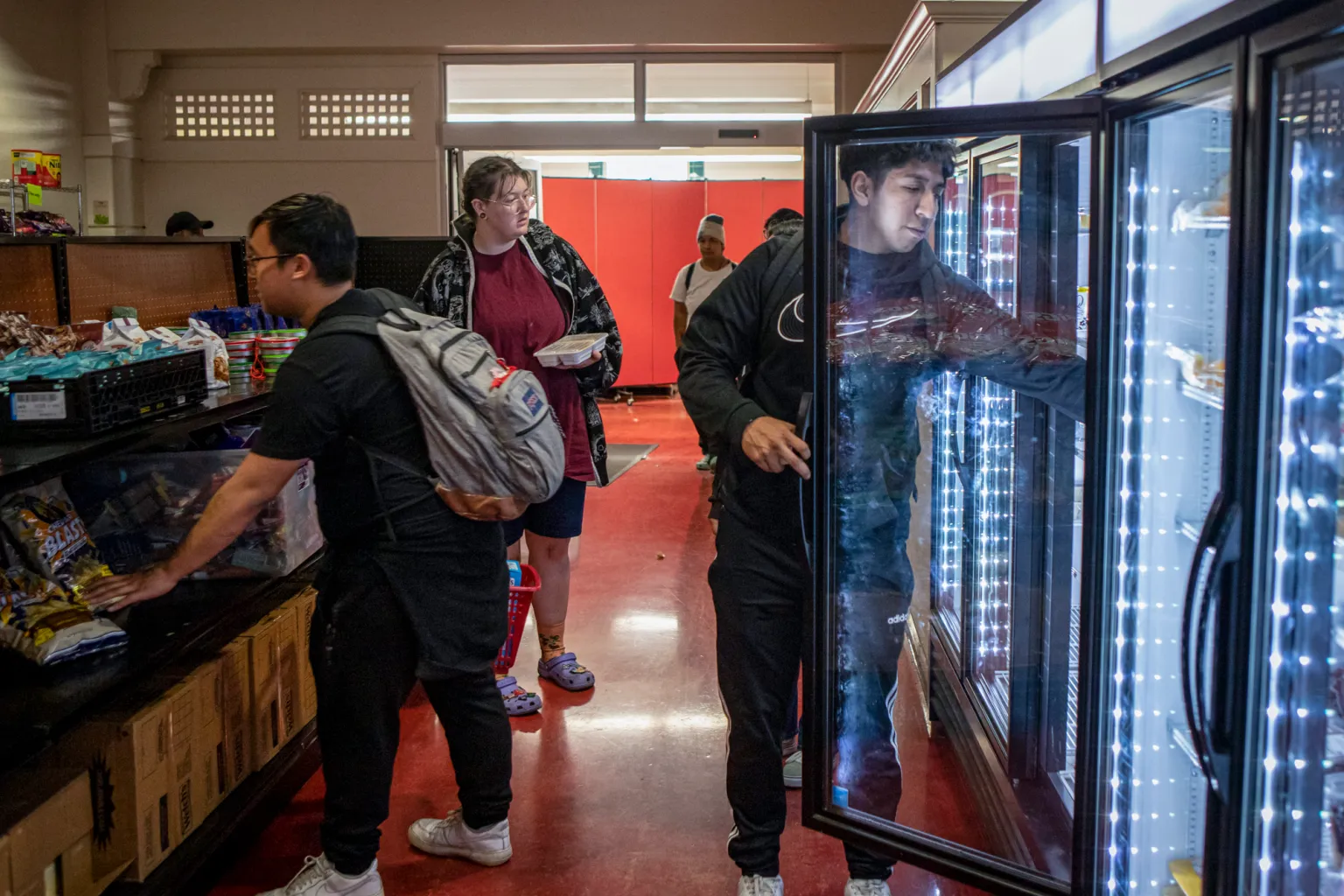
Students look for groceries inside the Ram Pantry at Fresno City College on May 5, 2023. Photo by Larry Valenzuela, CalMatters/CatchLight Local
The Ram Pantry serves more than 900 students a day, Monday through Thursday, with free food on the Fresno City College campus.
The college also offers subsidized housing for students facing homelessness, serving as many as 300 students a year.
Community colleges across the state have different programs aimed at combating problems students face such as homelessness, food insecurity, transportation and even healthcare in some cases. To help and make the system less fragmented for students, lawmakers included $100 million in one-time funding, plus $30 million in annual funding, in the 2021-22 state budget for community colleges to establish a “basic needs center” on each campus by July 1, 2022.
Roughly a third of the state’s 115 community colleges missed the deadline to establish a brick-and-mortar basic needs center, Rebecca Ruan-O’Shaugnessy, a vice chancellor at the community college chancellor’s office, told a state Senate subcommittee last week.
The portion of the 2021-22 budget that set the deadline doesn’t specify any kind of penalty for missing it.
The Community College Chancellor’s Office can withhold money from colleges that fall behind, however. But Paul Feist, a vice chancellor with the office, said its “goal is to limit harm on the very students we are trying to help.”
Just because a college has missed the deadline for establishing a physical, centralized basic needs center doesn’t mean it isn’t providing those services.
All of California’s community colleges are now providing students with some kind of support for basic needs, according to a draft report from the chancellor’s office.
Different timelines
In the case of Fresno City College and its Ram Pantry, for instance, the basic needs center required by the state won’t be finished until 2024, said Lataria Hall, vice president of student services. But the college still finds ways to help its students.
Like roughly one in five community college students in California, Mateo Vargas was homeless last year. He had been staying with relatives during his first semester at Fresno City College until one day in December 2021, they told him they needed the room back. He tried sleeping on other people’s couches, only to be pushed out again.
In a last resort, he pulled up a months-old email from Fresno City College that mentioned a survey students could fill out if they were at risk of losing their housing. He filled it out on a Friday, doubtful that anyone would really respond. On a Monday, he got a call.
In a matter of hours, the college found him a heavily-subsidized apartment a few blocks away from campus, allowing him to pay $301 a month for a year while he gathered the savings and credit history to afford his own place.
When Fresno City College learned about the state dollars regarding basic needs centers, administrators decided to combine the money, roughly $1 million this year, with a federal grant. The plan is to renovate the existing food pantry to go “above and beyond,” offering additional services on-site such as mental health counseling and financial aid.
Hall said such a renovation wasn’t possible on the state’s initial timeline. Fresno City College received guidance from the chancellor’s office right before winter break in November 2021, leaving the school with a little more than 6 months for building construction.
“We were in a panic,” said Hall. “There was a lot of conversation within the state, like, ‘Where’s the guidelines? Where’s the criteria? Can we get more information?’ And we were in ongoing conversations with our state chancellor’s office, and they kept saying it’s coming but these are soft deadlines.”
The chancellor’s office denies ever saying the deadlines were “soft.” “We do not take liberties with creating deadlines that are different from those established in legislation,” Feist said.
Hiring impact
Other colleges that embarked on infrastructure projects faced similar challenges: Diablo Valley College in Contra Costa County will open its basic needs center “toward the end of 2023” because of delays regarding the construction of gender-inclusive bathrooms, said Brandy Howard, the college’s director of marketing. Cuesta College delayed the opening of its center to spring 2023 in part because of issues with paint, carpeting, and furniture.
Many community colleges across the state also missed the deadline to hire a full-time staff member in charge of basic needs. They cited procedural and administrative issues with human resources, or to avoid hiring hiccups, they repurposed existing staff roles, adding more responsibilities to already overtaxed employees.
Los Medanos College in Pittsburg hired its full-time position in October 2022, five months after the state deadline, though there was no gap in services to students because basic needs programs already existed.

Student Sofia Lopez picks out grocery items at the Basic Needs Program site at Los Medanos College in Pittsburg on May 4, 2023. Photo by Loren Elliott for CalMatters
In 2017, Los Medanos students partnered with private philanthropists to start a food pantry and clothing donation site, co-opting larger spaces over the years as the needs and supplies grew. Students continued to manage these services up until the advent of state funding allowed a full-time hire.
Now, the college’s basic needs center occupies a nondescript brown trailer at the corner of campus, but inside, it’s a buzz of activity.
On a spring day in April, students brought their friends to peruse through aisles filled with food, toiletries, and toiletries, and they lingered at the intake table to catch up with the staff, some of the same students who preceded the center’s full-time hire. On average, the center has served approximately 238 people a month since opening last August, according to the center’s staff.
In the Senate subcommittee hearing, Ruan-O’Shaugnessy said all of the remaining campuses will have their basic needs centers in place by next month, a year after the state’s deadline and a year before Fresno City College plans to complete its center.
“The report and timelines for completion are based on what colleges communicated to us previously,” Feist said about the discrepancy.
The discrepancy also depends on the definition of a basic needs center.

Associated Student Government President, Mateo Vargas stands on campus of Fresno City College on May 5, 2023. Photo by Larry Valenzuela, CalMatters/CatchLight Local
At the Ram Pantry, students at Fresno City College access an array of basic needs services, even though the official basic needs center opens next year.
The chancellor’s office report says the data collected so far only provides a glimpse at the outcomes because the basic needs centers are so new.
Its report only includes data from 60 colleges, which have collectively served more than 47,000 students. More than half of those students received assistance with food, the report says. Assistance with transportation and technology were the next most common services delivered.
About 4,000 students in the colleges surveyed for the report — less than 1% of total community college students — received help with housing, including eviction assistance, emergency funds for rent payments, or referrals to the housing authority.
Vargas was one of those students. He said his experience finding housing assistance was seamless, but added that other services, like mental health counseling, located on another end of campus, remain siloed for students like him. The new basic needs center in Fresno will have the counselors’ offices next to the food pantry when the building opens next year.
###
CalMatters.org is a nonprofit, nonpartisan media venture explaining California policies and politics.
OBITUARY: Sandra Sue Carson, 1938-2023
LoCO Staff / Wednesday, May 10, 2023 @ 6:56 a.m. / Obits
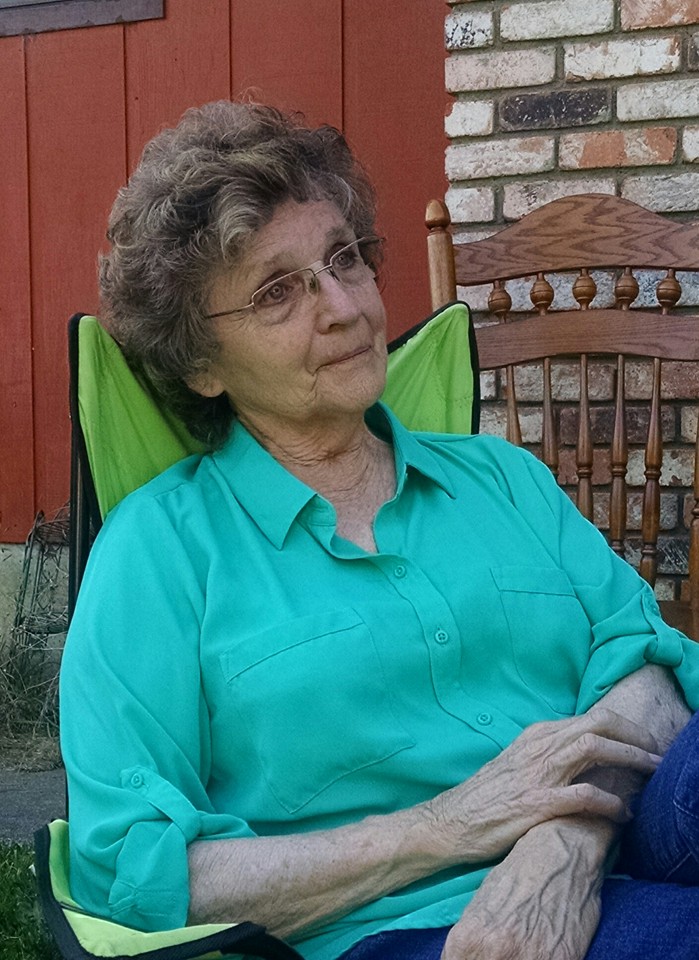
Suey was born in 1938 to Stan
and Becky Houseworth in Seville, Ohio. In 1948 Papa Stan loaded up
the family, including her brother Terry’s imaginary friend, Dickie
Ronnie, and moved to California. Kinda like the Beverly Hillbillies.
She graduated eighth
grade from Rio Dell Elementary and attended Fortuna High. That is
until dad came in to her Aunt Bessie’s café and swept his little
“blue-eyed darlin” (dad’s sarcastic nick-name for her) off her
feet and married her. March 26 marked 70 years of marriage for mom
and dad.
Mom was kind of like Cher or Madonna. No matter where you went with her you would hear the cries of “Suey.” Some random person would come up and give her a huge hug. Mostly former co-workers from St. Luke Manor, where she was kind of like the “mother superior.” They remembered her because she listened, encouraged, laughed and loved them and it stuck with them years later. Three weeks ago a nurse asked me “aren’t you Sue Carson’s daughter, I used to work at St. Luke’s” Yep, Madonna, Cher and Suey.
Mom never met a person she didn’t love. Well……..maybe a couple, but they would never have known it. She told me once, “You don’t have to love everyone, but you have to treat them like you do.” That is how she lived her life. Her church and relationship with Jesus were the second most important thing in her life, which I think breaks the First Commandment, but we’ll get to that later. Mom loved her church and especially her church family. Working with Dolores Gardner after she retired was one of her favorite times of life. She formed a fast friendship with Dolores that lasted long after they both retired from the church. She knew she was serving Jesus by serving others. She loved the years she taught in the Kindergarten Sabbath School class and being the lesson study supply clerk. But what she loved most was bringing her children, grand-children and great grand-children to church.
Mom loved her family more than anything in this world. It is impossible to put it in to words and do that love justice. Her family was everything. Three generations, soon to be a fourth, received the benefits of that love. Basically, her family was her only hobby. Her time was spent taking the kids on trips to the beach, Safari World, Brookings, Redding and especially Disneyland! She would do twelve days of Christmas for all the kids until there just became too many and she couldn’t remember what day she was on and what she had already given to which kid. Plus, dad would cut off her Christmas shopping money! She would plan “picnic on the floor” nights when blankets went on the floor, snacks abounded and a movie was played. Dad’s favorite quote (and gripe) was “when I die I wanna come back as one of your grandchildren.” We’re waiting, Dad!
Mom had the greatest sense of humor! The goal was always to tease and harass her until she was laughing so hard she had to run to the bathroom, her belly was hurting or sometimes she even had to pull the car over to finish laughing. It was just so easy to do. Humor came easily to her. Many people (and some family) did not understand our family’s sense of humor which some would say bordered on verbal abuse. But that is just how we roll here. Mom always said, “if my girls aren’t teasing, harassing and calling me names I know they’re mad at me.” And that was a two-way street my friends. Mom gave as good as she got. Sometimes she accidentally made us laugh by some of the crazy things she didn’t even realize she was saying. Like when “someone” accidentally shot a doe not a buck during hunting season and frantic conversations with words like game-warden, and fines were being thrown around. After listening to all this worry mom simply said, “just cut its head off and the game-warden won’t know if it’s male or female.” Think about it. You’ll get it! We call these kind of statements “Sueyisms”.
There are just so many people to thank. Kathy McWhorter. She loved working with you at St. Luke Manor. You too, teased and harassed her making you part of the family. When she came home from Napa, you came down to be with her. You held her hand, shared memories with us, laughed and cried. We know she sensed you and felt your love. Thank you for that.
Paulette Houseworth and Sharon Eglin. You guys came almost every day that mom was home. It didn’t matter to you that she didn’t know you were there. You sat in the quiet with her and just held her hand. You supported all of us as much as mom during that time. Those last days were made easier for us because you guys were there and helped bring some sense of normalcy and distraction during in a challenging time. Paulette I remember when Uncle Jim passed and we were sitting there and mom was saying it wasn’t fair that he went first. She was saying why couldn’t he stay and I be the one to go. You looked at her and said, “because God knew we would need you” and you were so right.
John Denny. When Aunt Bobby passed you and mom became so close. You two understood the same pain of losing a mother and a sister. You were bound together in your grief. You, Gracie, Natalie and Sarah meant so much to her. She swept you all up under her wings and tried to fill a void in your hearts . Thank you. We love you.
Now, the Two Tims. Whitchurch and Elwell. You guys were her sons. Tim Whitchurch you grew up with Connie and just naturally wrangled your way in to the family. You always teased her and made her laugh, and always made sure she had your home-made bread. You checked in on her faithfully and would do anything for her. The crazy things you got your self in to and all the things you always lost kept her quite entertained. We love you for it. Tim Elwell. You too were raised as part of our family. For 60 years you have been her son. You always teased her, made her laugh and checked in on her. At church you always made sure she drank plenty of water and saved her a place. Our pew will never be the same. Thank you and we love you.
Evon Bowling. You guys were babies raising babies when Dad and Amos introduced you. You two didn’t even like each other. But that changed and you spent the next seven decades helping each other collectively raise six kids that to this day consider one another brothers and sisters. Ron and Pam are mom’s children of the heart and our siblings. To Connie and I, you are our other mother. You were her sister, not just her best friend. Thank you for calling everyday when mom was home to check on not just her, but Connie and I as well. When I put the phone up to her ear that day and she heard your voice, she opened her eyes and tried to talk. She knew whose voice that was and wanted you to know it. We can not love you more for sticking with Suey through good and bad times and loving her forever.
We have to say thank you so much to Hospice of Humboldt. Your tender care, compassion and encouragement helped us give mom the best care we could. Thank your for patiently answering our questions and showing us the best way to keep mom comfortable. What you do is not easy, but we saw the heart you have for this kind of work in everyone who came.
Mom did not need to pound people over the head with a Bible to teach them about Jesus. She just lived the love of Christ. Like she said, “you don’t have to like everybody but you have to treat them like you love them.” She knew where her hope and strength came from and never stopped praying that all her friends and family would come to know the grace of Jesus.
In recent years one of mom and dad’s favorite past-times was to compare whose aches and pains, hearing and vision were the worst. It was a feverish competition of some sort. Not sure who was winning. If mom was falling behind, she never hesitated to play the Parkinson’s card. Were sure that they’re up there somewhere comparing whose recent ambulance rides, airplane ride and hospital stays were the worst. There is a Spanish saying that translates to “distance is just a measure of love’s reach.” The distance is unbearable, Mom, but we feel your love. Keep laughing and we’ll see you on the other side.
###
The obituary above was submitted on behalf of Suey Carson’s loved ones. The Lost Coast Outpost runs obituaries of Humboldt County residents at no charge. See guidelines here. Email news@lostcoastoutpost.com.
OBITUARY: Elizabeth ‘Betty’ McGuire, 1929-2023
LoCO Staff / Wednesday, May 10, 2023 @ 6:56 a.m. / Obits
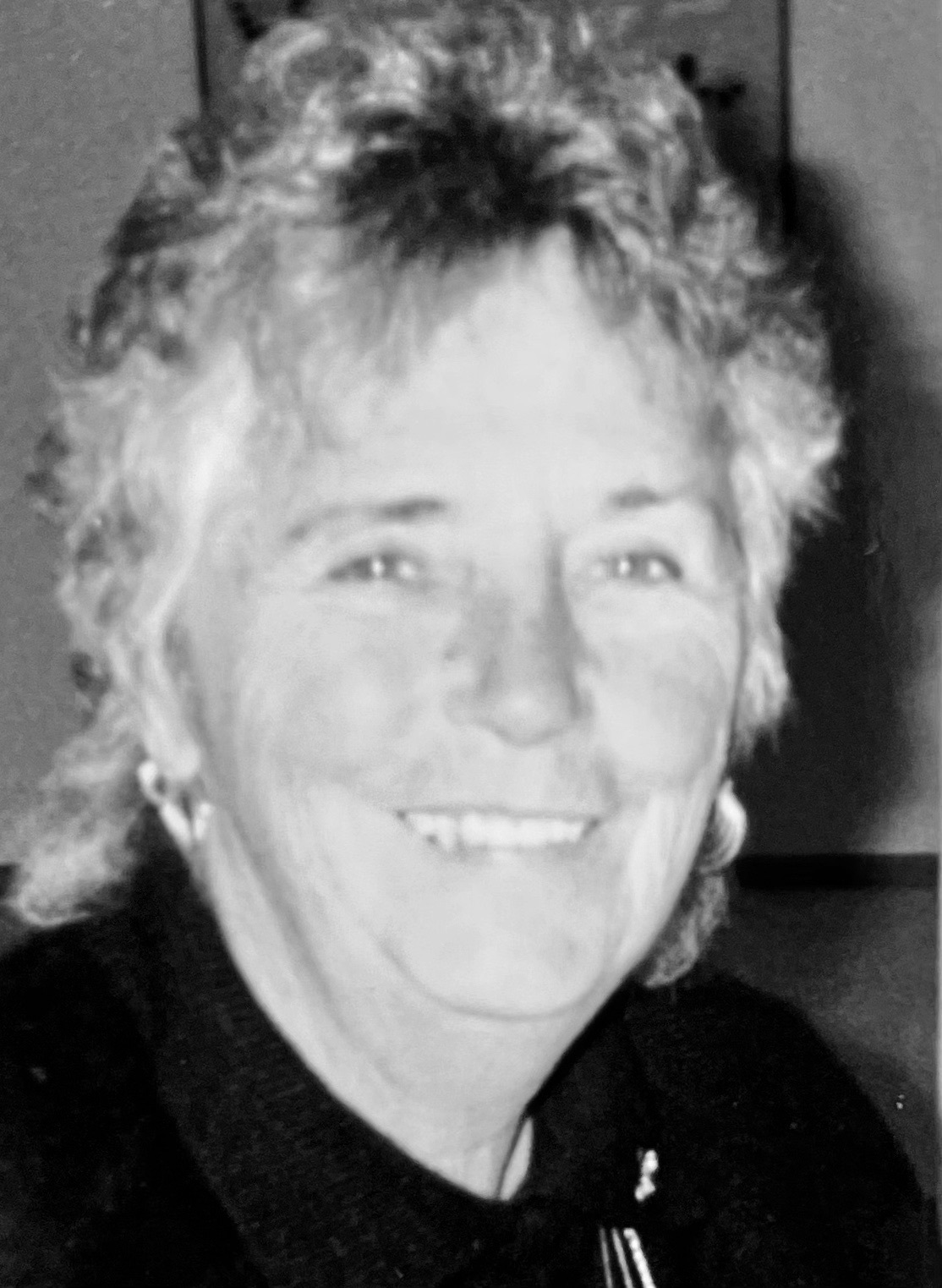
Elizabeth “Betty” McGuire passed away peacefully on April 25, 2023 in Eureka. Betty was born on October 12, 1929 in Glasgow, Scotland. Unfortunately, her mother, Agnes, died when Betty was only 12 years old. Betty lived with her oldest sister and family until she met and married her husband John McGuire on June 24, 1950. They were married for 70 years!
John worked as a Terrazzo mason throughout Scotland and England before being offered an opportunity to emigrate to Vancouver, Canada in 1956. Embracing this chance, John went to Canada to begin work and earned enough money to send for the passage of Betty and their two “wee” sons, John and Gerald. After a 4 months apart, Betty began her travels to Vancouver with the young boys on a long ocean passage from Liverpool, England to Quebec, Canada. She told stories about the trip where she and the boys slept in one small bunk and a kind steward would bring them occasional treats. Once they arrived in Quebec, they boarded a train for the trip to Vancouver through the plains of Manitoba and over the Canadian Rockies. During the 1950s this was quite a feat for a young woman alone with two small children.
After four years in British Colombia, the family which now included the youngest son Stephan, moved to Eureka in 1960. It took three cars to travel from Vancouver to Eureka, where they were able to fulfill their dream of owning a home. Settling into life in Humboldt County, Betty attended night school learning secretarial skills. In 1967 she became the administrative secretary for Zoe Barnum Continuation High School, from which she retired 23 years later. Betty truly enjoyed her job and the students. The students equally appreciated Betty and her no-nonsense but caring approach.
Upon retirement, Betty and John moved to a home they had previously built in Willow Creek. Betty loved golf and she and John became members of Willow Creek Golf Club. While living in Willow Creek she played golf daily and looked forward to the Women’s Club events, where she developed close friendships with many of the ladies. She took many golf trips to Oregon, Nevada, Arizona, Hawaii, and throughout California. She and John were very fortunate to enjoy many years of golf, friendships, family and sunshine.
Betty was preceded in death by her husband, John Kennedy McGuire. She leaves behind sons John, wife Melody, Jerry, Stephan, wife Sherry, grandchildren Jason, Adam, Jake, Brittany, Stephan and Katie, great-grandchildren, Maya, Luke, Natalie, Avery, Lucy and brother-in-law Charlie McGuire, along with numerous nieces and nephews in Scotland and Canada.
A special thanks to the staff at Hospice and Timber Ridge for their compassionate care in the last few days of our mother’s life.
###
The obituary above was submitted on behalf of Betty McGuire’s loved ones. The Lost Coast Outpost runs obituaries of Humboldt County residents at no charge. See guidelines here. Email news@lostcoastoutpost.com.
OBITUARY: Marvin John Rogers, 1949-2023
LoCO Staff / Wednesday, May 10, 2023 @ 6:56 a.m. / Obits

Marvin John Rogers, 74, of Eureka, passed away on April 24.
John was a loving father and grandfather whose hobbies were classic cars and motorcycles. He worked with his brother Ron for many years specializing in custom furniture. He then went on to being the number-one sales man at Harper Ford Motors. Lastly, he worked for Richard Miller Motorcycles, where he retired from.
John loved playing his guitar and singing karaoke. He even taught his grandchildren to play the guitar.
He is survived by his brother Ron, his three sisters, Kim, Christine, and Tamara, and his three sons, John T, Don, and Dan. John T’s partner Trish and his children John Jr., Damon, Britton, Lucy, and Aimee. Don’s children Levi, Sierra, and Tessa. Dan’s partner Heather and their children Dylan and Madison.
John loved his family, and he will be forever in their hearts. No public services are planned, and a private celebration of life will be observed by his family.
###
The obituary above was submitted on behalf of John Rogers’ loved ones. The Lost Coast Outpost runs obituaries of Humboldt County residents at no charge. See guidelines here. Email news@lostcoastoutpost.com.
HUMBOLDT TODAY with John Kennedy O’Connor | May 9, 2023 (San Marino Week, Day 1)
LoCO Staff / Tuesday, May 9, 2023 @ 5:29 p.m. / Humboldt Today
HUMBOLDT TODAY: Did you ever dream you’d get your Humboldt news delivered to you in the dead of night from the streets of the world’s oldest republic? Yes? Well, you’re an odd one.
This week LoCO has dispatched our very own John Kennedy O’Connor to the nation state of San Marino. New temporary location, same local news. Tune in! Ciao bella!
FURTHER READING:
- Cal Poly Humboldt Professor Leads First-of-its-Kind Study on Legacy Cannabis Genetics
- Up in Brookings, a Church Keeps Feeding the Hungry Despite the City’s Orders to Stop
- Cal Poly Humboldt to Hold Its First Regional Commencement Ceremony in Beverly Hills Next Monday
HUMBOLDT TODAY can be viewed on LoCO’s homepage each night starting at 6 p.m.
Want to LISTEN to HUMBOLDT TODAY? Subscribe to the podcast version here.


