

Local Tribe Backs Out of Hosting ‘Freedom Conference’ Led by Inflammatory Ferndale Pastor Tyrel Bramwell
Ryan Burns / Tuesday, Oct. 3, 2023 @ 2:09 p.m. / Tribes
UPDATE, Oct. 4: The day after this post was published, the Bear River Band of the Rohnerville Rancheria issued a statement explaining its refusal to host Bramwell’s event. Read it here.
###
Original post:
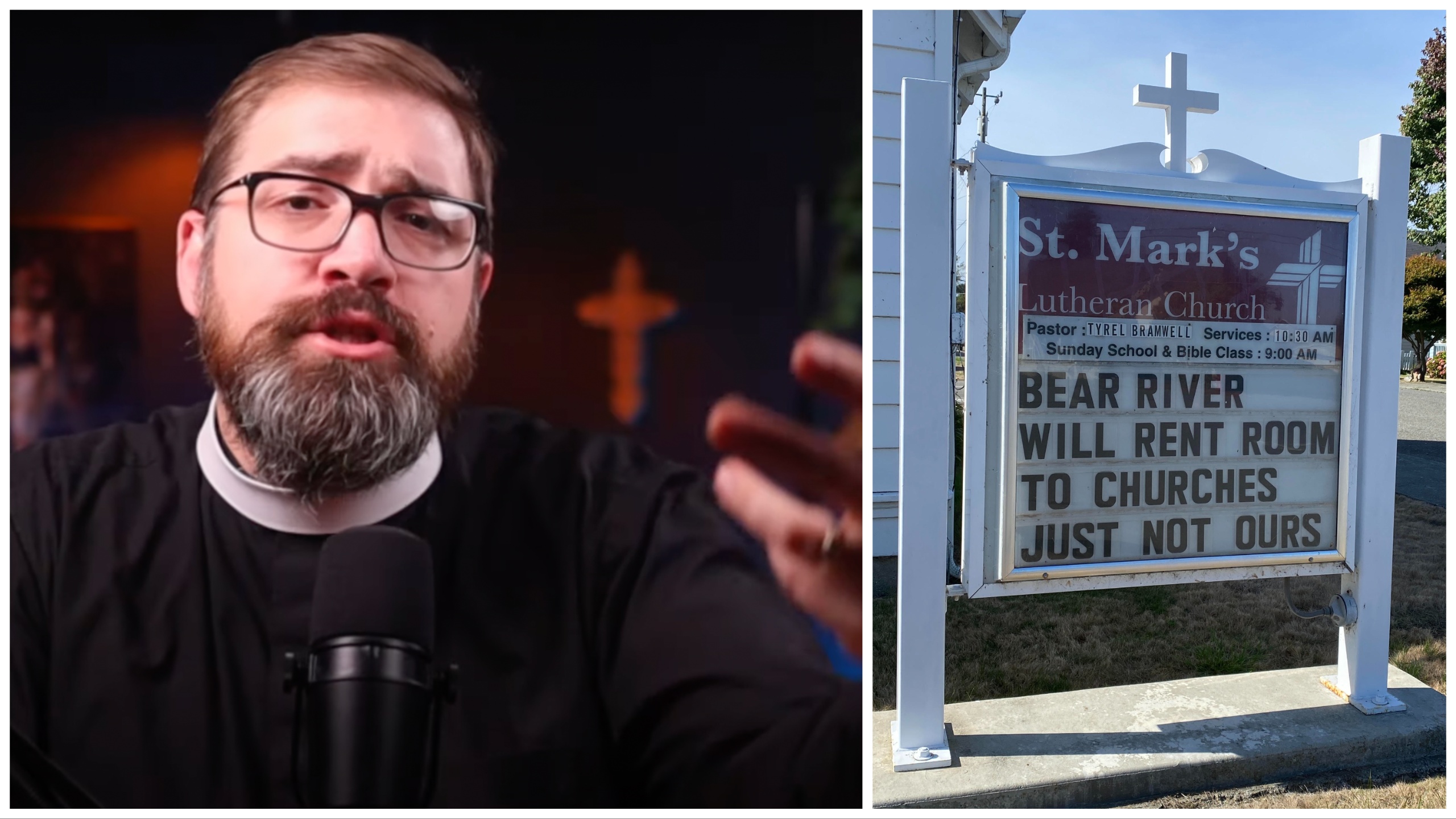
St. Mark Lutheran Church Pastor Tyrel Bramwell (screenshot via YouTube), and the sign outside his Ferndale church (submitted by Bramwell).
###
The Bear River Band of the Rohnerville Rancheria has opted not to provide space for an upcoming “Religious Liberty” conference hosted by local Pastor Tyrel Bramwell, who has stirred community discord in recent years with inflammatory messages posted to the sign outside his small Lutheran church in Ferndale.
Bramwell announced the tribe’s decision on his blog Monday morning in a post that originally misidentified the Bear River Band of the Rohnerville Rancheria as the Wiyot Tribe. (He corrected the tribe’s name after an inquiry from the Outpost.)
“After agreeing to rent us the Tish Non Room and providing a block of [hotel] rooms for our Freedom of Conscience and Religious Liberty Conference, scheduled for October 28, 2023, the Wiyot Tribe [sic] Bear River decided to return our deposit and release our rooms,” the post says. “The Tribal Chairman cited complaints about Pastor Bramwell’s public teaching as the reason for their reversal.”
Bramwell’s public messages, posted to the marquee outside St. Mark, have demonized the LGBTQ+ community repeatedly as well as female pastors, abortion, “woke America,” drag shows and the Black Lives Matter Movement.
But it was a message posted around this time last year that proved particularly offensive to local Native American communities. On October 10, officially recognized by the state and the county as Indigenous Peoples’ Day, Bramwell posted a message on his church marquee that read, “PRAISE GOD FOR COLUMBUS THE LOVING EVANGELIST.”
In an accompanying blog post and pamphlet that he handed out around town, Bramwell argued that Italian explorer Christopher Columbus, whose enslavement and violent abuse of native inhabitants of the West Indies is a well-documented matter of historical fact, couldn’t possibly be “a bad guy” because he “wanted to bring Christ to people deceived by paganism.”
By extension, Bramwell posited, the European settlers for whom Columbus “opened the door,” including Ferndale’s own Christian forefathers, were heroes who deserve to be defended against “the conquest of the county and the state as they work to undo the very identity of our village” by recognizing Indigenous Peoples’ Day.
He later gave a sermon in which he spoke admiringly of Seth Kinman, a 19th Century bear trapper, chair-maker and notoriously brutal “California Indian Killer,” who was among the first Anglo “settlers” in the Humboldt County region. An accompanying YouTube video uses Kinman as a metaphor, suggesting that an old yarn about his mule fighting off a grizzly bear should serve as a model for modern Ferndalians fighting off the “woke” “LGBTQ bears” who are out to seize Ferndale’s “provisions” by corrupting “the souls of our family and friends.”
The Bear River Band of the Rohnerville Rancheria did not respond to emails and phone messages seeking comment, so we don’t know for sure why they chose to cancel Bramwell’s reservation and return his deposit, but Wiyot Tribal Chair Ted Hernandez told the Outpost that he’s grateful for their decision.

The St. Mark sign before being corrected. | Submitted.
“The Wiyot Tribe supports Bear River in their decision to not host a conference that puts our community at risk and would like to give Bear River Band of Rohnerville Rancheria a public Hou’ (thank you) for their leadership.” Hernandez said in an emailed statement.
Wiyot Tribal Administrator Michelle Vassel said that now is a good time to draw attention to Bramwell’s divisive messages.
“Orange Shirt Day was on Saturday, September 30, which is an international day dedicated to honoring survivors and families of the Indigenous boarding school system, and memorializing the children who didn’t return home,” she said, offering a link to an investigative report into the Federal Indian Boarding School Initiative.
Vassel also pointed to a recent dramatic depiction of such boarding schools on the critically acclaimed Hulu series Reservation Dogs, and she said Bramwell’s praise for Columbus and Kinman flies in the face of those men’s legacies among Indigenous peoples.
“We are still living with the intergenerational harm caused by boarding schools and fighting to seek justice for Missing and Murdered Indigenous Women and Two-Spirit individuals,” Vassel wrote, citing a 2004 study that found gender-based violence, including sexual assault, is committed against 78% to 85% of Indigenous Two Spirit individuals.
A 2008 study from the National Criminal Justice Reference Service found that American Indian and Alaska Native women suffer murder rates of up to ten times the national average and experience rape and other sexual assaults at a higher rate than African American and white women.
Vassel believes Bramwell’s words and actions have been counterproductive.
“We have spent generations working to heal from the horrific atrocities committed here and we are still healing,” she said. “In recent years we have seen great examples of how we can work together, the indigenous and non-indigenous communities … to benefit everyone. The Wiyot Tribe Stands with Bear River on their decision to keep our community safe. As Tribal Communities we have a lived experience, we must intervene when hate is being promulgated in our communities our lives depend on it.”
The “Freedom of Conscience and Religious Liberty Conference” was scheduled to take place in the 3,500-square-foot Tish-Non Ballroom at Bear River Casino and Resort, with general admission tickets priced at $75.
In an email, Bramwell told the Outpost that the conference will now take place for free at his church.
###
PREVIOUSLY:
- Dueling Church Signs in Ferndale Spark Controversy Over LGBTQ Inclusion
- (PHOTOS/VIDEO) St. Mark’s Pastor, Pride Marchers Meet Face-to-Face Before Ferndale’s First Pride Demonstration
- For Black History Month, Ferndale Reverend Calls BLM ‘Evil’ and Says the Movement is ‘Built on Sin’
- Ferndale Drag Show Canceled After ‘Beware’ Sign at Local Church Prompts Concerns About Extremist Response
- Humboldt Supervisors Stand Up For Communities ‘Living in Fear,’ Adopt Resolution Condemning Hate Speech
BOOKED
Today: 6 felonies, 12 misdemeanors, 0 infractions
JUDGED
Humboldt County Superior Court Calendar: Today
CHP REPORTS
777 Casino Way (HM office): Trfc Collision-No Inj
Us101 / Sandmine Rd (HM office): Trfc Collision-No Inj
7985 Mm101 S Hum 79.90 (HM office): Assist with Construction
Us199 / Us101 N Us199 N Con (HM office): Assist CT with Maintenance
Poppy Dr / Sherwood Rd (HM office): Closure of a Road
ELSEWHERE
KINS’s Talk Shop: Talkshop September 3rd, 2026 – William Honsal
Governor’s Office: California prioritized fighting organized retail theft, those results are paying off with 36,000 arrests and $293 million in stolen goods recovered
Mad River Union: Whistleblower calls for Miranda’s Rescue end
Mad River Union: Arcata’s petite data center only the first
JERRY LIVES! Born-and-Raised Arcata Artist Designs the Cover For New Special-Edition Jerry Garcia Album
Stephanie McGeary / Tuesday, Oct. 3, 2023 @ 1:21 p.m. / Art , Music , Our Culture

The special release album, Pure Jerry, is coming soon! | Photos/ images submitted by Gabe Schneider
###
Good news for all you Jerry fans out there (and we know there are a few of you in Humboldt)! The late musician, best known as the front man for this little band called the Grateful Dead, has a new album coming out, and the cover art was done by our very own local artist, Gabe Schneider.
The album, Pure Jerry: Marin Veterans’ Memorial Auditorium, San Rafael, CA February 28, 1986, is being released on vinyl for the very first time next month on Record Store Day, the Jerry Garcia Family and Round Records announced yesterday. The double album, featuring music performed live by Garcia and John Kahn, will be a special release, pressed on gold vinyl, and features a full gatefold cover designed by Schneider.

Schneider | Photo by Anne Schneider
“I feel like Jerry Garcia is such a staple of our area and I just feel especially proud to get to work on this project,” Schneider told the Outpost in a phone interview on Monday afternoon, following the announcement of the album’s release.
Born and raised in Arcata, 27-year-old Schneider has been doing some form of art ever since he can remember. His artistic passion was largely influenced by his father, Keith Schneider, a well-known local ceramic artist and art professor. Schneider’s interest in art really grew during his high school years, when he attended the Arcata Arts Institute. After high school, Schneider began fine-tuning his skills and doing freelance work as a graphic designer, honing his distinguishable style, which he said is largely influenced by folk art, collage and visual symbolism.
Eventually, Schneider landed a gig as the in-house graphic designer for Dick Taylor Chocolates and has also continued to do freelance commercial work, creating artwork for concert posters, T-shirts and album covers for some notable bands, including Pearl Jam, Young the Giant and Vetiver. He has also designed multiple posters for event production company Folk Yeah! About a year ago, Schneider’s Instagram, Sight Study, began to grow in prominence, and in September of this year he was contacted by Red Light Management, which manages Garcia’s music, to design the limited-release album cover.
Though Schneider has designed album cover art before and even done so for a couple of famous artists, this was a special honor for the Arcata-based artist. Schneider is a big fan of Garcia and the Grateful Dead, which he said was like “the background music of Arcata” when he was growing up. With Humboldt’s strong ties to the hippie movement, Garcia is a pretty beloved figure in our area. A portrait of Garcia hangs behind the bar at the Logger Bar in Blue Lake, and Schneider recalls a Humboldt Crabs game he attended on Garcia’s birthday one year, where the announcer came on the loudspeaker at one point to say, “Happy birthday to Jerry, from Humboldt County.”
To design the cover, Schneider said he listened to the album multiple times, drawing inspiration from the music and lyrics. The artwork features symbols representing different themes and lines from the songs featured on the album, including a ripple in the bottom center for the song “Ripple,” some hounds, twenty dollars and a devil, all drawn from the song “Friend of the Devil,” and a rose to represent “Run for the Roses.” There are a couple of other ones in there, but we’ll leave it up to the superfans to figure them out.

A closer look at the cover.
Schneider said that he definitely designed the cover with the fans in mind, using images that anyone who is super-familiar with Garcia’s music would recognize, but that non-fans probably would not. Schneider figures, probably correctly, that mostly big fans will rush out to buy a special-edition double album of a live Jerry concert from 1986.
For those of you who are salivating over this special album, Pure Jerry will be released on Record Store Day, which is also Black Friday, Nov. 24. Schneider is not exactly sure where the record will be available, but both The Works and People’s Records are listed as Record Store Day participants. And it seems, given the local audience, they will likely have copies.
Schneider added that this opportunity has been very “career-affirming” and he hopes that it will lead to more chances for him to do work for artists that he loves. He also hopes to focus more on his own projects and has plans to open a studio and print shop in the area.
“I love doing commercial work. It’s great,” Schneider said. “But I have a personal art practice as well. So I’m prioritizing getting a print shop up and running again.”
Deputies Discover Meth and Fentanyl While Making Pair of Arrests in McKinleyville, Says HCSO
LoCO Staff / Tuesday, Oct. 3, 2023 @ 11:33 a.m. / Crime

Lynzee Strange and John Ellis II
Press release from the Humboldt County Sheriff’s Office:
On Oct. 1, 2023, at about 10:14 a.m., Humboldt County Sheriff’s deputies on patrol in the McKinleyville area observed a vehicle being driven by a man wanted on a felony warrant.
The vehicle stopped at a business on the 1000 block of Murray Road in McKinleyville and two people exited, 43-year-old John Wayne Ellis II and 22-year-old Lynzee Aurora Strange. Both Ellis and Strange were confirmed to have warrants for their arrest.
Ellis and Strange were both taken into custody without incident. During a search of Ellis, deputies located approximately 3.2 grams of methamphetamine, .7 grams of fentanyl and drug paraphernalia.
Ellis was transported to a local hospital for treatment of an unrelated illness and was cited on his felony warrant, in addition to charges of possession of a controlled substance (HS 11377(a)) and possession of a narcotic controlled substance (HS11350(a)).
Strange was booked into the Humboldt County Correctional Facility on warrant charges of transportation/sale of a narcotic controlled substance (HS 11352(a)), possession of a controlled substance (HS 11378 & 11351), transportation/sale of a controlled substance (HS 11379(a)), disorderly conduct (PC 647(a)) and possession of a controlled substance paraphernalia (HS 11364(a)).
Anyone with information about this case or related criminal activity is encouraged to call the Humboldt County Sheriff’s Office at (707) 445-7251 or the Sheriff’s Office Crime Tip line at (707) 268-2539.
Yurok Tribe Lands $6M Grant to Build New Fuel Mart, Laundromat and Tribal Government Offices in Orick
LoCO Staff / Tuesday, Oct. 3, 2023 @ 9:54 a.m. / Government , Tribes

Conceptual drawings of Shoreline Fuel Mart courtesy Yurok Tribe.
###
Press release from the Yurok Tribe:
The Yurok Economic Development Corporation (YEDC) recently secured a $6 million grant from the US Economic Development Agency to build a brand-new fuel mart, laundromat and tribal government offices within Yurok ancestral territory in Orick.
“I would like to thank US EDA for making this much-needed investment in our community,” said Joseph L. James, the Chairman of the Yurok Tribe. “The state-of-the-art facility will be a great resource for local residents and Redwood National and State Parks visitors. The business will generate more than a dozen new jobs too.”
“These Economic Development funds for the Yurok Tribe will help provide the small town of Orick on the edge of Redwood National and State Parks a real boost,” added Rep. Jared Huffman. “This new facility will be a welcome gateway for travelers, whether they are using conventional vehicles or new electric models. This is a great match for the area and will help tourists orient themselves in Yurok Country and one of the most beautiful parks in the world.”
Located in the footprint of the aging Shoreline Market, the economic development project will involve the construction of a stunning two-story building. The one-of-a-kind, approximately 6,000-square-foot structure will resemble a customary Yurok home with traditional basket designs on the exterior walls, pitched roofing and a round door. A minimart will occupy the first floor of the partially solar-powered facility. The laundromat will also be on the ground level, but it will have a separate entryway. The second story will contain tribal offices and two conference rooms. The US Highway 101-adjancent business will offer eight unleaded and high-flow diesel fuel pumps as well as multiple electric vehicle charging stations. The conventional fuel dispensers and electric charging stations will be open 24/7.
The new facility was deliberately designed to serve as a gateway to welcome visitors to Orick. The Shoreline Market property is on the south side of Orick, in close proximity to one of the most picturesque stretches of the California coastline. It is also near Redwood National and State Parks’ Lady Bird Johnson Grove and the fabled Fern Canyon, which draws visitors from across the globe. Every year, approximately 1.5 million people spend time in the parks to enjoy the unspoiled beaches and hike through the tallest trees on the planet.
“The Shoreline Market project represents real economic progress for the Orick community and the Yurok Tribe,” said the Yurok Economic Development Corporation’s Executive Director Raymond Bacon. “This project is phase one in our long-term our plan to revitalize Orick.”
The construction of the new Shoreline Market is expected to begin in the first quarter of 2025. Since the start, the Yurok Tribal Council and YEDC have engaged the Orick community and will continue to do so as the project progresses. During the build, the current gas pump will remain open because there is only one fueling station in Orick.
In 2020, the Yurok Tribal Council allocated funds to the YEDC for the purchase of the nine-acre Shoreline Market property. Following the acquisition, YEDC took over the management of the business.
The town of Orick is roughly in the center of the Tribe’s ancestral territory on the coast. Orick is named after a traditional village called Owr-rekw. For millennia, prior to the arrival of European colonizers, Yurok people enjoyed a rich existence in the large village due to an extreme abundance of ocean and river resources, wild game and plant foods, all of which were carefully managed for maximum sustainability.
The revitalization of Orick will ensure that Yurok people continue to remain connected to this part of the Tribe’s ancestral territory. The YEDC is working hard to build up the economy within the coastal town and throughout the Tribe’s homeland.
The Yurok Development Corporation is the economic development branch of the Yurok Tribe. The YEDC owns and operates several businesses, including: Shoreline Market, Pem-mey Fuel Mart, Pek-tah Fuel Mart, Redwood Yurok Canoe Tours, Redwood Hotel Casino, Abalone Bar and Grill, Yurok Country Visitor Center, Klamath Jet Boat Tours, Yurok Alliance CDFI, Bluff Creek Resort, Redwood RV Park, Riverside RV Park and Requa Resort.
The California Earthquake Authority — Yes, That’s a Thing — Would Like to Hear About Your Experience of Last Year’s Quakes in Order to Serve You Better
LoCO Staff / Tuesday, Oct. 3, 2023 @ 7:30 a.m. / Earthquake

Graphic by DALL-E, an artificial intelligence.
Press release from the California Earthquake Authority:
The California Earthquake Authority (CEA) is seeking input from Humboldt County residents following the 6.4 magnitude earthquake that hit Ferndale in late December and the 5.4 magnitude quake that struck near Rio Dell in January.
The data received from this brief survey - https://forms.office.com/r/v13ReytYeU - will greatly assist CEA’s efforts to understand how these earthquakes and the lessons learned from them can help better prepare the community for future events.
The survey should take no more than five minutes to complete.
The California Earthquake Authority (CEA) is a not-for-profit public instrumentality of the state of California that has two distinct roles: Since 1996, CEA has provided residential earthquake insurance while educating Californians about earthquake risk and helping them reduce their risk of earthquake losses through residential mitigation. Since 2019, CEA also has administered the Wildfire Fund, a catastrophe fund that provides a source of funding for payment of claims arising from a wildfire caused by any large electrical utility company that meets the legal requirements for participation in the fund.
Beyond Crayons and Circle Time: What California Transitional Kindergarten Needs to Succeed
Carolyn Jones / Tuesday, Oct. 3, 2023 @ 7 a.m. / Sacramento

Teachers Michelle Ramos-La Grone and Elsa Cintora work with students in the transitional kindergarten program at Westwood Elementary School in Stockton on Sept. 22, 2023. Photo by Loren Elliott for CalMatters
Thanks to TikTok videos, billboards and other creative marketing techniques, enrollment in transitional kindergarten in California appears to be climbing. But advocates are keeping an eye on how those 4-year-olds are spending their class time — which they say will be a key factor in whether the $2.7 billion program is a success.
“Quality is top of mind for us. Some districts are treating it like a second year of kindergarten, which we know doesn’t work,” said Benjamin Cottingham, with Policy Analysis for California Education, an independent, nonpartisan research center. “To be effective, TK needs to be a play-based, developmentally appropriate course of study.”
Transitional kindergarten, which California first launched in limited capacity in 2010, is meant to ease 4-year-olds into the rigors of elementary school. Ideally, it combines the carefree fun of preschool with a hint of structure and academic know-how, so children are better prepared for kindergarten and beyond. In a high-quality TK classroom, children learn to share and take turns, draw pictures and play with blocks, sit in a circle and enjoy story time, among other skills.
A study of California’s TK program by the American Institute of Research found that children who completed TK had stronger skills in math and literacy when they started kindergarten and were more engaged in learning than their peers who didn’t participate in the program. The benefits were especially pronounced for English learners and low-income students.
In 2021, California expanded its transitional kindergarten, requiring schools to provide space for all eligible 4-year-olds whose families want it. With a rollout period of five years, schools have been busy hiring and training teachers, buying more crayons and blocks, converting classrooms to meet state guidelines and getting the word out.
After a lull, enrollment appears to rebound
In 2022-23, enrollment lagged below expectations, likely due to the lingering effects of the COVID pandemic, according to the Legislative Analysist’s Office. Just over half of California’s eligible 4-year-olds were enrolled in TK last year, roughly 22% below state projections. But now enrollment appears to be increasing. The official numbers for 2023-24 won’t be available for several months, but a CalMatters sampling of districts statewide reported better-than-expected enrollment so far this year.
Schools credit the uptick to improved outreach. District staff are talking to parents at local preschools and child care centers, posting flyers in pediatricians’ offices, buying ads on social media and even going door-to-door.

Hazel Perkins (left) and Scarlett Perkins (right), students at Rescue Union School District in El Dorado County. Photo courtesy of the El Dorado County School District
In Rescue Union School District in the Sierra foothills of El Dorado County, word-of-mouth has been the most effective recruitment tool, said Superintendent Jim Shoemake. The district bought newspaper ads and put up signs, but nothing compares to the power of parents chatting at barbecues, block parties and soccer games. Enrollment has increased steadily, with 142 students enrolled this year, and the retention rate is nearly 100%, he said.
“TK has benefitted the entire district,” Shoemake said. “It’s great to have a child on campus for six years, but seven is even better. We get a chance to onboard these kids early, so they’re successful not just in elementary school, but middle school and beyond.”
Rescue Union parent Aly Perkins said her twin daughters, Hazel and Scarlett, loved their TK class last year. They learned their ABCs and 123s, but it was social skills that had the biggest impact, she said.
“They learned things like manners, how to make friends, how to keep friends — those skills will benefit them their whole lives,” Perkins said. “I think TK gives kids the confidence and cushion they need to succeed in school. I’m really glad we decided to send them.”
Even in Los Angeles Unified, the nation’s second-largest school district, word-of-mouth has been key to TK enrollment. In addition to bus ads and billboards, a social media campaign, a hotline and robocalls, the district has enlisted school staff and parent volunteers to hand out flyers within a four-block radius of elementary schools.
“A parent saying, ‘I have my kid in this program and it’s great’ is much better than it coming from me,” said Dean Tagawa, the district’s executive director for early childhood education. “That parent-to-parent connection, that level of trust, is what’s important.”
“We get a chance to onboard these kids early, so they’re successful not just in elementary school, but middle school and beyond.”
— Jim Shoemake, superintendent of the Rescue Union School District
The tactics seem to be working. Los Angeles Unified has opened TK classrooms at nearly all 488 elementary schools. And children who attended the district’s TK program have significantly outperformed their peers not in the program in reading, writing and math in kindergarten and first grade, according to district data. They also fared better social-emotionally, based on teacher feedback on report cards.
In Lodi Unified, a TikTok video chronicling a day in the life of a Lodi kindergartener has garnered more than 13,200 views and helped fill classrooms. With enrollment exceeding expectations, the district is on track to open at least one TK classroom at every elementary school by 2025-26.
“Overall, it’s going really well, and I believe that by the time these students are in third grade, we’re going to see huge improvements in outcomes,” said Susan Petersen, the district’s director of education.
Persistent staffing challenges
While some districts have struggled to hire enough TK teachers, Lodi Unified has filled all its vacancies, she said. The district is providing training and in-classroom coaching, and using a curriculum focused on learning through playing. Some of the new TK teachers are credentialed elementary teachers, and some are veteran preschool teachers pursuing credentials.
“We’ve found that it’s a sought-after position,” she said.
Recognizing that 4-year-olds learn in unique ways, the Legislature will require by 2025 TK teachers to have credentials as well as 24 units of early childhood education or the equivalent. That extra requirement may pose a barrier to filling positions — many districts are already grappling with teacher shortages. An analysis by the Learning Policy Institute last fall found that 80% of school districts in California didn’t yet have enough qualified TK teachers.
Meanwhile, the California Commission on Teacher Credentialing is working on a new credential that will prepare teachers for preschool through third grade, with a focus on literacy. A goal: create a seamless continuum in which students learn by playing, rather than sitting at desks.

Students play in the transitional kindergarten program at Westwood Elementary School in Stockton on Sept. 22, 2023. Photo by Loren Elliott for CalMatters
That focus on high-quality teaching and learning is imperative if TK is going to succeed in getting students ahead in the early years, Cottingham said. The state is updating its preschool guidelines to include TK, but schools cannot afford to wait for the new version; they should “work with what we’ve already got,” or students will lose out on the benefits of an additional year of schooling, Cottingham said.
Assessments will also be important, he said, to hold districts accountable for the quality of their programs. Currently, the state is not requiring schools to test students in TK, although it does provide guidelines on how to measure students’ progress.
Hanna Melnick, senior policy adviser at the Learning Policy Institute who co-leads the early childhood learning team, adds that assessment, as well as curriculum, will be important as TK expands.
“The TK rollout has been faster than we expected, but we don’t have a good way to monitor quality, and district capacities to teach 4-year-olds vary greatly,” she said. “Some have been doing this for a long time, and some are new and don’t yet have the background or training.”
‘A system that’s working’ in Tulare
Tulare City School District, a 9,200-student district south of Fresno, has been offering a cohesive preschool-through-first-grade program for a decade, and seeing positive results. Until the pandemic, third grade math and reading scores had jumped nearly 30% since the district implemented the program in the early 2010s. Now they are again beginning to improve.
The curriculum is linked from grade to grade, and teachers work closely together, easing children’s transitions from one classroom to the next. All sites offer after-school care, making it easier for parents with jobs. And teachers try to get to know families and ensure they feel welcome and part of their children’s education, said Jennifer Marroquin, the district’s assistant superintendent of educational services.

Students work on puzzles in the transitional kindergarten program at Westwood Elementary School in Stockton on Sept. 22, 2023. Photo by Loren Elliott for CalMatters
“For parents, it can be scary dropping your 3- or 4-year-old off for the first time. So we try to make them feel supported,” Marroquin said. “We found a system that’s working, and it’s become one of our district’s strengths.”
By the time TK is fully in place statewide, most districts should have programs resembling Tulare’s, said Kelly Reynolds, a policy analyst for Early Edge California, a nonprofit advocacy group that’s worked closely with the state on transitional kindergarten. She expects the challenges with staffing, enrollment and quality will be resolved — or close to it — within the next few years.
Because transitional kindergarten, like kindergarten itself, is not mandatory, enrollment will never be 100%, she noted. And depending on where they live, 4-year-olds have plenty of high-quality options aside from TK — including private preschool, state-supported preschool, child care and Head Start.
“We want to make sure all 4-year-olds are being served in high-quality programs, and families know the breadth of opportunities available to them,” she said. “I do think we’re on track. Enrollment is trending upwards, and we’re seeing there’s a real demand for TK.”
###
CalMatters.org is a nonprofit, nonpartisan media venture explaining California policies and politics.
California Could Soon Ban 4 Food Additives in Common Sweets. What to Know
Shreya Agrawal / Tuesday, Oct. 3, 2023 @ 7 a.m. / Sacramento

Image via Pixnio.
It’s no longer the “Skittles ban,” but legislation on Gov. Gavin Newsom’s desk still could force food manufacturers to change their recipes for a variety of sweets and baked goods.
The California Food Safety Act would prohibit the sale of food products containing several additives that are outlawed in the European Union and are thought to be harmful to the health of people who eat them.
The bill made headlines as “the Skittles ban” earlier this year because the original version of it would have prohibited a chemical used to add color to the popular candy. Lawmakers last month amended the bill to allow the sale of products with that chemical, although it still would ban chemicals that are commonly used in other sweets.
If Newsom signs the bill, manufacturers would have until Jan. 1, 2027 to reformulate their products and comply with California law. That could lead the companies to remove the additives from their products nationwide because of the size of California’s market.
Consumer Reports is a cosponsor of the bill. Brian Ronholm, director of food policy at the nonprofit, said California’s ban could be important for the rest of the country.
“This groundbreaking bill passed with strong bipartisan support and bans four food chemicals that have been linked to serious health problems, including a higher risk of cancer, nervous system damage, hyperactivity and other neurological conditions. The FDA has been slow to address these dangers, so it is critical for states like California to protect consumers from these toxic food chemicals,” he said.
Opponents of the bill believe it would disrupt operations for manufacturers and retailers. They also argue it would harm consumers because they wouldn’t be able to purchase these products.
The bill is the latest among several recent California laws that attempt to influence national consumer markets. Most notably, voters approved a 2018 initiative that compels ranchers to provide more space to livestock, such as egg-laying hens and pigs, if they want to sell their products in California. The U.S. Supreme Court last year upheld the law against a challenge from the National Pork Producers Association.
The organizations that opposed the current bill to ban the sale of food with certain chemicals have not said whether they plan to sue if Newsom signs it into law.
What does this bill ban?
The bill will ban red dye 3, propylparaben, brominated vegetable oil and potassium bromate from all foods meant for human consumption.
Red dye 3 is a common color additive found in candies and other food products. It was banned from cosmetic use more than 30 years ago by the Food and Drug Administration due to concerns about it being a carcinogen. It is still used in popular candies like Peeps, as well as other foods such as cookies and colored drinks, according to the nonprofit organization Environmental Working Group.
Just Born Quality Confections, which makes Peeps, earlier this year told CNN the additive is “an approved colorant for use in candy by the (Food and Drug Administration). We manufacture all our candies in compliance with FDA regulations, sourcing our ingredients and packaging exclusively from reputable suppliers who adhere to high quality and safety standards.”
Propylparaben is a preservative used in baked goods like muffins and cakes, as well as in popular trail mixes.
Brominated vegetable oil is added to popular citrus drinks to prevent the flavoring oils from floating on top. While many beverage companies stopped using it a while ago, brands like Sun Drop continue to use it in their citrus sodas, according to its parent beverage company Keurig Dr Pepper.
Potassium bromate is a substance used to strengthen dough and can be found in all kinds of breads, cookies and tortillas. It has been banned in the European Union, United Kingdom, Canada and Brazil.
Why ban these particular chemicals?
In scientific studies on rats, the chemicals have been found to either be carcinogenic or neurotoxic or cause endocrine or reproductive damage.
They have already been banned from foods in the European Union, except red dye 3, which is allowed only in candied cherries. Many brands in recent years have switched away from several of these chemicals in order to protect their consumers. PepsiCo previously used brominated vegetable oil in several of its beverages, such as Mountain Dew and certain flavors of Gatorade, but has since changed those formulations after their use of brominated vegetable oil became controversial.
Advocates for a ban on the chemicals in California said manufacturers should be able to reformulate their products to comply with the bill.
“There’s no reason that the foods that you can find on the supermarket shelves in Europe should be safer than the ones that we find here in California,” said Melanie Benesh, vice president of governmental affairs at the Environmental Working Group, which is a cosponsor of the bill.
What happened to Skittles?
Skittles contain titanium dioxide, which is used to add whiteness to foods like candies and dairy products. The bill in its original text would have banned titanium dioxide. It was removed by an amendment.
The Food and Drug Administration has said that titanium dioxide is generally safe to consume in small quantities.
Manufacturers stressed that point in lobbying to exempt titanium dioxide from the bill.
“Our belief is that the science and the international regulatory reviews of titanium dioxide support its continued safe use in these applications and didn’t warrant being included in the bill,” said Tim Shestek, senior director of state affairs at the American Chemistry Council.
Given concerns about the chemical after it was banned in the European Union, the Food and Drug Administration put it under review based on a petition several environmental and consumer groups filed in April.
Are these chemicals actually dangerous?
Red dye 3 has been shown to cause cancers in rats but only at very high doses; there have been no proven cancers due to human consumption. Similarly, the other chemicals have been tested in rats and other mammals, but no cancers or other health issues in humans have been directly associated with them.
James Coughlin, a food expert at UC Davis, said this move by California to ban these four chemicals from food is “unnecessary and unscientific.”
According to Coughlin, who has researched toxins in food for over 40 years, all of these chemicals are safe for human consumption in legally permissible quantities.
Who opposes this bill and why?
This bill is strongly opposed by various food and beverage associations across the country, as well as the California Manufacturers and Technology Association.
Christopher Gindlesperger, a senior vice president at the National Confectioners Association, said, “We should rely on the scientific rigor of the FDA in terms of evaluating the safety of food ingredients and additives. Banning food and color additives which FDA has approved undermines consumer confidence and disrupts the protection of public health. It replaces a uniform national food safety system with a patchwork of inconsistent state requirements that increase food costs.”
Retail associations said California should have waited for the Food and Drug Administration to evaluate these chemicals and set a national standard for them. Rachel Michelin, CEO of the California Retailers Association, said these state laws will “put a burden on California consumers, who will end up paying more for their products or will not have access to them.”
The agency is currently working on a rule to remove authorizations for the use of brominated vegetable oil in food. It is also reviewing red dye 3.
Benesh, of the Environmental Working Group, said the opposition from manufacturers is just “inertia on their part.”
“Companies have been manufacturing these foods without these additives for a long time.
They’re selling them in Europe to comply with the European market. It shows that it is possible and affordable to reformulate,” she said.
###
Supported by the California Health Care Foundation (CHCF), which works to ensure that people have access to the care they need, when they need it, at a price they can afford. Visit www.chcf.org to learn more.
CalMatters.org is a nonprofit, nonpartisan media venture explaining California policies and politics.


