

OBITUARY: Bernice Francis Capeder, 1930-2023
LoCO Staff / Thursday, Aug. 3, 2023 @ 6:56 a.m. / Obits
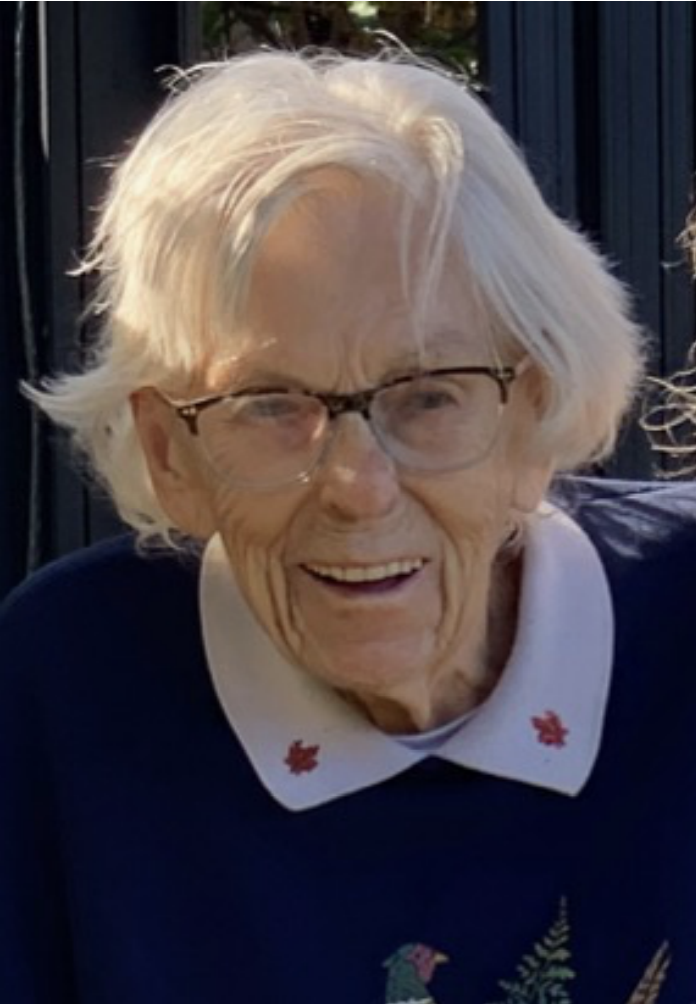
Bernice Francis Capeder (née Turner) of Santa Clara, CA entered into eternal rest on December 24th,
2022 in Santa Clara, CA at the age of 92 of natural causes.
One of three children, she was born in Ferndale on December 10, 1930 to Henry Sanford Turner and Helen Bernice Hansen. She had two brothers, Ron and Wayne Turner, who preceded her in death.
Growing up in Port Kenyon, her beloved grandparents, Hans and Esther Hansen, stepped in to help raise her. She was close to her stepfather Luther Jensen who was a father figure in her life. She attended Fortuna High and was crowned the 1951 Fortuna Rodeo Queen. A natural beauty, she caught the eye of Pierre (Ben) Benito Capeder in high school while roller skating.At the age of 22, she married Ben on June 22, 1952 at the Church of the Assumption in Ferndale and together they raised a family of six children.
Ben was in the Air Force early on and the young family moved from place to place as their family grew. She would recall, years later, how hot it was in Mississippi while stationed there and welcomed the chance to return to our cooling coastal fog. The seaside was always her favorite place and she would tell tales of the abundance of the Salt River and digging for giant clams in her youth.
Born a farmer girl in rural Humboldt County, she developed her trademark toughness and positivity. Stubbornly optimistic, “Just be positive” was her tagline, a message that we all could benefit from. She loved her gardening, flowers (especially roses), and her many canine companions. Her whimsical garden, filled with gnomes, lights and fairies, is legendary and those who have seen it know it as almost magical at night.
Most of all, she loved her family. Ben’s parents and siblings were always dear to her heart and she considered them her own. As a mother of six, it could be difficult to provide all the love and attention they needed in their head-strong years, but she endured and loved her family deeply, along with her adored eleven grandchildren and nine great grandchildren. Talking about their adventures or seeing them always made her eyes light up. Her happiest times were whenever her house was filled with family laughter and sharing a good meal while telling the tales of life.
Bernice’s remains will be interred with Ben on August 4th, 2023 at Ocean View Cemetery in Eureka at 10 a.m. She will be missed by the many who loved her. May her memory be eternal.
###
The obituary above was submitted on behalf of Bernice’s loved ones. The Lost Coast Outpost runs obituaries of Humboldt County residents at no charge. See guidelines here. Email news@lostcoastoutpost.com.
BOOKED
Today: 6 felonies, 12 misdemeanors, 0 infractions
JUDGED
Humboldt County Superior Court Calendar: Today
CHP REPORTS
Sr299 / Mill St (RD office): Trfc Collision-No Inj
2700 Nickel Ave (HM office): Traffic Hazard
2700 MM199 N DN 27.00 (HM office): Trfc Collision-1141 Enrt
Us101 / Sandmine Rd (HM office): Trfc Collision-No Inj
Us199 / Us101 N Us199 N Con (HM office): Assist CT with Maintenance
Poppy Dr / Sherwood Rd (HM office): Closure of a Road
ELSEWHERE
County of Humboldt Meetings: CAT (Committee for Active Transportation) Meeting Agenda
Governor’s Office: California and the Australian state of Queensland ink new partnership to accelerate climate resilience, agricultural technology, and innovation
County of Humboldt Meetings: Human Rights Commission Agenda- Hybrid Meeting
Fishing the North Coast : Cool Water, Rain Spark Klamath Salmon Push
Eureka City Council Reviews ‘Big Picture’ Plans for the City’s Waterfront, Approves New Downtown Parking Fees and More!
Isabella Vanderheiden / Wednesday, Aug. 2, 2023 @ 5:04 p.m. / Local Government
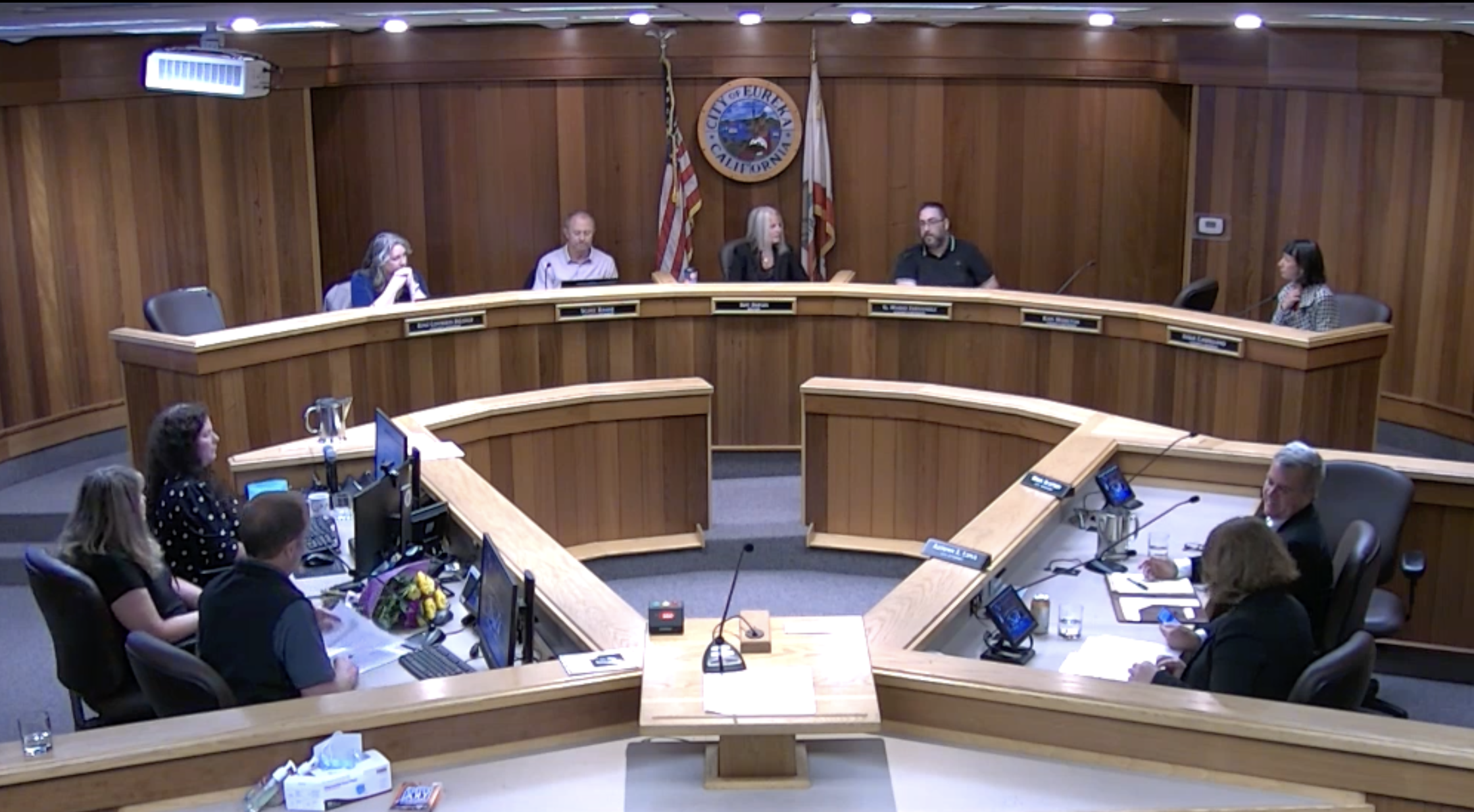
Screenshot of Tuesday’s Eureka Council meeting.
###
The Eureka City Council took its second look at the draft Waterfront Eureka Plan during Tuesday’s regular meeting, a plan that would revamp the heart of the city.
The project area covers all three “districts” that have been defined by the city — the “Old Town District,” the “Library District” and the “Commercial Bayfront District.” Similar to Arcata’s Gateway Area Plan, the Waterfront Eureka Plan aims to streamline housing approvals and accelerate mixed-use development in the northern portion of Eureka, between Humboldt Bay and downtown.
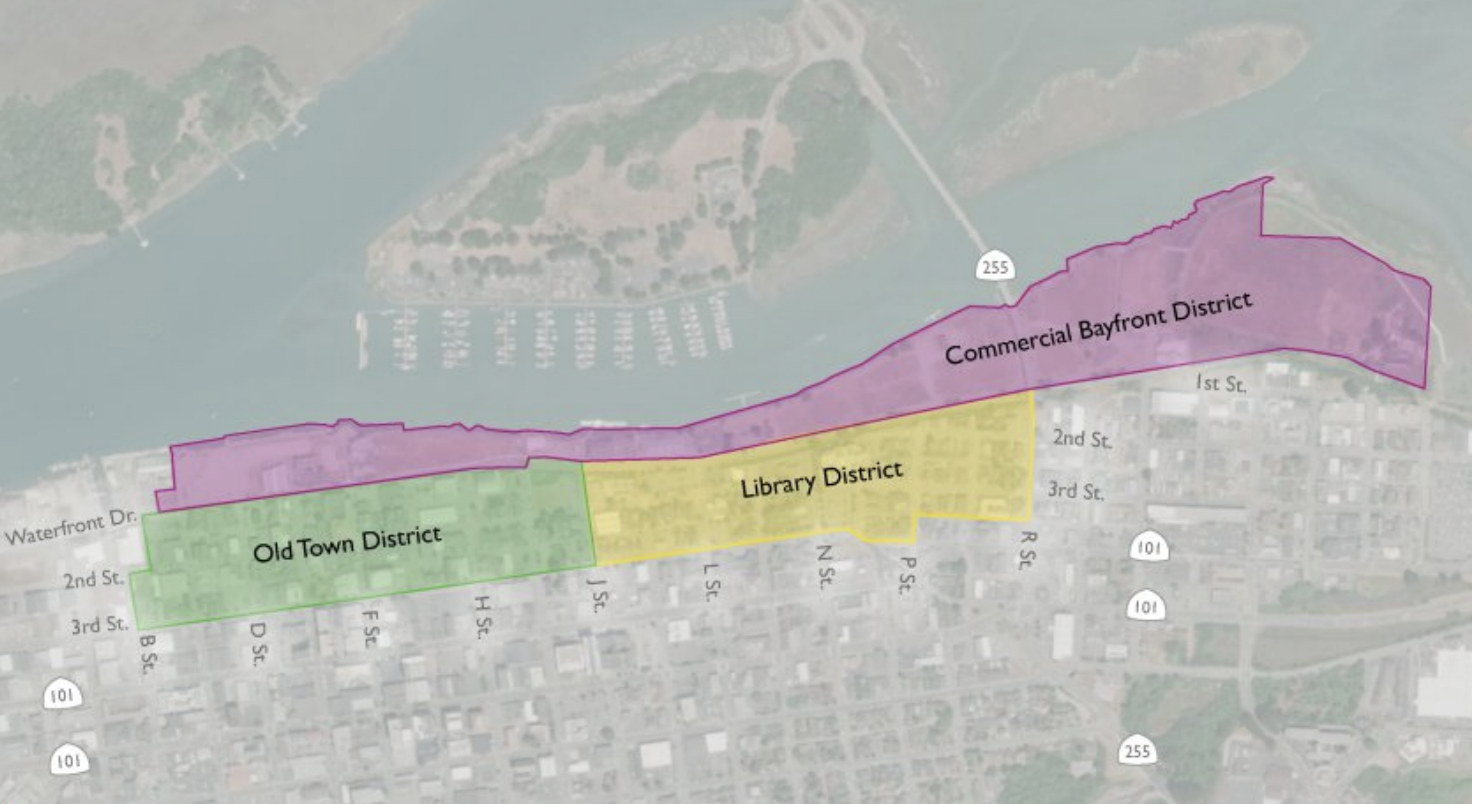
Image: City of Eureka
“The purpose of the plan … is to provide a roadmap for the development and redevelopment of vacant and underutilized sites and buildings along and near Eureka’s central waterfront,” Caitlin Castellano, a senior planner for the City of Eureka, explained during Tuesday’s meeting. “[It also] plans for at least 115 housing units to be built, which the plan contemplates happening by 2027.”
Unlike the city’s General Plan, the Waterfront Eureka Plan is a “specific plan” which combines a policy document with zoning regulations to “set realistic development expectations while also signaling the big picture of the plan and vision for a particular area,” according to the staff report.
The plan must adhere to the goals of Eureka’s 2040 General Plan and the Land Use Plan portion of the city’s Local Coastal Program (LCP). Castellano noted that the LCP update is still in progress but said the city will use the environmental analysis collected through the Waterfront Eureka Plan process to better inform the LCP update.
The city has hosted several public forums on the planning process and received hundreds of comments from community members on the subject. Something that has come up time and time again, Castellano said, is the importance of balanced development.
“People wanted to make sure that there was a balance between the new residences and the visitors to the area while maintaining existing resources for Eureka residents who live and visit the waterfront,” she said. The community’s feedback helped staff develop the guiding principles of the document, which can be found on page 54 of the draft document.
Turning to questions from the council, Councilmember Leslie Castellano asked if staff has worked with the private parking lot owners to better accommodate parking needs for both the private and public sectors. “I just, I look at all of that parking and I just think there could be potentially better ways of collaborating around how parking is used on private areas as well as public,” she said.
Senior Planner Castellano said she had not spoken directly to individual property owners but said staff has reached out to the Eureka Chamber of Commerce and Eureka Main Street on the subject. “They sent emails to all of their constituents to attend stakeholder conversations, which didn’t have a very good turnout.”
City Manager Miles Slattery said he has “definitely been contacted by private property owners about different parking lots,” some of whom wanted to sell the lots to the city while others wanted to offer them up for parking structures.
Councilmember G Mario Fernandez thanked staff for being aware of the potential displacement of existing residents as a result of gentrification. “I really do commend you for thinking that far forward and trying to mitigate the impact on the residents along those tracks,” he said. “What – if anything – has staff considered moving forward with that? What are the plans that are being considered, if any?”
Senior Planner Castellano said staff didn’t have any plans just yet.
Councilmember Scott Bauer said he really appreciated the document’s focus on walkability throughout the project area, adding that he “love[s] the idea of being able to stroll in on the street and not to worry about cars.”
“The thought of, you know, building housing and then having to travel to get groceries … it used to be that there were grocery stores close to your home,” he said. “The idea of trying to incorporate as much of that kind of living style is exciting.”
After a bit of additional discussion on the matter, the council agreed to accept the report but did not take any action on the item.
Staff will present the final Waterfront Eureka Plan and the associated environmental documents to the Eureka Planning Commission during a public hearing in September. If everything goes according to plan, the final document will be presented to the city council at a public hearing in October.
Those interested in commenting on the draft plan have about a week to do so. The public review period will close on Friday, Aug. 11. Click here to access the comment form.
Parking Fees = Parking Improvements
The council also approved a proposal to change city code to allow for the implementation of pay-to-park parking in four city-owned lots to “better manage the city’s existing parking resources” and “improve utilization and access to parking” throughout Eureka’s Old Town and Downtown districts.
The new pay-to-park lots are located at:
- the southwest side of 3rd and E streets (by the Sea Grill)
- the northeast side of 3rd and E streets (by The Madrone Brick Fire Pizza and Taphouse)
- the southeast side of 1st and E streets (behind Los Bagels) and
- the southeast side of 2nd and H streets (sorta near Smug’s Pizza).
The parking fees – $0.50 per hour – will fund several improvements throughout Old Town and Downtown Eureka, including parking lot wayfinding signage, website updates and outreach of existing parking resources and long-term upgrades to the parking lots, such as striping/resurfacing/lighting improvements and the creation of a parking lot shuttle program, according to the staff report.
A silver lining: The city will increase the existing parking time limit zones from two hours to four hours — a small but valuable consolation, especially for folks working in Old Town and Downtown.
Councilmember Fernandez asked if staff would be willing to allow for free parking on Saturdays, as it does currently. Public Works Director Brian Gerving stood by staff’s recommendation to only allow for free parking on Sundays and certain holidays.
Councilmember Castellano asked if staff had any plans for additional funds collected from the lots after the aforementioned improvements are taken care of.
“There definitely will be projects that can take up any of the revenue that the parking program can generate for the foreseeable future,” Gerving said. “In the event that we run out of projects – which I can’t forecast at this point – then, you know, we could consider doing something different with those funds.”
Gerving added that, if approved, the parking fees would go into effect on Sept. 1. “That’s if we can get the infrastructure installed by then,” he added.
Councilmember Bauer made a motion to adopt staff’s recommendation. Castellano offered a second.
Fernandez returned to the issue of free parking on Saturdays and asked if his fellow council members would be willing to amend the motion. “Is there anybody else amenable to leaving Saturdays as they are?” he asked. “Because I find it difficult to vote for that without Saturday’s remaining free parking.”
Gerving noted that Saturdays are currently enforced because that’s what the signage has reflected in most cases. “It’s just the municipal code language that was incorrect and inconsistent with what that signage said,” he added.
Fernandez opted to “leave it at that” and the motion passed in a 3-1 vote with Fernandez dissenting and Councilmember Kati Moulton absent.
###
Other notable bits from Tuesday’s meeting:
- The council also approved a request to declare a little slice of city-owned land at Fifth Street and Myrtle Avenue as surplus.
- The council also received a report regarding privacy concerns surroundings accessory dwelling units (ADUs) in neighborhoods. However, Cristin Kenyon, the city planner presenting the report, was feeling under the weather and the council opted to revisit the subject at a future date.
- The council also received a presentation from Fogbreak Justice LLC, regarding the city’s workplace diversity, equity and inclusion efforts. The council accepted the report but did not take any action on the matter.
After Suffering Water Damage Caused by the Earthquake, Fortuna Theatre is Still Closed and it Looks Like it Won’t Be Reopening Any Time Soon
Stephanie McGeary / Wednesday, Aug. 2, 2023 @ 4:45 p.m. / News
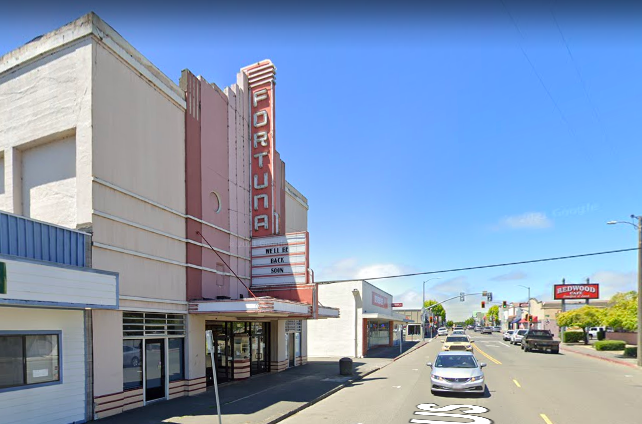
The Fortuna Theatre at 1241 Main St. in Fortuna | Screenshot from Google Earth
###
Fortuna residents and visitors are likely aware that the Fortuna Theatre has been closed since late last year and, with this being “Barbenheimer” season, you’ve probably been wondering lately if and when the theater will reopen, hoping that you might get a chance to view the summer’s hottest movies on Humboldt’s largest screen.
But it looks like eager Fortuna moviegoers will have to continue to wait for a while. David Corkill, owner of Cinema West, the Petaluma-based company that owns Fortuna Theatre, said that the company is still unsure of how soon the theater will be able to reopen after it suffered some water damage that will probably be very expensive to repair.
The closure happened after the area was rocked by a 6.4 earthquake last December, which broke a fire sprinkler line inside of the theater, causing significant water damage to the ceiling and drywall in the building. Corkill said that the cost of repairs has still not been determined, but he plans to be at the theater sometime in the next couple of weeks to have the damage fully evaluated and get an estimate for the repairs.
You’re probably wondering, but why has it taken the owner so long to repair the building? Well, because the theater was already not making any money in recent years, reopening it has not exactly been a high priority for Cinema West, which operates 175 movie screens in 18 different locations. Corkill said that he’s still not sure if it will be worth it to invest the money for repairs and reopen the theater during a time when attendance has been low.
“We need to make sure that the theater will be able to support itself,” Corkill told the Outpost in a phone interview Wednesday. “It’s just not quite performing like it used to.”
The Fortuna Theatre was built in 1938 and, like most old theaters, originally held only one large screen. Cinema West purchased the theater in 1999, restoring the aging building and converting the upstairs balcony into two additional screening auditoriums. Eventually, Cinema West bought two adjoined properties and added three more screen rooms, making Fortuna Theater into a large, six-screen movie theater. One of the screens is 50 feet wide, Corkill said, making it the largest movie screen in Humboldt County.
For a while after the remodel the theater did pretty well, Corkill said, but after a few years business started to gradually decline. When COVID hit in early 2020, the theater, like most businesses, had to close for a while and lost a lot of revenue. Since reopening after the pandemic closure, Corkill said, attendance has just not returned to what it was pre-COVID and the theater has not been profitable for Cinema West. When the earthquake-related damage happened, it seemed like a good time to close the theater for a while, and take some time to decide what to do about the repairs and about the business in general.
Of course, Fortuna city officials would like to see the theater reopen as soon as possible and Fortuna City Manager Merritt Perry said that he has talked with Corkill and has tried to offer as much help from the City as he can, including helping find a local company to do the repairs and even offering a low-interest loan to help cover the costs.
But Corkill said that he doesn’t need to borrow money to cover the repairs; the issue is just whether or not it is worth it yet to reopen a theater that was not turning a profit, especially after Cinema West has already spent so much money and time on repairs to the building. Corkill added that he “really would like to be able to reopen for the community,” and that, despite the unprofitability, the theater would still be open and limping along were it not for the added issue of the water damage.
When asked if he had considered just selling the theater, Corkill said that he has not put the property on the market yet, but he would “entertain an offer” if someone were interested in buying it. If that someone is you, then you can reach out to Corkill via the Cinema West office at (707) 762-0990.
Perry also said he would love to see the space sold to someone local and he hopes that the theater, which has been a part of the community for so long, will be able to open again soon.
“It’s one of the few things that young people have to do in town,” Perry said. “Without a theater, we’re more of a bedroom community. It adds to the quality of life and makes [Fortuna] a better place to live.”
U.S. News & World Report Names St. Joseph a ‘Best Regional Hospital,’ Though the Full Report Card is Mixed
Ryan Burns / Wednesday, Aug. 2, 2023 @ 3:56 p.m. / Health Care
###
U.S. News and World Report has just released its annual “Best Hospitals” report, for which data journalists analyzed “millions of hospital visits and admissions” to assess the quality of care across a range of specialties, procedures and conditions.
In a press release (published in full below), Providence Northern California Communications Manager Christian Hill proudly announces that Eureka’s Providence St. Joseph Hospital landed on the publication’s list of Best Regional Hospitals.
Indeed, U.S. News and World Report evaluated 420 hospitals in the state, with 68 of them meeting the publication’s “high standards” to be ranked among the Best Hospitals in California. St. Joe’s made the cut, just barely, coming in at No. 68.
It did so by being rated “high performing” in seven adult procedures or conditions. Namely, these:
- colon cancer surgery
- heart attack
- heart failure
- kidney failure
- hip fracture
- chronic obstructive pulmonary disorder (COPD)
- pneumonia
St. Joe’s performed less well in other categories — notably, prostate cancer surgery and heart bypass surgery, both of which earned “below average” marks, as well as patient experience, for which St. Joe’s scored just two stars out of a possible five.
The patient experience rankings are broken into 10 categories, and St. Joe’s only managed to score above two stars in one of them: “satisfaction with quality of discharge information.” Eight categories earned two-star ratings while one (“satisfaction with noise volume”) earned a single star.
You can click here to access the full scorecard for St. Joe’s, which includes profiles for individual doctors and report cards for the hospital’s performance across more than two dozen procedures or conditions.
None of the eight other hospitals in the North Coast region made the Best Regional Hospitals list, and only one (Adventist Health Howard Memorial in Willits) ranked as “high performing” on any procedures or conditions.
Mad River Hospital in Arcata ranked higher than St. Joe’s in patient experience (four stars out of five) but also ranked below average for treating heart failure, diabetes and stroke.
Tiny little Jerold Phelps Community Hospital in Garberville was only rated on a single condition, scoring below average for treating pneumonia. The report also notes that nurse staffing is “very low.”
Below is the full press release from Providence:
Following a year of delivering outstanding patient care, Providence St. Joseph Hospital in Eureka is proud to announce that it has been named by U.S. News & World Report to its 2023-2024 Best Hospitals. The rankings assist patients and their doctors in choosing the right hospital for them. Overall, U.S. News ranked St. Joseph Hospital #68 in the state of California out of 420 hospitals evaluated.
St. Joseph Hospital was named as a Best Regional Hospital on the North Coast in the 2023-2024 “Best Hospital” Rankings. U.S. News evaluated more than 4,500 hospitals across 15 specialties and 21 procedures and conditions; only 12% of evaluated hospitals earned a Best Hospitals ranking. Hospitals awarded a “Best” designation excelled at factors such as clinical outcomes, level of nursing care and patient experience.
“Providence St. Joseph Hospital is committed to providing the highest level of care to our friends, families and neighbors in Humboldt County and ensuring every patient has access to leading-edge procedures and research-backed treatments,” Interim Chief Executive and Chief Medical Officer Ranjit Hundal, MD, said. “I want to congratulate our physicians, nurses and staff members who made this achievement possible by providing exceptional outcomes for our community.”
In addition to the Best Regional Hospital recognition, St. Joseph Hospital received acclaim as a High Performing hospital in seven common procedures or conditions – colon cancer surgery, chronic obstructive pulmonary disease (COPD), heart attack, heart failure, hip fracture, kidney disease, and pneumonia. This is the highest distinction a hospital can earn for U.S. News’ Best Hospitals Procedures & Conditions ratings.
The annual Procedures & Conditions ratings are designed to assist patients and their doctors in making informed decisions about where to receive care for challenging health conditions or elective procedures.
“For 34 years, U.S. News has provided data-informed rankings to help patients and their doctors find the best hospital to treat their illness or condition,” said Ben Harder, chief of health analysis and managing editor at U.S. News.
###
For more information on the U.S. News Best Hospitals, explore Facebook, Twitter and Instagram using #BestHospitals.
Convicted Felon Arrested With Fentanyl and a Folding Firearm the Size and Shape of a Credit Card, Humboldt County Drug Task Force Says
LoCO Staff / Wednesday, Aug. 2, 2023 @ 1:43 p.m. / Crime
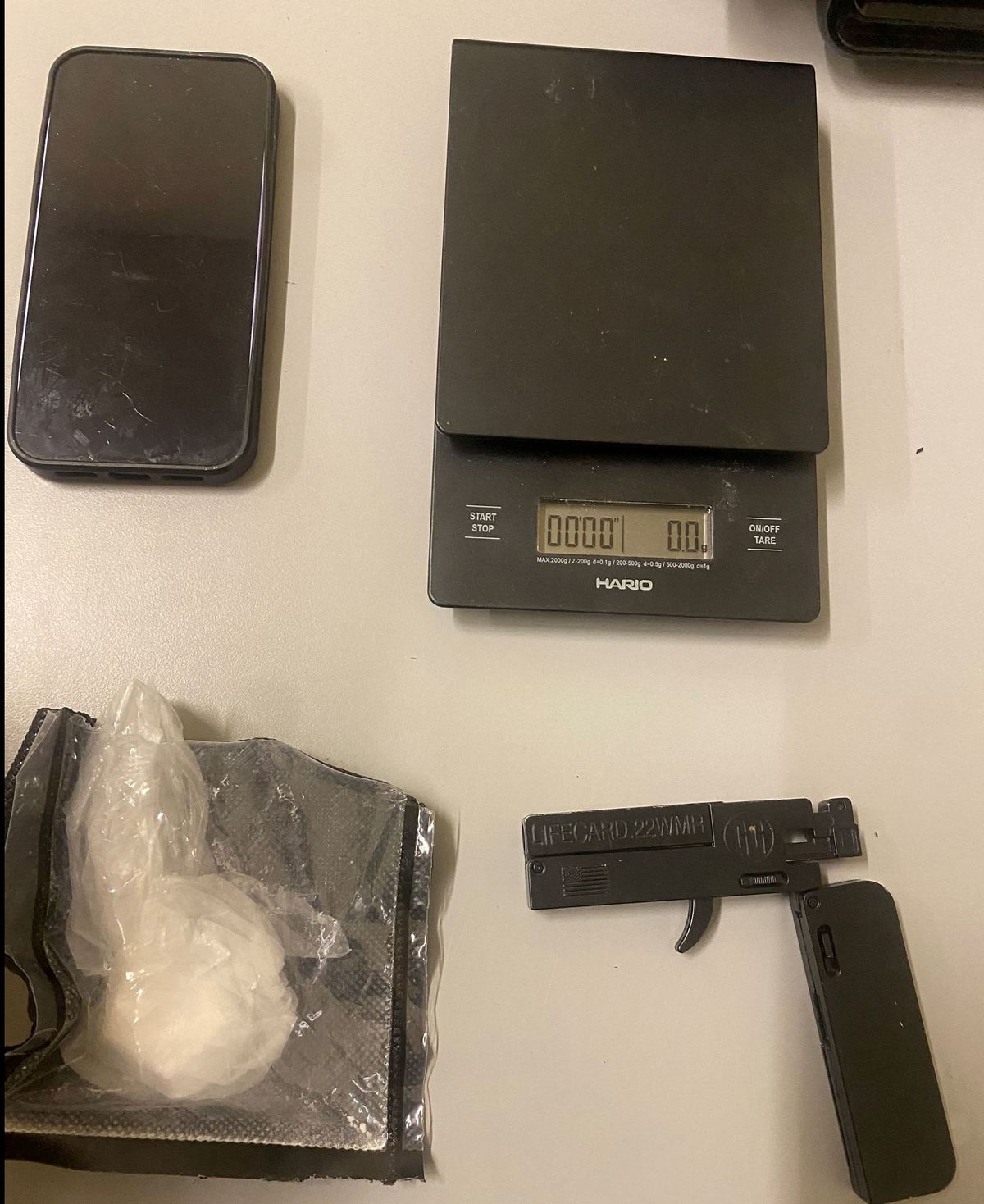
Alleged fentanyl and a non-serialized “Lifecard” .22 magnum handgun. | Photos via HCDTF.
###
PREVIOUSLY: Drug Task Force Arrests Three at Fortuna Motel
###
Press release from the Humboldt County Drug Task Force:

Lovfald
On August 1st, 2023, Humboldt County Drug Task Force Agents received information that Cheyenne Lea Silva Lovfald (age 29) had purchased narcotics and a firearm outside of Humboldt County, and was currently traveling back to the Eureka area. Silva Lovfald is a convicted felon and is also on felony probation with a search clause for narcotic related offenses.
HCDTF Agents set up in the area of a hotel located in the 200 block of 5th Street in Eureka, where Silva Lovfald was suspected to be staying. While in the area, Agents watched Silva Lovfald arrive in a vehicle and park in the parking lot of the hotel. Agents moved in and detained Silva Lovfald without incident.
Agents searched Silva Lovfald’s person and vehicle. Agents located approximately 1 ounce of fentanyl, a digital scale, and a non-serialized “Lifecard” .22 magnum handgun. The firearm was the size and shape of a credit card that unfolded into a functional single shot handgun.
Silva Lovfald was placed under arrest and transported to the Humboldt County correctional facility where she was booked for the following charges:
- 11351 HS: Possession of narcotics for the purpose of sales
- 11352 HS: Trafficking narcotics for the purpose of sales
- 24710 PC: Possession of a “wallet gun”
- 29800(a)(1) PC: Felon in possession of a firearm
- 1203.2 PC: Violation of probation
Anyone with information related to this investigation or other narcotics related crimes are encouraged to call the Humboldt County Drug Task Force at 707-267-9976.

###
A note from the Outpost: If you’ve never seen one of these “Lifecard” weapons, here’s a short video of one:


Don’t Call It ‘Toilet to Tap’ — California Plans to Turn Sewage Into Drinking Water
Rachel Becker / Wednesday, Aug. 2, 2023 @ 1:23 p.m. / Sacramento

In summary
Waste would undergo extensive treatment and testing before it’s piped directly to taps, providing a new, costly but renewable water supply. The state’s new draft rules are more than a decade in the making.
Californians could drink highly purified sewage water that is piped directly into drinking water supplies for the first time under proposed rules unveiled by state water officials.
The drought-prone state has turned to recycled water for more than 60 years to bolster its scarce supplies, but the current regulations require it to first make a pit stop in a reservoir or an aquifer before it can flow to taps.
The new rules, mandated by state law, would require extensive treatment and monitoring before wastewater can be piped to taps or mingled with raw water upstream of a drinking water treatment plant.
“Toilet-to-tap” this is not.
Between flush and faucet, a slew of steps are designed to remove chemicals and pathogens that remain in sewage after it has already undergone traditional primary, secondary and sometimes tertiary treatment.
It is bubbled with ozone, chewed by bacteria, filtered through activated carbon, pushed at high pressures through reverse osmosis membranes multiple times, cleansed with an oxidizer like hydrogen peroxide and beamed with high-intensity UV light. Valuable minerals, such as calcium, that were filtered out are restored. And then, finally, the wastewater is subjected to the regular treatment that all drinking water currently undergoes.
“Quite honestly, it’ll be the cleanest drinking water around,” said Darrin Polhemus, deputy director of the state’s Division of Drinking Water.
The 62 pages of proposed rules, more than a decade in the making, are not triggering much, if any, debate among health or water experts. A panel of engineering and water quality scientists deemed an earlier version of the regulations protective of public health, although they raised concerns that the treatment process would be energy-intensive.
“I would have no hesitation drinking this water my whole life,” said Daniel McCurry, an assistant professor of civil and environmental engineering at the University of Southern California.
This water is expected to be more expensive than imported water, but also provide a more renewable and reliable supply for California as climate change continues. Most treated sewage — about 400 million gallons a day in Los Angeles County alone — is released into rivers, streams and the deep ocean.
 Luis Canela, a water quality technician, injects chemicals to chlorinate water at the Pure Water Southern California Demonstration Plant in Carson. Photo by Lauren Justice for CalMatters
The draft rules, released on July 21st, still face a gauntlet of public comment, a hearing and peer review by another panel of experts before being finalized. The State Water Resources Control Board is required by law to vote on them by the end of December, though they can extend the deadline if necessary. They would likely go into effect next April and it will take many years to reach people’s taps.
Heather Collins, water treatment manager for the Metropolitan Water District of Southern California, said the regulations will give the district more certainty about how to design a massive, multi-billion dollar water recycling project with the Los Angeles County Sanitation Districts. The district imports water that is provided to 19 million Southern Californians.
The joint effort, called Pure Water Southern California, has already received $80 million from the state. The first phase of the project, which could be completed by 2032, is expected to produce about 115 million gallons of recycled water a day, enough for 385,000 Southern California households.
Most is planned to go towards recharging local water agencies’ groundwater stores, but about 20% could be added to drinking water supplies upstream of Metropolitan’s existing treatment plant for imported water.
“We’re excited,” Collins said. “It helps better inform us on what our project needs to include, so that we can have a climate-resistant supply for our agencies in Southern California.”
The new rules come as endless cycles of drought leave California’s water suppliers scrabbling for new sources of water, like purified sewage. In 2021, Californians used about 732,000 acre feet of recycled water, equivalent to the amount used by roughly 2.6 million households, though much of it goes to non-drinking purposes, like irrigating landscapes, golf courses and crops.
Last year, Gov. Gavin Newsom called for increasing recycled water use in California roughly 9% by 2030 and more than doubling it by 2040.
“Water recycling is about finding new water, not just accepting the scarcity mindset — being more resourceful in terms of our approach,” Newsom said last May in front of Metropolitan’s Pure Water Southern California demonstration plant.
Some recycled water is already used to refill underground stores that provide drinking water, a process called indirect potable reuse, employed beginning in the 1960s in Los Angeles and Orange counties. But a water agency must have a clean and convenient place to store the expensive, highly-purified water. “You don’t want to inject this recycled wastewater that you’ve spent all this effort cleaning into a dirty, polluted aquifer just to ruin it again,” McCurry said.
To expand these uses, state lawmakers in 2010 tasked the water board with investigating the possibility of adding recycled water either directly into a public water system or just upstream of a water treatment plant. In 2017, they set a deadline to develop the regulations by the end of 2023.
California won’t be the first; Colorado already has regulations and the nation’s first direct potable reuse plant was built in Texas in 2013. Florida and Arizona have rules in the works.
California’s statewide rules, however, are expected to be the most stringent, said Andrew Salveson, water reuse chief technologist at Carollo Engineers, an environmental engineering consulting firm that specializes in water treatment.
“They are more conservative than anywhere else,” he said. “And I’m not being critical. In the state of California, because we’re in the early days of (direct potable reuse) implementation, they’re taking measured and conservative steps.”
Removing viruses and chemicals
The water that flushes down toilets, whirls down sinks, runs from industrial facilities and flows off agricultural fields is teeming with viruses, parasites and other pathogens that can make people sick. Chemicals also contaminate this sewage, everything from industrial perfluorinated “forever chemicals” to drugs excreted in urine. Bypassing groundwater stores or reservoirs to funnel purified sewage directly into pipes means that there’s less room for error.
The new regulations would ramp up restrictions on pathogens, calling for scrubbing away more than 99.9999% of diarrhea-causing viruses and certain parasites. Also a series of treatments are designed to break down chemical contaminants like anti-seizure drugs, pain relievers, antidepressants and other pharmaceuticals. Medications can bypass traditional sewage treatment so they are found in low concentrations in recycled sewage and groundwater.
 Water makes its way to the first step of the water purification process, membrane bioreactors, at the demonstration plant in Carson. Photo by Lauren Justice for CalMatters
The added technologies are good at washing away pharmaceuticals, McCurry said, so having them “back-to-back introduces a ton of redundancy,” he said. “Any pharmaceutical you could think of, if you tried to measure it in the product water of one of these plants, is going to be below the detection limit.”
The new rules call for extensive monitoring to ensure the treatment is working. Some harmful chemicals, such as lead and nitrates, which are dangerous to babies and young children, will be tested for weekly; others, monthly. And water providers must also monitor the sewage itself before it even reaches treatment for any chemical spikes that could indicate illegal dumping or spills.
“We think we’ve got the chemical classes covered in the treatment processes, so that we’re removing materials that we don’t even know are there,” the water board’s Polhemus said.
Jennifer West, managing director of WateReuse California, a trade association for water recycling, said she was happy to finally see California’s regulations, though she hopes the state will build in more flexibility for water providers to alter the suite of treatments as technologies change.
Richard Gersberg, San Diego State University professor emeritus of environmental health, said he supports using highly treated waste for drinking water. But he suggests that the state fund long-term studies comparing health effects in people who drink it to those whose drinking water comes from another source, such as rivers, “which might end up being worse. Probably is,” he said.
Given the vast and changing cocktail of chemicals constantly in use, “we don’t know what we don’t know,” Gersberg said. “If this becomes huge in California, and it will, I believe … we should at least spend a little money.”
Who will be first?
All this treatment and monitoring is likely to be pricey, which is why Polhemus expects to see it largely limited to large urban areas that produce a lot of wastewater, such as Los Angeles County. The Metropolitan Water District’s $3.4 billion estimate for building the project dates back to 2018, and has likely increased since then, according to spokesperson Rebecca Kimitch.
For small and medium communities, Polhemus said, “it doesn’t pencil in a small scale type of arrangement.”
The Orange County Water District, which has long been a leader in purifying recycled water, has concluded that piping it directly to customers doesn’t pencil out for them, either, because they’ve already invested so heavily in refilling their carefully tended aquifer.
It would “require adding more treatment processes and increasing operating expenses,” board president Cathy Green said in a statement. “Local water agencies are currently well-equipped to continue to supply drinking water to customers in our service area at a low cost using the Orange County Groundwater Basin.”
For other regions like Silicon Valley, though, the costs may be worth it as climate change continues to shrink state supplies.
“At this point, it’s more expensive than water we might import during a drought. But who knows what will happen in the future,” said Kirsten Struve, assistant officer in the water supply division at the Santa Clara Valley Water District, which serves approximately 2 million people.
“That’s why we need to get prepared.”
 The Pure Water Southern California Demonstration Plant showcases technology that may provide drinking water to Southern Californians by 2032. Photo by Lauren Justice for CalMatters
The Santa Clara water agency, known as Valley Water, is planning a $1.2 billion project in Palo Alto to produce about 10 million gallons a day of water for groundwater recharge, but Struve said she hopes the plant also will be used for direct potable reuse in the future.
The timing of the regulations has butted up against the realities of planning for Monterey One Water on the Monterey Peninsula as well. The utility has been injecting purified wastewater into the seaside aquifer for three years, producing about a third of the local supply, said General Manager Paul Sciuto. It is working on expanding the project by 2025, Sciuto said.
“I get that question of, ‘This water is so pure, why do you put it in the ground? Why can’t you just serve it?’ ” he said. “And I always fall back on, well, there’s no regulations that allow us to do that at this point.”
Now that the state is closer to finalizing them, he said, “there’s a point on the horizon to shoot for.”
###
CalMatters.org is a nonprofit, nonpartisan media venture explaining California policies and politics.
COP ACCESSORIES! Humboldt County Sheriff’s Office Announces It is Offering More Fashion Options to Its Deputies
LoCO Staff / Wednesday, Aug. 2, 2023 @ 7:46 a.m. / Our Culture

A message from the Humboldt County Sheriff’s Office:
Well, it’s official… the cowboy hats are here to stay! Our deputies now have the option to wear cowboy hats as part of their daily uniform.
Next time you see us, make sure to give us a howdy!


