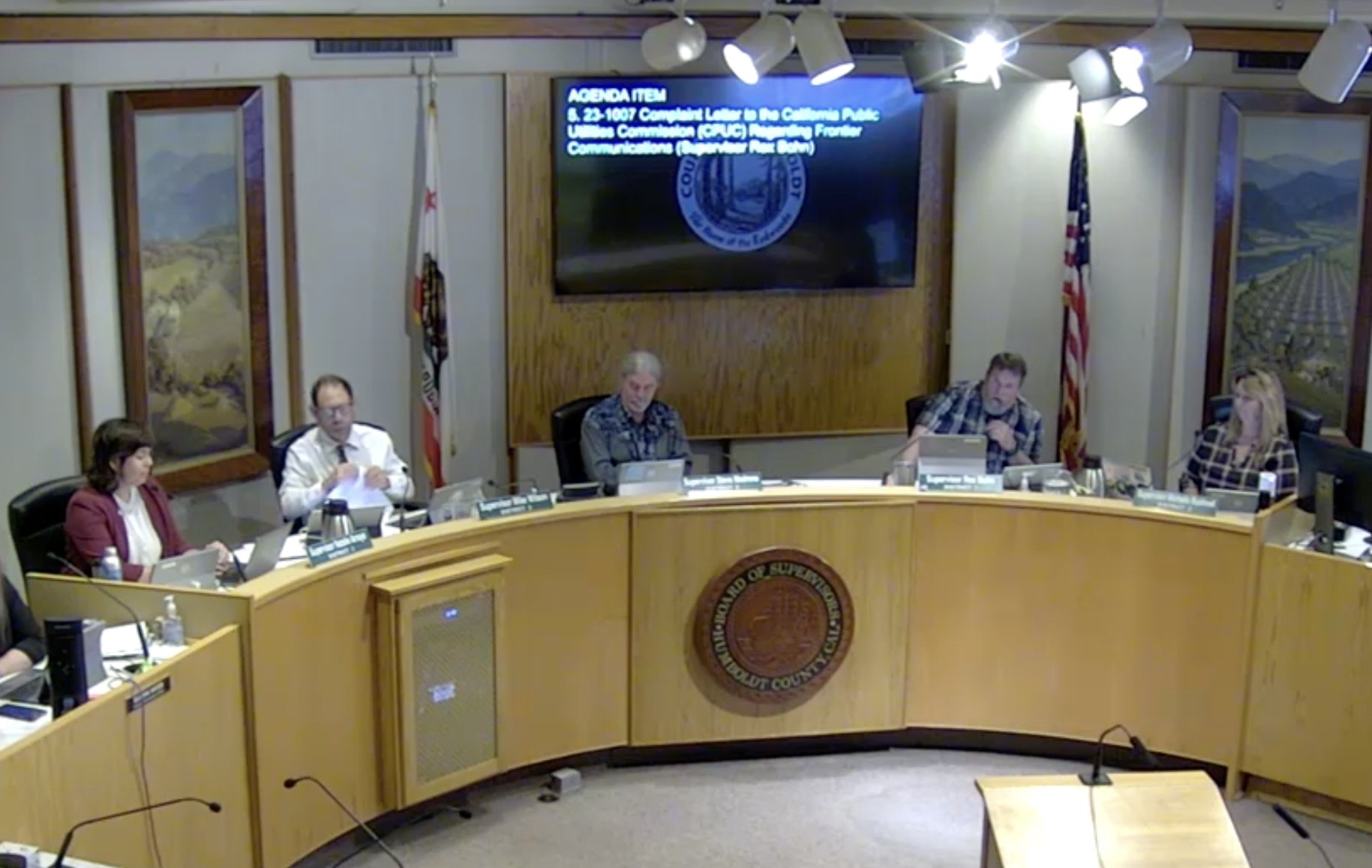
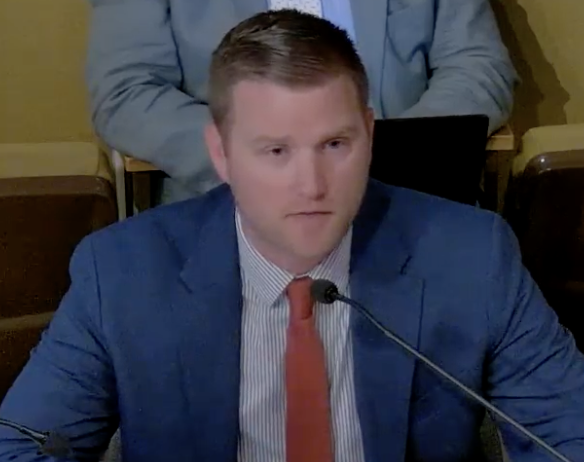
Screenshot of Tuesday’s Humboldt County Board of Supervisors meeting.
###
The Humboldt County Board of Supervisors on Tuesday gave its final stamp of approval to a $1 million funding request to pay for emergency repairs to the earthquake-damaged grandstands at the Ferndale Fairgrounds.
The board authorized the initial funding request during a special meeting at the end of last month and directed staff to return to the board if additional funds were required. Despite a bit of confusion on the matter, yesterday’s agenda item was not a request for additional funding but a bookkeeping item to document the increase in expenditures to the Department of Public Works and approve a construction agreement with Aquatic Designing, Inc. and Mobley Construction.
Speaking during Tuesday’s meeting, County Administrative Officer (CAO) Elishia Hayes reminded the board that the funds would come from the 2020 Finance Plan and would, essentially, serve as a loan from the county to the county.
Elishia Hayes
“These are dollars that are grown from ourselves,” Hayes said. “These dollars are pretty strictly available for county infrastructure repair and replacement needs. … This is the last remaining availability in the Finance Plan, and there are no other foreseeable needs immediately on the table at this point in time where these funds could be utilized.”
Hayes added that she is “very cognizant [of] the current budget situation” and emphasized that the funds could not be used to fund county road improvements, “retain staffing or to reduce the General Fund structural deficit.”
“They do – very explicitly at this point in time – have to be used for infrastructure needs,” she said. “I just wanted to make that clear because I think there’s some confusion in the community on the purpose of these funds.”
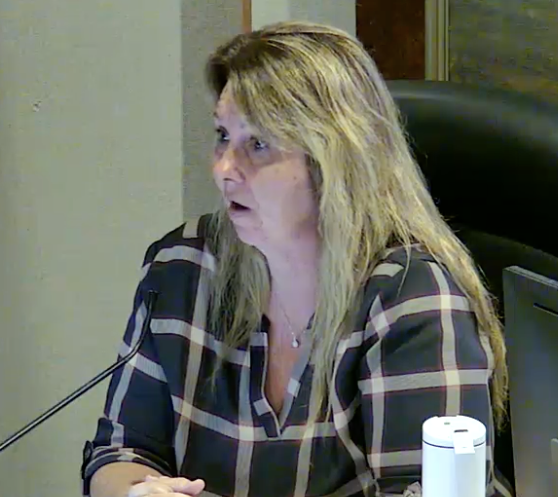
Fourth District Supervisor Natalie Arroyo noted that the supplemental budget request attached to the agenda totaled $2 million and asked if staff could offer an explanation or correct the item. Hayes explained that the document accounts for $1 million in the revenue line and another million in the expenditure line, “so it nets to $1 million in overall increases in the budget but the overall transaction totals to $2 million.”
“Rest assured, it is a $1 million expenditure from the 2020 Finance Plan,” Hayes added. “Revenue from the 2020 Finance Plan [is] offset by a $1 million expenditure in fixed assets.”
Third District Supervisor Mike Wilson, who was not present during the June 29 special meeting, asked if the Humboldt County Fair Association has done any private fundraising to raise money for repairs to the grandstands.
“I mean, if you think about when Food for People had their disaster occur at their facility, there was a lot of private fundraising around that,” Wilson said. “The reason I ask it in this in this context is also because … I heard that Supervisor Arroyo was really adamant [that] the $1 million [would] not go over … that budget amount [and] if there’s work being done to prepare for the possibility that there may be the need for private funds [in addition].”
From a government standpoint, Hayes said the Fair Association could seek potential support from the Headwaters Fund for potential support, but deferred the question to Jill Duffy, interim general manager of the Humboldt County Fair Association.
Jill Duffy
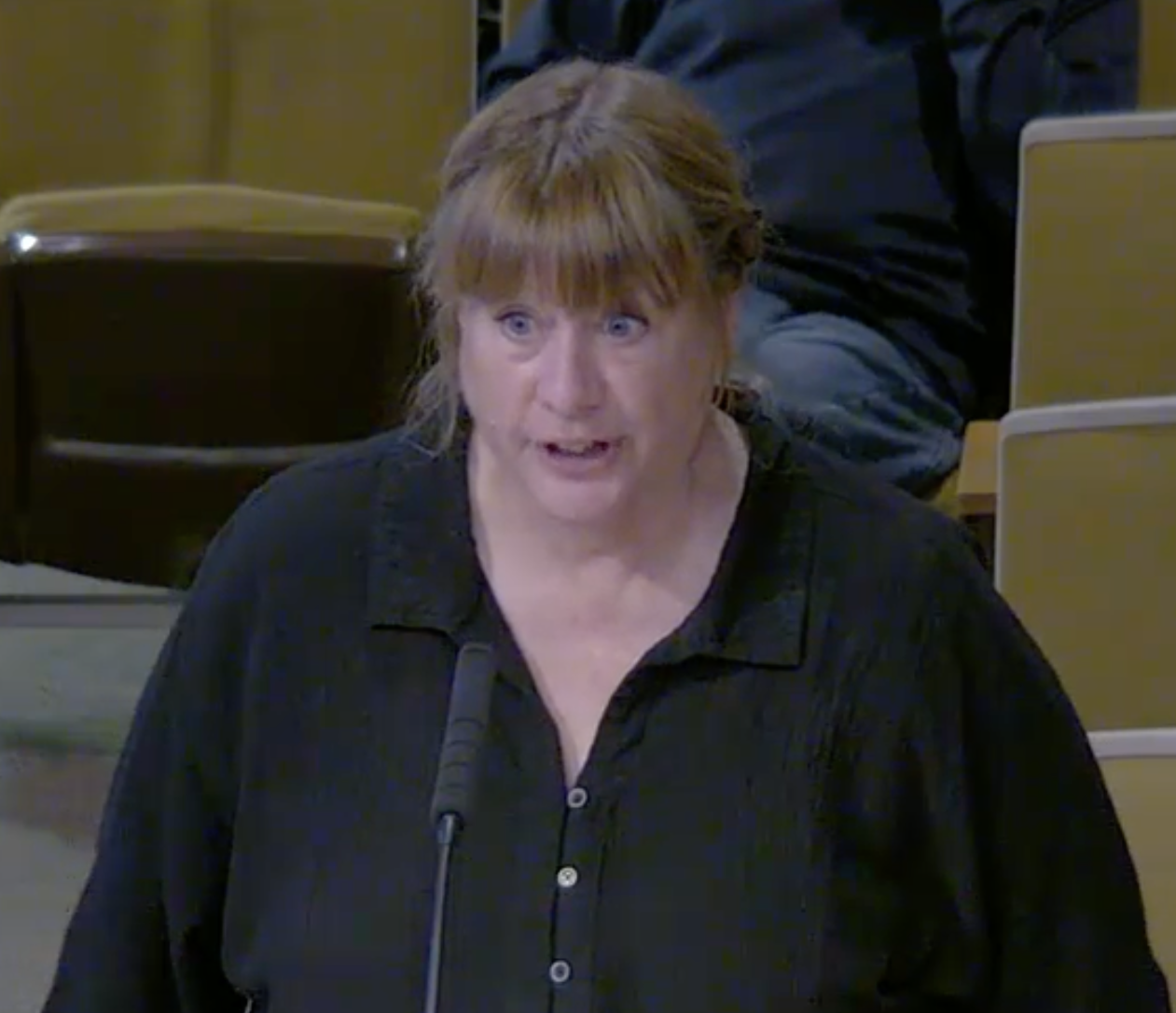
“The short answer is no,” Duffy said. “Does that mean it is not being thought about? Absolutely it’s been thought about, [but] this is the short-term fix. This isn’t the final project. We’re gonna have to [put] together a more comprehensive capital campaign for the purpose of making all of the upgrades to the facility, and that’s going to include ADA and other types of amenities. When that time comes, it’s not going to be a million-dollar fix – it’s going to be significantly more.”
Right now, Duffy said, the Fair Association is focused on getting everything in line for the fair, which opens on Aug. 17. “I’m just moving forward with a lot of contracts at the moment,” she said. “After we get through the fair – provided that the structure is stabilized [and] we’re able to utilize them – we’ll need to sit down with the CAO’s office … and we will have to work out what some form of a repayment structure is going to be.”
There’s a possibility that the California Office of Emergency Services (CalOES) will reimburse the county for some of the money spent on repairs to the grandstands because it was damaged during the Dec. 20 earthquake, but it’s not a guarantee. CalOES will not pay for deferred maintenance at the fairgrounds.
Speaking during public comment, fair board member Clint Duey thanked the Board of Supervisors for moving so quickly to address the repairs to the grandstands and reiterated his board’s commitment to “working to repay our portion over time.”
“I just want to express our commitment to continuing that relationship,” Duey said, referring to the memorandum of understanding (MOU) the board was poised to approve. “I completely agree with you [that] there is deferred maintenance that needs to be addressed on the fairgrounds, but we’re not here again because of deferred maintenance issues. We’re here right now because of a major earthquake that caused significant damage across the county into a county building that is, quite frankly, beyond our means to do on our own.”
Following public comment, Wilson asked for more consistency in communications between the county and the Fair Association moving forward.
“It seems like a lot of the times when we’re talking about the fairgrounds and the fair board’s issues, it’s always [an] emergency [or] some issue has popped up,” he said. “Although we may have a relationship – and some would say it’s good – it doesn’t seem to be consistent. … I want to make sure that whatever MOU is structured here really speaks to that. About our … fiscal relationship but also from an infrastructure perspective.”
Wilson added that he would like to see some “visioning” from the fair board surrounding diversity, equity and inclusion, noting that he has seen vendors flying confederate flags flying at the fair. “That is something we have to deal with,” he said.
Duffy acknowledged Wilson’s concerns and agreed that there are “a number of items to be addressed” surrounding fiscal sustainability and diversity. “It’s not for me to have that conversation, but for the two boards to have that,” she said. “The question that we’re here for today is to do the authorization of the funding, in addition to the contracts. That’s the important stuff that needs to move forward.”
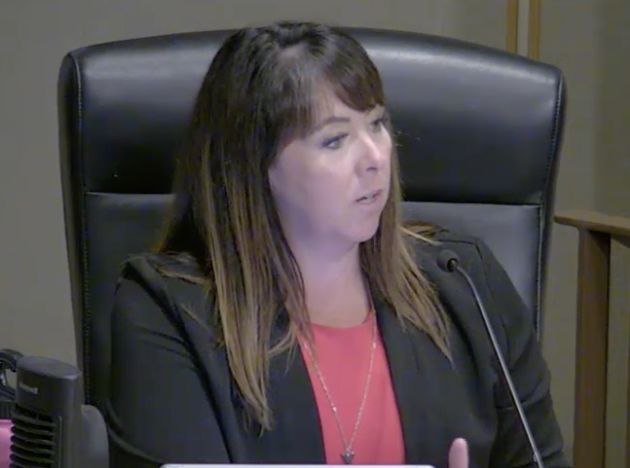
Second District Supervisor Michelle Bushnell made a motion to authorize both the construction contract and the MOU with the Fair Association. First District Supervisor Rex Bohn seconded, and emphasized that contractors have already broken ground on repairs to the grandstands. He reminded the board: “If we don’t vote for this today, we’re liable for all funds spent up into this point.”
“The big iron showed up today, it’s custom cut, so it’s not a return possibility,” he said. “If you remember, the motion that was made on [June 29] was that all structural fixes that we do now have to tie into the permanent fix. … So there’s so much more to this.”
The motion passed 5-0.
Expanding Telework Opportunities
The board also considered a request, brought forth by Bushnell, to revisit the county’s telework policy and potentially expand the availability of remote work to provide rural residents with better job opportunities.
Michelle Bushnell
“As we all know the rural areas – especially in my district [in] Southern Humboldt – [are] having an economic downturn and there are not a lot of jobs that are available down there for people who are wishing to stay in their communities,” Bushnell said. “Throughout our organization, there are a lot of jobs that aren’t necessarily forward-facing or public-facing, that could be very well served with teleworking. At this time, it is discretionary to the department heads, so my idea behind this is just to have a discussion and to ask the department heads’ input.”
The county’s existing telework program, adopted in February 2022, notes that “eligibility for teleworking is based on both the position and the employee and is subject to department approval” based on several guidelines surrounding productivity, dependability and responsibility. On top of that, teleworking agreements vary from regular/recurring to occasional/temporary, depending on the position and the individual employee.
Bushnell acknowledged that more teleworking opportunities often mean more work for department heads who would have to monitor their remote employees but asked if there would be any interest in revisiting the topic to accommodate people experiencing “transportation hardships” who live more than 20 miles from their place of work.
Human Resources Director Zachary O’Hanen noted that the county’s existing policy “doesn’t preclude us from doing this,” but reiterated the point that it is up to department heads.
Zachary O’Hanen
“I can speak about my department,” he said. “One of the considerations that I’ve made is when gas prices were $6 a gallon, I said, ‘Hey, does anyone want to telework?’ So we have a number of employees in HR who telework at least one or two days a week.”
But Bushnell was asking for specific language that would guarantee teleworking opportunities for an individual in the future. “You’re not going to get someone to apply for a job if some if the department head says, ‘Well, I can take that back anytime’ and there’s no policy that accommodates it [to] ensure that they won’t be living two hours away and all of a sudden the department head says, ‘No, you can’t tell work anymore because I’m done with that and I don’t want to do that in my department anymore,’” she said.
Hayes noted that “there’s not necessarily a surety” that a prospective employee would be a good fit for a given position or someone who would be an effective employee.
“In my mind, this is more of a policy statement from the board that you want to encourage that this be utilized in a more robust fashion for those folks who do reside in those areas,” she said. “I think that this could be a separate policy statement whereby you keep intact the current policy, which does allow for revocation of telework if an individual isn’t meeting certain performance standards. I do think that’s important that we still retain that ability for an employee who has proven over time to be somewhat ineffective in the telework situation.”
Bushnell said she knew of existing county employees that want to telework but their supervisors will not let them “and they have no criteria for saying no, they just don’t want to do it.”
Bohn felt as though the vast majority of department heads were willing to accommodate remote employees in certain situations but expressed concern for a drop-off in productivity.
“I just remember hearing one time that the [effiency rating of people in the office] work[ing] at home was like 65 percent,” he said. “I don’t want to put the department head on the spot but I think that’s what John Ford said.”
Several department heads offered their perspective on the matter. County Clerk-Recorder and Registrar of Voters Juan Pablo Cervantes said he would be open to additional teleworking opportunities in his office but said there are currently too many variables.
“We’re a small county and our departments are lean, we’re scrappy and we’re having to do more with fewer resources, and that means that the nature of the job can change,” he said. “I see positions in my departments that I’m wanting to move towards telework [but] the hesitancy is, what happens when the ground under me changes and I’m having to redeploy them in a different facet that would require them to come into the office? … I can’t fathom, you know, the next few months or the next year or two allowing me that kind of discretion, even though I’d like to find those opportunities.”
Public Works Director Tom Mattson said he supported the county’s current policy of allowing department heads to decide where teleworking is appropriate.
“I would hate to get into a situation where it becomes a right and it’s grieved over who can do this and which position can and cannot,” he said. “I have a lot of people that do telework that operate very effectively. I have some that don’t operate very effectively teleworking – myself included. … Financially, structure-wise it is good for the county and it is good for employees, but don’t let it become a right that can be grieved.”
Speaking specifically to his department, Planning and Building Director John Ford raised the quality control issue.
“We can have people answering phones remotely, we have done that,” he said. “We can have people answering emails remotely, we have done that. One of the things we experienced when we do that is a lack of quality control, whereby the people who are remotely saying things aren’t being overheard by a senior staff or by a manager and are giving wrong information. Then we have a problem with somebody coming back in and saying, ‘You told me I could do this,’ and they can’t.”
It’s not a one-size-fits-all issue, he added.
Connie Beck, director of the county Department of Health and Human Services (DHHS), said she agreed completely with Mattson, adding that some of her employees are effective teleworkers while others are not.
“There [are] some programs that we work mostly in the field and having the ability to telework when you’ve been out in the field all day is a nice gesture for people,” she said. “And then we have people that have actually moved to other areas and are still working for us. So, because our staffing levels are so critical, we need to have the ability to do that. We are actually even looking at having training available in different areas of the county because one of the things that we worry about is the support and training that happens with individuals when they’re first hired.”
Following a brief public comment period and a bit of additional discussion from the board, Arroyo made a motion to keep the teleworking policy as is for the time being and directed staff to look into ways to strengthen the policy in a way that could accommodate more teleworking opportunities. She also asked staff to return to the board in roughly six months with some data on county employees who are already working remotely. Bushnell seconded the action.
The motion passed in a unanimous 5-0 vote.
###
Other notable bits from the meeting:
The board unanimously approved a letter of complaint to the California Public Utilities Commission (CPUC) regarding recent local service interruptions with Frontier Communications. The letter was prompted by a recent four-and-a-half day outage that took out telecommunications – including 911 services – throughout the Mattole Valley. The letter calls upon the CPUC to address Frontier’s negligence. The item was approved in a unanimous 5-0 vote.
The board also reviewed and approved several grant awards from the Friends of the Eel River (FOER) Mitigation and Remediation Grant Fund to fund sediment reduction programs associated with roads that serve cannabis cultivation sites and/or are located in impacted watersheds. FOER Executive Director Alicia Hamann said the grant funds would further projects that will “improve water quality for our native fish” for years to come. The board approved the list of grant applications in a 5-0 vote. You can read more about those projects here.
The board also approved two amendments to the General Plan – a transitional and supportive housing zoning ordinance and an emergency shelter zoning ordinance – to conform to state laws surrounding housing projects and shelter. Both items were approved in 5-0 votes.
Press release from the Humboldt County Drug Task Force:
Coffman.
On
July 11th, 2023,
Humboldt County Drug Task Force Agents and Officers with the Fortuna
Police Department executed a probation search at the residence of
Brian Andrew Coffman (Age 37) located in 1000 block of P Street in
Fortuna. The HCDTF had received information that Coffman was
traveling out of the area to purchase large quantities of fentanyl
and then trafficking the fentanyl back to Humboldt County for the
purpose of sales. Coffman was currently on felony probation with a
search clause for narcotics sales and he had an active felony warrant
for his arrest for narcotics sales.
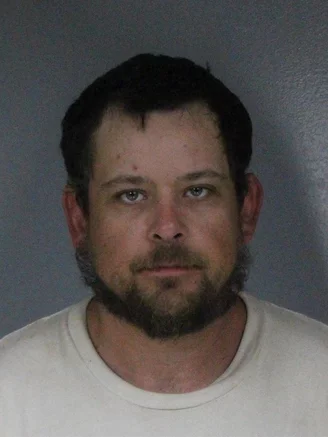
Welton.
Upon
arrival at Coffman’s residence, Agents located and detained Coffman
without incident. inside the residence. Agents began clearing the
residence and located two additional subjects attempting to hide
themselves inside of a bathroom. The two subjects were identified as
Bianca Welton (Age 37) and Kenneth Anderson-Rose (Age 36). Both
subjects were detained without incident. Anderson-Rose attempted to
provide a false name to HCDTF Agents but was immediately identified
due to Anderson-Rose having multiple contacts with the HCDTF. It was
later confirmed that Anderson-Rose had a felony warrant for his
arrest for narcotics sales. Welton had two felony warrants for her
arrest for vehicle theft and PRCS revocation.
Anderson-Rose.
While
clearing the scene, an adult female accompanied by two young children
were also located inside the residence. After further investigation
it was later determined that the adult female and two young children
were residing with Coffman. Child Welfare Services was contacted and
advised of the living conditions for the two young children.
Once
the scene was secure, HCDTF Agents searched the residence and located
3 ½ ounces of fentanyl, ¼ ounce of methamphetamine, digital scales,
packaging material, metal knuckles, a large cannister of pepper
spray, and approximately $8,000 in US Currency. All items were
collected as evidence and the US Currency was seized as asset
forfeiture.
Coffman
was arrested and transported to the Humboldt County Jail where he was
booked for the following charges:
11351
HS: Possession of narcotics for the purpose of sales
273a(a)
PC: Child endangerment
22810
PC: Felon in possession of a tear gas weapon
21810
PC:Possession of metal knuckles
Felony
Warrant
Anderson-Rose
was arrested and transported to the Humboldt County Jail where he was
booked for the following charges:
11351
HS: Possession of narcotics for the purpose of sales
148.9
PC: Providing a false identity to a peace officer
Felony
Warrant
Welton
was arrested and transported to the Humboldt County Jail where she
was booked for the following charges:
11351
HS: Possession of narcotics for the purpose of sales
Felony
Warrants
Anyone
with information related to this investigation or other narcotics
related crimes are encouraged to call the Humboldt County Drug Task
Force at 707-267-9976.
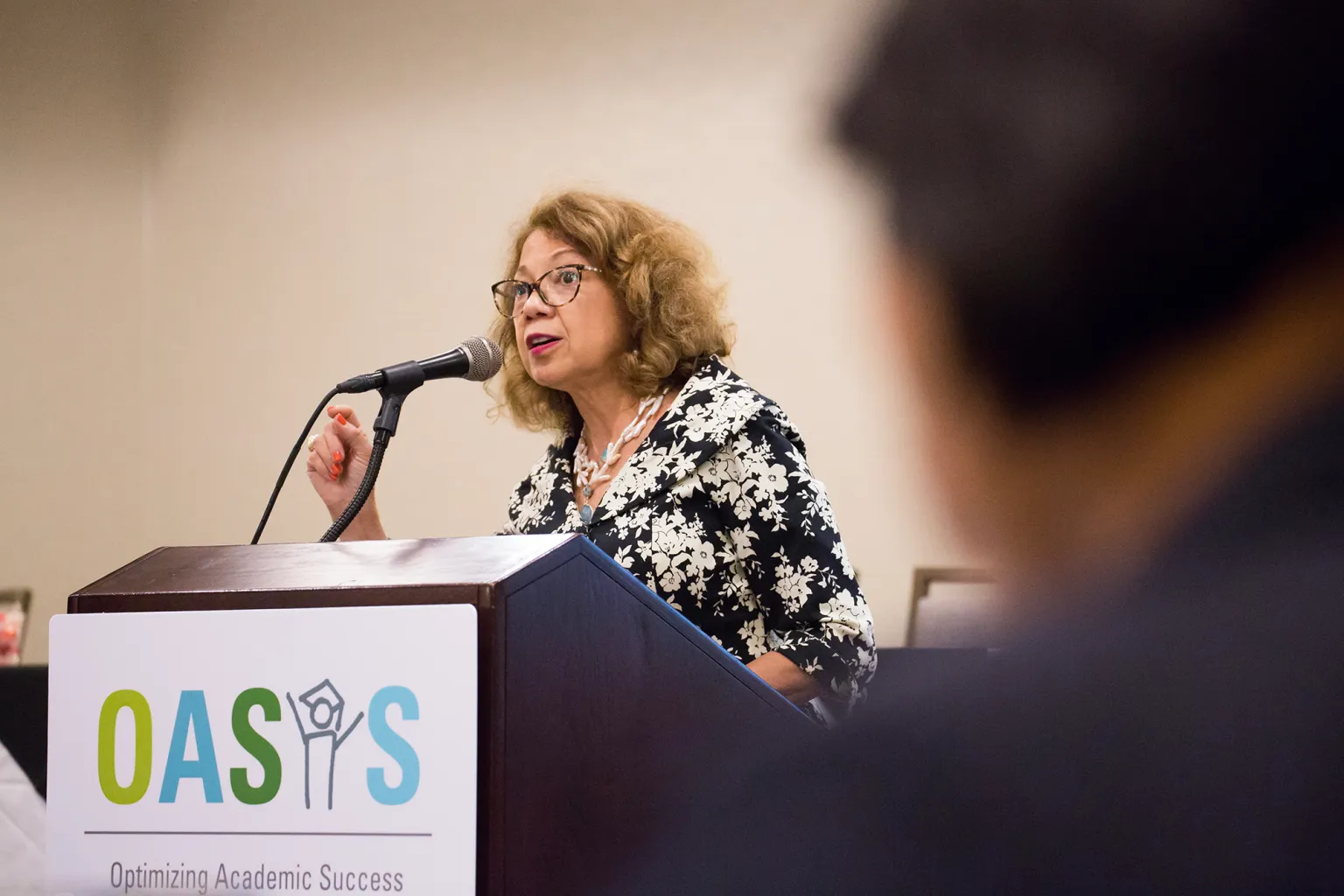
Fomer CSU Fullerton President Mildred García speaks during an event in 2016. Photo via California State University, Fullerton
A $1.5 billion budget shortfall, student outrage over planned annual 6% tuition hikes for at least five years, stubborn racial gaps in graduation rates and widespread distrust over how the university handles sexual assault claims.
García will oversee the nation’s largest four-year public university system and its nearly 500,000 students at a time when public confidence in the value of a bachelor’s degree is at a nadir.She’ll begin her post October 1.
One more challenge to overcome? Persuading more students to enroll at Cal State’s 23 campuses as the system is beset by an enrollment decline that’s also upending its finances.
“I am honored, humbled and excited for this opportunity to serve the nation’s largest four-year university system and work alongside its dedicated leaders, faculty and staff, and its talented and diverse students to further student achievement, close equity gaps and continue to drive California’s economic prosperity,” she said in a statement.García, who’ll become the first Latina chancellor in the system’s 63-year history,
She left her post at Fullerton to lead a national association representing 350 public colleges and universities, the American Association of State Colleges and Universities, where she’s remained since. Among the association’s members are all 23 Cal State campuses and one University of California campus, UC Merced.
While at Cal State Fullerton, García oversaw a rapid rise in graduation rates:
The four-year graduation rate grew from 14% for students who started as freshmen in 2008 to 25.5% for students who began in 2014.
The six-year graduation rate grew from 51% for students who started as freshmen in 2006 to 67.8% for students who began in 2012.
During her tenure, Cal State Fullerton’s six-year graduation rate actually surpassed the systemwide average after being nearly identical when she took over as president.
The six-year graduation rate gap between racial and ethnic groups also narrowed some while she was president. For example, between 2012 and 2018:
The graduation rate gap between white and Black students at Cal State Fullerton decreased from about 15 percentage points to approximately 9 percentage points;
Systemwide, the gap remained wider overall between those two groups, shrinking slightly from about 24 percentage points to around 20 percentage points.
And while the graduation rate among Latino students was the same at Fullerton and systemwide — 44.6% — the rate jumped nearly 19 percentage points in that time period at Fullerton while climbing just under 12 percentage points across the CSU.
Systemwide, the gap between white and Latino students narrowed slightly from 13.8 percentage points to 12.4 percentage points. At Fullerton, the trend was similar, dropping somewhat from a gap of 11.4 points to 9.8 points.
Systemwide graduation rate gaps
It’s those wide gaps across the system that will likely consume much of Garcia’s reign at the CSU. Cal State still graduates just under half of Black students within six years — 49% — who started as freshmen. That rate has been about 20 percentage points lower than that of white students for at least 16 years, as CalMatters has reported.
Cal State’s program to grow graduation rates and close gaps among identity groups, Graduation Initiative 2025, now receives $380 million a year in state and institutional support, wrote Amy Bentley-Smith, a Cal State spokesperson, in an email. Since the initiative debuted in 2015, rates for all ethnic and racial groups grew, but the gaps among specific racial and ethnic groups remain.
García will have just two years to steer the system toward reaching a key 2025 goal of doing away with any differences in graduation rates among racial groups.
Distrust over system’s handling of sexual assault claims
García will also have to contend with a Cal State rocked by allegations of sexual harassment and abuse. The fallout began when USA Today published an investigation revealing that the system’s then-chancellor, Joseph I. Castro, mishandled claims that a vice president at Fresno State sexually harassed students and staff when Castro was president of the campus. The allegations against Castro led to his resignation in February 2022.
Since then, news outlets uncovered more instances of sexual misconduct among senior officials at other CSU campuses. For example, according to EdSource, a Bakersfield campus vice president “was fired for viewing pornography on his work computer,” a Monterey Bay campus dean “harassed and demeaned female employees,” and “an administrator at Sonoma State University ‘asserted his dominance’ over a female co-worker and became violent when she rebuffed his advances.”The Los Angeles Times has produced nearly 30 articles in the past 18 months detailing campus claims of rape, assault, harrasment and intimidation. Last year the president of Sonoma State resigned after facing outcry over “her leadership amid a campus sexual harassment and retaliation scandal involving her and her husband.” The newspaper also chronicled allegations of rape and assault aboard a training ship operated by Cal Maritime.
Outside lawyers told Cal State trustees in May that students and staff don’t trust system leaders or processes for handing sexual assault claims. That firm plans to release a formal report on its findings by Monday. On Tuesday, the state auditor also plans to issue a report, requested by lawmakers, about the system’s ability to handle sexual assault claims.These reports will come with recommendations of at least $25 million annually for systemwide changes, such as more data-tracking, training investigators and hiring more staff across the campuses and central office, Cal State senior officials predict.
Funding gap and likely tuition hikes
Cal State faces a growing $1.5 billion shortfall between what it should be spending on student academics and what it actually collects from its main revenue sources — state tax dollars and tuition.
Lawmakers and Gov. Gavin Newsom have approved more than $400 million in new, ongoing education spending for the system in the past two years, part of Newsom’s promise that, if kept, would lead to more than $1 billion in extra revenue by 2026-27.
But that’s still far too little to plug Cal State’s budget hole — and relying on state revenues alone exposes Cal State to California’s often volatile budget, which can have a $100 billion surplus one year and a $31.5 billion deficit the next.
So the system’s trustees are now eyeing annual tuition increases of 6% for all students for at least five years — a plan they’ll vote on in September. Most trustees seemed in favor of raising tuition for several years at the meeting Tuesday, but many balked at the original proposal that the hikes continue without end. Some asked to delay the vote until November. Lt. Gov. Eleni Kounalakis, a trustee, said the timing of the discussion was unfair to students who are now off for the summer.
“I was right that what we would hear was that this was not the right time to do it,” interim Chancellor Jolene Koester said later in the meeting yesterday. She argued that the system cannot wait any longer to pass these hikes.
Undergraduates would see base tuition increase by $342 in the first year. However, around 60% of Cal State’s students would be unaffected by the tuition hikes because they receive non-loan financial aid. The state’s Cal Grant program that covers tuition for many students would automatically adjust to continue covering students’ full tuition, though technically the governor’s office could bill the system for the added costs to the grant.
But for the remaining 40%, annual jumps in tuition will cut deep, especially for “students on the verge of middle class who are still struggling,” said Sacramento State student and activist Michael Lee-Chang, in an interview.
The system’s student government association also opposes these hikes, but backs some kind of increase to tuition, said Dominic Treseler, president of the Cal State Student Association, in an interview with CalMatters. “We’re not opposed to multi-year increases,” he told CalMatters, but 6% is too high, and the association faults the Cal State’s senior leaders for not spelling out specifically how the new tuition revenue will be spent.
Trustees also fear sticker-price shock will chase away students, no matter how much financial aid they’ll get. Getting the word out that the cost of attendance is much less with grants and scholarships costs money too, Koester said Tuesday.The tuition plan would boost system revenues by $148 million in the first year and grow to an extra $840 million by the fifth year of the tuition spikes. System officials say they will divert 33% of that extra revenue to campus financial aid for low-income students, known as the State University Grant.
With the new revenue from tuition, Cal State wants to pour money into programs to help students graduate faster, narrow the gaps in the graduation rates among racial groups, and respond to the months-long demands of employee unions for salary increases to restore the buying power they lost due to inflation. Professors and counselors seek 12% raises.Increasing employee salaries by 1% alone would cost the system $55 million annually — and already about three-fourths of the system’s operating budget is spent on compensation.
On Tuesday, July 11th 2023, at about 8:08 PM, the Fortuna Police Department was contacted by the parent of two
juveniles. The parent told police that she had been told by the two juveniles that a carnival employee grabbed one
of the juvenile’s arms in an alleged attempt to pull the juvenile into a vehicle, which was parked nearby.
The Fortuna Police Department is currently investigating the matter to substantiate facts surrounding this report.
Further, the Fortuna Police have identified a person of interest in this matter. Coordination with management
personnel associated with the carnival has also been completed.
The Fortuna Police Department is asking all members of the public and/or potential witnesses to please come
forward with any known information concerning this matter. Members of the public and/or witnesses can reach
the Fortuna Police Department at 707-725-7550.
Cal Fire Division Chief Jon Heggie, shown at San Diego County Fire Station 44 in Pine Valley, served as a fire behavior specialist for one of California’s worst wildfires, the 2020 CZU Lightning Complex. Photo by Kristian Carreon for CalMatters
Cal Fire Battalion Chief Jon Heggie wasn’t expecting much to worry about when a late summer fire erupted north of Santa Cruz, home to California’s moist and cool “asbestos forests.” This place doesn’t burn, he thought, with just three notable fires there in 70 years.
Heggie’s job was to predict for the crews where the wildfire might go and when, working through calculations based on topography, weather and fuels — the “immutable” basics. For fire behavior analysts like Heggie, predictable and familiar are manageable, while weird and unexpected are synonyms for danger.
But that 2020 fire was anything but predictable.
Around 3 a.m. on Aug. 16, ominous thunder cells formed over the region. Tens of thousands of lightning strikes rained down, creating a convulsion of fire that became the CZU Lightning Complex.
By noon there were nearly two dozen fires burning, and not nearly enough people to handle them. Flames were roaring throughout the Coast Range in deep-shaded forests and waist-high ferns in sight of the Pacific Ocean. No one had ever seen anything like it.The blaze defied predictions and ran unchecked for a month. The fire spread to San Mateo County, burned through 86,000 acres, destroyed almost 1,500 structures and killed a fleeing resident.
“It was astonishing to see that behavior and consumption of heavy fuels,” Heggie said. “Seeing the devastation was mind-boggling. Things were burning outside the norm. I hadn’t seen anything burn that intensely in my 30 years.”
Almost as troubling was what this fire didn’t do — it didn’t back off at night.
“We would have burning periods increase in the afternoon, and we saw continuous high-intensity burns in the night,” Heggie said. “That’s when we are supposed to make up ground. That didn’t happen.”
“Seeing the devastation was mind-boggling. Things were burning outside the norm. I hadn’t seen anything burn that intensely in my 30 years.” — John Heggie, Cal Fire battalion chief
That 2020 summer of fires, the worst in California history, recalibrated what veteran firefighters understand about fire behavior: Nothing is as it was.
As California now heads into its peak time for wildfires, even with last year’s quiet season and the end of its three-year drought, the specter of megafires hasn’t receded. Last winter’s record winter rains, rather than tamping down fire threats, have promoted lush growth, which provides more fuel for summer fires.
Cal Fire officials warn that this year’s conditions are similar to the summer and fall of 2017 — when a rainy winter was followed by one of the state’s most destructive fire seasons, killing 47 people and destroying almost 11,000 structures.
US Forest Service teams deploy drones to capture photographs and infrared images, which are used to map fires to find areas where flames are still active and where they might spread. Photo by Andrew Avitt, US Forest Service
It’s not just the size and power of modern wildfires, but their capricious behavior that has confounded fire veterans — the feints and shifts that bedevil efforts to predict what a fire might do and then devise strategies to stop it. It’s a dangerous calculation: In the literal heat of a fire, choices are consequential. People’s lives and livelihoods are at stake.
Cal Fire crews now often find themselves outflanked. Responding to larger and more erratic and intense fires requires more personnel and equipment. And staging crews and engines where flames are expected to go has been thrown off-kilter.
“We live in this new reality,” Gov. Gavin Newsom said at a recent Cal Fire event, “where we can’t necessarily attach ourselves to some of the more predictive models of the past because of a world that is getting a lot hotter, a lot drier and a lot more uncertain because of climate change.”
CalFire has responded by tapping into all the new technology — such as drones, military satellites, infrared images and AI-assisted maps — that can be brought to bear during a fire. Commanders now must consider a broader range of possibilities so they can pivot when the firefront shifts in an unexpected way. The agency also has beefed up its ability to fight nighttime fires with a new fleet of Fire Hawk helicopters equipped to fly in darkness.
“We live in this new reality. ..We’re enlisting cutting-edge technology in our efforts to fight wildfires, exploring how innovations like artificial intelligence can help us identify threats quicker and deploy resources smarter.” — Gov. Gavin Newsom
The state has thrown every possible data point at the problem with its year-old Wildfire Threat and Intelligence Integration Center, which pulls information from dozens of federal, state and private sources to create a minute-by-minute picture of conditions conducive to sparking or spreading fires.
“We’re enlisting cutting-edge technology in our efforts to fight wildfires,” Newsom said, “exploring how innovations like artificial intelligence can help us identify threats quicker and deploy resources smarter.”
An unforeseen assault on a coastal town
The 2017 Thomas Fire stands as an example of what happens when a massive fire, ignited after a rainy winter, veers and shifts in unexpected ways.
The blaze in coastal Ventura and Santa Barbara counties struck in December, when fire season normally has quieted down. Fire veterans knew fall and winter fires were tamed by a blanket of moist air and fog.
But that didn’t happen.
“We were on day five or six, and the incident commander comes to me and asks, ‘Are we going to have to evacuate Carpinteria tonight?’,” said Cal Fire Assistant Chief Tim Chavez, who was the fire behavior analyst for the Thomas Fire.“I looked at the maps and we both came to the conclusion that Carpinteria would be fine, don’t worry. Sure enough, that night it burned into Carpinteria and they had to evacuate the town.”
Based on fire and weather data and informed hunches, no one expected the fire to continue advancing overnight. And, as the winds calmed, no one predicted the blaze would move toward the small seaside community of 13,000 south of Santa Barbara. But high temperatures, low humidity and a steep, dry landscape that hadn’t felt flames in more than 30 years drew the Thomas Fire to the coast.
“I looked at the maps and we both came to the conclusion that Carpinteria would be fine, don’t worry. Sure enough, that night it burned into Carpinteria and they had to evacuate the town.” —Tim Chavez, Cal Fire Assistant Chief
The sudden shift put the town in peril. Some 300 residents were evacuated in the middle of the night as the blaze moved into the eastern edge of Carpinteria.
In all, the fire, which was sparked by power lines downed by high winds, burned for nearly 40 days, spread across 281,000 acres, destroyed more than 1,000 homes and other buildings and killed two people, including a firefighter. At the time, it was the largest wildfire in California’s modern history; now, just six years later, it ranks at number eight.
The unforeseen assault on Carpenteria was an I-told-you-so from nature, the sort of humbling slap-down that fire behavior analysts in California are experiencing more and more.
“I’ve learned more from being wrong than from being right,” Chavez said. “You cannot do this job and not be surprised by something you see. Even the small fires will surprise you sometimes.”
Warmer nights, drought, lack of fog alter fire behavior
Scientists say the past 20 years have brought a profound — and perhaps irreversible — shift in the norms of wildfire behavior and intensity. Fires burn along the coast even when there’s no desert winds to drive them, fires refuse to lay down at night and fires pierced the so-called Redwood Curtain, burning 97% of California’s oldest state park, Big Basin Redwoods.
The changes in wildfires are driven by an array of factors: a megadrought from the driest period recorded in the Western U.S.in the past 1,200 years, the loss of fog along the California coast, and stubborn nighttime temperatures that propel flames well into the night.
###
CalMatters.org is a nonprofit, nonpartisan media venture explaining California policies and politics.
Born August 5, 1936, in Denver and shortly after moved to Selma, Calif., Jim attended Selma High School, where he earned his letterman sweater playing football, swimming, and diving.
After high school, he joined the United States Marines Corps and then the United States Navy serving 23 years including service in the Vietnam Conflict.
After retiring from the Navy Jim became involved with church ministries in the Hanford, Calif. area. Wishing to serve the Lord, Jim moved with his wife Janice, to McKinleyville, where he pastored churches, led men’s studies, and counseled individuals for 35 years until he passed on July 1, 2023, at age 86.
Jim is preceded in death by his wife, Janice Proctor, and grandson, Brandon Van Sant. He is survived by his daughter, Michelle Proctor, sons Richard Allbritton (wife Lynda) and James Richard Proctor Jr (wife Sandra), eight grandchildren, and 10 great-grandchildren.
Memorial Service ~ Saturday, July 15 at 0900 hrs ~ Telios Christian Fellowship, 1575 L St., Arcata.
Interment ~ Saturday, July 15 at 1200 hrs ~ Greenwood Cemetery, 1757 J St., Arcata ~ Military Honors.
###
The obituary above was submitted on behalf of Jim Proctor’s loved ones. The Lost Coast Outpost runs obituaries of Humboldt County residents at no charge. See guidelines here. Email news@lostcoastoutpost.com.
Press release from the Humboldt County Drug Task Force:
Rucker.
On July 10, 2023, Humboldt County Drug Task Force Agents and HCSO Deputies served a search warrant at the residence of Dusty Rucker (Age 42) located on 4000 block of Van Dyke Court in Arcata. After a multi-week investigation and several neighborhood complaints, the HCDTF believed Rucker was in possession of narcotics for the purpose of sales and in possession of several firearms.
Upon arrival at the Rucker’s residence, Agents located and detained a Tamerra Schumacher (Age 43) inside the residence. Rucker was not present during the service of the search warrant. As Agents were processing the scene, Schumacher became verbally aggressive and started to physically resist. Agents were able to control Schumacher, place her in handcuffs, and secure her in the back of a patrol vehicle without further incident.
Schumacher.
Once the scene was secure, Deputy McKenzie and his K9 partner Rex assisted with the search of the residence. K9 Rex alerted to several locations inside the residence indicating narcotics and/or firearms were present.
Agents searched the areas that K9 Rex had alerted to and located two semi-automatic 9mm handguns, multiple rounds of live ammunition, homemade explosives, ballistic body armor, ¼ ounce of fentanyl, 3 grams of methamphetamine, digital scales and a CA Exempt license plate belonging to a Humboldt County owned vehicle.
After locating the explosive devices inside the residence, the Humboldt County Sheriff’s Office Explosive Ordnance Disposal Team responded to the scene. HCSO EOD was able to safely remove the explosives from the residence. At the conclusion of the search warrant, HCSO EOD transported the explosives to a secure location where they were rendered safe.
Schumacher was transported to the Humboldt County Correctional Facility where she was booked for the following charges:
11370.1(A): Possession of a controlled substance while armed with a loaded firearm
PC 148(a)(1): Resisting, Delaying, Obstructing a Peace Officer
The HCDTF will be pursuing an Arrest Warrant for Rucker for the following charges:
29800(a)(1): PC Prohibited person in possession of a firearm
30305(A)(1): PC Prohibited person in possession of ammunition
11370.1(A)HS: Possession of a controlled substance while armed with a loaded firearm
11377(A) HS: Possession of a controlled substance
11350(A): Possession of narcotics
Anyone with information related to this investigation or other narcotics related crimes are encouraged to call the Humboldt County Drug Task Force at 707-267-9976.