SATURDAY, OCT. 17 at 7:30 P.M.
Cal Poly Humboldt Wind Ensemble and Jazz Orchestra
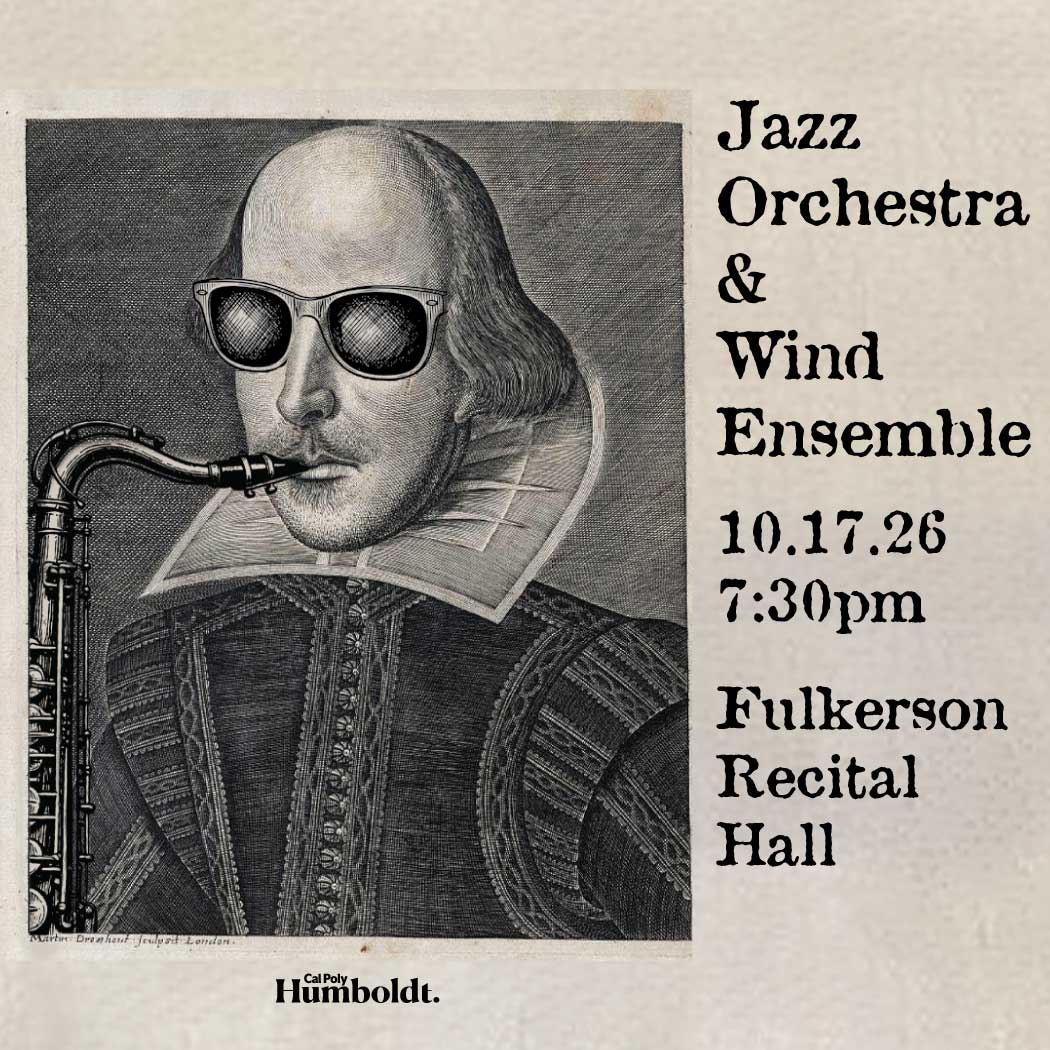
The Cal Poly Humboldt Department of Dance, Music, and Theatre Presents the Jazz Orchestra and Wind Ensemble. Join us Saturday, October 17th at 7:30PM at the Fulkerson Recital Hall to hear the Jazz Orchestra performing the complete Such Sweet Thunder, Duke Ellington and Billy Strayhorn’s Shakespearean suite. The Wind Ensemble will perform Renaissance-inspired compositions among other great works from the wind repertoire. Tickets are $15 General, $5 for Children and FREE for Cal Poly Humboldt Students with ID. Tickets can be purchased at the door or online at https://tickets.humboldt.edu/section/dance-music-theatre-kldu
In 1956, the Duke Ellington Orchestra was invited to perform at the Stratford Shakespearean Festival in Stratford, Ontario. Ellington was so taken by the festival that he promised the festival’s organizers that he would come back the next year with an entire suite of music inspired by Shakespeare’s works. Ellington and his musical partner Billy Strayhorn each owned the complete works of Shakespeare already, and they began traveling with those volumes, re-reading the plays and sonnets and making notes in the margins about characters and events that caught their attention.
They formulated a 12-movement suite of pieces inspired by Shakespeare’s creations. Four of the movements are in sonnet form. Sonnets are 14 lines, each line 10 syllables in iambic pentameter (alternating weak and strong stresses) and the lines grouped into three quatrains and a final couplet. The quatrains rhyme alternately, the couplet successively. Ellington adhered to this strict form, writing Sonnet for Caesar, Sonnet to Hank Cinq, Sonnet for Sister Kate, and Sonnet in Search of a Moor to each feature a single soloist who plays 14 phrases of 10 notes each, with musical accents and rhymes in all of the correct places. The Jazz Orchestra performance will showcase Sam Aldag (clarinet) on Sonnet for Caesar, Nate Heron (trombone) on Sonnet to Hank Cinq and Sonnet for Sister Kate, and Tyler Endsley (bass) on Sonnet in Search of a Moor.
One of the movements of the suite, Such Sweet Thunder, shares its name with the entire work, and that name comes from Act IV, Scene 1 of A Midsummer Night’s Dream, when Hippolyta, in talking about the sounds of nature, says, “I never heard so musical a discord, such sweet thunder.” Other notable movements include one of Billy Strayhorn’s contributions to the suite, The Star-Crossed Lovers, which is of course a musical depiction of Romeo and Juliet. It will feature True Laboissonniere on alto sax. Ellington’s Madness in Great Ones was inspired by Hamlet’s attempt to deceive his stepfather by pretending to be insane (“Madness in great ones must not unwatched go.”) Ellington’s musical depiction of madness finds the band rapidly jumping from one musical idea to another in a seemingly haphazard (but actually well-organized) way. It culminates with a soaring trumpet solo from Angelo Bernardi.
Orchestra leader Dan Aldag comments on the piece, “I believe that the Ellington and Strayhorn compositions that comprise Such Sweet Thunder can stand on their own as musical masterworks, but the listener’s appreciation of them is enhanced by knowing the inspirations behind each movement. The suite, with its many moods and textures, is an outstanding showcase of both the collective power of the band and the individual members’ contributions, with nearly everyone in the band in the spotlight at some point during the work.”
The Cal Poly Wind Ensemble will continue the theme of music from the Shakespearean era. While the music is not directly connected to a play written by William Shakespeare, the first two selections were inspired by music written during his lifetime.
The William Byrd Suite by Gordon Jacob (1895-1984) is based on the music of William Byrd (1540-1623), an English Renaissance composer and a founder of the English Madrigal School. Jacob assembled the suite in 1923, most likely as part of the festivities for the tercentenary of Byrd’s death. He “freely transcribed” it from six pieces of Byrd’s keyboard work that appeared in the Fitzwilliam Virginal Book, a contemporary collection of almost 300 pieces written between about 1562 and 1612.
Cathedrals was written by Kathryn Salfelder (1987). She intertwines her music with Canzon Primi Toni from the Sacrae Symphoniae by Giovanni Gabrieli’s (1557-1612). Gabrieli was one of the most influential musicians of the Italian Venetian School. He composed the Sacre Symphonie in 1597 to be performed in St. Mark’s Basilica in Venice, Italy. Cathedrals is a synthesis of the old and the new, evoking the mystery and allure of Gabrieli’s spatial music, intertwined with the rich color palette, modal harmonies, and textures of woodwinds and percussion.
Foundry was written by John Mackey (1973). The idea with Foundry was to make a piece that celebrates the fact that percussionists have this ability to make just about anything into an “instrument.” Snare drums and bass drums are great, but why not write a whole piece featuring non-traditional percussion — things like salad bowls and mixing bowls and piles of wood?
José Pablo Moncayo García (912-1958) was a Mexican pianist, percussionist, music teacher, composer and conductor. His composition Huapango (1941), was his first important work for orchestra. Its music is based on three authentic folk dances: Siqui Siri, Balajú and El Gavilán. The piece is arranged in three sections, with fiery music at beginning and end recalling the manner of huapango singing in coplas (i.e., the song is shouted alternately between two men singers, here transmuted by Moncayo into a trombone—trumpet dialogue) surrounding a slower central portion based on a lyrical melody.
DATES/TIMES
- Saturday, Oct. 17 : 7:30 p.m.
WHERE
PRICE
- $15
- $5 Children
- Free Cal Poly Students with ID
CONTACT INFO
- Phone: 707-826-3928
- Email: mus@humboldt.edu
- Web site
CLICK TO MANAGE