

OBITUARY: Andrew McKaye, 1923-2022
LoCO Staff / Thursday, Oct. 27, 2022 @ 6:56 a.m. / Obits

Andrew McKaye of Fortuna died on
October 18 at the age of 99.
He was born on October 12, 1923 at Diamond Lake, Michigan, where he spent the summers of his childhood and youth. During the school year he lived in South Bend, Indiana, which he considered home.
In 1941 he graduated from South Bend Central High School and nine days later, on June 12, he enlisted in the U.S. Navy. He made the navy a career and retired in August 1961 after attaining the rank of Senior Chief Hospital Corpsman. He was a veteran of World War II, the Korean War and the Vietnam War.
After completing his naval service he attained a degree and teaching credentials at San Francisco State University. For 24 years he was a teacher and librarian for South Fork High School in Miranda.
In 1947 he married Jean Collins of New York City who preceded him in death in September 2019. They had a son, Professor Kenneth Robert McKaye, who is a permanent resident in both Cape Maclear, Malawi and Helsinki, Finland; and two grandchildren, Mark Robert, now in Connecticut, and Lara Nicole now in Seattle.
Andrew was a dedicated conservationist and educator who requested that donations or contributions be made to any conservation organization, especially ones that focus on preserving redwoods and Beaches of Northern California.
A celebration of his life will be held at Redwood Lodge Conference Center 1800 Riverwalk Drive, Fortuna between 1:30 and 4:30 p.m. on August 27 2023. RSVP: For additional information contact andy.party2023@gmail.com.
###
The obituary above was submitted on behalf of Andrew McKaye’s loved ones. The Lost Coast Outpost runs obituaries of Humboldt County residents at no charge. See guidelines here. Email news@lostcoastoutpost.com.
BOOKED
Today: 12 felonies, 10 misdemeanors, 0 infractions
JUDGED
Humboldt County Superior Court Calendar: Today
CHP REPORTS
7700 Mm101 N Hum 77.00 (HM office): Assist with Construction
10270 Mm101 N Hum R102.70 (HM office): Traffic Hazard
1656 Union St (HM office): Missing Elderly
1700 Mm96 E Hum 17.00 (HM office): Report of Fire
ELSEWHERE
RHBB: Silver Alert Issued for Missing McKinleyville Man
Governor’s Office: Governor Newsom announces appointments 7.8.2026
Governor’s Office: Governor Newsom signs legislation to ensure corporations pay their fair share, protecting vital services for Californians
EcoNews: RRAS Birding Field Trips and Guided Walks: July 2026
Supervisors Opt to Leave the Planning Commission at Seven Members
Ryan Burns / Wednesday, Oct. 26, 2022 @ 5:04 p.m. / Local Government
PREVIOUSLY: In the Wake of Bongio Controversy, Supes to Consider Changes to the Planning Commission
###
On Tuesday the Humboldt County Board of Supervisors considered reducing the number of members on the Planning Commission from seven to five but wound up thinking better of it, keeping the body at seven people while changing the method by which a commissioner can be removed.
The board also adopted a code of conduct and ethics by which the commission must now abide. The lack of such a code has become an issue recently after former Commission Chair Alan Bongio made racist comments at an Aug. 18 hearing.
Staff had recommended reducing the size of the commission to just five members after surveying 21 other counties and finding that 18 of them have five-member planning commissions.
“So, while having seven we’re not necessarily a unicorn, we are not in a field of like beings with that makeup,” County Administrative Officer Elishia Hayes said.
But the supervisors weren’t keen on the suggestion.
“I think that seven gives us a diversity [and] helps us meet quorum,” Fifth District Supervisor Steve Madrone said. “I think it’s a positive thing. And I think when we have problems it’s easy to take a knee-jerk reaction and think, ‘Okay, here’s how we solve this problem.’”
This appeared to be a reference to the Bongio controversy. “But really, I think you need to go after the problem directly rather than trying to just reduce numbers,” Madrone said.
Second District Supervisor Michelle Bushnell disagreed initially, saying she doesn’t consider this a knee-jerk response but would like to reduce the size of the commission to five. She also said she supports a staff recommendation to require a four-fifths vote of the county supervisors to remove a member of the Planning Commission, and later in the meeting she said this whole conversation was initiated before the Bongio controversy.
In the current setup, each supervisor appoints one member to the Planning Commission and that supervisor is solely responsible for removing their appointee, should the occasion arise. A majority of the board must approve the appointment of each at-large member, of which there are two.
Third District Supervisor Mike Wilson said he was initially in favor of reducing the commission to five, plus including one active alternate who could step in when another member is missing. But he said that after learning that quite a few other counties in the state do have seven-member commissions he changed his mind and would like to see Humboldt’s remain that size.
First District Supervisor Rex Bohn said he likes seven, too, as well as the suggested four-fifths vote requirement for removal.
Turning to the matter of his own appointee (Bongio), Bohn said, “I’ll address the elephant in the room. I’ve had a lot of talks with my planning commissioner and everybody says that I shouldn’t put friendship into this, and sorry, you’re wrong. I have friends and I have friends because I respect them.”
Somewhat cryptically, he added, “And going forward, we’ll address it. But it’s mine to address and I’ll wear that.”
Board Chair and Fourth District Supervisor Virginia Bass said she, too, likes having a seven-member commission. Madrone later made a motion to keep it that way and to implement the four-fifths provision for removal.
Bushnell then brought up the matter of commissioners holding “incompatible offices,” a clear reference to At-Large Commissioner Melanie McCavour, whom the supervisors considered removing late last year over conflict-of-interest concerns. McCavour is employed as the tribal historic preservation officer of the Bear River Band of the Rohnerville Rancheria, a role that has required her to recuse herself from a few planning commission deliberations, including the one that’s been the source of such controversy of late.
The Wiyot Tribe recently submitted a letter to the county objecting not only to Bongio’s remarks but to McCavour’s dual roles, which the tribe argued gives her a privileged position for communicating with her fellow commissioners and county staff.
Bushnell said she’d support the board majority’s preference for a seven-member commission, “but I want those seven members to be able to participate and not have to recuse continually.”
She said people thought she was “picking on someone” when she brought up McCavour’s potential conflict last year. “I was not. I am not now,” Bushnell said. “I want to ensure that our Planning Commission works well and does its job.”
Madrone agreed that the issue needs to be discussed, but the board agreed to bring it back at a later date.
The board also indicated that it would like to change the length of appointments for the two at-large Planning Commission members, reducing their terms from four years to two and staggering those terms so one at-large commissioner will be up for renewal each year. However, that arrangement wasn’t finalized. The board will consider options at a later date.
Arcata Planning Commission Approves Big Apartment Expansion Project in Westwood Neighborhood
Stephanie McGeary / Wednesday, Oct. 26, 2022 @ 4:15 p.m. / Local Government
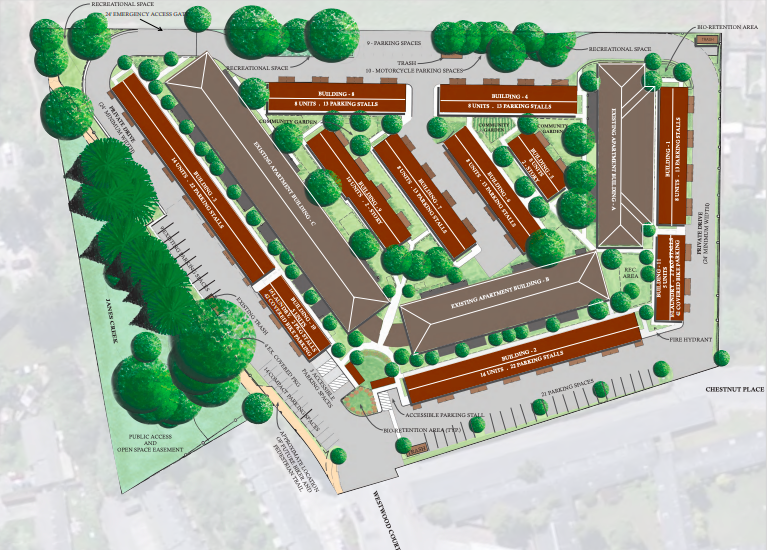
The update project design, now with 11 buildings instead of 12 and a lot more trees | Image from city staff report
PREVIOUSLY:
###
The Westwood Garden Apartments in Arcata is likely getting a lot more residents, after the Arcata Planning Commission approved a project that will more than double the size of the apartment complex on Westwood Court.
The complex, which is one of several sites in Arcata owned by Strombeck Properties, currently holds three buildings with a total of 60 two-bedroom apartments. Strombeck Properties and its hired consulting firm LACO Associates now plans to add 11 buildings, which would hold 102 total one-bedroom units. Initially the planners proposed adding 12 buildings, but during a meeting in September the planning commission rejected the proposed project, asking that the planner return with an amended design that retained more open space on the property.
In addition to removing one of the buildings from the plan, the designers also changed the general layout of the buildings. Four buildings that include parking on the ground floor with apartments above will be added to the perimeter of the existing buildings on the site, and seven apartment buildings will be added to the green space at the center of the property.
The planners had also initially proposed removing 49 trees from the property to make room for the new developments. But at the request of the planning commission, the project now only includes removal of 21 trees, plus the planting of 33 additional trees.
Several community members, mostly residents or neighbors of the Westwood Garden Apartments, voiced concerns over the project during Tuesday’s meeting, urging the commission not to approve the development. The biggest issue people had was with the closeness of the buildings, which they feared would cause privacy issues and would shade the existing residents.
Raelina Kriskston, a resident of the apartments and a current Arcata city council candidate, delivered a very thorough presentation to the commission, highlighting the buildings “being placed unreasonably close together” and the project taking away some of the outdoor recreation area that is very important to the residents.
“Yes, we need housing,” Kriskston said during the meeting. “But moreover, we need housing that will serve our community in the future. This project is objectively and practically inferior to quality and standards that we as a community need in order to grow in a healthy way.”
Kriskston pushed for a design that included more stories on the buildings, so that the same number of units could be fit into a smaller footprint – something she pointed out is what the City is looking to do with the proposed Gateway Area Plan. But Steve Strombeck, the owner of the property, said he is not willing or able to support a design with buildings more than two stories tall.
“At this point in time, I’m not willing to go up three or four stories,” Strombeck, who had called into the meeting, said. “It’s just cost-prohibitive.”
Despite the developers having made the changes requested by the planning commission at the last meeting, several of the commissioners still weren’t thrilled with the project. But because of the need for housing in Arcata, Commissioner Daniel Tagney made a motion to approve the project.
At first it seemed like no one was going to second the motion. Then Commissioner Judith Mayer said she feared that if the commission didn’t vote on the project, that the planners would return with a proposal that was subject to Housing Accountability Act – which limits government bodies’ ability to deny affordable housing projects – and would no longer need the Planning Commission’s approval.
Christian Figueroa then seconded the motion, which passed 4-1, with Mayer dissenting. Planning Chair Julie Vaissade-Elcock had recused herself because her husband did work on the project.
Now that the Planning Commission has approved the permit for the project, the permit has a 10-day appeal period. If no one appeals within 10 days, the development can move forward.
Supes Agree to Put Controversial Weed Initiative on 2024 Ballot, Though They Hope to Work With Organizers on Alternatives
Ryan Burns / Wednesday, Oct. 26, 2022 @ 3:57 p.m. / Cannabis , Local Government
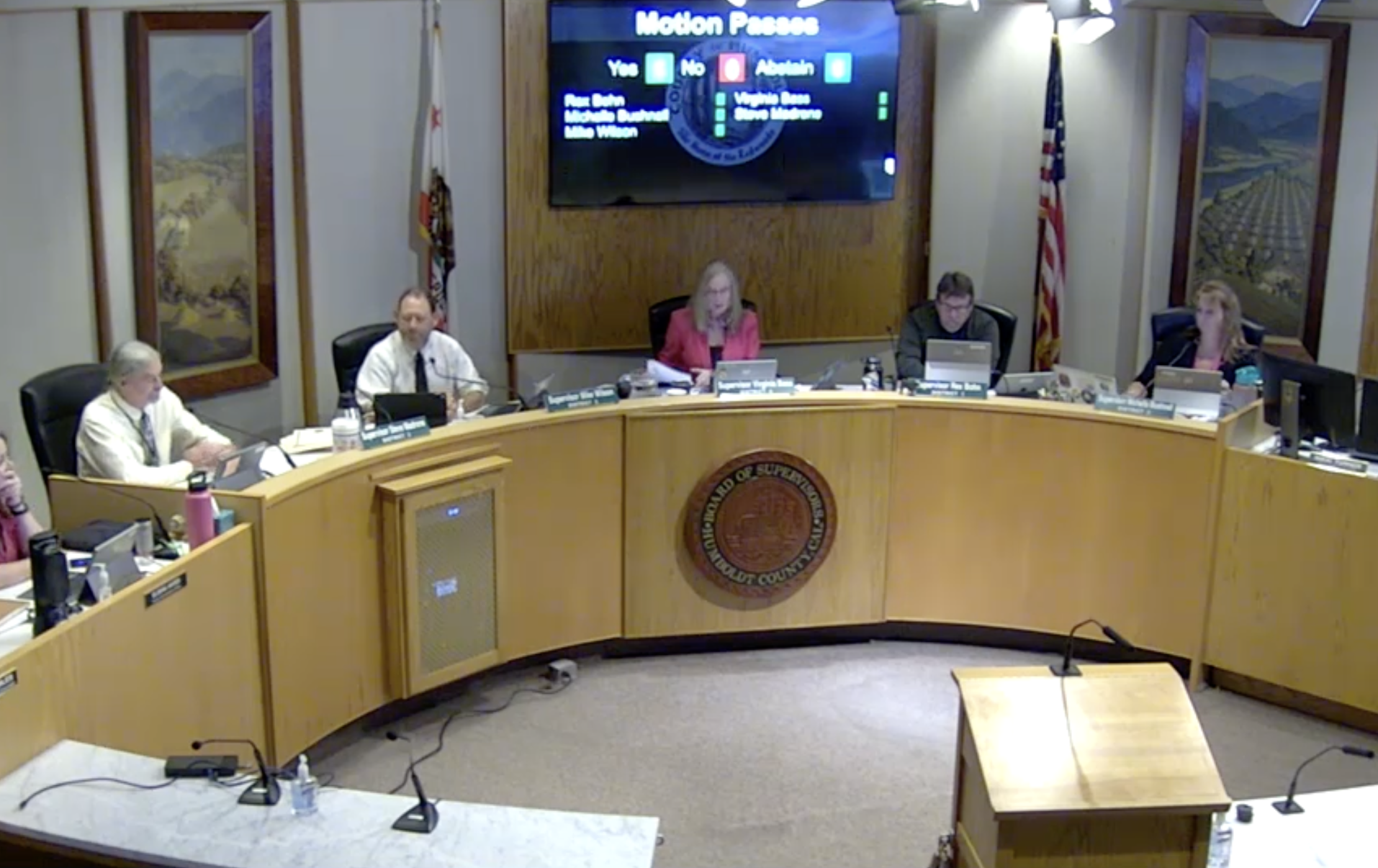
The Humboldt County Board of Supervisors (from left): Fifth District Supervisor Steve Madrone, Third District Supervisor Mike Wilson, Chair and Fourth District Supervisor Virginia Bass, First District Supervisor Rex Bohn and Second District Supervisor Michelle Bushnell. | Screenshot.
###
PREVIOUSLY: An Initiative to Reshape Humboldt’s Cannabis Industry Qualified for the Ballot, and It Has Growers Worried
###
The Humboldt County Board of Supervisors had just three options, and they didn’t seem too happy about any of them.
On Tuesday the board was presented with an initiative that, if approved by voters, would effectively prohibit new cannabis-growing operations countywide while ushering in a host of stringent new rules for industry, including a prohibition on farms larger than 10,000 square feet.
The board listened to two hours of passionate public feedback, the vast majority of it from local growers who lambasted the initiative as an ill-conceived and deceptively promoted measure that would destroy their livelihoods and decimate the storied Humboldt County cannabis industry.
But backers of the initiative — a relatively small group of retirees living in Kneeland — had submitted more than 7,000 signatures supporting their petition, more than enough to qualify the measure for ballot. The signatures had been approved by the Elections Office, and so per California law, the board could only do one of three things:
- adopt the ordinance without alteration, either right there in the meeting or within the next 10 days,
- submit the ordinance to the voters (again, without changing anything) at the next available statewide election — in this case, the California primary in March of 2024, or
- direct staff to prepare a report on the ordinance, and when that report is presented at a subsequent meeting either adopt the ordinance or order a special election, which would cost the county $35,000 to $40,000.
Somewhere around the nine-hour mark of an 11-hour meeting, the board unanimously chose option 2, agreeing to put the measure on the March 2024 ballot, though before taking the vote several supervisors — particularly Fifth District Supervisor Steve Madrone — indicated that they’d like to work toward an alternative outcome.
Madrone asked Betsy Watson, one of the two organizers present for the meeting, if she and her fellow organizers would be willing to work with the county and the community over the next year-and-change to explore other ways to modify the county’s cannabis regulations — and maybe even pull their initiative off the ballot.
Watson agreed. “Anything can be improved,” she said, adding, “We would would demand, though, that it not just be cannabis people that are being consulted and negotiated with. … What we would need to do is to consult a broad level of the community so we can all live here.”
The board also directed staff to prepare a report analyzing the potential impacts of the initiative and suggesting possible next steps.
As mentioned in a story from last week, the organizers of this initiative feel that the weed industry has run amok in Humboldt County, with the proliferation of what they see as industrial-scale cultivation activities that have dramatically impacted their way of life, threatening their water supplies, increasing traffic and harming the environment.
Their year-long organizing and signature-gathering effort led to the Humboldt Cannabis Reform Initiative, which was subsequently (and rather unfortunately) renamed the Large-Scale Commercial Cannabis Cultivation Restrictions Amending Humboldt County General Plan, Local Coastal Plans and County Code Amendments Initiative.
Early in yesterday’s hearing, Second District Supervisor Michelle Bushnell asked Planning and Building Director John Ford, “With this petition, what does it mean to cultivators that are already licensed? And what does it mean to future cultivators?”
“What it will essentially do,” Ford replied, “is prohibit new applications for cultivation.” He explained that the initiative would set new caps on the number of permits allowed in each watershed, limiting them to five percent above the number of permitted operations present on March 4 of this year. He displayed a spreadsheet (screenshot below) showing that this cap has already been exceeded in all but two watersheds countywide.

Screenshot of a slide from a staff presentation.
“And as you can see,” Ford said, “there are actually only two permits left to be allocated.”
The initiative would also require all cultivation sites to be located on roads that meet Category 4 standards, Ford said, which is not currently the case under either version 1.0 or version 2.0 of the county’s commercial cannabis land use ordinance (though roads that don’t meet those standards must be analyzed for capacity).
Existing permit-holders with operations larger than 10,000 square feet would be considered “legal non-conforming” operations upon implementation of the initiative, Ford explained.
“They will continue to be legal permits,” he said, but because the ordinance now limits new permits to 10,000 square feet, they couldn’t expand. And there’s some question as to how much they could modify their property. Could they add water tanks? Could they add solar power? Could they do some other things that may make a lot of sense and be highly beneficial from an environmental standpoint?”
He said the language of the ordinance seems to indicate that such changes would require a discretionary permit, and for operations larger than 10,000 square feet, those types of changes wouldn’t be allowed at all.
The initiative also says that multiple permits cannot be held by an individual or on a given property, “and is unclear if that just cannabis cultivation permits or [if] that includes nursery, processing, distribution, manufacturing, canna-tourism, micro-business — things that in [ordinance] 2.0 the county was very intentional about wanting to have value added, particularly to small farmers, so that they could have secondary sources of income to support the cannabis cultivation,” Ford said.
Bushnell challenged the ordinance backers on a number of issues, asking them to explain why they consider 10,000 square feet an industrial-scale operation.
First District Supervisor Rex Bohn also pushed back on that notion, saying, “That’s not industrial.” He also said he feels the initiative was misrepresented by backers, who tried to get him to sign their petition by saying it would take out the “mega-grows.”
Bushnell was distressed.
“My heart’s racing right now,” she said to the petitioners. She took issue with them singling out the cannabis industry.
“And I don’t understand. I don’t understand why you targeted only cannabis. … And I won’t support [the initiative] the way it’s written. I respect you, you know, but I am so sad for the cannabis community, for the departments that have worked so hard to bring this forward, for this board that has worked hard to try to make this work. And [cannabis farmers] are on their knees. They’re broke. Cannabis is failing. And they’re struggling for everything to keep their livelihood, and now they have anxiety again because of this. And it just breaks my heart. It does.”
Third District Supervisor Mike Wilson asked staff what qualifies as a large-scale grow, and Ford said that to have anything larger than an acre, the property must be at least 320 acres.
Wilson interjected to say he was looking for a definition of large-scale, “because this ordinance defines large-scale as anything 10,000 square feet or more. … The title is defining it before we as a community vote to define it.”
Watson stepped up to the podium shortly thereafter to defend the ordinance. She said that in general she’s not a fan of the initiative process, saying, “There was an initiative in this state that kept me from getting married.” But she added that she and her neighbors were unable to get results any other way.
“While gathering 7,000 signatures we found that citizens felt overlooked,” Watson said. “There’s the perception that this whole thing is completely out of control. … We’re offering a forward-looking plan. It’s a vision for cannabis cultivation in the future. We are not anti-cannabis people at all.”
The public comment period kicked off with Ross Gordon, policy director for the Humboldt County Growers Alliance, a cannabis business organization. He criticized the title and content of the initiative as well as the process by which it came to the board.
“These rules and restrictions were developed without public process and input,” Gordon said. “Many are not viable to implement or comply with, as Director Ford spoke to, and many would result in the bureaucratic strangulation of the small cannabis farms in Humboldt County.”
He said he believes there were two main reasons why more than 7,000 people signed the petition.
“The first is that they falsely believed that this was an initiative primarily about restricting large-scale commercial cannabis cultivation in Humboldt County, and they believed the stated purpose and intent: to support small farmers,” he said. “I believe if they knew what was actually in this initiative, many people would not have signed it.”
Dozens of growers spoke over the next two hours, and several refrains were heard over and over again. Many said they’re struggling to survive and that this initiative would be the final nail in the coffin for their operations. Others asked the supervisors to formally oppose the initiative and maybe come up with an alternative one themselves. Many said the measure would destroy the industry altogether here in Humboldt County.
“I suggest that we request a full and robust report on this initiative … ,” farmer Nate Whittington said. “Let [voters] see the facts of just how absurd this initiative is, and I think we’ll see that the county will resoundingly vote it down, and then we can move on to more productive discussions.”
Nik Erickson, owner of Full Moon Farms, said the organizers failed to consult the industry. “Small farms were not asked what challenges we were facing, how this initiative would help us and how it would deter corporate cannabis from coming into Humboldt County when in fact it does the exact opposite,” he said. “It creates impossible hurdles for small farms.”
His voice began to tremble as he continued. “This initiative threatens all that we’ve worked so hard for,” he said. “This initiative, in fact, is the extinction of small farms.”
After everyone in board chambers had taken their turn, Board Chair Virginia Bass turned it over to people calling in via Zoom. The thrust of the comments remained the same.
“We are greatly, greatly affected by the overregulation already and with everything we put into our business, our life,” said the owner of Humboldt Renegade Farms. “This was our passion, our livelihood. We can’t take any more. We’re hanging on by a thread. This would really be the nail in the coffin for us.”
When the comment period finally wrapped up, Wilson remarked that the conversation was overdue.
“We shouldn’t have this hearing today; we should have had this hearing the day that there was an initiative put on the table,” he said. Instead, the board was left in what he called “this very locked-in situation” with only the three options.
Madrone pointed out that proponents of an initiative can withdraw it anytime until 88 days before the election, and he implored organizers to engage in discussions.
“I know Betsy to be a person who spent decades in this county working on conflict resolution,” he said, adding that Watson and fellow organizer Mark Thurmond had said they didn’t really want to pursue an initiative in the first place.
“So I’m not going to give up hope,” Madrone continued. “I really believe it is entirely possible for us as a board, working with our community, to figure out: what are the things we can do to make this all better?”
No date was set for when staff will bring back its analysis of the initiative’s impacts, nor did the board iron out a method for working further with the initiative’s proponents. But with the understanding that the conversation will continue, the board voted unanimously to approve the measure for the March 2024 ballot.
###
DOCUMENT: The Humboldt Cannabis Reform Initiative (full text)
Bicyclist Killed in Crash on 101 Near Herrick Offramp, CHP Reports
LoCO Staff / Wednesday, Oct. 26, 2022 @ 1:38 p.m. / Emergencies
PREVIOUSLY:
###
Press release from the California Highway Patrol:
On 10/23/2022, at approximately 7:42 PM, the CHP Humboldt Communication Center (HCC) received a call of a vehicle versus bicyclist traffic crash on US-101 Northbound, south of Herrick Avenue. Based on CHP’s preliminary investigation, it appears this crash occurred when a bicyclist was struck within the #1 lane by a 2015 Chevrolet pickup, driven by 29-year-old Colton Daniels of Eureka. The bicyclist, 51-year-old Donald Ferguson of Rio Dell, received fatal injuries as a result of this crash.
Impairment is not considered to be a factor in the driving of the vehicle. Impairment of the bicyclist is unknown at this time and is pending toxicology results by the Humboldt County Coroner’s Office.
The CHP is continuing to investigate this crash and asks anyone with information to contact the Humboldt Area CHP at (707) 822-5981 or the 24-hour dispatch line at (707) 268-2000.
The #1 lane of northbound US-101 was closed for approximately two hours to allow for the safe investigation of this crash. The California Highway Patrol extends its condolences to the family of the deceased and would like to thank the following agencies for their response and assistance with the investigation: Humboldt Bay Fire, Eureka Police Department, Humboldt Towing.
Harbor District Announces Massive Offshore Wind Partnership; Project Would Lead to an 86-Acre Redevelopment of Old Pulp Mill Site
Hank Sims / Wednesday, Oct. 26, 2022 @ 11:50 a.m. / Economy , Offshore Wind
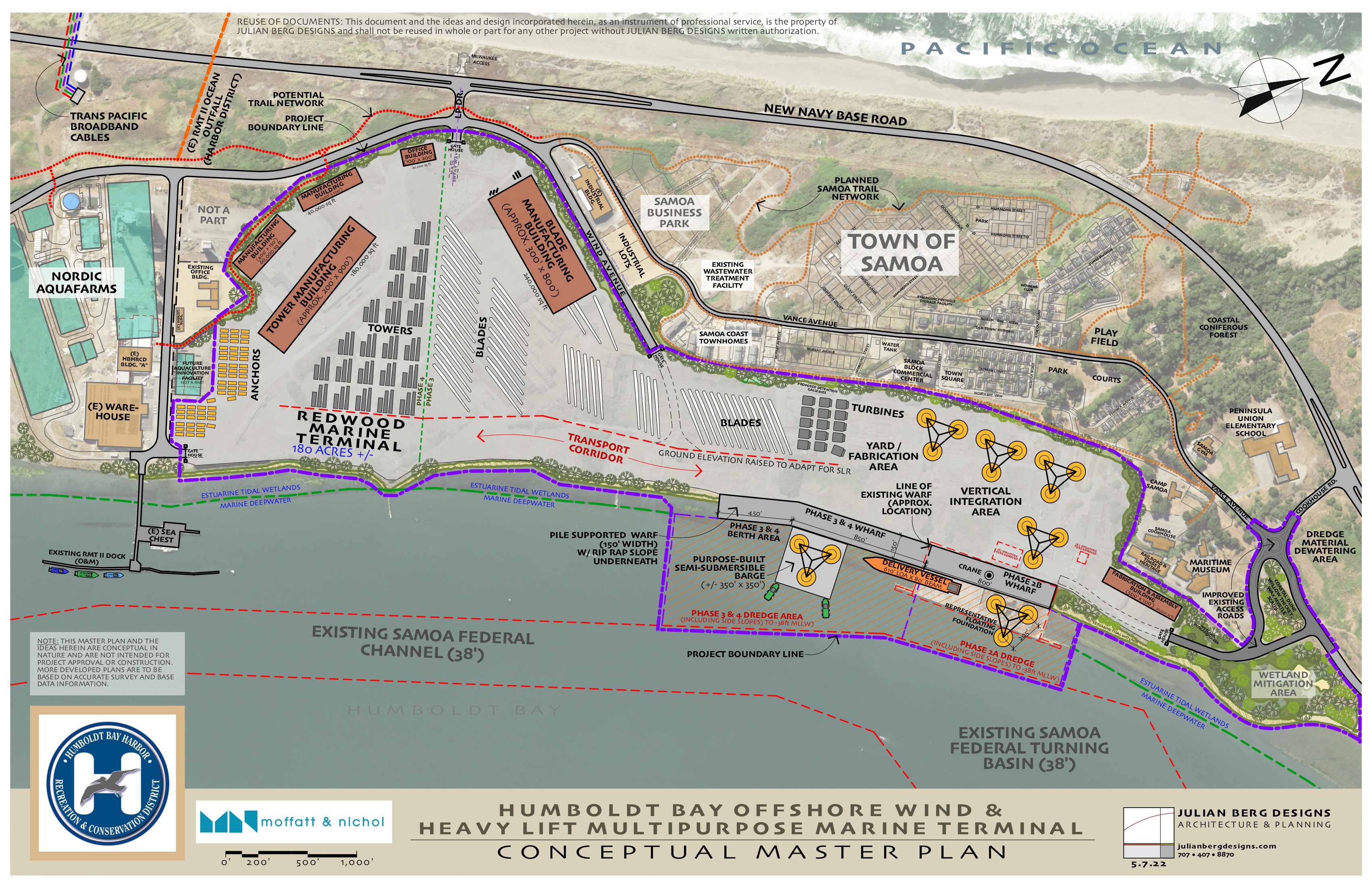
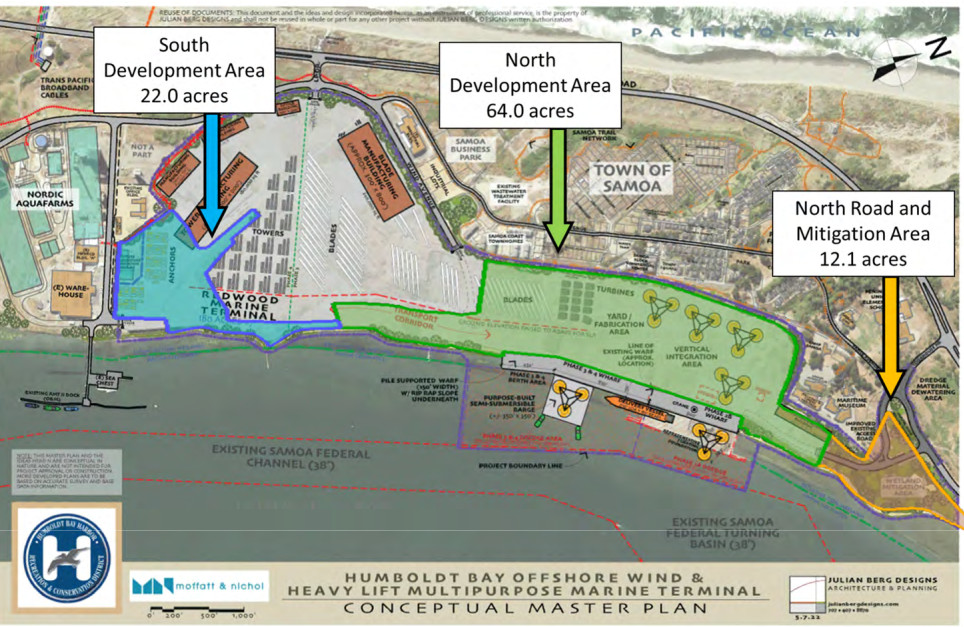
Illustrations via Harbor District. Click to enlarge.
Well, this is happening pretty quickly.
This morning, the Humboldt Bay Harbor District has announced a partnership with a private company — Crowley Wind Services — to build a full-service facility to support offshore wind development all along the West Coast.
The development would happen at the district’s Marine Terminal II — a.k.a., the old pulp mill property in Samoa, which it acquired in 2013 — and would be located next to the planned Nordic Aquafarms onshore Atlantic salmon factory.
The new facility — which would become the second-largest wind terminal in the United States, according to the Harbor District — would be able to manufacture and ship the platforms and wind turbines that are currently being planned for the waters off Humboldt County and Morro Bay.
Those “lease areas” — areas of the ocean where the windmills will someday be placed — are scheduled to be auctioned off by the federal Bureau of Ocean Energy Management on Dec. 6.
But local business-watchers have long hoped that Humboldt Bay could serve as a “hub” for the development all along the length of the West Coast, having both a first-to-market advantage (with the first lease areas on the Pacific Coast) and also several geographic advantages — i.e., a protected bay unencumbered by bridges over the harbor entrance, as well as a great deal of available industrial land along the shore.
The Harbor District says it is holding a “celebration” tomorrow at 1:30 p.m. on Woodley Island to further spell out the details of the deal with Crowley Wind Services.
Announcement from the Humboldt Bay Harbor, Recreation and Conservation District:
Tomorrow at 1:30 PM, the Humboldt Bay Harbor District will be hosting a ceremony celebrating a new partnership that will accelerate the Humboldt Offshore Wind Port project. See attached for more information. Please join us for a Celebration of Partnership as outlined below:
- Date/Time: Thursday, October 27 at 1:30 PM
- Location: Woodley Island, Eureka (601 Startare Drive); at the Fisherman’s Statue Parking Lot at the far west end of the island
- Topic: Announcement Regarding new Partnership for the Humboldt Bay Offshore Wind and Heavy Lift Marine Terminal
- Tentative Speakers:
- Greg Dale, President of the Board, Humboldt Bay Harbor, Recreation and Conservation District
- Tentative – Ted Hernandez, Tribal Chair, Wiyot Tribe
- Jeff Andreini, Vice President, Crowley Wind Services
- Virginia Bass, Chair of the Humboldt County Board of Supervisors
- US Congressman Jared Huffman
- Details: Through Crowley’s Wind Services group, the company will serve as the port’s developer of the Humboldt Bay Offshore Wind Heavy Lift Marine Terminal. Services there will support tenants in the manufacturing, installation and operation of offshore wind floating platforms, use of large heavy cargo vessels and providing crewing and marshalling services in the Pacific waters. The terminal would be second largest wind terminal in the U.S. at this time.
- Summary of the Economic Impact Study:
- 4,257 jobs in Humboldt County
- Stage 1 830 jobs
- Stage 2 3,426 jobs
- $279 million in labor income in Humboldt County
- $38 million in state and local tax revenues
- Total industry output
- Stage 1 would generate $136 million in Humboldt County or $178 Million across California
- Stage 2 would generate $481 million in Humboldt County or $633 Million across California
- Background: The Humboldt Bay Harbor District has been conducting strategic planning since 2019 to establish a world-class marine terminal to service the offshore wind industry at a 180-acre site on the Samoa Peninsula. Utilizing a grant from the Humboldt County Headwaters Fund in 2021, the District developed a conceptual Master Plan for the site. That led to a $10.45M grant from the California Energy Commission, which the Port has utilized to conduct a range of technical studies, preliminary design, and pre-permitting activities. The District anticipates completing permitting and design in mid-2024. Humboldt Bay offers advantages for offshore wind because its location and size allows it to serve as a manufacturing, fabrication, construction and assembly, staging and tow-out hub. It is close to the ocean and provides a shipping channel clear of bridges or other airspace obstructions while minimizing environmental and wildlife impacts. Because of these advantages, the Bay has drawn the attention of many Federal and State agencies as well as a suite of international energy development firms. The Humboldt Wind Port project is now transitioning to the next stage as the District plans to sign a lease with a premier marine terminal development firm. The agreement focuses on an 86-acre Phase I, with the potential to expand to additional Phases. This partnership and project will generate high-skill manufacturing and technical jobs, investments, and clean energy that will extend for generations into the future. On 10/27/22 at 1:30 PM, the District will host a Celebration of Partnership with several dignitaries as guest speakers.
Pedestrian Killed in Hit-and-Run Incident in Valley West Area of Arcata
LoCO Staff / Wednesday, Oct. 26, 2022 @ 9:39 a.m. / Crime
Press release from the City of Arcata:
On 10/26/22 at about 5:53 AM, Arcata Police Department received a 9-1-1 call for a pedestrian down in the roadway on the 5000 block of Valley West Boulevard. Arcata Police, Arcata Fire District, and Arcata Ambulance responded and found an injured victim in the roadway who appeared to have been struck by a vehicle.
The victim was transported to St Joseph’s Hospital where they later succumbed to their injuries.
Arcata Police Department is actively investigating this as a felony hit and run and asks anybody who witnessed the collision or has any information about the collision to call the Arcata Police Department at 707-822-2426 or on the anonymous tip line at 707-825-2588.


