Going Electric: Opponents Clash as California Aims to Force Diesel Trucks Off the Road
Nadia Lopez / Thursday, Oct. 27, 2022 @ 12:21 p.m. / Sacramento

Image generated by DALL-E, an artificial intelligence.
###
Environmentalists and trucking industry groups sparred with clean air regulators today over a contentious proposal to phase out California’s big rigs and other trucks with internal combustion engines and force manufacturers to speed mass-production of electric trucks.
The California Air Resources Board held its first public hearing on rules that would ban manufacturers from selling any new fossil-fueled medium-duty and heavy-duty trucks by 2040. The new rules would also require large trucking companies to convert their fleets to electric models, buying more over time until all are zero-emission by 2042. The move is part of the state’s wider strategy to end its reliance on fossil fuels and cut planet-warming emissions.
“California is leading the transition to wide-scale electrification of trucks and buses,” said board chair Liane Randolph. “These actions can show the world how to simultaneously address the climate crisis, improve air quality and alleviate key concerns identified by communities.”
The proposed regulation received widespread criticism from both sides, as 167 members of the public lined up to speak at today’s hearing. Environmentalists and public health groups called for a tougher rule that would speed up the 100% electric truck sales requirement to 2036 instead of 2040, while trucking companies said the proposal ignores concerns about electric vehicle costs and technology, lack of infrastructure and the loss of good-paying jobs.
The Air Resources Board is expected to hold a second hearing on the proposal and vote in the spring.
Jeff Cox, a truck driver of 24 years and owner of the Madera-based trucking company Best Drayage, worries the rule could drive many family-owned fleet operators out of business – especially those with certain types of trucks that the regulation would affect first.
“Obviously we all want cleaner air, but this would be catastrophic to the industry,” he said. “We’re operating in an already challenging environment. To add something else that is this drastic would be very harmful.”
California often leads the country in passing stringent emission reduction standards. The new rule would lead to a transformation of the trucking industry, affecting about 1.8 million trucks on state roads. It builds on other mandates to reduce emissions in the transportation sector, including the gas-powered car ban adopted earlier this year and clean trucks regulation passed in 2020.
But environmental groups often say that while the air board’s regulations on the transportation industry are well-intentioned, they don’t go far enough to reduce the production or use of fossil fuels.
Andrea Vidaurre, a policy analyst at the People’s Collective for Environmental Justice, said the effects of toxic diesel emissions from big rigs and other heavy-duty trucks in heavily polluted communities underscores the need for California to accelerate the transition. Diesel exhaust can lead to several health problems, including asthma and other respiratory illnesses, and increase the risk of hospitalization and premature death, according to air board staff.
“Families all across California are suffering,” Vidaurre said in a statement. “The California Air Resources Board has a responsibility to maximize and accelerate the benefits identified in this report to those families to ensure that the rule reflects this critical need across the state.”
The gradual conversion of existing fleets would apply only to federal agencies and “high-priority fleets,” which are owned or operated by companies with 50 or more trucks or $50 million or more in annual revenue. Also affected: trucks weighing 10,001 pounds or more and package delivery vehicles of 8,500 lbs or more, including U.S. Postal Service, FedEx, UPS and Amazon fleets.
These companies and federal agencies could comply in one of two ways. They could choose to purchase only zero-emission trucks beginning in 2024 while retiring diesel trucks at the end of their useful life, or decide to phase in zero-emission trucks as an increasing percentage of their total fleet. The second option would require starting with 10% of delivery trucks and other types that are the easiest to electrify in 2025, then ramping up to 100% between 2035 and 2042.
“This is both impractical and impossible to comply with.”
— Jeff Cox, owner of Best Drayage Trucking
The transition to electric trucks for many fleet operators would begin as early as 2024. These trucks have the strictest timeline since they are among the easiest to electrify, including delivery and drayage trucks, which transport cargo at railways and ports in Los Angeles and Long Beach. New models would need to be zero-emission in 2024, while diesel and gas drayage trucks must retire after 18 years.
Drayage trucks are among the most suitable for electrification because they may not need a long range to transport cargo to and from their destinations, and may have more down time for fueling, according to air board staff’s analysis.
But Cox, of Best Dayage, said the rule fails to consider drayage companies with daily haul ranges of 200 to 400 miles that don’t just operate at ports or railyards, such as those that transport goods within the Central Valley. Cox said the high upfront cost of electric trucks and lack of available models also worry drivers, who may not feel confident that the technology can improve before the mandate goes into effect.
“Getting the cart before the horse isn’t going to help matters by forcing the purchase of a vehicle that doesn’t exist today,” he said. “This is both impractical and impossible to comply with.”
Chris Shimoda, a senior vice president at the California Trucking Association, which represents truck drivers, said the heavy weight of electric truck batteries could force trucks to forgo around 8,000 pounds of their load capacity, increasing the need for more trucks and drivers to transport cargo at a time when the industry is already facing a worker shortage.
Just 1,943 zero emission medium and heavy duty vehicles are on the state’s roads, and nearly all of them are buses. About 300 are zero-emission commercial trucks, and less than 90 are electric semi-trucks. The rule would add about 510,000 carbon- free medium and heavy-duty vehicles to roads and highways in 2035, increasing to 1.2 million in 2045 and nearly 1.6 million in 2050.
To meet that demand, Shimoda said the state would need to install as many as 800 chargers per week to power truck fleets, representing anywhere from 64 to158 megawatts of new charging capacity, or enough to power 118,000 households.
“We don’t even know that chargers are going to be in place in the next two years to have somewhere to plug in the trucks,” he added. “We can’t even lose time to charging if there’s nowhere to charge.”
Some board members questioned whether the California Public Utilities Commission was prepared to build out the necessary infrastructure and power grid improvements under the proposed timeline.
“This is really a very large undertaking,” said board vice chair Sandra Berg. “I’m trying to understand where the grid problems are going to be and how they can be resolved. How much time do we really need here?”
Air board member Daniel Sperling, who is also the director of the Institute of Transportation Studies at UC Davis, echoed many of the concerns raised by the trucking industry about installing charging stations and making rapid grid improvements.
“I’m having the same whiplash experience that so many fleets have been talking about — the challenges they’re having and getting hooked up to the infrastructure,” he said. “Why are we hearing from these fleets — some of them are saying that they’re not even being given a timeline for when the infrastructure will be in place.”
Yulia Shmidt, an analyst for the Office of Ratepayer Advocates at the California Public Utilities Commission, assured the board that the agency was making significant investments in grid upgrades.
“That is certainly a concern that we are deeply thinking about and that is why we’re looking at the forecast to see where the new load may come from so that we can trigger upgrades in those areas if they’re needed,”she said.
Many truck drivers at the hearing called the proposal unfair due to the high costs of purchasing an electric truck compared to that of a traditional diesel truck.
“Families all across California are suffering. The (board) has a responsibility to maximize and accelerate the benefits identified in this report…”
— Andrea Vidaurre, policy analyst at the People’s Collective for Environmental Justice
Air board staff estimate that truck drivers and companies would pay higher upfront vehicle prices now but expect those costs to go down as more models enter the market, eventually bringing the cost down to that of a conventional truck.
When comparing diesel and electric trucks in 2035, staff project that buying and operating an electric semi-truck over its lifespan, for example, could range between $765,000 and $1.1 million compared to a gas or diesel truck, which could cost between $919,000 and $1.2 million. These totals exclude state and federal subsidies that some companies could receive to help them pay for a truck.
Staff also said lower maintenance and operational costs would save fleet operators money over time.
Though trucks represent just 2 million of the 30 million registered vehicles in the state, they are the largest single source of air pollution from vehicles. Heavy-duty trucks spew 70% of the state’s smog-forming gases and 80% of carcinogenic diesel pollutants, according to the air board.
Sam Wilson, a senior vehicles analyst with the Union of Concerned Scientists, a science advocacy organization, said the air board needs to tighten the rule to get more emission reductions from the most polluting trucks to avoid the damaging effects of diesel exhaust.
The proposal has different deadlines for phasing in new sales of electric models, varying based on the size and type of truck, until all are electric by 2042. In addition, the requirements for converting fleets would not apply to smaller companies that operate less than 50 trucks, unless they were using a larger company’s trucks.They could keep their trucks as long as they want under the proposal, although their new purchases would have to be zero-emission by 2040.
Wilson said the requirement for fleet operators who manage some of the largest and most polluting trucks — such as long-haulers, big-rigs and semis — should be put on a faster electrification timeline, with a phase-in starting date in 2027 rather than 2030.
He also said the proposal threshold of 50 trucks should be lowered to 10 trucks for these fleet operators, given the outsized role large trucks have in emitting deadly soot pollution. A fleet of 10 tractor trucks emits about three times as much nitrogen oxide – a smog-forming pollutant – and about the same amount of fine particulate pollution as a fleet of 50 delivery vans, according to air board staff’s estimates.
“There’s a difference in the amount of pollution that is emitted between a plumbing company that has 50 vans, for example, and a hauling company that has 50 tractor trucks,” he said. “In order to account for this, a fleet of tractor trucks should have a compliance threshold of 10 rather than 50 just to account for the extremely disproportionate impact that they have.”
A coalition of representatives from several states, including New York, Washington, Wisconsin and Connecticut, urged the board to adopt the rule and said they would move to implement it in their states too.
“The board’s approval of the advanced clean fleet regulations will enable New York and other states to adopt those regulations to support the needed transition to zero emission transportation and cleaner, healthier communities,” said Jared Snyder, the deputy commissioner for Air Resources, Climate Change and Energy at the New York State Department of Environmental Conservation.
Although California legislators have no direct say over whether the board adopts the rule, dozens of lawmakers weighed in on the proposal — and vastly disagreed about it.
In a letter to the air board, a group of state legislators, including Democratic Sens. Nancy Skinner of Berkeley and Josh Becker of Menlo Park, and Assemblymember Cristina Garcia of Bell Gardens, agreed with environmentalists. They note that these changes are achievable due to this year’s massive $54 billion climate investment, which includes $10 billion in state funding to rapidly deploy electric vehicles and charging stations.
The climate package allocates billions for electrifying medium- and heavy-duty trucks, including $1.1 billion for zero-emission trucks, buses, off-road equipment and fueling infrastructure and $400 million for charging stations at ports. Truck drivers and companies could receive additional benefits through the federal Inflation Reduction Act, which includes a 30% tax credit for zero-emission commercial vehicles and charging stations.
But in a separate statement, some legislators including Democratic Assemblymembers Blanca Rubio of Baldwin Park, Carlos Villapudua of Stockton and Rudy Salas of Bakersfield — especially those from rural areas or with high concentrations of fleet operators in their districts — sided with the trucking industry, saying the proposal is too “aggressive” and places many financial burdens on fleet operators. They also said the plan fails to address many technical challenges, such as the toll electric trucks will have on the grid as power demand grows, and the fast-charging needs of heavy-duty rental vehicles like water and dump trucks that operate in remote locations.
###
CalMatters.org is a nonprofit, nonpartisan media venture explaining California policies and politics.
BOOKED
Today: 5 felonies, 11 misdemeanors, 0 infractions
JUDGED
Humboldt County Superior Court Calendar: Yesterday
CHP REPORTS
No current incidents
ELSEWHERE
RHBB: Friday’s Covelo Earthquakes Highlight a Fault Scientists Still Don’t Fully Understand
RHBB: Amazon Ballot Initiative Gathers 4,300 Signatures But Falls Short
RHBB: Training Burn Set for Ukiah Airport Saturday Morning
RHBB: Training Burn Scheduled Today At Ukiah Municipal Airport
29-Year-Old Arcata Man Arrested in Connection With Fatal Valley West Hit-and-Run, Police Say
LoCO Staff / Thursday, Oct. 27, 2022 @ 11:26 a.m. / Crime
PREVIOUSLY:
###
Press release from the Arcata Police Department:

On 10/26/22 at about 5:53 AM, Arcata Police Department received a 9-1-1 call of a pedestrian down in the roadway on the 5000 block of Valley West Boulevard. Arcata Police, Arcata Fire District, and Arcata Ambulance responded and found an injured victim in the roadway who appeared to have been struck by a vehicle.
The victim was transported to St Joseph’s Hospital where they later succumbed to their injuries.
Arcata Police Department Detectives identified a potential suspect based upon video surveillance and witness statements.
On 10/26/22, Jose Luis Miranda-Osorio, 29 of Arcata, was arrested and booked into the Humboldt County Correctional Facility for a violation of 20001 CVC, felony Hit and Run resulting in death.
Impairment does not appear to be a factor in the collision.
The identity of the victim is being withheld pending notification of next of kin.
Offshore Wind is Coming to the North Coast. What’s in it For Humboldt?
Isabella Vanderheiden / Thursday, Oct. 27, 2022 @ 10:16 a.m. / Energy , Offshore Wind

Photo by Nicholas Doherty via Unsplash.
As efforts to bring an offshore wind development to the Humboldt County coast ramp up, local stakeholders are vying to get a big ol’ slice of that offshore wind pie.
If you haven’t been following the proposed development, now is a good time to tune in.
The Humboldt Wind Energy Area (WEA), located approximately 20 miles west of Eureka, will be broken into two “lease areas” that will be auctioned off by the Bureau of Ocean Energy Management (BOEM) later this year. The entire development will span more than 200 square miles.
The Schatz Energy Research Center has studied the ins and outs of offshore wind energy for years. Because offshore wind speeds are fairly steady, offshore wind can provide stable, consistent energy year-round. And it just so happens that the wind resource beyond our beloved bay is among the best in the United States, according to Schatz Center Executive Director and Cal Poly Humboldt professor Arne Jacobson.
“Perhaps it’s obvious, but [utilizing] offshore wind is a way of generating renewable energy that can contribute to addressing climate change in a fairly significant way,” Jacobson told the Outpost in a recent interview. “It’s also an energy resource that is complimentary to solar. Wind energy can be generated into the evening hours and it also has quite a strong generation profile in the winter.”
Of course, there are challenges associated with offshore wind as well. Building the infrastructure that will be needed to connect the wind turbines to Humboldt County and, ultimately, into a national grid will be no small feat.
Just yesterday, the Humboldt Bay Harbor, Recreation and Conservation District announced a partnership with Crowley Wind Services to build a full-service terminal out on the Samoa Peninsula to support offshore wind development.
“There are actually very few ports on the West Coast that could be used for deployment but Humboldt Bay is one of them,” Jacobson said. “But the infrastructure is old and there would have to be a significant investment needed to prepare the port for offshore wind. It’s a challenge but it’s also an opportunity to really invest in the future of our region and the job creation that will be associated with offshore wind.”
There will also be localized environmental impacts associated with offshore wind. One of the main criticisms of wind energy is its impact on birds, but Jacobson maintains that the pros outweigh the cons.
“Our group has engaged in research with various environmental partners … to better understand, for example, sea birds and the risk associated with wind farms,” he said. “The National Audubon Society supports offshore wind … because they see climate change as a more significant environmental risk to sea birds than offshore wind. …I’ve heard similar things from people who work with marine mammals.”
While it might feel as though offshore wind is moving full steam ahead, Jacobson emphasized that there will be plenty of opportunities for the public to weigh in on the proposed development in the months and years ahead.
“This upcoming lease auction is really the first step,” he said. “There are still a lot of steps the developers will have to take to confirm what their plans are, initiate studies, apply for permits [and] environmental reviews. There will be a lot of opportunities to share your perspective along the way because this is really a five or six-year process for them to get everything in line before building anything.”
Community-Centered Benefits and Bid Credits
Before we dive into the details of what’s to come and the upcoming lease auction, let’s talk about what this all means for Humboldt. If this development moves forward, how would it impact our community? And what’s in it for us?
Despite all of the aforementioned benefits of offshore wind energy, there will be inevitable impacts associated with the development, especially for folks living along the Samoa Peninsula where the terminal will be built and wind turbine construction, assembly and staging will take place.
To mitigate potential impacts, BOEM offers a little something called a bid credit package. In this case, to qualify for the credit package the bidder “must commit to mak[ing] a qualifying monetary contribution to programs or initiatives” that benefit the greater Humboldt County community.
“A bidder will be eligible to elect to qualify for one or more of the bidding credits,” according to the Final Sale Notice (FSN). “A bidder may target either workforce training, supply chain development, or a combination thereof for a 20 percent credit. The Lease Area Use Community Benefits Agreement (CBA) bidding credit will be worth 5 percent of the cash bid. The General CBA bidding credit will be worth 5 percent of the cash bid.”
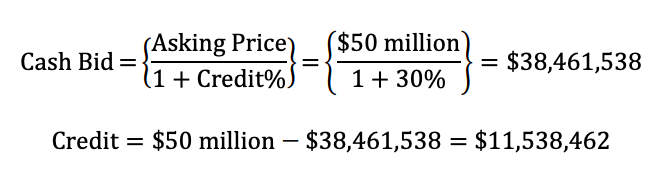
That means – if the bidder qualifies for all three bidding credits – 30 percent of the final cash bid that is accepted during the upcoming auction will be set aside to offset potential impacts associated with offshore wind development. So, hypothetically speaking, if one lease area goes for $50 million, $38.5 million would go to the federal treasury and $11.5 million would be set aside.
Of that hypothetical $11.5 million, $3.8 million would directly benefit Humboldt County. The Lease Area CBA would provide $1.9 million in benefits to communities that use or harvest resources from the geographic space of the lease area, such as fisheries. The General CBA would provide $1.9 million in benefits to a broader set of communities and tribes that will be directly affected by the offshore wind development, including folks living on the Samoa Peninsula.
However, local stakeholders had hoped for a bit more.
In comments submitted to BOEM prior to the release of the FSN, the Redwood Region Climate & Community Resilience (CORE) Hub and the North Coast Offshore Wind Community Benefits Network (the Network) – a coalition of local governments, districts and agencies, tribes, environmental advocacy groups and community-based organizations – requested a 50 percent bid credit package that would be dedicated to local communities, tribes, tribal fisheries, and environmental research and monitoring.
“We are pleased to see a General CBA credit, but the [five percent] doesn’t go far enough in addressing our region’s unique needs,” Katerina Oskarsson, a spokesperson for CORE Hub and the Network, told the Outpost. “We do not want to see the industry repeating the same boom-and-bust cycles that have created a legacy of underinvestment in our region. To be effective, community benefits must be designed by our communities, for our communities.”
The Network’s proposed credit package drew from months of conversations and interviews with community representatives.
“We heard that our community needs equitable access to quality careers, increased environmental research and monitoring capacity, reliable transportation systems, local electrification, childcare services and housing to facilitate offshore wind development,” Oskarsson explained. “We also heard that in order to change the paradigm and build trust in this new industry, a significant portion of the federal revenue generated from this project should be invested directly in the communities who will support its development, instead of the federal treasury.”
To achieve those goals, strong community governance will be a critical component as the development moves forward, Oskarsson added.
“This governance structure can also act as an effective community-led decision-making body,” she said. “As part of our recommendations, we advocate that funds are managed by community-led steering committees composed of regional constituencies with relevant expertise and close understanding of community contexts.”
Speaking with her Redwood Community Action Agency (RCAA) hat on, Eureka City Council representative and soon-to-be Fourth District Humboldt County Supervisor Natalie Arroyo called for robust engagement with Samoa residents in particular.
“I can’t speak for RCAA’s entire leadership, but my small team has been involved in this process to have a seat at the table, advocate for a responsible and innovative way forward that benefits locals,” Arroyo told the Outpost in a recent interview. “There will be inevitable impacts from these developments … I think we all expect a lot of benefits to the community and our world from off-shore wind, but we want to ensure there is a responsible approach to addressing any impacts.”
It’s important to remember that we are still in the beginning stages of offshore wind development. The upcoming auction (more on that below) really represents the first step in bringing this ambitious proposal to life.
Lease Auction Set for Dec. 6
Just last week, the Biden Administration announced that it is ready to auction off leases to potential offshore wind developers. Forty-three separate entities, ranging from regional LLCs all the way up to energy giants like Shell, have qualified as potential bidders for the five lease areas along the West Coast – three off Morro Bay and two off Humboldt Bay.
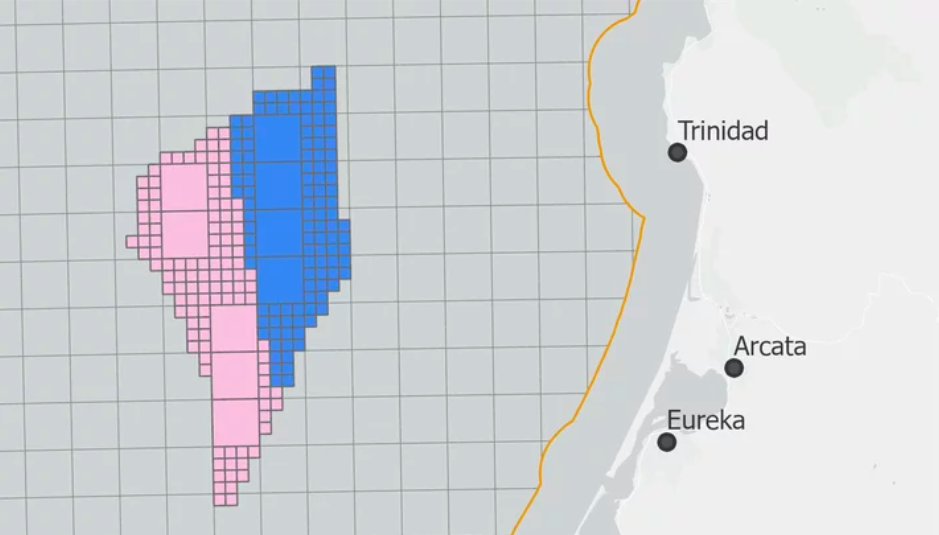
The two areas off Humboldt County’s shores that will be opened for wind energy leases on Tuesday, Dec. 6. Map: Bureau of Ocean Energy Management.
Here’s how the bidding process works:
On the morning of Dec. 6, all bidders will hop online for the monetary auction. All five lease areas will be offered up in a single auction. Each lease area has its own minimum bid requirement, ranging from $6.3 to $8 million. “There will be no distinction made between Lease Areas in the Humboldt WEA and the Morro Bay WEA within the auction process. Each bidder may only bid for one of the offered Lease Areas at a time and, ultimately, acquire only one of the Lease Areas in the auction,” as noted in the FSN.
Bidding will go in rounds until there are no new “live bids.” The auction will probably wrap up on the same day but if bids are still coming in at 6 p.m. EST the auction will continue the next day. After bidding ends, BOEM will determine the “provisionally winning bid” for each lease area through a two-step procedure.
In stage one, the highest single bid received for each lease area in the final round will be deemed the provisionally winning bid. In the event of a tie, selection of the winning bid will be deferred to stage two.
In stage two, BOEM will consider bids for lease areas that were not assigned in the first stage. Only bidders who were not assigned a lease area will be up for consideration. “BOEM will select the combination of such bids that maximizes the sum of the bid amounts of the selected bids … If there is a unique combination of bids that solves this maximization problem, then these bids will be deemed to be the remaining provisionally winning bids.”
The provisional winners and the winning bid amounts will be published shortly after the auction. Once the post-auction review is completed, BOEM will send off three unsigned copies of the lease to each provisionally winning bidder who must sign the lease agreement, file financial assurance and pay off any outstanding balance of their bonus bid within 10 days.
As soon as those requirements have been met and BOEM decides all is well and good, the lease will be executed. After that happens the leaseholder will begin the actual planning process.
“After they get the lease, then they go through the vetting process of planning and permitting,” Matthew Marshall, executive director of the Redwood Coast Energy Authority (RCEA), told the Outpost in a recent interview. “They’re going to have to work with tribes, work with commercial fishermen [and] work with the community. …There’s a lot in [the bid credit package] that requires [the developers] to have a robust community engagement process. There are a lot of stipulations that have really been pushed for by the California Coastal Commission.”
The RCEA appears on the list of bidders but, Marshall says, the local joint powers authority isn’t actually planning on making a bid.
“Back in 2016, when we were in the process of launching our Community Choice Energy program … we decided to explore offshore wind as a potential energy down the road,” he explained. A couple of years later, RCEA initiated conversations with developers and put together an Unsolicited Lease Request to pursue offshore wind on the North Coast. “That’s why we’re on the list as a proposed bidder. To submit that [request] we had to be a qualified entity.”
Even still, Marshall says RCEA will work closely with the winning bidder to ensure the project’s success.
“We want to see good projects move forward,” he said. “We’re going to continue to want to work with [future developers] to ensure they’re engaging local stakeholders and having a good process that’s transparent and supportive of community concerns. We want to make sure we end up with something that everybody’s excited about and proud of. We can’t put the local community sort of at the expense of broader climate goals and providing renewable resources to California.”
###
DOCUMENTS:
PREVIOUSLY:
- Biden Administration Proposes Offshore Wind Lease Sale, Including Two Spots Off the Humboldt County Coast
- IT’S ON: Humboldt Offshore Wind Leases to Go Up For Auction on Dec. 6
- Harbor District Announces Massive Offshore Wind Partnership; Project Would Lead to an 86-Acre Redevelopment of Old Pulp Mill Site
Despite Confession, McK Attempted Murder Suspect Claims He Only Wanted to Rob His Victim
Rhonda Parker / Thursday, Oct. 27, 2022 @ 8:33 a.m. / Courts
Despite his full confession to being a gang hitman hired to kill a McKinleyville man, Isreal Soria Jr. testified yesterday that his only intention was to steal Dylan Eubanks’s guns and marijuana.
Under questioning by defense attorney Christina DiEdoardo and cross-examination by Deputy District Attorney Trent Timm, Soria offered a three-word explanation for why he confessed: “I was high.”

Soria.
On June 24, 2021, Soria was packing a semi-automatic pistol with an extended, illegal magazine loaded with 32 bullets. He fired 11 rounds through a window of Eubanks’s home, striking Eubanks once in the arm. He then fled and was arrested in a neighbor’s back yard.
Soria told the arresting officer he had been hired by a Norteño gang member who believed Eubanks stole from him. He received a down payment of $7,500, with $25,000 due if he killed Eubanks.
That day, Soria says, he consumed a half-bottle of Johnny Walker whiskey, numerous shots of Don Julio 1942 tequila and some cognac. He also smoked concentrated marijuana and took his usual six to eight Xanax. This explains why he made a false confession, he says, but the truth is he only wanted “to rip (Eubanks) off.”
Eubanks had posted on Snapchat, bragging about his guns and money. More than 200 pounds of marijuana was found in his garage after the shooting.
In phone conversations while Soria was in jail, he told family members “I took those stupid pills and blacked out and did a bunch of stupid things.”
He also acknowledged to his mother that he had confessed his crimes.
“I ratted myself out,” he said. “I threw myself under the bus.”
But he also confirmed a scenario his mother presented. The gun belonged to Eubanks, not Soria. Soria wrestled the gun away and shot his way out.
“You needed to defend yourself,” the mother said.
“Yes, I did.”
Timm noted that despite Soria’s assertions about being high and blacking out, he now has a detailed memory of the shooting.
“You remember the incident of the shooting in precise detail. Is that true?”
“Yeah, it’s true.”
Soria now recalls that he went to Eubanks’s front door and looked through a window next to the door. He saw Eubanks approaching, empty-handed. He looked again and Eubanks was holding a 2-foot machete.
Soria said he panicked and ran to the back of the house, where he peered through a gap in the draperies and observed Eubanks and two assault rifles. Eubanks was holding one rifle, and when he raised it up Soria opened fire.
Soria was on the witness stand all day yesterday and is expected to continue testifying this morning.
Among the charges against him is premeditated attempted murder, which carries a maximum penalty of 25 years to life in prison. He also is charged with two counts of personal discharge of a firearm. This is California’s “Use a Gun and You’re Done” law, with a conviction adding up to 25 years to life to the sentence.
Soria posted bail and remains out of custody.
###
OBITUARY: Jose ‘Joe’ Valentine Rocha, 1931-2022
LoCO Staff / Thursday, Oct. 27, 2022 @ 6:56 a.m. / Obits
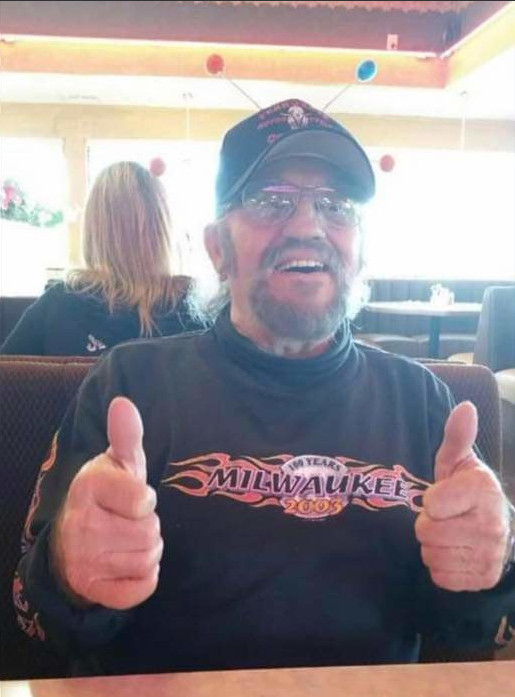
Jose “Joe” Valentine Rocha was born August 10, 1931, in San Bandan, Terciera, Azores in Portugal. Joe passed away September 26, 2022, in Fortuna.
Joe was preceded in death by his son, John Rocha and sisters, Theresa Rocha, Mary Frietas and Edith Rocha.
He is survived by his wife of 46 years Gail Rocha and daughters, Carmen Rocha and Mandy Rocha; sister Elmira LeScog and brother David Rocha; grandchildren Conner Newbry, Dillion Newbry, Savanah Jacobs, Christopher Jacobs, Lowel Archambault; great-grandchildren Zaiden, Carter, King and one on the way; nephews Lionel, Tony, Danny, and Todd; niece Maggie.
As a child in Portugal, he worked in his father’s blacksmith shop until at the age of 12 he started working at an American Air base during WWII. At the age of 17 Joe moved to the United States and worked as a milker on a dairy farm in Gustine, California from 1948 to 1950.
At the age of 19 Joe moved to Humboldt County, where he worked at Pacific Lumber for 16 years, from 1950-1966.
At the age of 35, Joe moved to San Rafael, where he worked in a brickyard until 1969. He then at the age of 38 moved to the Rohnert Park/Cloverdale area to work at the Golden Gate Bridge from 1969 to 1992, when he retired.
After retiring in 1992, Joe moved his family back to Humboldt to the Rio Dell area where Joe spent his remaining years.
Joe was a people person and never met a stranger. If you met Joe, you remembered him. He was not called “Wild Man Joe” for no reason, although most knew him as “Portuguese Joe.” Joe was big, loud and very proud of his Portuguese heritage. He LOVED riding his Harley. He loved cars, motorcycles and airplanes. In reality he just loved going fast.
There will be a celebration of Joe’s life Saturday, October 29, 2022, at 2:00 PM at the Rio Dell Fireman’s Hall.
###
The obituary above was submitted on behalf of Joe Rocha’s loved ones. The Lost Coast Outpost runs obituaries of Humboldt County residents at no charge. See guidelines here. Email news@lostcoastoutpost.com.
OBITUARY: Deanna Doris Deuel Lesku, 1943-2022
LoCO Staff / Thursday, Oct. 27, 2022 @ 6:56 a.m. / Obits
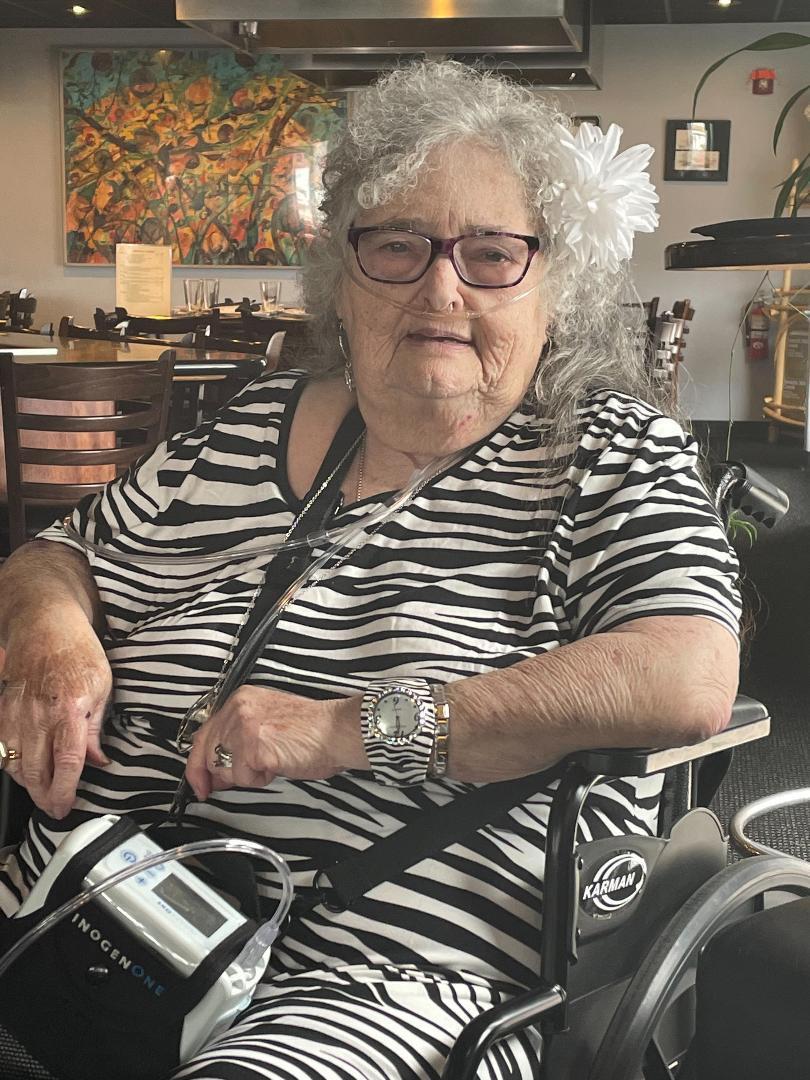
Deanna Doris Deuel Lesku passed away on Friday, October 21, 2022 at
Redwood Memorial Hospital. She was born on August 7, 1943 in Arcata to Francis and Elina Deuel.
Deanna attended Stewart Elementary, Arcata High School and Humboldt State University. She graduated from HSU in 1966 with a degree in Education. She began her teaching career at Dow’s Prairie in McKinleyville and retired in 2002 from Ferndale Elementary after 36 years of teaching. She taught at Ferndale for 33 years. During these years she taught first, second and third grades.
She had a passion for teaching. She brought her own flair to her style of teaching. She was the original Miss Frizzle. She dressed to match her curriculum and made learning fun in her classroom. She had a lollipop tree for spelling, crocheted Christmas stockings for each child every year and made many other crafty items for her students. She will be forever known as the Flamingo Lady. After her retirement, she continued to help in the schools by substituting, reading to various classes, helping in her daughter’s classroom and reading at the Fortuna Library.
Deanna was always involved with her church, whether it was as church secretary, President of the women’s group, teaching Sunday School or serving on the Church Council. She was a loyal member of Christ Lutheran Church in Fortuna.
Deanna married the love of her life, Laszlo Lesku, on June 8, 1968. They enjoyed many happy years together until his death in 2014. Her devoted daughter Erika was born in 1971. Deanna and Erika spent many happy times together traveling, shopping and other adventures. She was the most loving and devoted mom to her daughter.
Deanna was very crafty and loved to share her talent with others. She was always making pins or crocheting something. She loved to give these treasures to others to uplift them. She continued her crafts up until a few weeks before she passed in spite of her physical limitations.
Deanna was preceded in death by her parents Francis and Elina Deuel and her beloved husband Laszlo. She is survived by her daughter Erika, son-in-law Demetrius Williams and granddaughters Kaelyn, Aaliyah and Jasmine Williams. She also leaves behind her brother Darrel Deuel and his wife Janet, her niece Jamie Eisenbeisz (Tim) and nephews Dan Deuel (Miriam) and Darren Deuel (Candace) and her great nieces and nephews Tori, David, Cody, Emily, Justin, Tatum, Peyton, Josie, Isaac, Christopher and AiLan. She also leaves behind special friends Pat, Dottie, Ilene, Pam and Corinne.
There will be a private burial at Ocean View Cemetery and a memorial service on Friday, October 28 at 1 p.m. at Christ Lutheran Church in Fortuna. Deanna loved bright colors and dressing for every holiday, so if you attend please dress in some way that honors her sense of style, even if it is wearing something crafty she made you.
The family would like to thank the doctors, nurses and staff at Redwood Memorial Hospital for their great care, Dr. Tamara Douglass for her years of care and her caregiver Mary Murphy.
###
The obituary above was submitted on behalf of Deanna Lesku’s loved ones. The Lost Coast Outpost runs obituaries of Humboldt County residents at no charge. See guidelines here. Email news@lostcoastoutpost.com.
OBITUARY: Andrew McKaye, 1923-2022
LoCO Staff / Thursday, Oct. 27, 2022 @ 6:56 a.m. / Obits

Andrew McKaye of Fortuna died on
October 18 at the age of 99.
He was born on October 12, 1923 at Diamond Lake, Michigan, where he spent the summers of his childhood and youth. During the school year he lived in South Bend, Indiana, which he considered home.
In 1941 he graduated from South Bend Central High School and nine days later, on June 12, he enlisted in the U.S. Navy. He made the navy a career and retired in August 1961 after attaining the rank of Senior Chief Hospital Corpsman. He was a veteran of World War II, the Korean War and the Vietnam War.
After completing his naval service he attained a degree and teaching credentials at San Francisco State University. For 24 years he was a teacher and librarian for South Fork High School in Miranda.
In 1947 he married Jean Collins of New York City who preceded him in death in September 2019. They had a son, Professor Kenneth Robert McKaye, who is a permanent resident in both Cape Maclear, Malawi and Helsinki, Finland; and two grandchildren, Mark Robert, now in Connecticut, and Lara Nicole now in Seattle.
Andrew was a dedicated conservationist and educator who requested that donations or contributions be made to any conservation organization, especially ones that focus on preserving redwoods and Beaches of Northern California.
A celebration of his life will be held at Redwood Lodge Conference Center 1800 Riverwalk Drive, Fortuna between 1:30 and 4:30 p.m. on August 27 2023. RSVP: For additional information contact andy.party2023@gmail.com.
###
The obituary above was submitted on behalf of Andrew McKaye’s loved ones. The Lost Coast Outpost runs obituaries of Humboldt County residents at no charge. See guidelines here. Email news@lostcoastoutpost.com.