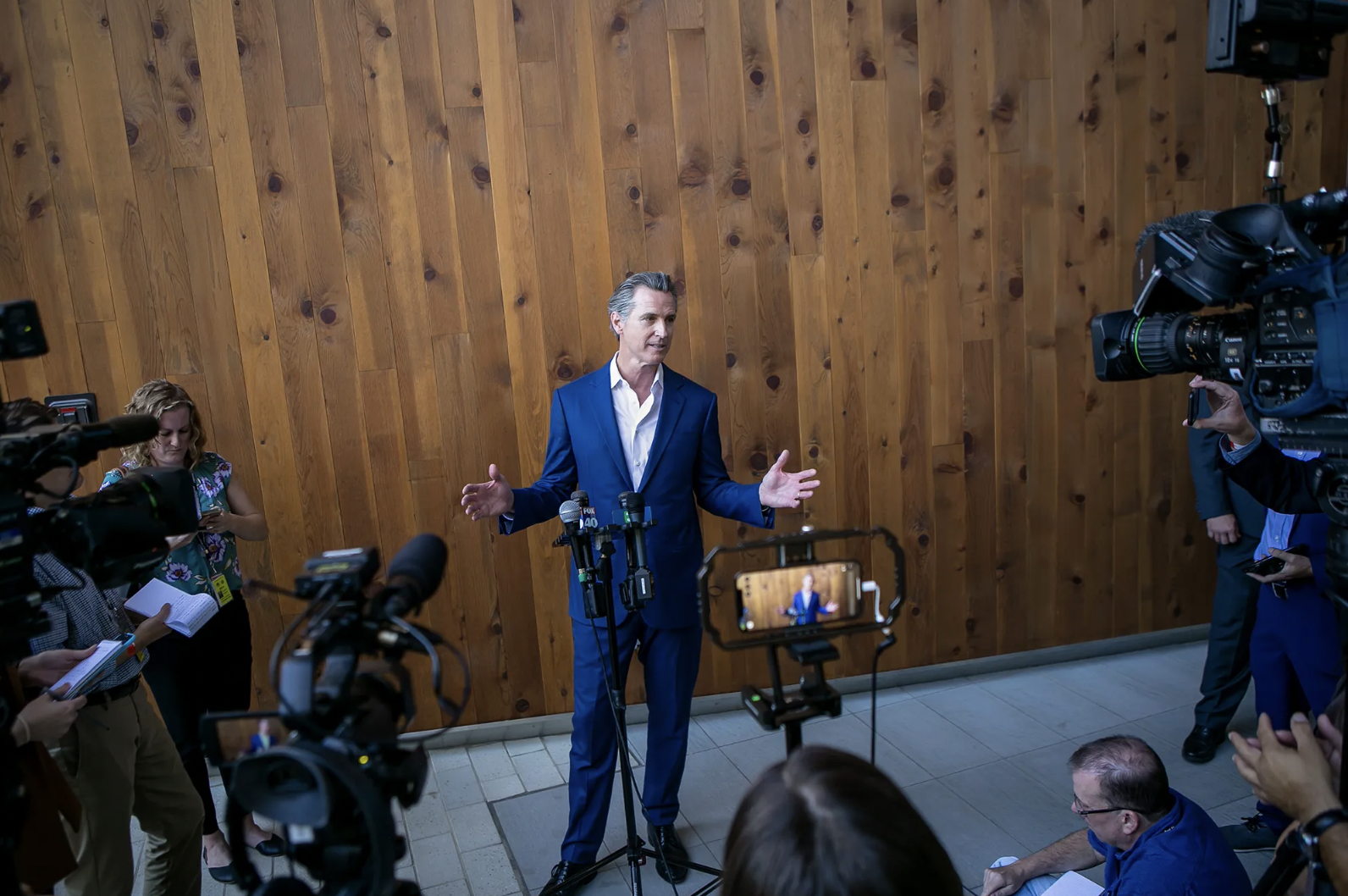
Gov. Gavin Newsom tells reporters he’s calling a special legislative session on an oil windfall profits tax to fund rebates in Sacramento on Oct. 7, 2022. Photo by Rahul Lal, CalMatters
Gov. Gavin Newsom plans to call a special legislative session in December to push for a tax on oil industry profits, the latest escalation in a feud over soaring gasoline prices that Newsom calls greedy and manipulative.
Newsom said today that he would convene the special session on Dec. 5, the same day that a new class of lawmakers is sworn in. The work will take place on a separate track from the regular session to focus attention on what Newsom said has become one of the most urgent priorities for Californians: an “inexplicable” gap between gas prices in California and the national average that has grown to a record $2.50 a gallon.
“This is just rank price-gouging,” Newsom told reporters following a speech in Sacramento, adding, “There’s nothing to justify it. Nothing. Not one thing.”
Gas prices in California have soared in recent weeks to an average of $6.39 per gallon, as of Friday, according to AAA, near the highest they’ve ever been. That compares to a national average of $3.89 per gallon.
Analysts have blamed maintenance-related shutdowns at several refineries in California, constricting the supply of a special blend of gasoline mandated by the state to reduce pollution.
But Newsom said that the stoppages had knocked less than 6% of production offline, not nearly enough to justify the surge in costs at the pump. He said oil companies were clearly taking advantage of the situation to manipulate prices and pad their profits.
“This is one of the greatest fleecings for consumers in world history,” he said.
In a statement, a representative for the oil industry said the Legislature could better use its time reconsidering decades of energy policy that have driven up costs for Californians, rather than passing another tax that would only raise prices further.
“If this was anything other than a political stunt, the governor wouldn’t wait two months and would call the special session now, before the election,” said Kevin Slagle, a spokesperson for the Western States Petroleum Association. “This industry is ready right now to work on real solutions to energy costs and reliability if that is what the Governor is truly interested in.”
Newsom, who originally unveiled his plans for a so-called “windfall tax” on oil companies a week ago, had few additional details to share today. He said he had been studying examples from other countries, including Italy, Spain and the United Kingdom, and exchanging ideas with legislative leaders over the past few days. The plan could take the form of an excise tax, he said, with revenue being returned to taxpayers as rebates.
Despite his urgency, he said convening the special session in two months would give his team time to “get our ducks in a row” — developing a strategy that can get through the Legislature, where a two-thirds vote by both houses is required for any tax measure, and stand up to expected legal challenges by the oil industry.
“It’s about doing it right, not fast,” he said. “We want to be deliberative.”
While Newsom’s proposal was cheered by environmental groups, it remains to be seen what level of enthusiasm there will be in the Legislature, where the governor twisted arms to pass a sweeping package of climate measures over the summer. (The oil industry has already filed a referendum to overturn one of those, a setback requirement around oil and gas wells.) Dozens of new lawmakers will be taking office in December and the first issue they will now be asked to consider is a tax.
“A solution that takes excessive profits out of the hands of oil corporations and puts money back into the hands of consumers deserves strong consideration by the Legislature,” Senate President Pro Tem Toni Atkins, a San Diego Democrat, and Assembly Speaker Anthony Rendon, a Lakewood Democrat, said in a joint statement. “We look forward to examining the Governor’s detailed proposal when we receive it.”
Republicans, who comprise a superminority of the Legislature, criticized the tax plan as insulting and said that it would drive up prices further because oil companies would pass on the cost.
“The only reason to call a special legislative session would be to suspend the gas tax, reduce the fees and regulations that make California gas so expensive, and allow permits to increase production to lower gas prices,” Assemblymember Vince Fong, a Bakersfield Republican who is vice chairperson of the Assembly budget committee, said in a statement.
Today, Newsom once again rejected calls to suspend the state’s 54-cent-per-gallon gas tax, because he said oil companies would simply pocket the savings. He said a windfall tax was the bold approach needed after years of “too timid” studies and investigations into excessive gas prices in California.
“That just offsets their greed and avarice,” he said of suspending the gas tax, “when in fact we should be going after that greed and addressing the anxiety of people at the same time.”
###
CalMatters.org is a nonprofit, nonpartisan media venture explaining California policies and politics.
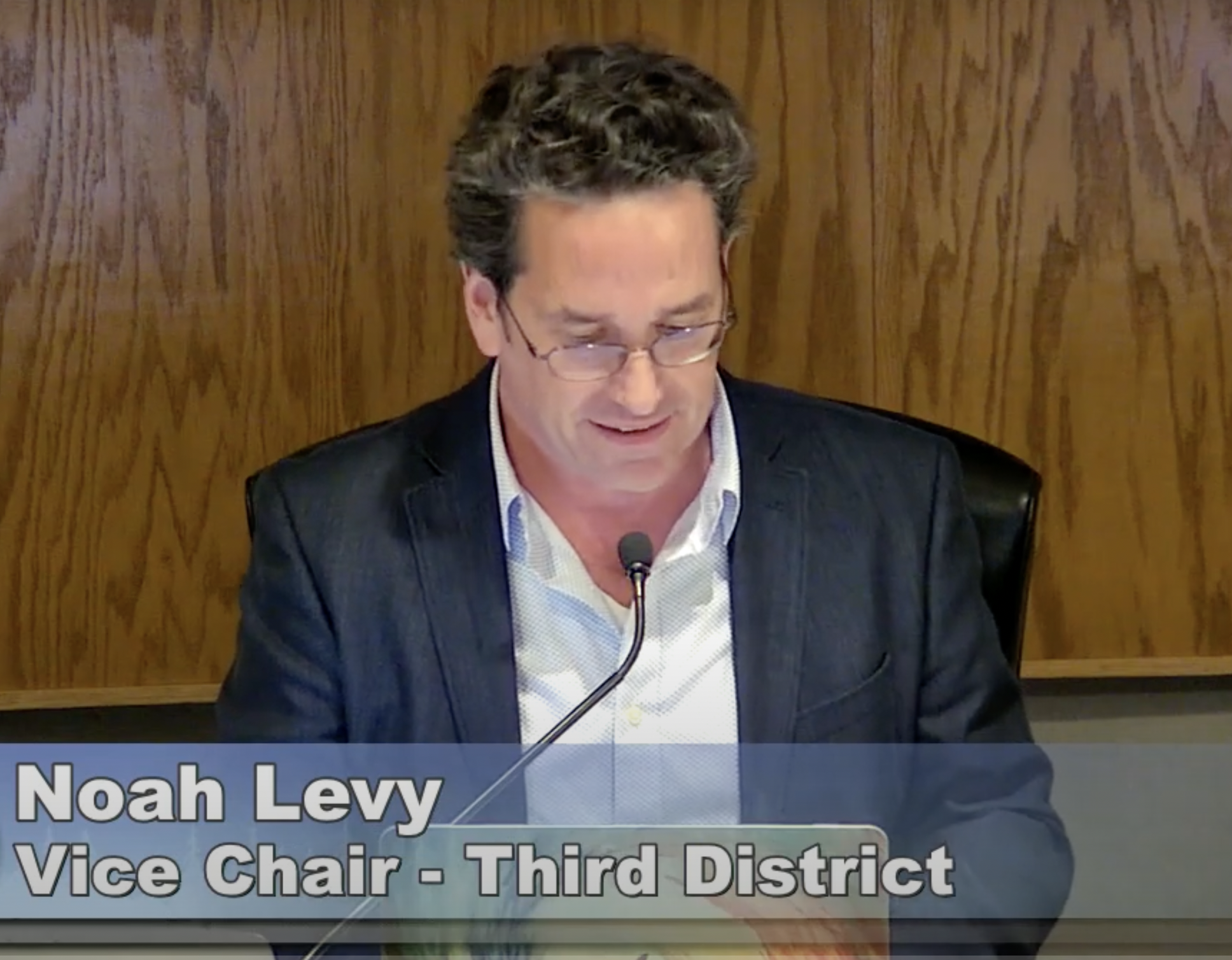
Planning Commissioner Alan Bongio speaks during last night’s meeting. | Screenshot.
###
Humboldt County Planning Commissioner Alan Bongio quietly stepped down from his position as chair sometime prior to Thursday’s meeting, handing the reins over to Noah Levy, who stepped up from his vice-chair position to lead the night’s proceedings. The resignation had been requested by the Humboldt County Board of Supervisors, who unanimously censured Bongio at their September 20 meeting.
Late in yesterday’s meeting, the commission unanimously approved a letter of apology to local Wiyot-area tribes for Bongio’s “insensitive” and “racist” comments during an August 18 hearing — though not before quibbling over the draft language. The debate over how best to wordsmith the mea culpa included a warning from Bongio about the risks of being too “woke” or “politically correct.”
Levy misidentified as “Vice Chair.”
There was some confusion at the outset, with Levy identifying himself as “vice chair” before correcting himself after everyone had recited the Pledge of Allegiance. The chyron displayed on streaming video also identified Levy as vice chair, and when Bongio first appeared onscreen the chyron incorrectly listed him as “chair.” Both titles were later corrected mid-stream.
However, it’s not clear whether the informal changing of the guard, which occurred behind closed doors, was sufficient public process to make Levy the new chair on a full-time basis. Attempts to get an answer from county staff on Friday were unsuccessful.
During the meeting’s first public comment period, local anti-vaccine activist Donnie Creekmore defended Bongio, saying the longtime commissioner had “failed to show any semblance of racism.” He also accused local tribes of embracing “the woke-left ideology of weakness.”
Creekmore’s perspective was countered by a Trinidad resident who identified himself only as Andrew. He asked for Bongio to resign from the commission altogether over the recent revelation, published in the North Coast Journal, that Bongio personally performed concrete work on the property of local developer Travis Schneider and yet never publicly disclosed his labor. Schneider’s various permit violations on his “dream home” project, located on Walker Point Road near the Indianola cutoff, were the topic of the commission’s heated August 18 hearing.
“That’s a major breach of trust with the public,” Andrew said, regarding Bongio’s undeclared concrete work. “Whether or not he was paid, he still did work that was of value. That is a breach of trust … and it warrants his dismissal from the commission.”
The commission moved on to other business but returned to the matter of the apology letter about an hour later.
Commissioner Peggy O’Neill, who represents the Fifth District, said she didn’t like the way the draft apology was written because it insinuated that “as a group that we did nothing and that we’re all responsible. I don’t feel responsible for someone else’s behavior,” she said.
O’Neill said she did speak up during the August 18 hearing, and she reiterated her objections to comments made that night, including Bongio’s repeated use of the term “the Indians” to refer to two or three different Wiyot-area tribes — the Bear River Band of the Rohnerville Rancheria, the Blue Lake Rancheria and the Wiyot Tribe.
“It’s not just a word, but sometimes it’s how you use that word that makes it inappropriate … ,” she said. “I mean, even though they are Native American people, they are different and you can’t lump them together … . I think in that regard it was insensitive to use that word the way it was being used, because you have different histories, you have different languages, you have different experiences that have gone on and you need to be respectful of that.”
She added, “I went home that night very upset, feeling like I had gone back in time and wondering if if everyone really knows our local history.”
Bongio then spoke up, saying he was “not trying to make excuses for any of that meeting” but then adding that if the commission fails to “ask hard questions” and “delve into things” then it is “just as big of an injustice to the County of Humboldt.”
“And there’s some things that didn’t add up that night,” Bongio said. “I’m just saying that I think we run a real risk when we’re so worried about being politically correct or I don’t even know what the term [is] — woke enough. … I’m just saying, we need to have respect in the discourse and I will say it was not my best night. … I’m just trying to be honest here, but I think we go down a really slippery slope if we don’t be open to talk about the project and the whole thing, whatever it is … .”
After Bongio’s comments, Planning and Building Director John Ford asked the commission to take a break, saying, “I just sense that this could get very, very sensitive. … I don’t want to avoid the conversation, but I also am concerned about how this conversation can go.”
Levy said he was open to that suggestion but wanted to let Commissioner Melanie McAvour speak first. The commission never wound up taking the requested break.
McAvour also quibbled with some of the language in the draft apology letter, saying she was concerned about signing it when she had recused herself from the August 18 hearing, at which she participated only as the Tribal Historic Preservation Officer for the Bear River Band of the Rohnerville Rancheria.
“I agree with Commissioner O’Neill, that people should take responsibility for their own actions and words, and I don’t necessarily agree with a letter that is all-encompassing, especially if others feel uncomfortable with that,” McAvour said.
She suggested that the letter could invite tribal representatives to a luncheon rather than a meeting to help repair the damaged relationship with the county, and she said that while Schneider should bear responsibility for knowing the terms of his coastal development permit, the county planning department also bears some responsibility for not catching his violations sooner.
“The monitoring was really, really poor, as it often is in environmental impact assessment generally, honestly. It’s the weak link,” McAvour said.
The commissioners debated other aspects of the apology’s wording, with some pushing for it to say the balance of the commission “did not do enough to address the problem” rather than “did nothing to address the problem in the moment.” That change was made.
Fourth District Commissioner Mike Newman sought to “take the temperature” of his colleagues by asking their thoughts on removing the words “racist” and “biased” while leaving in “insensitive.”
“I think ‘insensitive’ is enough, there, in my opinion,” he said.
O’Neill initially agreed, reiterating her discomfort at taking responsibility for actions that weren’t her own. “I think that that evening there was a few insensitive and biased and racist opinions, but they didn’t come from all of us,” she said.
Ford then spoke up for the draft language. “In all honesty,” he said, “part of a good apology is to completely own what happened and not try to understate it and make it seem like it wasn’t as bad as it really was. And this letter was written to forcefully state that what happened was inappropriate.”
“I do agree that I could have done more,” O’Neill said, “and I felt really bad, that I didn’t do more in the moment.”
After some more discussion, Commissioner Thomas Mulder made the motion to approve the letter with the minor edits that had been made. Newman seconded the motion, and the roll call vote to approve was unanimous. Below is the text of the letter:
Dear Jason Ramos and Tribal Council:
The intent of this letter is to express our sincere apology to the Wiyot People. At the Planning Commission meeting of August 18, 2022, several comments were made that were inappropriate and traumatic. First, we as a body unequivocally recognize that these comments were insensitive, racist, inconsistent with the values of the County of Humboldt, biased and understandably may have shaken your faith in the impartiality of this Commission. We further recognize that the comments added to past injury and injustices resulting from governmental actions. We, as the Humboldt County Planning Commission concede we did not do enough to address the problem and therefore, are all responsible. We understand this has damaged the relationship between the Planning Commission and the Wiyot people and that cultivating a positive relationship with the Wiyot people will require time and commitment.
We apologize for each of our roles in this event and ask your forgiveness. If you would be willing, we would like to schedule a luncheon outside the Board of Supervisors Chambers to hear from you, grow in our understanding and seek restoration.
Should you decide to meet with us, we would welcome your input on additional steps the Commission could take that you feel would contribute to our individual and collective growth and facilitate a rebuild of our important relationship.
Thank you for your consideration,
Sincerely,
Humboldt County Planning Commission
Alan Bongio, Noah Levy, Peggy O’Neill, Thomas Mulder , Brian Mitchell, Mike Newman, Melanie McAvour (recused from August 18 meeting)
At 6 a.m. on Monday, October 10, the Northern California Condor Restoration Program (NCCRP) will attempt to release two more prey-go-neesh (California condors) into Yurok ancestral territory. The potential release can be viewed live on the Yurok condor cam, which can be found here. On Monday morning, Yurok Wildlife Department Director Tiana Williams-Claussen will be providing real-time commentary on the release via Facebook Live. The livestream can be viewed here.
“We are extremely excited to start releasing our second prey-go-neesh cohort,” said Yurok Wildlife Department Director Tiana Williams-Claussen. “The birds we released in the spring and summer are doing great. I would like to thank all of our project partners and supporters for their contributions to the Northern California condor recovery effort.”
For the release, NCCRP biologists will employ a multistep procedure to keep the juvenile birds as calm as possible during the transition into the wild. First, the NCCRP team will wait for previously released prey-go-neesh to land within sight of the condor release and management facility. The free-flying birds signal to the captive condors that it is safe to exit the flight pen. Second, the NCCRP will open the door to a trap on the side of the flight pen. The gate will remain open until two birds enter the enclosure, which serves as a staging area. Once this occurs, the staging area door will be opened and the birds will have access to the outside world. Prior to the release, the birds must voluntarily enter and leave the staging area. The timing of the release is entirely contingent upon the birds’ movements. Additionally, young, captivity-raised prey-go-neesh are incredibly cautious. It might take multiple days for them to depart from the facility.
The two condors are part of a group of four. Over the next month, the NCCRP will release the remaining two prey-go-neesh. When the NCCRP releases the fourth member of the second cohort, there will eight free-flying condors in Yurok Country. The staggered release is one component of a comprehensive plan to ensure the success of the young birds. The newest condor cohort arrived in mid-August and has had ample time to acclimate to the local environmental conditions and become familiar with the NCCRP’s wild condors. The cohort is comprised of three males and one female. All of the birds were born between April and June of 2021. The Oregon Zoo’s Jonsson Center for Wildlife Conservation and the Peregrine Fund’s World Center for Birds of Prey each reared two of the prey-go-neesh. Releasing juvenile birds is a standard practice at all of the condor reintroduction sites in the US and Mexico. Decades of data show that young condors are more resilient and fare much better in the wild. The NCCRP, a partnership between the Yurok Tribe and Redwood National and State Parks, plans to reintroduce one cohort of prey-go-neesh every year for at least the next two decades. The tribe and park collaboratively manage the population.
In May, the NCCRP released the first of four condors to fly over Yurok skies in more than a century. The fourth bird was reintroduced to the wild in July. The birds include: Ney-gem’ ‘Ne-chween-kah (She carries our prayers, A0), Hlow Hoo-let (Finally, I/we fly A1), Nes-kwe-chokw’ (He returns/arrives, A2) and Poy’-we-son (The one who goes ahead, “leader” A3). The condors are thriving in the redwood region.
The Yurok Tribe and Prey-go-neesh
The Yurok Tribe initiated the condor reintroduction project in 2008. The restoration of this sacred species is an important element of a far-sighted plan to bring balance back to the coastal rainforest ecosystem in Yurok ancestral territory on the far Northern California coast. In addition to the reintroduction of the critically endangered condor, the Tribe is currently restoring fish and wildlife habitat on a landscape scale in the Klamath River basin. The Tribe is also intimately involved in the pending removal of four Klamath River dams, which represents the largest river restoration project in US history. The removal of the dams will benefit a wide diversity of fish and wildlife species, including condors.
With funding support from the Yurok Tribe, Redwood National Park, the U.S. Fish and Wildlife Service, the Bureau of Indian Affairs, the Administration for Native Americans, as well as Pacific Gas and Electric Company, Global Conservation Fund, the Redwood National Park Foundation, and many more corporate, agency and private supporters and citizens, the Yurok Wildlife Department completed a vast volume of work to prepare for the reintroduction of this imperiled species. Working in cooperation with the Ventana Wildlife Society, Redwood National Park, California State Parks, and Pacific Gas and Electric Company, as well as volunteers, the Tribe designed and built the NCCRP release and management facility. The flight pen includes a simulated, shock-wired power pole (to teach the birds to avoid this threat after release), two four-foot diameter pools and perches overlooking old-growth redwood forest. NCRRP staff monitor the birds from modified shipping containers which form a fire-resistant observation structure. The facility is also is designed to allow biologists and technicians to conduct regular health assessments and provide treatment if necessary.
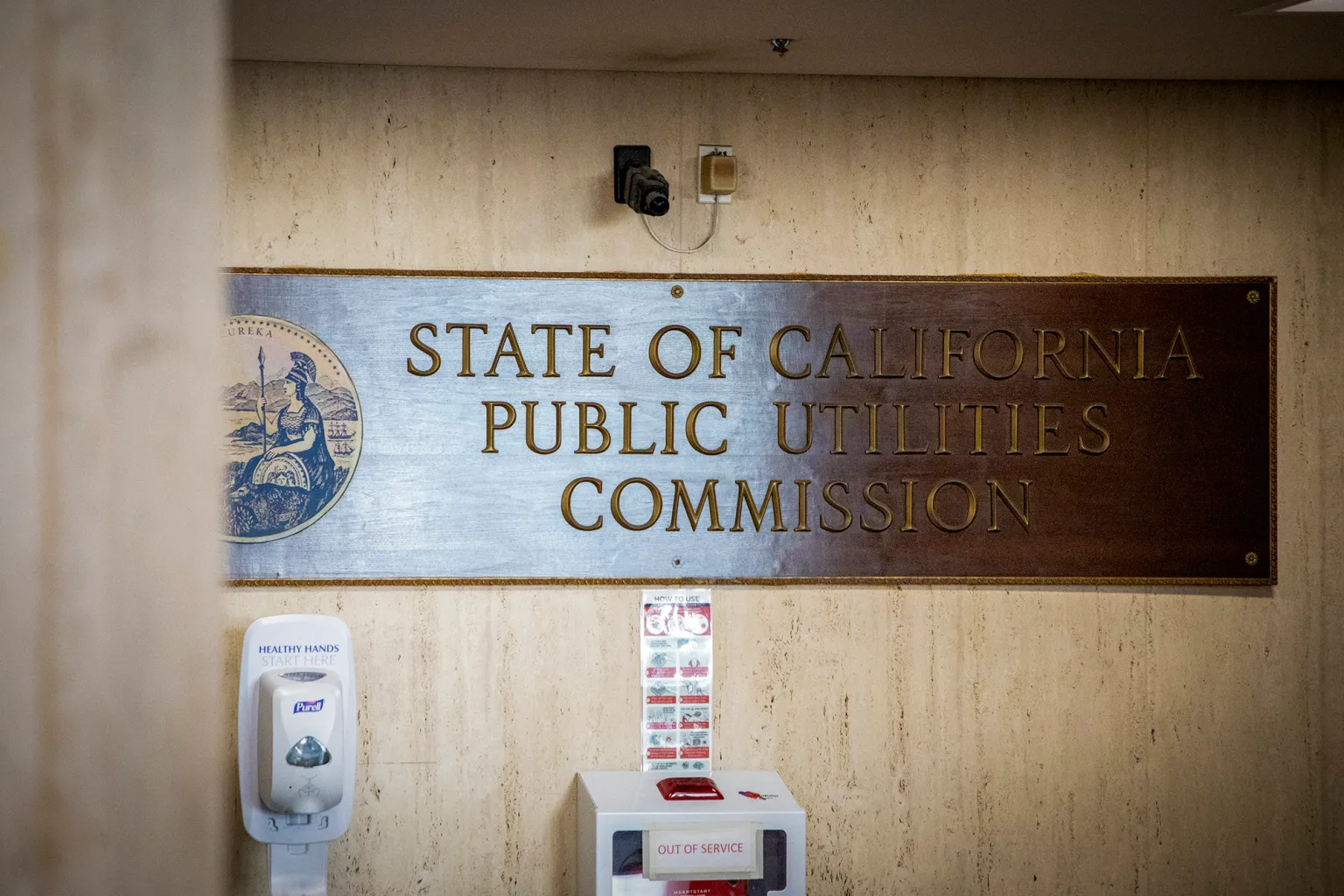
The California Public Utilities Commission offices at the Edmund G. Pat Brown building in San Francisco on Jan. 28, 2022. Photo by Martin do Nascimento, CalMatters
###
A day before the California Public Utilities Commission was to vote on a rule that would have shrunken subsidies low-income residents use for phone and internet services, officials pulled the item from the commission’s agenda.
Under the proposed rule, low-income California households who qualify for federal help to pay for phone service and internet access would have lost some or all of their California LifeLine monthly discounts. The result: Instead of being able to stack three discounts, most California LifeLine users would have been limited to two, for a total of up to $39.25 in discounts a month.
The commission was scheduled to discuss and vote on the proposal at its meeting Thursday but officials removed it from the agenda without a written explanation. A commission spokesperson did not respond to requests for comment.
The withdrawal comes after months of objections and mounting pressure from state legislators, LifeLine provider companies, and ordinary Californians who submitted 38 public comments to the commission.
The California LifeLine program provides discounts to low-income households for phone and internet services. It is similar to and sometimes is used with the federal Lifeline program.
In August, Assemblymember Sharon Quirk-Silva, a Buena Park Democrat, and eight other legislators sent a letter to the commission urging it to amend the proposal.
“This proposed decision would make critically needed broadband services for potentially millions of low-income Californians harder to afford at a time when they are struggling from the harmful impacts of the pandemic and record inflation,” Quirk-Silva wrote.
The bipartisan group of Assembly members also expressed concern in the letter about the commission’s analysis of its new rule, which claims that 6 gigabytes of wireless data is sufficient for low-income Californians.
By contrast, the average smartphone user in the United States used 11GB or more each month in 2020, according to Ericsson, a Swedish telecommunications company.
Costs of staying connected
Similarly more than 8,000 Californians signed an online petition urging the commission to allow residents to receive unlimited wireless connectivity with all three state and federal discounts.
Until March of this year, low-income families were able to leverage up to $75 a month in discounts from a combination of three subsidies. They could “stack” two federal subsidies and one California LifeLine subsidy to pay for phone and internet.
In May 2021, the federal government created the Emergency Broadband Benefit, a $50-per-month subsidy to support families struggling to stay connected in the pandemic. The government phased out the program late last year and replaced it with the Affordable Connectivity Plan, a slightly slimmer discount of $30 a month.
‘This proposed decision would make critically needed broadband services for … low-income Californians harder to afford at a time when they are struggling from the harmful impacts of the pandemic and record inflation.’ — Assemblymember Sharon Quirk-Silva, Democrat from Buena Park
At the same time, California’s LifeLine program provided a $16.23 per month discount for low-income households.
Currently consumers are able to apply the Affordable Connectivity discount and one LifeLine plan per household, either the state or the national LifeLine plan.
The proposed rule would have permanently cut the amount of California LifeLine subsidies to $9.25 for a family that also receives federal support, giving them a maximum of $39.25 a month.
But now with the plan withdrawn, the commission has a number of options moving forward, said supporters of the rule. It can make revisions to the proposal, propose a new one, or not vote on one at all.
Under current rules set by the commission, LifeLine plans have to offer unlimited voice and text as well as 6 gigabytes of data per month.
Is it a victory?
Ashley Salas, an attorney for the consumer advocacy group The Utility Reform Network, doesn’t know why the commission withdrew the decision.
“I wouldn’t put too much significance into it,” Salas said. “Right now, there aren’t any providers that are offering both (Affordable Connectivity Plan) and LifeLine service discounts in California. It doesn’t move anything right now.”
LifeLine providers, however, see the withdrawal as a step in the right direction toward expanding how low-income consumers can use their phone and internet discounts. Also the more generous and flexible subsidies would add to the companies’ bottom lines.
Rudy Reyes, Verizon’s west region vice president and general counsel, said the withdrawal was a “great victory” in the larger fight for improving service for California LifeLine consumers. Last year the telephone giant acquired Tracfone Wireless, a LifeLine provider.
Asm. Sharon Quirk-Silva has taken at least
$6.7 million
from the Party
sector since she was elected to the legislature. That represents
51%
of her total campaign contributions.
Reyes says it is a sign that the commission is listening to the needs of low-income consumers, but the commission still needs to make clear how providers can use the Affordable Connectivity Plan benefit and what that will mean for consumers.
“I cannot count how many times things wither on the vine at the commission,” he said. “Proceedings like this can go on for years with no resolution.”
The commission will next meet on October 20.
###
CalMatters.org is a nonprofit, nonpartisan media venture explaining California policies and politics.
Prop.
27 would allow
licensed tribes and gaming companies to offer mobile and online
sports betting for adults 21 and older outside Native American tribal
lands. Gaming companies — such as FanDuel and DraftKings — could
only offer sports betting if they made a deal with a tribe.
The
proposition creates a new division within the state’s Justice
Department to regulate online sports wagering. That division could
also decide whether to approve new forms of gambling, such as betting
on awards shows and video games. It also gives the Justice Department
additional powers to address illegal sports betting.
Tribes
and gaming companies would pay fees and taxes to the state that could
total several hundred million dollars a year, state
analysts estimate.
The actual amount is uncertain, in part because gaming operators are
allowed to deduct certain expenses to reduce their tax bill.
After
covering the state’s new regulatory costs, most of the money would
be used to address homelessness and for gambling addiction programs,
while 15% would go to Native American tribes that aren’t involved
in sports betting.
The
U.S. Supreme Court allowed states to legalize sports betting in 2018.
Since then, 35
states plus D.C.
have made the move. It’s proven to be big business: Americans bet
more
than $57 billion on sports betting
in 2021. The explosion of sports betting has also concernedadvocates,
who say that gambling addiction will increase, and that research into
the long-term effects of legalizing sports betting has fallen short.
Supporters
say Prop. 27 would create a permanent source of funding to reduce
homelessness and will allow every tribe to benefit — including
tribes that decide not to offer sports betting. It would protect
against underage gambling with fines for violators and would prohibit
betting on youth sporting events.
Opponents
say that Prop. 27 would turn every cellphone and computer into a
gambling device. They say it would escalate the risks of underage and
problem gambling. They also say it would drive business away from
tribal casinos and threaten
tribal sovereignty
because tribes would have to give up some of their rights in order to
offer sports betting. And they argue that most of the money would go
to companies in other states.
Eugene
Dale Coleman, born April 29, 1940 in Scotia, passed away peacefully
on September 22, 2022 in his home in Orleans. Eugene was a member of
the Karuk tribe and a lifelong resident of Humboldt County. Eugene
lived most of his life in the Weitchpec and Orleans area, where he
and the one and only love of his life of 59 years, Billie Sue, raised
six children.
Like
most men in the area, Eugene started working in the woods and would
soon find his passion of driving truck. Eugene would be known to be
one of the best when it came to hauling a load of logs off the hill,
he would drive truck for over 50-plus
years before finally retiring at the age of 80 years young.
Another
skill which he would hand down was the art of eel basket making and
stripping the eels, an art he would pass down to his children,
grandchildren and great-grandchildren. Eugene loved to sit with
friends and family and tell stories. You
knew he was ready to tell a joke by watching his eyes and then a
little twitch he made with his lip, you knew it was going to be a
good one, because he would smile, followed by a brief chuckle. If you
knew Eugene really well, you knew he would tell you the three things
that were most important to him were: his
wife Billie Sue’s love, being
a good
truck
driver,
and having longevity.
Eugene will be greatly missed by all who had the pleasure to have
known him.
Preceded
in death by his father,
Phillip Allen Coleman; mother,
Nancy Ella Sanderson; brothers
Larry Coleman and Antone Detrick; sister
Phyllis Wantt; daughter
Terry Harrison; grandchildren
Kevin Lane Jr, Phillip Coleman and Nikki Starr Owen McCovey.
Eugene
is survived by his wife and soulmate of 59 years, Billie Sue; sisters
Judy Scott and Voncie Detrick; sons Tracy Coleman (Barbara Coleman),
Phillip Coleman (Ruby Coleman); daughters Angela Coleman, Samantha
Sylvia Myers (Dewey Myers), Lisa McGinnis (Dakota McGinnis Jr.), Ella
Kane (Bob Kane Sr.) and 26 grandchildren and 55 great-grandchildren
and numerous nieces and nephews. And you can’t forget his trusted
companion Macky the dog.
Funeral
services were held at the Karuk Tribal DNR building in Orleans on
Saturday October 1, 2022 at 11 a.m.
Officiated by Lucinda Myers; pallbearers
were Tracy Coleman, Phillip Coleman, Dakota McGinnis Jr, Dewey Myers,
Bob Kane Sr., Archie Wantt, Sonny Sanderson.
Honorary
pallbearers,
Travis Coleman, Joey Coleman, Lloyd Owen Jr., Chaygee Sylvia,
Treffery Sylvia, William Sylvia, Jacob Lane, Eugene Coleman,
Creedence Coleman, Burt King, Tommy Horn.
Eugene’s
wife and children would like to express their overwhelming sense of
gratitude to the family, friends and community members that went
above and beyond without hesitation to offer generosity, love and
respect in this time of great loss. Forever Grateful.
###
The obituary above was submitted on behalf of Eugene Coleman’s loved ones. The Lost Coast Outpost runs obituaries of Humboldt County residents at no charge. See guidelines here. Email news@lostcoastoutpost.com.
On
October 2, 2022, Mary Jo Pelascini passed away quietly with her
children by her side after an almost three-year battle with cancer at
the young age of 69. She was born Mary Eggel on March 12, 1953 to
Emil and Olga Eggel of Orick. She was the youngest of five siblings,
preceded in death by her brother James and sister Kathleen, survived
by brothers Thomas and Robert.
Since
she was nine years old, she was active in 4-H and later FFA. She held
offices in both organizations for many years. She raised a Reserve
Champion Dairy, Junior Champion pig and Champion steer while in FFA.
She was the FFA Chapter Sweetheart in 1971, and a 1971 graduate of
Arcata High. Mary spent all but four years of her life in Humboldt
County. Living in Orick, Arcata, Eureka and finally Ferndale. She had two children. Danniel Pelascini who currently lives in Fort Worth,
Texas working for Lockheed Martin as an Aerospace Engineer and Julie
Clark who currently lives in Grants Pass, Oregon where she’s a
disabled combat veteran, with her husband, Mary’s favorite
son-in-law: Bill Clark. Julie and Bill gave Mary three grandchildren:
Forrest, Joseph and Bobbie Ann.
Mary
worked a long time as a collection specialist at McMahan’s
Furniture before switching over to the collections department at
Coast Central Credit Union, where she retired four years ago. Halloween
was her favorite holiday and she went all out every year. She won
many local and work contests. She was also a key figure for the
family’s yearly Thanksgiving reunion at the Swiss Hall. She shied
away from no task.
Mary
loved to dance, was an active member of the Moose Club, enjoyed
country music, thrift shopping, remodeling her house and her three grandchildren.
There
will be a gathering in her remembrance from 1 p.m. to 2 p.m. on
Saturday October 29 at the Swiss Hall located at 5403 Tompkins Hill
Rd, Loleta, CA 95551. Please just come as you are.
###
The obituary above was submitted on behalf of Mary Pelascini’s loved ones. The Lost Coast Outpost runs obituaries of Humboldt County residents at no charge. See guidelines here. Email news@lostcoastoutpost.com.