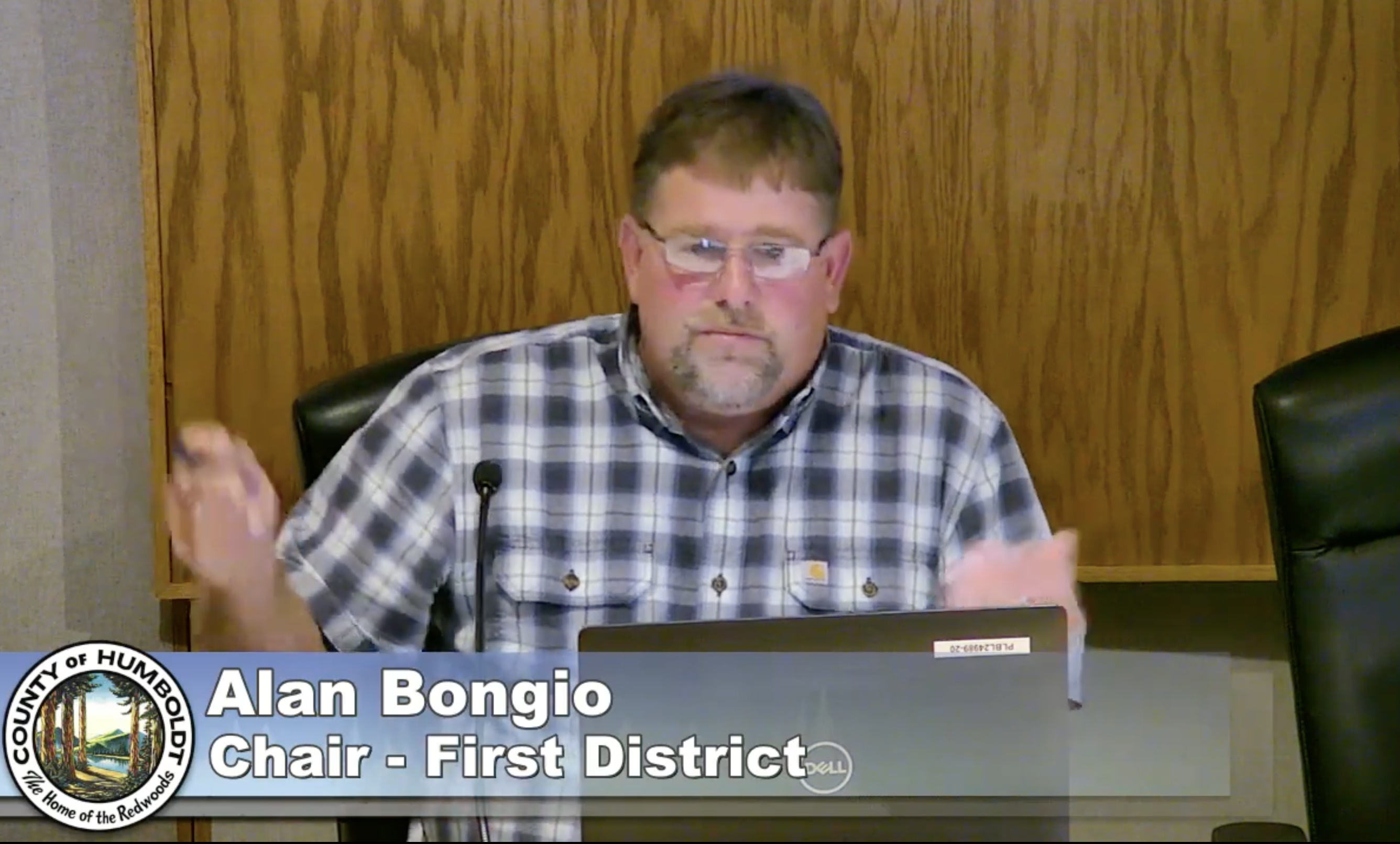
Screenshot of Bongio from the Humboldt County Planning Commission’s Aug. 18 meeting.
###
Embattled Humboldt County Planning Commissioner Alan Bongio says he will step down from his longtime chair position at Thursday’s meeting, acquiescing to a recent request from the Board of Supervisors in response to racist remarks Bongio made during an August 18 hearing.
Reached by phone this afternoon, Bongio was terse, but he confirmed that he plans to step down and hand over control of the meeting to Vice Chair Noah Levy, the commission’s Third District representative. Bongio said he doesn’t know what the process will be to select the commission’s next full-time chair.
Bongio downplayed the drama of this latest turn in an ongoing controversy. “There’s not gonna be any big fireworks,” he said.
The agenda for Thursday night’s meeting includes a draft letter of apology to three Wiyot-area tribes — namely, the Bear River Band of the Rohnerville Rancheria, the Blue Lake Rancheria and the Wiyot Tribe — for Bongio’s August 15 comments, which the letter calls “inappropriate” as well as “insensitive, racist, and biased.”
“The comments added to past injury and injustices resulting from governmental actions,” the draft letter continues. “We as the Humboldt County Planning Commission recognize we did nothing to address the problem in the moment and so are all responsible. We understand this has damaged the relationship between the Planning Commission and the Wiyot people.”
At the August 15 hearing, which concerned permit violations by local business owner and developer Travis Schneider, Bongio accused the local tribes of playing games and manipulating negotiations in talks about potential damage done to a designated archaeological site and tribal cultural resource on Schneider’s property. He made several derisive comments about “the Indians” and accused two of the tribes of reneging on an agreement, adding, “I have a different term for it but, you know, whatever.”
The Board of Supervisors formally censured Bongio by unanimous vote last month, and First District Supervisor Rex Bohn, who appointed Bongio to the Planning Commission nearly a decade ago, said that county staff had arranged for Bongio to participate in diversity, equity and inclusion training.
In today’s brief phone conversation, Bongio said he has read the draft letter and is prepared to talk about it Thursday evening. “We’ll have a discussion and if everyone agrees [with it] we’ll sign it,” he said.
Asked if he has any personal opinions about the language of the draft apology, Bongio offered a one-word reply: “No.”
Hey, people, please
put your hands together for the newest Lost Coast Outpost
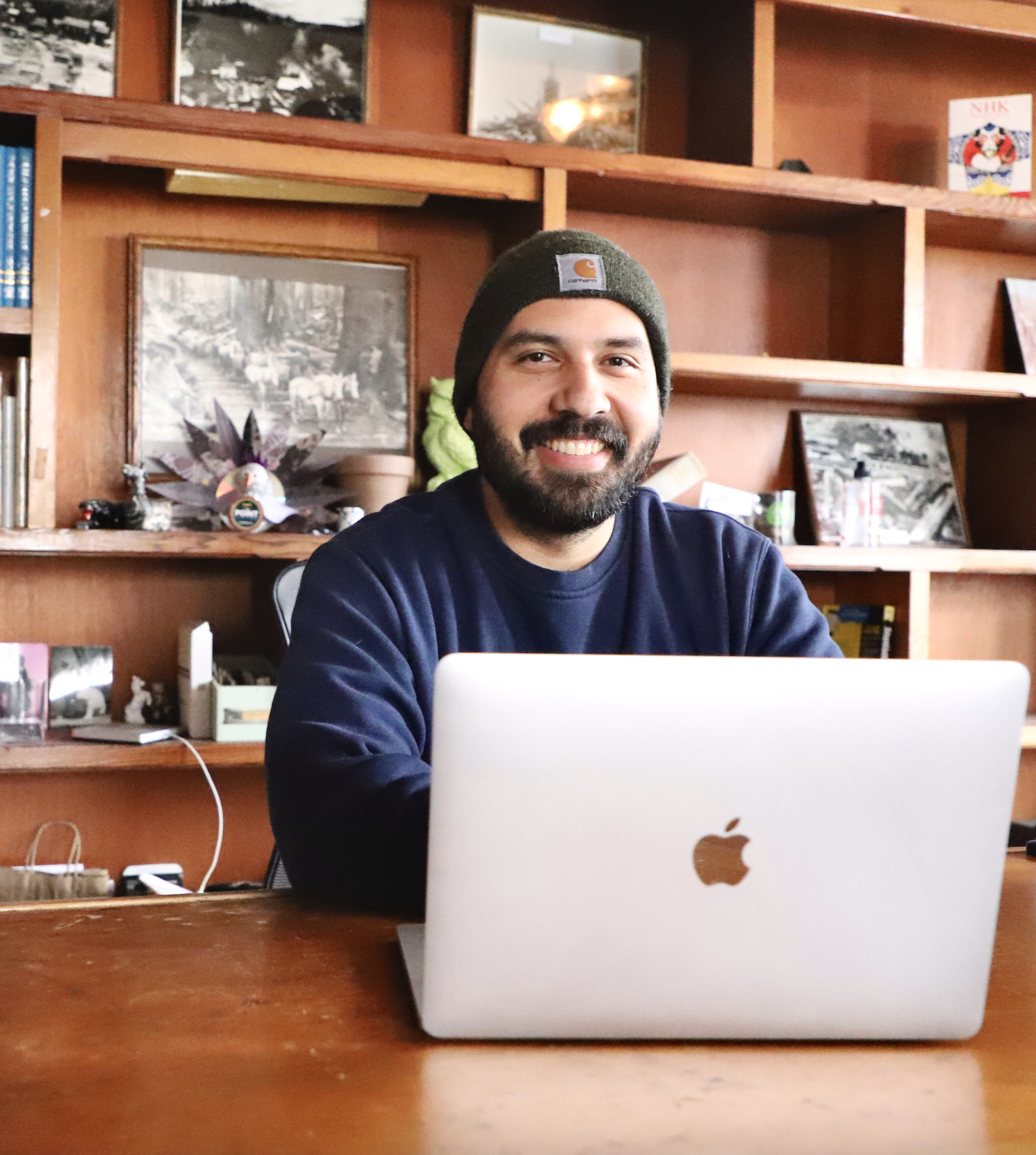
reporter: Eduardo
Ruffcorn-Barragán!
Let’s hear it for Eduardo, everyone!
Eddie – or
“Wardo,” as his friends call him behind his back – is a recent
returnee to Humboldt shores, having ridden out much of the pandemic
in the interesting town of Albuquerque, N.M. But he and Mrs.
Ruffcorn-Barragán
and their charming child are now firmly ensconced back here in the
place they want to be henceforth.
Did
you know Eddie before today? Possibly. For a while there he was the
production
director of, and
DJ on, the
late, lamented FM radio station 95.5 KBAE (“The Bay”), and even
before that he was part of the mid-2010s HSU journalism
cohort that produced such local
legends
as Sabina Gallier, John Ross Ferrara and Isabella Vanderheiden.
Did you see the
launch of Eddie’s series “The Humboldt Hustle” over the
weekend? Well, he’s going to be doing a lot more of those in the
near future – profiles of people who find ways of making a living
doing what they love in a difficult economy – so if you have any
ideas for that, please reach out! He’s at
eddie@lostcoastoutpost.com.
A note: Wardo is
himself a hustler, in that he has only a dozen or so hours per week
to devote to the work he was put on this planet to do (write for
LoCO) while devoting the remainder of his time to his family,
his hobbies and the out-of-town company that writes him fat checks
and pays his bills. But that’s how it goes, ain’t it!
Press release from the Humboldt County Sheriff’s Office:
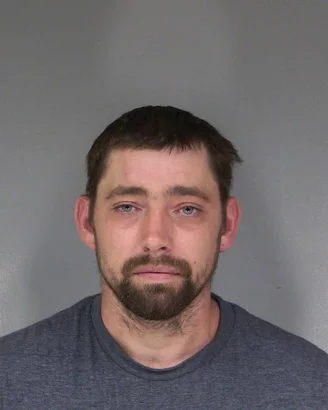
On Oct. 2, 2022, at about 2:01 a.m., Humboldt County Sheriff’s deputies on patrol in the Garberville area attempted a traffic stop for a vehicle code violation. The vehicle failed to yield, and a pursuit ensued.
Deputies pursued the vehicle for over two miles. The pursuit came to an end in the area of 2400 block of Sprowel Creek Road when the suspect crashed the vehicle into a tree. The suspect, 34-year-old Brandon Michael Andrew Fink, was extracted from the vehicle and transported to a local hospital for medical evaluation. While in custody, Fink was uncooperative and continued to physically resist law enforcement and emergency personnel.
Fink was later booked into the Humboldt County Correctional Facility on charges of flight from a traffic officer (VC 2800.1(a)), battery on an emergency responder (PC 243(b)), resisting a peace officer (PC 148(a)(1)), driving under the influence of alcohol (VC 23152(a)), failure to stop at a stop sign (VC 22450(a)) and failure to yield to emergency personnel (VC 21806(a))
Anyone with information about this case or related criminal activity is encouraged to call the Humboldt County Sheriff’s Office at (707) 445-7251 or the Sheriff’s Office Crime Tip line at (707) 268-2539.
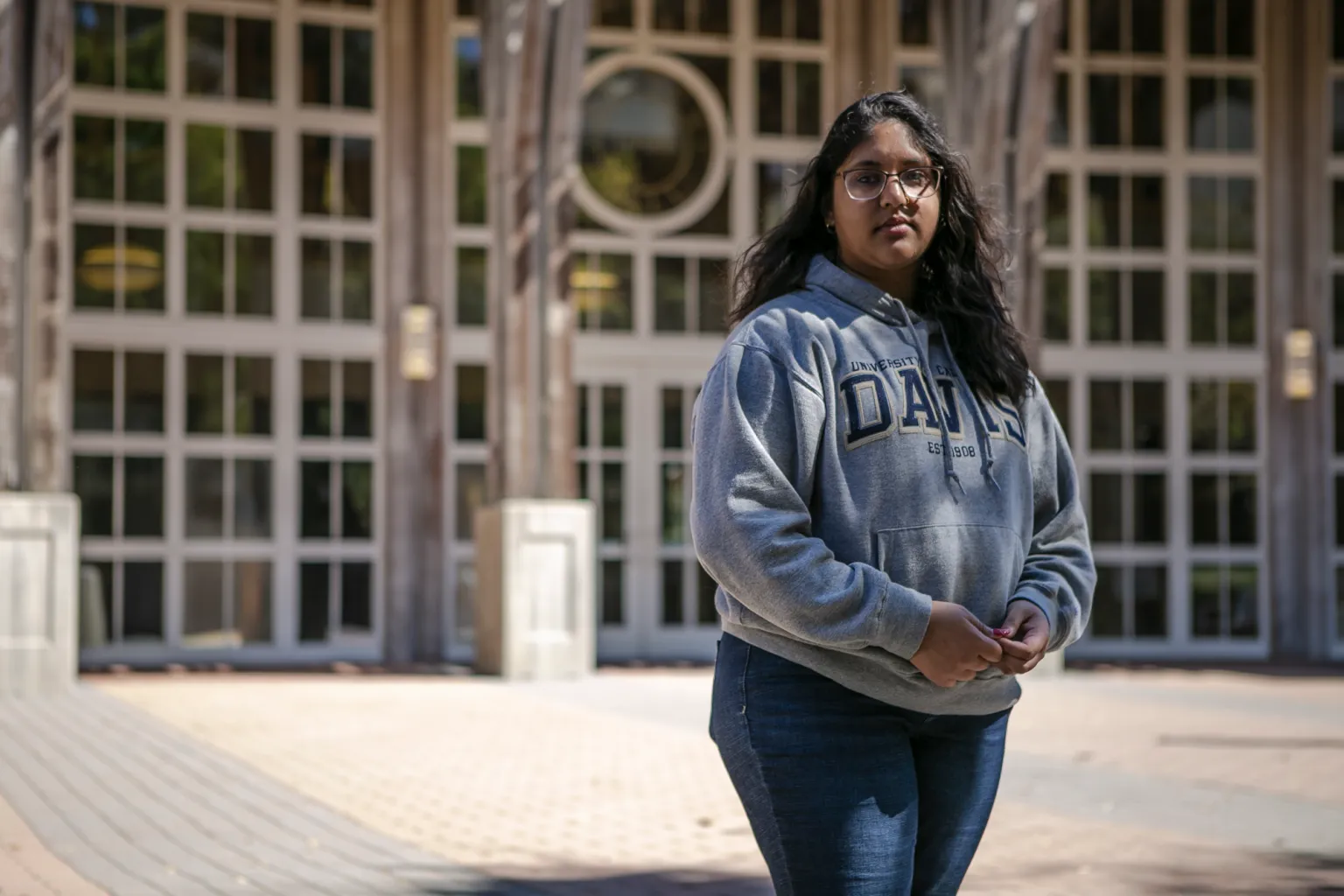
Ananya Bapat, a student at UC Davis, is photographed on campus in Davis on Sept. 29, 2022. Photo by Rahul Lal, CalMatters
For Ananya Bapat, getting to the University of California Davis was a feat of coordination. In her second year at De Anza College, Bapat spent her fall semester contacting counselors and admissions officers at the community college and the UC, trying to ensure that her hard-earned credits would transfer to a new campus. The conflicting advice they gave her, she said, only added to the confusion of the transfer experience.
“The process itself can be really overwhelming … coupled with (the fact that) you’re a second year in college, you’re transferring on top of classes and everything,” said Bapat, who is currently a fourth-year student at Davis and a peer advisor at the university’sTransfer and Reentry Center.
A new pilot program may make it easier for students like Bapat to transfer to the UC starting next fall. Under the dual admission program, high school seniors rejected from the UC can enroll at a California Community College with a conditional offer of admission to one of six UC campuses. They’ll have access to the UC campus from the first day of their community college career, and can use UC libraries, attend transfer events and receive advice from special dual admission counselors.
The program specifically targets students who have missed at least one of 15 high school courses required for UC admission, but earned a high school grade point average of a 3.0 or higher. During the UC Board of Regents meeting last week, Provost Michael Brown touted the program as advancing academic equity in the state. He added that personal challenges or a lack of UC-required courses at high schools can prevent students from preparing for admission, at no fault of their own.
At the same time, the program aims to address some of the obstacles preventing community college students from transferring. Only 19% of California Community College students who intend to transfer to a four-year university successfully do so within four years, according to the Public Policy Institute of California.
Abeeha Hussain, a fourth-year UCLA student and the transfer student affairs officer for the UC Student Association, said she believes students will take advantage of dual admission, as long as UC campuses actively promote the program to local high schools.
“It really creates this incentive for students to be like, ‘I’m not getting rejected because I’m not good enough for the school, I’m being deferred to admission later,’ ” said Hussain, who transferred from Palomar College. “Of course I’ll go to my community college if it means that I’ll eventually get to go to the UC of my dreams.”
“It really creates this incentive for students to be like, ‘I’m not getting rejected because I’m not good enough for the school, I’m being deferred to admission later.’” — Abeeha Hussain, a fourth-year UCLA student
Approximately 10,000 high school students apply to the UC every year without meeting freshman eligibility requirements, UC admissions director Han Mi Yoon Wu said at the Regents meeting. Of this population, 3,700 students have not met the UC’s high school coursework requirements but have GPAs of 3.0 or higher, making them eligible for the pilot program.
Students who receive a freshman offer of admission to the UC are excluded — even if they join the 7,000 individuals who annually turn down their UC acceptance to attend a California Community College. The UC may also exclude some majors from the dual admission pilot, which will admit students until fall 2025, including computer science and engineering at certain campuses.
A similar program is in the works at California State University, where it will also include students who were admitted but are unable to immediately attend due to financial or personal challenges.
More support for transfer students
Entering community college with a clear path to a UC campus can set transfer students up for success, said Hans Johnson, a senior fellow at the Public Policy Institute of California. He added that the early offer of admissions distinguishes the pilot program from existing transfer pathways at the UC, which don’t admit students until spring and lack the same access to UC campuses and support.
Dual admission “could be really powerful in connecting a student with the campus or campuses that they’re interested in going to,” Johnson said.
Regent Eloy Ortiz Oakley, the former chancellor of the California Community Colleges, said he believes the program will promote greater geographic diversity among UC transfers by providing a clear pathway forward for students in underserved regions of the state, such as the Central Valley and Inland Empire.
Students of color, as well as individuals who are low-income or the first in their family to attend college, may be more likely to apply to the UC without meeting admission requirements and have the most to gain from the pilot program, added Jessie Ryan, executive vice president of the Campaign for College Opportunity, a research and advocacy group.
Logan Ueno, a fourth-year transfer student at UC Davis studying political science, said regular visits to a UC campus can help transfer students make informed decisions about their futures and get the feel of attending a larger school.
“Coming from the community college, going to a UC is so much bigger, and there’s so much more resources that can be utilized on campus,” Ueno said. “I know that I’ve taken advantage of some of the resources on campus since I’ve transferred to Davis, and it’s really helped alleviate some of the stress about going to a UC.”
Having access to a coordinator who can act as a liaison between the UC and California Community College systems will also benefit students, who often shoulder the responsibility of navigating the transfer system themselves, Bapat said.
“That will help you on both ends of the transfer,” Bapat said. “I think (the coordinator) would clear up a lot of confusion and make the process even more streamlined.”
The UC’s pilot follows a handful of other dual admission programs across the nation. In Virginia, George Mason University has partnered with Northern Virginia Community College to provide students with automatic admissions to the university. The program, which began in 2018, has drawn attention for its robust support for community college students, who can spend time on the George Mason campus and take courses there as they earn their associate’s degree.
The UC also created its own dual admission program in 2004, but the program faced an early end after cuts to funding in the 2004-05 state budget. Only 67 students joined the fall 2004 dual admission cohort, despite the fact that more than 37,000 were able to apply.
Oakley believes the UC’s new program will fare better than its predecessor.
“I think now the governor is behind this pilot, I think the legislature is behind the pilot and I believe the regents are behind the pilot,” said Oakley, who left the community college system to become president of College Futures Foundation, which helps fund CalMatters’ higher education coverage. “I do think it has a much better chance of succeeding.”
Most-selective campuses are excluded
However, UCLA, UC Berkeley and UC San Diego remain glaringly absent from the new pilot program. Some Regents criticized the three highly-selective campuses for failing to participate. Student Regent-designate Merhawi Tesfai said the three campuses face some of the greatest challenges in admitting and enrolling students from underrepresented backgrounds.
“I feel like there’s the idea that (dual admission) would help that problem in some ways,” Tesfai said. “I would really want us to consider those three campuses being involved.”
Demand for the three campuses is high among transfer students. Forty-five percent of students who receive guaranteed admissions to a UC campus through one of the university’s existing programs end up instead enrolling in UCLA, UC San Diego or UC Berkeley, despite the lack of guaranteed admission pathways at these schools, Brown said during the Regents meeting.
However, he added, offering dual admission at high-demand campuses may unintentionally displace other deserving applicants.
“Every guarantee program displaces,” he said. “We also have a goal of being as fair as we can in admission processes, too.”
By creating a clear and affordable path to the UCs, Oakley said he hopes the pilot program will boost community college enrollment, whichwas on the decline prior to the COVID-19 pandemic and has continued to fall. California’s community colleges have lost 350,000 students since the 2019-2020 school year, a drop of more than 16%.
“I think the more students see themselves as transfer students, the more they’ll take advantage of their local community college,” Oakley said.\
###
Tagami is a fellow with the CalMatters College Journalism Network, a collaboration between CalMatters and student journalists from across California. This story and other higher education coverage are supported by the College Futures Foundation.
CalMatters.org is a nonprofit, nonpartisan media venture explaining California policies and politics.
The Cathedral of the Blessed Sacrament in Sacramento on Sept. 12, 2022. Catholic churches are leading the opposition to a ballot measure on abortion rights. Photo by Rahul Lal, CalMatters
From the pulpit of the bright and airy Christ Cathedral in Garden Grove, Father Bao Thai delivered a homily on a recent Sunday morning, urging his congregation to vote against Proposition 1, a measure on the Nov. 8 ballot that would enshrine the right to abortion in California’s constitution.
“A steward is entrusted to care for the master’s property until his return,” he preached. “What precious goods has the creator placed in our care? Do they include the innocent and sacred lives of the unborn and children to be born?”
A few weeks earlier, at Good Shepherd Catholic Church in Pacifica, two congregants spoke at weekend masses to ask attendees to support the campaign against the “harmful” Prop. 1 with prayers, fasting and money.
Bishops and other clergy from California’s dozen Catholic dioceses and archdioceses — spanning Sacramento to Fresno, Monterey to San Bernardino — have released videos to speak directly to the faithful, sometimes in multiple languages, about their concerns that the initiative would remove all existing restrictions on abortion in the state.
“Life is precious from the very moment of conception,” Father Michael Mahoney of Our Lady of Angels Parish in Burlingame said in a recent message filmed at the site of a future parish garden, where he encouraged families to take home “No Prop 1” signs for their yards. “This is against everything that we believe in as Catholics.”
Fundraising by the opposition campaign is trailing significantly, in a state where a clear majority of adults regularly express support for abortion rights. So the success of a long-shot effort to defeat Prop. 1 may rest primarily on outreach by faith leaders and their ability to mobilize followers from the pews to the polls.
About a month before Election Day, as mail ballots are set to begin arriving at the homes of every registered voter in California, officials across several major denominations are tapping into their networks of worshippers to get the word out against the abortion measure. Meanwhile, some conservative faith-based political groups are organizing voters to involve their churches in the campaign. Though not legally allowed to endorse partisan candidates because of their tax-exempt status, churches can advocate on issues, including ballot measures.
Fighting an ‘egregious expansion’ of abortion
The most significant push so far has come from the Catholic Church.Over the summer, it started training clergy and parishioners, registering voters and developing educational resources about Prop. 1, which it calls the “most egregious expansion of abortion this country has ever seen.”
A novena led by the California bishops — nine days of prayer to Our Lady of the Holy Rosary for the defeat of the initiative — began Thursday, ahead of Respect Life Month during October, an annual Catholic program to advocate against abortion and support women dealing with unexpected pregnancies.
Nearly one in three Californians is Catholic, providing the church an immense platform from which to try to shift the tide on Prop. 1. An August poll by the UC Berkeley Institute of Governmental Studies found 71% of registered voters were prepared to support the measure.
Kathleen Domingo, executive director of the California Catholic Conference, the state public policy office of the church, said even Catholic leaders are divided on whether they have a real chance to defeat Prop. 1. But they are undertaking a serious organizing effort regardless, she said, because it also presents an opportunity to get more people involved in their regular activities serving needy women, children and families.
“Win or lose, there’s benefit in the process,” she said. “It’s never a bad thing to get people thinking about vulnerable people in their communities.”
Andits arguments against the measure are entirely secular: The campaign dismisses Prop. 1, placed on the ballot by the Legislature, as a cynical attempt by Democrats to boost voter turnout that is unnecessary to guarantee abortion access in California, where the procedure is already protected by law.
Opponents also raise concerns that the broad language of the initiative (“The state shall not deny or interfere with an individual’s reproductive freedom in their most intimate decisions”) would override all existing restrictions, allowing abortions past the current limit when a fetus is viable outside the womb at around 24 weeks and putting taxpayers on the hook as people come to California from other states seeking to terminate their pregnancies.
Yes on Proposition 1 spokesperson Molly Weedn said the characterization that the measure would remove all abortion restrictions in California is false. “That is a lot of misinformation and fear-mongering from the opposition,” she said. “The initiative is simply going to take existing law and add it to the constitution.”
Catherine Hadro, a spokesperson for California Together, No on Proposition 1, said that while thecampaign is grateful for the assistance from religious leaders, it is targeting its communications to all Californians. She said opponents can see the momentum against Prop. 1 growing with a rise in grassroots donations.
“We know this is a message that resonates with Californians, no matter their faith,” she said.
But spreading that message through traditional electoral methods, such as digital advertising and mailers, has been challenging. The campaign has reported raising $1.1 million so far, most of it in the final week of September. Hadro declined to discuss the specifics of the opposition strategy.
A separate effort, led by groups affiliated with the evangelical Christian movement, has raised about $73,000.
“There’s no more trusting, effective way to get that message out than from the pulpit.” — Tanner DiBella, president of the American Council
Proponents of Prop. 1, by comparison, have reported $11.8 million in contributions, including a $5 million donation by the Federated Indians of Graton Rancheria.
The measure was also recently endorsed by Catholics For Choice, a national nonprofit that advocates for abortion access and other policies in conflict with church doctrine. In a statement, President Jamie Manson said “the bishops’ radical anti-choice views are wildly out-of-step with the majority of the people in their own pews.”
A July survey by Pew Research Center found that Catholics in the United States are split on abortion, with a majority now agreeing that the procedure should be legal in most or all cases — though more than two-thirds of regular mass attendees believe it should be illegal in most or all cases.
“This faithful pro-choice majority supports abortion access because it aligns with our Catholic social justice values of human dignity, justice for the poor and marginalized, and religious freedom — not in spite of our Catholic faith, but because of it,” Manson said.
‘A culture of death’
Nearly 60% of what the No on Prop. 1 campaign has reported raising so far comes from the Catholic Church and affiliated donors, including $500,000 from the Knights of Columbus, a national Catholic fraternal organization. Officials at its Connecticut headquarters did not respond to an interview request.
Priests, deacons and other church employees, largely in Orange County, have directly donated $20,000 to the campaign. Another $105,000 so far has come from the California Catholic Conference and half a dozen of the dioceses and archdioceses, which Domingo said are in-kind contributions for the extensive work that the church has done on its No on Prop 1 campaign.
That includes developing bilingual fliers and pew cards in English, Spanish, Vietnamese and Korean to distribute at masses, as well as suggested weekly bulletin announcements (“Don’t hand lawmakers a blank check to pay for abortions, and don’t let them make California an ‘abortion sanctuary’”) and homily helps for pastors that recommend readings from the Bible and how to connect them to Prop. 1 (“the abortion industry has been as clever as a fox in its self-interest, like the dishonest steward who acted to preserve his income by immorally manipulating his master’s debtors, at the master’s expense”).
Bishops and other high-ranking clergy from across the state are making their own direct appeals to Catholic voters in video messages that amount to campaign advertisements. Though often framed within religious reflections, their arguments are also largely focused on what they consider to be the extreme implications of Prop. 1, which they believe would allow abortions until the moment of birth without exception. Some have compared the measure to human rights violations in North Korea and challenged parishioners to bring their pro-abortion rights friends into the campaign against the initiative by educating them about what it “actually does.”
“We rejoiced in the U.S. Supreme Court’s overturning of Roe v. Wade in June, but we are now faced with the proposal to make abortion permanently legal without any restrictions in our state constitution,” Bishop Alberto Rojas of the Diocese of San Bernardino said in a video. “This doesn’t affirm the duty and value of the life that God has given us. It promotes a culture of death.”
Father Bruce Patterson, episcopal vicar for priests in the Diocese of Orange, invoked the Parable of the Prodigal Son to reflect on how Catholics could change minds and win the “uphill battle” of ending abortion by not treating their opponents as enemies.
“To ever persuade them, we need to apply the same patience, love and clarity that the father used to retrieve his lost and disarm his angry son,” Patterson said. “In doing so, we must remind ourselves that many who support abortion are, like St. Paul, acting out of ignorance and, yes, they remain our brothers and sisters.”
CalMatters reached out to Archbishop Salvatore Cordileone of the Archdiocese of San Francisco and Bishops Jaime Soto of the Diocese of Sacramento, Kevin Vann of the Diocese of Orange and Daniel Garcia of the Diocese of Monterey, who were identified in a July memorandum as the leadership team for the Catholic campaign against Prop. 1.
Representatives for Soto and Garcia did not return numerous calls and emails. Representatives for Cordileone and Vann initially expressed a willingness to connect CalMatters with diocesan leaders active in the campaign, but subsequently declined because they were told to direct all inquiries through Domingo of the California Catholic Conference.
Soto, who gave $1,000 to the No on Prop. 1 campaign, introduced the second day of the novena on Friday. In a video, he said that the initiative “demeans women and destroys all human nature” and called on Catholics to “translate the gospel of life by our own living testimony.”
“The taking of an innocent human life should never be the solution to a problem. Freedom should not be defined by violence against the innocent,” Soto said. “Consider carefully, then, the moral and social costs of allowing the language of Proposition 1 to be embedded in the state constitution.”
Domingo said the church’s political engagement has been more extensive in this election because preventing abortions of “viable unborn children” is “something that’s dear to us.” She said it was important to “help people understand that common sense should prevail” over the “open-ended expansion of late-term abortion in California.”
“There’s a lot of value to people of faith speaking about issues that we believe strongly in,” she said. “And in this particular issue, we know that the majority of people in California and the majority of the people in the U.S. agree with us.”
Evangelical churches organizing
Other faith communities in the state have also begun outreach against Prop. 1 through their networks, though none is yet as extensive as the Catholic Church’s campaign. Many of the leaders recognize that they face long odds to stop the measure, but say they feel a moral imperative to fight to uphold what limits still remain on abortion in California.
“For many of us who have a Biblical view, this is very alarming,” said Tanner DiBella, president of The American Council, an organization he founded two years ago to bring evangelical voters into state politics.
DiBella said his group has provided educational resources about Prop. 1 to more than 620 member churches, including talking points and scriptural references for pastors to include in their sermons.
“In a season where people are inundated with political ads and hearing political pundits on the news, it becomes white noise after a while,” he said. “There’s no more trusting, effective way to get that message out than from the pulpit.”
John Jackson, president of William Jessup University, a private Christian institution near Sacramento, recently sent an email to its 1,500-member pastor network encouraging them to join the campaign. He said Christians are often reluctant to get involved in politics because they believe there should be a divide between secular and sacred activities.
“All of life is spiritual,” he said. “The proponents have mastered the media. And our hope is that we will be able to mobilize the masses.”
Separately from the official opposition campaign, a handful of religiously-affiliated groups have launched websites to organize against Prop. 1.
One site developed by Pray California includes form letters to pastors and priests with actions they can take to prevent “the murder of an innocent, helpless child” from being added to California’s constitution: speaking to their congregations from the pulpit, sending emails, encouraging others to “VOTE for the Lord’s Choices” and praying.
Another site warns on the home page that “Governor Newsom wants birth day abortions to be legal” over a picture of a baby in a trash can next to a woman on an exam table. The campaign is run by Karen England, executive director of the Capitol Resource Institute, which advocates for “Judeo-Christian values in California,” in partnership with Pastor Jack Hibbs of the Calvary Chapel megachurch in Chino Hills.
England said polling shows that voters overwhelmingly oppose “late-term abortions,” referring to those after fetal viability, so their campaign aims to inform the public that Prop. 1 is a sneaky attempt to open the door to unlimited abortions. Many of their materials are designed for churches, including a letter to pastors, a guide on what types of political activity are legally allowed and doorhangers they can print and distribute.
“We want to make sure we reach them with our limited time and that is a natural place to go with a community of people,” England said.
‘Moved by the moral imperative’
Not every religious leader speaking out against Prop. 1 is motivated primarily by defeating the measure at the ballot box.
Bishop Eric Menees of the Anglican Diocese of San Joaquin does not expect California voters will reject the measure, but said he has felt compelled to condemn abortion since early in his career, when he prayed with a woman who was facing pressure from her boyfriend and family to terminate an unwanted pregnancy and she chose adoption instead.
“It became very real for me,” he said.
Menees plans to send a letter to his diocese on Tuesday, the Feast of St. Francis, asking people to vote no on Prop. 1, pray for its defeat and share the word about the initiative. He is working with churches in the Fresno area, where he is based, on a day of prayer in late October to ask for God’s intervention.
“As a Christian, I’m always hopeful. I pray that hearts and minds will be changed. Maybe people are so sure that Prop. 1 is going to pass that they won’t show up to the voting booth,” he said. “But I’m primarily moved by the moral imperative.”
Mahoney, the priest in Burlingame, said the question of protecting life that drives the Catholic Church is much larger than this initiative.
The debate over abortion obscures other efforts to get women the resources they need to carry their pregnancies to term and take care of their babies after birth, he said. His parish collects baby clothes and other supplies for young mothers who could not otherwise afford them.
With Prop. 1 appearing likely to pass, Mahoney, who preached against the measure at a recent Sunday mass, said his ultimate goal is to shift the entire notion of what it means to give women a choice. Rather than pouring hundreds of millions of dollars into shoring up abortion providers, he said California should direct that money to programs that support poor mothers or to expanding access to adoption.
“What we are trying to do is to say, ‘Look, there are options,’” Mahoney said. “I would love to change the conversation, because we have no chance whatsoever” to defeat Prop. 1.
###
CalMatters.org is a nonprofit, nonpartisan media venture explaining California policies and politics.
Image generated by DALL-E, an artificial intelligence.
The
Pandemic is officially over. At least that is the impression we just
received. A declaration of the end of the pandemic is now causing
quite a stir.
So
that’s it? We are done with all that?
Experts
are saying that it is highly likely that most of us have been
infected with COVID-19, and we have a fair number of people
vaccinated. That means that for most of us, the threat of COVID-19 is
not the same as it was a year or two ago. That said, infections from
COVID continue to decline slowly, but more than 300 Americans still
die from COVID every day. Those numbers don’t really sound like
it’s over, do they?
What
cannot be over just yet — especially if you have loved ones who are
vulnerable to severe disease or death from COVID-19 — are good hand
hygiene, common sense approaches to going out into crowded areas
(wear a mask!) and getting tested. Vaccines and boosters have helped
to keep people from severe disease and death. For those 70 and older,
or those with just about any underlying health condition —
including, dare I say it, inactivity — the pandemic is not over,
and we need to talk about it.
That’s
right, exercise.
Fall
is when we start spending more time indoors. It gets dark earlier,
and it’s easier to go from your desk to your couch to your bed, with
lots of food in between.
If
you’re still reading a COVID column in late 2022, nodding along with
my recommendations for masking, testing, and ventilation, you’re
serious about your health and the health of those around you. So, if
you follow safety recommendations but haven’t been exercising, you’re
basically putting a bigger bumper on your car but not changing the
oil or putting air in the tires. That’s a recipe for bad
outcomes.
A
study from March of almost two million adults in 10 countries showed
that those who participated in regular physical activity every week
had an 11 percent lower risk of infection with SARS-CoV-2, the virus
responsible for COVID-19. They also had 36 percent lower risk of
hospital admission, 44 percent lower risk of severe COVID-related
illness, and 43 percent lower risk of death from the virus than those
of the same age who were more sedentary.
Cold
and flu season, colder weather, winter months and holiday time can be
challenging for people to stay active. I know for myself, I need to
get up and move more. I like to travel, and I am not currently in
travel shape. I need help getting there though, so I reached out to
my colleagues here at UIHS who are in the “moving” business. They
sent me some great tips that I’d like to share with you. These
ideas were submitted by Ryan Matteri, UIHS Fitness Coordinator and
Dennis Hernandez, Physical Therapy Provider:
The
exercises listed below are merely suggestions and are not a “one
size fits all” solution. Injuries can make exercising more
difficult. Some of these suggestions may need be avoided if you
experience pain during the movements or have a recent injury -
consult with your primary care provider if you’re not sure.
Regular
physical activity is one of the best things that you can do for your
health. Thirty minutes of movement can help reduce your risk of chronic
disease, enhance your fitness level, prevent injuries, and improve
your overall mental/physical health.
Unfortunately, as the
winter months are approaching, the weather sometimes does not
cooperate with our outdoor activities.
Here are 5
tips to find opportunities for movement throughout your day when you
are stuck inside this winter:
1. Supported squats at
the kitchen counter, sit-to-stands from a stable chair or sofa,
push-ups, lunges, and abdominal crunches. These traditional exercises
require minimal space and are great for working specific body
parts.
2. Walk around the house during commercial breaks
during your favorite TV show or movie.
3. Use the stairs.
A few brisk trips up and down stairs will soon get your heart
pumping. Increase the speed for increased benefits. Make as many
trips as you can.
4. Complete chores around the house.
Many household activities burn up calories at a fast rate and do a
good job of working different muscles.
5. Dance to some
upbeat music. Ten minutes spent dancing to your favorite tunes
morning and night can go a long way to meeting physical activity
targets. And it’s fun!
If you find yourself
skipping out on exercise because of difficulty standing, then you
should consider chair exercises. Our physical therapists can guide
you through a routine, and there are great options available
online
as well.
I
encourage you to move more, for both your physical AND mental health.
Isolation, loneliness, depression, fear and anxiety have taken their
toll on many of us. While this is getting better, it’s important to
be honest with yourself about your mental health and reach out for
support if you need it. A little bit of exercise can go a long way
towards improving your mental state, and help your body feel better
too.
If
you’re serious about preventing poor outcomes from COVID-19,
rededicate yourself to fitness and a healthy lifestyle.
###
Michelle
Lewis-Lusso (she/her) is an Infection Prevention and Control nurse at
United Indian Health Services, serving the 11,000+ clients and staff
at their seven area clinics. Michelle isn’t trying to be Ms. Olympia,
but she may want to hike Mt. Olympia someday, so she’ll keep
exercising.
I was born yea 80 long years ago,
September 6, 1942. At the time, the sun was firmly in the
constellation of Leo. See the starchart for that date. So my sun
sign’s Leo, right? I’m a Leo? Fire sign: A leader, strong, wise,
handsome as all getout… (Not to mention androgynous, if nearby Mars
and Venus are anything to go by.)
(“In” here is a relative term. You
can’t see the stars in daytime, of course, so you just have to
trust that’s where the sun is. And “in front of” might be a
better descriptor than “in,” since the sun is close by, 8 minutes
away as the photon flies. Meanwhile, the light you’ll see from
Regulus, Leo’s brightest star, left there, about the time I was
born. Coincidence? I think not…)
Nope, apparently I’m not a
Leo. Well, shit. According to my horoscope, as now printed in about
three-quarters of all daily newspapers in the US, I’m one of those
fussy, wimpy, perfectionistic Virgos. Earth sign. Think mud,
stick-in-the. But why (I hear you ask) if the sun was in Leo at your
birth, why are you a Virgo???
It’s all about precession.
Earth’s axis, which you can imagine as an 8000-mile long rod
impaling our planet from the South to the North Pole, now points,
more or less, to the North Star, Polaris. It wasn’t always this
way. Like a spinning top as it slows down, Earth’s axis precesses,
pointing to a different part of the night sky, moving in a great
circle. Unlike a top, this precession takes quite a while: 26,000
years.
Fun fact:The Greek
astronomer Hipparchus figured this out in the 2nd century BC.
So, in Babylonian times, so the story
goes, the sun’s (invisible, remember?) apparent motion through the
background stars — the ecliptic — was codified into 12 equal
segments, each given the name of the relevant constellation. Back
then, the sun would have been “in” the constellation Virgo on
September 6. This is the tale I’ve been telling for years, any time
someone looked pityingly at me when they figured out my sun sign.
But, like all astrology, it’s
bullshit. Forget the Babylonians. Or Hipparchus. Or anyone up until
1936. Blame Edward Wigner, a reporter for the New York Post
who set out to do an exposé
on astrology, but who quickly realized that the real money was to be
made from the chumps who believed their lives were ruled by the
stars. He was the first one who came up with the idea of printing
mini-fortunes under the 12 headings of the 12 ecliptic constellations
— and Your Daily Horoscope took off. (Yours for today: “Don’t
believe anything you read in LoCO.”)
Actually, before the 12 sun signs
(so-called) were harnessed by Wigner, the story goes that, on the
birth of Queen Elizabeth’s second daughter, Margaret, on August 21,
1930, an editor at the London Sunday Express was looking for a
new hook. In some sort of desperation, he asked a Professional
Astrologer (!) to “do the princess’ horoscope and predict her
future.” He, one R.H. Naylor, did so, adding a few paragraphs on
what lay in store for others born the same week.
You can see where it went from there,
to today’s 40 million horoscope readers. By the way, I do love the
late Carroll Righter’s disclaimer, which prefaced all his
horoscopes. Remember Righter? He advised both Nancy and — when he
was president — Ronald Reagan. Shudder. “The stars impel, they don’t
compel. What you make of your life depends on you.” Nice out.
(When the NYT lost their astrologer’s
copy some years ago, a copy editor quickly filled in, according to
the paper’s former editor Nick Williams Sr. “It was a lot better
to do that than to answer the telephone the next day.”)
But enough about our individual
12-category lives; no one will remember us in 100 years. Let’s look
at the big picture, starting with the Age we’re all in. I saw Hair
when it opened in London. Loved it, totally believe we entered
the Age of Aquarius in 1967. Forget about those fuddy-duddies at the
International Astronomical Union who say we’ll actually go from
Pisces to Aquarius around 2600 AD. (I bet they’re all Virgos.) Or
some dude who thought we came into the Aquarian Age 600 years ago.
Who you gonna believe? Some nerdy, Earth-sign scientists? Or The
5th Dimension? Duh.