
‘Unfit to Serve’: Local Environmental, Social Justice Groups Call for Resignation or Replacement of Planning Commissioner Alan Bongio
LoCO Staff / Thursday, Sept. 8, 2022 @ 12:15 p.m. / Local Government
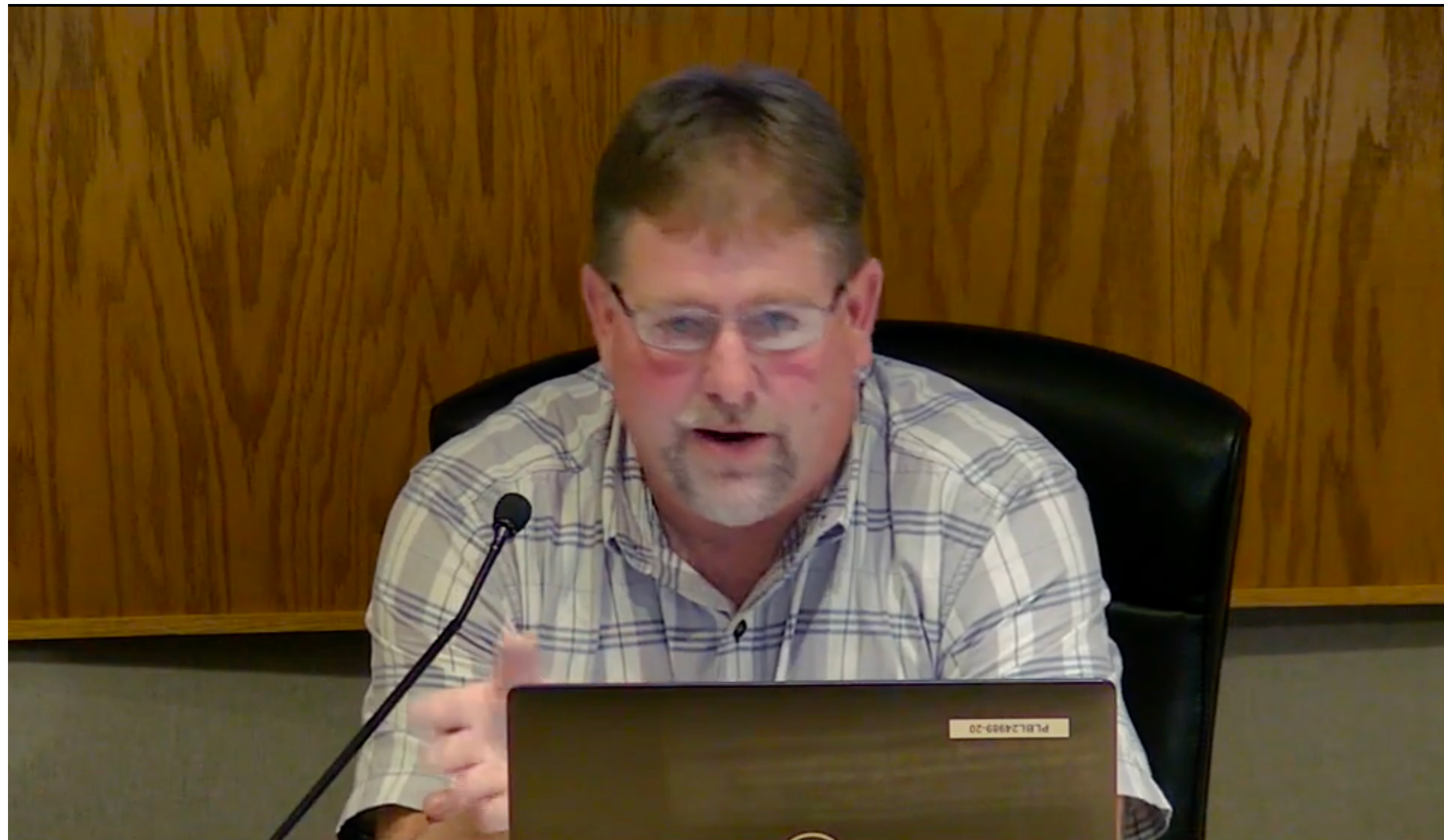
Humboldt County Planning Commissioner Alan Bongio. File photo.
###
PREVIOUSLY:
- Heated Meeting Sparks Accusations of Dishonesty and Discrimination, Opening Rift Between Tribes and Humboldt County Planning Commission
- Despite Silence From Tribes, Mega-Home Builder Optimistic Ahead of Tonight’s Continued Planning Commission Hearing to Address Permit Violation Fallout
- After Rebukes and Apologies for Bongio’s ‘Disrespectful’ Comments, Planning Commission Defers Decision on Mega-Home Permits
###
Open letter to Supervisor Rex Bohn and Planning Commissioner Alan Bongio:
Dear Supervisor Bohn and Commissioner Bongio,
On behalf of the undersigned organizations, we call for the resignation or removal of Commissioner Alan Bongio from the Humboldt County Planning Commission. In a recent Planning Commission meeting, Mr. Bongio used racist and other offensive language when discussing sovereign tribal governments. Representatives from local sovereign tribal governments and fellow Planning Commissioners immediately recognized and objected to Mr. Bongio, who not only did not apologize but made further disturbing statements. Mr. Bongio has since failed to apologize for his actions, only apologizing for an “offense” he may have caused. Mr. Bongio cannot represent the people of Humboldt County while failing to give even a modicum of respect to local sovereign tribal governments. His behavior makes clear that he is not fit for this position.
Mr. Bongio’s responsibilities as Planning Commissioner require an understanding of local, state, and federal regulations protecting tribal cultural resources and the environment. These include the National Historic Preservation Act of 1966, the California Coastal Act of 1976, the Native American Graves Protection and Repatriation Act of 1990, the 2014 CEQA Guidelines update for protecting Tribal Cultural Resources, and state law governing tribal consultation by cities and counties. Anyone who cannot impartially apply these regulations to any and all applicants is unfit to serve in the role of Planning Commissioner.
The Planning Commission represents Humboldt County and all of its residents. Mr. Bongio’s conduct strains relationships between Humboldt County and sovereign tribal governments and trustee agencies, and makes government-to-government relationships more difficult.
Mr. Bongio’s conduct is unacceptable for a representative of Humboldt County and we ask for his immediate resignation or removal.
Sincerely,
Tom Wheeler
Executive Director
Environmental Protection Information CenterJennifer Kalt
Executive Director
Humboldt BaykeeperCaroline Griffith
Executive Director
Northcoast Environmental CenterColin Fiske
Executive Director
Coalition for Responsible Transportation PrioritiesTamara McFarland, Caroline Griffith, Leila Roberts, Kate Lancaster
Board of Directors
Cooperation HumboldtBrenda Pérez
Program Director
Centro del Pueblo HumboldtMatt Simmons
Co-Director
Redwood Coalition for Climate and Environmental ResponsibilityAlicia Hamann
Executive Director
Friends of the Eel RiverMike Cipra
Executive Director
Friends of the Dunes
BOOKED
Today: 6 felonies, 12 misdemeanors, 0 infractions
JUDGED
Humboldt County Superior Court Calendar: Today
CHP REPORTS
Us101 / Sandmine Rd (HM office): Trfc Collision-No Inj
0 Us101 N (HM office): Traffic Hazard
7985 Mm101 S Hum 79.90 (HM office): Assist with Construction
Us199 / Us101 N Us199 N Con (HM office): Assist CT with Maintenance
Poppy Dr / Sherwood Rd (HM office): Closure of a Road
ELSEWHERE
KINS’s Talk Shop: Talkshop September 3rd, 2026 – William Honsal
Governor’s Office: California prioritized fighting organized retail theft, those results are paying off with 36,000 arrests and $293 million in stolen goods recovered
Mad River Union: Whistleblower calls for Miranda’s Rescue end
Mad River Union: Arcata’s petite data center only the first
Providence Appoints New Chief Executive for St. Joseph and Redwood Memorial Hospitals
LoCO Staff / Thursday, Sept. 8, 2022 @ 11:55 a.m. / Health Care
Press release from Providence:
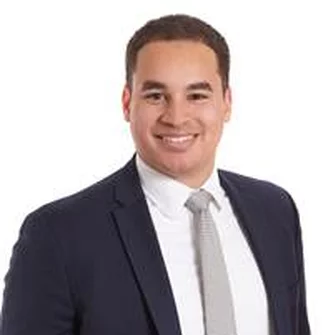
Harris | Image via Providence
Providence in Humboldt County is pleased to announce that Darian Harris has been appointed the new chief executive for Providence St. Joseph Hospital and Providence Redwood Memorial Hospital. He will be responsible for the operational effectiveness and performance at both hospitals.
Harris joined Providence in early 2021 and served as the chief executive for Healdsburg and Petaluma Valley hospitals in Sonoma County. While serving there, “he and his leadership team built a collaborative and engaged culture, reduced employee turnover, and delivered strong quality performance, all during the height of the pandemic,” according to Laureen Driscoll, region chief executive, Providence Northern California.
“I’m thrilled and honored to have the opportunity to serve the amazing people of Humboldt County,” said Harris. “In my first few weeks, I have been incredibly inspired by the love that our caregivers and physicians have for our community and the deep passion they have for ensuring all within our community have access to exceptional care. My family and I are truly grateful for the very warm welcome we’ve received here in Humboldt.”
Before joining Providence, Harris held a variety of operational and strategic health care roles at Kaiser Permanente and at Massachusetts General Hospital. He holds a master’s degree in health administration from the University of Washington and a bachelor’s degree in health services management from East Carolina University, where he has also been an adjunct professor, focusing on health care operations management and patient flow.
Additionally, while in Sonoma County, Harris was recognized by the North Bay Business Journal in their “Forty under 40” recognition series as a leader who has demonstrated unique leadership skills early in his career. He credits his career performance thus far to “having the tremendous value of perspective and humility; knowing there are great learnings to be gained from those who proceeded me. I also have a strong appreciation for the opportunities to be realized through innovation, the pursuit of continuous improvement, and passion and energy of our caregivers.”

FIRE UPDATE: Smoky Conditions Will Continue in the Mornings; Fires Mostly Contained to Interior Burning
LoCO Staff / Thursday, Sept. 8, 2022 @ 9:31 a.m. / Fire
Press release from the unified command of the Six Rivers Lightning Complex:
The Six Rivers Lightning Complex is currently 41, 502 acres with 81% containment and 998 personnel assigned to the incident.
(Ammon – 11,465 acres; Campbell – 30,037 acres)
CURRENT SITUATION
Hot temperatures are expected to persist for the next several days. Although there has been no perimeter growth across the Ammon and Campbell fires for several days, interior burning of litter and heavier ground fuels across the forest floor will continue to produce smoke. The current stable weather conditions will keep the smoke from moving out of the area, so similar conditions are expected with the smoke accumulating along the Trinity River in the morning and lifting in the late afternoon each day. Firefighters continue to patrol the perimeter of the fire, coordinating with the Unmanned Aerial Systems (UAS) to identify the remaining hot areas near the control lines. Wildland crews are also continue to remove hazard trees that could impact the road systems throughout the fire area.
Resource Advisors (READS) are working closely will local tribal and forest personnel to identify the many cultural resource areas in the fire areas in advance of suppression repair and rehabilitation to ensure these areas will not be disturbed while fire crews work in the areas of concerns. This coordination also allows for efficient use of shared resources.
Check out the Six Rivers Smoke Outlook for more information at this link.
Learn how you can help be fire safe at this link. .
ROAD CLOSURES
Due to a large presence of fire personnel and machinery working to build containment lines for the Ammon Fire, residents are asked to limit travel on Titlow Hill Road/Route 1 in zones HUM-E052 and HUM-E062 to essential traffic only. Residents may still use roads to travel out of evacuation order zones:
The following roads into evacuation zones have been closed.
Forest Route 7n15 at Six Rivers Forest Boundary
The following roads are restricted to local traffic only:
Horse Linto Creek Road at Saddle Lane (Open to residents only)
6N06 Sandy Bar (Route6)
Titlow Hill Road (Route1) at Horse Mountain Botanical Area
State Route 299 remains open to through traffic. Residents are encouraged to visit the Caltrans Quickmap to check for state highway closures.
FOREST CLOSURES
Forest order NO. 22-10-06 Six Rivers Lightning Complex is currently in place, which includes river access at Kimtu Park.
To view this closure and map, please visit this link.
EVACUATION UPDATES
For the latest evacuation information go to Humboldt County Office of Emergency Services at this link. Also see the the Zonehaven Aware map.
To sign up for alerts visit this link.
LARGE ANIMAL EVACUATION CENTER
Hoopa Rodeo Grounds
1767 Pine Creek Rd., Hoopa, CA 95546
Phone: (707) 492-2851CLEAN AIR FACILITIES:
Clean Air Centers are open at locations in eastern Humboldt and western Trinity counties for residents seeking relief from the smoky conditions. Please see the list below for times and locations at this link.
California Lawmakers Approved CARE Court. What Comes Next?
Manuela Tobias and Jocelyn Wiener / Thursday, Sept. 8, 2022 @ 7:44 a.m. / Sacramento

Lawyers address a judge in Madera County Superior Court in Madera on Tuesday, Sept. 29, 2021. Photo by Larry Valenzuela for CalMatters
###
In the next two years, California’s 58 counties will be tasked with setting up new court systems to address the needs of people with severe mental illness who often languish on the streets.
Gov. Gavin Newsom’s Community Assistance, Recovery, and Empowerment (CARE) Court proposal swept through the state Legislature with resounding approval from Democrats and Republicans in both houses on Aug. 30 — only two of the state’s 120 legislators voted against it — and is expected to be signed into law by the governor any day. The proposal was authored by Democratic Sens. Tom Umberg of Garden Grove and Susan Talamantes Eggman of Stockton through Senate Bill 1338.
Originally, Newsom’s proposal — which would compel people with untreated schizophrenia and other severe mental illness into housing and treatment — had a start date of July 1, 2022. But it faced resistance from county officials who said they were unprepared to create and maintain an entire legal apparatus, much less provide the necessary services. After months of successful lobbying to slow down the timeline devised by the governor and secure more money for planning, the California State Association of Counties now says it stands ready to help implement the far-reaching proposal.
Under the new timeline, seven counties will have to establish new courts by Oct. 1, 2023, followed by the remaining 51 counties in December 2024. The pilot counties are San Francisco, San Diego, Orange, Riverside, Stanislaus, Tuolumne and Glenn.
The system will theoretically work like this: Family, close friends, first responders and behavioral health workers will be able to submit a petition to the court, signed under penalty of perjury, on behalf of a person with untreated schizophrenia spectrum or other psychotic disorders that shows why they qualify for CARE Court. In order to qualify, the person must be either unlikely to survive safely without supervision or be a threat to themselves or others without support. The petition must include either an affidavit from a licensed health care professional who examined them or tried to — or proof the person was recently detained under intensive treatment.
The court would then order a clinical evaluation of the person — and review the evaluation to see if the person qualifies for CARE Court services. If they do, they’ll get legal counsel and a “supporter” — an advocate to walk them through the process, as well as a “Care Plan” that can include recommended treatment, medication and housing. Medication can be court-ordered, but not forcibly administered. During 12 months, a participant will have to attend hearings to make sure they’re adhering to the plan — and counties are providing the court-ordered services.
Following that year, a person could receive another year of treatment or a graduation plan, which would not be enforceable by the court. If a person received the court-mandated services but failed to complete their treatment, they could be considered by the court for conservatorship, though refusing medication alone wouldn’t be grounds for failure. The idea is to make it easier for people who need help, but may not be seeking it, to get it before they lose legal autonomy or end up in jail.
“CARE Court is a paradigm shift: providing housing and services in the community, where people can heal – and not behind locked walls of institutions and prisons,” Newsom said in a statement on Aug. 30.
This is the governor’s latest and boldest strategy to address homelessness, which consistently ranks at the top of the list of voter concerns in California — albeit participants don’t have to be unhoused to qualify. The governor has previously pledged to deal with encampments and dedicated unprecedented budget funding to the issue. But his administration concedes this will only serve a small sliver of the 161,000 Californians who were unhoused in 2020 — an estimated 7,000 to 12,000 people a year.
Implementing CARE Courts
Counties now face a series of practical questions critical to turning the fuzzy concept into a reality: How will unhoused people get to court? What happens if someone doesn’t show up? Which courts will house CARE Court? Which judges will preside? Who will conduct the medical evaluations?
There’s about $88 million in this year’s budget to help figure it out. The counties will get $57 million for startup costs, with $26 million earmarked for the first seven counties. Farrah McDaid Ting, public affairs director for the California State Association of Counties, said that money would go toward everything from cell phones and transportation to setting up an information sharing system that tracks data on counties’ progress. A working group for those first seven courts hasn’t yet been pulled together, she said.
The state Department of Health Care Services, the Health and Human Services Agency and the Judicial Branch will get another $31 million to also help set up and coordinate the court system and train staff.
But many of the big questions that swarmed the proposal from the start still linger — such as whether the necessary housing, mental health services or workforce would be available, or whether forcing people to receive treatment is an effective form of help.
The administration’s response to many of these concerns is that there’s unprecedented funding available through the last two budgets, including $1.4 billion to support the behavioral health workforce and $14 billion for housing and clinical residential placements, including $1.5 billion in bridge housing for which CARE Court participants would be prioritized.
The staggered start should allow the state’s counties to answer some current unknowns, including how many petitions come in and if housing or services are available for them, said Michelle Cabrera, executive director of the County Behavioral Health Directors Association. But with so many unanswered questions, she said, “even estimating how much staff you’ll need is a shot in the dark.”
Cabrera anticipates the next few months will be devoted to coming up with a framework for how the court will look in those seven counties, including figuring out financing and training and drawing up forms.
“Even estimating how much staff you’ll need is a shot in the dark.”
— Michelle Cabrera, executive director, County Behavioral Health Directors Association
Orange County officials don’t expect their new court to represent a dramatic departure from the status quo — they already operate a drug court and a mental health court — which is partly why they volunteered to go first.
“I think the bulk of the people who are going to be referred are not going to have schizophrenia,” said Veronica Kelley, chief of Mental Health and Recovery Services at the Orange County Health Care Agency. “We have many people who are clinically stable, meaning they’re not going to hurt themselves or others. They can function, but they still might shout at their voices. They still are experiencing symptoms. So if they are involved in treatment, they’re clinically stabilized, they don’t qualify for this.”
Luke Bergmann, director of behavioral health in San Diego County — another of the first seven counties — says he is especially concerned about the workforce. He worries about what CARE Court will mean for long-term care, which is “already under a lot of stress.” He anticipates a substantial uptick in demand for such facilities, including board-and-care homes, where serious shortages already exist.
In addition, he says, it is not yet clear who will pay for a lot of the ongoing operational costs of CARE Court. “We don’t currently have a good model for how that kind of work should be reimbursed,” he said, especially for people insured by Medi-Cal.
The state’s Health and Human Services department told CalMatters most CARE Court participants will be either insured by or eligible for Medi-Cal. Those with commercial insurance would be required to reimburse the county for eligible behavioral health care costs. They pointed to nearly $10 billion counties already receive annually for behavioral health care.
Civil rights concerns
Still, advocates worry the court system will backfire.
Eve Garrow, homelessness policy analyst and advocate at the ACLU of Southern California, which opposes the bill, says people who need help the most may avoid the mental health system — or even avoid family members who can file petitions — “because they fear being hauled into court.”
Garrow also fears the number of people funneled into conservatorships — which restrict far more aspects of a person’s life — will climb. And she believes Black people will be disproportionately impacted because they are more likely to be over-policed, experience homelessness and be misdiagnosed with psychotic disorders.
“The last thing I want to see is a system where, in order to get timely access to the kinds of resources that you need to survive, you have to give up all of your rights and be subjected to a court order,” Garrow said.
“We’re outraged. We’re horrified. We’re ready to file suit.”
— Lili Graham, litigation counsel, Disability Rights California
In fact, civil rights groups argue the program would “unravel decades of progress for people with disabilities to have the same civil rights of everyone else,” said Lili Graham, litigation counsel at Disability Rights California. Her group says it plans to sue once the law goes into effect.
“We’re outraged,” Graham said. “We’re horrified. We’re ready to file suit.”
But vehement opposition from similar groups across the country and dozens of other civil rights groups and homelessness advocates — who are now urging Newsom to veto his own bill — was not enough to stop it from flying through both houses.
As legislator after legislator took to the microphone on the penultimate day of the legislative session, they spoke to a choice between an imperfect solution and continued inaction.
“I don’t think this is a great bill, but it seems to be the best idea that we have, at this point, to try to improve a God awful situation,” said Assemblymember Al Muratsuchi, a Democrat from Torrance.
“To walk away and say we can’t do anything, to basically say this isn’t good enough, is to in a perverse kind of way say, ‘We really don’t care,’” said Assemblymember Jim Patterson, a Republican from Fresno. Patterson acknowledged casting a vote would not be enough, either.
“This is going to take walking beside these folks, not just today, when we push the button, but next week, next year, perhaps another decade or so.”
###
CalMatters.org is a nonprofit, nonpartisan media venture explaining California policies and politics.
Unanswered Cries: Why California Faces a Shortage of Mental Health Workers
Jocelyn Wiener / Thursday, Sept. 8, 2022 @ 7:30 a.m. / Sacramento
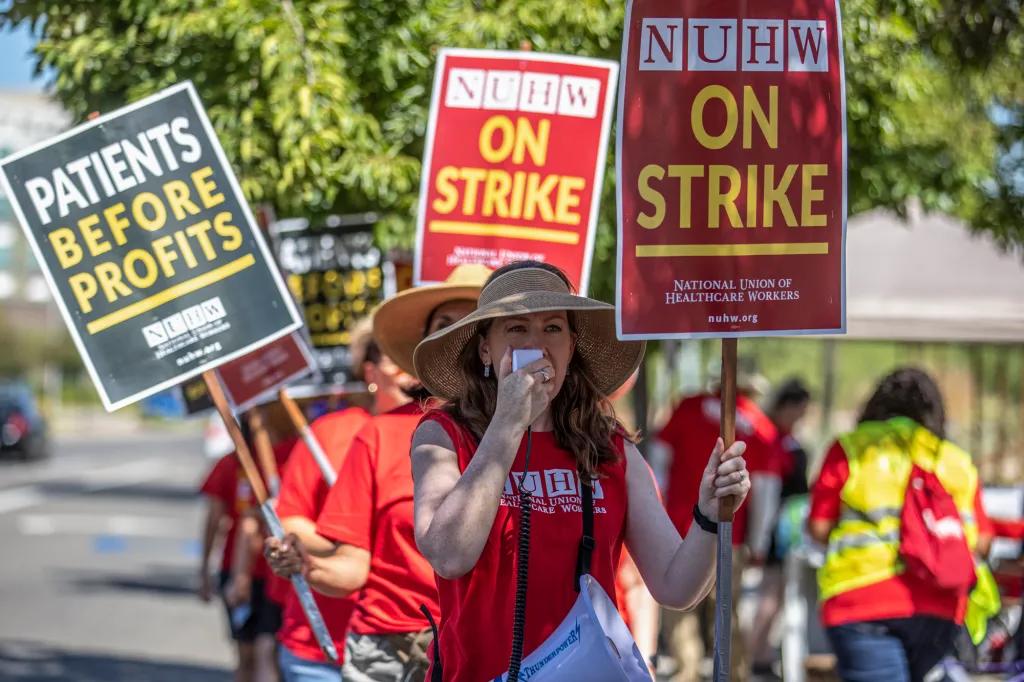
National Union of Healthcare Workers members march in a circle as they strike in front of Kaiser Permanente in Fresno on Aug. 15, 2022. Photo by Larry Valenzuela, CalMatters/CatchLight Local
###
The need for therapists, social workers, psychologists and psychiatrists is greater than ever. Under relentless pressure from the pandemic and inflation, wildfires and gun violence, racism and war, Californians are crying out for help.
But that doesn’t mean they can get it.
In every corner of mental health right now, a similar story is being told. There simply aren’t enough providers.
Patients receive lists of names from their insurers, only to learn none of the therapists on these so-called “ghost lists” will see them. Clinicians who do offer a spot often only accept cash.
Nonprofit mental health providers report needing to have an offer letter ready at a job interview, fearing applicants will take another position if they wait.
Kaiser mental health clinicians have been out on strike for weeks now in Northern California, describing exhausting working conditions and long delays in care for their patients. Kaiser, for its part, points a finger at a familiar culprit: the mental health provider shortage.
CalMatters spoke with more than two dozen mental health experts, public officials and providers around California to ask about the impacts of the mental health provider shortage, and what can be done about it. Their responses ranged from desperate to hopeful.
All agree we are at a pivotal movement.
In part, that’s because Gov. Gavin Newsom’s administration is investing heavily in overhauling the state’s mental health system. At the same time, the state has recently enacted laws requiring insurers to provide timely access to mental health care. Some worry a lack of providers could jeopardize these bold new initiatives. Others see this as an opportunity to reimagine how mental health care in the state is delivered.
Here’s what the experts had to say:
1. How big is the provider shortage problem?
It depends on what part of the elephant you’re looking at, said Catherine Teare, associate director of the California Health Care Foundation’s People-Centered Care team. County mental health departments are struggling to hire. So are commercial health plans. So are nonprofits.
At the same time, she said, “the level of mental distress is increased.”
“For children or adults who need a lot, or need it urgently, it’s a scary time.”
Dr. Mark Ghaly, secretary of the California Health and Human Services Agency, told CalMatters that the number of licensed behavioral health providers in the state increased by 20% between 2016 and 2020. But, that’s been offset by an increase in demand he calls “really unprecedented.”
For patients, how bad the shortage is depends, in part, on where you live, your insurance, your income, your age, the care you need and whether you want a clinician of color or one who speaks a language other than English.
A report published by the University of California, San Francisco, in 2018 – even before the pandemic sent need skyrocketing – predicted that by 2028, demand for psychologists and other therapists would be 40% more than supply. For kids, the shortage is especially dire. Close to a third of California’s 58 counties have no child and adolescent psychiatrists at all, according to the American Academy of Child & Adolescent Psychiatry.
A new report from the California Health Care Foundation shows that the Bay Area has 19 licensed psychiatrists and 73 licensed psychologists per 100,000 people – significantly more than the state averages of 12 and 44. At the other end of the spectrum, the San Joaquin Valley has six psychiatrists and 16 psychologists for the equivalent number of people.
Jessica Dominguez, a licensed marriage and family therapist at Kaiser Richmond who is currently on strike, said the Bay Area has plenty of providers.
“Throw a rock, you’re going to hit a therapist,” said Dominguez, who said she plans to leave the organization.
But others who work in the region, including Matthew Madaus, executive director of the Behavioral Health Collaborative of Alameda County, said “100% absolutely” there’s a shortage even in the Bay Area.
“For children or adults who need a lot, or need it urgently, it’s a scary time.”
— Catherine Teare, California Health Care Foundation
If you search for a behavioral health clinician on Indeed.com, he said, it comes up with thousands of open positions within a 25-mile radius.
“It’s extraordinary the level of demand,” he said.
One problem: It’s difficult to capture how many clinicians don’t accept any insurance at all, and thus aren’t accessible to the vast majority of patients who can’t pay cash.
What we do know: We need more and better data. For instance, some experts say the increase described by Ghaly does not reflect how many licensed providers are actually seeing patients, nor does it capture how many are seeing people who are uninsured or on Medi-Cal.
Democratic Sen. Scott Wiener of San Francisco authored a bill this year that would require the Department of Health Care Access and Information to prepare a report for the Legislature by Jan. 1, 2024, describing the state of California’s behavioral health workforce, and how best to address the shortage. Senate Bill 964 is on the governor’s desk.
San Diego County has already researched the shortage. Officials there estimate they currently have 17,000 behavioral health workers and need an additional 8,100 to meet current demand. In the next five years, they anticipate needing another 10,000 workers, in part because so many will be retiring.
2. What’s causing the shortage?
Mental health leaders will tell you the shortage itself is nothing new. But the pandemic has aggravated the problems. More providers have left their jobs, citing burnout. Or they’ve left the state, citing cost of living. New telehealth startups specializing in mental health treatment offer good pay and flexible hours; many experts said they have added to the demand by siphoning off providers from the public sector.
In a 2018 report on the behavioral health workforce shortage, Janet Coffman of UCSF also raised the concern that 45% of psychiatrists and 37% of psychologists would likely be retiring within a decade. The pandemic has accelerated this trend, she said.
Many clinicians say they’re simply exhausted. It’s not just that more people need help, but many of them are coming in sicker, with mental health issues that have gone untreated.
“Our patient population has become so much more difficult to work with than it used to be a decade ago,” said Randall Hagar, legislative advocate and policy consultant for the Psychiatric Physicians Alliance of California.
As openings go unfilled, those who remain are left to carry more of the weight, he said.
Another problem Hagar and others mention: paperwork. Doctors spend some 40% of their time on paperwork, he said.
Many clinicians, especially providers of color, also say they are simply not getting enough emotional support from their employers. Dominguez, the Kaiser therapist, said she founded La Clinica, a nationally recognized pilot program to serve Spanish-speaking clients, in 2016. When tragedies happen in the community, she said, they impact clinicians, too. But, “you’re just expected to plug along and keep going,” she said.
Continually witnessing trauma can be exhausting, said Jeff Capps, a social worker with Pacific Clinics in Los Angeles. He emphasizes the need to make the work more sustainable for clinicians. That includes better pay.
“Sometimes in our field, the assumption is that since you get value out of your work, you don’t need to be as compensated,” he said.
A 2019 report by the healthcare consulting firm Milliman found that commercial plans in California, when setting rates, pay primary care providers an average 15% more than they pay behavioral health providers.
Luke Bergmann, San Diego County’s director of behavioral health, said his county’s report on the provider shortage showed that, in some cases, people chose to work at Panda Express instead of substance use disorder clinics “because they simply cannot make as much.”
“People talk about loving the work,” he said. “For people to leave this work is an incredible emotional sacrifice.”
Candy Curiel, clinical director of Pacific Clinics for the Inland Empire, said inflation is making the situation even worse.
“Everything is so costly at this point, people feel they need to seek more money,” she said.
3. Everyone is competing with everyone else. Is this a zero sum game?
Michelle Cabrera, executive director of the County Behavioral Health Directors Association, said the state’s mental health system is so overwhelmed, everyone is poaching from each other.
“Let me be clear: It is a zero-sum game,” she said. “There’s only so many licensed or competent professionals in the state of California to do these jobs.”
In August, state Superintendent of Public Instruction Tony Thurmond announced that he had secured funding to hire 10,000 additional mental health clinicians to serve the state’s students. That effort is key to the Department of Education’s push to increase mental health care provided in schools.
Adrienne Shilton, senior policy advocate for the California Alliance of Child and Family Services, called the $200 million to establish a new scholarship program for master’s level clinicians “a big win.”
But for Cabrera, the announcement “just puts fear at the heart of county behavioral health.”
She wonders how counties can possibly compete.
“I don’t know that we’ve really had a reckoning yet on the degree to which demand so far exceeds the available supply of providers in our state,” she said.
This is the vicious circle for workers who are salaried. Nonprofit providers often pay less than schools and counties. Schools and counties, in turn, pay less than Kaiser and some of the new telehealth startups.
Nonprofit jobs that used to attract 40 or 50 applicants might only get two or three now, said Madaus, of the Behavioral Health Collaborative of Alameda County. Some nonprofits are looking at the possibility of providing free housing as an incentive, he said.
Even as it contributes to burnout, the increasing demand has, in some ways, opened new doors for clinicians.
Michael Torres, a child and family clinical psychologist for Kaiser in San Leandro who is currently on strike, said that of 15 people on his team, six have left in the past year. Some are leaving to do telehealth, or to work in the private sector. Those positions can offer better work-life balance and more flexibility, he said. They also allow clinicians to see patients weekly or biweekly, he said, instead of every four to six weeks as often happens at Kaiser.
4. How will the provider shortage impact the Newsom administration’s big mental health initiatives?
Coming into office, Newsom made clear that he wanted to prioritize mental health. Over the past few years, his administration has championed a number of bold new initiatives. These include:
- The Children and Youth Behavioral Health Initiative, a $4.7 billion investment meant to transform the children’s mental health system.
- CalAIM, a major transformation of the state’s Medi-Cal system.
- Care Court, a controversial proposal to compel people with serious mental illness into care and housing.
Lawmakers in recent years strengthened requirements that private insurers adhere to federal and state mental health parity laws – which require equal treatment of mental and physical health concerns.
But many of those tasked with implementing these efforts say they are worried.
“We have that conversation all the time,” said Madaus of the Behavioral Health Collaborative of Alameda County. As new funding sources come online, he said, nonprofit executives consistently tell him: “I can’t take any more funding because I can’t hire more staff.”
“We finally have all of this money and transformation coming. All these amazing things … and it couldn’t come at a worse time in terms of our workforce.”
— Karen Larsen, The Steinberg Institute
Karen Larsen, chief executive officer of The Steinberg Institute, a nonprofit that advocates on mental health policy, is also concerned. Prior to assuming her current role, Larsen spent two decades as head of Yolo County’s behavioral health department.
“We finally have all of this money and transformation coming,” she said. “All these amazing things … and it couldn’t come at a worse time in terms of our workforce.”
Ghaly says he shares that concern. But he adds that “incredible investments have been made,” not just in innovative programs, but in addressing the workforce shortage head-on.
5. How do we increase the number of providers?
Earlier this year, Josh Leonard, executive director of the East Bay Agency for Children, was struggling to fill openings for mental health clinicians. Over several months, the nonprofit – anticipating a bump in its contract with Alameda County – raised all clinicians’ salaries by at least 15%.
It worked. At least for now.
While Leonard’s not considering the workforce crisis over, he knows that decision was important.
Jessica Hernandez, a clinician there, agrees.
“For me it has helped out tremendously,” she said. “Now I want to stay longer.”
To make the work more appealing and sustainable, providers say a lot needs to change. Besides pay, other factors are also critical, including reducing paperwork, offering more flexibility and providing more support to therapists.
That last one has been key for Hernandez.
“They’re acknowledging that it’s really, really tough,” she said.
“We’re making much bigger investments in the behavioral health workforce than we have since I started engaging in this field in the 90s.”
— Janet Coffman, University of California, San Francisco
To meet growing need, new providers also must be brought in. Scholarships and loan repayment programs are helpful, but universities need more spots to train new clinicians.
Coffman, of UCSF, calls herself “cautiously optimistic.”
“We’re making much bigger investments in the behavioral health workforce than we have since I started engaging in this field in the 90s,” she said.
This year’s budget allocates more than $360 million for the state to spend over the next three years on everything from recruiting high schoolers into behavioral health to expanding social work slots at public universities and helping psychiatry students with loan repayment.
Gov. Newsom also emphasized workforce development in his recent master plan for kids’ mental health. Some of the $4.7 billion will go toward bringing in 40,000 new mental health workers, he said.
6. Can we reimagine how mental health care is provided?
Ultimately, getting mental health care to everyone who needs it is going to require both expanding our idea of who should provide that care – and how.
“If you only see the system in the context of what it currently is, yeah, we’re stuck by the provider shortage,” said Alex Briscoe, head of California Children’s Trust, an initiative to change the state’s mental health system for children.
“But I would say that we can’t let that stop us, and I actually think it represents an opportunity.”
For Briscoe, this includes team-based models — already used by some nonprofits — involving a therapist, a case worker, a parenting coach or housing or employment specialist, and a peer provider who has lived with mental illness and is uniquely positioned to support others in crisis.
It includes more people with shared life experiences and those who live in the local community, he said.
Mental health workers are often middle-class white women, while many of the people they serve – especially on Medi-Cal – are lower-income people of color, said Dr. Rhea Boyd, a pediatrician and public health advocate who works with Briscoe at the California Children’s Trust. What if we expanded the provider class so that it included the people who cut or braid your hair? she wonders. What if the people who offered you mental health care lived on your block?
A lot of these things already exist informally, she said. What’s needed is a way to pay them.
That’s starting to emerge.
Two years ago, the state finally authorized a pathway to certify peer providers, allowing organizations that employ them to bill Medi-Cal. California was the 49th state to do so.
Other new categories of workers are also being proposed. CalAIM created a job description called “community health workers,” trusted residents who do outreach in their own communities. And the state’s Children and Youth Behavioral Health Initiative is developing the role of behavioral health coaches, who work with young people on school campuses. Both would work in team-based models under the supervision of licensed providers.
Coffman and others say it’s also important to invest in career ladders, so people who enter the field as peer providers have the option to earn more advanced degrees.
“This is the opportunity California has in front of it,” said Ghaly, secretary of the California Health and Human Services Agency. “And it’s going to start by how transformative, innovative and successful we are in creating not just the workforce that we know but the workforce that we’ve yet to discover.”
###
Our behavioral health coverage is supported by a grant from the California Health Care Foundation. CalMatters.org is a nonprofit, nonpartisan media venture explaining California policies and politics.
OBITUARY: Jarod Lawrence Jones, 2000-2022
LoCO Staff / Thursday, Sept. 8, 2022 @ 6:56 a.m. / Obits
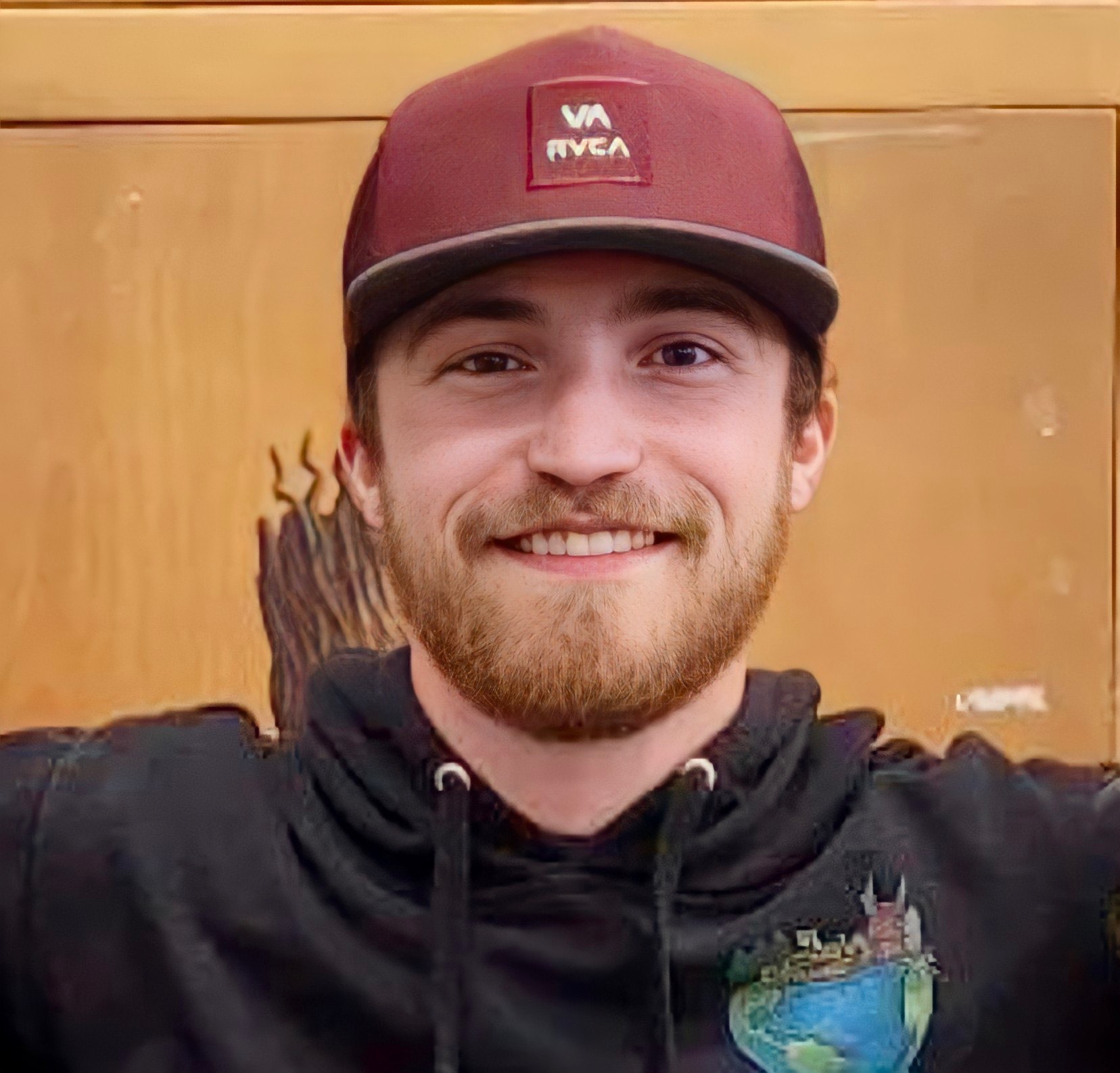
Jarod Lawrence Jones was born on January 5, 2000 in Marin County. On August 20, 2022, he left behind many heartbroken people with his passing at only 22 years old.
Jarod grew up in Rio Dell and graduated from Fortuna High School in 2018. Jarod is survived by his parents Jason Jones and Ronda Robbins, sister Halie Head (Bryant), brothers Jacob Jones and Jaden Jones, niece Kairi Head, nephew Cooper Head, and lastly grandparents George Jones, Debra Dobereiner, and Mardy & Janet Robbins. Jarod is preceded in death by his grandpa Ed Dobereiner, uncle Criss Robbins and aunt Kellie Jones.
Jarod was known for his quick-witted sense of humor, caring personality, a huge appetite for life, magnetic energy and his ability to make anyone else laugh even when his own cup was empty. He could be hard to crack and understand — but if you had the pleasure of knowing him, you knew that he was one of the most loyal loving people out there. When he loved, he loved hard. Many of us out there are lucky to have been loved like that by him.
Jarod lived his life unapologetically. He was going to live his life the way he wanted to and on his terms. As he did. He traveled all over the United States with his friends gaining unforgettable, once-in-a-lifetime experiences. He made time for hanging out with both old and new friends, loved going for long drives and spending time at the rivers and beaches. He enjoyed playing video games and playing basketball with his little brothers and going over to his sister’s house for home-cooked meals and heart-to-heart conversations. But the real reason for going to his sister’s house was to spend quality time with his niece and nephew, whom he loved so much. He also loved spending quality time with his family around the bonfire, and would visit his parents daily. Jarod was also proud of his nickname that many friends called him: J-Rod.
The amount that he accomplished in his short 22 years is often not achieved in a full lifetime. Jarod always said that he felt like he wasn’t going to live a long life and he was okay with that. He was going to make his life count and live life with no regrets. We are so thankful he always stayed true to himself. We believe he is at peace, but a piece of of us will always be missing. The world will not be the same without him in it. We love you, Jarod.
Forever 22.
We will be having a celebration of life open to the public for Jarod at the Fortuna Fire Hall on October 9 at 11 a.m. We would love to see anyone there who knew Jarod or would like to support our family during this time. We hope you will choose to come and share stories, photos and videos of our angel.
###
The obituary above was submitted by Jarod Jones’ loved ones. The Lost Coast Outpost runs obituaries of Humboldt County residents at no charge. See guidelines here. Email news@lostcoastoutpost.com.
OBITUARY: David Larry Cook, 1949-2022
LoCO Staff / Thursday, Sept. 8, 2022 @ 6:56 a.m. / Obits

David Larry Cook, born on May 4,
1949, passed away on Sept.
6, 2022. He lived in Orick since childhood.
He is survived by his wife, Anna Cook, and his daughters Sarah
Monedero and Natasha O’Loughlin.
He has five
grandchildren and a large extended family.
David was known for his love of the outdoors — fishing, hunting, and camping. Even though David was legally blind he did many types of jobs: fishing, logging, teaching, and was a martial arts instructor. David was a storyteller which is why he was such a good fisherman. His passion was to talk and one of his favorite stories to tell was how he survived a bear fight. He was funny and kind and was the type of person who would give someone the shirt off his back. He made many sacrifices for his family, David and his wife cared for his brother and mother for many years until their passing. He was a strong man with an even bigger heart for his family and friends.
David suffered a life-changing stroke in 2014 that forever changed his abilities to speak and walk. He had been living with chronic lung conditions, speech aphasia and limited mobility, which stole his ability to communicate and be active, all things he loved to do. David did overcome his disabilities and managed to still enjoy his days watching old western shows and giving his grandkids rides on his wheelchair. It was a sad day when his granddaughter Annahi got too big to ride on the back of the wheelchair because they started to do wheelies.
The family would like to thank Dr. Abassi and the nursing staff at Mad River Hospital for helping David and us through this hard time and making David as comfortable as possible. He passed away in his sleep next to his wife Anna, which is all we could ask for. We would like to thank Ayres Family Cremation for their services and compassion during this difficult time.
We will have a memorial/celebration on May 6. Further information will be provided on a location and time.
###
The obituary above was submitted by David Cook’s loved ones. The Lost Coast Outpost runs obituaries of Humboldt County residents at no charge. See guidelines here. Email news@lostcoastoutpost.com.


