Former Humboldt County Auditor-Controller Karen Paz Dominguez. | File photo by Andrew Goff.
###
The Humboldt County Board of Supervisors has approved a settlement agreement with the State Controller in the case of The
People vs. Karen Paz Dominguez and the County of Humboldt.
The state filed the suit on May 2, alleging that Paz Dominguez, the county’s former auditor-controller, failed to file the county’s adopted budgets on time for two consecutive fiscal years — 2020/21 and 2021/22 — and also failed to file the county’s Financial Transaction Reports for fiscal years 2019/20 and 2020/21 “in the time, form, and manner prescribed by the State Controller.”
The state sued Paz Dominguez in both her personal and official capacities. The county was named as a co-defendant.
In June, the county reached a separation agreement with Paz Dominguez, agreeing to pay her attorney fees and dropping its own cross-complaint against her, among other terms, in exchange for her early departure.
Meanwhile, staff and legal counsel have been negotiating settlement terms with the state, and at today’s Board of Supervisors meeting staff presented the agreement for approval.
What are the terms, you ask? For one, in exchange for the state dropping its suit, the county has committed to “a detailed action plan that includes milestones” for filing the overdue budgets and reports.
The county also agreed to provide the State Controller’s Office with an update to the action plan within seven days of the suit’s dismissal, plus progress reports at the end of October of this year and January, March and May of next year.
“If [the] county’s updates are unsatisfactory to [the State Controller’s Office], the parties will, within 14 days, meet and
confer to resolve their dispute,” the agreement says. “If the parties are unable to resolve their dispute within 14 days of
their first meeting, [the state] may seek judicial enforcement of the terms of this agreement
without further notice to defendants.”
The county also agreed to pay $12,000 in forfeitures for the delayed reporting, and each party will pay its own attorney fees.
The settlement agreement was approved unanimously, without discussion, as part of the consent calendar for today’s meeting.
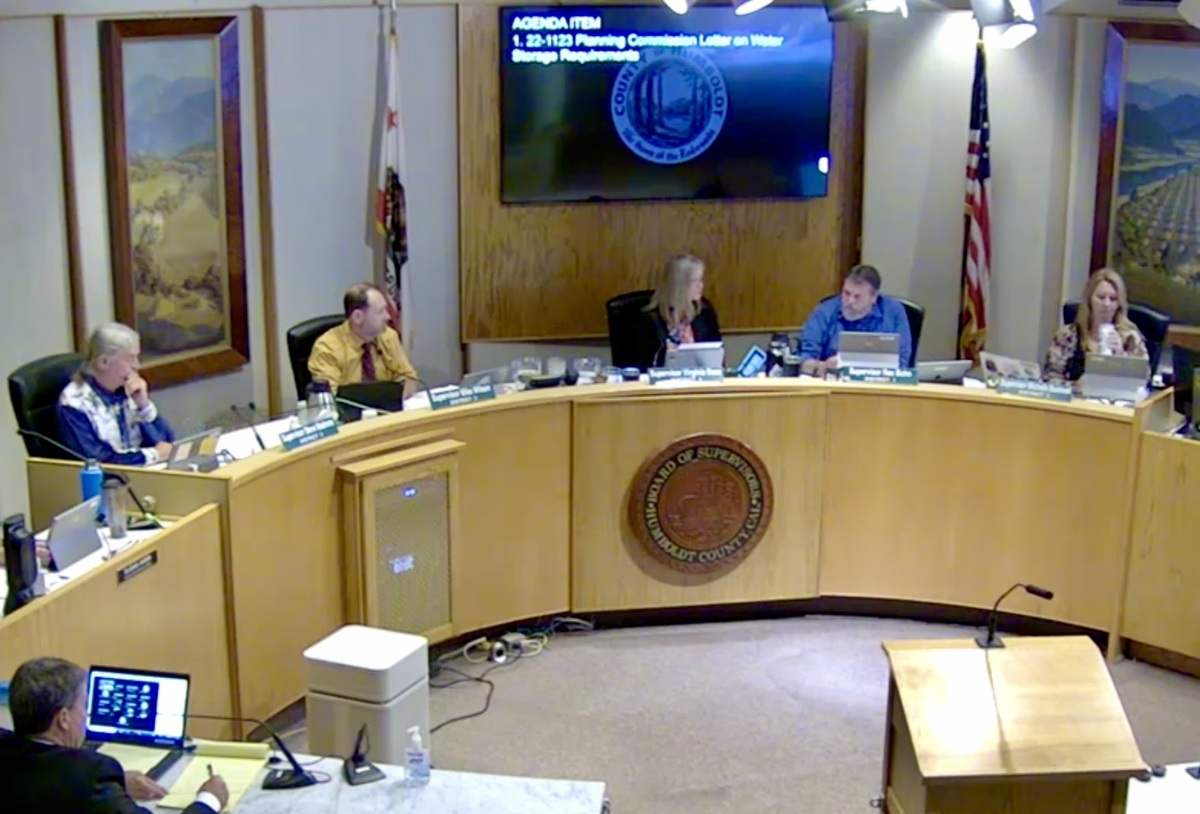
The Humboldt County Board of Supervisors. | Screenshot.
###
Humboldt County continues to experience severe-to-extreme drought conditions, heightening concerns about the water being used to irrigate our region’s most famous cash crop: cannabis.
On Tuesday, the Humboldt County Board of Supervisors responded to concerns from its own Planning Commission by directing staff to develop a new cannabis permitting policy addressing water storage and forbearance.
The Planning Commission recently asked the board for guidance on this matter. On August 11 the commission submitted a letter telling the board that “there continues to be substantial public concern expressed over the use of groundwater for cannabis irrigation needs.”
In particular, members of the public have said the county should stop permitting new wells until there’s a better understanding of how they connect to surface water in the county’s various watersheds. In response, the county planning department has been asking applicants to obtain a report from a licensed geologist or hydrologist to certify that their wells aren’t hydrologically connected to adjacent wells or surface water features.
The county is already operating under a settlement agreement from a 2019 lawsuit brought by Friends of the Eel River, in which the environmental group argued that the county hadn’t done enough to mitigate the impacts of commercial cannabis operations on local watersheds. The agreement requires the county to disperse grant funding to local landowners for culvert replacements and road repairs.
But local residents are still worried, with some neighbors of permitted cannabis farmers reporting that their own wells have gone dry despite the certifications from a hydrologist.
In response, the Planning Commission recently voted to require a condition on new permits that at least 20 percent of an applicant’s anticipated water needs be supplied by rainwater catchment.
In its letter, signed by Chair Alan Bongio, the Planning Commission asked the board for feedback “to either modify the ordinance or to establish policy to require rainwater catchment, water storage, or reliance on [the] Drought Task Force through [the] existing ordinance, in addition to groundwater wells.”
At today’s meeting, Planning and Building Director John Ford said the Planning Commission has only added that 20 percent rainwater catchment requirement to two permits thus far, both of which were for existing cultivation.
Second District Supervisor Michelle Bushnell noted that this requirement is not part of the county’s cannabis permitting ordinances, neither version 1.0 nor version 2.0.
During the public comment period, several members of the local cannabis community spoke against the prospect of a new rainwater catchment requirement.
Natalynne DeLapp, executive director of the Humboldt County Growers Alliance, said limiting water usage during dry months is widely considered a better approach.
“Forbearance is the gold standard for water conservation,” she said. DeLapp added that the county is working to collect additional data on groundwater connectivity while also distributing $12 million in state funding to incentivize water storage.
Any new policy should focus on forbearance, efficiency and decreased production scale, not just rainwater catchment, she argued.
SoHum resident Robie Tenorio said that with water storage being the goal, the county should encourage people to develop ponds. But, like DeLapp, she doesn’t necessarily support a new policy requiring rain catchment.
A new policy would just create confusion, she said, adding, “I think we really need to focus on forbearance.”
Fellow SoHum resident Bonnie Blackberry said the county should wait until after the drought task force finishes its studies on the county’s hydro-geological conditions, saying the drought is causing an environmental crisis.
“I believe it’s all connected,” she said regarding local water supplies.
When the matter came back to the board, First District Supervisor Rex Bohn said he also believes in the wisdom of forbearance.
“I’m a pond guy,” Bohn said, adding that he’s happy deferring to staff to work out a recommendation. He also noted that cannabis gets treated differently than other crops. “They can put [in] any other agricultural crop — 50 acres of grapes — and [those farmers] don’t come anywhere near our office.”
Bushnell said she’d like to see more consistency from the Planning Commission, adding that “cannabis gets tore up” in a lot of their meetings.
Bushnell said someone recently asked about her own cannabis cultivation project.
“Yes, I have a rain catchment pond,” she said. “I did it. I didn’t have to but I did it because I want to. I’m going to utilize that for my cows and for lots of things — for fire suppression.”
But she doesn’t think it’s right to mandate such a thing for all applicants right now.
“We have changed the goalposts for these folks so many times,” Bushnell said.
Ford said the Planning Commission really wants an answer to the question in their letter.
“Well, I think the Planning Commission has an answer,” Bushnell said. “They have an ordinance that they should follow.” She again said that she feels cannabis projects are being singled out for harsher treatment from the commission.
Ford said the Planning Commission wants to respond to public concerns, though he added, “I think that’s where sometimes we get into situations where projects have been conditioned to require more storage than at other times. It does start to get a little bit inconsistent.”
Third District Supervisor Mike Wilson said he thinks any forbearance policy shouldn’t be limited to cannabis.
“We’re seeing 10,000-square-foot homes and whatever the associated landscaping and pools and other things associated with that,” he said regarding development in the hills. He also mentioned vineyards. “I’ve been watching that trend south of here. It’s coming here,” he said.
Wilson also noted that he doesn’t have a problem with the Planning Commission making its own judgment calls. “There is statutory discretion,” he said.
Fifth District Supervisor Steve Madrone credited ranchers as being “the original innovators of storage and forbearance,” and he reiterated his oft-stated belief in the power of incentives. He suggested “stewardship incentives” such as tax credits as a means of encouraging storage and forbearance.
Bushnell made a motion to direct staff in the Planning and Building Department to come back with recommendations on a forbearance policy, later adding direction to include a proposal for incentive-based reductions of Measure S cultivation taxes for storage and forbearance.
“I want to ensure that we while we’re doing this process, that [the] Planning Commission can be considerate that we’ve heard them and be patient as we get some ordinance or policy changes coming forward,” Bushnell said, “and to not stifle projects as they come to them.”
She amended her motion to include a letter from the board to the Planning Commission expressing that sentiment.
The mighty LoCO Elections Eagle brings tidings of another election season.
###
Election season is
back, and that means LoCO Elections is back!
LoCO Elections is
the place where you, the Lost Coast Outpost
readership, may put questions to the people who seek to represent you
in higher office. It’s also where those candidates may answer those
questions, and also to communicate with you via their press releases
about endorsements and policy positions and stuff.
Right
now, here are the races we’re looking at on LoCO Elections:
Are
you a candidate who doesn’t yet have a green check? That means
either: 1) You haven’t answered my email yet, or 2) I couldn’t
find your email address. Want to get hooked up with an account? Shoot
me a line – hank@lostcoastoutpost.com.
Are
you a candidate for some other office on the current ballot, one that
is not already listed on LoCO Elections? Would you like to have a
LoCO Elections page too, so’s that people in your jurisdiction can
ask you things? Again, shoot me a line and we can probably add your
race to the site, if you promise to participate.
Happy LoCO Election season, everyone! Let’s figure out who the best candidates are, together!
Press release from the Humboldt County Sheriff’s Office:
On August 28, 2022, at about 6:27 a.m., Humboldt County Sheriff’s
deputies on patrol in the county’s jurisdiction of Eureka observed
a vehicle parked in the middle of the roadway on the 2900 block of
O’Neil Lane. Deputies contacted two women standing in the roadway
near the vehicle.
Deputies recognized
one of the women from previous law enforcement contacts as
56-year-old Nonie Annette Bishop, who was wanted on outstanding
misdemeanor warrants. During a search of Bishop’s vehicle incident
to arrest, deputies located approximately 2.42 ounces of crystal
methamphetamine, items consistent with the sale of controlled
substances, drug paraphernalia and burglary tools.
Bishop was arrested
and booked into the Humboldt County Correctional Facility on charges
of possession of a controlled substance for sales (HS 11378) and
possession of burglary tools (PC 466), in addition to
warrant charges of petty theft (PC 488), possession of a
controlled substance (HS 11377(a)) and driving with a
suspended license (VC 14601.2(a)).
Anyone with
information about this case or related criminal activity is
encouraged to call the Humboldt County
Sheriff’s Office at (707) 445-7251 or the Sheriff’s Office Crime
Tip line at (707) 268-2539.
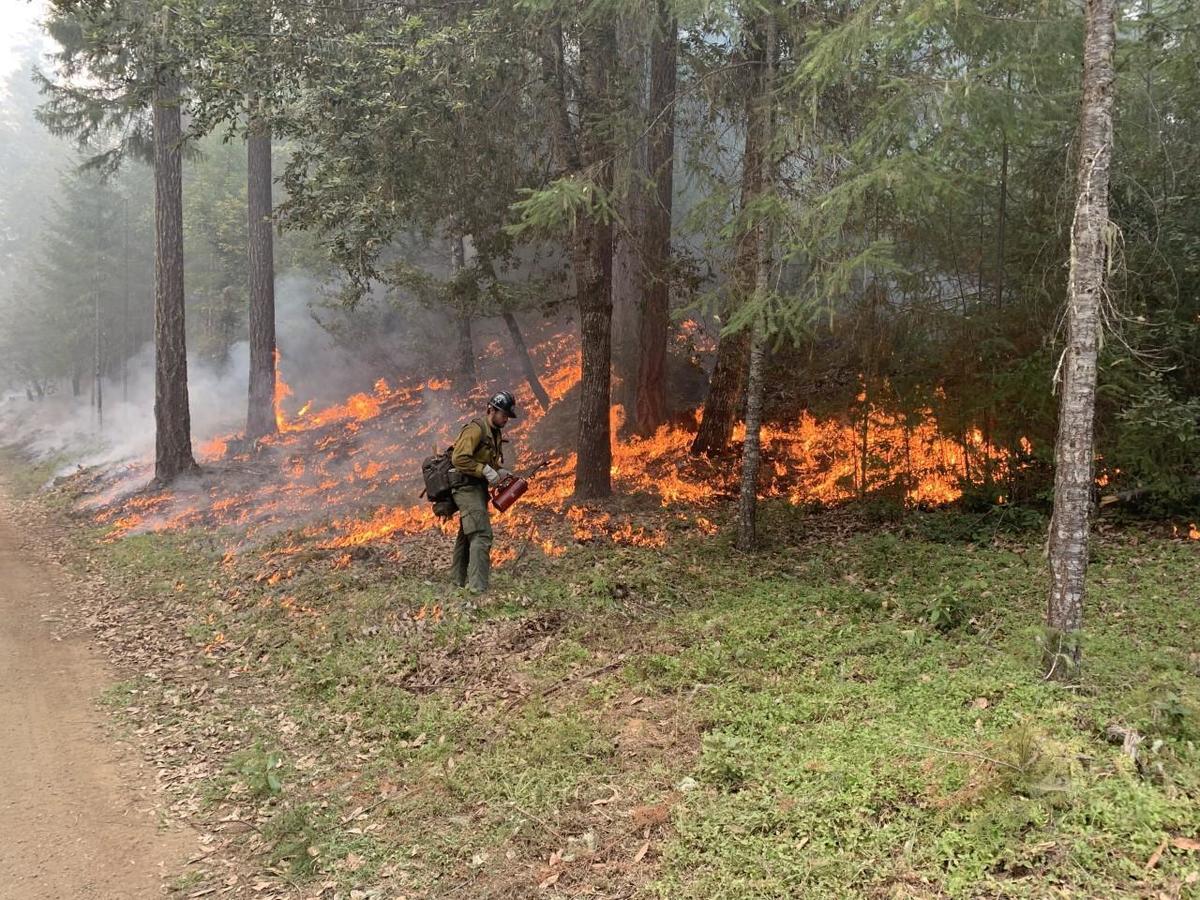
A firefighter uses a drip-torch during a defensive burning operation. Defensive burning is used to remove leaf litter, grass and other small vegetation between an established fire control line and the main fire Photo/caption: CAIIMT14
###
Press release from the unified command of the Six Rivers Lightning Complex:
The
Six Rivers Lightning Complex remains in unified command with
California Interagency Incident Management Team 14, California
Highway Patrol, Trinity County Sheriff, and Humboldt County Sheriff.
The Six Rivers Lightning Complex is currently 34,076 acres with 54%
containment and 1,922 personnel assigned to the incident.
The
containment percentage has been updated to correctly reflect the
amount of the fire perimeter that is deemed fully contained. Although
this represents a sizeable reduction to the containment percentage,
it should be noted that much of the control lines have been completed
and are nearing containment classification.
CURRENT
SITUATION
Monday,
firefighters began their day with an excellent hold on most areas of
the fire after several days of highly effective defensive firing
operations. This positive position is a direct result of the full
suppression strategy and the tireless efforts of the firefighters on
the fire line.
Through
Monday, the Ammon Fire held within its current footprint.
Firefighters remained engaged around the fire, extinguishing hot
spots and securing control lines around Madden Creek. In addition,
fire suppression repair work has begun on the contingency lines of
the Ammon Fire.
Firefighters assigned to the Campbell Fire
carried on with their primary objective of completing defensive
firing operations along designated control lines. Efforts were
concentrated around Horse Linto Campground, Lone Pine Ridge, and
Groves Prairie Road. In the areas where firing operations have been
completed, there is a large buffer intended to stop the forward
progress of the fire.
In the
evening hours of Monday, fire activity increased in the southeast
portion of the Campbell Fire. Aerial reconnaissance identified a spot
fire south of the control line at Zeigler Ridge. Firefighters today
will pick up where night operations left off, prioritizing the
containment of the spot fire near Zeigler Point. The structure
protection task force will remain assigned to the areas of Trinity
Village and Hawkins Bar.
Forest
order NO. 22-10-06 Six Rivers Lightning Complex is currently in
place, which includes river access at Kimtu Park.
To
view this closure and map, please visit this link.
ROAD
CLOSURES
Due to a
large presence of fire personnel and machinery working to build
containment lines for the Ammon Fire, residents are asked to limit
travel on Titlow Hill Road/Route 1 in zones HUM-E052 and HUM-E062 to
essential traffic only. Residents may still use roads to travel out
of evacuation order zones:
The
following roads into evacuation zones have been closed.
Forest
Route 7n15 at Six Rivers Forest Boundary
The
following roads are restricted to local traffic only:
Horse
Linto Creek Road at Saddle Lane (Open to residents only)
6N06
Sandy Bar (Route 6)
Titlow
Hill Road (Route 1) at Horse Mountain Botanical Area
State
Route 299 remains open to through traffic. Residents are encouraged
to visit the Caltrans Quickmap
to
check for state highway closures.
*Evacuation
Warnings have been lifted for zones HUM-E062, HUM-E063, HUM-E076-B,
HUM-E077.*
EVACUATION
ORDERS
remain
in effect for zones: HUM-E058 and HUM-E061-A.
EVACUATION
WARNINGS remain
in effect for zone: HUM-E032, 483 - Fisher Road and all residences
off of Fisher Road, Trinity Village, Wallen Ranch Road.
Zone
482 - Suzy Q Road and all roads off of Suzy Q Road
Zone
480 - Ziegler Point Road / Forest Service Road 7N04
An
EVACUATION
WARNING remains
in effect for Campbell Ridge Road from Salyer Heights to Seeley
McIntosh Road. Salyer area, including Galaxy Road, and the
area of Ziegler Point Road/Forest Service Road 7N04 have been reduced
to an Evacuation Warning.
ANIMAL
EVACUATION CENTER
Hoopa
Rodeo Grounds 1767
Pine Creek Rd., Hoopa, CA 95546 Phone:
(707) 492-2851
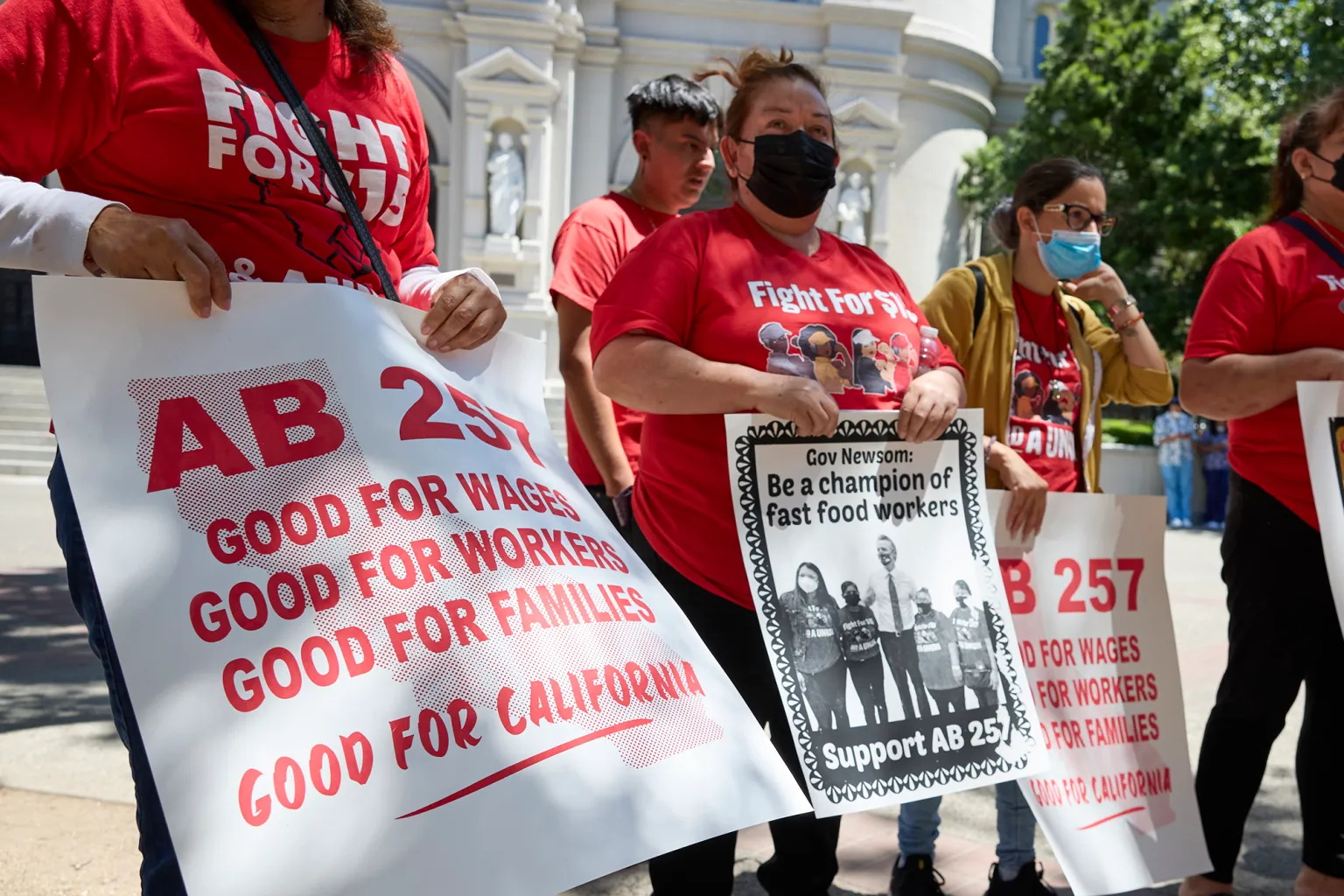
Fast-food workers and other SEIU members marched to the Capitol to deliver postcards and petitions in support of AB257 to the Governor’s Office on May 31, 2022. Photo by Fred Greaves for CalMatters
###
The California Legislature sent Gov. Gavin Newsom a first-in-the-nation bill Monday creating a council to regulate wages and working conditions in fast food restaurants.
The bill would give labor advocates a long-elusive bargaining foothold in a low-wage industry that employs more than half a million non-unionized workers statewide.
Pushed by the Service Employees International Union and fiercely opposed by business groups, the FAST Recovery Act barely passed the state Senate with the minimum number of votes. The vote was just as narrow in the Assembly hours later. Several Democrats abstained; after it passed six switched their votes to support it.
If Newsom signs AB 257, a council would be able to set standards across the fast food industry on wages and workplace conditions such as safety measures and even the temperature of a restaurant. Labor advocates say the bill would give workers bargaining power in an industry where union representation is difficult to achieve because of high staff turnover and franchise ownership.
Lawmakers pared back the bill significantly to push it toward final passage after several moderate Democratic Legislators balked at earlier proposals to give the new council sweeping regulatory authority over the industry. Lawmakers added a bevy of amendments last week to address the concerns of business owners.
In one major concession, lawmakers stripped out a provision that would have held fast food corporations jointly responsible for wage and labor violations at franchise locations. The bill’s sponsor, Democratic Assemblymember Chris Holden of Pasadena, said that was a “significant piece” in swaying some colleagues.
California in recent years has been extending this kind of labor law liability in other industries — from janitorial and gardening contractors to the building owners and firms that hire them, for example — as part of its efforts to combat wage theft. But fast food franchise corporations have long avoided that responsibility in federal and state labor law.
Even without that provision, labor leaders were calling the bill a victory. SEIU president Mary Kay Henry said at a rally outside the Capitol that the bill was a “watershed moment for working people.”
Of particular significance: including workers on the council alongside industry representatives, said Columbia University labor law expert Kate Andrias.
“Upending our state’s existing lawmaking structure and regulatory platform is no way to help workers.” — Jot Condie, California Restaurant Association president
The United States and California have used boards for other industries before to set minimum wages, particularly during the first half of the 20th century. But, Andrias said, the fast food bill is “a more expansive and ambitious variation” of those past efforts by having workers sit directly on the council and covering a wider range of working conditions.
Business and restaurant groups, which spent big on TV advertising opposing the bill, released a statement Monday afternoon urging Gov. Gavin Newsom to veto it. They have said fast food is being unfairly targeted and warned the new regulations would force restaurants to increase prices at a time of record inflation.
The broadcast and digital ads called the bill a “food tax.”
“Upending our state’s existing lawmaking structure and regulatory platform is no way to help workers,” said Jot Condie, California Restaurant Association president, in a statement.
Key compromises
Newsom has not stated a position on the bill, but his Department of Finance opposes it, saying it would create ongoing costs and worsen delays in the state’s labor enforcement system.
Supporters said Monday the bill incorporates their discussions with the Newsom administration.
Aside from the removal of labor liability for fast food chains, the bill’s other changes include provisions preventing the council from requiring any new paid leave benefits for workers, or from regulating how fast food restaurant operators schedule workers’ hours. Also any minimum wage the council sets would be capped at $22 an hour in 2023 and subject to inflationary increases in future years. The bill also includes a six-year expiration date.
Some food businesses would be exempt from the council’s rules, including bakeries, grocery store fast food counters, and chains with fewer than 100 locations nationally — that’s up from a prior threshold of 30 locations or less.
Balancing act
It was not immediately clear how many business or workers would be excluded by raising that threshold. For franchised brands with locations in California, the number of chains fitting the description fell from 149 to 84, according to the International Franchise Association.
The bill would give workers and their advocates an equal number of seats on the council as business representatives. The rest of the council would include two representatives of the governor’s administration – from the Labor & Workforce Development Agency and the Office of Business and Economic Development.
Sen. Dave Min, an Irvine Democrat, said he initially “had some deep concerns” about the legislation but supported the more limited version.
“I feel it’s our duty to protect our business centers from overburdensome state regulations, but we also have to balance that against the rights of the workers that serve us,” he said.
###
CalMatters.org is a nonprofit, nonpartisan media venture explaining California policies and politics.
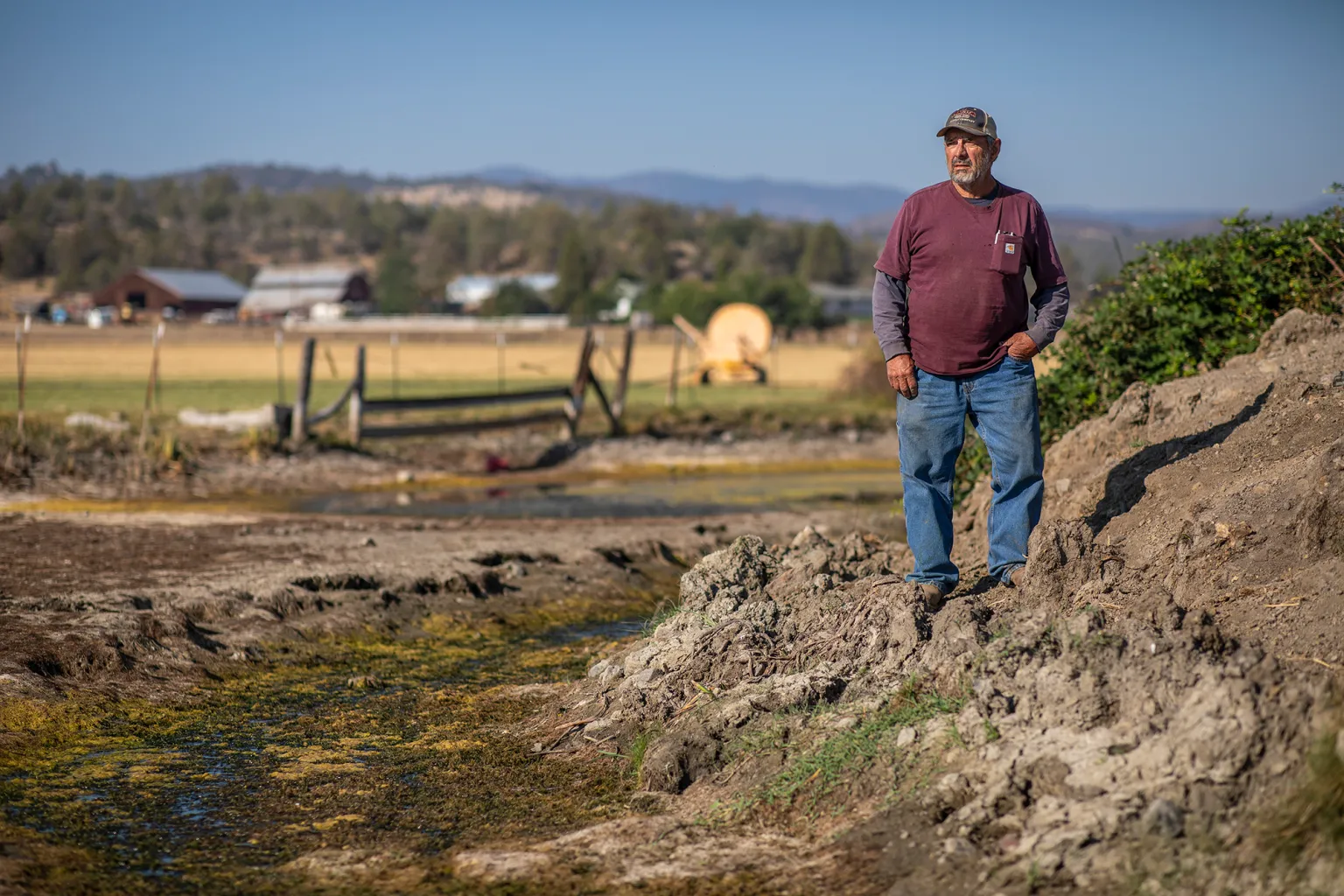
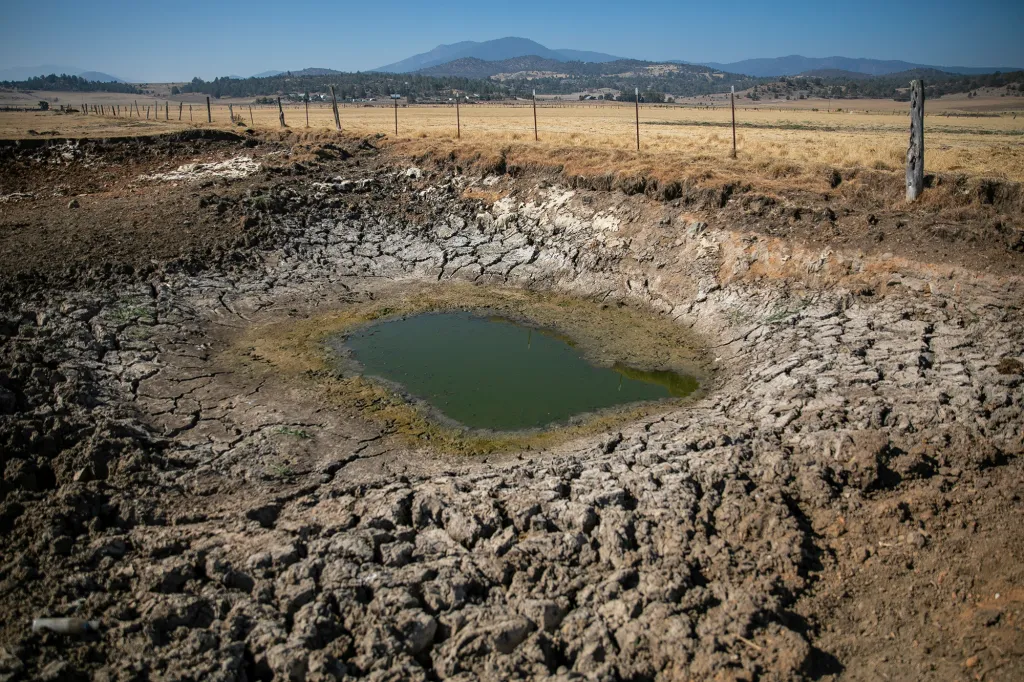
Jim Scala, a rancher in Siskiyou County, looks out over his dry stock pond in Montague on Aug. 29, 2022. Scala and others defied a state order to stop pumping water from the Shasta River. Photo by Martin do Nascimento, CalMatters.
###
The land that Jim Scala and his family have been ranching for three generations is parched and brown as far as he can see. The pond where his cattle used to drink is now a puddle, ringed with cracked mud.
In other years, water pumped from the Shasta River would have periodically flooded this land, keeping his pasture alive and pond full. But the state had ordered Scala and other ranchers and farmers in rural Siskiyou County to stop irrigating when the drought-plagued river dipped below a certain level.
With bills mounting from trucking in water and buying hay to replace dead pasture, and facing the prospect of selling half his herd, Scala and others made a decision to defy the state’s order.
“We said, ‘To hell with it,’” Scala said. “We’re starting the pumps.”
In a single day in mid-August, the Shasta River’s flows dropped by more than half and stayed there for a week, which could jeopardize the salmon and other fish that spawn there.
Klamath river tribes were outraged, and California water regulators sounded the alarm. The State Water Resources Control Boardordered the Shasta River Water Association, which serves roughly 110 farms and ranches in central Siskiyou County, to stop pumping. Fines would start at $500 per day but could rise to $10,000 after a 20-day waiting period or a hearing.
“The unlawful diversion sets a terrible precedent that irrigators can egregiously violate state water rights and impact listed and tribal trust species,” said Jim Simondet, Klamath branch chief for the National Oceanic and Atmospheric Administration’s fisheries division.
A week later, on Aug. 24, Scala and the other ranchers and growers turned the water pumps off.
“We accomplished what we set out to do,” said Rick Lemos, a fifth generation rancher who also is a board member of the rural water association. “We got relief for the cattle that were out of water and wading out in the mud and getting stuck.” He said one of his cows had died in the mud.
The weeklong standoff crystallized a warning from California water watchers: The state has limited power to speedily intervene in urgent conflicts over water, which are expected to flare across the state as drought squeezes water supplies for ranches, farms, tribes, cities and fish.
“This is about the Shasta and it’s about Klamath salmon and it’s about tribes in the Klamath. But this is really about: can the state protect its water supplies, or is it just going to be the Wild West? Is it going to be every cowboy for himself?” said Craig Tucker, a natural resources consultant for the Karuk Tribe.
‘Farmers open the floodgates’
Scala is the president and Lemos sits on the board of the Shasta River Water Association, a private, non-profit water distributor that operates in the heart of Siskiyou County in the shadow of Mount Shasta.
In normal years, the water association pumps from the Shasta River from April to October, sending the water through a network of canals to irrigate roughly 3,400 acres.
The county, where locals have long chafed under Sacramento’s authority, was primed for simmering tensions over water to boil over.
“The dictatorial whims of (the) State Water Board has no authority to tell the people of Siskiyou county what to do with their property they own,” U.S. Congressman Doug LaMalfa, a Republican whose district includes the county, said in an emailed statement. “This violates our constitutional guarantee against unlawful seizure. I encourage anyone to stop ‘voluntarily complying’ with government looters.”
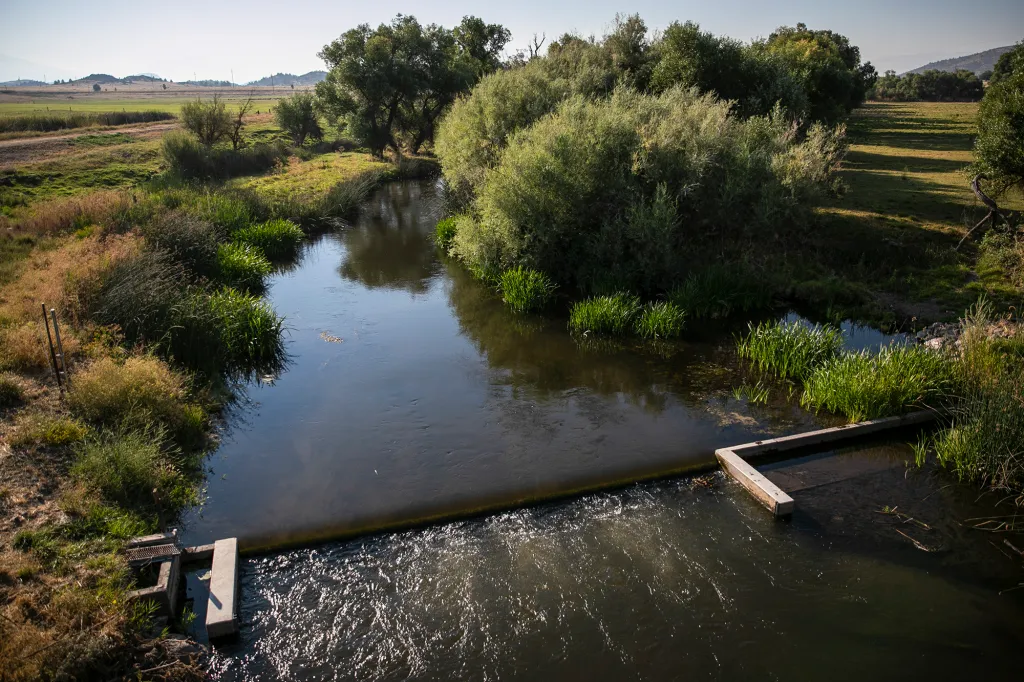
The Shasta River flows through Montague. Photo by Martin do Nascimento, CalMatters
This has been the fourth driest year to date in a region where drought has been tightening its grip for years. Even in 2020, the local agricultural commissioner reported an increase in fallowed acres and limited irrigation that reduced yields. Wildfires have burned through rangeland and timber.
But agriculture, too, has taken its toll on water in the region — warming the Shasta River and degrading its water quality, according to the Shasta Valley Resource Conservation District.
Salmon runs have been declining for decades and few adult coho return every year, NOAA’s Simondet said. “Fish,” he said, “are not doing fine.”
The Shasta River empties into the larger Klamath — a small source of its flow but an outsized producer of its fish.
“Can the state protect its water supplies, or is it just going to be the Wild West? Is it going to be every cowboy for himself?” — Craig Tucker, Karuk Tribe Consultant
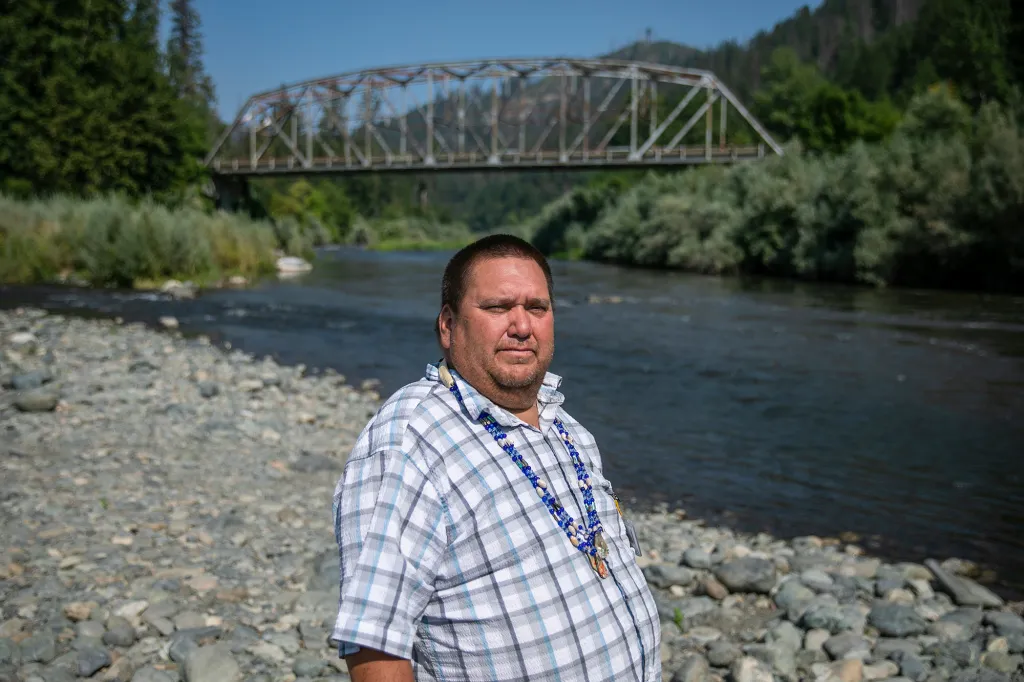
In Happy Camp along the Klamath River, about 75 miles east from the pumps that the ranchers turned on, Karuk Tribal Council Member Arron “Troy” Hockaday has been watching the river and its salmon populations change over his lifetime.
“(If) those fish are gone, our people suffer. Those fish don’t spawn, our people suffer. We live off that — it’s our culture,” said Hockaday, a fourth generation traditional fisherman.
Hockaday has been dipping handmade nets into the rapids at Somes Bar to catch salmon since he was a child, and worries that his grandson won’t be able to continue the tradition.
“There ain’t going to be no fish for him to fish. He’s never going to learn how to catch fish and be a Karuk Tribal fisherman.”
Aaron “Troy” Hockaday, a council member of the Karuk Tribe, looks out on the Klamath River in Happy Camp. He wants the ranchers to be penalized for pumping water from the Shasta River, a tributary of the Klamath. Photo by Martin do Nascimento, CalMatters
Seeing the salmon populations decline even as water continues to flow through irrigation canals “hurts. It hurts so bad to see that,” Hockaday said. “And then to put pain into my soul, into our family, into the river — the farmers open the floodgates on the Shasta River.”
From his vantage point, he said, “Nobody gets into trouble for it.”
‘Egregious and blatant disregard’ of emergency order
The aim is to protect salmon and trout species, including steelhead, fall-run Chinook and threatened Coho salmon. But the limit is fiercely contested by area ranchers, who note that it’s higher than the average historic flows in August since 1933.
The Shasta River Water Association petitioned in early August to continue diverting water to fill stock ponds for approximately 5,000 cattle plus calves and other assorted animals, according to a copy of the petition the water board shared with CalMatters. The water board said the request was still under review.
Lemos said the ranchers couldn’t afford to wait.
“How long do they review it while the cows are dying of thirst?” Lemos said. “We didn’t just fly off the handle and say hey, we’re going to break the law and get into a big mess. We tried the other way first.”
In a letter dated Aug. 17, the water association notified state regulators that they planned to violate the curtailment that day.
“We were in a critical situation. We have cattle out of water… We have nowhere to move them. You can’t just get them in and sell them tomorrow,” Lemos said. “So that’s why we started diverting (water).”
The pumps rapidly sucked away river water, dropping flows by more than half in a day, state officials said.
“It’s an egregious and blatant disregard for the environment and for our regulations…We are really, really interested in taking some swift action because we do take this so seriously,” said Julé Rizzardo, permitting and enforcement branch manager for the water board’s division of water rights.
The board is still investigating and determining whether to seek fines.
“We were in a critical situation. We have cattle out of water…So that’s why we started diverting (water).” — Rick Lemos, Siskiyou County rancher
It took only a day after flows began dropping for the agency to notify the water association that they had violated their curtailment and could face fines of up to $500 per day. But under state law, the ranchers had 20 days to respond and request a hearing.
Only after the 20 days are up or a hearing has occurred can the water board adopt a final cease and desist order and raise the fines to $10,000 a day. By then, fall-run Chinook salmon would have been migrating through the river.
“It’s really unfortunate that we have those limitations,” Rizzardo said.
Felicia Marcus, a visiting fellow at Stanford’s water in the west program and former chair of the California water board, was more blunt: “In theory the water board has a lot of authority to deal with illegal diversions. In practice, they have to do it blindfolded and with one hand tied behind their back.”
California water law experts have been pushing for the water board to be granted more power to act swiftly.
“The bottom line is, we live in a very different world than we lived in 20, 30, 40 years ago in terms of the immediacy of some of these threats,” Harder said.
The stock pond on Jim Scala’s ranch in Montague has shrunk as the drought endures and water pumping is shut down. Photo by Martin do Nascimento, CalMatters
After receiving the board’s notices, Scala, Lemos and the rest of the Shasta River Water Association kept pumping the river’s water for almost a week.
“Only regret I have is we didn’t start earlier,” Scala said on Aug. 24, with irrigation water running across his land. “We’re going to lose the crop anyway. We’re going to have to pay a fine, probably.”
But later that day, Lemos said they shut off the pumps; they had accomplished what they’d set out to do, he said.
“We were going to fill our stock ponds and get some stock water and get things where we could survive, and shut off,” Lemos said. “And that’s what we basically did.”
The 20-day period before fines escalate had also factored into their discussions, Lemos said. Considering the costs of hay, replanting desiccated pasture and selling off cows, he said, “at $500 a day, it would probably be worth it, I’ll be quite honest. It’d probably be more than affordable. At $10,000 a day, it wouldn’t be.”
Lemos estimates he’s bought around $50,000 worth of hay so far this year, with more on the way; Scala counts over $100,000 in hay costs between this year and last. Both are bracing to sell off large proportions of their herds to make it through the coming year – for Scala, it could be as much as half. And he doesn’t think the water even made it a third of the way across his field.
“I’ve been pretty depressed the last couple of days,” Scala said. “There’s no future. We don’t have water. Without water, we’re done. And we can’t sell the place. Who’s going to buy a place without water?”
Pumps turned off, but will the damage remain?
Hockaday of the Karuk tribe was relieved to see flows returning to the Shasta River, but hopes to see the ranchers and growers held accountable for diversions that the state water board says are illegal.
“It’s great that they turned off the pumps. But they knew they weren’t supposed to turn them on in the first place,” Hockaday said.
The California Department of Fish and Wildlife is still evaluating the damage that the pumping may have caused, Tina Bartlett, the department’s northern regional manager, said in a letter to the water board Friday.
But the department expects that the rapid reduction in flows could have put young salmon and trout species at risk by shrinking their habitat, increasing temperatures downstream and interfering with critical food production.
“It is likely that some perished,” wrote Bartlett, who added that the rapid dewatering also “does not bode well” for adult Chinook salmon migrating from the Pacific to their spawning grounds.
“(If) those fish are gone, our people suffer. Those fish don’t spawn, our people suffer. We live off that — it’s our culture.” — Arron “Troy” Hoc, Karuk Tribal Council Member
Lemos said he doubts that fish were harmed by the diversions. He expects warm summertime temperatures kept salmon species out of the lower reaches of the Shasta. “I wish you’d go down the canyon and look for some dead fish because you won’t find them,” Lemos said. “There was nothing harmed by our diversion at all.”
But Mike Belchik, a senior water policy analyst for the Yurok tribe, said the damage goes beyond salmon.
Fish species like lamprey that also are culturally important to the Yurok people are vulnerable to being stranded by a rapidly retreating water line, Belchik said. And reducing the river’s flows can cause long-term harm to the food web that can affect production for in the years to come.
“If you interrupt the food production in the summer, you don’t just get it back. It’s like removing the oxygen from a room for 20 minutes,” he said. “It’s lethal.”
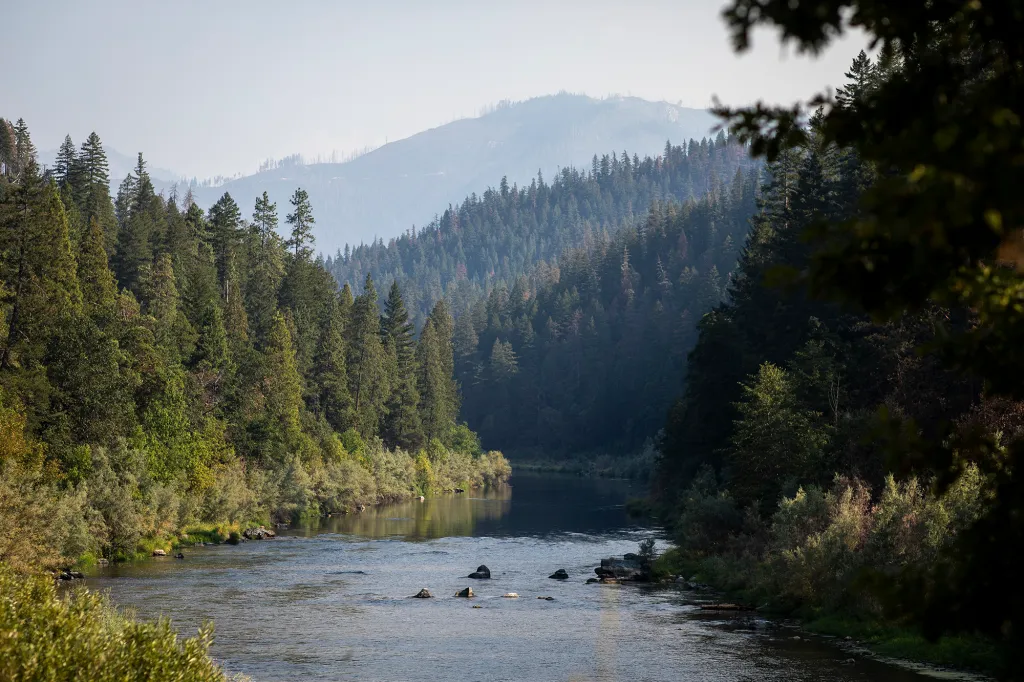
The Klamath River, shown here outside of Happy Camp, provides important habitat for migrating salmon, steelhead and rainbow trout. The Shasta River feeds into the Klamath. Photo by Martin do Nascimento, CalMatters
Hockaday said land can be replanted and economies rebuilt; if a species of fish disappears from the river, it’s gone forever.
The ranchers who pumped the water “need to take care of his family. I understand that,” Hockaday said. But he wants to know when it’ll be the tribes’ turn to stop sacrificing so much.
“We gave up everything since the colonist people came here,” Hockaday said. “We’ve given our land, we’ve given our water, we’ve given our homeland. We gave everything up.”
###
CalMatters.org is a nonprofit, nonpartisan media venture explaining California policies and politics.