These candidates believe they are the ones to represent this peculiar shade of red/orange, which we don’t know what to call. What do you call it? Photo: Andrew Goff.
###
Incumbent First Ward City Councilmember Leslie Castellano will run unopposed for reelection on the November ballot.
That’s according to information just released by the city of Eureka, just after the 4 p.m. deadline for nominations for the city council races.
Two candidates for the ballot have qualified for the Third and the Fifth wards, which are being vacated by termed-out councilmembers Natalie Arroyo and Kim Bergel, respectively. They are:
THIRD WARD:
John Fullerton
G. Mario Fernandez
Fullerton is a former member of the Eureka Planning Commission and a former candidate for office. Fernandez is a member of the board of Eureka City Schools.
The Mayor’s race, if there is one, is still TBD. Bergel has submitted her paperwork, according to a city press release, but because incumbent Susan Seaman chose not to run for reelection the deadline is extended until Wednesday at 4 p.m.
Humboldt County Roads, following a request from CAL FIRE, has closed
Harris Street in Eureka between Hubbard Lane and Viale Avenue. This closure is to
facilitate the safety of first responders and support staff assigned to the CAL FIRE
incident base camp operating out of Redwood Acres Fairground. This section of Harris
Street is restricted to emergency response vehicles and civilian personnel working
under contract and assigned by CAL FIRE to the Six Rivers Lightning Complex.
The closure comes after complaints of speeding traffic and a near-miss accident where
a firefighter was nearly struck by a passing motorist. Due to the large amount of
resources assigned to the incident, large equipment such as fire engines, hand crew
buses, and bull dozers are utilizing the parking area on the north side of Harris Street
opposite the fairgrounds. Firefighters must cross Harris Street to get to the rest of the
incident base camp facilities. The level of foot traffic is highest in the early morning
hours as crews arrive for morning briefing and prepare for assignments. The low light
conditions that time of day further add to the danger posed to the pedestrian traffic.
Travelers using Hall Avenue to connect between Harris Street and Myrtle Avenue will
need to use an alternate route. CAL FIRE apologies for the inconvenience created by
the closure. Public and first responder safety is always the top priority for firefighting
operations. The CAL FIRE Humboldt – Del Norte Unit would like to thank the public for
their patience and their support.
For information on planning for potential evacuations and how to be prepared for
wildfires, as well as tips to prevent wildfires, visit www.ReadyForWildfire.org.
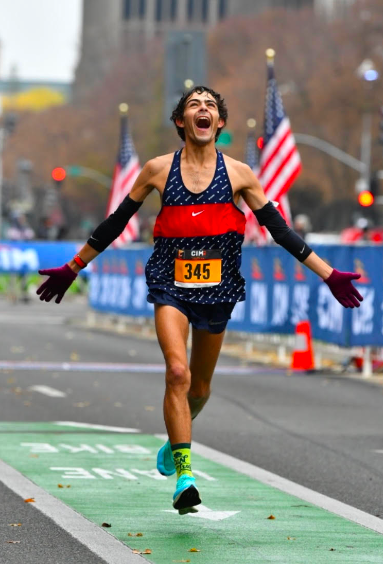
Patrick Hutton has been racing in marathons across the country for the last nine years, and this weekend he will run his first ever course in beautiful Humboldt County – the Humboldt Bay Marathon in Eureka – and he intends to break the current course record.
Patrick Hutton at the California International Marathon in Sacramento | Submitted
“I’m excited to come out there and hungry to run fast,” Hutton told the Outpost in a phone interview Thursday afternoon.
Originally from San Diego and now living in Flagstaff, Arizona, 30-year-old Hutton trains every day, running up to three times per day and roughly 120 miles per week, he told the Outpost. When he isn’t doing his own training, Hutton professionally trains other marathon runners.
Hutton said he is excited for the Humboldt Bay Marathon course, a 26.2-mile route that runs along the Waterfront Trail, because of the flatness of the trail and the coolness of North Coast climate – two conditions that make this an ideal course for him to break his personal best time of 2:24:45 (two hours, 24 minutes, 25 seconds). Hutton tries to break his own record during each marathon, getting closer to his goal of 2 hours 18 minutes – the time a runner of Hutton’s age and gender needs to qualify for the U.S. Olympic Trials. In December Hutton plans to compete in the California International Marathon, which is an Olympic trial qualifier, meaning that if he competes that course in 2:18:00 or less, he could be one of the 200 runners who qualify for the next Olympic Trials. Out of those 200, only three will move on to compete in the Olympic Games.
Based on the course conditions and his own training, Hutton expects to finish the Humboldt Bay Marathon in about two hours, 22 minutes, which will not only be his personal best but also break the course record of two hours, 33 minutes and five seconds, set by Jochen Uhrig in 2018.
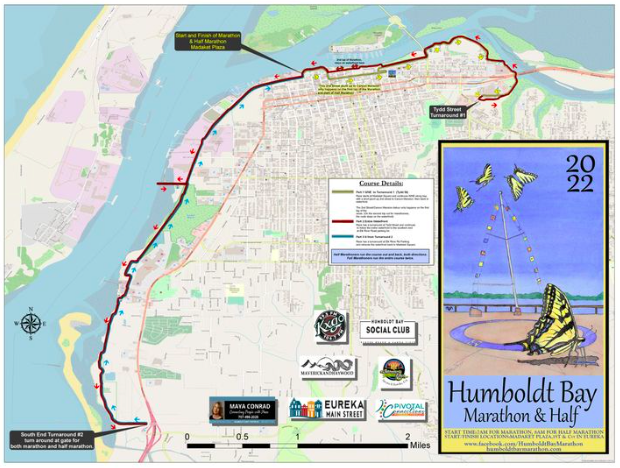
The marathon course starts at Madaket Plaza and runs north, mostly following the Waterfront Trail up to Tydd Street, then back down to the Waterfront Trail south to the end of the Hikshari’ Trail and, finally, back to Madaket Plaza. Those running the half marathon (13.1 miles) will complete the course once and those doing the full marathon (26.2 miles) will complete the course twice. There will be aid stations, with water and other supplies available, about every two miles.
If you are an avid marathon runner, you are probably already aware that 26.2 miles is the standard marathon distance. But for those who don’t know much about running (like this sluggish reporter), then you might be wondering: Why this specific length? According to History.com, the marathon length was initially set at 40 kilometers (about 24.85 miles) to honor the legend of a Greek messenger who ran the distance from the city of Marathon to Athens in 40 B.C. to announce Greece’s victory over the invading Persian army. Legend has it that after the Greek messenger ran the roughly 40 kilometers between the two cities he collapsed and died.
For the next several Olympics, the marathon length remained at 40 kilometers, until 1908 during the Olympic Games in London, when the length of the race was changed to accommodate the British royal family. Allegedly, Queen Alexandra requested that the race start on the lawn of the Windsor Castle and finish in front of the royal box at the Olympic stadium – a distance of 42.195 kilometers, or 26.2 miles. For some reason, the increase in length stuck and in 1921 the length of a marathon was standardized to 26.2 miles. (The Outpost hopes you enjoyed today’s random history lesson.)
Map of the Humboldt Bay Marathon Course. Click this link for a larger, zoomable map.
Of course, to run the impressive distance of 26.2 miles takes a great deal of training and endurance. Those who are not up to such a long run might prefer the half marathon, which is usually a more popular choice. Terri Little, co-director of the Humboldt Bay Marathon, said that about 100 people are registered for the full marathon, and about 200 are registered for the half marathon.
This is a pretty small number compared to some of Humboldt’s larger and more well-known races, like the Avenue of the Giants and the Humboldt Redwoods marathons, which both generally have about 1,000 participants. But Little said this is considered a good turnout and that many people are coming from out of town to participate. One of the biggest draws to this marathon is the weather, with temperatures expected to run from the mid 50s to mid 60s.
“That’s part of why we’re doing it in August, because pretty much everywhere else in the country is super hot and miserable,” Little told the Outpost. “People can come here and run in fairly cool weather.”
Another draw for the Humboldt Bay Marathon is that it’s a Boston Qualifier, Little said, meaning that runners can use their time from this course to qualify for the Boston Marathon. Times needed to qualify vary depending on age and sex and on how many people apply. So beating your qualified time by a larger amount makes you more likely to be accepted into the marathon.
“Qualifying for Boston is a big deal,” Little said. “People strive for that.”
The deadline to sign up for the Humboldt Bay Marathon online has already passed, but late registration will be available on Saturday, Aug. 13 between 4 and 7 p.m. As of Thursday evening, there were still some spots available for both the full and half marathon. The marathon starts at 7 a.m. on Sunday, Aug. 14.
And if you enjoy running but a marathon isn’t your thing, the organizers are also supporting a 5K fun run hosted by Kelly Ridgeway, a survivor of Spontaneous Bilateral Vertebral Artery Dissection (VAD). The run starts at Madaket Plaza on Saturday, Aug. 13 at 3 p.m. Sign-up costs $25 and proceeds will go toward to Teddy’s Team – a non-profit dedicated to raising awareness for stroke and heart disease.
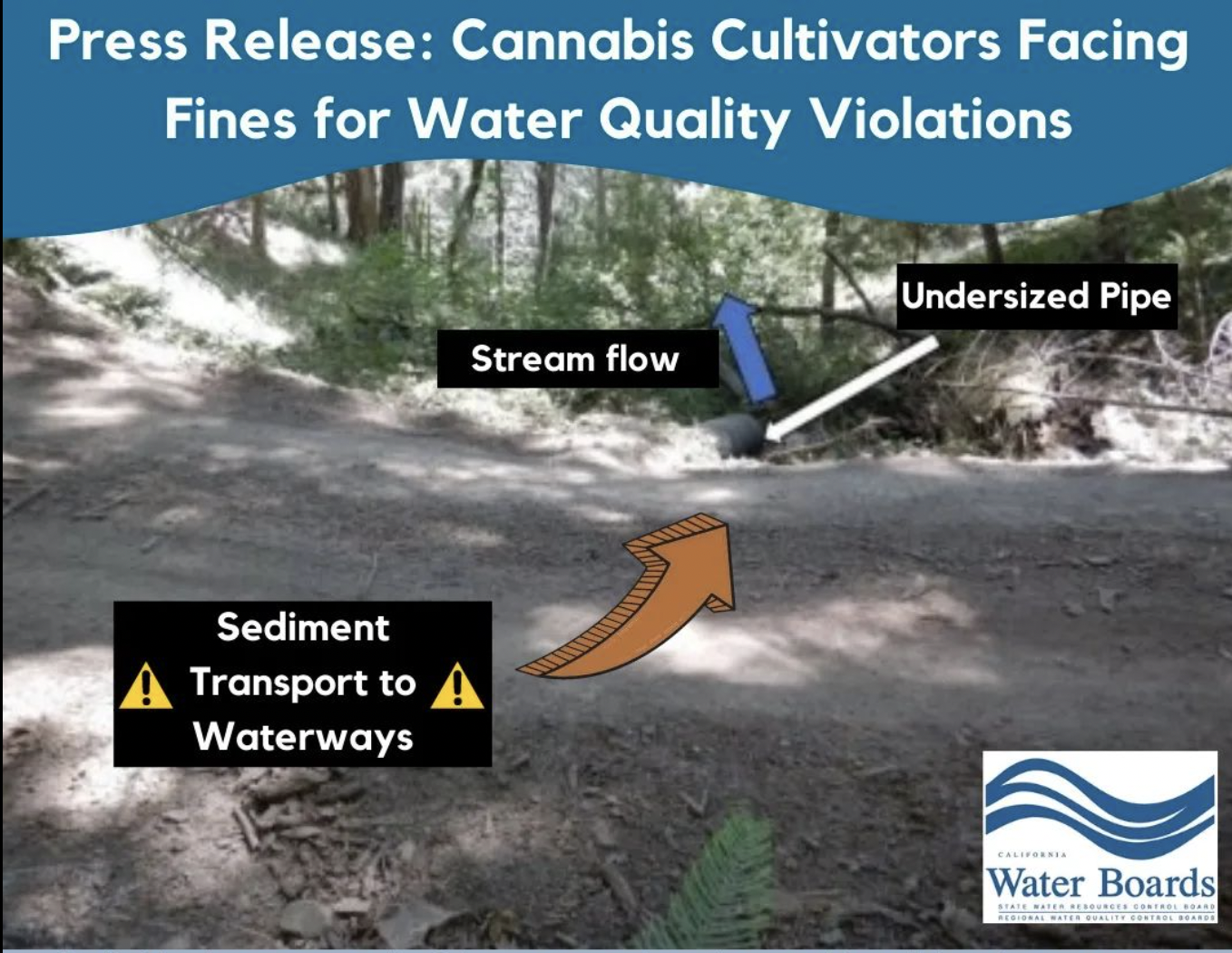
Photo looking downstream at the road crossing an unnamed tributary to the Mad River on the Szagora LLC property, near the Humboldt/Trinity County border. | Image via Water Board.
###
Press release from the California Environmental Protection Agency’s State Water Resources Control Board:
The North Coast Water Board approved a fine of $301,950 against a cultivator in Humboldt County for failing to cleanup and abate sediment discharges to Mad River tributaries, according to an order adopted at an August 4 board hearing. The fine was increased by more than 40 percent from the proposed liability.
Szagora LLC, (the “cultivator”) commercially cultivated cannabis on a 100-acre property along the Humboldt-Trinity County line between the towns of Dinsmore and Mad River.
The board found that the cultivator failed to respond to an enforcement order requiring it to maintain an access road on their property consistent with industry standards created to protect water quality and beneficial uses. North Coast Water Board staff determined the road is undersized, misaligned and contains failed stream crossings that threaten to discharge sediment to the Mad River less than a quarter mile east of the property. During a public hearing where the cultivator failed to appear, the board determined that a higher fine was justified because the cultivator was largely unresponsive to various board actions requiring corrective actions at the property.
“The cultivator made no effort to comply with water quality protection standards and this constitutes intentional misconduct,” said Gregory Giusti, the board chair.
Excess sediment washing into streams can harm the migration, spawning, reproduction and early development of cold-water fish. The discharge of sediment in the Mad River watershed is especially problematic because the Mad River watershed is listed as an impaired water body under Section 303(d) of the Clean Water Act due to elevated sedimentation/siltation and turbidity.
The enforcement order directed the cultivator to submit a workplan to correct the road on their property by July 1, 2021, and to implement an approved plan by October 15, 2021. To date, the cultivators have not submitted a workplan or implemented any corrective actions.
“These monetary penalties do not remove the requirement for the cultivator to correct the poorly designed road and failed stream crossings on the property,” said Gregory Giusti, the board chair. “It is the board’s expectation that the cultivators implement corrective actions to protect aquatic species or else risk additional fines.”
The board has prioritized enforcement on missed deadlines in existing enforcement orders and on discharge violations associated with site development and use for cannabis cultivation without applicable permits.
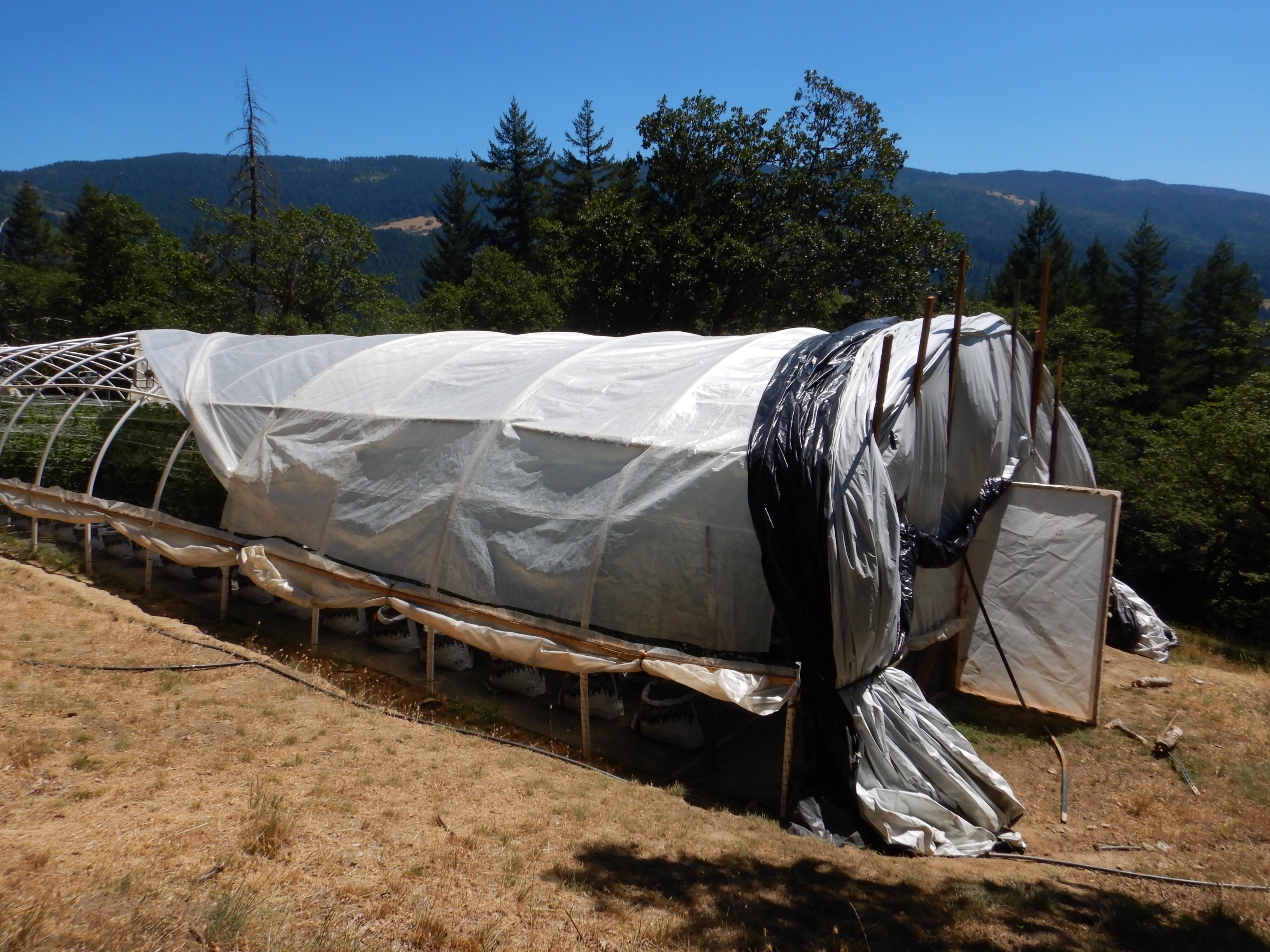
More photos from the property:
Illegal and un-permitted cannabis cultivation on the property during the 7/20/2020 warrant inspection. | Images via North Coast Regional Water District.
The Cedar Fire — since merged with the Waterman fire — above the incident command post on the evening of Aug. 10. Photo by firefighter Steven Douglas, via Inciweb.
Press release from the Six River Lightning Complex Management Team:
INCIDENT INFORMATION
Unified Command: Six Rivers National Forest, CAL FIRE, California Highway Patrol, Trinity County Sheriff and Humboldt County Sheriff.
CURRENT CONDITIONS
The Lightning Complex Fire is currently 13,968 acres with 0% containment. There are 1,400 personnel assigned to the incident. USFS, CIIMT 11 and CAL FIRE continue to work together in order to create a single unified operational plan for firefighters to collectively fight fire and support the communities impacted.
Overnight in the area west of the Bremer Fire burning within the Lightning Complex, firefighters performed firing operations off dozer and handlines to remove fuels to protect homes. Crews will continue to monitor and patrol the fire to look for threats to control lines. If the visibility permits, aviation crews will assist ground firefighters with water drops.
On the northwest side of the Waterman Fire burning within the Lightning Complex, crews had a successful firing operations near the Four Road which held overnight without any challenges. To the north of this fire, resources were able to improve the dozer and handlines towards Horse Linto Creek and will continue to work in this area today. There was another firing operation on the far southeast side which was successful in removing fuels. Fire crews will continue to work in this area. Firefighters will be concentrating on securing the communities near Salyer Loop and Salyer Heights.
On the Campbell Fire burning within the Lightning Complex, resources continue to prep Waterman Road/The Four Road and make a turn towards Zigler Point and toward the community of Trinity. Crews did firing operations in this area that held well without challenges. To the southeastern edge of this fire, dozers put in line above Trinity Village. There were some challenges with spot fires, however fire crews were able to get these spots and bring them back into the main body of the fire. Nightshift crews were able to improve the lines that were made around spot fires and feel confident about those holding up.
On the west side of the Ammon Fire burning within the Lightning Complex, crews are scouting routes for dozer line that will be put in today. In the southeast corner, prep work continues with no current challenges to the line. Along Ammon Ridge prep work was completed yesterday and firefighters will continue to improve the line without any expected challenges in this area.
To the west side of this fire along Friday Ridge Road progress is slow as there are very thick fuels in this area. Dozer and handlines have been started on the northwest side of this fire and firefighters will continue to work in this area to connect to dozer line that has been put in from the northeast.
Overnight humidity recovery was moderate with values from 40-60% which was much drier than previous nights. Gradual warming and drying in the coming days means the fuels will be more susceptible to burning. The fire will be more active as the inversion lifts. Air operations will be limited due to poor visibility from the inversion layer. This will impact northern areas of the Lightning Complex.
Strategic objectives are to keep the fire north of Ammon Ridge Road, south of Lone Pine Ridge Road, east of the FS-1 road and west of the boundary with the Shasta-Trinity National Forest.
EVACUATIONS
** NEW ORDER ISSUED FOR HUM-E032-B, northeast of Willow Creek. Zone description: HUM-E032-B north of Forest Route 7n02. South of Horse Linto Creek Road. East of Horse Linto Creek Road. West of Forest Route 7n10.
The fire threatens communities along the Trinity River. Five main fires burn North and South of Highway 299. Primary areas of focus are the communities along the 299 corridor, Waterman Ridge, Friday Ridge Road, and Ammon Ridge. Evacuations continue around Willow Creek, Friday Ridge, Salyer and Trinity Village. Additional fire growth could impact communities and residences along the Route 1 road.
If you are under an evacuation warning, take the necessary steps to be ready to leave.
EVACUATION CENTER
Trinity Valley Elementary School 730 Highway 96, Willow Creek, CA 95573
ANIMAL EVACUATION CENTER
Hoopa Rodeo Grounds 1767 Pine Creek Rd., Hoopa, CA 95546 Phone: (707) 492-2851
** The Hoopa Rodeo Grounds has several single pens and larger pens for whole herds. Call directly if you need directions or help transporting your large animals. They cannot house sheep, goats, poultry, or small animals, but they can potentially help arrange for temporary foster placement. If you can foster, please reach out regarding your availability and capacity.
ROAD CLOSURES
State Route 299, State Route 96, and Route 1 remain open to through traffic. Residents are encouraged to visit http://quickmap.dot.ca.gov/ to check for state highway closures.
The following roads into evacuation zones have been closed. Residents may still use these roads to travel out of evacuation order zones:
• Horse Linto Creek Road at Saddle Lane • Country Club Road at Kimtu Bridge • Friday Ridge Road at Hwy 299
SMOKE
Heavy smoke and strong inversions continue to affect the health of those who are not yet evacuated. Please check https://www.ncuaqmd.org for air quality resources.
Humboldt County Department of Health and Human Services release:
People at high risk of monkeypox will have the opportunity to start getting vaccinated right away after the Humboldt County Department of Health & Human Services (DHHS) Public Health Branch received 100 doses of the Jynneos vaccine earlier this week.
Prior to this allotment, Public Health received 20 monkeypox vaccines earlier in the month, with a quarter of them earmarked for staff in Humboldt and Del Norte counties who will be in charge of vaccinating community members.
Due to the shortage of vaccines, on Tuesday the Federal Food and Drug Administration issued an emergency use authorization which allows health care providers to administer one-fifth of a dose of the Jynneos vaccine intradermally under the top layer of a person’s skin rather than into the subcutaneous tissue, which is the deepest layer of the skin, as it has been done previously. In studies, using a smaller dose intradermally has been shown to give protection that is very close to what you get from a larger, subcutaneous dose. This decision effectively multiplies the county’s allotment.
Humboldt County Health Officer Dr. Candy Stockton said this is great news. “With this new guidance, Humboldt County went from having just over 100 doses of monkeypox vaccine available to having more than 500. This means we can make the vaccine available to the members in our community who are at highest risk instead of waiting and responding only to outbreaks.”
Dr. Stockton said Public Health is working with local health care providers to help identify patients who fall into the highest risk category and scheduling them to be vaccinated. Community members who fall into the highest risk category can also reach out to their providers to get a vaccine scheduled.
The Centers for Disease Control and Prevention (CDC) identifies people who fall into the highest risk category as gay, bisexual and other men (including cisgender and transgender men) who have sex with men or transgender women, who meet at least oneof the following criteria:
Have been diagnosed with a bacterial sexually transmitted disease (e.g., chlamydia, gonorrhea, syphilis) in the past three months, or
Have engaged in chemsex (using specific drugs before or during sex) or group sex with other men in the past seven days, or
Have had sex in the past seven days with anonymous male partners, or
Have attended sex-on-premises venues (e.g., saunas, bathhouses, sex clubs) in the past seven days, or
Have engaged in survival and/or transactional sex in the past three months.
Additionally, people among the above-mentioned groups who are living with HIV or other conditions that cause them to be immunocompromised should be prioritized for vaccination. Currently, there has been one confirmed case of monkeypox in Humboldt County.
Monkeypox is a viral infection which is spread through close personal contact, including skin-to-skin contact, kissing and sex. Symptoms of monkeypox include:
Fever
Headache
Muscle aches and backaches
Swollen lymph nodes
Chills
Exhaustion
Sore throat, nasal congestion or cough.
It may also include a rash located on or near the genitals or anus, as well as other areas such as the hands, feet, chest, face or mouth. The rash can look like pimples or blisters and may be painful or itchy. The rash will typically go through several stages including scabs before healing, according to the CDC.
Testing for monkeypox must be ordered by a health care provider and includes taking a sample from an existing lesion.
Monkeypox is a rare zoonotic infection caused by the monkeypox virus, which is in the same family as smallpox but less severe. The monkeypox virus is spread to humans from infected humans, animals and materials contaminated with the virus. The current outbreak has impacted mostly gay and bisexual men and men who have sex with men. Although the risk to the general U.S. population is low, the following tips can help keep you safe:
Practice good hand hygiene
Always talk to your intimate partner/s about recent illness, and be aware of new or unexplained sores or rashes on your body or your partner’s body, including on the mouth, genitals, anus and hands
Avoid intimate contact, including sex, with people who have symptoms like sores or rashes
Avoid contact with infected animals and materials containing the virus
Use appropriate personal protective equipment (PPE) like a mask, gown and gloves when caring for people with symptoms
Infected people should isolate until their symptoms, including rash, have gone away completely.
In addition to the vaccines, Public Health has more than 400 doses of an antiviral medication which would be made available for people with severe complications.
Additionally, people at high risk for severe monkeypox who are immunocompromised, 8 years old or younger, pregnant or breastfeeding or have a history of skin disease may also be eligible for the medication.
While monkeypox is endemic to many Central and West African countries, there have been recent cases of monkeypox reported in non-endemic countries, including the U.S., Canada and the U.K., as well as other parts of Europe and Australia.
To date, there are more than 10,750 cases of monkeypox in the country, including nearly 1,900 cases in California. If you are experiencing symptoms, have been in contact with an individual who has tested positive for monkeypox or fall into the high-risk category, please contact your health care provider. If you do not have a provider, call Public Health at 707-445-6201.
But many other closely-watched bills came to an unceremonious end, killed in one of Sacramento’s most opaque lawmaking processes. They included a Republican-backed bill that would have capped copays for insulin, a California Medical Association-backed proposal making it easier for doctors to approve procedures and prescriptions without first getting permission from an insurance company,and a bill to allow prosecutors to go after social media companies for knowingly addicting children.
It’s called the suspense file. For months, the appropriations committees, tasked with assessing the fiscal impact of any bill outside the annual budget, gather any legislation with more than a negligible price tagand put it to the side. Then twice a year, after legislative leaders decide which bills live and which die behind closed doors, they announce the results in a single hearing. In most cases, no public votes are taken and no debates are held.
In theory, this arcane procedure allows lawmakers to quickly run through the hundreds of fiscal bills they need to consider by the end of the legislative session, which arrives at the end of this month. Today, the two committees ran through more than 820 bills.
In practice, it’s also a good way for Democratic lawmakers, who hold super-majority power, to kill legislation without having to take a public, and potentially politically difficult, stand. The stakes were especially high today. The legislative session ends this month and many lawmakers will either retire or be replaced before the next one begins, making this the last opportunity for some legislators to leave their mark on state policy. Politically, it’s also a tense time: theNovember general election is less than three months away.
Thus, bills requiring gun owners to buy liability insurance and forcing law enforcement agencies to let the public listen to police radio transmissions were also quietly killed. Who pulled the trigger? The public often has no way to know for sure. We can only count the legislation that succumbed.
In this case, more than 200 were killed, while nearly 600 stayed alive.
Here are some of the other bills that were culled — and the advocacy and interest groups that lobbied on them:
No help for diabetics
Dead for the session: A bill by Sen. Pat Bates, a San Clemente Republican, that would have capped insulin copays at $35 per prescription per month for diabetics. With insulin list prices increasing on average 15% to 17% per year since 2012, some state and federal leaders have been pressing for action with little success. A similar effort for privately insured patients was also recently abandoned in the U.S. Senate; Congress is, however, moving forward with a $35-a-month cap for Medicare patients.
“The decision by Assembly Democratic leadership to hold the bill blocked meaningful relief for millions of California residents struggling to pay for the rising cost of insulin. This was a missed opportunity for the California State Legislature to accomplish what Washington D.C. failed to do,” Bates said in a statement.
Her bill was opposed by the health insurance lobby that has long argued that copay caps do nothing to bring down the actual list price of the drug and would only shift the cost in the form of higher premiums.
Supporters said such a bill could have provided more immediate relief to patients. California has plans to manufacture and distribute its own, more affordable insulin, but that could take years. As of last week, the governor’s office said it has started a “request for information” process with drug manufacturers interested in partnering with the state. In California, 3.2 million people have been diagnosed with diabetes and many of them rely on insulin to survive.
Cunningham, who called the bill the most important of his career, pitched it as a response to a youth mental health crisis exacerbated by social media companies conducting “an unfettered social experiment on children.”
Cunningham said he was “extremely disappointed” that Senate Appropriations Committee Chairperson Anthony Portantino, a Glendale Democrat, made “the unilateral decision” to hold the bill and warned that “the bill’s death means that a handful of social media companies will be able to continue their experiment on millions of California kids, causing generational harm.”
“I believe that this idea would be overwhelmingly supported if presented directly to the voters, as it would be prohibitively expensive for social media companies to take every California voter on a Tech Caucus junket in Napa,” Cunningham added in a statement.
But tech companies countered there were better ways to address kids’ mental health than impinging on online platforms’ First Amendment rights.
“As we’ve said from the start, protecting children online is a priority but must be done responsibly and effectively,” Dylan Hoffman, TechNet’s executive director for California and the Southwest, said in a statement. TechNet, an industry group that represents such companies as Meta (the parent of Facebook and Instagram), Apple and Google, lobbied aggressively against the bill. “We’re glad to see that this bill won’t move forward in its current form. If it had, companies would’ve been punished for simply having a platform that kids can access. It would’ve done little to improve child safety.”
Lawmakers in the Assembly Appropriations Committee advanced a pay transparency bill intended to root out discrimination and pay disparities — but only after stripping out its most significant provision: To require the state to post for public view businesses’ pay data, broken down by position, race and gender.
That proposal by Sen. Monique Limón a Santa Barbara Democrat, landed SB 1162 on the California Chamber of Commerce’s “job killer” list, a designation policy advocate Ashley Hoffman said the Chamber is now prepared to remove.
Businesses with 100 or more employees are required to report the data to the state under a 2020 law, but the reports are not available for the public. The bill would have required the reports be published online for businesses with 1,000 employees or more by 2025 and 250 employees or more by 2027. The Chamber and other employer groups pushed back hard against the public reporting provision, arguing the reports are too broad to show discrimination but would be “held out to the public, whether it’s a media headline or a lawsuit … as representing something it’s not.”
Other parts of the bill, which proponents say will still help narrow the wage gap, survived. The bill would still require the companies also to report the pay data of their contractors, and require all employers with more than 15 workers to post the pay ranges for open positions and add state enforcement authority for businesses not reporting the data.
In a statement, Limón said that she was “deeply disappointed” in the amendments.
“One day California will lead on pay equity and our actions will match our aspirations,” she said. “That day is just not today.”
— Jeanne Kuang
No leeway for doctors
The doctor’s lobby took an “L” on one of its priority bills for the year. Senate Bill 250 by Sen. Richard Pan, a Sacramento Democrat, sought to ease administrative hurdles for physicians. More specifically, the bill would have required health insurance plans to exempt certain medical providers from prior authorization rules.
Prior authorization is seen as a cost-control tool that keeps doctors from providing and charging for unnecessary care. Health insurance plans must deem certain medication and procedures as “medically necessary” before a doctor can prescribe or render services.
The California Medical Association argued that reducing red tape would allow doctors to spend more time on patient care and less on paperwork — most importantly, it would help patients access the care and medications they need more quickly. A timely example: one Orange County pediatrician shared on Twitter this morning that one of his premature baby patients can’t access “life-saving medication” because he can’t get a hold of the patient’s insurer.
Health insurance plans, in opposition of the bill, argued that SB 250 could instead lead to over-prescribing and inefficient care, ultimately raising costs.
— Ana B. Ibarra
Student housing money in limbo
If lawmakers have a plan to spend $1.8 billion in loans to public colleges and universities to build student housing, the public doesn’t know about it. Held on the suspense file today was a bill that would have set the rules for a revolving loan to build student housing. It’s a strange development for a spending plan that lawmakers and the governor already approved in the state budget this year. Basically, the money is there, but the rules for spending the money are not.
Among advocacy groups, the lone registered foe of the bill is the all-powerful State Building and Construction Trades Council. The construction union knocked the bill in June for what it said were “watered down” provisions to ensure that workers who build the campus housing are part of an apprenticeship program. But other unions whose workers are key to housing development backed the bill, including the California State Association of Electrical Workers and California State Pipe Trades Council.
The bill sought $5 billion for a revolving loan fund to build campus housing for students and staff. The budget deal approved over the summer would commit a smaller amount, $1.8 billion, for that purpose starting in the 2023-24 fiscal year. Either way, the idea is that the state lends campuses money to build housing, and as they pay back the loans over time, the state replenishes its campus housing reserves to lend out additional dollars. The loan fund would add to the several billion dollars in grants lawmakers have already committed to building student housing.
The bill’s author, Assemblymember Kevin McCarty, a Democrat from Sacramento, said “we still need some further clarification on how it’s actually implemented in next year’s budget.”
What that language will look like is unknown. Portantino’s office and the leadership of the Senate and Assembly didn’t respond to emails from CalMatters seeking comment.
— Mikhail Zinshteyn
Police radios can stay silent to the public
If they’re willing to wade through the crackly radio and police patois, reporters assigned to the newsroom scanner will hear about unexplained booms, cats lost, lawn equipment missing, kitchens smoking and shots fired.
That is, unless they’re in parts of the Bay Area and Inland Empire, where some police departments and sheriff’s offices encrypt radio communications.
Sen. Josh Becker, a San Mateo Democrat, and First Amendment advocates tried to change that this year, but Senate Bill 1000 today failed to clear Assembly Appropriations.
At issue: a state Justice Department memo mandating that California police agencies submit a plan to keep identifying information such as people’s driver’s license numbers and criminal histories off police airwaves by December 2020. Some police departments ran with it, encrypting all of their communications. Others, including the California Highway Patrol, relay personal info on special channels while keeping most communications public.
The bill, while requiring unencrypted radio traffic, would have created exceptions: Officers would be urged to communicate identifying information through something other than a radio, and tactical or undercover operations communications could be encrypted.
Asked why the bill died, Becker said “I think there’s some misinformation on the cost side. This is not a cost issue. This bill would have saved money.”
The California State Sheriffs’ Association argued it would force police agencies that have already encrypted their radios to revert to their original, unencrypted transmission “at tremendous expense” — and that alternatives such as cell phones or laptops would not work in places where there’s no signal.
“We think it’s really critical for our reporters to cover not only breaking news, but also how police respond to those situations as they occur,” said Brittney Barsotti, general counsel for the California News Publishers Association, which backed the bill. (CalMatters is a member of the association.)
The Democrat from Downey faced steep opposition from agricultural interests, who agreed that farmland can soak up and store carbon but questioned whether the targets were feasible. Critics also questioned whether the bill might alter the state’s forest management strategies to maximize carbon storage.
Despite support from environmental groups, the bill failed to clear the suspense file. “This summer is a stern reminder that bold action is needed now, and we must use all the tools available to us, it’s literally a matter of life and death,” Garcia said in a statement.
The move could be a setback for Gov. Newsom’s climate agenda for the final days of the legislative session, which called for state policy to “support sequestering carbon through natural carbon sequestration.”
Or it could signal that there may be life yet for natural carbon sequestration in another form. There’s less than three weeks left to find out.
— Rachel Becker
###
CalMatters.org is a nonprofit, nonpartisan media venture explaining California policies and politics.