

Newsom Signs Laws to Resist Trump’s Immigration Crackdown, Including Ban on Masks for ICE Agents
Cayla Mihalovich and Jeanne Kuang / Monday, Sept. 22, 2025 @ 7:03 a.m. / Sacramento

Gov. Gavin Newsom speaks to the media at Downey Memorial Christian Church after visiting Los Angeles communities affected by immigration raids, in Downey on July 16, 2025. Photo by Ted Soqui for CalMatters.
###
This story was originally published by CalMatters. Sign up for their newsletters.
###
Gov. Gavin Newsom today signed a set of bills meant to check the Trump administration’s aggressive immigration crackdown in California, including measures that limit their access on schools and force them to identify themselves in public.
The new laws echo the “resistance” measures California adopted during the first administration, when it passed a so-called sanctuary law to limit local law enforcement from cooperating with immigration agents, among other policies.
President Trump promised a historic deportation effort and assault on sanctuary-style policies when he took office for the second time. His administration criticized the state’s new immigration laws even before Newsom signed them.
The Department of Homeland Security earlier this week called on Newsom to veto the mask bill — one of the more contentious pieces of immigration legislation — calling it “despicable.”
“Once again sanctuary politicians are trying to outlaw officers wearing masks to protect themselves from being doxed and targeted by known and suspected terrorist sympathizers,” said Assistant Secretary Tricia McLaughlin in a Sept. 16 press release.
California may struggle to enforce the new laws, some of which have already raised constitutional questions around the state’s role in federal operations, but lawmakers maintain that they are legally defensible.
California political consultant Mike Madrid said in signing the laws Newsom is showing that he can stand up and fight, whether or not he has a chance of winning.
“In this moment, when there are very few cards to play for state governments and state legislatures, California has done what no other state has done: establish itself as the tip of the spear on resisting a lot of these efforts that are an affront to its values,” said Madrid, a longtime Republican consultant who co-founded the anti-Trump Lincoln Project.
“99% of this is the purview of the federal government. So a lot of it is just symbolic, but symbolism matters. It’s both politically astute but also morally right,” he said.
The package of bills Newsom signed included:
- Senate Bill 627 widely prohibits federal and local law enforcement officers from wearing face masks while conducting their duties.
- Senate Bill 805 requires that law enforcement officers identify themselves while conducting their duties, with some exceptions.
- Senate Bill 81 prohibits immigration enforcement from entering restricted areas of a health facility without a judicial warrant or court order.
- Senate Bill 98 requires schools and higher education institutions to send community notifications when immigration enforcement is on campus, and prohibits immigration enforcement from entering certain areas without a judicial warrant or court order.
California Democrats began drafting immigration-related bills almost as soon Trump took office in January. Those efforts accelerated after the Trump administration launched aggressive immigration sweeps throughout Los Angeles, which led to weeks of protests and a subsequent National Guard deployment.
“All of this legislative resistance is to protect Angelenos from their own federal government. That is profound,” Los Angeles Mayor Karen Bass said at a news conference with Newsom and other Democratic leaders.
Will the laws make a difference?
Kevin Johnson, an immigration law professor and former dean of the UC Davis School of Law, said the legislation may have a marginal impact on federal immigration enforcement operations.
In 2018, for instance, California passed a law to restrict immigration arrests at superior court buildings. That hasn’t stopped the Trump administration from detaining people at those courts this year.
“The federal government is going to continue doing what it’s doing, in one form or another,” he said. “I do think the legislation gives some hope and optimism to communities that feel under fire, vulnerable and basically hated by the federal government.”
Shiu-Ming Cheer, deputy director at California Immigrant Policy Center, remains hopeful that the package of bills will ensure safety for people attending school and accessing health care.
“With most laws, there has to be really vigorous monitoring, both by the state as well as by advocates to ensure that it’s truly being implemented and followed,” she said.
California police opposed mask ban
The most controversial bill in the package was Democratic Sen. Scott Wiener’s proposal to widely ban federal and local law enforcement officers from wearing face masks while conducting their duties. The law, also known as the “No Secret Police Act,” does not apply to certain forms of face coverings, such as face shields, and it exempts some officers, including those who are undercover. Officers who violate the law will face an infraction or misdemeanor.
Wiener and Democratic Sens. Jesse Arreguín, Sasha Pérez and Aisha Wahab championed the legislation after seeing footage of masked and unidentifiable agents carrying out operations.
“ICE’s recklessness creates chaos as agents run around with what are effectively ski masks and no identification, grabbing people, throwing them in unmarked vehicles, and disappearing them,” Wiener of San Francisco said at a legislative hearing in August. “When law enforcement officers hide their identities, it destroys community trust.”
California’s law enforcement groups widely opposed the bill, arguing it will largely apply to local police, rather than federal agents, because the federal government is likely to sue on constitutional grounds.
“It’s using an emotionally charged issue on a federal level to pass a bill that will only affect local peace officers,” said Brian Marvel, president of the Peace Officers Research Association of California, an umbrella labor organization that lobbies on behalf of police unions. “You’re upset with the feds, but you’re going to punish us.”
Other law enforcement experts echoed those concerns, arguing that it’s illegal to interfere with federal operations.
“California cops are not going to enforce this law,” said Ed Obayashi, a longtime California police officer who now is a special prosecutor and policy adviser to the Modoc County Sheriff’s Office. “You cannot regulate lawful federal conduct, whether the Legislature likes it or not.”
The law allows officers to be sued personally for “tortious conduct,” including if they assault or falsely arrest someone while masked.
“Private enforcement could be the avenue where enforcement is the likeliest,” said Johnson.
The bill caused hours of contentious debate on the Senate and Assembly floors, with many Republicans calling it misguided.
“My immigrant family is not afraid” of ramped-up immigration enforcement, Fresno Republican Assemblymember David Tangipa said, “because we did not break the law.”
But Democrats were animated because just days before, the U.S. Supreme Court had sided with the Trump administration and ICE for conducting roving sweeps through Los Angeles, apparently catching bystander day laborers or anyone who appeared Latino in their dragnet. The bill, they said, was their way of pushing back.
“We need a full front defense for the violence that is coming from this regime,” said Hector Pereyra, policy manager for the nonprofit Inland Coalition for Immigrant Justice, which co-sponsored the mask bill and another bill to protect the private data of street vendors. “We have to respond with a united front of strength and aggressiveness, not of passiveness.”
###
Cayla Mihalovich is a California Local News fellow.
BOOKED
Today: 8 felonies, 13 misdemeanors, 0 infractions
JUDGED
Humboldt County Superior Court Calendar: Today
CHP REPORTS
Sr299 / Bremer St (RD office): Animal Hazard
Sr96 / Kings Crk (YK office): Car Fire
ELSEWHERE
Governor’s Office: Governor Newsom calls for immediate tariff refund checks following Supreme Court ruling against Trump
RHBB: Humboldt Ranks Among Highest in State for CARE Court Referrals Despite Funding Gaps
RHBB: California Attorney General Urges U.S. Senate to Reject SAVE America Act
OBITUARY: Walter Sam Del Biaggio, 1933-2025
LoCO Staff / Monday, Sept. 22, 2025 @ 6:56 a.m. / Obits

Walter Sam Del
Biaggio
March
10, 1933 – August 26, 2025
Walt was born in Ferndale and grew up in Rio Dell with his two older brothers, Hank and Arthur. He lived in Humboldt County his entire life, except for a short time in San Francisco, where he attended and completed barber college.
While in San Francisco, Walt made the most important decision of his life: he learned the personal name of God, Jehovah, and in 1955 was baptized as one of Jehovah’s Witnesses. Throughout his life, he continued to learn about his God and zealously talk about Him in the community.
Also in San Francisco, Walt made the second most important decision of his life — he met and married Diane Birkenseer. This October would have marked their 69th year of marriage.
Many in the community, as well as their children and grandchildren, received a haircut from Walt. He operated Walt’s Barbershop for over 40 years. If you were a youngster, you left with a very short haircut and a bag of chips. Over the years, customers enjoyed watching the tarantulas, seahorses, fish and other critters he kept in tanks. In the aviary connected to the shop, he raised finches, canaries, pigeons and more.
Walt enjoyed many hobbies throughout his life, including playing the accordion, painting and watch repair. He and Diane filled their yard with beautiful roses and their home with African violets and orchids. He loved working on the computer (his nemesis) and was always trying to better himself.
Walt is survived by his beloved wife of 69 years, Diane; his children Rose Marie (Bill), Walt (Pam), Debbie (Marty), and Sam (Terri); his grandchildren Jessie, Radenna, Rachel, Joshua, Staci, Nathan, Sean, Lyndsey, and Sophie; and his great-grandchildren Jacob, Addyson, Ariana, Cadence, Levi, Lincoln, and Penelope. He was preceded in death by his daughter Ruth and his granddaughter Kelley.
A memorial service was held Friday, August 29, 2025. The family extends heartfelt thanks to Doug Chez for his beautiful and comforting talk, and to the many family and friends who joined in person and on Zoom. Your support and kindness have been deeply appreciated.
In Walt’s memory, the family invites you to visit JW.org to find Bible-based answers to life’s most serious questions.
###
The obituary above was submitted on behalf of Walt Del Biaggio’s loved ones. The Lost Coast Outpost runs obituaries of Humboldt County residents at no charge. See guidelines here.
TO YOUR WEALTH: Why You Need To Know That Stocks Will Drop
Brandon Stockman / Sunday, Sept. 21, 2025 @ 7:45 a.m. / Money
Stocks will drop.
How’s that for a headline? This isn’t clickbait. This isn’t a forecast for the rest of 2025. Nor is it about whether stocks are currently priced fair, cheap, or expensive.
This is common investment knowledge. You can’t say I didn’t warn you.
In fact, since 1950, the S&P 500 spends most of its time off of its highs.

This means the biggest companies on Wall Street are in a 3% drawdown more than 60% of the time and in a 5% decline more than half the time.
The more worrisome corrections happen about one-third of the time, and terrible bear markets about 16% of the time.
Say it again with me, stocks go down.
This is an essential truth to realize as a long-term investor. What’s more essential than that is to recognize that the pathway in the past to experiencing growth in the stock market is to endure it anyway.
You know what else is true? Even though stocks have usually been down from their highs and recessions have occurred throughout the decades, stocks are up big since the 1950s.

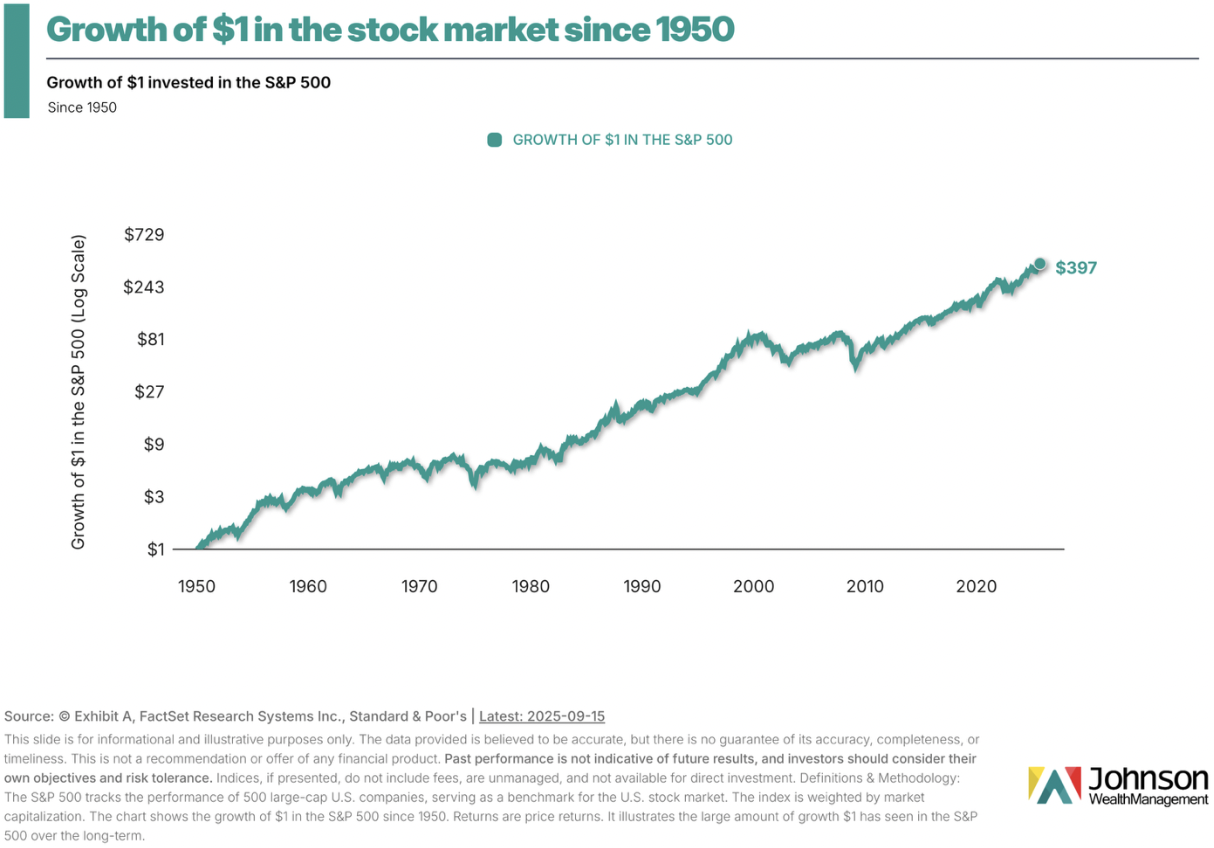
Living by fear is rarely the answer to anything in life, let alone investing.
To paraphrase a quote attributed to famed investor Peter Lynch, preparing for, and acting on the fear of losing money in the stock market has lost more money than being invested in the stock market itself.
Many know the problem with investors panic-selling based on fear during rapid market declines. But there is also another problem that can plague some investors: the wait-and-see approach (also based on fear) during market gains.
Here is a shocking statistic. Did you know that those who invested at every stock market peak since 1950 have averaged an 8.7% investment return?

Why are you talking so much about fear? Isn’t the market at or near all-time highs? As of mid-way through September 2025, yes.
What may also come as a surprise: according to one popular survey, there is still more bears then bulls right now.

None of this means you should go headfirst into stocks. Investment allocation and risk management go hand in hand.
It does mean that making money over the long term in the stock market normally requires remaining appropriately invested and investing while the stock market goes down.
I have no idea when the next drop might come.
But I know it will.
The question is not simply what will you do with your money when it happens, but what are you doing with it while you wait?
Invest based on something more significant than dopamine hits from headlines juiced by greed, envy, or fear.
In an attention economy you must know that many headlines you read about investing aren’t geared toward you or your family’s long-term financial success, but for clicks and profits. It’s so easy to be distracted and to have your attention on things that may feel urgent in the short-term but are not for your long-term benefit.
Educate yourself about investing and/or find a trusted financial advisor who can help.# # #
Brandon Stockman has been a Wealth Advisor licensed with the Series 7 and 66 since the Great Financial Crisis of 2008. He has the privilege of helping manage accounts throughout the United States and works in the Fortuna office of Johnson Wealth Management. You can sign up for his weekly newsletter on investing and financial education or subscribe to his YouTube channel. Securities and advisory services offered through Prospera Financial Services, Inc. | Member FINRA, SIPC. This should not be considered tax, legal, or investment advice. Past performance is no guarantee of future results.
THE ECONEWS REPORT: You Should Attend the Eel River Community Meeting
The EcoNews Report / Saturday, Sept. 20, 2025 @ 10 a.m. / Environment

On this week’s episode of the Econews Report we discuss restoration planning in the Eel River with a rockstar team of restoration experts. Your host Alicia Hamann of Friends of the Eel River is joined by Kaydee Boozel from the California Department of Fish and Wildlife, Marisa Parish-Hansen and Ruth Goodfield from National Oceanic and Atmospheric Administration, and Julie Weeder, former NOAA staff and current FOER staff and CDFW volunteer. Tune in for a discussion of how state and federal agencies are working with the local community to develop restoration solutions for the Lower Eel River that work for fish and for people. We’ll discuss upcoming ways for you to participate..
After listening, mark your calendars for the Eel River Community Meeting on Saturday, September 27, from 11 a.m. to 2 p.m. at the Gene Lucas Community Center in Fortuna. Email EelRiverShaRP@googlegroups.com with any questions.
See below links for additional information:
AUDIO:
“The Econews Report,” Sept. 20, 2025
(Sorry, no transcript this week.)
HUMBOLDT HISTORY: Memories of Lloyd H. Brubaker, an Early Weirdo in the Mountains of the Mateel
Stanley ‘Neb’ Roscoe / Saturday, Sept. 20, 2025 @ 7:30 a.m. / History

Image: ChatGPT.
The night after Eureka High School let out for the summer of 1939,1 went to Camp Bauer to dance until 2 a.m. to Jimmie Fasullo’s orchestra. The next morning at daybreak, my brother Jim woke me up and asked if I would like to walk to Mattole with him and our cousins Earl and Waldo Gossard. I was only half awake and said, “Sure.” Earl and Waldo’s dad, Ralph Gossard, Eureka’s jovial parcel post delivery man for many years, picked us up and drove the four of us to the Mt. Pierce geodetic monument above Rio Dell.
From Monument Ridge we took off on foot for Upper Mattole. The distance would be about 10 miles by air, but it’s more like 25 along the steep, meandering old mail trail down into the head of Bear River, then up over Rainbow Ridge, down Little Rainbow and across the hogback between the headwaters of the Upper and Lower North Forks of the Mattole, up over Van Choick (pronounced Vanscort) Ridge, around the east end of Everts Ridge above Pritchard (pronounced Pritchett) Creek, and finally down Mail Ridge to the Ida and Ernest Roscoe Ranch on Granny Creek.
We stopped to catch and release a few trout as we crossed the head of Bear River about 9 a.m. and ate our brown-bag lunches before starting the climb up the steep back side of Rainbow Ridge. By noon we regretted our premature consumption of the lunches. We were quite hungry by the time we reached “Vanscort” in the early afternoon and stopped by the cabin of Lloyd Brubaker. Brubaker was an old hermit my father had told us about before we left our house that morning. Dad said Brubaker was harmless but warned that he liked to talk to strangers and would probably invite us to stay for dinner and that we should decline.
As we walked up to the cabin we noticed part of a deer carcass hanging from the limb of a pepperwood tree. It appeared to be solid black from a distance, but as we approached we could see that it was only covered with blow flies. Dad’s prediction proved correct.
After we introduced ourselves, Brubaker said, “You boys must be hungry. Let me fry you some pancakes and buck steaks. I’m out of bear grease, but I have plenty of coon fat.”
We assured him we had just eaten our lunches and weren’t hungry.
Brubaker seemed disappointed but offered an alternative we could readily accept. “Well, you boys surely could eat some fresh strawberries for dessert. They’re just coming on strong. You’ll have to pick them yourselves, but you can eat all you want.”
For the next hour we ate strawberries from the patch of vines in his large garden while Brubaker regaled us with episodes from the semi-autobiographical novel he had been writing for the past 20 years on his rusty old Underwood typewriter. Its title was Why Ever So?, and at that point it consisted of more than 2,000 single-spaced pages.
It seems Brubaker had been in love with the silent and talking movie queen Ruth Chatterton prior to World War I, but she had thrown him over for some actor, and he was “pretty sure she was on dope now.” He was heart broken and had gone up to San Francisco and got a job driving a trolley car on the Market Street line.
Brubaker said he had a hot temper with a short fuse in his youth, and some ruffians who rode the line regularly got to baiting him to make him furious. Finally, he said, he’d had all he could take. The electric current that powered trolleys was controlled by a removable brass handle that was used to drive the trolley from either end. Brubaker pulled the heavy crank off its hub and dented the tormentor’s skull, possibly killing him.
Brubaker said he had fled the scene, leaving the trolley and passengers stranded, and made his way to Upper Mattole where he took to the hills and built his cabin on “Vanscort.” He never learned the outcome of the incident, but evidently the San Francisco police had made no effort to track him down. By 1939 he felt safe and frequently wrote letters to the editor of the Chronicle on the sorry state of civilization, using his own name. Some were even published.
Brubaker said he had a hot temper with a short fuse in his youth, and some ruffians who rode the line regularly got to baiting him to make him furious. Finally, he said, he’d had all he could take.
I never learned the source of Brubaker’s income, and though he lived mainly off his garden and fruit trees and wild game, he had to have some income if only to buy rifle ammunition, paper for Why Ever So? and a new typewriter ribbon every four or five years.
Following our harvesting his strawberries and proceeding on to Upper Mattole, Brubaker started coming down from his mountain more frequently than he had in the past, visiting the Roscoe Ranch, buying bacon and ham and some canned and packaged foods at the Petrolia store, and after a bit, taking the stage to Ferndale and on to Eureka to visit my parents, Stan and Martha, while I was going to college. Brubaker became a close friend of the family.
In the summer of 1942,1 enlisted in the Army Air Corps but was not called up until the end of the fall semester. I came home from Berkeley before my reporting date, and Brubaker came to Eureka to see me before I departed. He said he wanted me to help him buy a car so he could come to town whenever he wanted to.
I took him to K.B. McCarthy’s Dodge dealership between Sixth and Seventh on H Street. Brubaker liked an early 1930s Dodge coupe and surprised me by paying cash for it, including collision insurance, which the salesman was happy to provide and I thought probably a good investment, since Brubaker confided that he had driven “a Model-T a few times in the 1920s.”
Our first stop, with me driving, was the Department of Motor Vehicles office by the curve near the east end of Fourth Street. Brubaker assured the examiner he had driven a Model-T Ford and, in about five minutes, was issued a California driver’s license without a driving test. I drove out to what was then an empty field across the street from Sequoia Park and switched seats with my confident pupil.
He did surprisingly well, so I let him out of the field and onto the streets for a few blocks. No problem, so I decided to see what he would do on the steep, crooked road down to the park’s duck pond. As he approached the first sharp turn, I cautioned him to slow down, but he became confused and hit the gas instead of the brake. I reached over and turned off the ignition, grabbed the wheel, and steered us into the nearest redwood tree.
Brubaker was not dismayed in the slightest. “Quick thinking,” he said as we got out to examine the bumper and left front fender, which was bent down against the tire. I backed onto the road, we pried the fender off the tire, and within an hour of our departure, drove back to K.B. McCarthy’s for a good-natured insurance adjustment.
The following day I left for San Francisco to report for active duty, and the next I heard of my adventurous friend came in the form of the following letter, addressed to my parents, which they passed along to me at boot camp in Lincoln, Neb.
###
A letter from Lloyd H. Brubaker
January of 1943;
Thursday the Seventh
Petrolia, California
Stanley Roscoe and the Threefourths of Wedded Twain,
Dear Ones, can you take a bit of originality as upper line there seems to jar the usual platitudinous reference to wedlock? Yeah; you find it easy to do so, and I’ll bet a doughnut against a breadcrumb, you’ll agree that this is an apt division of that sweetest bond. How would I know? O, ever since I was not much taller than a pretzel, long way up, and more or less. I’ve been observant; and surely was that quarter portion, once in my lifetime [evidently Brubaker had once been married and judged the female “better half of a married couple to be the “better three- fourths”].
But the gist of this letter is to relieve you of all thoughts as that I would fail to make the grades via Bull Creek Road to Petrolia. I made it, but nothing to whoop-it-out- loud, withal. And for interesting recital of adventure, here you have the entire writing of a thrilling ride.
Fine enough, I left Eureka after Stanley kindly drove the car through Eureka. Had not a least trouble anywhere on the way, until the foot brake went soft on me at the Bull Creek store. And there I noticed also a tire not as plump as it were to be if fully inflated. Even so, I believed I could make the ride with using low, in making the way down steepest places, so going very slow. The tire I believed to be a slow-leak, so it might possibly and probably hold up until the end of the way. However, the brake was the worst trouble whenever I should meet someone, and sure enough, I met a speed-demon near a curve, and with a sudden swerve to aside so as to miss him, I shoved the same fender into a road-bank, so kinking it some.
Then I prowled onward until away up near the top of the mountain, and hearing a sort of a queer grinding, I stopped, got out and found a tire too flat for moving any further toward Honeydew. Hell’s vicious populace!!! And it had not gone more than 60 miles from McCarthy ‘s careful collaborators!!! I had a spare ? 0, joy be unto that handy preparedness. I opened to see its beautiful plumpness, and LO; it was as lean as a bursted golf-ball.
Hell-en-a high cussedness!!!!! That quickly became greater than THAT. I had not a pump, nor a wrench, but it were an easy matter to get the latter from anyone passing; the pump a more probable no-have-‘em. Anyhow, I awaited all chances of some kind of fate to intercede wonderfully well. And this while, Charles Clark came from Petrolia, but no pump, no jack, no wrench; the jack immaterial because it is easy to run a car up on rocks or something, chuck it up, and dooky OK. Well, Charley grieved with me until another man came to drive him on his way; this fellow also as naked of tools as newly born kitten. But he, and another man with him, helped me with triple grief for a while. And after all condolences had again become exhausted they rode away, and I remained there the night.
I was pleased with the delicious soup that I’d eaten at your house, and was leastly peeved because I’d refused the larger bowl. But I had an excellent time there with listening to the radio, and running races with myself when three o’clock was hovering around the place so extremely chilliness causing activity. Time shall not wait for anyone’s grief, thusly moming came at last, and I had, I believe, solved the problem of that funnel with an indicator that should tell FULL CAN, or other opaque container.
And after the beautiful sun slid out from behind Earth, the mail-carrier, Carl Briceland came along. With using his jack, we hoisted the wheel in easy manner, unbolted it, and I went with him to Weeot [Weott], and all became well done? Not in your holy dictionary!!! I started out ahead, but a yell stopped me. A wheel looking for stumps and so rubbing severely on its tire became the rest of it. So we took it off, removed the tire from the removed wheel, and the tire from wobbly wheel, thusly creating a straight scooter.
Aye; very well done, but it was slowest meandering to get down to Honeydew on low, the great part of the ride. And all this while the emergency-brake was confusing whenever stopping. And above Upper Mattole I suddenly came to some men working on the road, and with firstly trying the blank-brake and then reaching for the emergency brake, I came near tipping over the grade-fill so as to land in the Mattole River. There the boys declared the car to be almost ready to tip over, but I could easily see exactly how to hitch on the front end so as to pull it back on the roadway. This I finally persuaded them to do, and all was well.
The rest of the ride was as tame as attending an old ladies’darning bee, so I got home in time to get my mail, and all of the trip now has become past thrills. But I am a fatalist, so nothing shall come to be, that was not my eventuality today, shall come tomorrow, and so I’ll float along through every dangerous approach until (?). However, today, and yesterday I would not perform otherwise than careful to not harm the other damn fool. No? ‘Nufsed.
So here am I tonight as sound as before this adventure, but if the car had not stopped on a solid rock, with half of the lower, as to position of the vehicle, the wheel farthest adown toward the river, lacking as leastly sliding to thereafter drop a sheer distance of about six feet, I’d have had a dandy rolling inside of the cage. But it was not to be, so I was truly as safe as though I were in God’s lap.
And while tinware of the car is leastly wrinkled in places, lean do the repair job very neatly. The wheel must have received much of a bumb [bump?], because the flat of central plate where the five bolts pass through is warped considerably. But now if I may have afoot-brake I’ll drive the cab to most anywhere, and with m.ore practice so as to overcome the heavy-foot of T-type days, all shall be well done, I think, but greatest care will enter all maneuvers.
One other grievance at McCarthy and workmen, they had not put on a fan-belt that were to turn the fan; a strip of felting had been draped around these pulleys but it was a flat piece of fiber where rightly it should have been three inches shorter and triangular for grooves. So what in technikology [sic] is the matter with that firm? Excuse me for swearing so broadly, please. Any more repairs will be done by Weeot Garage where the man perked up my wheel today for 50 cents flat. I’d have charged a one-plunker for the work of finding a small hole, patching it, and all the work of removing from wheel, and putting back with added air to fill it.
Tell Mr. H. [Harold “Wog” Horion, Martha Roscoe’s brother-in-law who played jazz piano by ear] that those songs [lyrics written by Brubaker] have never yet been sung, so, if it pleases him to allow me to better understand these melodies [accompaniments written by Horton], I’ll listen to the rendering of them while later on I may be in Eureka. Heck’s lead-chain! I almost now threaten to do them at that time if he will play the piano to drown my vocalization so offered.
I’m rather weary, so here’s a halt for this spill of words on the whiteness ofh writing paper. As with suggestions of all deario, cheerio, but no beerio.
Ever Sincerely Yours Truly,
LIFE
A Thirst no lapsing time may fully sate;
All quaff of daily-brews inadequate.
Nor Truths of Nectar in a breathing while.
More clearly known with flowing of Love’s Smile
Falls waning Thrill alike reverse of dawn;
Here wonder, fear, perhaps, then lastly gone.
No longer, here, with struggling through lives’ tears;Nay; sleeping there throughout eternal years.
Lloyd H. Brubaker.
POSTSCRIPT:
For years thereafter, the Dodge coupe rested on four chopping blocks in the yard beside the Petrolia post office, with all four wheels removed.

UPDATE from 2025: Lloyd Brubaker died in 1955. We went looking for his grave in the Ferndale Cemetery. As best we can tell, from these maps, his is one of the two plots marked with plain a wooden plank above — probably the one farther out, on the edge of the wilderness. Photo: Andrew Goff.
###
The story above was originally printed in the Summer 1994 issue of the Humboldt Historian, a journal of the Humboldt County Historical Society. It is reprinted here with permission. The Humboldt County Historical Society is a nonprofit organization devoted to archiving, preserving and sharing Humboldt County’s rich history. You can become a member and receive a year’s worth of new issues of The Humboldt Historian at this link.
OBITUARY: Nicholas Edward Davidson, 1989-2025
LoCO Staff / Saturday, Sept. 20, 2025 @ 6:56 a.m. / Obits

Nicholas Edward Davidson was born in Escondido, California on January 10, 1989. The family soon moved north, behind the splendor of the Redwood Curtain, to Arcata, where Nicholas’s boundless curiosity and love for history set him apart from an early age. Nicholas was always proud to have grown up in small, historical Humboldt County surrounded by dairy farms, ocean landscaping, and the Redwood Forest. As a boy, he proudly wore old military uniforms to school — not for attention, but out of a deep fascination with the past and a connection to those who came before him. That passion shaped not only the life he lived, but also the legacy he leaves behind.
Nicholas answered the call to serve his country and became a proud U.S. Army soldier. Over nearly 17 years in uniform, he completed multiple tours in Afghanistan and Iraq, forging bonds that would last a lifetime and giving more of himself than most could ever imagine. He fought with extraordinary courage in battles that pushed him to his limits — one of which was later depicted in the film The Outpost, a stark reminder of the sacrifices he and his brothers-in-arms made. Though he carried unseen wounds alongside his medals, his devotion to his family, his friends, and his country never faltered.
Of all his roles, “Dad” was the one Nicholas treasured most. His four children — Natalia, Jeremiah, Isaiah, and Ezekiel — were his greatest pride and joy. He read with them, traveled with them, shared music with them, and filled their lives with laughter. To them, he wasn’t just their father- he was also a playful spirit whose humor brightened every room. Although his military service often presented barriers to being alongside his children, Nicholas always tried to make up for lost time by adventuring with them. Any activity imaginable was theirs for the taking — whether I was going to endless museums, getting lost beneath the Redwood canopy, visiting Sequoia Park Zoo, or hunting for sea creatures in the tide pools.
Nicholas was also a devoted uncle, a role he cherished. He delighted in cheering on his nieces and nephew, guiding them as a mentor and role model. He pushed both his children and his nieces and nephew to chase their dreams and strive to be their best selves. His influence will live on in their lives as they carry forward the lessons of perseverance, strength, and kindness he instilled in them.
His Catholic faith became an anchor in his adult life, offering comfort and direction when the world felt heavy. Nicholas clung tightly to his strong moral compass, striving to always do the right thing. He also took great pride in his Scottish heritage, often tracing his family tree and sharing with his children the importance of their roots. That lineage- grounded in strength and resilience — mirrored the way Nicholas lived: with dignity, loyalty, and honor.
Quietly steadfast, Nicholas came from humble beginnings and overcame more obstacles than most ever knew. Yet he lived with generosity, always willing to help others without hesitation. He believed deeply in the philosophy of community and lived with the conviction that people are stronger together. He embodied that belief by welcoming others with open arms and by creating spaces where everyone felt they belonged. Whether with family, friends, fellow veterans, or neighbors, Nicholas showed that community isn’t just where you live — it’s how you love and stand by one another.
For Nicholas, family extended beyond blood; he built a chosen family as well, embracing friends as brothers and sisters, loving them fiercely, and standing by them with steadfast loyalty. Those who knew Nicholas will remember his laugh, his kindness, his resilience, and the way he made everyone feel welcome. His story is one of love, sacrifice, and perseverance — one that will live on in the hearts of all who were fortunate enough to share life with him.
In honor of Nicholas’s life, and in reflection of the two roles he cherished most- that of soldier and father — the family asks that anyone wishing to honor his legacy consider donating to a charity of their choice that supports either children or veterans. Supporting the future of young people and caring for those who served was close to Nicholas’s heart, and giving in this way continues the work he valued most.
Nicholas’s ashes will be scattered in Humboldt County and a small candlelight memorial will be held at Tepona Point in Westhaven on Friday October 3, 2025 at 6:15 p.m.
###
The obituary above was submitted on behalf of Nicholas Davidson’s loved ones. The Lost Coast Outpost runs obituaries of Humboldt County residents at no charge. See guidelines here.
Humboldt Planning Commission OKs ‘Heroic’ McKinleyville Town Center Ordinance, Forwards to Board of Supervisors for Review
Isabella Vanderheiden / Friday, Sept. 19, 2025 @ 5:01 p.m. / Local Government

Screenshot of Thursday’s Humboldt County Planning Commission meeting.
###
The long-awaited McKinleyville Town Center Ordinance cleared yet another hurdle Thursday night, securing unanimous approval from the Humboldt County Planning Commission. The ambitious rezoning plan will head to the Board of Supervisors for final review in mid-October.
The ordinance aims to rezone a 134-acre swath of land in the heart of town to make way for the McKinleyville Town Center Project — a mixed-use development that would allow more than 2,600 housing units and 900,000 square feet of retail and office space, along with pedestrian- and cyclist-focused infrastructure and other outdoor amenities. The vision for the project was first conceived in the mid-1960s as a way to create a viable town center and foster community development.
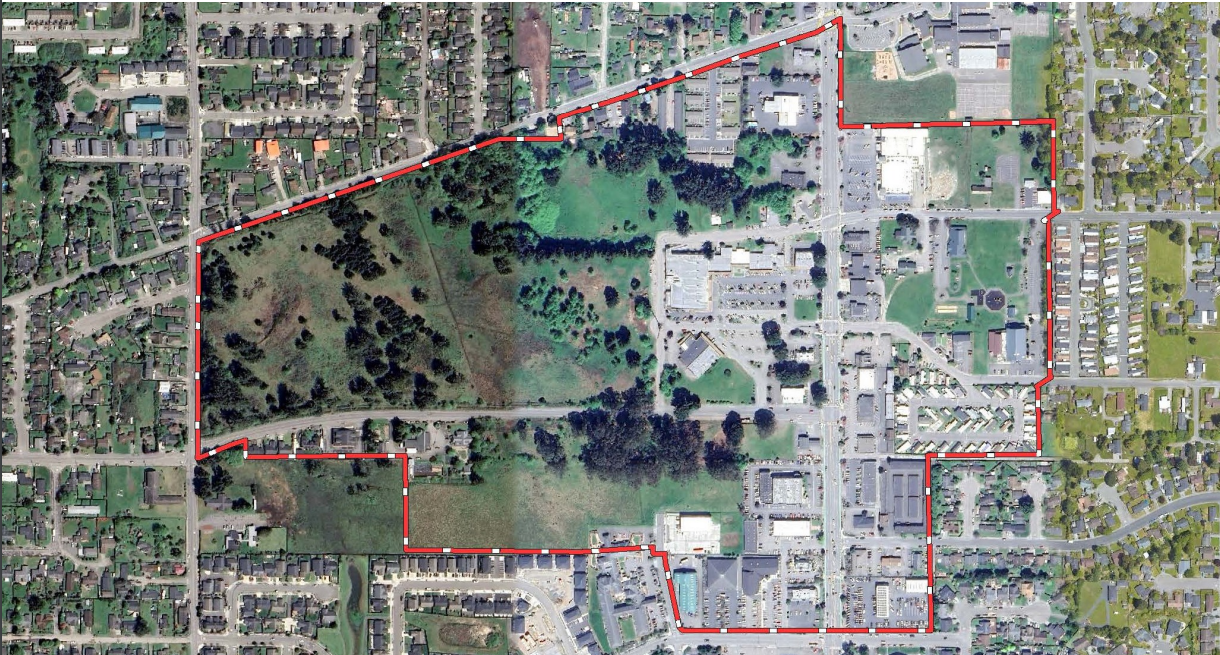
A map of the 134-acre McKinleyville Town Center site. | Map: County of Humboldt
Speaking during last night’s meeting, Humboldt County Planning and Building Director John Ford acknowledged the public’s concern about the four-story building height limit and the number of housing units slated for the site. “The EIR [environmental impact report] may have evaluated that number of units, but that’s not the number of units that are guaranteed in the zone,” he said. “The development ability is dictated by the form-based code contained within the ordinance itself.”
The two-and-a-half-hour discussion largely focused on the proposed “road diet” for Central Avenue, which would reduce traffic on the thoroughfare from five to three lanes to improve pedestrian safety. Commissioner Peggy O’Neill, a resident of McKinleyville, asked if staff would be willing to amend the ordinance to require a thorough transportation study before moving ahead with any changes.
“I’d like to see a study — and I realize there is no money to do any of this right now — at the time or prior to making changes,” she said. “[Staff] could even do a test period where they shut down lanes [to] see what the impacts are going to be. … When I drive down that road, I try to envision [the changes and] sometimes it seems like three lanes is going to be sufficient, but other times, when people are going to school or going to work in the morning, it’s pretty crowded and that’s without the additional units.”
Ford said he was all for additional traffic analysis, but emphasized that the ordinance and the McKinleyville Town Center Project are focused on defining a communal area in the unincorporated city.
“It’s unusual to have a five-lane arterial ripping through an area that you want to be your area of coming together of the community joining,” Ford said. “The idea there is modifying Central also establishes a sense of place. It’s not a road to get from point A to point B; it becomes more of a destination. I think those are important considerations. Yes, safety is an absolute consideration, and the engineers who would work on the road diet — no matter what it looks like — are going to take safety into account. This is not something that will be done haphazardly.”
Several residents spoke about current traffic issues on Central Ave. during public comment. McKinleyville resident and former state assemblymember Wesley Chesbro shared a harrowing story in which two teenagers were almost hit by a speeding vehicle while crossing the street at a crosswalk.

Chesbro| Screenshot
“It was truly terrifying,” Chesbro said. “There’s no reason why the main street through McKinleyville has to be as wide as South Broadway carrying 101’s traffic through south Eureka, and that’s what we have. Think about it: The five lanes that you drive on South Broadway to carry that heavy traffic is the same width through the community of McKinleyville.”
The vast majority of commenters spoke in favor of the ordinance, with many thanking the McKinleyville Municipal Advisory Committee (MMAC) for its work in refining the document.
“To me, the whole thing’s really heroic,” said Peter Pennekamp, a board member of the Anne S. Pierson Foundation, which owns most of the 134-acre town center site. “No one’s ever going to be happy about all the details, but what started out with the bureaucracy … has now grown into this thing that everyone’s involved with. … This ordinance is the product of many years of public input and careful deliberation, and it reflects the community’s vision for a town center that balances housing, services, open space, and ecological stewardship.”
Patrick Kaspari, general manager of the McKinleyville Community Services District, also expressed his gratitude to county staff and the MMAC, noting that the ordinance crafting process was “the most focused and extensive public process that I’ve ever been part of in my 45 years of working in the public sector.”
However, the few residents who spoke against the ordinance said they were disappointed in the lack of public process.
After a two-and-a-half-hour discussion on traffic and various other aspects of the ordinance, the commission ultimately agreed that the county should pursue additional analysis before finalizing plans for Central Ave.
O’Neill made a motion to approve staff’s recommendation to certify the Environmental Impact Report (EIR) for the project, adopt a Mitigation Monitoring and Reporting Program (MMRP) and approve “all required findings of approval” for a zoning ordinance amendment that would change the town center zoning designation to mixed use with a qualified combining zone (Q-Zone) overlay.
The motion was seconded by Commissioner Jerome Qiriazi and passed in a unanimous 5-0 vote, with at-large commissioners Sarah West and Lorna McFarlane absent.


