

Public Health Monitoring COVID Outbreak at Fortuna Care Home
LoCO Staff / Friday, May 20, 2022 @ 4:26 p.m. / COVID-19 and Humboldt
Press release from the Humboldt County Department of Health and Human Services, Public Health Division:
The Humboldt County Public Health Branch is assisting staff and management at Fortuna Rehabilitation & Wellness Center in response to a COVID-19 outbreak.
Public Health visited the long-term care facility Wednesday following concerns about possible infections. To date, 12 people have tested positive for the virus, which includes both residents and staff.
“We’re always concerned when our seniors and medically vulnerable members of the community are at risk,” said Humboldt County Public Health Director Sofia Pereira. As of now, no residents have been hospitalized.
Pereira said staff were in consultation with the California Department of Public Health’s Healthcare-Associated Infections Program and are working with the facility to provide infection prevention education and guidance, as well as assisting with acquiring any state resources that may be available.
Public Health’s Outbreak Response Team has visited Fortuna Rehabilitation & Wellness Center twice so far to provide testing and offer infection prevention recommendations, and will continue to work with facility management to test residents every two to three days.
According to the facility management, Fortuna Rehab has stepped up screening of all employees for COVID-19 symptoms, adding that visits are currently restricted to slow the spread of illness.
Public Health staff will provide support as needed through the weekend. Additional information will be available next week.
For the most recent COVID-19 information, visit cdc.gov or cdph.ca.gov Local information is available at humboldtgov.org.
BOOKED
Today: 7 felonies, 6 misdemeanors, 0 infractions
JUDGED
Humboldt County Superior Court Calendar: Today
CHP REPORTS
No current incidents
ELSEWHERE
Governor’s Office: California’s public safety strategy works: Governor Newsom’s commitment helps lower crime as new study shows violence prevention saves lives
Humboldt Last Week: 394: Dorm sex-assault arrest twice, Hoopa homicide teens, trafficking bust, 6-victim abuse case, Miranda suspended, more
Governor’s Office: Six years after Creek Fire, Governor Newsom recognizes historic nighttime CalGuard rescue that saved 242 lives
Sheriff’s Office Patrol Deputies Now Equipped With Innovative, Cell-Phone-Based Body Cams
LoCO Staff / Friday, May 20, 2022 @ 3:39 p.m. / Crime
Press release from the Humboldt County Sheriff’s Office:
The Humboldt County Sheriff’s Office is excited to announce the launch of our Deputy Sheriff Body Worn Camera Program. Every deputy sheriff working in a public setting is now equipped with a body worn camera allowing them to capture interactions with the public and properly document essential evidence. But these aren’t your typical body worn cameras, they’re smart phones and can do so much more than just record video.
“Our new body worn camera is an Android device with a specially designed application that can record video and audio, take photos, and facilitate/record phone calls,” OHV Deputy Raleigh Willoughby said. Deputy Willoughby was part of the team tasked to test and help select the cameras. He said a lot of factors were considered during the selection period, including ease of use. “It’s pretty simple. To activate the camera, you just press the side or top button on the phone, and it gives you an audio to confirm that it is recording. Then you do the same thing to turn it off.”
While traditional body worn cameras, like the ones currently in use inside the county’s correctional facility, require law enforcement officers to manually upload footage and charge at a central docking station, the cellphone-based technology provides more flexibility to accommodate the county’s rural makeup and sheriff’s substations.
“Because we serve a rural county and not all deputies have the same headquarters, it’s essential that our deputies are able to use these cameras and have all the video uploaded instantaneously through a cell signal,” Humboldt County Sheriff William Honsal said.
For deputies in parts of the county without cell signal, the videos are saved on the device and uploaded automatically when service is restored. Once uploaded, the deputy is able to review the video prior to writing their report, and then the video is sent to the District Attorney’s Office to assist with potential prosecution. All video recorded is stored in the cloud for at least 180 days.
“These cameras will be utilized by every deputy sheriff on every contact, whether it’s an investigation, a traffic stop, a domestic violence incident- they’re going to be recording everything,” Sheriff Honsal said. “So, this will enhance our ability to capture evidence and statements, and also provide a level of transparency to the public.”
Though the cameras will capture every incident, to protect the privacy of the individuals we serve the videos will only become available to the public in some cases as applicable by state law.
“The videos that we capture on our body worn cameras are used for official purposes only,” Sheriff Honsal said. “There are only very few circumstances that these become a matter of public record. Otherwise, the videos will be used as evidence and sent to the District Attorney’s Office, or will be used for internal investigations and training.”
In addition to the development and availability of the new technology making the program more feasible, Sheriff Honsal says the program also would have not been possible without Measure Z funding.
“It costs about $75,000 to get the program started and then there’s upwards of $40,000 worth of expenses annually for cloud storage and equipment to keep this program going,” Sheriff Honsal said. “It has become the industry standard to have body worn cameras for all law enforcement contacts and I think it’s just really necessary now for law enforcement. So, we are very thankful for Measure Z to be able to afford this program.”
GROVE of TITANS: New Trail Opened Through Ancient Jed Smith Redwoods
LoCO Staff / Friday, May 20, 2022 @ 1:02 p.m. / Nature
Press release from the Save the Redwoods League:
California State Parks, Tolowa Dee-Ni’ Nation, Save the Redwoods League, Redwood Parks Conservancy, and the National Park Service today announce the opening of Grove of Titans and the Mill Creek Trail in Jedediah Smith Redwoods State Park, part of Redwood National and State Parks (RNSP) in Del Norte County. Park visitors are invited year-round to explore the new 1,300-foot-long boardwalk through the Grove of Titans, which is accessible from the newly realigned Mill Creek Trail.
For the first time, park visitors will have official, low-impact access to the famed grove to see some of the world’s largest and oldest coast redwoods.
“The Grove of Titans is a premier example of an extraordinary old-growth redwood forest that was experiencing significant damage from visitors walking ‘off trail’ to access this area,” said Erin Gates, deputy superintendent, RNSP and North Coast Redwoods District, California State Parks. “This project is really a story about legacy: being mindful of the role we all play in helping to keep our parks thriving. Through powerful partnerships, we have been able to create an opportunity for visitors to experience the beauty and awe of this grove in a way that also helps protect this sensitive and delicate habitat into the future.”
New Visitor Experience
The new elevated boardwalk through the Grove of Titans also features interpretive signage and exhibits, complete with redwood forest illustrations and hands-on features to educate visitors about the habitat and safe trail use. Interpretation was developed in consultation with the Tolowa Dee-ni’ Nation to illuminate the Indigenous history of the area and present-day relationships that Tolowa people have sustained with these lands for generations.
The Tolowa Dee-ni’ Tribal Council offered this statement: “Tolowa Dee-ni’ Nation is pleased to have collaborated on the Grove of Titans Trail Project. Tolowa Dee-ni’ maintain our responsibility as the original stewards of the Grove of Titans through a government-to-government relationship with the Redwood National and State Parks. With the completion of this project, we are grateful park visitors will be able to more responsibly visit our ancestral territory and magnificent redwood relatives.”
New services and amenities have been added nearby along Howland Hill Road, including ADA-accessible parking and restrooms.
In total, trail crews spent more than 23,000 hours to realign the 3-mile Mill Creek Trail and build the new elevated walkway. To minimize construction impact on the sensitive habitat, the crews also hand-carried close to 128 tons of construction materials and tools to the site. They removed old, unofficial social trails and restored previously damaged and degraded areas by replanting ferns and other understory plants.
“Balance is key when planning and building a trail in such a rare and beautiful ecosystem,” said Jessica Carter, director of parks and public engagement for Save the Redwoods League. “With the realigned trail, new boardwalk and signage, we’re respecting the natural grandeur of this special place while also welcoming all visitors to experience and enjoy Grove of Titans for generations to come.”
New Titaneers Volunteer Program to Care for the Grove
Redwood National and State Parks is actively recruiting volunteers to monitor the trails and interact with park visitors to support the long-term care of the Grove of Titans and nearby trails. Contact JedSmithTitans@gmail.com to learn more about the new Titaneers volunteer program and to get involved.
“The Grove of Titans project shows how we can—and must—work together to accomplish great things,” said Scott Larson, executive director of Redwood Parks Conservancy. “It starts with generous giving through organizations like Redwood Parks Conservancy. But the work is not done. We need to teach existing visitors and do a better job reaching out to include new communities, to understand WHY this project happened and how they can help by treading on places like this more gently to truly ‘leave no trace’.”
Funding the Grove of Titans Trail
The cost of the Mill Creek Trail realignment, Grove of Titans boardwalk, associated new visitor amenities and grove restoration was approximately $4 million.
Save the Redwoods League supporters contributed more than $2 million toward the project, including a generous challenge grant from Josie Merck of Connecticut. The project was also supported by $875,000 from California Natural Resources Agency through the Prop 68 Parks, Environment, and Water Bond Act of 2018; over $900,000 of in-kind contributions from the project partners; and $205,000 from Redwood Parks Conservancy donors.
About Grove of Titans
Grove of Titans is within Tolowa Dee-ni’ Nation ancestral territories. It is also part of Jedediah Smith Redwoods State Park within Redwood National and State Parks (RNSP) in Del Norte County, California. RNSP is internationally recognized as a UNESCO World Heritage Site because it protects a significant population of coast redwoods, the world’s tallest living things and among the most impressive trees in the world.
Social media and unofficial promotion of the grove’s off-trail location led to a dramatic increase in visitation over the last 20 years. With no official trails or visitor infrastructure, the influx of people threatened the health of the grove.
A complex web of unplanned social trails formed over the years. This brought meandering foot traffic directly through the grove, which destroyed understory plants and damaged the trees’ shallow root systems. Hiking through the sensitive ecosystem also pushed eroded soil and litter into the streams, impacting coho and steelhead spawning habitat. Visitors often left waste behind.
In 2018, California State Parks, Save the Redwoods League, Redwood Parks Conservancy and the National Park Service unveiled their collaborative plan to safeguard the famed old-growth grove and establish formalized, inspirational visitor access. The realigned Mill Creek Trail and elevated walkway through the Grove of Titans were designed to limit the impact of visitation to the grove while providing official, ecologically sensitive public access.
“The Grove of Titans boardwalk is bound to become one of the signature trails within Redwood National and State Parks”, said Steve Mietz, superintendent of RNSP, National Park Service. “The unique design of the walkway provides an aesthetically pleasing, intimate connection between visitors and redwoods while protecting the giant redwoods of what is now known as the Grove of Titans.”
Recreate Responsibly
California State Parks reminds visitors to recreate responsibly with COVID-19 still present.
Prior to leaving home, visitors are asked to check the status of the park units they want to visit to find out what restrictions and guidelines are in place. Having a back-up plan in case their destination is crowded is recommended. For additional guidelines and safety tips, please visit parks.ca.gov/COVID19.
With An Increase of Depression and Anxiety Among Children and Teens, New Mental Health Crisis Center Will Open to Serve our Local Youth
Stephanie McGeary / Friday, May 20, 2022 @ 11:05 a.m. / Health Care

The Sorell Leaf Healing Center at 124 Indianola Rd. is set to open in 2023 | Photos provided by Evan Buxbaum
###
Dr. Evan Buxbaum, who has worked as a pediatrician in Humboldt County for 11 years, recently had a patient who was suffering from a severe mental health crisis and was suicidal. Buxbaum had to send his patient to the emergency room at St. Joseph Hospital, where she stayed for 15 days, because there was no other facility that could take her.
That was when Buxbaum knew that something must be done to better accommodate children with mental health issues in our county.
“Our practice, and I think all the pediatric practices in the county, have been seeing increasing numbers of adolescents coming in, in significant mental health distress,” Buxbaum told the Outpost in a recent phone interview. “We’re seeing younger and younger kids experiencing the symptoms of anxiety, depression and suicidality.”
Anxiety, depression and self-harm among youths have been on the rise around the country for the last few years, a problem that was exacerbated by the isolation and stress from the COVID-19 pandemic. And with a lack of mental health resources available, hospitals and pediatricians have been overwhelmed with caring for children and adolescents in a mental health crisis.
This is why Buxbaum and his team, along with the Humboldt County Department of Health and Human Services (DHHS) Behavioral Health Branch, are creating the Sorrel Leaf Healing Center – a mental health crisis facility, the first of its kind in Humboldt, designed specifically to treat children and adolescents.
It will actually be the only mental health facility for children and teens for about 150 miles. Currently the closest options for treatment are in either Santa Rosa or Redding, and those centers are frequently at capacity. Currently, if a child or teen is reaches the point of a crisis or suicide attempt, the only local option is to send them to the emergency room. Adults in a mental health crisis are also often sent to the emergency room, causing the ERs to be packed past capacity and causing a chaotic and sometimes dangerous environment for patients and medical staff.
“It’s very hard on the staff in the emergency room because there’s really not a lot that they can do for these kids,” Buxbaum said. “And they just sit there, hour after hour, day after day, sometimes into the weeks.”
And the emergency room, which is not designed or staffed for mental health treatment, is not a particularly therapeutic environment for those in mental crisis. It is loud and chaotic, patients have little to no privacy, and with people coming in for medical emergencies, patients sometimes witness things that can be more traumatizing.
With the development of Sorrel Leaf, there will be an option for treating children and adolescents in a much more therapeutic environment. Located on a beautiful property on Indianola Road, the center will have four different service branches – crisis stabilization, crisis residential treatment, continuing aftercare and a mobile response team.

The mobile response team, Buxbaum told the Outpost, will consist of a vehicle staffed by a therapist and a caseworker, who will be available to go out into the community, into the emergency rooms, law enforcement offices and schools or the homes of a child is experiencing a mental health emergency. The goal of the mobile response team will be to de-escalate the crisis, provide immediate counseling and case management and, if possible, prevent hospitalization or the need for a higher level of care.
Patients can also be submitted to the crisis stabilization program, which Buxbaum explained is offered as sort of an alternative to the ER. There, patients are given a private room for up to 24 hours and will be offered intensive therapy, family counseling or medication support, if needed. “Ideally, from there, we want to be able to send the kids home or to a safe environment,” Buxbaum said.
If it is determined that the patient needs further care beyond the crisis stabilization, they can move to the crisis residential treatment facility, where they will do the “deep work,” Buxbaum said. The residential facility will implement different types of therapy including dialectical behavior therapy, cognitive behavior therapy, somatic therapy and therapy through exercise, yoga and breathing techniques. The center is also based on a farm and will use animal therapy and allow the patients to help care for the animals. The center will also focus on teaching kids to grow and prepare their own food as part of the center’s therapy model.
“I believe that a crisis is an opportunity for healing,” Buxbaum said. “And you don’t heal with a pill. Certainly medications help. But you heal by reconnecting to purpose, meaning and community in your life.”
Treatment at Sorrel Leaf will also include continuing aftercare, which would consist of continuing the forms of therapy that were most effective for the patient during their residential treatment, including individual or group therapy, to help prevent a mental health relapse. Another advantage to having a local facility like this, Buxbaum said, is that it will be much easier for the patients to have access to follow-up care.
Funding for the center will come largely from a $5.1 million California Health Facilities Financing Authority (CHFFA) Children and Youth Mental Wellness grant, which was awarded to the project about a year ago. The money was used for purchasing and retrofitting the property. Additional support will come from community partners Providence Humboldt County, the North Coast Grantmaking Partnership, the McLean Foundation, the Kurt Feuerman Foundation, Redwood Region Economic Development and various community members.
The center is expected to open in 2023 and Buxbaum and his team are currently working with designing engineers and an architect to renovate and remodel the building to fit the center’s needs. The next step will be staffing, which Buxbaum did acknowledge can be a challenge in Humboldt. Conducting recruitment efforts outside our area may be necessary. The center will also be looking to hire people from the social worker or psychology departments at Cal Poly Humboldt. Fully staffed, the center will employ about 30 people, Buxbaum said.
Buxbaum added that the center will strive to accommodate low-income families and will accept all types of insurance, including Medi-Cal. For those who are uninsured, the center will also have case management staff to connect families with financial services.
“There are programs like this in other areas, but they’re $2,000 a day,” Buxbaum said. “We’re trying to design the [kind of] program that the child of a Silicon Valley millionaire would have, only accessible to everyone.”
UC System Takes Another Step Toward Keeping Students Debt-Free
Mikhail Zinshteyn / Friday, May 20, 2022 @ 7:26 a.m. / Sacramento
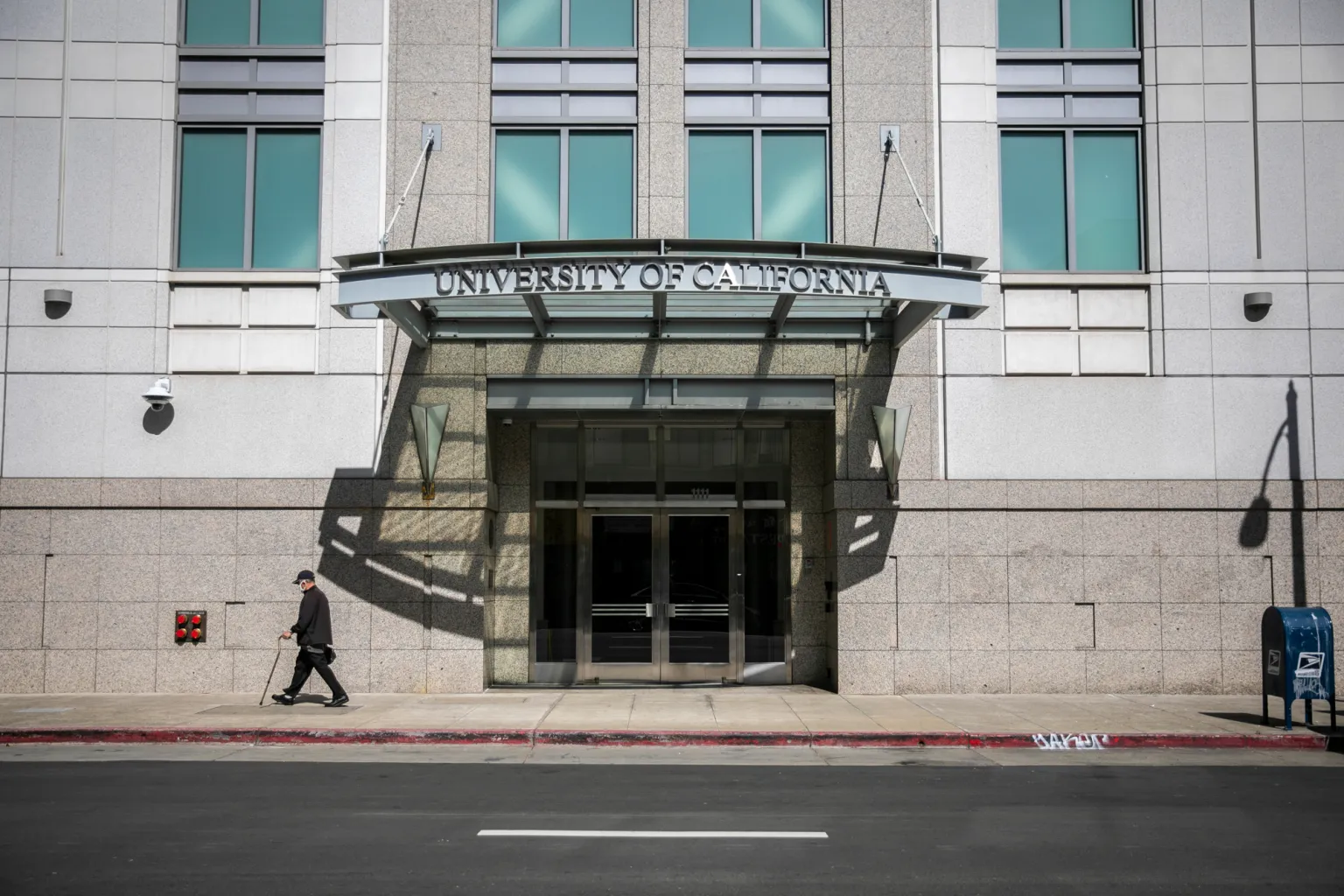
The University of California Office of the President offices in downtown Oakland on May 19, 2022. Photo by Martin do Nascimento, CalMatters
The University of California is vowing to offer its California undergraduates a debt-free college experience by 2030 as part of an overhaul of how the system views college affordability.
To get there, the system of 230,000 students seeking bachelor’s degrees is relying on a mix of state and federal support, revenues from recent tuition increases, and students working part-time to cover the full cost of an education. Students from wealthier households would also rely on parental support.
The system’s governing body, the Board of Regents, took another step toward that debt-free goal Thursday by voting to prioritize part-time work over taking out loans as part of the UC’s official financial aid policy. The change is subtle but is yet another instance of the UC signaling that its students should be able to earn a bachelor’s degree without the need to borrow within the next several years.
“The preferred outcome of our financial aid strategy is that students can afford their education through opportunities for part-time work made available to them and minimize student loan borrowing,” said Michael Brown, provost of the entire UC system, at Wednesday’s UC Regents meeting.
Though more than half of UC’s in-state undergraduate students don’t pay tuition due to financial aid, the free-college movement has widened its scope to include non-academic expenses that are still vital to a student’s education, such as housing, transportation and food.
All those expenses add up. Just over half of resident students graduate from the UC with student loans, accumulating an average of $18,800 in debt. It’s a figure that’s well below the national average but is still a financial millstone around borrowers’ necks. A CalMatters analysis noted low-income students who receive federal aid also take out loans, at amounts ranging from $11,000 to $16,000 typically.
Earlier in the year, the UC said it would award additional aid to 6,000 low-income students this fall so the students could avoid loans.
The 2030 debt-free goal depends in large part on compliance from California’s lawmakers and the federal government.
The state Legislature and Gov. Gavin Newsom are expected to commit $632 million this year as part of a down payment on a debt-free grant that experts say will eventually cost $2.6 billion. Once fully funded, the grant is supposed to give students enough money to cover the full cost of attendance after parental support, part-time work and grant aid are considered.
Low-income students whose families cannot afford to help out with college will have to contribute about $8,000 annually to their education, which they can raise by working 15 hours a week during the school year. Where they find these jobs is an open question, but lawmakers and the governor last year launched a $500 million fund to create part-time work opportunities for low-income students attending the state’s public colleges and universities.
Students from higher-income households will also be able to avoid taking out loans, but that assumes their families will provide money toward their educations based on a federal formula. Higher-income students would also be expected to work.
There’s no timeline to fully fund the debt-free grant. However, the Senate wants to commit more money up front and fully fund the program by 2025-26 as part of the budget deal due June 15.
The new debt-free grant, which lawmakers are calling the Middle Class Scholarship 2.0, is key to UC’s debt-free goals.
That 2030 debt-free goal “is reliant on the middle class scholarship reform that the Legislature passed last year and the full funding of that,” said Seija Virtanen, associate director of state budget relations for the UC, during an Assembly budget subcommittee on education hearing this week.
For its part, the UC will divert 45% of its revenue from its recent tuition hikes toward student financial aid — up from 33%. The policy came to life last year. It’s also in UC’s compact with the governor, a de-facto deal in which Newsom is promising 5% in annual increases in education funding for the UC in exchange for key promises on affordability and student success. Those funding increases still need legislative approval.
In an analysis conducted by UC officials last August and shared with CalMatters this week, the system projects raising an additional $333 million by 2029-30 for its undergraduate grant aid program through the tuition increases. The current level of aid is $785 million, wrote Ryan King, a UC spokesperson, in an email.
Already UC grant aid is the second largest source of financial support for undergraduates at the system. The federal government contributed $420 million toward student grants last year. California programs, chief among them the Cal Grant that covers tuition, poured in nearly $1 billion in grant aid for students last year.
That state share will grow once the Middle Class Scholarship is officially funded. But there’s another wild card that may steer more grant aid to students.
Last year Gov. Newsom vetoed a bill to add more than 100,000 students, including several thousand UC students, to the Cal Grant program, though he expanded grant eligibility in other ways. A nearly identical bill is moving through the Legislature now, but some lawmakers backing the bill were bewildered that Newsom’s May budget proposal didn’t promise funding for the bill, which is expected to cost more than $300 million annually.
One leading lawmaker who helps shape higher education spending policy called that omission a “significant irony.” Assemblymember Kevin McCarty, a Democrat from Sacramento who is chair of the budget subcommittee on education, said at a hearing this week that though the governor’s office made a debt-free compact with the UC, the governor’s budget doesn’t “fund that thing that you need to get debt-free college.”
About 109,000 of the 150,000 students who’d benefit from Cal Grant expansion are community college students. (About 500,000 students across all institutions already get the Cal Grant.) Unlike UC and Cal State students, those attending community colleges aren’t eligible for the planned Middle Class Scholarship expansion, though they’d get it if they transfer to a California public university.
That’s why Eloy Ortiz Oakley, who is both a UC regent and chancellor of the California Community Colleges, calls passage of the Cal Grant expansion bill the community college system’s top priority. The bill would give those students at least $1,648 a year while they’re in community college and grant them free tuition if they transfer to a UC or Cal State.
“The students who have been last in line for so long, need to get to the front of the line here real soon,” Oakley said in an interview.But more money for financial aid is only one half of the conversation, he added. The UC also needs to figure out how to lower its costs. That may mean offering more online courses and avoiding refilling certain job vacancies, among other solutions.“Are we hiring in places that continue to grow the bureaucracy of our colleges and universities? Or are we growing in places that directly serve the needs of students?” he asked.
###
CalMatters.org is a nonprofit, nonpartisan media venture explaining California policies and politics.
The Great Culling: Which California Bills Did Legislators Kill?
Alexei Koseff / Friday, May 20, 2022 @ 7:04 a.m. / Sacramento

Illustration by Miguel Gutierrez Jr., CalMatters.
California lawmakers won’t be creating a state Election Day holiday this year. Nor will they be providing grants to local governments to convert public golf courses into affordable housing, or forcing health insurers to cover fertility treatments.
All of these proposals were victims of the seasonal culling of bills known as the suspense file. This stately and secretive process, led by the Senate and Assembly appropriations committees, serves as a final fiscal review before any legislation expected to have a significant cost to the state is sent to the full chamber for a vote.
In fast and furious hearings on Thursday that stretched for two hours, the committees ran through the fates of nearly 1,000 bills, offering no explanations for their decisions and, in many cases, no formal announcement at all that a measure was held.
The results had already been determined in private deliberations. The suspense file, among the most opaque practices at the Capitol, allows legislative leaders to not only shelve proposals that are too expensive, but to also more quietly dispatch those that are controversial or politically inconvenient, particularly in an election year.
About 220 bills were shelved. The bills that made it through — more than 700 of them — now face another looming deadline next week to pass out of their house of origin. If successful, they will move to the other chamber for further consideration.
Here are some of the notable measures that are not advancing this session:
Election Day holiday
Five times Assemblymember Evan Low, a Campbell Democrat, has tried to create a state holiday for the November election, closing schools and giving public employees paid time off to vote. And five times the bill has been held on the Assembly suspense file, including again this year.
Assembly Bill 1872 was slightly different from several of its predecessors in that it would have swapped out Presidents’ Day with an Election Day holiday in even-numbered years, rather than simply adding another day off, thereby lowering its cost. But with every California voter now being mailed a ballot in every election, the urgency for such a plan has diminished considerably.
A separate measure to create a state holiday for Juneteenth, Assembly Bill 1655 by Assemblymember Reggie Jones-Sawyer, a Los Angeles Democrat, advanced to the floor, however.
Affordable housing
If a powerful interest group swings hard enough at a bill, they just might kill it. That’s what happened when nearly 80 local, regional and national golf groups, as well as several organizations that favor local control over housing development, coalesced against Assemblymember Cristina Garcia’s Assembly Bill 1910.
The measure targeted the state’s hundreds of municipal golf courses, many of which are operating at significant financial losses, as prime locations to help the state build its way out of its housing shortage. It would have offered grants to local governments to convert their golf courses into housing, at least a quarter of which would have to be affordable to low-income families. The result wasn’t too surprising: everyone wants affordable housing, until it threatens to come to their backyard — or local golf course.
— Manuela Tobias
Fertility treatment
Assemblymember Buffy Wicks’ push to require health insurers to cover fertility treatment, including costly in-vitro fertilization, fell short for the third time in four years.
Unlike 17 other states, California does not require health insurers to pay for fertility treatments. A round of in vitro and the accompanying medication can cost upwards of $20,000, deterring some people from having children and leaving others in exorbitant debt.
Assembly Bill 2029 by Wicks, an Oakland Democrat, was opposed by health insurance plans and other business groups, which noted the high price tag: an estimated $715 million that would be fronted by employers and health plan enrollees largely in the form of increased premiums.
— Ana B. Ibarra
Salary transparency
Assembly Bill 2095 by Assemblymember Ash Kalra, a San Jose Democrat, was a first-in-the-nation bill that would have required large companies to report a broad swath of data on their workforce, including how much they are paid and what benefits they receive. The state could have used that information to provide the public with easy-to-understand measurements of how companies treat their employees and to give top performers certain perks, like tax credits.
But the bill faced ardent opposition from business groups, including the California Chamber of Commerce, which put the bill on its “job killer” list — the collection of measures it lobbies against most aggressively each year. The Chamber argued that the data would create unfair comparisons between companies or be taken out of context.
Legislators did advance another workplace transparency proposal on the “job killer” list: Senate Bill 1162 by Sen. Monique Limón, a Santa Barbara Democrat, which would require companies to make some pay data public, including salary ranges in job posting, passed with a few amendments, including one that exempted companies with 15 or fewer workers.
— Grace Gedye
Community college professor pay
Part-time community college faculty are having a mixed moment in Sacramento. A pending $200 million health care fund they’ve championed has the support of the governor. But a bill to match the wages of part-time community faculty with full-time faculty for similar levels of work died on the suspense file.Assembly Bill 1752 by Miguel Santiago, a Los Angeles Democrat, would have increased community college costs by an estimated hundreds of millions of dollars annually. That the cost is so high speaks to the enormous wage gap between part-time faculty — who are typically paid only for the hours they teach, but not for other related work like lesson planning and grading — and their full-time salaried peers.
A majority of community college faculty are part-time, earning on average $20,000 per year. Labor unions backed this bill while the organization representing community college executives opposed it, arguing that they were already struggling to meet staffing obligations in an era of declining student enrollment.
“Educators are deeply disappointed,” Claudia Briggs, spokesperson for the California Teachers Association, said in a text message. “AB 1752 was the right thing to do for students and part-time faculty in a year that the state budget has the resources.”
— Mikhail Zinshteyn
Oil consumption and drilling
Assembly Bill 2816 by Assemblymember Phil Ting, a San Francisco Democrat, was meant to provide a boost for California’s signature program to persuade drivers to swap their gas guzzlers for electric cars. The measure would have directed the California Air Resources Board to restructure the rebates for zero-emission vehicle purchases so that consumers would receive more money for giving up cars that used more gasoline. But the proposal failed to garner widespread support among environmental groups.
The fossil fuel industry and the labor unions that represent its workers also flexed their considerable muscle at the Capitol again, helping to kill Senate Bill 953 by Sen. Dave Min, a Costa Mesa Democrat. After a massive oil spill near the coast of Huntington Beach last fall, Min had sought to shut down the three remaining offshore rigs in state waters by requiring California to negotiate an end to their use in the next two years. Even as Democratic leaders eye phasing out oil and gas production in the state over the coming decades, they’ve been reluctant to take even modest steps to limit drilling more immediately. Min’s bill was further undercut by concerns about potential financial liabilities to taxpayers should the state take ownership of the rigs.
— Nadia Lopez and Alexei Koseff
###
CalMatters.org is a nonprofit, nonpartisan media venture explaining California policies and politics.
OBITUARY: Alberta Delene Johnson, 1933-2022
LoCO Staff / Friday, May 20, 2022 @ 6:56 a.m. / Obits

Alberta
Delene Johnson
February 8, 1933 to May 14, 2022
Alberta was born on February 8, 1933 in Spearville, Kansas to mother Lucinda Mathilda (Helfrich) Schultz and father Albert Harry Johnson. Alberta graduated from Ford High School in Ford, Kansas on May 24,1950, and entered St Anthony Hospital School of Nursing in Dodge City, Kansas with a full scholarship. Alberta graduated in August 1953 and passed her RN Boards in September 1953.
Alberta married the love of her life, Carl Preston Johnson on August 12, 1953 at St. John Catholic Church in Spearville, Kansas. Carl and Alberta became the proud and loving parents of Gregory, Albert, Mark, Delene, Charles, Steven, Aaron, Matthew, and Richard. Carl and Alberta moved their new family from Kansas to California in 1967, and eventually settled in the Loleta/Fortuna area. Alberta continued her career as a Registered Nurse in the Humboldt County area at St Joseph’s Hospital, Redwood Memorial Hospital, Mad River Hospital, Granada and Seaview Skilled Nursing Facilities, and Redwood Coast Region Professional Standards Review Organization (PSRO).
Alberta is survived by her daughter Delene Baty (Steven) of San Antonio, Texas, sons Charles Johnson (Allison) of Beaverton, Oregon, Steven Johnson (Eileen) of Sacramento, Aaron Johnson of Loleta, Matthew Johnson (Jennifer) of Woodinville, Wash., and Richard Johnson (Joyce) of Carmichael, Calif., and grandchildren Stephanie and Colleen Johnson, Callan, Makenna, and Cameron Wenger-Johnson, Brian and James Johnson, and Patrick and Natalie Baty. Nieces and nephews include Nancy Klenke, Duane Boyd, Cliff Boyd, Lance Boyd, Rodney Johnson, Donny Thorn, Linda Thorn, Jeanine Thorn, Karla Robson, Bill Collet, and sister-in-law Ilda Fay Janzen.
Alberta is preceded in death by her loving husband Carl, her infant sons Gregory, Albert, and Mark, sisters Erma Jean (Schultz) Boyd and Linda (Schultz) Niemeyer, and her parents Albert and Lucinda.
A Rosary will be held at Goble’s Fortuna Mortuary on Sunday May 22, 2022 from 6 p.m., with doors opening at 5 p.m. for visitation.The Funeral Mass will be held on Monday, May 23 at 10 a.m. at St Joseph’s Catholic Church, Fortuna, with internment and Final Blessing immediately to follow at St Patrick’s Catholic Cemetery, Loleta. Reception to follow at the River Lodge Conference Center-Coho Room, Fortuna, from 12-2 p.m. Alberta’s family would like to extend a heartfelt thank you to Dr. Donald Baird, Jan Borges, Janet Anderson, Celeste Heinrich, Cindy August, Katie Todd, Maria Riddle, and Hospice of Humboldt for providing such excellent care.
###
The obituary above was submitted by Alberta Johnson’s loved ones. The Lost Coast Outpost runs obituaries of Humboldt County residents at no charge. See guidelines here. Email news@lostcoastoutpost.com.


