

SOTOLONGO TRIAL: New Evidence Shows That Victim in Hoopa Stabbing Was Carrying Knife in His Pocket
Rhonda Parker / Thursday, May 19, 2022 @ 4:45 p.m. / Courts
Prosecutors in the murder trial of Gearold Sotolongo will have to call at least one more witness to address new evidence that victim Roger Yale had a knife in his back pocket when Sotolongo allegedly stabbed him in the heart.
Under cross-examination today by defense attorney Zack Curtis, the doctor who conducted Yale’s autopsy six years ago said there was a black, folding knife in Yale’s rear pants pocket.

Dr. Mark Super testified he has no independent memory of seeing the knife, but he documented its existence in the 2016 autopsy report. No witness has reported seeing Yale with any kind of weapon, other than possibly a stick.
Deputy District Attorney Roger Rees asked Super if the knife was covered in blood. Super has no recollection but said he would have made note of seeing blood.
Super was expected to be the last prosecution witness, but plans have changed. Also, Curtis said outside the courtroom he intends to call defense witnesses, “hopefully three or four.”
Jurors were told not to return until Monday morning, leaving the court dark tomorrow. So the trial may extend well into next week.
Super said the knife that killed Yale passed between two ribs, without nicking the ribs, and then punctured his heart. Super described the wound as “a pretty big hole.”
Sotolongo, also known as Roldo Pratt, wasn’t arrested until nearly a month after the killing. No alleged murder weapon has been introduced as evidence. Super testified today that judging by a wound on Yale’s arm, the knife may have been serrated.
Yale was covered head to toe in bruises and abrasions, the doctor said. Some of the wounds were scabbed over, meaning they were older. Others appeared to have been inflicted during the fatal altercation. Yale fell backward on concrete at one point, which could explain a bruise on the back of his head and some of the other injuries.
Also, as Curtis pointed out, it’s possible Yale may have been injured when he was fighting violently with paramedics in the back of an ambulance. He died in the ambulance before he could be flown to a hospital.
Sotolongo, now 31, is accused of stabbing the 30-year-old Yale outside the Hoopa Mini-mart about 8:30 a.m. on Feb. 13, 2016. The case has taken six years and three months to get to trial. At least one potential witness has died, and at least one is in prison.
As usual with long-time jail occupants, Sotolongo no longer resembles his booking mugshot. He is plump, has short hair and is wearing a dress shirt and slacks. Like everyone else in the courtroom, he wears a mask.
###
PREVIOUSLY:
BOOKED
Today: 7 felonies, 6 misdemeanors, 0 infractions
JUDGED
Humboldt County Superior Court Calendar: Today
CHP REPORTS
No current incidents
ELSEWHERE
Governor’s Office: California’s public safety strategy works: Governor Newsom’s commitment helps lower crime as new study shows violence prevention saves lives
Humboldt Last Week: 394: Dorm sex-assault arrest twice, Hoopa homicide teens, trafficking bust, 6-victim abuse case, Miranda suspended, more
Governor’s Office: Six years after Creek Fire, Governor Newsom recognizes historic nighttime CalGuard rescue that saved 242 lives
Alderpoint Murder Suspect Told Cops He Shot Man in the Head to Save His Puppy, Investigator Testifies
Rhonda Parker / Thursday, May 19, 2022 @ 4:01 p.m. / Courts
Murder suspect Jake Henry Combs freely admitted he shot Trevor Earley in the head, saying Earley had threatened to kill his dog after the puppy bit him in the face.
“He wasn’t going to let Mr. Earley kill his dog, so he shot him instead,” sheriff’s Investigator Brandon Head testified this morning during Combs’s preliminary hearing.

After the brief hearing, visiting Judge Marjorie Lord Carter held Combs, 29, to answer on a charge of murder. His arraignment and possible trial-setting is scheduled for June 2. He also is accused of personally discharging a firearm, a Glock 9mm pistol.
The courtroom was filled nearly to capacity with friends and family members of Earley. Many wore shirts bearing his photograph.
The evidence presented today by Deputy District Attorneys Shelly Small and Jessica Acosta was pretty straight-forward: An eyewitness told law enforcement Combs put a pistol to Earley’s head and pulled the trigger, and Combs fully confessed to Investigator Head on Jan. 6, the day of the killing.
The shooting happened in the early morning hours at the Alderpoint home of Elias Antunez, who reported he was face to face with Earley, having a conversation on an outdoor patio, when Combs walked up and shot him. The bullet entered above Earley’s left eye and exited below his right ear.
Deputy Coroner Chad Zeck, also testifying today, said the bullet hole was a “contact wound,” with evidence of burn marks around it.
According to Head’s testimony, Combs, Earley, Antunez and Earley’s best friend Zeb Humphrey had been drinking since the early afternoon. About 7 p.m. they arrived at a Garberville bar and spent two or three hours. They left together in Earley’s Toyota Tacoma and drove to Antunez’s house on Sixth Street in Alderpoint.
The four were getting along well. But within minutes after arriving in Alderpoint, Combs’s Cane Corso puppy bit Earley near his right eye, drawing blood. According to Combs, Earley said he was going to kill the dog. No one saw Earley with a gun. His pistol was found later in his truck outside.
After Earley was shot dead, Combs, along with his dog and Antunez, drove away in Combs’s Ford SUV. Humphrey had left the house earlier and wasn’t there when Earley was killed. He came back to find his best friend dead on the patio.
Antunez went with Combs because “he was concerned about what Mr. Combs might do to him,” Head testified under questioning by Small.
“He was scared.”
At some point on Highway 36 Combs lost control of the SUV and it crashed. Combs told Head he looked for the gun after the wreck and couldn’t find it.
“He said he was going to throw it in the river if he found it,” Head said. He said Combs told him he considered going to his brother’s house in Chico or to Mexico, but he realized that was “an improbable or impractical situation.”
After the crash the two men walked in the dark for about an hour, until they came upon a house with lights on. Antunez asked Combs if they could part ways, and Combs agreed. Antunez went to the house and told the residents what had happened that morning.
Combs, when he spoke to Head, called Earley “this dude who came into my house like we were friends. My dog bit this person. That person said they were going to have to kill my dog so I went up and shot that person in the head.”
At the end of the hearing Small argued Combs obviously had the intent to kill, along with consciousness of guilt. McLaughlin did not argue against holding Combs to answer, saying he believed Combs had been candid with law enforcement.
“I believe Mr. Combs was forthright,” McLaughlin said, adding this case is going to be more about the circumstances immediately before the killing.
Tests showed the 25-year-old Earley had a blood alcohol level of .24 when he died. That is three times the legal limit for driving. No drugs were found in his system.
Cane Corso is an Italian breed of mastiff. No mention was made today about the dog’s size, though Head said his impression was the animal was still a puppy.
###
PREVIOUSLY:
- 29-Year-Old Arrested in Connection With Alderpoint Homicide This Morning
- Friends and Family of Alderpoint Murder Victim Pack Courtroom as Suspect is Arraigned
- TODAY in COURT: Two Local Murder Cases Moving Forward
- TODAY in COURT: Man Convicted of Rio Dell Murder May Finally be Sentenced Next Month; Alderpoint Murder Suspect Scheduled for Preliminary Hearing
‘Cold-Blooded and Egregious’: Humboldt Man Sent to Prison for ‘Terrifying’ Abduction of His Ex and Two Others, Feds Say
LoCO Staff / Thursday, May 19, 2022 @ 3:49 p.m. / Courts
Press release from the U.S. Attorney’s Office, District of Oregon:
On May 17, 2022, a Humboldt County, California man was sentenced to 25 years in federal prison for the armed kidnapping of three adult victims, including a former dating partner, and illegally possessing a stolen firearm as a convicted felon.
George Gene Rose, 45, was sentenced to 300 months in federal prison and five years’ supervised release.
“Mr. Rose’s callous and terrifying kidnapping of his former partner and two other adult victims warrant the lengthy prison sentence imposed today. We hope this sentence will bring some measure of peace and closure for these victims after this harrowing ordeal,” said Scott Erik Asphaug, U.S. Attorney for the District of Oregon.
“The physical and emotional toll Mr. Rose subjected his victims to cannot be undone; however, our hope is that today’s sentence begins the healing process for these victims. His actions were cold-blooded and egregious and physical and emotional violence of this kind will not be tolerated,” said Kieran L. Ramsey, Special Agent in Charge of the FBI in Oregon.
According to court documents, on August 3, 2020, Rose entered the apartment of his first victim, a former dating partner, and waited for them to return home from work. Once inside, he stole a shotgun and several shotgun shells belonging to the victim’s landlord. When the victim returned home with a roommate, Rose confronted both individuals and ordered them to the ground at gunpoint. He bound both by their hands and feet and placed duct tape over their mouths and faces. Rose located a third victim in an adjacent bedroom and tied them up in a similar manner at gunpoint. When the third victim tried to break free of the binding, Rose struck them in the head with the butt of the stolen shotgun.
Rose then forced all three victims into a stolen pickup truck and fled. Several hours later, he released his second and third victims in a rural area of Northern California and told them to seek help from a house located two miles away. Rose continued driving north toward Oregon, while his first victim faded in and out of consciousness. Near Talent, Oregon, Rose abandoned the truck and led his first victim, who was not wearing shoes, through a densely wooded area. He repeatedly voiced his intention to kill the victim and himself.
Three days after the kidnapping, Rose’s victim convinced him to turn himself in. Rose eventually allowed the victim to knock on the door of a nearby residence and negotiate the terms of his surrender to police. Rose was arrested in possession of the stolen shotgun and more than two dozen shotgun shells.
On May 20, 2021, a federal grand jury in Medford returned a two-count indictment charging Rose with kidnapping and illegally possessing a firearm as a convicted felon. On September 27, 2021, he pleaded guilty to both charges.
U.S. Attorney Asphaug and Special Agent in Charge Ramsey made the announcement.
This case was investigated by the FBI with assistance from the Jackson County Sheriff’s Office, Humboldt County Sheriff’s Office, and the Humboldt County District Attorney’s Office. It was prosecuted by John C. Brassell, Assistant U.S. Attorney for the District of Oregon.
Domestic violence involving a current or former partner is a serious crime that includes both physical and emotional abuse. Sometimes these crimes are hidden from public view with survivors suffering in silence, afraid to seek help or not knowing where to turn. The traumatic effects of domestic violence also extend beyond the abused person, impacting family members and communities.
If you or someone you know are in immediate danger, please call 911.
If you need assistance or know someone who needs help, please contact the National Domestic Violence Hotline by calling 1-800-799-SAFE (7233) or texting “START” to 88788. Many communities throughout the country have also developed support networks to assist survivors in the process of recovery.

###
PREVIOUSLY:
DISCOVERY: Redwood Trees Use Two Completely Different Types of Leaves to Manage Sunlight and Water Intake, UC Davis and Cal Poly Humboldt Scientists Say
John Ross Ferrara / Thursday, May 19, 2022 @ 3:21 p.m. / Cal Poly Humboldt , Nature , Science

Peripheral (left) and axial (right) redwood leaves. | Photos provided by UC Davis
California’s coastal redwoods are even better adapted for local climates than scientists previously realized, according to a new study published in the American Journal of Botany.
The study, authored by researchers at UC Davis and Cal Poly Humboldt, shows that redwood trees use two different types of leaves to manage their sunlight and water intakes.
“Redwoods are among the most well-studied trees on the planet, and yet their mysteries continue to surprise and delight scientists and nature lovers,” UC Davis stated in a March press release.
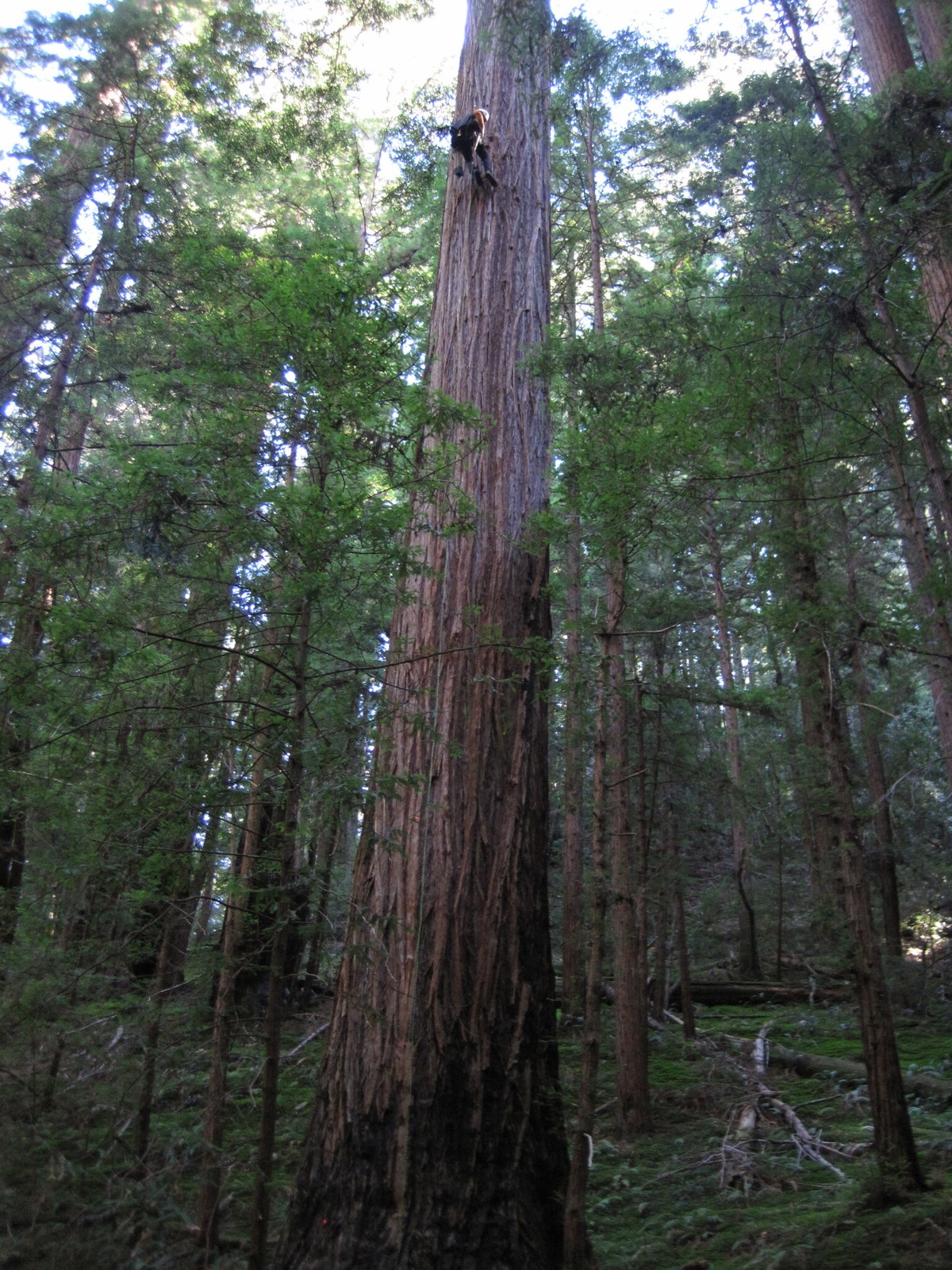
While peripheral redwood leaves function like most tree leaves, converting sunlight into sugar (tree food) through photosynthesis, axial redwood leaves reportedly serve an entirely different purpose. According to the study, these axial leaves are almost exclusively dedicated to absorbing water and do very little to aid in photosynthesis. The tree’s axial leaves are so effective at absorbing moisture, a large redwood with 100 million leaves can reportedly soak up as much as 14 gallons of water in one hour.
“I’d be surprised if there weren’t a lot of conifers doing this,” the study’s lead author Alana Chin, a Mendocino County native, said. “Having leaves that aren’t for photosynthesis is in itself surprising. If you’re a tree, you don’t want to have a leaf that’s not photosynthesizing unless there’s a very good reason for it.”
This variation in leaves was discovered while researchers were conducting a first-of-its-kind study that estimated how much water a mature redwood tree could absorb through its crown. The redwood shoot clusters used in the study were collected from six redwood trees in five forest locations between Del Norte County and the Santa Cruz Mountains.
Researchers say the dual-leaf system may aid redwoods in the photosynthesis process. While some tree leaves can become inundated by excess water in the rainy season, limiting their potential to absorb sunlight, the peripheral redwood leaves were found to have a waxy coating, which slows water absorption and may help the trees photosynthesize year-round.

Wax on redwood leaf surface.
The study also found that redwood trees have the ability to shift the placement of these leaf types, allowing the trees to thrive in wet and dry regions of Northern California and Southern Oregon. For example: In temperate rainforests, the peripheral sun-absorbing leaves are found in the highest redwood branches and the axial water-absorbing leaves are found in the lower branches — a strategy that allows the trees to absorb more sunlight. In drier regions, researchers found the opposite: water-absorbing leaves in the upper branches and photosynthesizing leaves below. The study suggests that this allows the trees to collect more water from rain and fog.
“The cool thing here is their ability to thrive under all these circumstances and adjust themselves to these different environments,” Chin said. “That things like this can be happening right under our nose in one of the best-studied species out there — none of us assumed this would be the story.”
Cal Poly Humboldt Professors Stephen Sillett and Lucy Kerhoulas, and Equipment Technician for the university’s College of Natural Resources and Sciences Marty Reed co-authored the study.

Lead author of the study Alana Chin.
THIS WEEK in EUREKA CITY COUNCIL: ‘Big, Huge Studio Movie’ Productions, Arts Alive Street Closures, Annual Budgets and More!
Isabella Vanderheiden / Thursday, May 19, 2022 @ 3:15 p.m. / Local Government
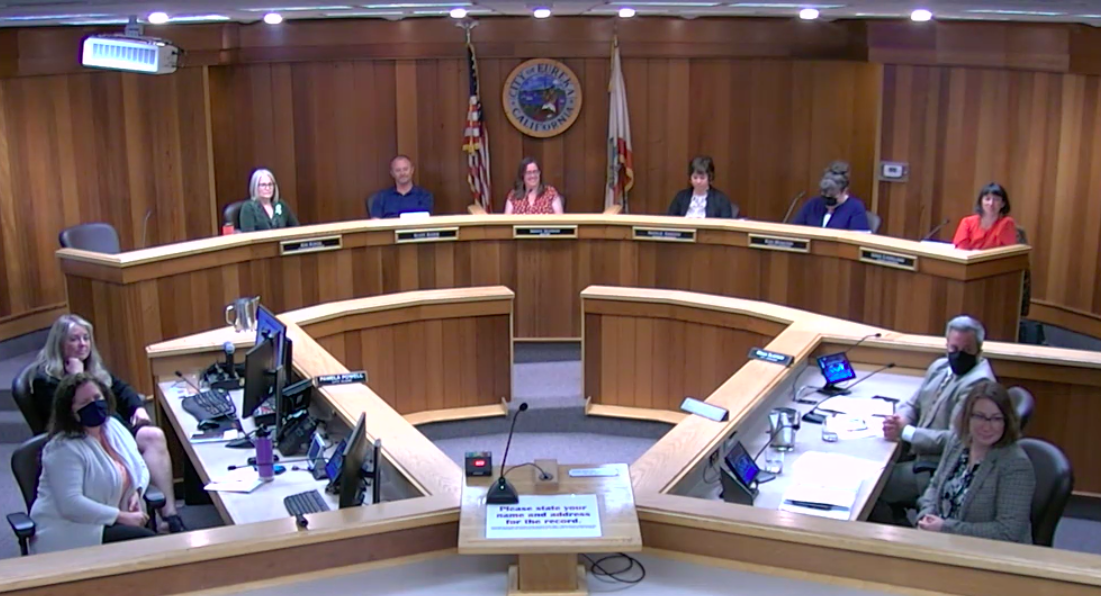
Screenshot of Tuesday’s Eureka City Council meeting.
###
Film Commission Funding Request
In anticipation of two major studio film productions coming to Humboldt County this year, the Humboldt-Del Norte Film Commission asked the Eureka City Council for an additional $10,000 in funding to support its small staff in hosting and production efforts.
“We found out that they’ve got a lot of work coming up – [including] two very large productions coming into the area – and are looking for some additional financial support,” Eureka City Manager Miles Slattery explained during Tuesday’s meeting. “As the council is aware, we have a funding agreement with the film commission, amongst other agencies here locally, that gets approved on an annual basis.”
Mayor Susan Seaman asked how much money the two productions are anticipated to bring into the community. Film Commissioner Cassandra Hesseltine said one of the productions is projected to bring in approximately $20 million in six months – more than the last decade of films combined.
“I’ve been working on both films for three years pre-pandemic and now they both have told us that they have the green light to come,” Hesseltine said. “…They both were actually in town two weeks ago scouting. …I was told two years ago by the line producer [that the first one] would be bringing in approximately $20 million. That’s direct dollars in six months. The film commission has only done $12 million in 11 years, to put that it in perspective.”
Approximately three-quarters of the second film would be shot in Humboldt County, she said, noting that it’s “actually been written for Eureka specifically.”
“I can’t tell you the name of any of his movies because [you would figure out] who he was but he’s big,” she said. “He’s writing the whole movie around the locations here. It would be a considerable amount of money.”
The film commission lost some funding last year as a result of the pandemic, and although funding is starting to pick back up, there’s too much to do for a staff of two. “We’re starting to turn down a lot of things,” she said. “It’s come to that point where it’s really great but it’s too much because it’s all happening at the same time. …We really need a part-time or full-time person in our office. …We’ve had to use our reserves and it’s been stressful to keep up where we are.”
In addition to the $25,000 the City provides annually, the film commission receives approximately $100,000 from the county, up to $15,000 from Del Norte County, roughly $4,300 from the City of Arcata, $4,000 from the Fortuna Chamber of Commerce and typically $60,000 from the Humboldt Lodging Alliance (HLA).
“This $10,000 would be supplementing an additional position,” Hesseltine said. “That’s the goal if we can get enough money between all of our funders.”
The council ultimately voted to unanimously approve the funding request.
Arts Alive Street Closure
The council also reviewed survey results from Old Town business owners regarding special event street closures. The City decided to take a walk on the wild side and implement a trial street closure during Arts Alive earlier this month, a move that was criticized by a handful of local business owners and Eureka Main Street’s Board of Directors, who said the closures impacted parking accessibility and business revenue.
The council decided to give the street closure a whirl during a meeting last month. The Eureka Main Street Board of Directors sent a letter of opposition to the council shortly thereafter, asking the City to reconsider and citing fears that the closure would “greatly limit accessibility for employees, customers, and residents to reach businesses or their homes with reasonable ease.” The City went ahead with the closure but agreed to survey local businesses within the closure area as a part of the trial run.
“There was a question that asked whether or not the foot traffic within their business was increased or not and 57 percent of the respondents said that there was an increase or no change in the footpath the traffic within their business and 24 percent of the respondents stated that there was a decrease in foot traffic,” City Manager Miles Slattery said. “The remainders were businesses that weren’t open, businesses that weren’t available or that they closed prior to the Arts Alive going on.”
Businesses were also asked whether their sales were impacted by the street closure. Sixty-two percent of businesses surveyed reported an increase or no change in revenue whereas 19 percent reported a decrease. The remainder of businesses surveyed were either not open or not available to be surveyed.
Businesses were also asked whether they supported the street closure. Fifty-four percent said they were in support of or indifferent to the closure, 21 percent did not support it and 12 percent said they would have preferred a different footprint for the closure.
Slattery said the folks who came out for Arts Alive expressed “overwhelming support for the street closures.” He said the City will continue the street closures for the foreseeable future, but added that staff will work with local business owners to address their concerns surrounding parking and communications.
Speaking from a safety standpoint, Interim Eureka Police Chief Todd Jarvis spoke in favor of the closure, noting that he had “concerns about the amount of traffic on the sidewalks being forced into the street” during previous events in Old Town.
“We talked about trying this test closure and I felt that was very successful,” he said. “…There were a few things we’re going to tune up as far as some of the gaps and some of the openings we left with the thought to let people [move their vehicles].
Next time, the City will provide more notice (at least 24 hours) to businesses and people parked within the closure area, said Eureka Public Works Director Brian Gerving.
The concrete blocks used for the closure were criticized by Eureka Main Street for not being “visually attractive.” Gerving said the concrete barriers would serve as a temporary method of blocking the road and invited local artists to beautify the blocks in the meantime.
“We’re looking at getting vehicle-rated bollards,” he said. “We’re in the process of nailing down bids for the materials and then working on quotes for the installation of those bollards at various locations in both Old Town and Henderson Center. …We probably won’t see those before next year, so in the meantime, we think the concrete blocks are a viable option.”
Councilmember Kim Bergel asked if the planters used to close E Street for Friday Night Market could be used instead of the concrete blocks. Gerving said they could be used for part of the closure but said staff has to use different equipment to move the planters versus the concrete barriers.
Councilmember Kati Moulton conducted her own anecdotal survey during Arts Alive and said people loved the closure because it provided a street festival feel.
“I talked to a few business owners who said they definitely saw more people coming in and talked to somebody with an art gallery who was really excited about the street closures and the potential for using the sidewalk space to basically spill her out in front and draw more people,” she said. “I think that’s an approach that a lot of businesses take advantage of.”
Councilmember Natalie Arroyo said she had a blast skating down Second Street during Arts Alive and said she received overwhelmingly positive feedback.
The council did not take any action on the item.
Climate Action Plan
The council also received an overview of the draft Humboldt Regional Climate Action Plan (CAP). Since 2019, the county’s seven incorporated cities have worked with the county and the Redwood Coast Energy Authority (RCEA) to develop a CAP to reduce local greenhouse gas emissions and build resilience to climate-related hazards. The 45-day public review period for the state-mandated document will end next month.
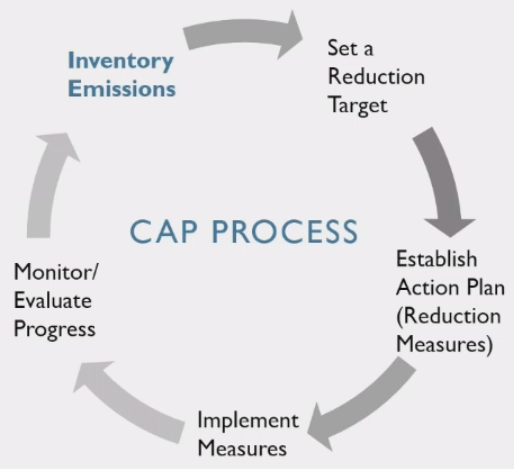
“The purpose of the short review period is to gauge whether there are any fatal flaws or whether we are ready to move on to the next phase,” Cristin Kenyon, Principal Planner for the City, explained. “The environmental review phase could take up to one year. During that phase, an Environmental Impact Report, or EIR, is going to be prepared under the California Environmental Quality Act (CEQA) for the CAP.”
The draft CAP outlines strategies to be implemented to reduce regional greenhouse gas emissions to 40% below 1990 levels by 2030 and make progress toward California’s goal of zero net emissions by 2045. While the draft CAP includes specific measure targets, it is less specific about how jurisdictions will achieve these targets, Kenyon said.
“Most of the qualified measures that are in the draft cap are focused on transportation and land use, energy usage and buildings as well as solid waste production,” she said. “…The CAP also has a bunch of measures that are not quantified but are supporting measures that are helping us reach our quantified targets. This includes a whole chapter of advisory measures on biological carbon sequestration. ….Something I learned from the CAP was that wetlands store more carbon per acre than forests. So wetland restoration is really important.”
Michael Richardson, a supervising planner for the County of Humboldt, noted that the CAP can be tweaked in the future “but it needs to be close enough that it is relevant to the EIR.”
Councilmember Scott Bauer thanked City and county staff for their efforts on the CAP but underscored the importance of getting the document finalized as soon as possible.
“I’m not wanting to sound, you know, doom and gloom, but we have limited time,” he said. “As a scientist, this is all we talk about. My question is, can we get it done faster? …I guess we can start implementing but having the [EIR] done is a really crucial component. What do you think?”
Because the CAP has minimal environmental impacts and is projected to actually have a positive impact on the environment, Richardson said the EIR “could write itself in a lot of ways and that will speed up the process.”
During public comment, Will Zerlang of Zerlang’s Construction expressed his support for the CAP but raised concern about how it would impact local builders.
“I’m all for environmental building, but to implement electrifying a home in the next five years in Humboldt County, it’s not even feasible,” he said. “…The cost to people building homes and homeowners is going to be significant. …I’m required to put solar panels on my homes and as many electrical heating systems as I possibly can. …Hot water heaters currently are not even up to speed in the United States to fully function more efficiently than a gas hot water heater. The technology is not even quite there yet.”
Local environmental attorney Paul Hagen called on the City and the county to take immediate action to mitigate the impacts of climate change.
“I believe in local government very much and this [CAP] is very significant,” he said. “…You really got a lot of options to change things for the future here in your city and in your county. …We have an enormous offshore wind component coming in off the county here within the next few years, we’ve got a lot of other things going on and time is not on our side.”
The council did not take any action on the item.
The draft CAP can be found here.
Fiscal Year 2022-23 Budget Proposal
It’s that time of the year again! The council took its first look at the city’s draft budget proposal for Fiscal Year (FY) 2022-23. After two years of significant budget cuts, the upcoming fiscal year is “pretty boring” in comparison to the last two years, according to Eureka Finance Director Lane Millar.
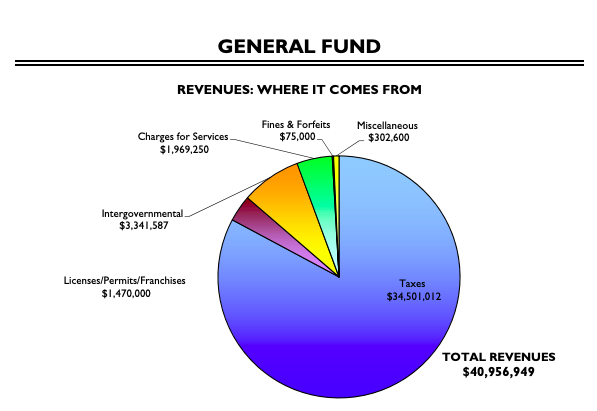
The City will experience virtually no change in its General Fund budget, which projects nearly $41 million in revenue for FY 22-23.
Screenshot
“This year, there are no cuts,” Millar said. “…Before COVID, we were looking at roughly a 1% increase year over year [in General Fund revenue]. This is not surprising. There are some things that are going down, such as intergovernmental [revenue] that represents a lot of grant reimbursements. Those fluctuate year to year and that’s normal to see.”
Following a brief presentation on the budget proposal, Councilmember Scott Bauer asked Millar if the budget could be impacted by instability in the global economy. “Do we anticipate any potential dark skies in the future for our budget?”
”The state is vulnerable because I believe they capture capital gains taxes, which are going to take a huge hit based on what’s going on in the market,” Millar said. “For us, there is a chance that you will see the consumer start to back off goods and go and spend their money towards services. That’s kind of what happened during the pandemic….And then you add on the effects of inflation, which tend to push people away from buying goods. I wouldn’t be surprised if we see a slight downturn in sales tax revenue.”
Even still, he emphasized that the City’s budget would be able to “withstand some bad years moving forward.”
Millar spared the council many of the nitty-gritty details of the budget since it was the council’s first look at the proposal. There will be at least two additional presentations on the proposal before it is adopted, including a budget study session during the council’s next special meeting on Tuesday, May 24 at 5:30 p.m.
A recording of Tuesday’s meeting can be found here.
Thieves Steal Old-Growth Redwood Logs From McKay Community Forest; County Environmental Services Asks For Public’s Help in Getting Them Back
Hank Sims / Thursday, May 19, 2022 @ 2:40 p.m. / Crime
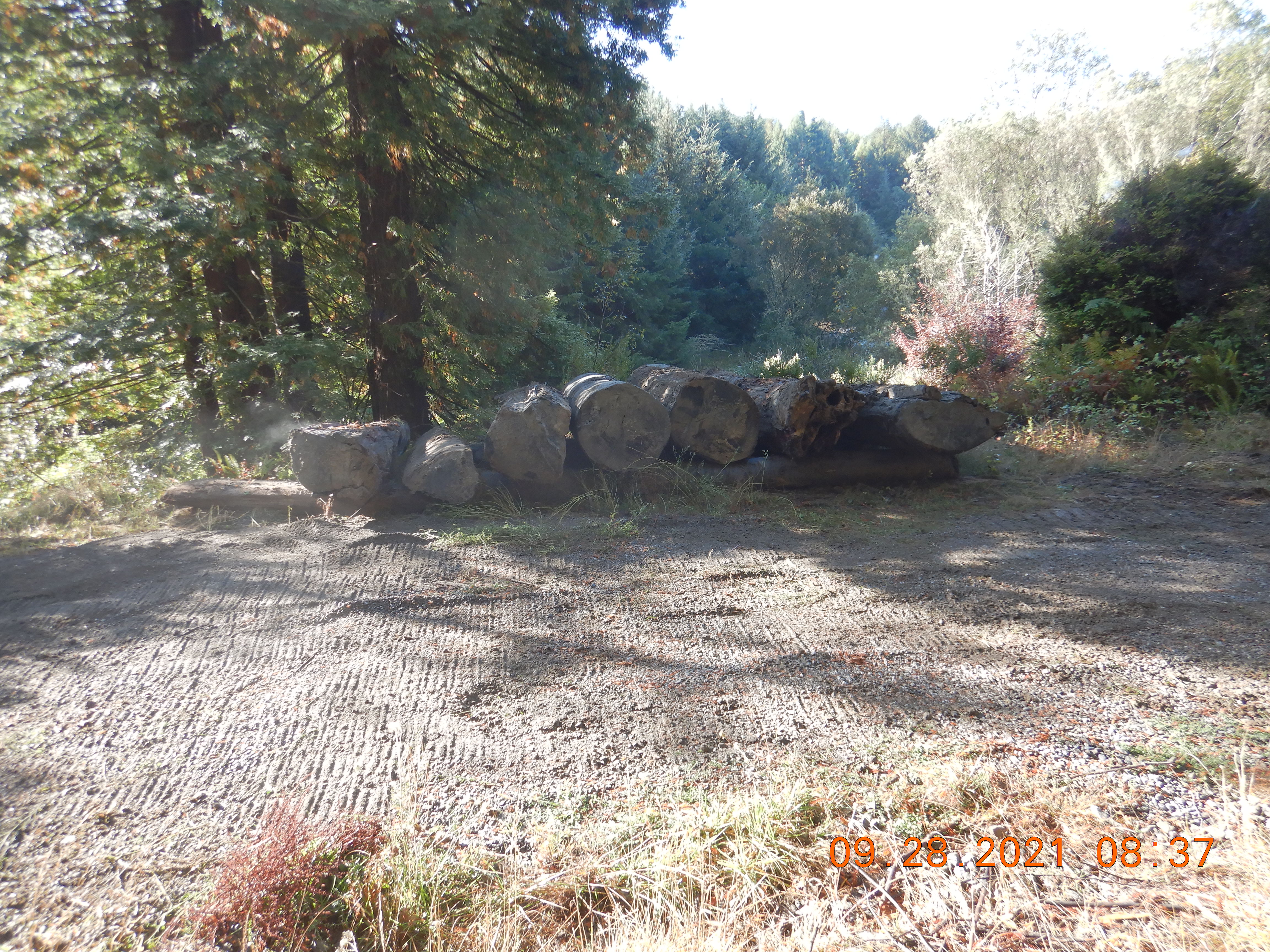
The logs stacked up last year. The two in the middle were the ones stolen. Photos: Robert Vogt.
Sometime in the last couple of weeks – likely even more recently than that – a crew of thieves cut the locks on two different gates inside the McKay Community Forest, drove in with a truck and probably some sort of specialized loading gear, and loaded up two large old-growth redwood logs that had been parked on a side road within the future community park.
The theft was discovered by Bob Vogt, an environmental analyst with the county’s public works department, when he was on his rounds of the forest this morning.
“It was a gut-punch,” Vogt told the Outpost today.
Vogt estimated the logs were between three and four feet in diameter and approximately 18 feet long. Each of them must have weighed at least a ton. While he couldn’t say offhand exactly what they would be worth on the lumber black market, Vogt said that it must amount to at least a few thousand dollars.
More than that, though, they held historical value. The logs were found buried in the forest underneath an old train right-of-way last year. Likely they were used as landfill. Eight logs had been uncovered in the find, and Vogt had tucked them away with hopes of using them, in some fashion or another, when the forest is fully opened. Perhaps they could have been fashioned into benches or railings, he said, or else displayed as artifacts, illustrating logging practices of the time.
The thieves took the two roundest, most well preserved of the eight logs, and Vogt is sure that they must have planned it out well in advance. Logs that large can’t be simply lifted onto the back of a pickup. Vogt believes that the thieves must have planned this out well in advance, and must brought in a hydraulic lifter or something similar to load them onto a vehicle.
Vogt is hoping that someone in the public might have seen something that would lead to the recovery of the logs, and/or the prosecution of the thieves.
“It takes a lot of special equipment to load and unload these things,” Vogt said. “Someone will know something, or will have seen something around – a truck with the logs on them, something. Whether or not they drop a dime … who knows.”
The logs were stacked behind the Harris Street entrance into the McKay Community Forest, down by Redwood Acres. A report has been filed with the Humboldt County Sheriff’s Office. If you have any that might help them track down the thieves call the Sheriff’s Office at (707) 445-7251, or the Sheriff’s Office Crime Tip line at (707) 268-2539. The case number is 2022-02629.
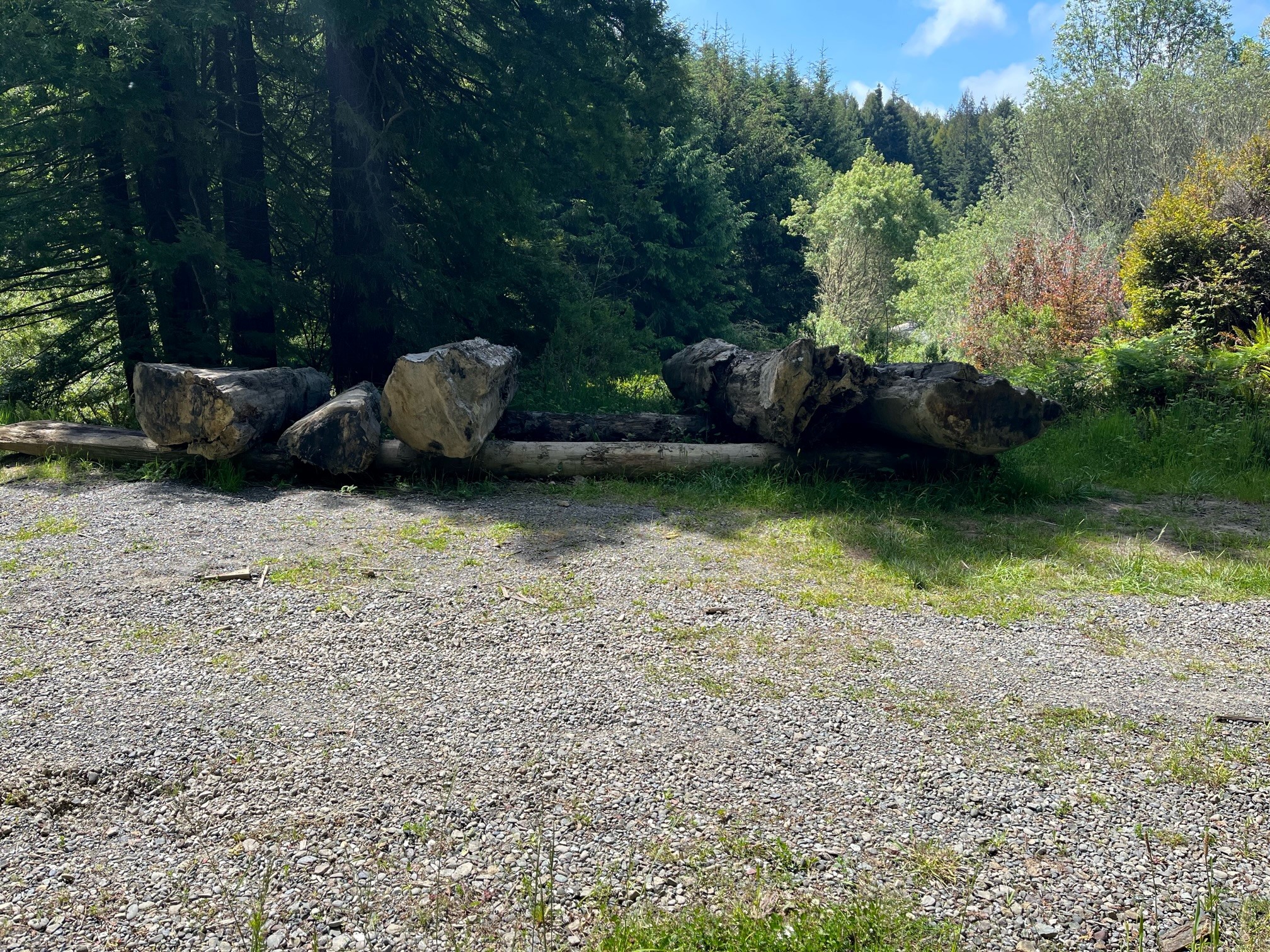
The same log pile today.
As School Districts Pursue Developer Impact Fees, Local Builders Say Added Cost Will Stifle Development
Ryan Burns / Thursday, May 19, 2022 @ 12:50 p.m. / Education
UPDATE, Friday, May 20:
At its May 19 meeting, the Eureka City Schools Board of Trustees voted unanimously to adopt the report justifying the developer fee and voted 4-1 to implement the fee.
Eureka City Schools Superintendent Fred Van Vleck said the board also decided to review the impact fee six months down the road to evaluate the impact it’s having on the community and the district.
###
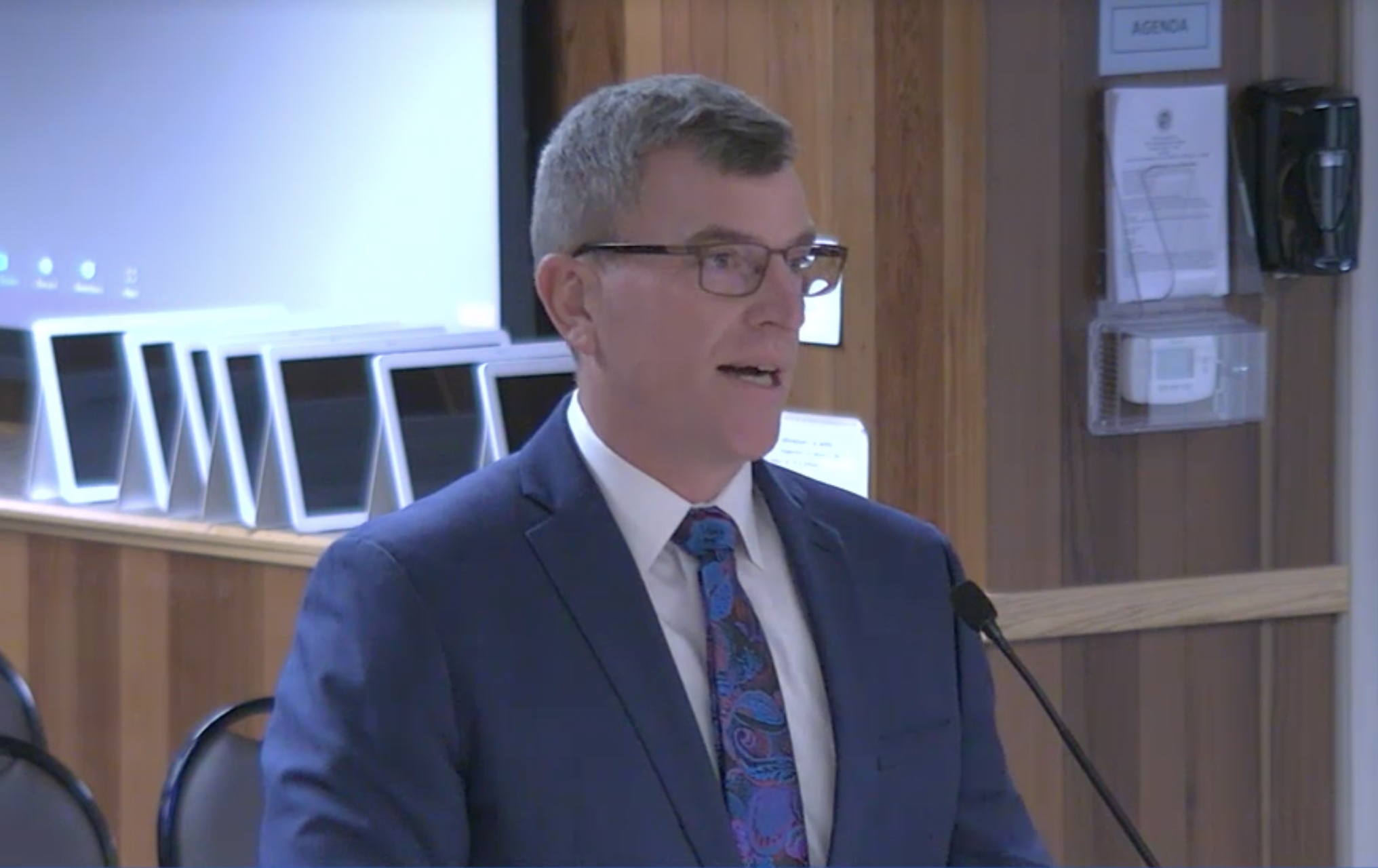
Eureka City Schools Superintendent Fred Van Vleck addresses the Eureka City Council. | Screenshot.
###
This evening, the Eureka City Schools Board of Trustees will consider whether or not to implement sizable new developer impact fees within the district’s boundaries. These charges, which would be assessed to local builders in the permitting process, would generate revenue while making the district eligible to pursue $5.6 million in state grant money for new preschool classroom facilities.
According to Eureka City Schools Superintendent Fred Van Vleck, the driving force behind this proposal is the state’s recent adoption of a universal transitional kindergarten (TK) program. Currently, only a subset of 4-year-olds — those who will turn 5 between Sept. 2 and Dec. 2 — are eligible to attend TK. But thanks to a $2.7 billion initiative supported by Gov. Gavin Newsom and others, California’s TK program will be gradually expanded until it includes all of the state’s 4-year-olds by the 2025-26 school year.
That expansion, Van Vleck says, will lead to an influx of new preschoolers, requiring the district to add more classrooms that meet the state’s Title 5 requirements. And in order to qualify for the $5.6 million state grant that could pay for those new facilities, the district needs to charge these fees, at least temporarily. (We’ll get to his explanation of why that’s the case below.)
Local builders, meanwhile, are voicing strong opposition to the proposal, saying the fees — which would be assessed at a rate of $4.79 per square foot for residential construction and $0.78 per square foot for commercial or industrial construction — would stifle much-needed efforts to build new housing by adding yet another construction-related cost to an ever-expanding list.
“We’re not going to be able to continue to apply for our permits and continue to build our buildings with these increased costs,” local contractor Will Zerlang said at a Eureka City Council meeting Tuesday night. “Not to mention small families that are trying to develop these additional dwelling units … . You’re gonna put those out of business also.”
Zerlang (who, disclosure, is a friend of mine) said permit fees have already increased exponentially. He told the council that in 2009 he paid $1,400 for a permit on a 3,400-square-foot development. He’s now working on a project of that same size, located in the county’s jurisdiction just outside Eureka city limits, and the permit will cost $13,000 this time around.
“If we add this fee, it’s gonna add about $16,000 to that permit cost,” he said. The total resulting permit fee of around $29,000 would represent a roughly 20-fold increase in just over a dozen years.
“Implementing this fee on local builders is going to slow down all of [the] movement you’re trying to do with increasing housing,” Zerlang said.
Neighboring elementary school districts, including those in nearby Cutten and Freshwater, are also looking to implement these fees, and local developer Kurt Kramer said that would “definitely” impact his recently approved, 320-unit North McKay Ranch subdivision project, potentially jeopardizing its financial viability.
Kramer said he’s fine with the district’s efforts to expand a preschool programs. “I don’t have any issues with them running their district and doing what they need to do,” he said in a phone interview on Tuesday. “They just can’t keep putting the burden on development.” He and other developers are have hired an attorney to fight the proposed new fee by challenging the document the district is using to justify it.
On the other side of the issue, Van Vleck says that while he understands the concerns of local builders, the State of California is effectively forcing the district’s hand. He explained the situation to the Eureka City Council on Tuesday.
In order to qualify for this state grant of $5.6 million, which would be specifically earmarked to build eight new preschool classrooms, the district must meet two criteria: First, it must have a relatively high level of poverty among the student body, and Eureka City Schools does, with about 70 percent of students qualifying for free or reduced-cost lunches, according to Van Vleck.
Second, the district must be experiencing financial hardship. That’s where the proposed fee comes in. In order to claim hardship, a district must have passed a bond measure fairly recently — which voters in Eureka City Schools district did, most recently, in 2020 — and it must be charging the maximum developer impact fees allowed by the state, which is where the figures of $4.79 and $0.78 come from. (There’s also a mini-storage category of construction, for which the district would collect a fee at a rate of $0.08 per square foot.)
School districts’ ability to assess these fees was ushered into law back in 1986 via Assembly Bill 2926. The State Allocation Board can (and usually does) adjust the fee amounts for inflation every two years.
At the council meeting, and again in a phone conversation Wednesday, Van Vleck lamented the lack of local control over these matters.
“It is really unfortunate that Sacramento is dictating local politics and [that] in order for our community to be eligible for this preschool building grant we basically have to [assess the fee],” he said.
The statewide expansion to universal pre-K will likely quadruple attendance at Eureka City Schools’ TK program, a figure based on “simple math,” Van Vleck said. But in order to justify the developer fee, the district needed to produce a report showing that there’s a nexus between anticipated development within district boundaries and the cost of providing adequate school facilities.
Eureka City Schools commissioned such a report from Sacramento-based Jack Schreder & Associates, Inc., a consultancy that specializes in producing these studies for school districts in California, the majority of which already charge developer impact fees. The report, which cost $6,675, was completed in early April. (Click here to download a copy.) It concludes that new residential construction in the district will create a facilities cost of $10.02 per square foot, easily justifying a charge of $4.79 per square foot.
Van Vleck said the district made an effort to circulate the report far and wide, even reaching out to local developers including Kramer, Rob McBeth, Dan Johnson, Kevin McKenny and others to arrange a sit-down meeting.
“We’re not trying to do this behind the veil of darkness … ,” Van Vleck said. “Our whole approach was, ‘We’re not coming here to change your mind; we just want you to understand the why.’”
The report concludes that the developer fees are indeed justified. “New students generated from future development will create a burden on existing school facilities,” it says, adding that capital improvements “are necessary to adequately house future enrollment growth at all school levels.”
According to the report, that enrollment growth won’t be limited to preschoolers. Citing population projections from the county and city planning departments, the study says a total of 1,526 units totaling 2,441,567 square feet “may be constructed” within the district’s boundary over the next 25 years. The population growth would add an average of 42 students per year to district enrollment, Van Vleck said.
Kramer, for one, is skeptical about that analysis.
“You’ve got to have growth to be able to charge the builders of new housing,” he said. “Because what [the district] is basically arguing is, ‘Your new housing is bringing new students into my district.’”
He doesn’t think that’s actually the case. Noting the closure of a couple schools in the past decade or so, Kramer said, “You’ve got Eureka City Schools cleaving campuses. They’re selling campuses off and shrinking. And then they’re saying, ‘Wait a minute, now we’re growing.’ Well, no you’re not. You’re not growing.”
The district’s total enrollment actually declined slightly from the 2016-17 school year to the 2020-21 school year, according to data collected by the California Department of Education.
Kramer alleged that the report’s conclusions were predetermined. “Basically what they did is they paid somebody to back into an argument that would get them to a point where they could implement developer impact fees,” he said.
On Monday, an attorney representing the Northern California Association of Home Builders sent a letter to the attorney representing Eureka City Schools, threatening legal action if the district’s board of trustees votes to implement the developer impact fee. (Click here to download a copy of the letter.)
The letter alleges that the district report justifying the fee “contains significant legal and methodological errors” and that revenues would not actually go toward construction and reconstruction of school facilities:
In short, the Study justifies the imposition of developer fees solely to fund deferred maintenance projects and modernization needs that currently exist throughout the District’s facilities and which would exist whether or not any new development occurs in the District. These costs cannot be reasonably attributed to the impact of future new development within the District, and it would be palpably unfair to force new families moving to Eureka to shoulder the cost of renovating the District’s aging school facilities on their own, when that renovation would clearly benefit all of Eureka’s families equally.
Van Vleck said there’s a mistaken impression out there that this whole effort to establish developer impact fees is because the district ran out of money to complete a new gym for Eureka High School.
“Not accurate,” he said, adding that the district has all the necessary money already set aside to complete not only the gym but also a renovation of Albee Stadium and a modernization of the sciences building. The district is “fine” financing projects in the short term, he said, and if the fee gets implemented then revenues would be limited to capital recovery projects.
As for the potential impact on local builders, Van Vleck readily admits that he’s not a housing expert.
“The best thing I can say is that I’m an education expert and we’re doing this for education reasons, to get the $5.6 million grant. That is our goal,” he said. “And we realize there’s a collateral impact that’s out there. I can’t speak with authority on what that will be, other than [pointing out] that pretty much all the rest of the state charges these fees.”
In Humboldt County, both McKinleyville Union School District and Fortuna Elementary School District assess developer fees, though they’re well below the state max.
At the trustees meeting tonight, the board will have a couple of decisions to make, Van Vleck said. First, they must decide whether to adopt the developer fee study, and, second, whether to implement the fees. Based on input from staff and the public, the board could choose to revise the report or reject it altogether, in which case there’d be no action on implementing the fee. Or they could adopt the study and postpone a decision on fee implementation to the following regular meeting, on June 23.
In his informational report to the city council on Tuesday, Van Vleck also noted that the board could potentially make the fee temporary. As part of the grant application process, the state Office of Public School Construction will likely conduct an audit of the district’s books.
“They take a snapshot of your books at that point, and then once they take that snapshot it’s over,” he told the council. “So the board can choose, after that, if they wanted to, to not collect developer fees, to reduce the developer fees [or] have exceptions for low-income housing. There’s all kinds of things they can choose after that point, but during the snapshot it has to be that amount” of $4.79 per square foot for residential and $0.78 for commercial or industrial
Kramer said districts rarely decide to reduce or rescind these fees once they’re in place, but he also doesn’t expect the board to adopt the fee tonight. In fact, he believes the attorney representing the Northern California Association of Home Builders will convince the board that the fee is not legally defensible.
“I’d be surprised if the tents don’t fold up before it gets too much further,” he said before quickly adding, “but maybe we have to go further.”
Van Vleck said the district has received the attorney’s letter and he expects representatives of the local building community to attend tonight’s meeting and offer their feedback. “That’s exactly what this process was designed to do,” he said.
The board of trustees meeting is open to the public and schedule for 6:30 p.m. at Marshall Elementary, 2100 J Street in Eureka.


