

(PHOTO/VIDEO) LOOK UP! Humboldt Blessed by Goodyear Blimp Visit
Andrew Goff / Monday, Sept. 15, 2025 @ 4:03 p.m. / LoCO Looks Up

Photo: Lynda Sale-Stockton
Finally! A reason to go outside today.
The Outpost has received numerous reports that the Goodyear Blimp has penetrated into Humboldt airspace. The latest reports suggest that the dirigible was seen circling over McKinleyville.
That’s all we got for the day’s excitement. There have been more boring days, for sure.
Video above and photo below courtesy Shannon G Cortez

PREVIOUSLY
- (UPDATE) Eureka! Run the Hell Outside and Look for the Goodyear Blimp! Arcata! You’re Next!
- Oh. The Goodyear Blimp is Back in Humboldt
- (UPDATE: Fog Delay) Keep Your Eyes on the Skies: The Goodyear Blimp Will Touch Down in Humboldt Today Maybe Tomorrow
- There It Is!: Humboldt’s Goodyear Blimp Watch 2016
- Look Up: The Goodyear Blimp Gives Us One More Flyby on Its Way Home
BOOKED
Today: 8 felonies, 13 misdemeanors, 0 infractions
JUDGED
Humboldt County Superior Court Calendar: Today
CHP REPORTS
No current incidents
ELSEWHERE
County of Humboldt Meetings: Humboldt County Fire Safe Council Quarterly Meeting Agenda - 2/26/2026
RHBB: After Four Days, River Gives Up Vehicle of Covelo Couple
Governor’s Office: Governor Newsom announces appointments 2.20.26
Governor’s Office: Governor Newsom announces multiple clemency actions
NO MORE PBS KIDS: KEET-TV Whittles Itself Down to One Single Broadcast Channel in Effort to Stay Alive
LoCO Staff / Monday, Sept. 15, 2025 @ 2:22 p.m. / Media

The KEET studios atop Humboldt Hill. Photo: Andrew Goff.
###
CLARIFICATION! Our friends at KEET wish to make it clear that there will still be PBS Kids programming available on the main channel in the future — it’s just that the 24/7 PBS Kids Channel that’s going away, along with the other channels mentioned.
“KEET PBS will still be airing PBS Kids programming from 7 a.m. to 2 p.m., Monday through Friday, and 6 a.m. - 8 a.m. Saturdays and Sundays, on KEET-HD,” they write.
###
Press release from KEET-TV:
KEET PBS, the PBS station serving California’s Redwood Coast, announced today that it will consolidate its broadcast operations to a single channel beginning October 1, 2025. The move comes in response to unprecedented federal funding cuts and urgent equipment needs, as KEET works to preserve its most essential services for the community.
Over the summer, KEET experienced a series of technical difficulties—including an extended broadcast outage and ongoing disruptions to its PBS KIDS channel—due to failures in aging transmission equipment and critical servers. While immediate repairs have restored the main signal, station leadership determined that a more sustainable, long-term solution was needed. “As a small station with limited resources, we face a stark reality,” says David Gordon, executive director of KEET. “With the loss of 50% of our federal grant funding and escalating costs to maintain and replace technical infrastructure, we had to make difficult choices to safeguard our mission.”
Beginning October 1, KEET will broadcast exclusively on KEET HD (Channel 13.1). The additional channels—PBS KIDS, Create, FNX, and WORLD—will no longer be available. This decision follows months of careful review by KEET’s board and management, with the goal of preserving uninterrupted access to PBS’s trusted news, educational programming, and cultural content.
The transition includes the installation of a new automated master control system, designed to enhance reliability and streamline operations. Viewers may notice some temporary disruptions during this upgrade, but KEET engineers are committed to minimizing impact and keeping the public informed.
“These changes, while difficult, ensure that KEET can remain a vital part of the Redwood Coast’s media landscape,” says Gordon. “We remain dedicated to providing high-quality programming, lifelong learning resources, and public service to all our viewers.” KEET invites the community to stay engaged and informed by visiting www.keet.org.
Eureka’s C Street Will Be Further Transformed Into a Bicycle Boulevard Starting Tuesday
LoCO Staff / Monday, Sept. 15, 2025 @ 9:58 a.m. / Transportation

Images via City of Eureka.
###
PREVIOUSLY
- Eureka City Council Unanimously Adopts 518-Page Bike Plan, a Master Plan for Human-Powered Transportation Improvements Throughout the City
- Eureka City Council Approves Bid Award for C Street Bike Boulevard Project in Split Vote, Despite Concerns About Community Engagement
- The Transformation of Eureka’s C Street Into a Pedestrian and Bicycle Friendly Thoroughfare Begins Next Week
###
Press release from the City of Eureka:
The City of Eureka’s contractor will be performing road asphalt pavement and markings work on C Street between Waterfront Drive and Harris Street beginning on Tuesday, September 16th, 2025.
This phase of construction is expected to take one week for road asphalt paving. After road paving has been completed, road markings and signage will be applied. The road marking and signage application typically takes an additional week. Paving will begin at the location of Waterfront Drive and C Street.
Press releases will continue to be issued to update the status of this project. Road closures, traffic detours and parking restrictions will be in effect. This work will be performed between the hours of 7:00am and 7:00pm, WEATHER PERMITTING.
The City of Eureka has more info on this project on its website.

OBITUARY: Jeffrey ‘Jeff’ Lovett Bobbitt, 1942-2025
LoCO Staff / Monday, Sept. 15, 2025 @ 7:25 a.m. / Obits

Jeffrey “Jeff” Lovett Bobbitt passed away peacefully on September 3, 2025 while surrounded by his loved ones. Jeff was born on December 12, 1942 in Houston, Texas where he spent most of his life.
He obtained his bachelor’s degree from the University of St. Thomas, and then went on to achieve a PhD in Chemistry from Texas A&M. During this time, he found a passion in teaching, and went on to be a professor at the University of Houston Downtown Campus. There he became a dean and served for 27 years, where he continued teaching due to his devotion to the craft.
In 1997 he became the Academic Vice President of College of the Redwoods, and surprised everyone by moving to Eureka, California, a place he loved deeply. While at College of the Redwoods, he made many improvements to the day to day operations of the campus, as well as being instrumental in the creation of Academy of the Redwoods, a renowned high school in Humboldt County.
His love for education never dwindled. Even after his retirement, he continued working with colleges across the nation, and served as an interim Vice President at Raritan Community College, and Onondaga Community College.
Over the years, Jeff supported Catholic churches in both Houston and Eureka by providing help with playing music and troubleshooting technology.
He truly loved the people and places in Houston and Humboldt County where he had many friends.
For over a decade, he volunteered at St. Joseph’s hospital, where he used his enthusiasm for technology to help in streamlining duties across the volunteer workforce.
Jeff is survived by his loving wife of 59 years, Mary Bobbitt. He is also survived by his three children, Jeffrey Andrew Bobbitt, Elizabeth “Beth” Bobbitt, and Amy Gores, as well as Amy’s husband Lincoln Gores and their son Jacob Gores.
He is also survived by his younger brother Byrne Bobbitt.
The world is a little emptier without his love, kindness, patience, wit, and wisdom. He was an example of true strength and endurance until the very end.
Friends and family know that he has entered heaven telling stories and making everyone laugh.
Jeffrey famously said “For those who understand no explanation is necessary, and for those who do not understand, no explanation is possible.”
The family would like to share profound gratitude for the team at Hospice of Humboldt and Melissa Brock for their dedication to Jeff’s care.
In lieu of flowers, donations can be made to the Hospice of Humboldt and the Betty Kwan Chin foundation in his name.
A celebration of life will be held on his birthday, December 12, 2025, at 11 a.m. at Saint Mary’s Church in Arcata.
###
The obituary above was submitted on behalf of Jeff Bobbitt’s loved ones. The Lost Coast Outpost runs obituaries of Humboldt County residents at no charge. See guidelines here.
OBITUARY: Hartmut R. ‘Hardy’ Ziesak, 1939-2025
LoCO Staff / Monday, Sept. 15, 2025 @ 7:21 a.m. / Obits

Hartmut R. Ziesak, lovingly known as “Hardy,” passed away peacefully on August 23, 2025, at the age of 86. Born on May 4, 1939, in Labonen, Germany, to Frida and Arthur Ziesak, Hardy’s early life was marked by immense hardship and resilience. Following the death of his father, the family fled the Soviet occupation, eventually immigrating to the United States in June of 1950 aboard the Queen Mary.
They settled in Richmond, Michigan, where Hardy spent his formative years. After graduating from high school, he enlisted in the U.S. Air Force, a decision that would lead him to Sacramento, California. It was there that Hardy achieved one of his proudest moments, becoming a U.S. citizen. It was also in Sacramento, at Arcade Baptist Church, that he met the love of his life, Jean. They were married on April 7, 1962, and soon after, they moved to Eureka, where they would build their life and family together.
Hardy embraced a variety of careers throughout his life, from his early days at Louisiana Pacific plywood mill to his retirement from HCAR. Yet, his true passion was his family. He and Jean welcomed their son, Matthew, in 1968, and their daughter, Tammi, in 1971. The family created a lifetime of cherished memories, from cross-country trips to Michigan to visit family, to camping adventures, and especially their time spent at Triumphant Life Camp (TLC), a place Hardy held dear to his heart.
A man of deep faith, Hardy was a long-time member of First Covenant Church of Eureka, where he treasured the fellowship and friendship of his community. He had a love for motorcycles, spending his earlier years tinkering on and riding everything from Harleys to Hondas. Later in life, he developed a passion for the San Francisco Giants, a love he shared with his wife, Jean. He rarely missed a game, often listening intently even when his eyes were closed.
Hardy is preceded in death by his beloved wife of 60 years, Jeanie; his parents, Frida and Arthur; his brothers Herbert, Dieter, and Manfred; his sister, Helgard; and his nephew, Jered.
He is survived by his children, Matthew (Lisa) and Tammi (Rod); his grandchildren, Cameron, Abby (Andrew), Bridget, Lily, Jackson (Sophia), and Gabe; his great-grandchildren, Lucy and Bella; his sister-in-law Joanne (Larry) and their son, Eric; as well as many other nieces and nephews.
The family extends their sincere gratitude to Becca for her dedicated care, as well as the staff at Timber Ridge Community and Hospice of Humboldt.
A memorial service will be held at 1:30 PM on September 25, 2025, at First Covenant Church of Eureka. In lieu of flowers, memorial contributions can be made to TLC c/o First Covenant Church, 2526 J St., Eureka, CA 95501.
###
The obituary above was submitted on behalf of Hardy Ziesak’s loved ones. The Lost Coast Outpost runs obituaries of Humboldt County residents at no charge. See guidelines here.
As RFK Pushes MAHA, Federal Cuts Shut Down California Health and Nutrition Programs
Kristen Hwang / Monday, Sept. 15, 2025 @ 5:10 a.m. / Sacramento
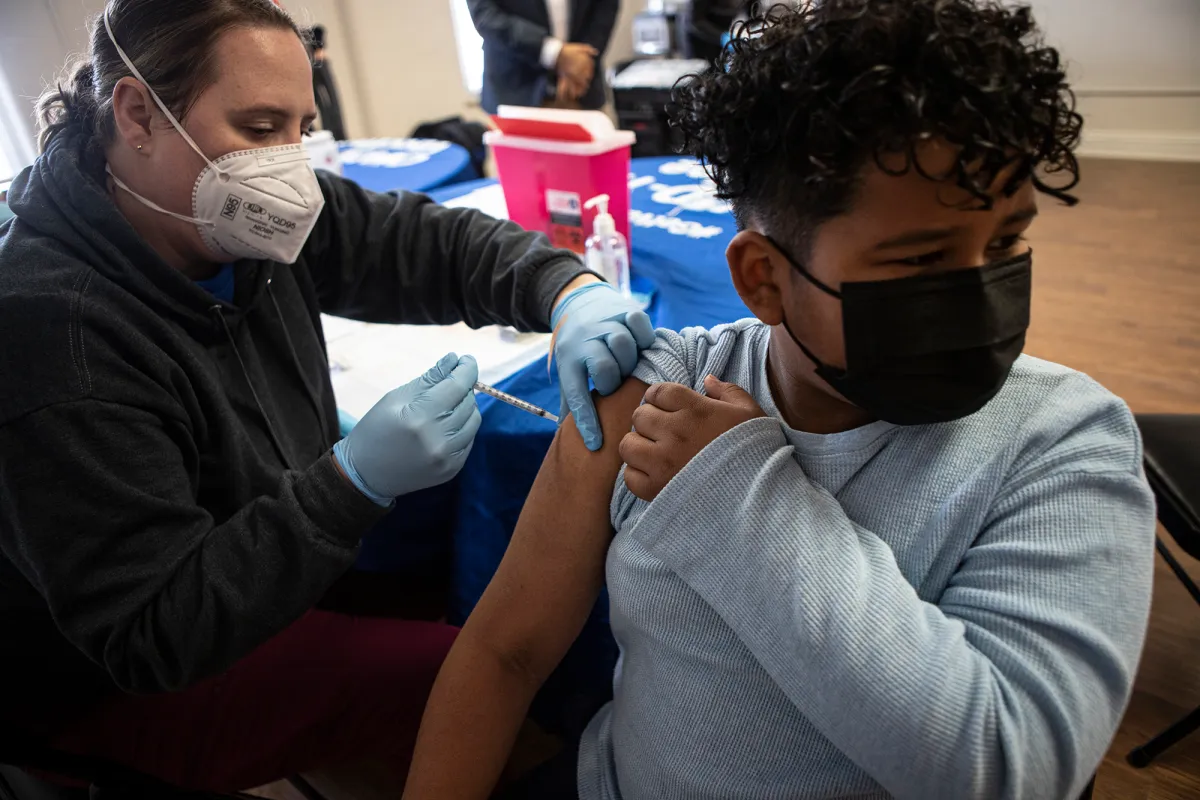
A nurse with the Kern County Public Health Department gives a shot of the COVID-19 vaccine to nine-year-old patient Bajron Perez during a vaccination drive at the old courthouse in Wasco on Feb. 26, 2023. Photo by Larry Valenzuela, CalMatters/CatchLight Local.
###
This story was originally published by CalMatters. Sign up for their newsletters.
###
Earlier this year, Selena Peña spent her days helping Kern County residents learn how to lead healthier lives through nutrition and fitness classes. She was part of a public health team focused on reducing high rates of obesity and heart disease.
But in July the county eliminated the program, citing the loss of $12.5 million in federal public health funding. It was early in a series of cascading cuts to Kern’s health programs this year. Other counties are making similar decisions.
Across the state, county health and human services departments have made significant reductions to bread-and-butter programs as a result of the Trump administration’s funding cuts and freezes. Kern, San Luis Obispo, Orange and Los Angeles counties, as well as the city of Long Beach, are among those reducing health services. The state’s budgetary crisis and subsequent public health cuts have also strained local resources.
California cities and counties have closed public health clinics, eliminated family planning programs, stopped dental services, reduced appointment availability for immunizations, instituted hiring freezes and laid off dozens of local health workers. At the end of the month, because of cuts in Trump’s so-called One Big Beautiful Bill, most county health departments will shut down nutrition programs focused on teaching low-income families how to stretch their food stamp dollars and cook healthier food.
Kern has the highest rate of diabetes-related deaths in the state, and 78% of adults are overweight or obese, according to state data. Peña, who was born and raised there, has seen firsthand how poverty, lack of education and language barriers contribute to poor health. That’s why she was thrilled to do work that helped people like her mom begin to take control of their health.
The irony is not lost on local health leaders that while U.S. Health and Human Services Secretary Robert F. Kennedy Jr. vocally pushes an agenda targeting leading causes of chronic disease like obesity and heart disease, local programs to address these issues and more have been gutted. His recent “Make Our Children Healthy Again” strategy report called out poor diet and lack of physical activity as primary drivers of chronic disease among kids.
“It’s not good enough to say this is important,” said Bernadette Boden-Albala, dean of the school of population and public health at UC Irvine. “They talk about nutrition, but where’s the money on nutrition?
Health departments are well-positioned to improve community health outcomes, Boden-Albala said, because their services are often aimed at improving systemic barriers that make it harder for people to be healthy. They focus on food insecurity, health education and access, disease prevention and surveillance, mental health and regulations to promote safety.
The work is preventative in nature, and without it communities will have more illness, higher costs and fewer health care options, said Long Beach Health and Human Services Director Alison King.
“When public health funding is reduced, prevention work is often the first to be impacted,” King said.
Long Beach has lost nearly $4 million in federal grants with the largest cut affecting its HIV and sexually transmitted infection prevention program.
These policies “will reverberate for the rest of this administration if not well beyond that,” said Arthur Reingold, professor of epidemiology at UC Berkeley School of Public Health and global infectious disease expert.
DOGE cuts billions of public health dollars
Many of the cuts to local health departments started in March when Elon Musk, then-adviser to the Department of Government Efficiency, terminated more than $11 billion of public health funding nationwide. California lost nearly $1 billion.
Those cuts targeted money that health departments had used to bolster their response to the COVID-19 pandemic by shoring up laboratory capacity, community outreach and immunization programs. In turn, many counties hired dozens of public health workers and were able to expand other services.
The grants were, in some cases, scheduled to last until 2027. Their abrupt termination left counties scrambling.
“We couldn’t even prepare for the end of this funding. That was what was so catastrophic for us,” said Brynn Carrigan, Kern County public health director. “We received notification the day after the stop-funding order was effective.”
California sued to prevent the Trump administration’s cuts, and a federal judge ruled in May that the money must be restored while the lawsuit plays out. But in many ways, the tug of war between federal cuts and state litigation still left local governments with no choice but to eliminate services. If the courts were to ultimately side with the Trump administration, counties would have to repay the money to the federal government.

On Tuesday and Wednesday, pop-up food distributions in Los Angeles served 1,600 tourism industry workers facing reduced wages or job loss. Photo courtesy of Los Angeles Regional Food Bank
“At the end of the day all of the liability and all of the risk is on the county, and we’re talking millions of dollars,” Carrigan said.
That’s why programs like Peña’s healthy habits team and others have been terminated.
Her team — called “Know Your Numbers” — checked residents’ blood pressure, glucose, cholesterol and body mass index before providing seven weeks of free dietary and exercise classes to show them how their numbers improved.
“Our health should be a priority. We should want to combat the things that make us unhealthy: Diseases, tobacco, unhealthy foods,” said Peña, a member of Service Employees International Union Local 721. “It’s discouraging when the government doesn’t want to care for the health of the public.”
California counties eliminate dental, other programs
In Kern County, the department has also been forced to close a clinic serving rural farm communities, stop most mobile clinic services, reduce appointment availability at its primary Bakersfield clinic by 67%, and eliminate 35 jobs.
More than 170 miles south, Orange County Health Director Veronica Kelley has grappled with the same difficult decisions. Public health has “not been whole for decades,” Kelly said, but the early federal grant terminations have been especially harsh. They cost Orange County $13.7 million over the next two years.
In May, the county closed its emergency dental clinic. A month later, the children’s clinic and family planning clinic also closed. A federal program to help new moms with diapers, breastfeeding support and food has also been reduced. In October, the county will lose an additional $4 million to combat obesity and food insecurity.
“If we do care about the health of Americans and people who live here and the health of Orange County residents, then we need to put more focus on funding these services,” Kelley said.
The department tried to make reductions in areas where other community providers could absorb the patient load and have the least impact on access to services, Kelley said. But the county isn’t blind to the probability that more cuts will happen in the coming years, as federal support for Medicaid decreases substantially.
Most counties rely on Medicaid to provide mental health services and inpatient substance abuse treatment. It also helps pay for public health clinics where people can get immunizations and testing and treatment for sexually transmitted infections. Counties that run public hospitals are facing even greater uncertainty.
Los Angeles public hospitals brace for Medicaid cuts
In Los Angeles County, the health services department projects it will have a $1.85 billion annual deficit by 2028-29 largely due to Medicaid cuts. The department operates four public hospitals, and 80% of its patients rely on Medicaid for health insurance.
At a recent county supervisors meeting, county Chief Executive Fesia Davenport said federal cuts will likely result in thousands of layoffs and could precipitate the closure of a county hospital.
There are no current plans to close any hospitals, said Jorge Orozco, chief executive of L.A. General Medical Center, but the department has instituted a hiring freeze. County officials are also considering consolidating services that might be provided at multiple hospitals like radiation oncology and delaying maintenance and capital improvement projects.
Still, a deficit of that magnitude will be impossible for the county to fully absorb.
“Belt tightening efforts and cost efficiencies really are not sufficient to make up $1.85 billion,” Orozco said. “That’s really catastrophic.”
The L.A. County Department of Public Health earlier this year also lost $45 million in federal grants and has instituted a hiring freeze.
Orozco said cuts to the health care safety net will ultimately impact everyone in L.A. County. One-third of all trauma cases are taken to a county hospital, he added.
“Our safety net system really serves a huge segment of our population here at L.A. General,” Orozco said. “So the impact of service reductions, the impact of budget reductions, will be felt not only to the most vulnerable, but really all of our community.”
###
Supported by the California Health Care Foundation (CHCF), which works to ensure that people have access to the care they need, when they need it, at a price they can afford. Visit www.chcf.org to learn more.
California Lawmakers Deliver Major Democratic Climate, Housing and Labor Wins to Newsom
Yue Stella Yu and Jeanne Kuang / Sunday, Sept. 14, 2025 @ 9:21 a.m. / Sacramento

Assemblymember Michelle Rodriguez sits at her desk during a floor session at the state Capitol in Sacramento on Sept. 12, 2025. Photo by Fred Greaves for CalMatters.
###
This story was originally published by CalMatters. Sign up for their newsletters.
###
Three days before the scheduled end of the legislative session this week, Sen. Lena Gonzalez introduced legislation to limit Los Angeles’ controversial recent “mansion tax” on high-value real estate deals. She backed down just a day later.
“We wanted more time,” she said. “We wanted to do more due diligence … There were so many other issues on the docket.”
The California Legislature slogged through a marathon final week this week, extending its session into Saturday to push through a major package of climate and energy policies. The Saturday vote was needed because Gov. Gavin Newsom, Assembly Speaker Robert Rivas and Senate President Pro Tem Mike McGuire didn’t finalize their privately negotiated deal on how to extend the state’s cap-and-trade greenhouse gas emissions program until early Wednesday, past the normal legislative deadline for introducing bills.
Lobbied heavily by interest groups across the state, the package took up significant energy in the final days of the session.
Leaders also rushed through several Newsom administration budget measures that shield construction for the Los Angeles Olympics from environmental review, prop up struggling child care centers, bolster the state’s ability to recommend immunizations and allocate $70 million in new state general fund spending.
The result? Other measures ran out of time. And, many Democrats were left grumbling about how business gets done on consequential measures — but they still overwhelmingly approved them.
Sen. John Laird, a Santa Cruz Democrat who has served in the Legislature for a combined 11 years, said the week seemed to contain “the most number of issues that are big issues that have been addressed in the last days of session.”
“To the extent any of them had already been through the policy committees, that’s great,” he said. “To the extent they’re seeing sunshine for the first time, then not so great.”
Assembly Budget Chair Jesse Gabriel, an Encino Democrat, attributed the time crunch partly to Democrats’ whirlwind weeklong efforts last month to place a congressional redistricting plan on the November ballot.
Gabriel said he shares the frustration with the lengthy session. “It’s a very clear negotiating strategy to drag things out to try to create leverage at the last minute,” he said.
Speaking to reporters afterward, Rivas said the January wildfires, President Donald Trump’s policies and the state’s structural budget deficit also added to the Legislature’s work this year. But he deemed it“the most productive year over the past decade,” celebrating the energy and climate deals as well as a historic rollback of the state’s environmental law to clear the way for development.
“With unity, with urgency and focus, this Assembly delivered,” he said in a floor speech.
Disputed antisemitism measure goes to governor
Lawmakers did approve a series of high-profile measures to fight federal immigration crackdowns, boost transit-oriented housing, rein in the tech industry and expand labor’s reach.
This week, the Legislature OK’d a pair of proposals to ban local, out-of-state and federal law enforcement from wearing masks on duty, a reaction to sweeping immigration raids by unidentified agents. They passed a labor-championed measure to allow Uber and Lyft drivers to unionize, tying it to an industry-friendly measure to lower companies’ insurance costs. They also gave the final greenlight to Senate Bill 79, a controversial measure allowing developers to build denser housing near transit regardless of local zoning regulations.
In the wee hours of Saturday morning, lawmakers agreed to appropriate $10 million per year toward funding local news. Google has agreed to commit $10 million toward the effort as well.
Also heading to Newsom’s desk is a controversial measure that aims to prevent antisemitism in schools. The bill, supported by the legislative Jewish Caucus, was passed following emotional hearings and animated debates. Following the bill’s passage, a few pro-Palestinian protesters began shouting from the Assembly gallery, yelling, “You will all have blood on your hands” as lawmakers continued their business.
While supporters argue the legislation is necessary to protect Jewish students from discrimination, opponents, including major education associations and the American Civil Liberties Union’s political action arm, argued for months that the proposal risked “weaponizing” public education and censoring Palestinian-related instruction in K-12 schools.

People gather in the rotunda of the state Capitol during the end of session in Sacramento on Sept. 12, 2025. Photo by Fred Greaves for CalMatters
Another bill awaiting Newsom’s signature would require human oversight when an employer primarily uses artificial intelligence for disciplinary purposes.
But lawmakers punted multiple tech measures to next year, including a proposal to require tests of automated decision systems before they can be used in important personnel decisions. This is at least the second time such efforts have stalled, amid strong opposition from business associations and health care providers.
They also shelved a measure that would have restricted workplace surveillance by public and private employers, a victory for the California Chamber of Commerce.
A controversial criminal justice bill that drew strong opposition from moderate Democrats failed to advance. The measure would have made low-level felony offenders eligible for diversion programs, allowing them to avoid jail time.
Some Democrats including Stephanie Nguyen of Elk Grove, Maggy Krell of Sacramento and Anamarie Avila Farias of Concord joined Republicans in opposing the bill.
Property tax limit, environmental rules fall short
The pileup of priorities caused some issues to fall by the wayside.
Gonzalez’s bill would cap the Los Angeles voter-approved tax on high-value real estate deals, currently 4 to 5.5% of the property’s value, over concerns it’s dampening construction.
The measure sparked opposition from tenants’ advocates, who campaigned for the tax to raise affordable housing funds, and from the Howard Jarvis Taxpayers Association, which opposes the tax. The bill is written to kneecap an anti-tax ballot initiative the association filed for next fall’s election.
The Long Beach Democrat said she’ll pick up the issue next year, and said she couldn’t meet with all sides this year in part because of the volume of priorities this session.
Another issue that remains unresolved: How to restore environmental review requirements for the construction of certain manufacturing plants — a priority for environmental justice advocates. Newsom earlier this year strong-armed lawmakers into loosening those reviews, but McGuire and other Democratic leaders promised in June to revisit it this fall.
But top Democrats failed to agree, angering colleagues. In a mad dash to show their efforts, lawmakers rolled out three last-minute proposals, but the only one to pass does little to address environmental concerns.

Assembly Speaker Robert Rivas, right, speaks with Assemblymember Chris Ward during an Assembly floor session at the state Capitol in Sacramento on Sept. 12, 2025. Photo by Fred Greaves for CalMatters
Rivas called the lack of progress “unfortunate,” and promised to convene a working group next year.
“Certainly it is unacceptable that that work was not completed by the end of session,” he told reporters.
Sen. Scott Wiener, a San Francisco Democrat who chairs the budget committee, attributed the lack of a deal to a disagreement with the Assembly, and said redistricting took up negotiating time
“We had a lot on our plate, and it delayed resolution of some issues,” he said. “That being said, it’s all happening … I don’t want to be here on a Saturday, but so be it.”
Frustration permeates California Senate
As the session dragged to its conclusion, some lawmakers were ready for new leadership.
Frustrations spilled over Wednesday night in the Senate Budget Committee, when several lawmakers of both parties criticized Newsom’s administration and legislative leaders for asking them to approve millions of dollars of state spending with little notice. The bills had been unveiled the day before, with no time left to amend them.
Several Democrats took issue with how leaders steered some funds to local projects without their input.
Sen. Chris Cabaldon, a Napa Democrat, singled out projects in the North Coast that would get funding and said he found “no basis” for why Californians and lawmakers statewide weren’t consulted.
“There are more than just a handful of disadvantaged communities, plus the North Coast, in California,” he said.
McGuire happens to represent that region. Altogether, his district would get upwards of $85 million through the bill for environmental, housing, transportation and fire protection projects. That includes about $50 million from the climate bond for the Great Redwood Trail, a plan McGuire has championed to convert 231 miles of old railway into a trail in Mendocino, Trinity and Humboldt counties.
Cabaldon slammed the “concentration of decision-making power that has emerged through this process this year.” In an interview, he said he wasn’t blaming anyone specifically, but“everyone is frustrated” by how the week played out.
Sen. Caroline Menjivar, a Van Nuys Democrat, was more frank.
“The buck stops with the people in charge,” Menjivar said. “How everything transpired this week left a sour taste in people’s mouths. I don’t think a majority of us would want us to repeat this next year.”
After being told in the spring that lawmakers needed to cut funding for undocumented immigrants’ health coverage, she was angered not to have gotten the chance to weigh in on new spending, and complained to Senate leadership.
Following all the griping, McGuire announced this week that the Senate was moving up the date that incoming Senate leader Sen. Monique Limón of Santa Barbara would take over, to Nov. 17 instead of in January.
###
CalMatters’ Alexei Koseff and Ben Christopher contributed reporting.


