Anne Marie Schubert, a candidate for California attorney general, answers questions during an interview with CalMatters reporters on April 19, 2022. Photo by Martin do Nascimento, CalMatters.
If you’ve heard Sacramento District Attorney Anne Marie Schubert speak at any point in the last half decade, you’ve probably heard about her special disdain for two numbers: 47 and 57.
Those are the two ballot propositions that California voters passed overwhelmingly as part of the decades-long policy upheaval to reduce the state’s crowded prisons and make the legal system less punitive.
Now, riding a wave of public apprehension about crime, Schubert is running to be the next attorney general of California. The career prosecutor is too politically savvy to say: “I told you so.”
But in a 75-minute conversation with CalMatters reporters earlier this month, she did, in fact, tell us so.
“I have long been raising the alarm…The consequences of 47 are very vivid now,” she said, saying that the law effectively “decriminalized” theft.
In fact, Proposition 47, which voters passed in 2014, reclassified certain crimes, including theft of items worth less than $950, as misdemeanors. Two years later, voters passed Prop. 57 making it easier for inmates charged with all but the most serious crimes to apply for early parole.
Schubert may sound like many in the state GOP in her criticisms of California’s liberal shift on criminal justice, but she isn’t a Republican. Not any more. In 2018, after a bruising reelection battle to be Sacramento County’s top prosecutor, she left the party and became a “no party preference” voter.
Schubert discounts the official data, noting that crime is often underreported. “Talk to the retailers or the people that are actually living it every day,” she said.
For those voters with buyers’ remorse about the state’s past criminal justice “reforms,” Schubert is presenting herself as a tough, nonpartisan corrective.
Here are four other highlights from our conversation with Schubert:
A grisly resume
Schubert made a name for herself in the Sacramento district attorney’s office by using DNA forensics to prosecute cold cases. That work culminated in the arrest and prosecution of the “Golden State Killer” who terrorized the Sacramento area in the 1970s and ’80s. It has also taken Schubert to some of the darker corners of the human psyche — details she doesn’t shy away from — though she prefers to talk about the victims.
“If we cannot recognize the human toll of crime in our policies and our laws, then we’re failing,” she said.
Schubert has made that human toll a centerpiece of her campaign. At a press conference last spring, Schubert announced her candidacy surrounded, by the family members of serial murder victims, abducted children and slain police officers. Campaign kick-offs are usually upbeat affairs, but Schubert recounted many of the crimes in detail.
A few months later, her campaign launched a true crime podcast, with each episode exploring a case that Schubert’s office prosecuted.
In the interview, Schubert, perhaps mindful of the state electorate’s recent track record of voting against tough on crime measures, stressed that she isn’t solely interested in locking people away. The two most memorable moments of her career, she said: The 2018 arrest and prosecution of the Golden State Killer, but also the 2020 exoneration through DNA evidence of Ricky Davis, an El Dorado County man who spent 15 years in prison for murder.
Liberal language, conservative critiques
Schubert couldn’t be mistaken for a progressive prosecutor, but she borrowed the language of the left to hammer the state’s criminal justice system and the Legislature’s crime policies.
Exhibit 1: Though Prop. 57 makes it easier for many prison inmates to qualify for parole consideration, those convicted of the most serious offenses are denied that extra leeway. Those 23 crimes are designated “violent felonies” under state law. Conservatives regularly highlight the most deplorable offenses that are deemed “nonviolent.”
“We can be the most progressive state you want to say we are,” she said. “But when we continue to tell our community that domestic violence is a nonviolent crime…I find that atrocious.”
Schubert also criticized the state for being too generous awarding good behavior credits to inmates — but also called on the state to spend more on rehabilitation.
“If we’re going to hand out credits like Halloween candy without adequate rehab, we are not doing a service to that individual, to that crime victim, and to our community,” she said.
Calling herself a nonpolitician
Schubert touts her “no party preference” label as an “authentic” expression of who she is and how she views the job of attorney general.
“I’m not in this for politics. I love public safety,” she said.
But that self-description is belied somewhat by Schubert’s decade-plus in politics. She briefly ran to be a superior court judge in 2010. In 2014, she won election as Sacramento County District attorney, then won again in 2018. Schubert also played a major role in two statewide ballot campaigns: a successful one in 2012 to preserve the death penalty and an unsuccessful effort in 2020 to tweak Propositions 47 and 57.
Almost all of that political activism she did as a Republican.
Running as an independent now could be Schubert’s best shot at winning over a statewide electorate that hasn’t elected a Republican since 2006. But Schubert said her political affiliation reflects her earnest view that law enforcement is a nonpartisan business. She also has plenty of personal experience putting politics aside. Just ask her brother, Frank, who led the Proposition 8 campaign in 2008 to ban same-sex marriage in California.
“It was personal to me because I know how I am as a mom,” said Schubert, who is openly gay and the mother of two. “His views are perhaps based in his religion, and I don’t disrespect anybody’s religion. I just disagree.”
Frank Schubert now supports his sister’s campaign.
Running against Gascón and Boudin
In the interview, Schubert mentioned Bonta twice. She name-dropped Los Angeles County District Attorney George Gascón seven times.
Schubert makes no secret of the fact that she is campaigning at least as much against Gascón and Chesa Boudin, his fellow progressive prosecutor in San Francisco, as she is against Bonta. She calls him “ideologically aligned” with the two DAs, whom she accused of trying to “dismantle the justice system.”
Both Gascón and Boudin have rankled police unions and rank-and-file prosecutors by phasing out cash bail, ending the use of most sentencing enhancements, supporting parole opportunities for inmates in most cases and referring many misdemeanor convictions toward non-penal alternatives. Boudin is facing a recall on June 7, with another possible one in the works against Gascón.
While Schubert blames the two prosecutors for rising crime in their jurisdictions, she deflected a question about whether she bears responsibility for an increase in gun homicides in Sacramento County. Schubert said the more meaningful distinction among DAs is not the crime rate, but “how do you deal with it as a prosecutor.”
After the interview, a column in the San Francisco Examiner raised the case of Justin Shepard, a former Sacramento police officer who was arrested and charged in San Francisco with domestic violence and assault. That came three months after Schubert’s office declined to file charges in a similar incident. Following Shepard’s arrest in San Francisco, the Sacramento D.A.’s office reversed course and filed its own charges.
Schubert declined to comment through her campaign spokesperson Kelly Garman, who instead referred questions to the Sacramento District Attorney’s office. In a written statement, Assistant Chief Deputy District Attorney Dawn Bladet pointed to a prior statement issued by Shepard’s lawyer who claimed that his client’s girlfriend had “fully recanted her allegations.”
The office’s subsequent decision to file charges “had nothing to do with San Francisco’s filing decision, but rather consideration of new information received by law enforcement,” Bladet said. Sacramento District Attorney’s office spokesperson Shelly Orio refused to provide further details about that additional information.
In the CalMatters interview, Schubert vowed that if Gascón and Boudin are still in office next year and she’s attorney general, she would “step in” and aggressively prosecute cases and challenge parole applications if they decline to do so.“It’s not necessarily what I would want to do, but crime victims do have a right,” she said. “And so I would be willing, but I’m not going to go crazy the first day.”
###
CalMatters.org is a nonprofit, nonpartisan media venture explaining California policies and politics.
The world became a little
quieter on March 26, 2022, when “Tim” Wayne Murray Mason said
goodbye to this place in search of greener pastures. It’s hard to
believe the family patriarch, just shy of his 93rd birthday, is no
longer with us. Our family is big, a little bit wild, and family
gatherings will no longer be the same without his mischievous smile,
stories, jokes, and harassment of his grandsons and close friends to
take their goddamn hats off at the table. Tim always felt blessed
with a wonderful family and multitude of friends (some who were here
and gone) and all at the center of his universe.
Tim
was born in Fieldbrook on May 4, 1929, in the family home to Warren
Mason and Bertha McClain Mason. He attended Fieldbrook Elementary and
Arcata High School (Class of ’47). He stayed connected with many
classmates for the rest of his life and many were present at the 65th
class reunion in 2012. He began working as a “gandy dancer” for
Annie Mary Railroad until they discovered he was under aged. He
started surveying in Humboldt and Mendocino counties with Oscar
Larson Company and often shared stories of “laying out” Geneva
Road in Redwood National Park and earning an extra dollar a month
cooking meals for the crew. Eventually, he found his way to the woods
and logged with his dad and brothers for several years. He became a
partner in Mason Logging, which is how he met his best friend of 73
years Red Emmerson, as fathers and sons haggling over log prices. In
the early 50’s, he helped establish the No. CA. Log & Scaling
Bureau and tended bar at the M&M Club. Predicting that the
logging industry might be winding down, Tim purchased Everett’s
Club on the Arcata Plaza in April 1959. Thereafter, Timberline
Liquors Corporation was born with the addition of the Samoa Club;
Timberline Liquor and Deli; and other financial endeavors. He
sponsored many teams over the years and hosted numerous customer
appreciation “Corned Beef and Cabbage Feeds”. Sixty-three years
later, he continued to share ownership of Everett’s Club with his
daughters and enjoyed a roll of the dice with good friends. Tim was a
50-year member of the Moose Lodge and the Odd Fellows that originated
in Arcata.
Tim
loved to hide out at the Redwood Creek property (remnant from his
family logging days) where he cut firewood, chased bears out of the
apple trees, and hosted family gatherings. The highlight of his
summer was a successful garden from tomatoes the size of grapefruit
to gigantic pumpkins to share with all. A life-long hunter and
fisherman, some of his most cherished adventures were spent with
family and friends on weekends at Red’s ranch known as “Redwood
House”. Old Papa witnessed many successes; including, the final
deer of the 2021 season, when his great-granddaughter Olivia shot her
first buck. Tim never took that time for granted and always felt
blessed that Red would include his wife, partner, grandsons,
great-grandchildren, other family members, and friends to experience
the serenity and successes at Redwood House over the years. Tim
hunted out-of-state for over 70 years and spent the last 15 years or
so in Montana with Terry, Jerry Luzar, and the Zehntner and Britt
families. He had an excellent memory and could recall almost every
detail and location, from his early teens and on, of anyone’s
successes which he loved to share. He cherished clamming at Clam and
Moonstone Beach and often told of long-ago exploits. He enjoyed
fishing in Alaska with the last trip in 2019 when his sea-worthy legs
were not happy while pulling in his last catch of halibut.
Even
after a stroke in 2021, he still chopped firewood, mowed the lawn,
hunted, and went to lunch regularly with his buddies. He was a proud
man; liked to live life to the fullest; shared a helping hand where
he could and did everything by himself. He set the “bar” high for
others to follow.
Tim
is survived by his beloved partner Terry Hines; daughters Linda Puzz
and Karen Hooven; son-in-law Art Hooven; “adopted” daughter
Barbara Thede Dimmick; grandsons and their spouses, Mike Puzz, John
Puzz (Kristi), Tim Hooven, Patrick Hooven (Melissa), and David Hooven
(Katie); great grandchildren Alex, Abby, Isaac, and Molly Puzz and
Mason, Cameron, Timmy, Olivia and Amelia Hooven which all live
locally. He is also survived by his brothers Jack Mason of Arcata, CA
and Gary Mason (Sue) of Lompoc, CA; sister Charlotte Greenwood of Elk
Grove, CA; numerous nephews and nieces, including John Mason who was
more like a son; and his dog Toby.
He
is preceded in death by his wife Virginia “Ginny” of 52 years;
parents Warren and Bertha McClain Mason; siblings Jim and Dave Mason
and Ruth Ford; nephew Gary Wayne Adams; brother-in-law Bill
Greenwood; sister-in-law Helen Mason; and numerous family pets.
We
extend our heartfelt thanks to Dr. Abel and staff for their
overwhelming support throughout the years, as well as Hospice of
Humboldt staff for making his last few days as comfortable, as
possible, at the Ida Emmerson Hospice House.
On
May 15 there will be a Celebration of Tim’s Life at the Ingomar
Club from 1-4 p.m. open to family and friends. On April 9th,
presided by long-time family friend Ron Roland, a private graveside
service was held at Ocean View Cemetery followed by a family
gathering which including a toast to Tim at Everett’s. Pallbearers
were Mike and John Puzz; Art, Tim, Patrick, and David Hooven; and Red
Emmerson. If you would like to make donations, they are welcome in
Tim’s honor to the Ida Emmerson Hospice House - Hospice of
Humboldt. We are blessed to have such a wonderful facility.
###
The obituary above was submitted by Tim Mason’s loved ones. The Lost Coast Outpost runs obituaries of Humboldt County residents at no charge. See guidelines here. Email news@lostcoastoutpost.com.
Bruce Miller, born July 10, 1943 in Missoula, Montana, was a man with a lot of passion and strength. He fought off two bouts of cancer – 2004 (throat), 2018 (bladder). His third bout with esophagus cancer took his strength and his life. Bruce went to his heaven peacefully on Easter Sunday. His last clear words spoken were, “Alexa. Shut me down.” His wish was granted prior to midnight April 17, 2022.
Predeceased by his parents, Frederick Alton Miller and Mary Holmes Green Miller born in Montana, Bruce traveled with his family to Dunsmuir, California when he was two months old. His father worked for the Southern Pacific Railroad from Klamath Falls to Dunsmuir.
At Dunsmuir, Bruce attended kindergarten in the office of the housing project where they lived. He was not the easiest child to nurture—always into mischief in school that drove the teachers wild. His dog always followed him to school. His mother was called in for a conference. The teacher said it was okay for his dog to stay, but Bruce was the problem. She needed help in how to handle him. His Dad called him “bucket head” a nickname that stuck in the family.
At the age of 7 Bruce lost his father in a railroad accident. The family moved to Gerber where Bruce attended Gerber grammar school and participated in 4-H and other youth activities. He had a pig called Lila. Bruce attended Los Molinos High School where he was active in FFA with a pig called Elvis. Living in the country Bruce was able to get a driver’s license at 14 ½ yrs. of age.
Bruce nearly didn’t graduate high school as he’d thrown the janitor’s broom up in a tree. His Mom was called to school again. After thinking about it, Bruce was allowed to graduate as the teachers dreaded the thought of him returning the following year. Reluctantly, his mother signed for Bruce to join the U.S. Navy after high school at the age of 17 as he planned to join anyway on his 18th birthday. By joining at 17 he served the minority cruise of a three-year stint instead of four years. He was proud of this military service that opened his eyes to traveling. Bruce sailed on the U.S.S. Midway aircraft carrier to Hawaii, Philippines’, and Japan.
Four months out of the Navy found Bruce attending Shasta College under the GI bill and working at U.S. Plywood in Anderson, CA. He and a friend Garnett decided to take a weekend trip to the coast where he met Rowetta Stapp. They were attracted to each other, discovered their love for dance, and after that first wild weekend together their love blossomed into a marriage August 7, 1965.
Bruce moved to Eureka and worked in the woods setting choker for a short time prior to beginning work during the startup of the pulp mill in Samoa. He worked 30 days straight after their wedding. Bruce and Rowetta’s first home was a 40-foot trailer until they moved to Redding in 1966 where Bruce returned to Shasta College. They moved from Redding to Shingletown and Bruce drove the school bus from Viola to Redding, attended college during the day, and drove the school bus home in the afternoon. He graduated in 1968 when oldest son Chad was a week old.
To continue education, Bruce’s family moved back to Humboldt County where Bruce enrolled at Humboldt State University. He drove school bus, attended college in the day, and graduated in 1970 – the year 2nd son Jason was born. Bruce drove water truck for Simpson Timber during the summer. Third son Cedric was born the year Bruce received his teaching credential in 1972.
Bruce decided teaching was not for him. He loved being a heavy equipment operator, and he took pride in driving the road grader for Simpson/Green Diamond where he had worked for over forty years prior to his retirement in 2011. When Rowetta’s parents passed, Bruce and Rowetta were able to take on the work of the homestead in Showers Pass known as Bootjack Timber.
After living in a doublewide mobile for 9 ½ years, and raising three sons, more space was needed. Good spirits followed Bruce and Rowetta as they discovered ideal Fieldbrook property in 1976 that was for sale. They had a home built and became active in the community. Bruce was a 4-H leader over 25 years. Swine and fairs were his specialty. He began what’s known as the Pig-Out Ranch and raised pigs for many years.
He was active with a variety of his sons’ activities – 4-H, FFA, soccer, football, baseball, basketball, drama, and wrestling. Later, he loved attending the HSU girls’ softball games. Sons being off to college out of the area, and in other countries, created more places to travel. Many trips were taken.
Great travel adventures were to Alaska, Canada, Caribbean, Mexico, Panama Canal, Costa Rica, Hawaii, Sweden, Norway, Scotland, England, Germany, Austria, Hungary, Denmark, Belgium, Switzerland, Liechtenstein, Czech Republic, Slovakia, Portugal, Spain, Russia, Estonia, South Korea, Italy, Turkey, Taiwan, England, Australia, New Zealand, South America, Fiji Islands, Argentina, and Brazil. Also trip by train across United States to New York was an adventure right after Bruce’s truck’s brakes locked up, and he rolled down over the bank on Gordon Road in Showers Pass.
Bruce’s life never slowed with travels to see the world. Alaska was the first of many cruises. Bruce liked unpacking only once until his last cruise when Rowetta became ill and they were put off the ship in Brazil. Bruce was up all night packing all the suitcases. Bruce with his I-pad was able to communicate from Brazil to make arrangements to get them home after a week’s stay in the hospital and hotel where the Tapajos River meets the Amazon.
COVID cancelled trips to Tahiti, Iceland, and family to Alaska. One can’t ask for a better travel partner than Bruce as he’s always aware of what was going on around him — perhaps from the old Navy training and his traveling.
In addition to his parents, Bruce was predeceased by a brother Grover E. Miller II, his parent-in-laws Marvin and Isabel Stapp, his Grandfather James Green and Grandmother Ethel Myers Green, Grandfather Grover E. Miller and Lilly Grace Fox Miller, Aunt Helen Kirkorian (Mike), Uncle Robert Green (Veda), and Uncle Donald Green (Dorothy), Aunt Jean Tuttle (Allen), and Uncle Joseph Miller (Marge).
Bruce is survived by his loving wife and dancing partner Rowetta Faye Stapp Miller and their three sons Chad Alton (Lynette), Jason Devoe (Holly), and Cedric Garth (Rachel). He is also survived by a brother Chip Miller (Bonney), and sister Perdita Miller (Don Timmons). Bruce’s grandchildren that survive him are Sadie Isabel, Sophie Jean, Liam Matthew, and Jade Emily; sister-in-laws Tanya Currier (Gene) and Anita Diaz; brothers-in-laws Aron Stapp and Brian Stapp (Karen); and by many cousins, nephews, nieces, too numerous to mention for fear of leaving one out.
Bruce was respected for all the time he gave to youth in sports and as a leader in raising pigs for 4-H and FFA members. He had such a family and community spirit, doing everything with so much heart. Bruce was a kind man, husband, and community-oriented person who went out of his way to help everyone he knew.
He desired to have his love and thanks expressed to all the great nurses and doctors who saw him through difficult times over the last two years. Special thanks to Hospice for guidance of volunteers both day and night.
Bruce and Rowetta’s last dance together was at the Fieldbrook Market & Eatery located in the community they hold dear in their hearts. Bruce’s family was with him at home on Easter Sunday where he had a peaceful and fitting send off. Bruce lived life to the fullest and accumulated so many friends along the way.
Near the end Bruce wished for a celebration of life, “I’d like a Wake while I’m awake — or not,” This celebration of his life will be at the Moose in Eureka in the afternoon of July 10, 2022. It would have been his 79th birthday. Family and friends are invited to join the festivities and perhaps share a story or two, drink a toast to a life well lived, enjoy food and music, and reacquaint with family and friends.
Memorial contributions can be made to a Cancer association, the Alzheimer’s group “Fieldbrook Friends Forever,” charity of your choice, or the non-profit Fieldbrook Community Club that Bruce worked diligently for as Grange Master and community member for over 41 years helping to keep the hall open for use by the Fieldbrook community.
###
The obituary above was submitted by Bruce Miller’s loved ones. The Lost Coast Outpost runs obituaries of Humboldt County residents at no charge. See guidelines here. Email news@lostcoastoutpost.com.
On April 9, a precious spirit left us. Irene was born to George and Bette Ritchey on July 10, 1945 in Orange, Calif. To say she was loved dearly by her parents doesn’t come close to the miracle she was. They had tried for 15 years to have a child. Thirteen months later her only sibling, Katherine, was born. The family relocated to Eureka in 1952.
Irene attended Lincoln Elementary, Jacobs Junior High and graduated with the Class of 1963 from Eureka Senior High. She took a few classes at College of the Redwoods and joined the workforce in retail sales in downtown Eureka. Later she worked for Crocker Bank, then Wells Fargo.
On June 19, 1993, Irene and family along with Kathi and family opened Home Plate Batting Cages in Eureka. There Irene was able to use all her coaching/teaching skills with a wide variety of customers of all ages. To sit in bleachers and watch a game with Irene was pretty entertaining indeed. She could yell out messages of support for both teams. If she didn’t know your name it would sound something like this, “You can do it #24!!” Many years of hard work and time spent together holds great memories for all of us. Her spirit lives on there.
Irene married Richard Pennington and became a step-mom to his daughter, Sharon, when she was four. Then came Carrie, Marci and Randall. Irene played women’s softball for several years and was great at 3rd base. Back then women played at Carson Park, but one game a season they were allowed to play one game at Hartman Field. Thank goodness times have changed. Apparently, there is a team picture of these gals on the wall at Dave’s Place. Teammates Charlotte Rose and Kitty Atkins, along with other teammates, have remained good friends of Irene’s all her life. Several of the team still meet for lunch about every 3 months, and it meant everything to Irene.
After about three years, as a single mom, Irene packed up the three younger kids and moved to Hayward, CA, to begin a life with Robert Johnson, also from Eureka. They married several years later and were together for over 40 years until April 9th.
Robert’s two sons, Chad and Dayne, came to live with them in Hayward. Later they had five teenagers driving in the Bay Area at the same time! An incredible feat for sure.
Irene always wanted to be a mom and she embraced all facets. Robert was usually working out of the country or elsewhere in the US, so it was all on Irene to guide 5 kids on her own. The kids loved sports and she did all she could to participate. She coached, umpired, and was President of the Babe Ruth League for several years. Her All-Star team won state championship two years! Because after school time was filled with various games and practices, Irene usually had a large pot of what Kathi referred to as her “pot of mystery meat with veggies, simmering on the stove. In her kitchen it was serve yourself when you are home and hungry!
Vacations were priceless and became more of a family reunion on Dwight and Leann Anderson’s property in Myers Flat. All were welcome and the kids always had some side shenanigans going on and have wonderful memories of their own. When there was water in the Eel River a fantastic rope swing hung from a tree across the river. Irene could be heard scoring each rope swing kid — “that’s an 8, your knees weren’t together”. You get it.
Well before long older teens would come toward our group, looking kind of intimidating to our young group. But all they wanted was for Irene to score their rope swing dives. Fun for all on the river! She should have been a PE teacher and coach.
Starting with Sharon, who blessed us with 3 children of Yurok blood, Irene and Robert have 16 grandchildren, and many great grandchildren. No birthday was missed by Irene.
Irene is survived by her husband, Robert, dear sister-in-law Joann, sister, Kathi (Barry Scarpellino), children and grandchildren. Sharon Reed (who was married to our beloved Simp), Carrie Peichel (Chris), Marci Pennington (Garrett Sehon), Randal Pennington (Luana), Chad Johnson (Jennifer), Dayne Johnson, (Liana Delucca Johnson), Oscar Gensaw (Georgiana), James Gensaw, Shoshoni Hostler (David), Phillip Reed, LaShon Reed, Mikayla Reed, Eric Clifford, Logan Clifford, Caitlin Clifford, Kaden Johnson (Jessica), Zaryn Johnson, Xavien Johnson, Brandt Pennington, Arriana Pennington, Noah Pennington, Delilah Pennington, Evan Johnson, Elias Johnson, and Mila Johnson. Two special nephews Zack Murphy and Ben Murphy (Laura), as well as two very loved great nieces, Tori Gallamay (Jake) and Jocelyn Washington Murphy, and their little siblings Wyatt and Penelope.
For more than half her life Irene lived with intense pain. First dealing with Gillian Barre Syndrome and years later, many serious injuries due to diabetes. She lived in a wheelchair for about 12 years due two shattered hips that couldn’t be replaced. The last few years Irene was almost deaf and very close to blind. Never one to complain, she always said there were lots of people worse off than her. Irene was known for her upbeat personality and always greeting everyone with a big, warm smile. Flat out a wonderful mom, step-mom, wife, grandmother, great grandmother, sister, sister-in-law, mother-in-law, best friend, (Dianna Ford Harvey), dog friend, and rope swing diving judge.
A Celebration of Life will be held on Saturday, June 4 at noon, at the Peace Officers Hall, 2351 Freshwater Road, Eureka, CA 95503. Please feel free to bring your pictures and stories to share in honor of this great lady.
###
The obituary above was submitted by Irene Johnsons’s loved ones. The Lost Coast Outpost runs obituaries of Humboldt County residents at no charge. See guidelines here. Email news@lostcoastoutpost.com.
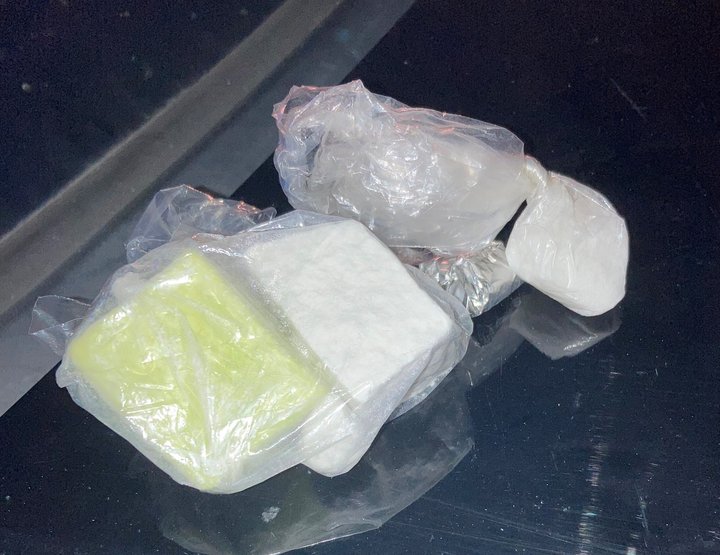
Humboldt County Supervisor Rex Bohn says he’s fed up with the rise in fentanyl overdoses in Humboldt County.
“I got frustrated,” he said in a phone conversation Monday afternoon, “and it’s just not stopping.”
At tomorrow’s meeting of the Board of Supervisors, Bohn will ask his fellow supes to consider sending a sternly worded letter to the district attorney of San Francisco, threatening legal action against the city he believes to be the county’s major supplier of the dangerous opioid.
A draft of the letter says, “The ‘open air dealing’ of drugs in the Tenderloin area
is causing an environment in which these drugs can be easily located, transported, sold and
distributed in the area with no repercussions.”
The letter’s tone reflects Bohn’s frustration.
“The County of Humboldt refuses to sit idle while this drug pours into our county from the Tenderloin,” it says. “If we cannot reach a mutually acceptable solution shortly, we will have no options but to seek a legal remedy.”
Bohn said there’s precedent for this type of lawsuit, citing Nebraska and Oklahoma’s unsuccessful attempt to sue Colorado after that state legalized recreational cannabis, as well as a recent suit brought by SoCal residents against the City of Los Angeles following a sewage spill last year.
The draft letter that Bohn is bringing forward notes that San Francisco Mayor London Breed declared a state of emergency in the Tenderloin, though it doesn’t mention that the declaration expired in March.
The draft letter describes some police work from local law enforcement:
The Humboldt County Drug Task Force has
surveyed numerous suspected drug dealers and has followed them to the San Francisco Tenderloin
District, wherein, they observed them purchasing fentanyl from dealers in the Tenderloin. They
were then followed back to Humboldt where they were stopped, and the fentanyl was confiscated.
In fact, four people were arrested on April 25, 2022. as they entered Humboldt County after they
had purchased fentanyl from the Tenderloin District. Humboldt County had 2 arrests for fentanyl
possession in 2020 and 84 arrests in 2021. Currently arrests for fentanyl possession in 2022 are
already at 76 and it is only 4 months into the year.
In closing, the draft letter urges Boudin to exercise his authority by “prosecuting all cases that are brought to your
office and make [sic] sure the dealers around the state understand that they are not welcome into your
county any longer.”
Some sharp-eyed readers took note of the “May 01” stamp in the photo below, which prompted some speculation that the County Administrative Office may have had a copy of the lawsuit in hand a full day before one was delivered to Auditor-Controller Karen Paz Dominguez.
But Clerk of the Board Kathy Hayes tells the Outpost that she accidentally used the wrong stamp when the suit was served on Monday.
“It should have been stamped Received on May 2, 2022,” Hayes explained in an email. “I have since re-stamped the lawsuit with the correct date of May 2nd, 2022.”
The courthouse isn’t even open on Sundays, so delivery on May 1 would not have been possible. Hayes said that only she, as clerk of the board, or deputy clerks in the office can accept service for a lawsuit being served on the county as a whole.
“We cannot accept service for individual employees, department heads or elected individuals when they are named separately/individually in a lawsuit,” she added. “Those must be served personally on the individual.”
Jennifer Hanson, press secretary to California State Controller Betty T. Yee, told the Outpost via email late Monday afternoon that both the county and Paz Dominguez were “in the process of being served.”
Hayes said her office’s process with lawsuits against the county is to accept service, log the date and time received and then send a copy to county counsel, the CAO’s Office and members of the Humboldt County Board of Supervisors, after which county counsel takes over.
“I want to be clear because there is misinformation out there stating that the CAO accepted service and that is incorrect,” Hayes said. “[T]he CAO is not authorized to accept service of lawsuits on behalf of the county.”
###
###
The State of California is suing Humboldt County and Auditor-Controller Karen Paz Dominguez, in both her personal and professional capacities, for failure to comply with government-mandated financial reporting requirements.
A nine-page complaint filed Monday by Supervising Deputy Attorney General Julianne Mossler says Paz Dominguez failed to file the county’s adopted budgets on time for two consecutive fiscal years — 2020/2021 and 2021/2022 — and also failed to file the county’s Financial Transaction Reports for fiscal years 2019/2020 and 2020/2021 “in the time, form, and manner prescribed by the State Controller.”
The state is asking the court to order Paz Dominguez to pay $10,000 — two fines of $5,000 apiece — and order the county to pay $2,000 for these delayed and/or improperly submitted reports. The suit also asks the court to issue a writ of mandate requiring Paz Dominguez “to perform her mandatory statutory duties” and submit the overdue reports correctly.
News of the lawsuit came as a surprise to Paz Dominguez, who told the Outpost via email Monday afternoon that she was not aware of it and had not received a copy.
“I don’t have a comment about a lawsuit as I have no documentation to reference,” she wrote. “I will need to check in with the CAO [County Administrative Office] regarding the submission of budgets as that is an item the CAO has historically submitted to the SCO [State Controller’s Office] on behalf of the County,” she added.
The state’s lawsuit, however, says that it’s Paz Dominguez’s responsibility as the county’s auditor-controller to file both the county’s adopted budgets and its Financial Transaction Reports.
“Defendant Paz Dominguez is sued in her personal and in her official capacity as the Auditor-Controller for [the] County,” the suit says. “She is an elected county official, has charge of the County’s financial records, and is responsible under Government Code sections 29093 and 53891, et seq., to ensure that the County’s adopted budgets and her FTRs are filed in the time, form, and manner required by the State Controller.”
The suit goes on to recount a succession of missed deadlines, incomplete or improperly submitted reports and long lapses in communication from the Auditor-Controller’s Office.
For example, the State Controller’s Office sent Paz Dominguez letters on Feb. 28 advising that the county’s 2020/2021 adopted budget had not been received by the Dec. 1, 2020, due date, nor had the subsequent year’s budget been received by the Dec. 1, 2021, due date, according to the suit. The letters warned that the county would be subject to a $1,000 forfeiture for each of those two “missing” budgets if Paz Dominguez failed to file them by March 21.
The state received the budget schedules on that due date, but they were incomplete, according to the suit. “Both sets of schedules were missing information required by Government Code … ,” the suit says. The budgets had no beginning fund balances, and funding sources did not equal financing uses, and so the State Controller’s “rejected the incomplete schedules” and has yet to receive adequate versions, according to the complaint.
That’s the state’s first cause of action. The second concerns the county’s delinquent 2019/2020 Financial Transactions Report, which has been a topic of argument and speculation in recent Board of Supervisors meetings. Financial transactions reports lay out all of a county’s financial transactions during the previous fiscal year.
According to the complaint, the State Controller’s Office first reached out to Paz Dominguez about the delinquent report on Nov. 6, 2020, following up on Feb. 26, 2021 with a warning that she’d be subject to a $5,000 fine if she failed to submit the report by March 18, 2021.
She failed to submit it by the deadline, and on June 1 of last year the State Controller’s Office followed up again.
“Paz Dominguez responded on June 14, 2021, stating that the County’s audit for fiscal year 2019/2020 was underway, but not yet complete,” the suit says. “Paz Dominguez offered to complete the report using unaudited information and indicated it would take two weeks.” The State Controller’s Office agreed, but Paz Dominguez missed the deadline again.
At a March 1 Board of Supervisors meeting, Paz Dominguez said she believed the final demand letter had been sent by mistake, or perhaps as the result of some automated process, because her office had been working directly with a team from the State Controller’s Office, who’d come to town to investigate the county’s financial practices and reporting, and they knew nothing about the final demand.
However, the Attorney General’s Office later confirmed that the notice was not sent by mistake.
According to the lawsuit, Paz Dominguez submitted the delinquent Financial Transactions Report on March 16, “and falsely stated it was prepared by the ‘AG,’ and ‘Under the Direction of the AG.’”
In response, the State Controller’s Office returned the report to Paz Dominguez with an email explaining that the report was deficient and instructing her to submit an accurate first and last name and title of the report preparer by no later than close of business March 23.
“Paz Dominguez did not respond to the SCO’s email and did not correct her FTR,” the complaint says. The report is now more than a year overdue, and the state’s lawsuit says submission of the “deficient” report “is inexcusable and does not satisfy Paz Dominguez’s statutory obligation.” Government Code dictates that she’s subject to forfeiture of $5,000, the suit says.
The county’s 2020/2021 Financial Transactions Report was also not submitted by the deadline of January 31, and on Feb. 25 the State Controller’s Office sent Paz Dominguez another letter, advising her that it was delinquent and giving her 20 days to comply. It also warned that failure to submit it by March 17 would result in a forfeiture of another fine of up to $5,000.
“Paz Dominguez did not file her 2020/2021 FTR by the March 17, 2022 deadline, nor has she filed it since then,” the suit says.
In a third cause of action, the state asks the court to issue a writ of mandate “compelling Paz Dominguez to perform her mandatory statutory duties.”
The Outpost sent Paz Dominguez a copy of the suit. She wrote back shortly thereafter, saying, “I will forward it to my attorney and communicate with the SCO. I will not be providing you any comment as this will best be handled in an official capacity.”
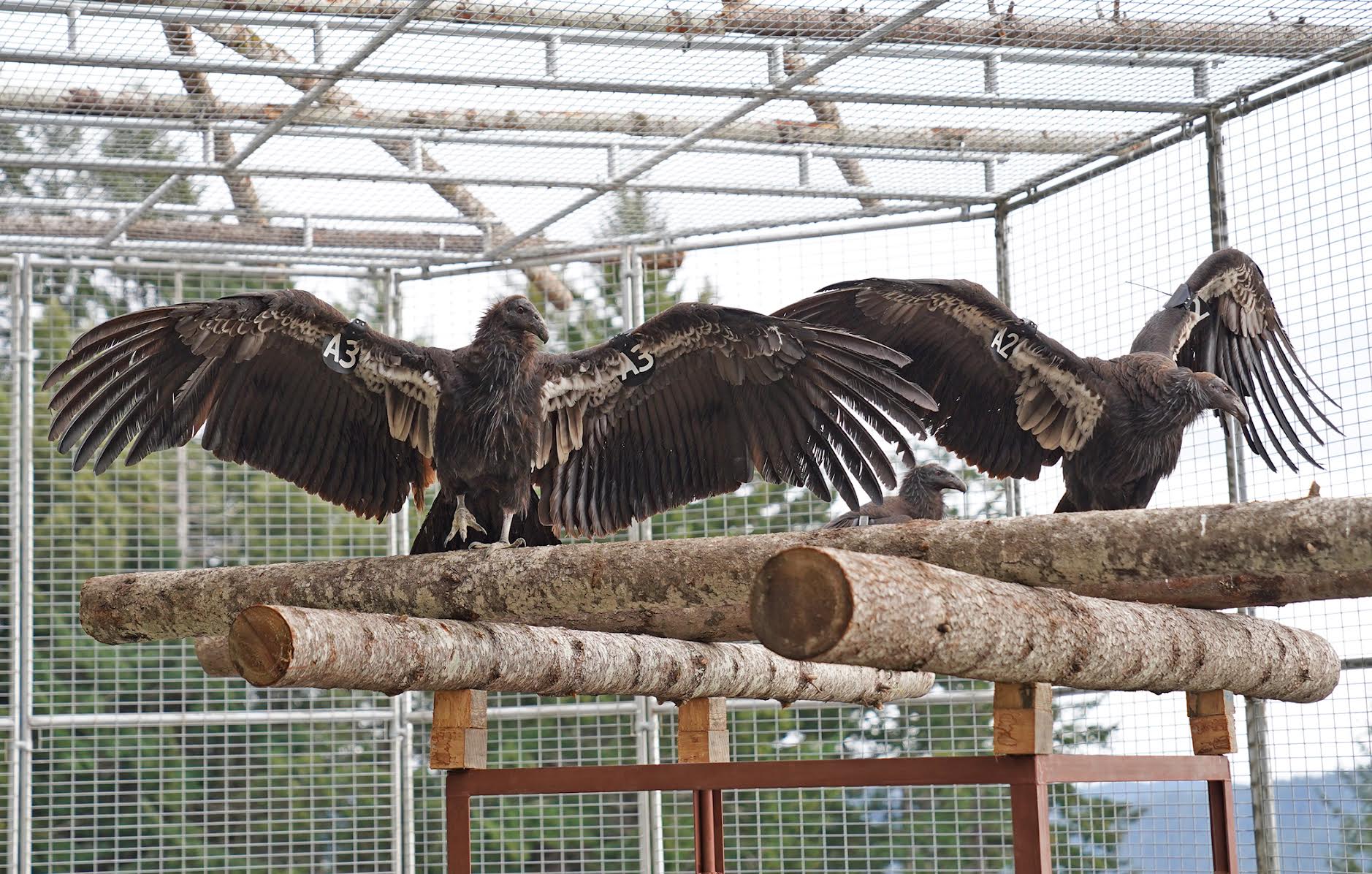
Two soon-to-be-released California condors acclimate to their new home in a holding pen near Redwood National and State Park | Photo: Matt Mais
Yurok Tribe release:
At 8 a.m. on Tuesday, May 3, the Yurok Tribe and Redwood National and State Parks will facilitate the release of the first two California condors to take flight in the center of the bird’s former range since 1892. Prior to their release, the condors must voluntarily enter a designated staging area with access to the outside world. If the birds do not enter the transition zone by 4 p.m., a second attempt to release the birds will occur at 8 a.m. on Wednesday, May 4. The carefully designed release procedure is one component of a comprehensive management plan for the reintroduction.
“For countless generations, the Yurok people have upheld a sacred responsibility to maintain balance in the natural world. Condor reintroduction is a real-life manifestation of our cultural commitment to restore and protect the planet for future generations,” said Joseph L. James, the Chairman of the Yurok Tribe. “On behalf of the Yurok Tribe, I would like to thank all of the individuals, agencies and organizations that helped us prepare to welcome prey-go-neesh (condor) back to our homeland.”
“The return of the condors to the skies over the redwoods represents a significant milestone in the restoration of this magnificent forest to its former glory,” remarked Redwood National and State Park Superintendent Steve Mietz. “This project is a model for listening to and following the lead of the park’s original stewards, healing both our relationship with the land and its original people.”
“The reintroduction of condors into Northern California is truly a monumental moment,” said Paul Souza, Regional Director for U.S. Fish and Wildlife Service Pacific Southwest Region. “This effort builds upon the program’s collective knowledge and history of releasing condors and showcases the benefit of partnering with Tribes and others to implement recovery of listed species. We are proud to support this collaborative and innovative partnership with the Yurok Tribe and Redwood National Park. Together we can recover listed species for future generations.”
Comprised of biologists and technicians from the Yurok Tribe and Redwood National Park, the Northern California Condor Restoration Program (NCCRP) will collaboratively manage the flock from a newly constructed condor release and management facility in Northern California, near the Klamath River. The NCCRP team will work collaboratively with the other condor field teams as part of the larger California Condor Recovery Program guided by the U.S. Fish and Wildlife Service (Service).
Two more condors will be released at a later date. Staggering condor releases is a management strategy that allows close observation and management of individual birds. Following releases, biologists must monitor condors to see that they display appropriate behavior. The four condors, including one female and three males, are between two and four years old, which is within the ideal age range for the successfully releasing condors to thrive in the wild. Two of the males were hatched at the Peregrine Fund’s World Center for Birds of Prey in Idaho. The other two condors were hatched at the Oregon Zoo and raised at the Idaho center. In September, the four birds were transferred to the Ventana Wildlife Society’s flight pen in San Simeon while finishing touches were put on the NCCRP facility. They were transported to the NCCRP site in late March.
Over the last 30 years, the Service’s California Condor Recovery Program has developed an exceptionally effective blueprint to guide the reintroduction process, which begins long before the birds are released. For example, reintroduced condors are reared in large flight pens with exposure to the natural environment and when possible, other condors of various ages for mentorship. The extremely social avian scavengers acquire life skills from their elders and their own experiences. Elder or mentor birds assist the juvenile condors in obtaining the worldly knowledge they need to survive outside of captivity. The World Center for Birds of Prey provided the NCCRP a seven-year-old condor to fulfill this important function for the four birds as they transition into the wild. Condor 746 will remain in the flight pen and is expected to mentor future release birds at this location. Similar to the reintroduced condors in Arizona, the Northern California flock will be considered a nonessential, experimental population under the Endangered Species Act. This pragmatic approach was selected because it has proven to be an effective method of recovering federally listed species. Additionally, the stakeholder-driven strategy better facilitates proactive conservation and reduces the regulatory impact of reintroducing a federally listed species.
At regular intervals, the NCCRP will be releasing new condor cohorts into Redwood National Park. Over time, the birds are expected to disperse across Northern California and Southern Oregon. Through careful management, the NCCRP’s primary goal is to develop a self-sustaining condor population in the rural region, which will fill a currently vacant ecological niche in the redwood forest ecosystem as well as aid in the overall recovery of the species.
“Every year, the Yurok Tribe completes multiple, largescale river and forest habitat improvement projects in our ancestral territory. We also manage a 15,000-acre Old Growth Redwood-Forest and Salmon Sanctuary. Condor reintroduction is a major part of our long-term plan to restore the diverse ecosystems within our homeland,” said Frankie Myers, the Yurok Tribe’s Vice Chairman. “As a people, we will not recover from the traumas of the last century until we fix our environment because our culture, our ceremonies, our wellbeing and our identity are inextricably linked to the landscape.”
Yurok Connection to the Condor For the Yurok Tribe, the recovery of this sacred species signifies significant progress toward the restoration of an intricately interconnected ecosystem and the people who are responsible for taking care of it. Prey-go-neesh plays a principal role in the Yurok creation story and is prominently featured in the Tribe’s White Deerskin Dance and Jump Dance. During the ten-day world renewal ceremonies, the condor is represented via the fallen feathers incorporated into tribal regalia and prayers for the earth and all of its inhabitants.
“The loss of the condor has limited our capacity to be Yurok because prey-go-neesh is such an important part of our culture and traditions. In a very real way, restoring condor habitat and returning condor to Yurok skies is a clear restoration of the Yurok people, homeland, ecological systems, culture, and lifeway,” added Yurok Wildlife Department Director Tiana Williams-Claussen, a Yurok citizen and traditional culture bearer, who has dedicated her entire professional career to condor reintroduction. “I have a 3-year-old-daughter. She is going to grow up with condors in her sky for her entire life. She is not going to know what it is to miss condors. She will always live in relationship with condors, which is really what this project is all about — bringing condor home, back into our communities, back into our conversations, back into our households, and into the minds and hearts of our children on behalf of the hearts of our elders.”
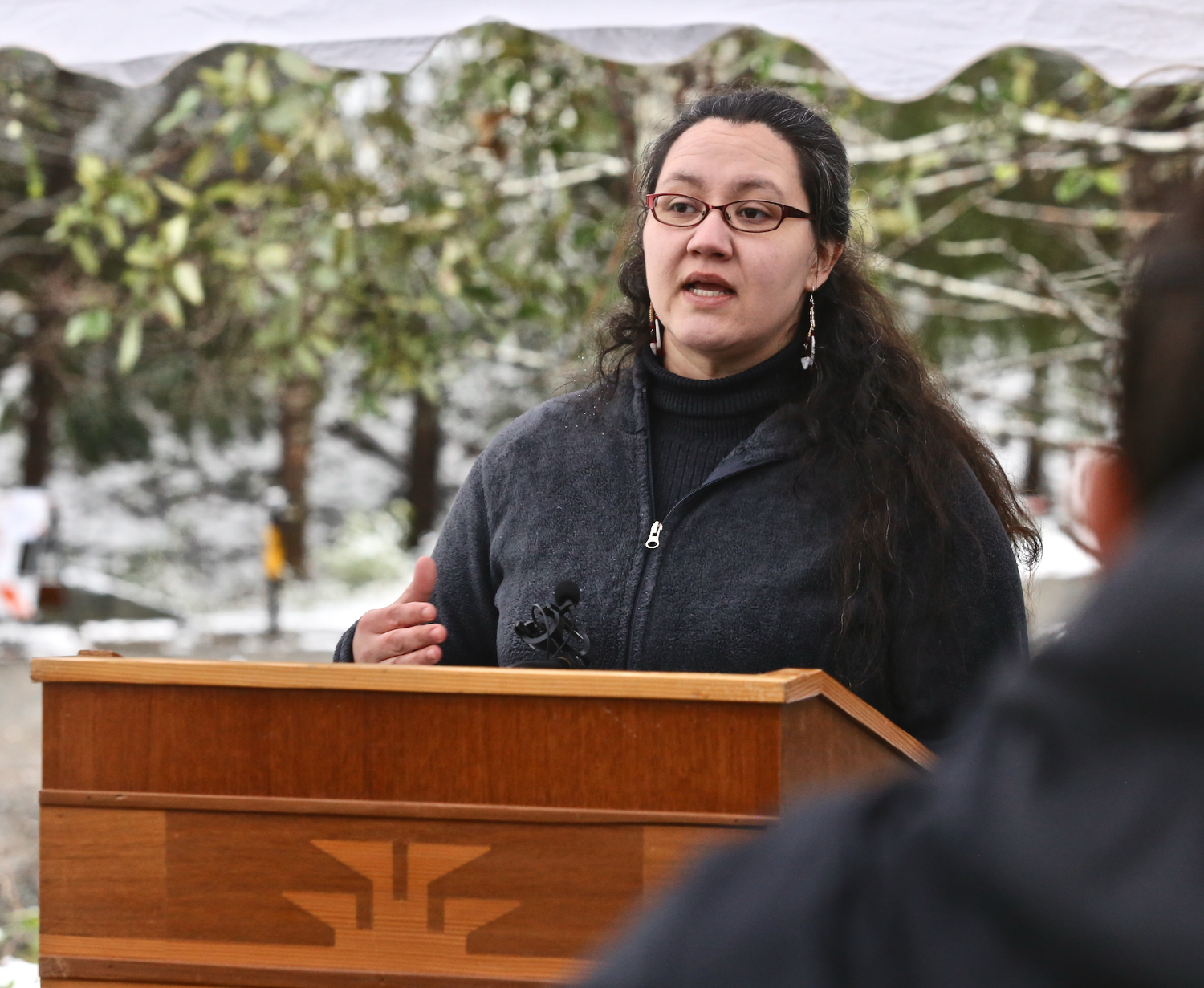
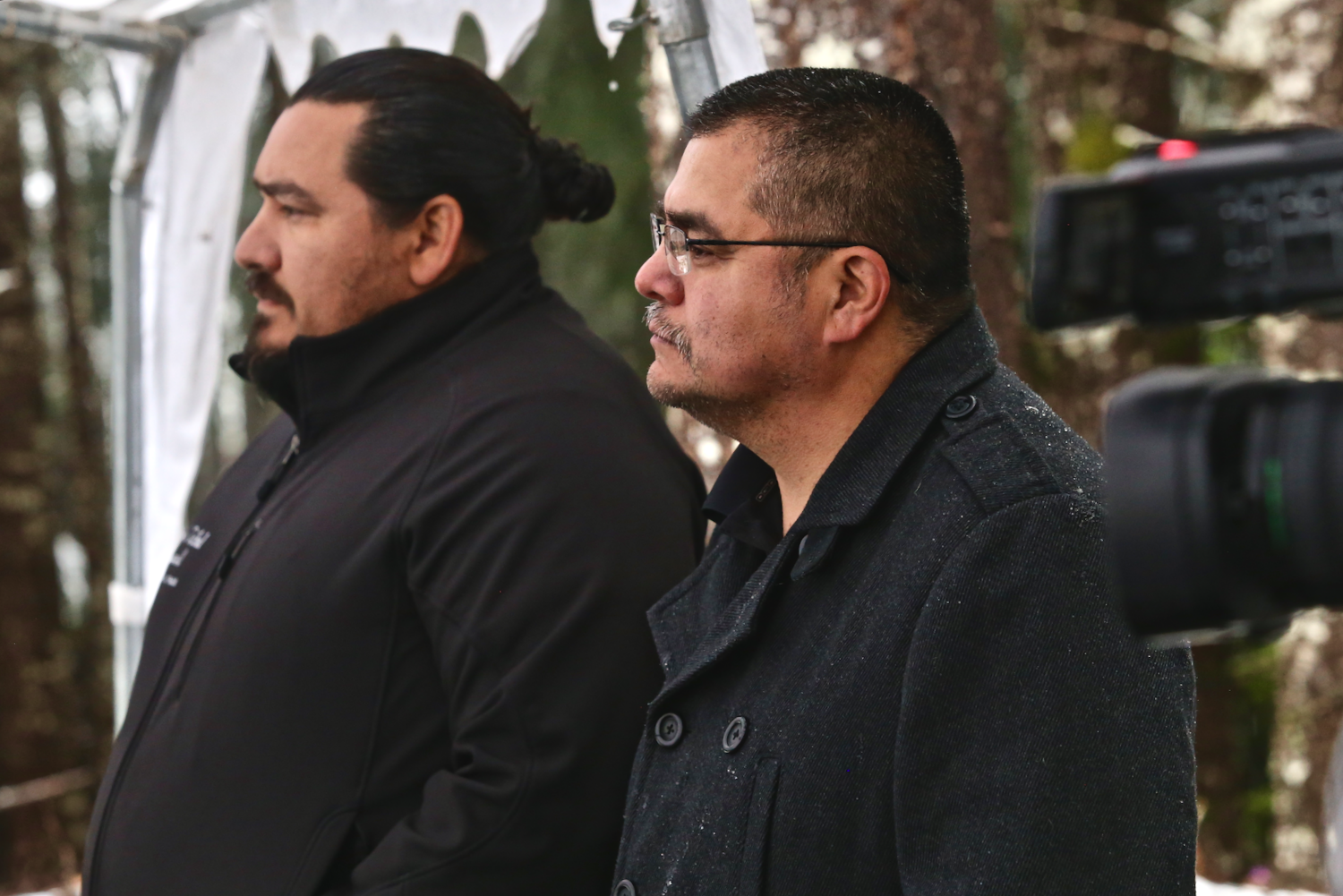
Yurok Wildlife Department Director Tiana Williams-Claussen (above) speaks at a recent condor media event while Yurok Tribal Chairman Joseph L. James (below, right) and Vice Chairman Frankie Myers (below, left) look on | Photos: Andrew Goff
The Yurok Tribe started working in earnest on condor reintroduction in 2008.The Yurok received a tribal wildlife grant from the Service to conduct a study to determine if Yurok ancestral territory could still support North America’s largest terrestrial bird.
With support from Redwood National Park, the Service and Bureau of Indian Affairs as well as the Administration for Native Americans, Pacific Gas and Electric and many other contributors, such as the Global Conservation Fund and the Redwood National Park Foundation, the Yurok Wildlife Department completed the tremendous amount of work required to reintroduce a critically endangered species. The following tasks represent a small fraction of what they had to accomplish in order to make condor reintroduction a reality: extensive environmental assessments, contaminant analyses, constant fundraising, planning, designing and constructing facilities, performing intensive community outreach and coordinating with numerous stakeholders and collaborators.
“The National Park Foundation is excited to be part of this collective effort to welcome the iconic California condors back to their historic range,” said Will Shafroth, president and CEO of the National Park Foundation (NPF). “This celebratory moment affirms the importance of long-term collaborations between the NPF, the National Park Service, Tribes, and other essential partners and should serve as a model for future partnerships.”
The Plight of the Condor The decline of the condor started shortly after arrival of European settlers in the American West. During the Gold Rush era, numerous condors were shot for sport and collected for museum displays, while others succumbed to poisons used to eradicate large predators, such as grizzly bears and wolves.One of the first species placed on the federal endangered species list, condor numbers continuously plummeted from 1800 to the 1980s, when a fortuitous decision was made to collect the last 22 birds from the wild and establish the first captive breeding program to save the species. In 1983, the Service teamed up with the LA Zoo and San Diego Wild Animal Park to launch the first-ever captive breeding facilities. Today, thanks to the California Condor Recovery Program’s continued success, approximately 300 wild condors are flying free in California, the Southwest and Baja California. There are now four captive breeding centers, which supply birds for the release sites in the U.S. and Mexico, including the Northern California Condor Restoration Program facility.
On-the-ground efforts have been led by Senior Biologist and Yurok Condor Restoration Program Manager Chris West, who has nearly 25 years of condor research and management experience. Working in collaboration with the Ventana Wildlife Society, the Tribe designed and built the NCCRP release and management facility on National Parks land. The cutting-edge facility boasts a blend of the best elements from all of the rearing and release sites in the US. The flight pen has a simulated, shock-wired power pole (to teach the birds to avoid this threat after release), two four-foot diameter pools, and a perch overlooking the redwood forest. Two high-definition cameras stream a live feed from the site, which is available here. Yurok Condor Program staff can observe the birds on-site from custom-modified shipping containers which form a fire-resistant structure, complete with isolation pens, where birds will receive regular health assessments and treatment if needed.
“We are fortunate to be able to develop our program based on an immense quantity of Traditional Ecological Knowledge and thirty years of real-world condor recovery experience from our partners within the California Condor Recovery Program. We are truly standing on the shoulders of giants. For these reasons, I have no doubt that our reintroduction will serve as a gateway to bring the condor back to the Pacific Northwest,” concluded West.