Wealthy real estate heir and suspected serial killer Robert Durst, who was found guilty in September of murdering his longtime friend Susan Berman decades earlier while he was a resident of Trinidad, has died.
Multiple news outlets report that Durst’s attorney announced today that the convict died in custody this morning. In August, the 78-year-old testified in court that he was suffering from a number of severe ailments, including bladder and esophageal cancers, chronic obstructive pulmonary disease and chronic kidney disease.
While Durst was convicted of only ever one murder, he was tied to a number of other disturbing cases, including the death and dismemberment of his Galveston, Texas neighbor Morris Black in 2001. Despite the nature of Black’s death and Durst’s admission to mutilating and dumping Black’s body, a jury found that Durst acted in self-defense.
Suspicions that Durst was a serial killer grew after the HBO documentary series “The Jinx” aired in 2015, summarizing the remarkable number of people who crossed paths with Durst only to end up murdered.
To this day, some suspect that Durst was also responsible for the disappearance of Eureka teen Karen Mitchell, who vanished while walking home from the Bayshore Mall in November of 1997.
Karen Mitchell.
Several interesting pieces of anecdotal evidence have tied the teen’s disappearance to Durst, who lived in Trinidad from 1995 to 2000. According to reports, Mitchell had volunteered at a local homeless shelter where Durst had previously been spotted. Durst, a known cross-dresser, also reportedly visited Mitchell’s aunt’s shoe store Annie’s Shoes in the Bayshore Mall while dressed in drag on multiple occasions. A sketch of a suspect made by a witness claiming to have seen Mitchell with an older man on the day of her disappearance also looks suspiciously like Durst.
“Robert Durst was a suspect, primarily because of proximity,” former Eureka Police Department Chief Andy Mills told Investigation Discovery in 2019. “The second piece of that was Robert Durst is a recluse, has some strange behaviors. The third reason is: One person did a composite sketch.”
Despite these connections, no physical evidence ever linked Durst to Mitchell’s disappearance.
Watch the Investigation Discovery piece embedded at the top of this story for a quick summary of Durst’s crimes and suspected criminal history.
From the California Faculty Association of Humboldt State University:
The Humboldt State
University Chapter of the California Faculty Association (CFA) urges
the administration of Humboldt State University (HSU), to approve all
requests for temporary virtual instruction from those faculty members
teaching face-to-face courses or who otherwise have face-to-face
interactions with students. Faculty members have the right to request
such a change in modality based on the Memorandum of Understanding
between CFA and HSU Management signed and dated August 24, 2021. No
faculty member should be forced to work in conditions that put
themselves or their loved ones at risk, especially when there are
alternatives.
CFA Humboldt urges
administration to grant such temporary changes in modality due to the
nature of the Omicron variant of the Covid-19 virus, in conjunction
with conditions specific to our local context. The Omicron variant
is extremely contagious, and cases have been identified throughout
California. In Humboldt County we are seeing our health care system
heavily impacted and a shortage of testing kits at area drugstores.
Due to the increased risk, many California State University campuses
will begin the Spring 2022 term providing virtual, not face-to-face
instruction. These campus locations include Los Angeles, Channel
Islands, Dominguez Hills, Fullerton, Long Beach, Northridge, San
Diego, San Marcos, Sacramento, San Francisco, Fresno, and East Bay -
all campuses which do not have the challenges of our rural health
care system. Such measures help ensure the health and safety of the
entire campus and local community.
Many faculty members
who are scheduled to have face-to-face interactions with students
have family members that are immunosuppressed and could inadvertently
be infected. Some faculty members are themselves particularly
susceptible to infection. The Collective Bargaining Agreement (CBA)
explicitly guarantees that no employee need to endure unsafe working
conditions. Requiring employees to work in contexts that put
themselves or their loved ones at risk flies in the face of the
social justice values that HSU espouses.
Lastly, due to an
error on the HSU scheduling website, students were already informed
that the first two weeks of the semester would be online. This error
was corrected just days ago. It is likely that beginning the semester
in a virtual modality is already expected by many of our students.
CFA Humboldt
believes that granting requests to postpone face-to-face instruction
will keep our faculty, staff, students, and loved ones safer than
otherwise and will alleviate the strain on our local health care
providers.
Health care justice
requires recognizing the importance of context. No one should be
required to put themselves of their loved ones at risk when
time-tested short-term alternatives exist.
On January 9, 2022, at about 5:19 p.m., officers with the Eureka Police Department
responded to northbound Highway 101, just north of the Slough Bridge, for the report
of a major injury collision involving a single motorcycle.
Humboldt Bay Fire and City Ambulance provided emergency medical care on scene;
however, due to the extent of the injuries the motorcyclist was pronounced deceased.
Next of kin has been notified and the motorcyclist has been identified as 37-year-old
Samantha Barney of Eureka.
Based on the initial investigation, it appears Barney was driving her motorcycle on
northbound Highway 101 when she lost control and struck a sign in the grassy center
median. No other vehicles were involved. At this time it is unknown if drugs or alcohol
played a factor in the collision.
Press release from the Humboldt County Sheriff’s Office:
On Jan. 10, 2022, at about 12:47 a.m., Humboldt County Sheriff’s deputies on patrol in the area of Bear Paw Way in Loleta observed a vehicle with false registration tabs.
Deputies contacted a female, identified as 37-year-old Teresa Roseann Olan, inside the vehicle. Olan was found to have an outstanding felony warrant for her arrest. Also during their investigation, deputies learned that the vehicle had been reported stolen out of Eureka.
Olan was taken into custody and booked into the Humboldt County Correctional Facility on charges of possession of a stolen vehicle (PC 496d(a)), resisting a public officer (PC 148(a)) and violation of probation (PC 1203.3(a)(2)), in addition to a warrant for violation of probation.
Anyone with information about this case or related criminal activity is encouraged to call the Humboldt County Sheriff’s Office at (707) 445-7251 or the Sheriff’s Office Crime Tip line at (707) 268-2539.
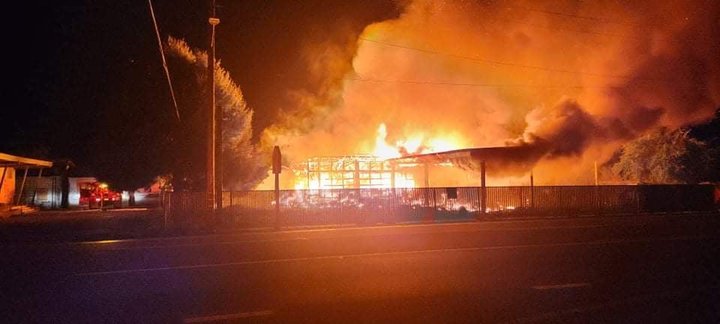
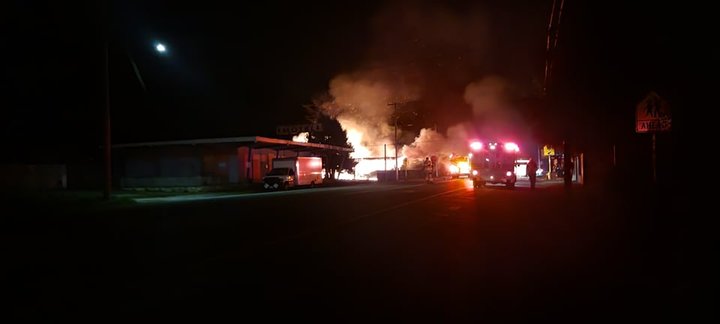
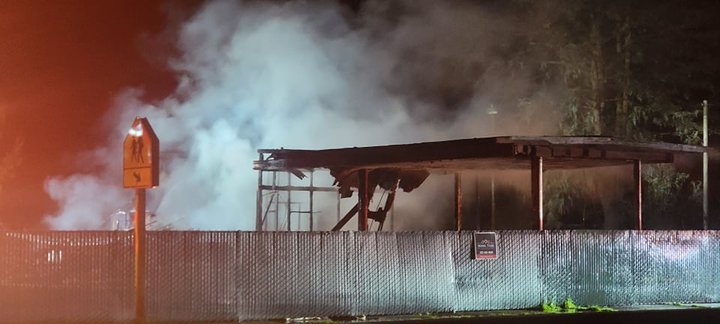
The old nonoperational gas station adjacent to the recently shuttered Green Valley Motel along Highway 101 in Orick was completely destroyed by fire last night.
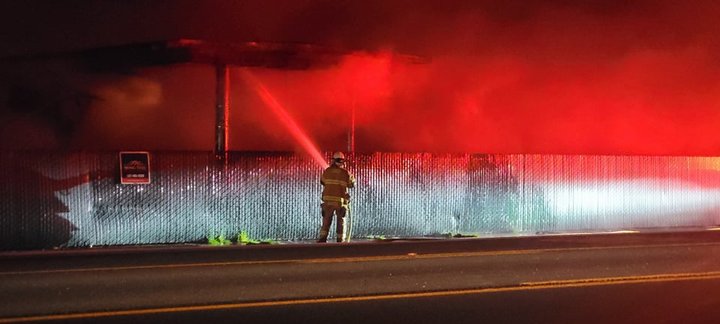
Orick Volunteer Fire Department Assistant Chief Steven Baker told the Outpost that firefighters were able to prevent the flames from damaging the motel or a nearby house.
“The building that burned was in pretty poor shape,” Baker said. “It’s completely gone.”
Firefighters responded to the scene shortly after 9 p.m. and shut down Highway 101 for about an hour in order to run a hose line across the roadway. Firefighters remained on scene performing mop-up duty until midnight.
The cause of the fire was unable to be determined. Additionally, Baker said that the gas station was decommissioned many years ago and that the fuel pumps didn’t pose any further threat to firefighters.
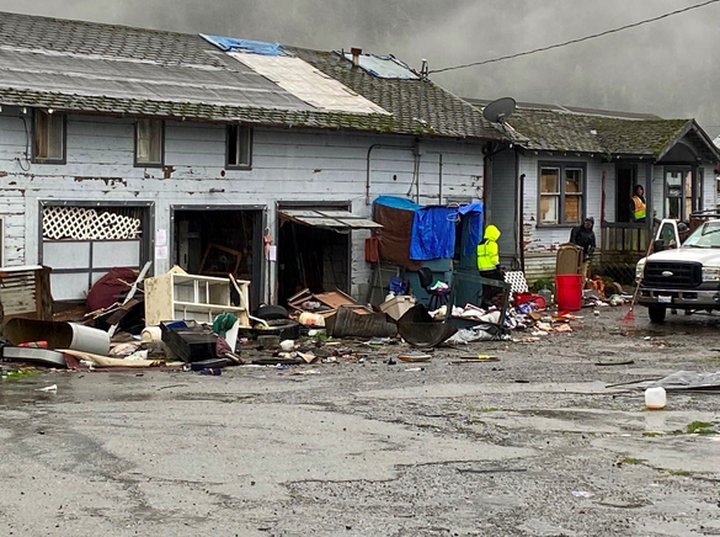
The building’s condition this morning.
“It went up really quick,” he said. “We were [fighting the fire] for about 10 minutes at most and more than half of the building was already engulfed.”
The adjacent Green Valley Motel was ordered closed by the County of Humboldt in November after the building was deemed uninhabitable due to extremely poor living conditions.
An inspection conducted in September by the Humboldt County Code Enforcement Unit, Building Inspection and Department of Health and Human Services revealed numerous code violations. These violations reportedly included inadequate sanitation, structural and fire hazards, faulty weather protection, hazardous electrical work and mechanical equipment, inadequate heat supply, solid waste accumulation and infestations of rats, cockroaches and bedbugs.
File photo of the now vacant and boarded up Green Valley Motel in Orick. | County of Humboldt
Multiple agencies responded to the fire last night to provide aid to the Orick Volunteer Fire Department, including Calfire, the Westhaven Volunteer Fire Department and the California Highway Patrol.
In Los Angeles, a severely ill patient has to wait for a new lung after his transplant, scheduled for last Friday, was canceled.
In San Diego, brain surgery to ease the chronic pain of a 7-year-old girl was called off last week.
In Arcadia, as many as 60 patients will likely have their surgeries canceled this week. In Folsom, at least 11 operations already were scrapped last week. And at one hospital in Anaheim, a patient waited on a gurney for back surgery for three hours before he was sent home because of lack of staff.
Throughout California, as COVID-19 infections deplete their staff of nurses, anesthesiologists and other essential workers, hospitals are canceling or postponing so-called “elective” surgeries to repair injured knees and aching back, remove kidney or bladder stones, and repair cataracts or hernias, among other procedures.
Alarmed by a growing shortage of specialized health care workers, the California Department of Public Health is evaluating whether to issue an order to hospitals statewide to suspend elective surgeries in cases in which patients wouldn’t be immediately harmed.
For now, the decision is voluntary for hospitals. But the state health department’s chief deputy director, Susan Fanelli, on Thursday told a meeting of county health officers, “We know (a directive on elective surgeries) has to be on the table.” Officials with the public health department did not respond to CalMatters’ requests for more information.
“Elective” means a surgery is not an emergency and can be scheduled in advance; it does not mean it’s optional. Waiting in some cases can be life-threatening.
Hospitals are carefully weighing which surgeries can be delayed, executives say. A cataract surgery or knee replacement might be canceled, for example, but not heart surgery or a breast cancer biopsy.
it’s recently been brought to my attention that most ppl don’t know what “elective surgery” means.
I have a brain tumor for which my neuro/oncology team is planning surgery within the next ~2 months.
In response to the shortages, the state health department on Saturday issued controversial new guidance to hospitals and skilled nursing facilities. Workers who are infected with COVID-19 but have no symptoms may immediately return to work without isolation or additional testing. Exposed health care workers may also work. The new guidelines remain in effect until Feb. 1.
Health workers immediately attacked the new policy.
SEIU-United Healthcare Workers member Gabe Montoya, an emergency room technician in Downey, called the policy dangerous and disappointing.”
“No patient wants to be cared for by someone who has COVID-19 or was just exposed to it,” he said.
Many surgeries already scrapped
On Friday, a scheduled lung transplant at a University of Southern California hospital had to be delayed for lack of specialized staff, according to Michael Simonton, a USC intensive care unit nurse. Further details were unavailable.
Also on Friday, at a Kaiser Permanente hospital in Anaheim, Joe Sanders, a 74-year-old retiree from La Habra, waited on a gurney for three hours after being prepped for surgery to treat serious lower back pain. He dozed until his surgeon appeared at his bedside.
“I have some bad news for you,” the surgeon told Sanders. There wasn’t enough staff for the operating room so the long-awaited procedure, scheduled two months earlier, would have to be postponed several days, Sanders told CalMatters.
“I was disappointed, my wife and I were looking forward to this. I’m in pain all the time,” Sanders said. “But I knew the pandemic was raging and we hadn’t reached the zenith of this thing. I knew it was going to be touch and go.”
At Methodist Hospital in Arcadia, east of Los Angeles, nearly a tenth of nurses were out sick or isolating last week. Only 17 of its 40 licensed intensive care beds could be staffed – and all of them were full, Clifford Daniels, senior vice president and chief strategy officer, told CalMatters on Friday.
Starting this week, the 348-bed hospital will cancel elective procedures such as gallbladder surgeries, joint replacements and colonoscopies, but not cancer treatments, Daniels said.
“We’re using every resource we can possibly find, including traveler and registry nurses at extraordinary costs,” he said.
In the Sacramento region, at least 11 elective procedures at Mercy Hospital of Folsom had to be postponed last week because of staffing shortages, said Dr. Brian Evans, CEO of the Folsom facility and Mercy General Hospital in Sacramento. Evans could not provide details about the types of procedures that will be canceled.
The two hospitals, both owned by Dignity Health, had about 54 patients admitted specifically for COVID-19 on Friday, but “we’re seeing many of our workers and health providers getting sick as well. We expect next week to be worse,” Evans said.
More than twice as many California hospitals reported critical staffing shortages last week than last summer — although not as many as a year ago.
Stanford Medical Center in Palo Alto has about 5% of its total workforce out sick, spokeswoman Julie Greicius said Saturday. “We have seen a doubling of nurses calling off per shift, reporting that they are ill,” Greicius said.
California ranks fifth in the nation in the percentage of hospitals reporting severe labor shortages.
A year ago, during the last surge, the state health officer directed hospitals for about one month to cancel certain procedures if their intensive care capacity was less than 10%.
Since then, the highly contagious omicron variant has transformed California’s COVID-19 landscape and hospitals’ decision-making. Omicron appears to cause less severe disease, but it’s more likely to infect vaccinated people than the original novel coronavirus and the delta variant. As a result, even though about 71% of eligible Californians are vaccinated and 38% of them are boosted, more people – including health care workers – are becoming infected, many with mild or no symptoms.
“This is not about beds, this is about the staff to care for the patients in those beds,” said Kiyomi Burchill, group vice president of policy for the California Hospital Association.
Exacerbating the problem: labor strife and an exodus of nurses and other hospital staffers who have quit or retired, citing burnout and lack of protections on the job.
Fanelli told county health officers last week that the state is working on other measures to support hospitals as they cope with yet another surge. The state health department predicts as many as 53,000 hospitalizations a day in the coming weeks.
A $614 million funding proposal
In response, the state plans to send up to 1,500 health care workers to hospitals with staffing shortages and has stockpiled oxygen, saline and other supplies ahead of the surge. Officials also are working with hospitals to help them adapt spaces to triage patients and more quickly find placements for patients ready to be discharged, she said.
Gov. Gavin Newsom’s new proposed emergency funding package, revealed Saturday, includes $614 million to help hospitals and other health facilities augment their staff.
“The bottom line is that we are worried about the…level of staff infections and the need for isolation and quarantine among the staff,” California Health and Human Services Secretary Dr. Mark Ghaly told reporters last week.
“The bottom line is that we are worried…about the level of staff infections and the need for isolation and quarantine among the staff.” — Mark Ghaly, California Health and Human Services
Many hospital emergency rooms also are packed with patients, some of whom arrived for other reasons than COVID-19 but happened to test positive upon arrival. Those patients then have to be isolated to protect other patients and hospital staff.
And intensive care beds already are in short supply around the state.
In 27 counties, fewer than five ICU beds remained available as of Jan. 5, according to state data. Statewide the number of available intensive care beds has dropped by about 10 percent since Jan. 1.A dearth of COVID tests also means only patients who come to Methodist’s emergency room with COVID-19 symptoms will be tested, Daniels said. Those who aren’t symptomatic who come in for other reasons won’t get a test, and people coming to the ER just for tests will be sent to Los Angeles County testing sites.
Michael Simonton, an intensive care unit nurse at the 60-bed USC Norris Comprehensive Cancer Center in Los Angeles, said he’s been working without breaks and lunches; some of his colleagues are working 18-hour shifts to care for a flood of patients.
“People are having to stay over(time) because there’s no one else to relieve them,” Simonton said.
A member of the California Nurses Association, a union that represents some 1,400 USC nurses, Simonton places some blame on hospital administrators for the staffing shortage.
“This is a crisis that’s basically been manufactured by the hospital,” Simonton said. “They were choosing temp workers rather than investing in (permanent employees) who are committed to their workplace, and now patients are paying the price.”
###
Reporter Kristen Hwang contributed to this story. CALmatters.org is a nonprofit, nonpartisan media venture explaining California policies and politics.
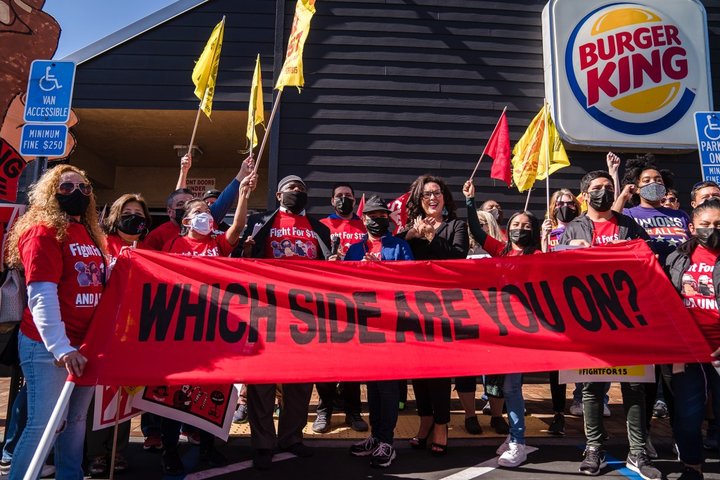
Assemblywoman Lorena Gonzalez, D-San Diego, Yusef Miller with the Racial Justice Coalition and Karina Narinan, a Burger King employee, pose for a photo along with others at a strike for better working conditions and to demand passage of AB 257 at Burger King in San Diego on Nov. 9, 2021. Photo by Ariana Drehsler for CalMatters
###
Amid growing awareness of inequality and jobs that don’t pay enough to cover child care and housing, California is considering a radical proposal: Allow the state to negotiate wages, hours and work conditions for an entire industry.
Proponents in the state Legislature say one solution to inequality is to empower workers to negotiate through unions, but that’s not happening in the fast food industry where frequent turnover, inexperience and intimidation make it too difficult for workers to organize. Only 3% of fast food and counter workers belong to unions nationwide.
In Sacramento, a union-backed Democratic proposal called the Fast Food Accountability and Standards Recovery Act, or FAST Recovery Act, would establish a state-appointed council to enact industry-wide minimum standards for wages, working hours and work conditions. If passed by state lawmakers and signed by Gov. Gavin Newsom, the proposal would also hold corporate franchisors responsible for compliance, not just the local franchise owners.
“California has the opportunity to really pave a path forward in a way that can work for both workers and employers,” said David Madland, a senior adviser to the American Worker Project at the Center for American Progress, a liberal Washington, D.C. think tank.
Legislation to approve the FAST Recovery Act, AB 257, fell three votes short of passing the state Assembly last June with eight Democrats voting no and another 13 not voting. Newsom did not take a position.
With strong support from major state labor groups, the issue is expected to resurface this year even though the bill’s author, Assemblymember Lorena Gonzalez, unexpectedly resigned from office the first week of January to transition into chief officer of the California Labor Federation, which supports the proposal.
One of the nation’s largest unions, Service Employees International Union, vowed to continue pushing the bill. It funds the Fight for $15 and a Union campaign, which organizes low-wage workers to advocate for better wages and work conditions, primarily in fast food. A rally is scheduled for Wednesday at the state Capitol and Assembly Speaker Anthony Rendon could transfer authorship to a committee or another lawmaker.
“The path forward on this bill is still being worked out,” said Rendon’s spokesperson Katie Talbot.
A new report from the UCLA Labor Center documents dangerous conditions during the pandemic, with nearly a quarter of surveyed workers having contracted the virus. Less than half said their employers offered paid sick leave — mandated by state and federal law — to workers who got COVID-19.
“It may not be in the cards to have the kind of traditional labor format we’ve seen in the United States in the near future,” said Saru Jayaraman, director of the UC Berkeley Food Labor Research Center. “But it may very well be in the cards to see these really innovative sector-wide, power-building strategies that change entire sectors.”
The idea of negotiating wages and work conditions for an industry, rather than for each workplace separately, has been modeled for many years in Europe and around the world. Known as “sectoral bargaining,” it has also gained support among progressives in the U.S. such as Bernie Sanders and Elizabeth Warren as a way to reduce income inequality.
Multiplestudies of sectoral bargaining in other countries have found evidence that it reduces inequality, and tends to swell union ranks — with some notable exceptions. But a number of European studies find that sectoral bargaining can reduce profits or productivity for companies. A 2015 study found that sectoral bargaining led to more layoffs during the Great Recession in Europe.
Under current American labor law, true sectoral bargaining is rare because multiple employers would have to voluntarily agree to come to the same negotiating table with workers, said Madland, the researcher at the Center for American Progress. He says America achieved this in the auto industry more than a century ago, and rail workers benefit from that arrangement today.
However, American “workers cannot insist on multi-employer bargaining,” unlike in other countries, he said.
The California proposal would carve a state path by directing an 11-member council — composed of fast food workers, franchisees and franchisors, and state health, safety and labor officials — to do the negotiating. The governor and leaders in the state Senate and Assembly would appoint the members. Its rules would be revisited every three years and, unlike traditional collective bargaining, they would be enforced by state agencies. The laws would apply to every restaurant that belongs to a fast food chain with 30 or more franchises.
Opposition from business, moderate Democrats
It’s a highly controversial proposal with opposition from industry, Republicans and a divide among Democrats.
Before the bill’s failed Assembly vote in June, Assemblymember Ken Cooley, a moderate Democrat from Rancho Cordova, said the power given to an unelected council was an “exceedingly problematic” precedent that is “undermining of the rule of law.”
Business groups are also adamant the government stay out of private negotiations. They argue the free market adjusts wages where it is needed, citing the fact that many California fast food restaurants are now raising their wages to $17 or $18 per hour to attract workers amid a labor shortage. Republicans said the bill was an example of government overreach that would destroy minimum wage jobs and small businesses. Meanwhile, the coalition of organizations lobbying against the bill, which include 40 local and ethnic chambers of commerce, launched a website with the slogan “Stop the Takeout Takeover.”
“The people who will pay for Lorena Gonzalez’s initiative aren’t the ‘evil corporations.’ It’s the working people who rely on that fast food” for either meals or employment, said Will Swaim, president of the right-leaning California Policy Center.
Industry groups also questioned whether the new model is needed since California is known for the strictest labor standards in the country, such as being first to set the $15 minimum wage and protections against heat illness.
“Throwing all of that out to this test case of a panel is absurd,” said Matt Sutton, a senior vice president at the California Restaurant Association.
Sutton also said the FAST Recovery Act’s extension of liability to corporate franchisors could raise costs and potentially drive fast-food chains out of the state. Franchise owners testified in hearings that the bill could change the franchise model, making local owners more regulated by the corporation and less independent.
“AB 257 would result in me and so many other franchisees losing our autonomy since the state would essentially be stripping us of our identity as business owners and making us basically employees for large corporations,” said Michaela Mendelsohn, a franchise owner of multiple El Pollo Loco restaurants, at a spring hearing.
State-imposed bargaining
Gonzalez said she also believes her bill is not the best solution. She says the state government shouldn’t be in the business of bargaining and she would rather maintain “a private-sector approach to reducing income inequality.” Unions, Gonzalez added, do a better job responding to workers’ needs worksite by worksite instead of one-size-fits-all state labor laws, which employers fight and the government enforces unevenly.
But given that businesses continue to fight union drives, Gonzalez said, and the U.S. Congress has stalled on federal labor law reform, the FAST Recovery Act is necessary to help workers and, she hopes, encourage more support for labor unions.
“Maybe an individual fast food franchisee or restaurant says ‘You know what, I’d rather have a conversation with my workers in my workplace, allow them if they so want to unionize, and provide them not what these people at the state level are bargaining for but what the workers in my workplace actually want,’” Gonzalez said. “That would be a great solution.”
For now, though, Assemblymember Ash Kalra, a San Jose Democrat who chairs the Assembly labor and employment committee, said that where labor organizing campaigns have failed in low-wage industries, the government needs to act.
“That’s the only way you can do it in some of these industries,” Kalra said. “Worksite by worksite is nearly impossible.”
Fast food workers protest
Two McDonald’s workers agreed. At different franchises in California, both helped organize two-week walkouts during the pandemic, with support from Fight for $15.
Imelda Arroyo earns $15.50 per hour at a McDonald’s in Oakland. She has little left for her 7-year-old daughter after paying $1,950 for rent. The single mother feels she deserves better wages, health insurance, paid sick leave, and “a place where we can explain our concerns” before having to resort to strikes.
Even though “fast food workers like me don’t have a union,” Arroyo said, “at least we are hoping to get something like AB 257.”
Another worker, Imelda Rosales, said her weekly hours were cut from 40 to 27 after protesting unsafe work conditions and unpaid sick leave last winter at a McDonald’s in a small, desert town near Palmdale.
The franchise owner, Andrew Marroquin, said the restaurant complied with paid emergency leave for all employees and didn’t retaliate, but Rosales disputes his claim.
“We have to hurry up and fight so that the law passes,” Rosales said. “And then continue (fighting) for the union after.”
###
This article is part of the California Divide project, a collaboration among newsrooms examining income inequality and economic survival in California. CALmatters.org is a nonprofit, nonpartisan media venture explaining California policies and politics.