

GROWING OLD UNGRACEFULLY: Follies (Just Because)
Barry Evans / Sunday, Nov. 14, 2021 @ 7 a.m. / Growing Old Ungracefully
Folly (noun): A building constructed merely for ornamental purposes, such as a mock ruin.
Follies abound, if you know where to look for them. As a kid on the old steam train from London to South Wales (where my family’s from) I’d stare up at a local Carmarthenshire folly built on top of a steep hill, a triangular 36-foot high stone tower. It was quite useless, having been erected in the early 1800s by a local landowner with more money than sense. Its faux battlements are not much use against any imaginary invaders, and no other buildings nearby mar its solitary oddness. It was built for the sake of building, as useless as a bridge to nowhere…
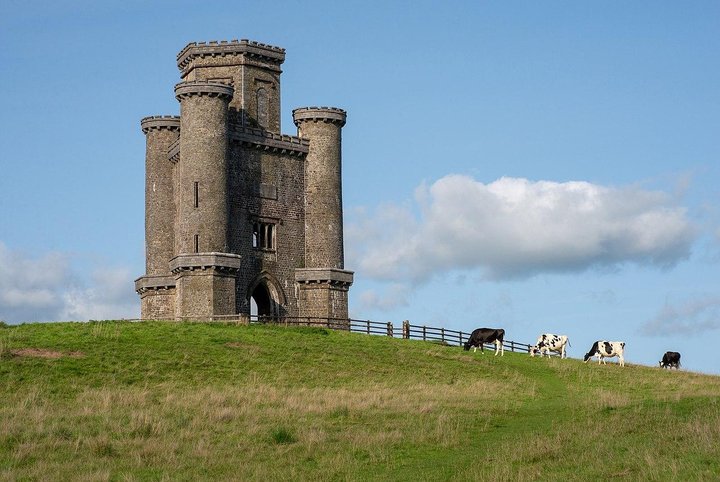
Paxton Tower in southwest Wales. Photo: Matt Phillips, via Wikimedia. Creative Commons license.
…unlike, for instance, Gustave Eiffel’s iconic tower, which doesn’t qualify as a folly, since it was built for a purpose. Financed largely by the French government, the 1,063-foot high tower was designed and built (in just two years!) expressly as the entranceway to the 1889 World’s Fair in Paris. It held the record for the tallest man-made structure in the world, twice the height of the previous record-holder, the Washington Monument, and only surpassed 40 years later by NYC’s Chrysler Building.
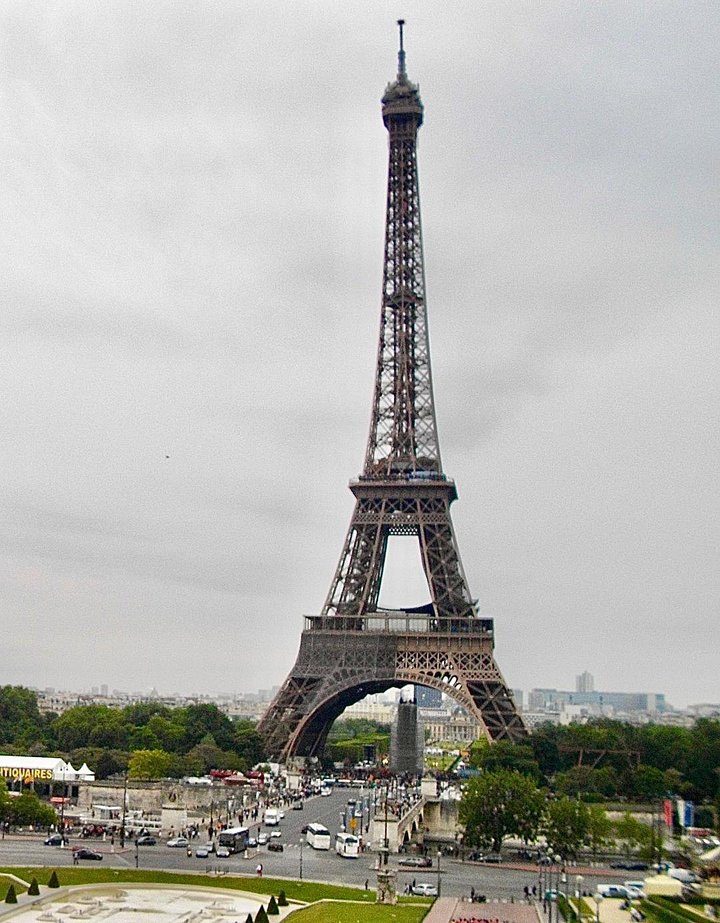
Photo: Barry Evans.
My favorite folly—actually an entire fever of follies—is located in Mexico’s Sierra Gorda, about six hours of winding road north of Mexico City. Las Pozas (“The Pools”) consists of about 30 useless structures commissioned by Bloomsbury-set English poet and eccentric, Edward James. It was built over a forty-year period starting soon after the end of the Second World War. Employing the services of Plutarco Gastélum, a Yaqui Indian with a bent for construction in reinforced concrete, James created a surrealist garden of stairs going nowhere, a bamboo forest (whose individual “stalks” are actually concrete), ornate arches, grottoes, and The House on Three Floors Which Will in Fact Have Five or Four or Six.
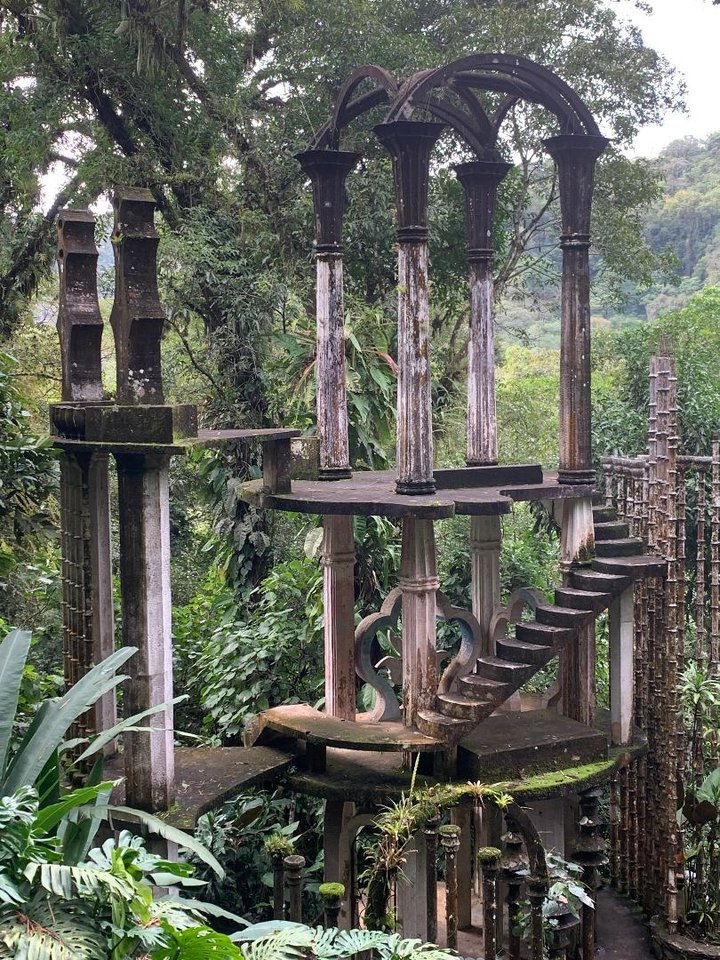
The Castillo, my favorite of James’ many whimsical structures. Photo: Barry Evans.
I was reminded of Las Pozas recently while visiting the Quinta da Regaleira palace and gardens outside Sintra, Portugal. Here, in the early 1900s, another wealthy eccentric, António Augusto Carvalho Monteiro, commissioned a mock palace, tunnels, lakes, fountains and terraces. Other than the palace, the main attraction is an “Initiation Well,” a throwback to Freemason initiation rites. Entering high on a hill overlooking the palace, wannabee initiates (like me) walk down the slightly challenging steep and damp spiral staircase. The idea, as I understand it, is to test our courage as we descend into the underworld (think of Orpheus’ attempt to rescue his beloved Eurydice from Hades). At the bottom, a maze of tunnels cut into bedrock leads to a waterfall and, finally, out into the Real World again.
As I say, a folly.
BOOKED
Yesterday: 12 felonies, 16 misdemeanors, 0 infractions
JUDGED
Humboldt County Superior Court Calendar: Today
CHP REPORTS
No current incidents
ELSEWHERE
100% Humboldt, with Scott Hammond: #129. You Don’t Have to Be Wealthy to Give Back | Sara Dronkers
RHBB: Trinity County Marks 25th Anniversary of September 11 with First Responder Commemoration Ceremony
RHBB: CDPH Issues Immunization Recommendations for 2026-27 Respiratory Virus Season
RHBB: Redway Transfer Station to Close an Extra Day for Construction
LETTER from ISTANBUL: Autumn Rhythms: Life in the ‘New Normal’
James Tressler / Sunday, Nov. 14, 2021 @ 7 a.m. / Letter From Istanbul
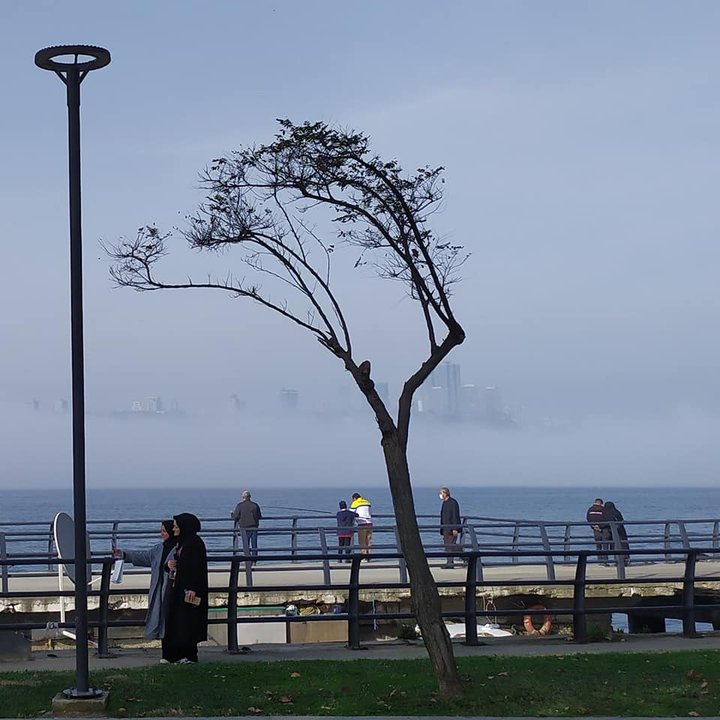
Photo: James Tressler.
Life begins all over again in the fall: That old saying is particularly apt this year.
In the city by the Bosphorus, students and teachers are back on campus (although we still have online lessons a couple days of the week). Seeing all the young people makes the city feel young and vibrant again. Their fresh
faces strike a stirring contrast to the fallen leaves, which lay scattered on the sidewalks in red, yellow and brown.
The city’s natural riotous rhythms have returned — the clamor of traffic, pedestrians crossing the crowded lanes, smartphones in hand; car horns puncturing the faintly misty air; the Bosphorus churning with ferries and container vessels passing under the bridges, the street musicians playing their saz and lutes in the tunnels and sidestreets.
With this rebirth of urban life, the anxieties many initially harbored about the “new normal” have more or less faded with the last rays of summer. Nationwide, nearly 60 percent of the population has been vaccinated against the virus, and in Istanbul that number is considerably higher. Overall, people seem to have turned a mental corner, and are determined to get on with the business of living.
That feeling prevails at the campus where I teach. Yes, we have to wear masks in the building and in the classrooms, which we all worried about at first, but so far the lessons have gone smoothly. The students enjoy seeing each other face to face again. After all, for them college is about socializing, seeing and being seen, flirting, hanging out, as much if not more so than the curriculum or prepping for their departmental studies next year. They feel like they are free to be young again.
In the classroom, they are more engaged than in years’ past. Of course, students are always like that in the first term, I suppose. They’re 18- and 19-year-olds, they’re excited and a bit impressed by this first step forward in their adult lives. By the second term, familiarity breeds contempt and they get bored with the prep program, anxious to get over to the main campus in Santral, to start “real” university. At any rate, it’s nice to see all their (masked) faces in person again.
On the home front, my wife Özge still has a few months left before she has to return to her job at the national palace. With me at the campus during the day, and the era of lockdowns behind us (touch wood!) she has finally been able to enjoy something of the idyllic maternity leave she had pictured in the days of her pregnancy two autumns ago. She takes our son Leo out for walks, or to museums, or to the aquarium to look at all the fish in the mornings, and during his afternoon nap, she’s able to have some quiet time to herself for a change. When I get home in the evening we take turns making dinner (depending on who’s got the energy), or go out to one of the local restaurants. Then we take Leo out again for a walk so that he’ll burn some energy and be able to settle down at bedtime.
On Thursdays and Fridays we have online lessons, so we go back to our old lockdown home routine, with me, the laptop and headset out on the balcony while Özge occupies Leo for a few hours until the lessons are over and we can head outside to catch the gorgeous afternoons.
On the weekends, we alternate between Kadıköy on the Asian side, and the shores of Beşiktaş and Karaköy over on the European side. In these glittering neighborhoods, the tourists have long since returned, for good or ill. I say that because the other night, after having tasty tantuni at a street food cafe in Karaköy, my wife wanted to grab some baklava from one of the famous places on our way to the ferry. While I waited outside with Leo in his stroller, she went in — emerging two minutes later empty-handed and frustrated.
“The queue is a mile long!” she said. “One Arab customer was ordering 10 kilos of baklava!”
“Ten kilos!” I exclaimed. “Who the hell needs that much baklava?”
“It’s to take home.”
As a local, at times you feel a bit pushed out in some places — or priced out. Inflation has been an issue for some time here — the lira limps along down 9-1 to the dollar, leaving locals to feel the crunch, while the tourists, with their dollars and euros, prance around raving about how “marvelously cheap everything is!” It’s nice to be them, I guess.
The tourists are generally well-behaved, though. We see a good deal of them in Kuzguncuk, a lovely seaside neighborhood that rests beneath the shade of reassuring chestnut trees, the sidewalks now freckled with their falling leaves. We often take Leo to the park there because he likes to kick his ball around and watch the older kids playing. The other parents bring their little ones too and they often come and take Leo’s ball and wander off with it, our son still too shy to stop them. The kids are all friendly, and their parents usually instruct their kid to give the ball back to “Arkadaşım” (“My friend,” the kind Turk address).
The tourists come into the park in groups, as part of a guided tour of the city that includes Kuzguncuk presumably. The ones we see most often are Italians, Russians, and Arabs, but recently I’ve overheard a few French speakers and have seen a few Asians too.
Most have their masks draped around their necks, which is OK in the city as long as you’re not in crowded areas like the markets; the park naturally offers lots of fresh, open air. The Russians for some reason never seem to wear masks, and seem a tad bit haughty about it, but then Russians have been coming to Turkey for ages — the southern coastal resorts, especially Alanya and Antalya practically become Russian towns in the summer. The signs and menus are in Turkish, English and Russian. During the worst days of the pandemic, the loss of Russian tourism was felt keenly in these areas. With their return, the Russians perhaps feel their self-satisfaction is well-deserved. Ah, well …maybe I’m just starting to sound like some grumpy local.
Walking through Kuzguncuk, with Leo walking beside us, my wife and I look at the people — mostly young — sitting at tables outside the busy cafes. On the weekends, they enjoy noon breakfasts, the famous Turkish kahvalti with all of its cheeses and meats and eggs and cream and honey spread on fresh simit bread, with tea in the hour-glass shaped glasses. With a toddler, we don’t have that luxury anymore, to wake up on the weekend whenever and be able to have late breakfast and afterward just sit as long as you want without a care in the world. The women are all young and fashionably dressed, elegant and lovely. Just like Özge, I remind myself — that’s right, you married one of them, remember James? That’s right.
I look at my wife walking beside me, and down at Leo, who’s helping push the stroller in his little determined way. We pass people having their late breakfasts and head back down to the intersection, where we can see the busy Bosphorus, the world and all its seasons, passing by.
###
James Tressler is a writer and teacher living in Istanbul.
Early Morning Fire at Brainard Destroys PG&E Building
LoCO Staff / Saturday, Nov. 13, 2021 @ 1:10 p.m. / Fire
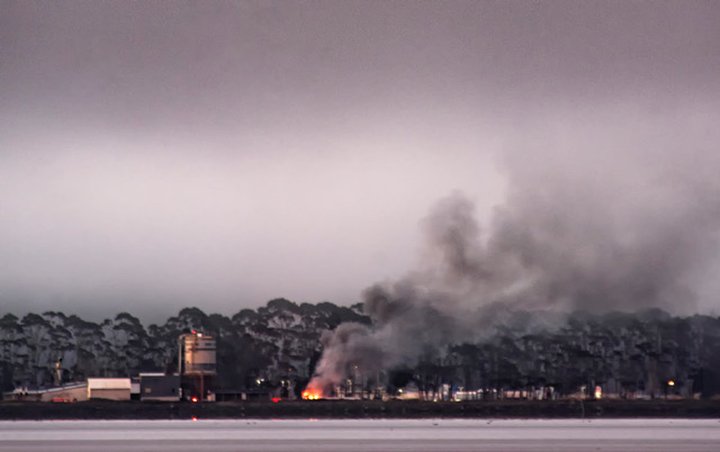
Photo taken by Dana Utman, from across the bay at the Arcata Marsh.
Press release from Humboldt Bay Fire:
On 11/13/2021 @ 0636 Humboldt Bay Fire responded to a reported Structure Fire at 5151 North HWY 101 in Eureka. Humboldt Bay Fire responded with 2 Chief Officers, 3 Engines and 1 Truck.
The first unit arrived on scene and reported a fully involved mobile office/storage building with exposures to vehicles parked nearby. The fire was declared a defensive operation and the first arriving Engine extended 2 hose lines, protected the exposures and controlled the fire in 15 minutes. Humboldt Bay Fire remained on scene for 1 1⁄2 hours to completely extinguish the fire.
The mobile office/storage building was owned and occupied by PG&E that contained a small office and storage of various tools and supplies. The building was a complete loss and a portable bathroom located next to the fire building was also damaged by the fire. Several PG&E service and bucket trucks parked near the fire building were not damaged by the fire.
Total damage is estimated at $360,000 and there was no civilian or Firefighter injuries. Due to the amount of fire damage to the building, the cause of the fire is undetermined.

Photo: Humboldt Bay Fire.
THE ECONEWS REPORT: Pomo Perspectives on Forest Protection at the Jackson State Forest
The EcoNews Report / Saturday, Nov. 13, 2021 @ 10 a.m. / Environment

Photo: Curtis, via Wikimedia. Public domain.
###
Chairman Michael Hunter of the Coyote Valley Band of Pomo Indians joins Gang Green to talk about his tribe’s work to protect the Jackson Demonstration State Forest. Chairman Hunter has been on the front lines of the struggle to protect sacred cultural resources and protect the redwood forest that his people have called home since time immemorial.
The Coyote Valley Band of Pomo Indians’ efforts to protect Jackson Demonstration State Forest is part of a larger story about how can America move towards reconciliation and reparation for lands stolen from native peoples.
AUDIO:
“The EcoNews Report,” Nov. 13, 2021.
REQUIRED READING:
- ”Tribal Chair Threatened in JDSF,” KZYX.
- ”Pomo Perspective: Priscilla Hunter and Polly Girvin on Jackson Demonstration State Forest Logging,” Trees Foundation.
- ”Please Join Our Journey to Save the Redwoods in the Jackson Demonstration State Forest,” Chairman Michael Hunter, YouTube.
- ”Protests in Jackson Demonstration State Forest Escalate in the Face of Unsafe Logging, Threats of Violence, and Harassment of Tribal Leaders,” Redwood Nation Earth First! Mama Tree Network
OBITUARY: Marie Judith Lorensen, 1945-2021
LoCO Staff / Saturday, Nov. 13, 2021 @ 6:56 a.m. / Obits
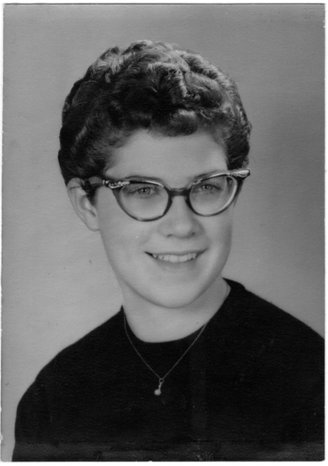
Marie Judith Lorensen was born January 19, 1945, in Eureka, to John and Gerry Lorensen of Elk River. She graduated from Eureka High School and was a resident of the Eureka area all of her life. She peacefully passed away October 27, 2021.
She had a strong work ethic and was an accomplished bookkeeper. She worked for several local companies such as Mack Trucking, Big Loaf Bakery, General Hospital, and Humboldt Moving & Storage.
Marie always enjoyed reading and her love of books led her to owning and operating The Paperback Exchange in Eureka for ten years. She was part-owner of the Lorensen family beef ranch on Tompkins Hill and managed it for fifteen years before its sale in 2010.
Marie loved animals, especially dogs and cats, and she was generous in her support of many abandoned or injured animals. She was a true patriot and loved our country, always supporting veterans’ causes. She was a loyal and caring friend to many. Marie was affectionately called “Aunt Ree” by her nieces and nephews. When she was younger, she enjoyed road trips in her latest sports car.
Marie was preceded in death by her parents, John and Gerry Lorensen, her brother-in-law, Don Michael, and her friend, Pansy Folkerts. She will be deeply missed by her two sisters, Jeanne Michael (Don) and Janice Roney (Larry), as well as numerous nieces, nephews, animals, and other family members.
Her family would like to thank all who provided loving care for her in her last days including friends, medical helpers and especially her Hospice caregivers. Marie requested no funeral service. In lieu of flowers, please donate to Hospice or to any animal shelter.
###
The obituary above was submitted on behalf of Marie Lorensen’s loved ones. The Lost Coast Outpost runs obituaries of Humboldt County residents at no charge. See guidelines here.
Mom of Bear River Murderer and Her Boyfriend Charged With Being Accessories After the Fact
Rhonda Parker / Friday, Nov. 12, 2021 @ 4:26 p.m. / Courts
Two people have been charged with being accessories after the fact to the Feb. 11 murders of three people on the Bear River Rancheria.
Mauricio Eduardo Johnson’s mother, Melissa Rene Johnson Sanchez, and her boyfriend, Von Eric Keener, are accused of aiding Johnson after he shot three people to death, then fled east. Keener was in the car with Johnson and Sanchez was in a vehicle following them when they were pulled over by the Utah Highway Patrol.
Both Keener and Sanchez were in Judge Christopher Wilson’s courtroom today, with Keener in custody and Sanchez free on bail. Sanchez appeared with attorney Kathleen Bryson, who said Sanchez had just hired her today.
Keener, a prison parolee already convicted of failing to register as a sex offender, is now accused of being an accessory to murder and is being held on $25,000 bail. He was barely recognizable today, because he has gained — a conservative estimate — at least 50 pounds.
Both were ordered to be back in court Monday so attorneys can agree on a date for the preliminary hearing. As of now Keener’s hearing is set for Nov. 23, but Sanchez and her attorney may want a later date.
Johnson has pleaded guilty to the murders of Nikki Dion Metcalf and Margarett Lee Moon, both 40, and Moon’s 16-year-old daughter Shelly Moon. He is scheduled for sentencing in January.
Public Defender Luke Brownfield was in court today for Keener. Deputy District Attorney Jane Mackey was there for the District Attorney’s Office.
GUTSWURRAK: Humboldt State Renames Student Activities Center to Honor Wiyot Legacy
LoCO Staff / Friday, Nov. 12, 2021 @ 4:08 p.m. / Education
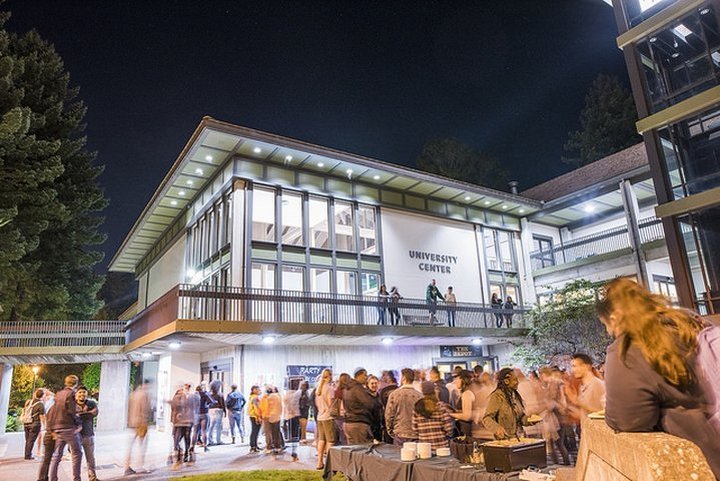
The soon-to-be Gutswurrak Student Activities Center. File photo: HSU.
###
Press release from Humboldt State University:
Humboldt State University will soon update the name of its student union to the Gutswurrak Student Activities Center, adding the Wiyot word for “gathering place” to the facility’s name. The naming recognizes the importance of the space as well as HSU’s location on traditional Wiyot land.
The name will be formally added and celebrated at an event early in the Spring 2022 semester.
Gutswurrak is pronounced “guts-wuh-dock”. The name was suggested by members of the Wiyot Tribe led by Wiyot Tribal Chair Ted Hernandez.
A request for the honor of such a naming was made by students and others who are part of the SAC Advisory Committee to re-imagine the activities and services offered in the Gutswurrak. Three possible names were suggested. Numerous groups and individuals were involved in a consultative process on the name that was ultimately selected. They appreciated the meaning of the word – “gathering place” – and how it could be seen as reinforcing the idea of the facility as a place for the entire Lumberjack family.
Discussions about this type of naming go back at least two years, and students have shared many ideas. In Spring 2021, students participated in a survey about the naming of the Student Activities Center, and many students commented that it would be valuable to have a name that honors the land where HSU sits.
HSU is located on traditional Wiyot land. HSU, in partnership with the College of the Redwoods, has adopted a formal land acknowledgement, which reads: “We acknowledge that the land on which Humboldt State University is located is unceded territory of the Wiyot people who continue to live and thrive today. It is surrounded by the traditional, ancestral, and present homelands of several indigenous nations including the Hupa, Karuk, Mattole, Tolowa, Wailaki, and Yurok that make up Humboldt County.”


