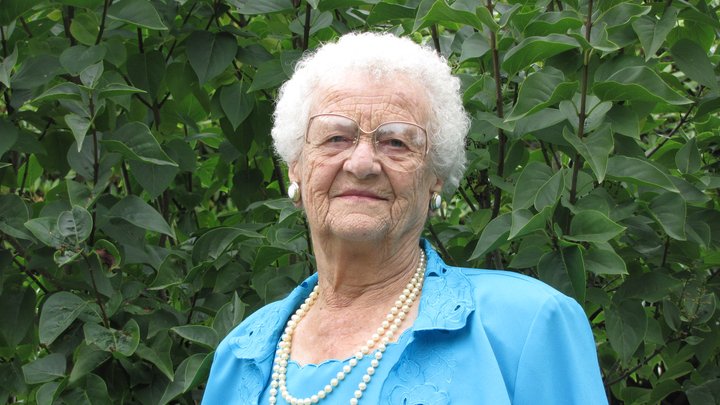
Loberta Bartlett Gwin passed away on
November 2, 2021 at Timber Ridge in McKinleyville at the age of 98.
Loberta
was born in Rio Dell (Stephenson Hollow) on December 19, 1922. She
had two sisters and a brother, both sisters are deceased, one just
recently. She lived in Lake County for a short time, but resided in
Humboldt County most of her life. Loberta attended elementary school
in Rio Dell, Yager Creek, Hydesville, and graduated eighth grade at
Rohnerville Elementary School. She graduated from Fortuna Union High
School in 1940.
After
graduation, Loberta worked as a secretary/clerk for Robert Newell in
Fortuna and later as a waitress in Fortuna. She spent a year at
Asilomar on a government project, was a telephone operator in South
San Francisco, and worked for the California Barrel Factory in
Arcata.
Loberta
married Donald W. Gwin after World War II. They lived in Arcata and
Blue Lake before moving to McKinleyville in 1950, where their three
children, Barry, Gerald, and Donette were born. While the children
were growing up, Loberta attended College of the Redwoods and
Humboldt State University obtaining her AA in Library Technology. She
was subsequently employed as the librarian at the McKinleyville
Elementary School, where she enjoyed her job and the students for 28
years.
Loberta
traveled extensively. In Norway, she and her husband, Donald, visited
his relatives. She has made several return trips to Norway. Loberta
and Don toured many parts of Canada and the United States. After her
husband passed away, a teacher friend, Pauline Webster, became her
traveling partner touring the British Isles and eight of the European
countries. She and Pauline also visited China, Australia, New
Zealand, Fiji, and Hawaii. She also took a cruise up the Inland
Passage to Alaska and with Pauline took a guided tour in South
America. Africa is the only continent she didn’t visit. She made
several attempts to tour a part of Africa, but something always
foiled her plans.
During
her children’s school years, Loberta belonged to the PTA (Parent
Teachers Association), was a den mother for Cub Scouts and a member
of CSEA. After retiring from school in 1991, she belonged to the
state CSEA and helped organize the retiree luncheons for the
McKinleyville Elementary School. During her working years, Loberta
attended quite a few of the state CSEA conventions and most of the
local conventions.
In
the past, Loberta attended the United Methodist Church in Arcata for
many years, was a member of the Humboldt Historical Society, the
Humboldt Pioneers, and was on the board of the Humboldt County
Library (McKinleyville Branch). For 20
years, she was chairperson
and organized the drivers for
the library’s
Author Festival.
Loberta
was very active with the Fortuna High School Class of 1940. For
several years, she helped with the class reunions and kept in touch
with most of the remaining graduates.
A
couple of her claims to fame: Loberta rescued the old Washington
School bell, which has been placed by the McKinleyville School
District Office. She also rescued the old Dows Prairie School bell, which is now located in its proper place at the Dows Prairie
School.
Loberta
completed a life-long dream by writing and publishing a book entitled
“Dow’s North of Mad River” and another book entitled “Hills
of Rohnerville”. She was a historian at heart and was always
looking up information, especially local history, which kept her
busy for many years.
Loberta
is survived by her three children, son Barry Gwin currently in Boise,
Idaho, son Gerald and his wife Julie Gwin of Santa Rosa, California,
and daughter Donette and her husband Ken Morris of Anderson,
California; and one grandson Philip and his wife Jennifer Gwin of
Brightwood, Oregon. She is also survived by her brother, Elwood and
his wife Deanna Bartlett of Arcata, California, and many nieces and
nephews.
Loberta
was preceded in death by her husband, Donald Gwin, parents Irving and
Dora Mary Ransdell Bartlett, her sisters Juanita Bartlett Waggoner
and Jean Bartlett Gwin.
Loberta
made many special friends throughout her life.
If
desired, memorial contributions may be made to the Humboldt County
Historical Society, Humboldt Library Foundation, or a charity of your
choice.
No services are planned at this time. A
celebration of her life in combination with her sister, Jean, will
follow at a later date. Loberta’s family would like to thank the
staff at Timber Ridge of McKinleyville and Hospice of Humboldt for
their caring and compassionate support.
###
The obituary above was submitted on behalf of Loberta Gwin’s loved ones. The Lost Coast Outpost runs obituaries of Humboldt County residents at no charge. See guidelines here.
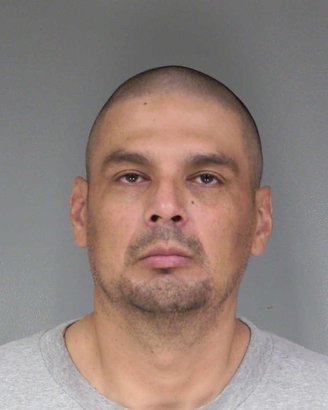
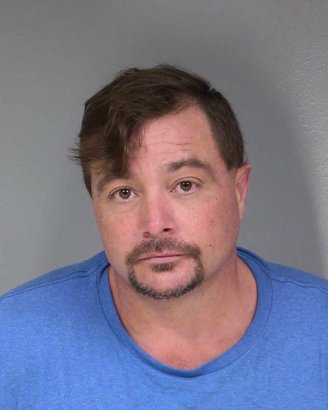
On Wednesday at about 11 a.m., detectives from the Fortuna Police Department located 47-year-old Von Eric Keener of Fortuna.
Von Eric Keener. | FPD
Mr. Keener, who was wanted by police on outstanding warrants, was located and taken into custody in the Loleta area.
Von Eric Keener had two active felony warrants for his arrest charging him as an accessory in a homicide investigation. Keener was also arrested for a violation/revocation of parole.
Keener was transported to the Humboldt County Correctional Facility where he was booked without incident.
The Fortuna Police Department remains committed to public safety. Any questions regarding this incident can be directed to the Patrol Commander, Lieutenant Matt Eberhardt at (707)-725-7550.
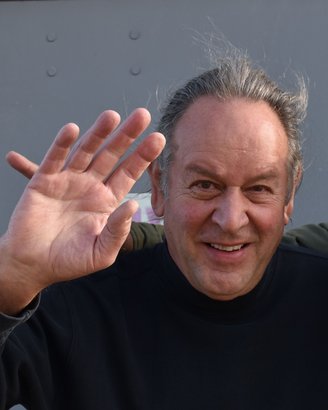
UPDATE, FRIDAY, NOV. 12:The EPD lets us know that Mr. Bridges has been in touch, and he’s fine.
###
From the Eureka Police Department:
The Eureka Police Department is asking for the public’s assistance in locating 71-year-
old missing male, Arthur Bridges. EPD took the missing person’s report on November
10, 2021 after family and friends said he was last seen November 3, 2021 in Eureka.
Bridges is a white male, 71 years old, 6’2”, 250 lbs, hazel eyes, and brown hair. He is
known to use two walking sticks to help get around.
Anyone with information regarding Bridge’s possible whereabouts is asked to contact
the Eureka Police Department at (707) 441-4044 or the nearest law enforcement
agency.
Open letter from the Humboldt County Human Rights Commission<:/p>
To Humboldt County
Board of Supervisors and all concerned parties:
The
following statement was approved by the Human Rights Commission on 9
November 2021:
A
CALL FOR IMMEDIATE ACTION FROM THE COMMUNITY
Humboldt
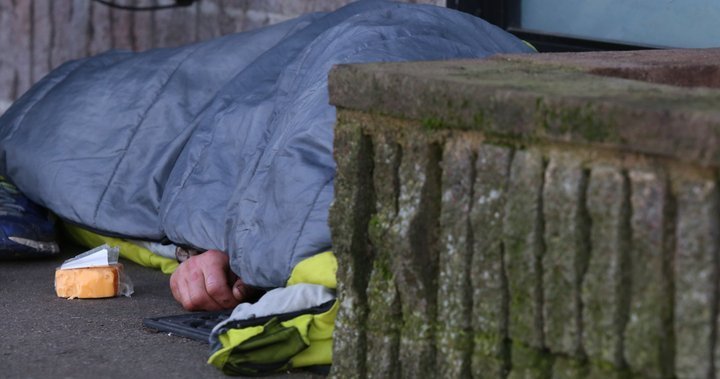
County has been declared a shelter crisis County in the State of
California. Humboldt County needs to comply with its own Resolution
No. 18-15 (Feb 2018) and all requirements of AB2553 (Chapter 147) or
risk the loss of funding and other consequences. Details can be found
in the August 12, 2021 letter from The Housing Trust Fund and
Homelessness Solutions of Humboldt County Committee Chair S. Lynn
Martinez [attached].
The
members of the Humboldt County Human Rights Commission recognize the
efforts of the Board of Supervisors to alleviate the aggravated
conditions of homelessness over the past decade and a half. We
applaud the numerous county agencies and local providers who have led
the way. But after nearly fourteen years, the problems related to
homelessness have gotten worse and the COVID-19 epidemic has
exacerbated the issue.
Meetings
with all the local entities have highlighted these seven concerns:
A
lack of a steady stream of funding
Substantial
barriers to receive federal and state funds (regulations)
The
need for education and legal services
Partnerships
with local clinics and mental health practitioners
Land
and infrastructure for affordable housing (access to restrooms and
clean, hot water)
Relaxing
zoning and regulations that restrict alternative living arrangements
as authorized by the state’s Declaration of Shelter Crisis
Safe
access to shelter and basic amenities including Wi-Fi
The
lack of housing and mental health care services is especially acute
and considering the new polytechnic designation of Humboldt State
University and its projected attraction of some 7-12,000 new students
will become even more oppressive.
Recommendations:
• The
State of California and Board of Supervisors in recent years have
established programs to convert old motels into housing and fund
hotel stays. Local providers have coordinated efforts to safely house
many. The Board of Supervisors must encumber more funds for the hotel
and motel conversions that have successfully provided temporary and
emergency housing for those in need and provide immediate assistance
to those in need as we enter the winter months. We should develop a
model that sees all homeowners as a shelter and safe parking for
people.
• Efforts
must be redoubled to acquire regular funding, coordinate with
federal, state, and local entities to keep funds allocated and not
lose them to bureaucratic barriers. Enlist support from the
California Center for Rural Policy to ensure Humboldt is set up to
receive and facilitate all federal grants and monies awarded to the
County for homelessness issues.
• Initiate
the largest building (and conversion) effort since the New Deal to
ensure all have housing who need it. We have the local talent to do
it! The state has authorized $12 billion to build 42,000 housing
units over the next 24-36 months. We should immediately fight to
secure our share of these funds.
• Provide
alternative living areas locally, specifically: legal campgrounds
with adequate safety and sanitation including showers and sanitary
supplies; safe parking areas, so we can avoid time consuming, costly
and unnecessary citations and further displacement of homeless
people; and restroom facilities. This would provide needed legal and
safe County designated areas to support the human rights to housing
and basic necessities for multiple homeless demographics in the
County, including for students. Immediately approve the trio of a
legal campground, safe parking, and restroom facilities on County
property in each of the following communities: Garberville, Fortuna,
Eureka, Arcata, Trinidad, and McKinleyville.
• Encumber
additional funds to extend and broaden a successful mobile showers
program that has served many and continues to support multiple
demographics in Humboldt County, as well as their implementation of a
model alternative transitional living pilot project for sleeping
cabins with a central facility capable of meeting the needs of the
residents for food preparation, restrooms, lighting, and waste
disposal.
• Enlarge
our mental health footprint taking the strain off local law
enforcement, freeing them to increase their presence in areas of
need. Sempervirens, a sixteen-bed facility, is an inadequate a
facility to serve an area encompassing over 300 miles radius. Eighty
or more beds in the Humboldt County Correctional Facility are devoted
to mental health care for the incarcerated; we definitely need to
focus on delinking the criminal justice and mental health systems. We
need better and more facilities for mental health treatment and
trauma recovery. A mental health philosophy built around
rehabilitation versus incarceration should be encouraged wherever
possible.
• Increase
the job training opportunities for people experiencing homelessness
and affordable childcare for those able to work.
• Add
and coordinate safe locations to power and access Wi-Fi so people can
stay in communication with loved ones, agency support, job search,
health care, emergency needs etc.
• Humboldt
County has missed critical deadlines required in the State’s AB
2553 law and we fear losing much needed funding opportunities. Our
suggestion is to appoint a well-connected and skilled Housing
Facilitator empowered to coordinate all relevant activities to get us
in compliance and prepare Humboldt County to receive the housing
funds provided by the state. And empower this position to access data
from all relevant state and federal agencies (Including the
California State Homeless Coordinating and Financial Council and
California Center for Rural Policy), and coordinate the work needed
from various county silos and program coordinators that serve these
people. Also expand the scope and amend the governing documents of
the Humboldt Housing and Homeless Coalition to include the local
tribes, all clinics for mental health services and make it accessible
for public participation. Provide the adequate funding and staff to
ensure successful impact in city and rural areas in both Northern and
Southern Humboldt. We also recommend performance requirements and
transparency to ensure we get this job done for our community.
• We
suggest a third-party agency expand the search for more funding
opportunities and manage the funding, so we have more helping hands
to support this effort.
We
expect the Board of Supervisors to respond to the seven concerns
listed above and specify which actions they will take by 12/15/21. We
sincerely believe it is in the best interests of our community that
we accomplish this without further delay.
Sincerely,
Mary
Ann Lyons Chair,
Humboldt County Human Rights Commission
Press release from the Humboldt County Sheriff’s Office:
On Nov. 9, 2021, at about 11:28 p.m., Humboldt County Sheriff’s deputies on patrol in the Redway area conducted a traffic stop for a vehicle code violation on the 50 block of Briceland Road.
During the traffic stop, deputies learned that the driver of the vehicle, 47-year-old Robert James Anderson, had an outstanding warrant for his arrest. Additionally, deputies observed a large bag of cannabis inside the vehicle in plain view. Deputies initiated a search of the vehicle, locating a loaded firearm and approximately 20 grams of methamphetamine.
Anderson was arrested and booked into the Humboldt County Correctional Facility on charges of convicted felon in possession of a firearm (PC 29800(A)), person prohibited in possession of ammunition (PC 30305(A)), possession of a controlled substance while armed (HS 11370.1(a)), carrying a loaded firearm in a public place (PC 25850(a)) and possession of a controlled substance (HS 11377(A)), in addition to warrant charges of possession of a controlled substance (HS 11377(A)) and possession of Nitrous Oxide (PC 381B).
Anyone with information about this case or related criminal activity is encouraged to call the Humboldt County Sheriff’s Office at (707) 445-7251 or the Sheriff’s Office Crime Tip line at (707) 268-2539.
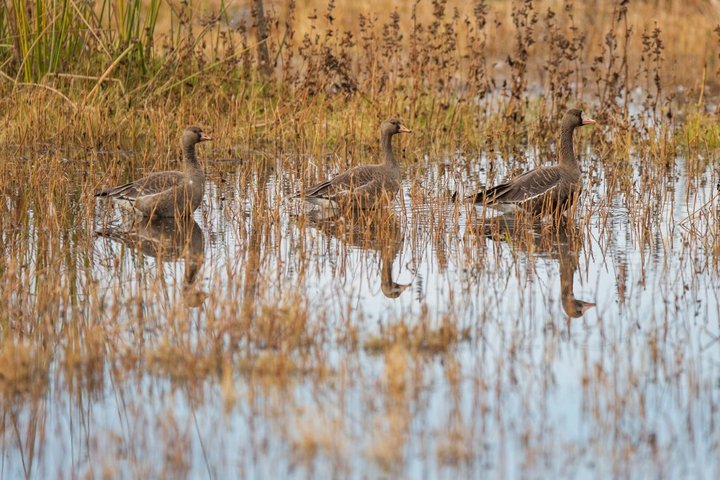
Snow geese fly over the Sacramento River National Wildlife Refuge complex in Willows on Oct. 6, 2021. Photo by Nina Riggio for CalMatters
###
It says something about the complexity of California’s water crisis that there are so many actors in the state’s water wars, all clamoring for more. Nature, alone, is silent in this fight, relying on others to speak on behalf of the welfare of wildlife and waterways.
Across the state, biologists, farmers and hunters are lending nature a helping hand. It’s sometimes an extreme intervention: trucking young salmon when drought shrinks rivers.
But this year these lifelines aren’t enough. Migratory birds — protected by state and national laws and an international treaty — are suffering mightily during this drought, even more quickly than they did during the last major dry spell, which lasted five years and ended in early 2017.
California is the most critical link in the 4,000-mile-long Pacific Flyway, a route along the West Coast where millions of birds shuttle between their summer and winter homes. It’s an arduous journey, hopscotching from wetlands and waterways, allowing birds to rest and refuel, shoring up strength for their trip.
Wildlife experts say this year’s severe drought has uncoupled that connectivity. Normal routes — long imprinted in migrating birds’ navigation systems — have gone haywire.
The great dryness has eliminated many of the flyway’s rest stops in California — particularly in the far north Klamath region — forcing ducks, geese, eagles, herons and other traveling birds to stay aloft and keep looking. Biologists in Northern California and Oregon say they are tracking flocks deviating far off established flight paths, seeking water where there is little.
Experts say evidence is already emerging a year into this drought that their labored journey is weakening and stressing birds that struggle to find wetlands along their journey to rest and feed.
This year is the driest on record in the Lower Klamath Basin, a lush region of marshes and streams that straddles the Oregon-California border. The refuges there are “almost completely dry,” said U.S. Fish and Wildlife Service spokesperson Susan Sawyer.
As a result, nearly all of the ducks have vanished. A recent aerial survey of the vast refuge showed about 34,000 ducks this year compared to 1.5 million in 1948; nearby Tule Lake refuge had only about 30,000 ducks in the survey, down from 3.5 million.
Geese forage at the Sacramento River National Wildlife Refuge complex in Willows on Oct. 6, 2021. Migratory birds are arriving at the refuge hungry and exhausted since wetlands farther north, in the Klamath region, are dried up. Photo by Nina Riggio for Calmatters.
In the span of a few human generations, even in years of plentiful rain, 90% of California’s wetlands have disappeared to development and agriculture, so migrating birds are especially vulnerable to prolonged droughts.
“The journey, from the human perspective, is enormous,” said Andrew Farnsworth, who researches bird migration at the Cornell Lab of Ornithology. “It requires a lot of energy. Some start in Alaska. Flights of 4,000 miles are absolutely quite common, and they will fly nonstop for a few days. Having the resources they need is critically important.”
Melanie Weaver, waterfowl coordinator for the state Department of Fish and Wildlife, has confidence in the ability of migrating birds to adapt, saying “ducks and geese are wired to go through drought. They don’t fall out of the sky. They have wings, they move where food and water is.”
But the widespread nature of this drought throughout the West, and its severity and potential duration, may challenge even the most resilient wildlife.
“I’m concerned that we are not going to see the populations come back,” Weaver said. “This drought is bad. The odds are against us.”
Even recent winter storms — which dumped rain across the north and central parts of the state and swelled some rivers and streams — made no dent to ease California’s drought, wetlands loss or water shortage.
“I’m concerned that we are not going to see the populations come back. This drought is bad. The odds are against us.” — Melanie Weaver, state Department of Fish and Wildlife
Resilient but still struggling
Resting and feeding spots at wildlife refuges are overcrowded this year, which can foster spikes in the infectious or water-borne illnesses spread by close quarters. Avian botulism and cholera, present even in wet years, spike in arid times. A botulism outbreak in the lower Klamath Basin last year killed an estimated 60,000 birds, likely many more.
So far the Klamath refuges have not experienced a severe disease outbreak like the one that took place last year. “But the spring could be a different story if birds leave the Central Valley early and return to the Klamath where there is little to no available habitat,” Sawyer said.
Klamath’s marshes, streams and grasslands provide vital stops during birds’ long journeys — more than 80% of migratory birds on the Pacific Flyway use them as a stopover in spring and fall. But the region has been one of the hardest hit in this year’s statewide drought.
Instances of young birds being “stranded” are amplified during drought. Dabbling ducks, which includes mallards and pintails, nest in upland areas and must walk to water sources. During dry periods those marches can be too long for young birds that have no flight feathers so they can’t survive. Biologists say this happens all over the state, even in normal years, but is more common during drought.
While the Klamath region is the hardest hit, wetlands farther south on the flyway are in bad shape, too. At the Sacramento River National Wildlife Refuge, the October bird count is not encouraging. By the third week in October last year, the rough waterfowl count was nearly 800,000 birds. This year, it was 600,000.
And, to illustrate how the intensity of this drought is coming sooner than the last: The refuge’s geese population today is less than half than it was for the same month in 2015, which was the region’s worst year during the last drought.
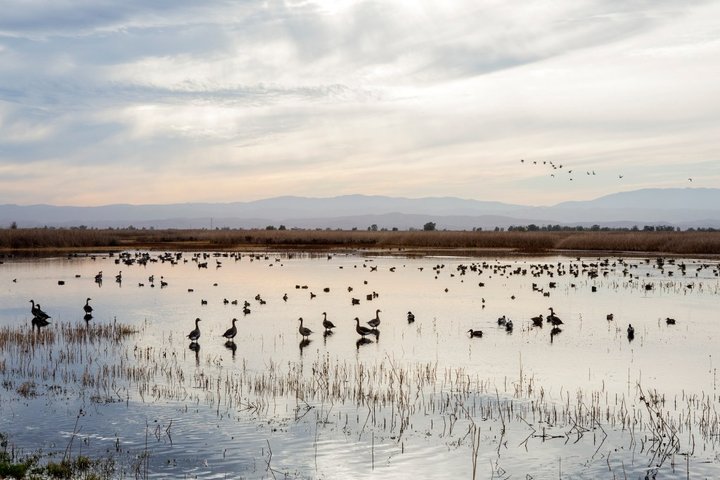
The Sacramento River National Wildlife Refuge complex received 75% of its water allocations this year. Photo by Nina Riggio for CalMatters
Biologists talk about the resilience of birds, hard-wired to just keep pushing on, but there is little good news now and even less for the near future. The National Audubon Society estimates that two-thirds of North American birds are at increasing risk of extinction because of climate change.
That vulnerability is repeated around the world: Only 9% of the planet’s migratory birds have protected areas along their routes, and loss of habitat and climate change is “a contributing factor to the decline of more than half of the migratory bird species across all major flyways in the last 30 years.”
Migrating birds, which a century ago filled the sky and blotted out the sun during trips along California’s long spine, need help.
To make the state more hospitable to migrating birds during the drought, state and federal programs are paying farmers to keep water on their fields. The state Department of Water Resources invested $8 million this fall. In the northern end of the Central Valley, agricultural land is flooded and managed as migratory bird habitat for exhausted annual travelers flapping in from as far away as Alaska and Russia.
“This past summer there was extremely reduced waterfowl reproduction on the (Klamath) refuge due to the very limited available habitat.” — Susan Sawyer, U.S. Fish and Wildlife Service
But the amount of water from rivers and lakes allocated for wildlife refuges has been cut back substantially this year. The Lower Klamath Refuge has been operating with half its water allocations from rivers and streams since 2006, but this year has been devastating: It received less than 1% of its allocations.
With the loss of more than 99% of its wetlands, few chicks were born in the refuge this year. Most birds didn’t bother stopping there to nest, moving instead to refuges the Sacramento area, which received 75% of their usual water allocation.
“This past summer there was extremely reduced waterfowl reproduction on the (Klamath) refuge due to the very limited available habitat,” Sawyer said.
Diagnosis: drought
The juvenile golden eagle, tagged as No. 2-21-0824, lay splayed on his back on a stainless-steel necropsy table at the state Wildlife Health Laboratory north of Sacramento. He had been discovered dead in Bakersfield, on the ground and emaciated, and taken to a wildlife rescue organization. His carcass was placed in a black trash bag, frozen and sent by FedEx to Krysta Rogers, head of avian investigations for the state fish and wildlife agency.
Rogers’ job is to discover what caused the young bird’s death. She selected large pruning shears, the sort gardeners might use to lop off a large tree branch. With a loud crack, she snapped the bird’s femur, setting aside a section of bone for further analysis.
Methodically examining the carcass, Rogers knew that the bird was not among the uncounted animals to succumb to drought-related causes. Instead, the young bird’s death was a case of bad housekeeping. It’s likely that the eagle’s parents brought home meals of especially fatty squirrels, Rogers said. The fat coated the bird’s wings, rendering it unable to fly. In a final blow, it’s possible that his nest-mate pushed him out of the family home to keep the food to itself.
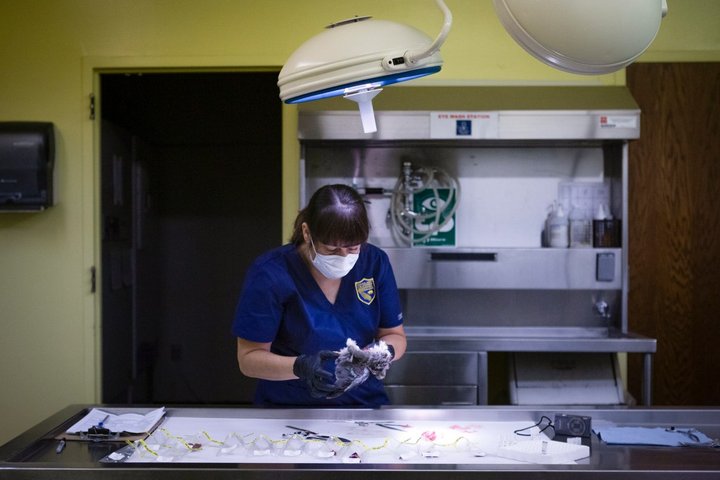
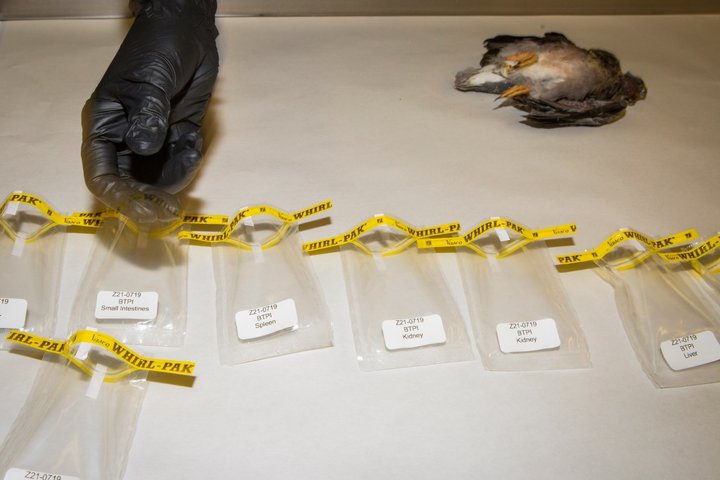
Krysta Rogers, a senior environmental scientist at the state’s Avian Investigations Wildlife Health Laboratory, gets ready to perform a necropsy on a band-tailed pigeon in Sacramento on Oct. 6, 2021. Photo by Nina Riggio for CalMatters
Photo by Nina Riggio for CalMatters
Ascribing a death to drought is a complex puzzle to solve, when nature offers so many ways to die. “It’s not often a direct, causative thing,” Rogers said, still hunched over the bird. “But we can say that in some cases it (drought) is a contributing factor” to bird deaths.
What drought does is render the already precarious existence for wildlife all the more dicey.
When normal weather patterns are off kilter, even in a small way, the impact on birds and their environment can be profound.
Birds can die during extreme heat events that sometimes accompany drought. That happened this spring and summer, with young barn owls dying of heat stress when sheltering in nesting boxes that people built in their yards in Contra Costa, Humboldt, Marin, San Diego, Stanislaus, Yolo and Los Angeles counties.
Water quality problems can occur when well-meaning people maintain backyard bird baths with stagnant, non-circulating water that speeds the spread of parasites. Disease can be spread when raptors or other animals prey on sick birds.
“Streams and creeks are not running like they typically would,” Rogers said. “Birds and other animals rely more heavily on artificial sources of water and food. I expect to see disease outbreaks at bird feeders and artificial sources of water such as bird baths and fountains.”
State wildlife officials can’t say with assurance that populations of migratory birds have declined; nearly two years of COVID-19 has grounded bird survey flights and this year’s winter migration has months to go.
But they have the last drought to go by, and that suggests migrating birds are in for trouble.
Scientists expect current data to mirror the declines during the height of the last drought. California’s population of breeding ducks in 2015 fell 30% compared to 2014, according to a U.S. Department of Fish and Wildlifesurvey.
“That didn’t surprise us,” said Weaver, of the state wildlife agency, who also sits on the Pacific Flyway Council. “Why breed when your habitat isn’t there? Local populations decline. They recover when conditions improve.”
Still, she said, the endless cycles of drought throughout the West, combined with drastic wetlands loss, could mean that migratory bird populations may not ever return to historic numbers.
Fields flooded for birds
In normal years, when water is plentiful and affordable, some 270,000 acres of winter rice fields in the Sacramento Valley are lightly flooded and available to receive wintering shorebirds, such as white faced ibis, great blue herons and many varieties of geese and ducks.
The Central Valley, with its usual bounty of food and space, supports 30% of the shorebirds and 60% of the ducks and geese in the entire Pacific Flyway, nearly 3 million ducks, 1 million geese and a half-million shorebirds overwintering annually.
Given the severe drought conditions and paucity of available water, there is substantially less habitat for those flocks this year. Luke Matthews, a biologist with the California Rice Commission, said his group estimates there are only 60,000 acres of flooded rice land this year. Adding the acreage supported by various state and private conservation programs brings the total agricultural winter habitat to just over 100,000 acres, Matthews said.
“We grow two crops: We grow rice and we grow birds.” — Nicole Montna Van Vleck, Montna Farms in Yuba City
Still, from the perspective of hungry, exhausted migratory birds, the Sacramento Valley must appear from the air like a spa retreat featuring an all-you-can-eat buffet.
Once settled, the birds will derive 50% of their diet from rice left on the ground after the fall harvest. As much as 300 pounds of rice per acre is available to birds after the crop is harvested.
Agricultural lands have proved critical for filling in the gaps from California’s wetlands loss. Dense, clay soil is nearly impermeable – a shallow vessel of water ideal for growing rice and hosting birds. Since air pollution concerns almost ended the practice of burning off rice straw after harvest, flooding harvested fields benefit both farmer and bird: While feeding in the fields, tiny bird feet and stomping geese churn and aerate soils, helping rice straw decompose, preparing the land for the next season’s crop.
A disparate collection of agencies and private groups is funding “pop-up wetlands.”Farmers are increasingly raising their hands to host wetlands, seeing a dual benefit: For rice farmers, winter flooding makes financial sense but also appeals to those with a conservation mindset.
“We grow two crops: We grow rice and we grow birds,” said Nicole Montna Van Vleck, president of Montna Farms in Yuba City.
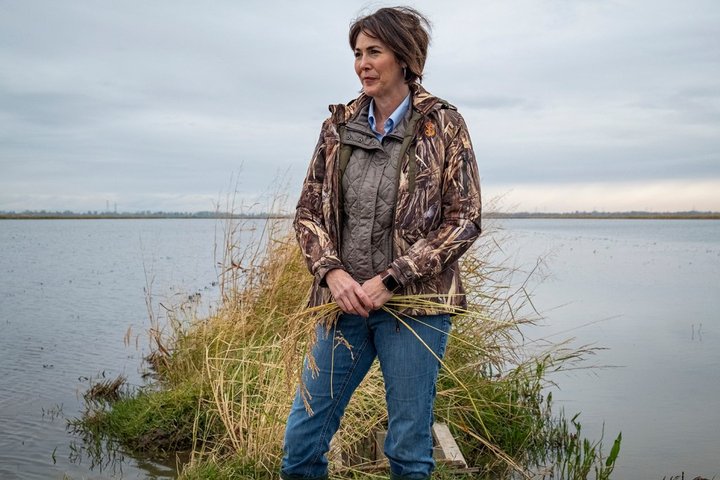
Nicole Montna Van Vleck stands on a levee holding stalks of rice at Montna Farms in Yuba City. Photo by Karlos Rene Ayala for CalMatters
Flooded fields on Montna Van Vleck’s sprawling 5,000-acre farm look like shallow kiddie pools. Some paddocks are dark with thousands of resting birds, with white molting-season feathers collected around the edges like a bathtub ring.
“Every season for me is awe-inspiring,” she said, surveying the flat expanse of water and birds. “You can almost imagine what it was like when this was a natural floodplain, when you get out here and see these ricelands work. We’ve created this ecosystem for them. There’s plenty of food for them. I never get tired of it.”
One conservation program, called BirdReturns, was launched during the last drought and is operated in part by Audubon California, the Nature Conservancy and Point Blue Conservation Science. It creates a marketplace for private landowners to provide shallow flooding, mostly for shorebirds.
A similar program, called Bid4Birds, operated by the California Ricelands Waterbird Foundation, encourages rice farmers to participate in a marketplace where they are compensated for the cost of leaving water on their land for migratory birds.
Paul Buttner, California Ricelands Waterbird Foundation’s executive director, called the outlook “really, really dismal.”
The BirdReturns program has a goal of creating an additional 100,000 acres of habitat available every year, said Rodd Kelsey, The Nature Conservancy’s lead scientist on the project.
Despite the gains made since its inception in 2014, “this drought is much worse,” Kelsey said. Rice farmers “will tell you that the water situation is something they have not seen since the late 70s drought.”
Paul Buttner, California Ricelands Waterbird Foundation’s executive director, called the outlook “really, really dismal.”
The severity of the last drought drove once-bickering sides into collaborative problem-solving. The drought was a “stark and shocking wakeup call,” prompting bird groups, farmers, duck hunting clubs and state and federal wildlife managers to begin conversations, said Meghan Hertel, Audubon California’s director of land and water conservation.
More than half of the wetlands in the Sacramento Valley are privately owned, operated by duck clubs established for bird hunting. Land managers regularly called each other to track birds on the move, Hertel said. “They’d say, ‘Hey I’ve got 100,000 snow geese coming your way, hold on to your water.”
A place of refuge
Steering an SUV through the slanting afternoon light at the Sacramento River National Wildlife Refuge, Craig Isola keeps a pair of binoculars handy. As deputy manager, Isola is trying to get a fix on how this drought might play out there.
The birds, he said, are arriving at the refuge hungry as they couldn’t find wetlands or food during their journey south.
“We are seeing birds show up earlier here because of lack of water in the north, in the Klamath Basin,” he said. “Historically birds will stage and hold up in the Klamath Valley before flying down to Sacramento. But when there’s nothing to the north, they move south. The birds are coming in hungry.”
“We are seeing birds show up earlier here because of lack of water in the north…The birds are coming in hungry.” — Craig Isola, Sacramento River National Wildlife Refuge
The Sacramento National Wildlife Refuge, operated by the U.S. Fish and Wildlife Service, is a string of five managed wetlands, seasonal pools and streams spread over 39,000 acres about an hour’s drive north of Sacramento. Established in 1937, the refuge provides critical wintering habitat for the Pacific Flyway’s birds.
Already, in October, tens of thousands of birds were scattered across the 10,000-acre Sacramento River Refuge, which is receiving water from Lake Shasta, via the U.S. Bureau of Reclamation, into the rain-starved marshes to accommodate the early arrivals. The refuge is operating on 75% of its usual water allocation, a generous amount compared to less than 1% at the Lower Klamath refuge and 16% at the Klamath region’s Tule Lake National Wildlife Refuge.
The refuge’s water grass and smartweed provide protein and fats to augment the carbohydrates birds get from the nearby rice farms. The flocks loaf in the refuge during the day and in the evening make their way to pick through the fields, where most of the rice is already harvested. It’s the time of day when the distant boom-boom of cannons echoes, fired off by growers to scare birds away from farms that have yet to harvest.
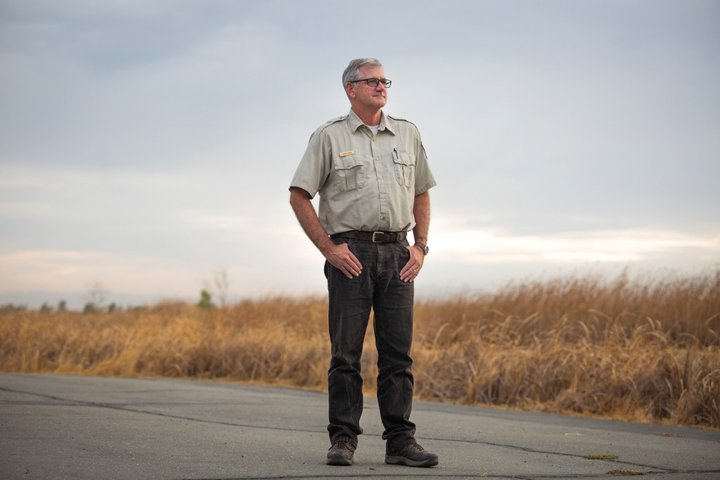
Craig Isola, deputy manager of U.S. Fish & Wildlife Service’s Sacramento River National Wildlife Refuge, said the health of birds is the most important indicator of the health of the refuge. Photo by Nina Riggio/CalMatters
The newly arrived birds are jumpy, Isola said, not yet settled into their surroundings. Dusk is a restless time at the refuge, with a constant soundtrack of chittering and squeaking. Even a hint of a raptor gliding overhead causes an explosion of wings and water as flocks take to the air. Bald eagles and peregrine Falcons won’t attack migratory birds while they are flying.
Wildlife managers have an obligation to support migrating birds under the Migratory Bird Treaty Act, and in some cases state and federal endangered species laws. Beyond that legal charge, the animals’ health is a window into California’s environmental stewardship.
“Wildlife are the ultimate indicators on how this land is doing,” Isola said. “They represent the idea of maintaining biodiversity and the ability to evolve into the future, for all of us.”
###
CALmatters.org is a nonprofit, nonpartisan media venture explaining California policies and politics.
A congressional map that splits Long Beach into two. The city of Fresno divided into three congressional districts. A state Assembly district in the Central Valley that could reduce the power of Latino voters.
These are only a few of the potential flashpoints as California’s independent redistricting commission slogs through its third week of working on early drafts of new legislative and congressional districts for the 2022 election and beyond — and as it prepares to release its official preliminary maps today.
But redrawing lines in response to public comments, advocacy groups’ pleas and commissioners’ own concerns can require cascading changes elsewhere, or could even mean blowing up entire statewide maps. And the pressure is on because commissioners face a compressed timeline.
Their foremost duty is to ensure every district in the state — 52 for Congress, 80 for state Assembly and 40 for state Senate — has about the same number of people. That’s about 761,000 Californians in each congressional district, about 988,000 in state Senate districts and 494,000 in Assembly districts. That can get complicated fast while trying to meet other requirements, such as not diluting any ethnic group’s vote and keeping districts geographically compact.
It’s even more complex this year because California is losing a congressional seat for the first time ever — and much of the tension centers on those maps. A series of marathon and at-times confusing meetings isn’t helping matters, either.
The commissioners have been discussing rounds of regional “visualizations” — hypothetical scenarios based on their direction to the line-drawers — while trying to incorporate some of the public input they’ve been receiving along the way, and in some cases going back to the drawing board.
In thefirstround of visualizations, for example, two longtime Black members of Congress were put in the same district in Los Angeles. That was fixed in the second round, but had ripple effects.
“Basically what we’re saying is, ‘The map is a hot mess.’ Is that correct?” commissioner Sara Sadhwani said at Monday’s meeting, referring to congressional districts in San Diego.
Then, there could still be significant changes between the preliminary maps and the final maps, which are due to the Secretary of State’s office by a court-ordered deadline of Dec. 27.
Especially given the condensed timeline, the preliminary maps won’t be perfect, said Fredy Ceja, communications director for the commission. The commission is already acknowledging that some districts still need a lot of work and that it will be doing a lot of line drawing next month.
“The commissioners have been very, very responsive to the community. So if the community has said, ‘Hey, we want to stay lumped together with this community,’ they try to make that a possibility,” he told CalMatters.
“And of course, you get instances where there’s conflicting public opinion or comment, where members of a community say they want to either go northeast, south or west. They’re trying to weigh those conflicting opinions. But they’ve done it with a smile on their face nonetheless. I think they’re pretty excited to be at this juncture.”
Here’s more detail on some flashpoints already drawing attention:
Partisan jockeying
Despite the mapping being done by an independent commission with a mix of Republicans, Democrats and independent members, the changes in districts still have ramifications for both parties — and hidden partisanship that continues to creep in.
And with control of Congress up for grabs, a lot of attention in California and across the country is focused on any built-in advantages for Democrats or Republicans in the new U.S. House districts heading into the 2022 election. That focus heightened after Republican wins in the Nov. 2 elections, including Glenn Youngkin flipping the Virginia governor seat.
Rep. Kevin McCarthy — a Bakersfield Republican who hopes to replace Rep. Nancy Pelosi of San Francisco as House speaker — claimed that any Democrat who won in 2020 by 16 percentage points or less wouldhave to fight for their seat next year. That would include six California House Democrats. But McCarthy, himself, could have a mostly new district, based on the latest draft maps.
Currently, Republicans hold 11 of California’s 53 U.S. House seats. The second round of maps suggested nine seats with an advantage for Republicans, according to an analysis by California Target Book, a political data firm.
The third set of lines showed nine districts where incumbents — some Republicans including Rep. Devin Nunes, as well as Democrats including Rep. Mike Levin — could face more competitive races, based on voter registration.
Diluting voting power?
Of the many challenges that the census data delay caused, the Voting Rights Act data analysis may have been one of the most consequential.
After population numbers, the second highest criteria is that the district lines must comply with the federal Voting Rights Act — specifically, ensuring that minorities have equal access to electing representatives of their choice.
In the initial scenarios, observers quickly flagged that longtime Reps. Karen Bass and Maxine Waters — both prominent Black Democrats — ended up in the same Los Angeles district. While that potential conflict was lessened because Bass is already running for Los Angeles mayor, the draft map resulted in only one district L.A. district with at least 30% African American voters and likely to elect a Black representative.
That criticism was resolved in the second round of visualizations released and debated last week, which included two L.A. districts with at least 30% Black voter registration. The latest maps keep those lines.
But James Woodson, policy director for the California Black Census and Redistricting Hub, said concerns remain about congressional districts that split Black communities throughout the Bay Area, particularly in Pittsburg and Antioch.
“It’s important that Black communities are kept together in this area,” Woodson said, pointing to the lack of resources for low-income residents.
Woodson said the Hub also remains concerned about the “packing” of Black voters in Los Angeles into fewer Assembly districts and limiting their “political voice.”
After releasing draft maps for the Central Valley, the commission was inundated with calls from residents of both Kern and Fresno counties, who were strongly opposed to being grouped together in a Congressional district.
Kern County residents spoke of concerns about competing water interests, as well as health equity, while residents from Fresno raised issues with the dilution of Latino votes by combining them with Kern County. But in the latest maps, they’re still together.
Fresno County residents also called in with their opposition to the city of Fresno being split into three different congressional districts.
Defining community
One of the cascading effects of preserving two Los Angeles congressional districts with sizable Black populations was breaking up Long Beach.
Commissioners noted the community input they heard from a broad swath of people in Long Beach, including the LGBTQ+ community and the Latino community, asking to unite the city in one congressional district. Now, Democrats Alan Lowenthal and Nanette Diaz Barragán represent parts of Long Beach.
In this week’s maps, Long Beach was split into two congressional districts. While commissioners acknowledged that wasn’t ideal, they said they wanted to be fair to other cities that were divided, including Irvine and other smaller cities.
If commissioners want to preserve the districts in Los Angeles and keep Long Beach together, however, they may need to cross county lines, something they initially tried to avoid.
Any changes to Long Beach could have a domino effect on the Vietnamese community in Orange County, which, despite residents’ calls to be grouped together as a community of interest, is in a congressional district that divides Westminster and Garden Grove.
This week’s discussions did yield wins for some groups. The commission was able to keep the Hmong community in Central California together. Across congressional and legislative maps, most Native American tribes were also kept together.
And while the lines could change, Equality California, the largest LGBTQ+ civil rights group, hailed the congressional districts in San Francisco for keeping the community together.
“This is a good draft for reactions,” commission Chairperson Trena Turner said Monday night after completing the latest round of congressional maps. “We feel better about the reactions.”
###
CALmatters.org is a nonprofit, nonpartisan media venture explaining California policies and politics.