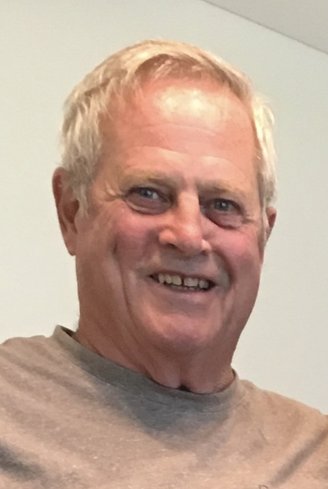
Ed always had a story to tell and a side story… now it’s our turn to tell his story. He loved his career of fighting fires just as much as his family.
Ed was proud of his family roots. His parents both came from large Irish farming families of Missouri. Ed had over 45 first cousins. He was born on November 9, 1948 as the third of four sons to Maurice and Madonna Brady in Santa Rosa. Ed attended Catholic school at St. Eugene’s Cathedral until 6th grade never letting a nun forget his name with his witty personality. He had a deep Catholic faith that he carried with him his whole life.
Ed attended Montgomery High school where he found his two loves wrestling and his high school sweetheart, Carolee Wiesenburger.
After high school in 1966, he started his summer job that turned into his career working for the California Department of Forestry. Ed was drafted May 8, 1968 and spent two Christmases in Okinawa. He was a military police officer. He enjoyed sharing stories of winning the iron man competitions, transporting prisoners back to the United States and driving way too fast on the island. Ed was like a walking map he rarely got lost, so it made out running the other military police fun. When he returned home, he continued his career with CDF working in the Santa Rosa area. He married Carolee September 4, 1971 and shortly after they moved to Garberville/Redway and started their life together raising their daughters Heidi and Deborah.
Ed was actively involved in many volunteer community groups. He joined the Redway Volunteer Fire Department in 1976 and became fire chief in 1993. When he retired from CDF 2002, he handed over the chief position to Brian Anderson, so he could travel to Alaska with their good friends then around the states in his fifth wheel with his sweetheart. He continued volunteering with the fire department as a commissioner until 2019 when his health issues became too much.
Ed enjoyed living and raising his family in Southern Humboldt. He loved to fish, rock pick abalone, he play softball for a number of years with CDF friends traveling to Elk Grove for tournaments and watching football. Ed loved to tailgate with friends at the Niners games. He watched his final 49er game with his grandson, Caden by his side before he passed. He also enjoyed his favorite holiday St. Patrick’s Day cooking corned beef and cabbage for his family, friends, and as a fundraiser for his church. It was always fun to toast with green beer straight from the keg celebrating his Irish roots. While his daughters were young, you could always count on him to volunteer with the PTA, booster club and 4-H. He also volunteered many hours helping coach wrestling in the ‘70s and the ‘90s at South Fork High School, sharing his passion of the sport.
Ed was very proud when his family started to grow. Heidi married Tony Harrison and Deborah married Joe Sauls. He was proud of both of his son in laws and the men they are.
In 2001, his first grandchild, Kenzy, was born and through the years Chaz, Caden, Mason, Gavin, Kegan and Ryden joined the family. Ed’s grandchildren were so important to him. He enjoyed spending time and making memories with each of them. He was most proud watching his grandsons find the joy of wrestling on the mat. Ed could always be heard when he was cheering.
He enjoyed his retirement years traveling to Yuma with his wife every winter spending time with friends going to Mexico on day trips, riding quads in the desert and visiting with friends, but his wife, daughters and their families was his world. Ed always made it a point to make it home for the holidays.
Sadly, Ed passed away September 22, 2021 at his home of 46 years surrounded by the love of his family. He is now reunited with his parents, brother Jim, his best friend from childhood, Tim Keegan and his firefighting buddy Jack Young. He will be dearly missed by his wife of 50 years Carolee, daughters Heidi (Tony) Harrison and Deborah (Joe) Sauls. His grandchildren: Kenzy, Chaz and Caden Harrison and Mason, Gavin, Kegan, and Ryden Sauls. His also leaves behind brothers Bob Brady, Ron (Evangeline) Brady, his sister in laws: Toni Harper and Margie (John) Cline along with many nieces, nephews, cousins and friends.
The family is having a small Catholic funeral on Saturday, October 23 at Our Lady of the Redwoods Church. We welcome everyone to attend the celebration of life on May 14, 2022 at 1 p.m. at the River Walk in Fortuna. Please come and share stories and memories
###
The obituary above was submitted on behalf of Ed Brady’s loved ones. The Lost Coast Outpost runs obituaries of Humboldt County residents at no charge. See guidelines here.
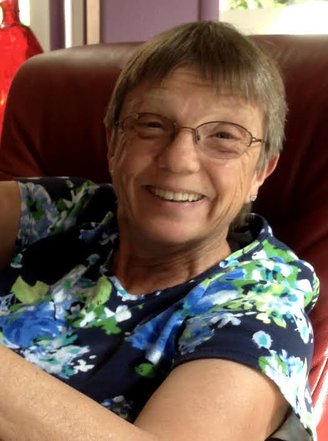
Dr. Wendy L. Woodward RN, PhD, 69, died after sunrise Sunday, October 3rd at home with her family present, after her battle fighting cancer. She was born in Bremerton, Washington and grew up in Ventura, and spending nearly all of her adult life in Humboldt County.
Wendy was a registered nurse and nursing faculty for Humboldt State University program from 1979 through her retirement as the chair of the Nursing program. She loved anything to do with being in the water, reading books, the beach, walks and hikes.
Wendy gave back to the community through her volunteer work at the dog shelter, Hospice of Humboldt and pulling ivy with the California State Parks.
She is survived by Susan Forbes, her domestic partner of over 35 years; sisters Sue Hanson and Gayle Carter; nieces Jaime Hannans, Kim Carr, Heidi Hanson, and nephew Ricky Hanson; cousins Candy, Ronnie, and Gary Lindstrom; and many good friends.
A celebration of life will be planned in Humboldt County in the near future. Messages, memories, or inquiries for Wendy can be sent to the family to: Jaime Hannans, 2078 Arcane Street, Simi Valley, CA 93065 or jaime.hannans@gmail.com.
###
The obituary above was submitted on behalf of Wendy Woodward’s loved ones. The Lost Coast Outpost runs obituaries of Humboldt County residents at no charge. See guidelines here.
Late Friday afternoon, the California Center for Rural Policy — the Humboldt State-based organization that is helping the county draw its new electoral maps — released the first set of draft plans that’ll go before the county Redistricting Advisory Committee next week.
What do we have? Let’s take a look.
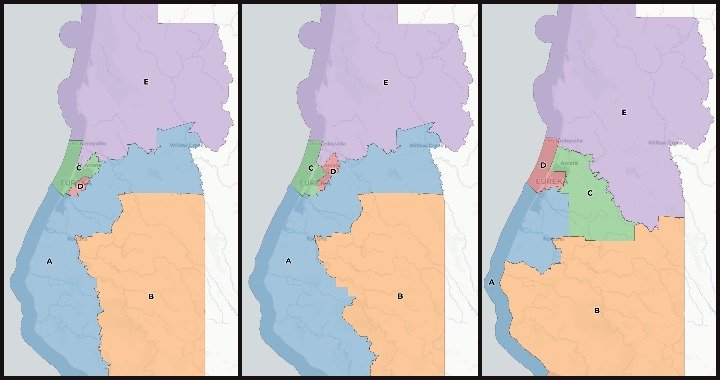
In all, they’ve published three draft supervisorial maps, largely based on the feedback the advisory committee has received to date. (Which has been relatively little.) Two of these maps are a dramatic departure from the way the county has been divvied up in the past, which the third more or less follows traditional lines, with a few tweaks to adjust for population trends.
The County of Humboldt is currently soliciting feedback on these draft maps. You can submit yours at this link, and/or attend the next meeting of the county’s Redistricting Advisory Committee, which has been rescheduled to Friday, Oct. 15, at 10 a.m. Check this page for an agenda and Zoom links when they become available.
The Humboldt County Board of Supervisors will have final say over any approved map, and is currently scheduled to hear feedback from the Redistricting Advisory Committee some time in November. Since there’s a Dec. 15 deadline
So let’s take a look at these new plans. As a refresher, here’s the status quo:
Unfortunately, the draft plans, which follow, are currently only available in PDF format, which we can’t plot on a map as above. We’ll update with better maps when we can. (UPDATE, Tuesday morning: The County has now published better maps. They’re included below.)
If you’re looking for further demographic detail on each of these plans, click the link at the end of each section below. They’ll give you the full numeric rundown on the population of each of these proposed maps by raw numbers, race and ethnicity. With one exception, that is — the mapmakers neglected to analyze the Native American population, a major faux pas that will surely be corrected shortly.
Draft Plan A
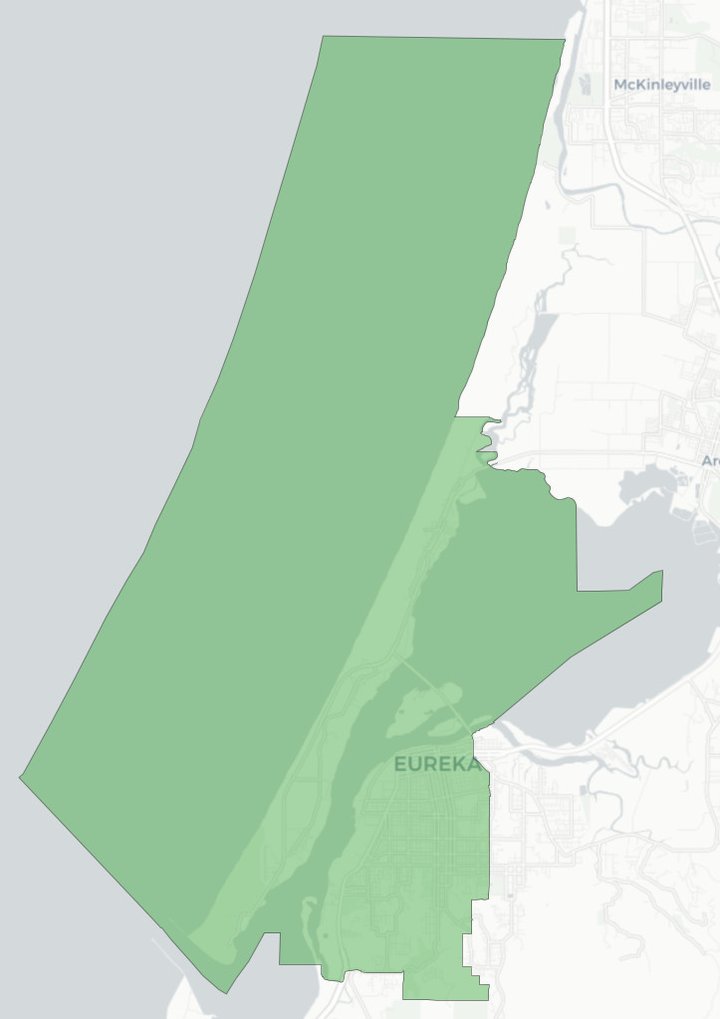
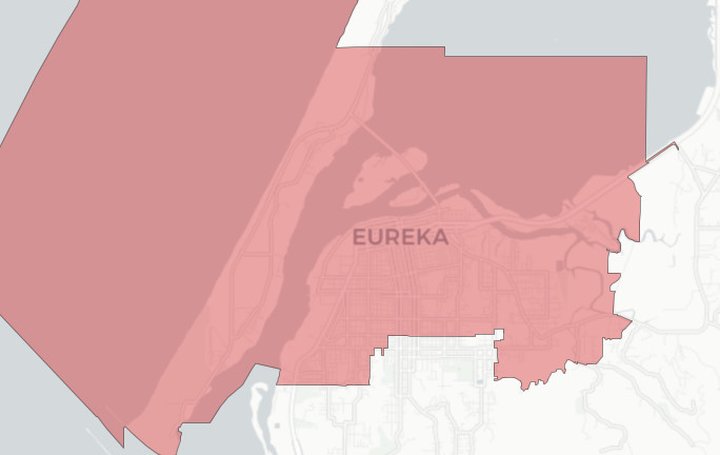
The first of these draft maps is the one we foreshadowed last week, when we wrote about the out-of-left-field push by a couple of citizens to incongruously unite the city of Arcata with the northwest corner of Eureka.
The first thing to say about Draft Map A is that, as it stands, it is probably illegal. California Elections Code requires that …
[t]o the extent practicable, supervisorial districts shall be geographically contiguous. Areas that meet only at the points of adjoining corners are not contiguous. Areas that are separated by water and not connected by a bridge, tunnel, or regular ferry service are not contiguous.
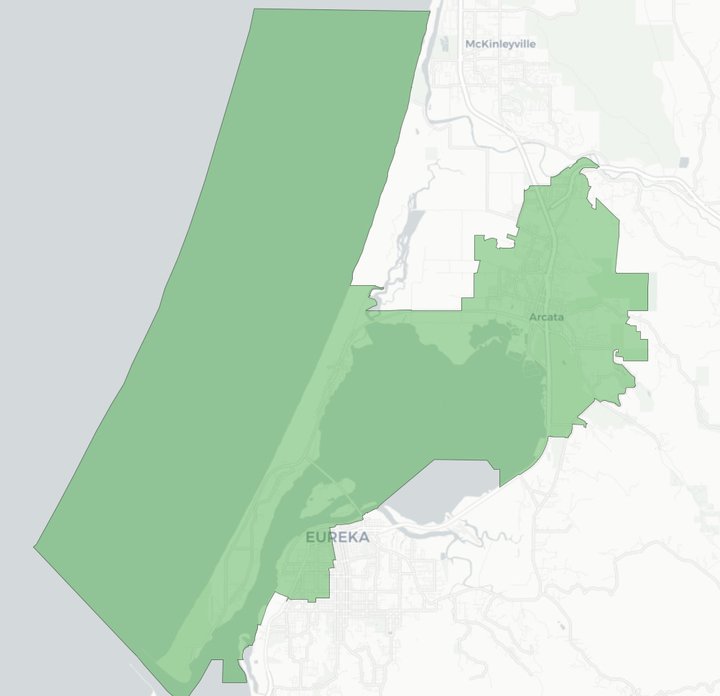
This is the case here — they are not contiguous — though Redistricting Partners, the out-of-town consulting firm that drew these maps, probably wouldn’t have any way of knowing it. Though the map tries to use the peninsula and the Samoa Bridge as connectors between the two disunited lobes of what they refer to as “District C,” it doesn’t quite pull it off. This District C cuts off at Waterfront Drive, which passes underneath the bridge; you have to be in nearby District D to actually get on the bridge.
Plan A’s Third District.
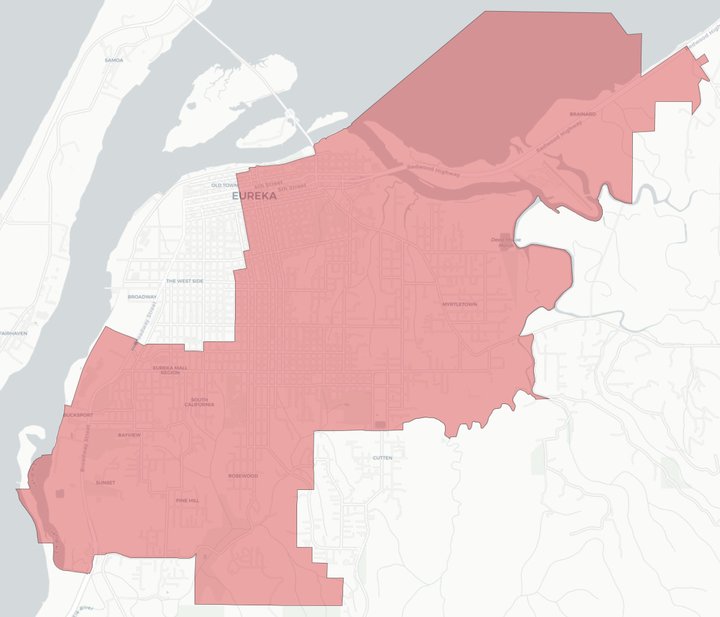
That’s a small point and one easily adjusted-for, though. The map is a radical adjustment to the way things are — and not only for its most radical feature, which is the Arcata-Samoa-West Eureka reacharound that ends up dividing Downtown and Old Town Eureka in two. (To compensate, Eureka reclaims Henderson Center and south, including Pine Hill, Rosewood and Lundbar Hills.)
Plan A’s Fourth District.
In addition, it removes the Arcata Bottoms from Arcata’s district, giving them to McKinleyville, and creates a vast, sprawling beast of a thing out of what is currently Rex Bohn’s First District. The First would begin all the way up north in Willow Creek, jog down to Blue Lake, take in Fickle Hill and Kneeland and touch at Indianola before swerving around to Cutten, jumping Highway 101 to Loleta and Ferndale, and then shooting down the Lost Coast through Honeydew and Petrolia … all the way to Shelter Cove!
Plan A’s First District.
To compensate for the loss of Shelter Cove, Draft Plan A offers the the SoHum-centric Second District — here called “District B” — the current First District’s famous protuberance up the Eel River Canyon … including, possibly, Scotia? It’s not clear to me from the low-res maps we have been provided.
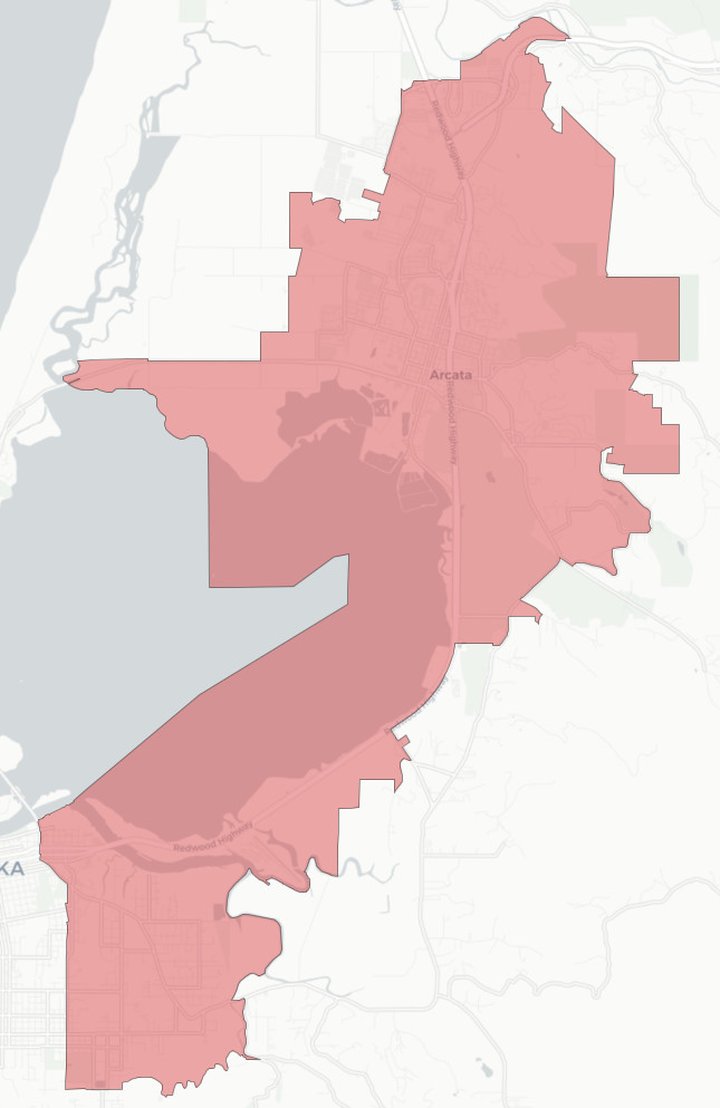
As with Draft Plan A, which it resembles in most particulars, the goal of Draft Plan B seems to be to pack city-dwellers around Humboldt Bay into as small a space as possible. In this case, it seeks to accomplish that goal by adding Myrtletown and the east side of Eureka, rather than the city’s northwestern quadrant, to the Arcata-centric district. In this case, Eureka would assume control of the entire Samoa Peninsula.
The rest of the map is, to the naked eye and without the ability to zoom in further, nearly identical to those presented in Draft Plan A, though the border between the First and Second districts (in blue and yellow) shifts a bit. McKinleyville snatches up the Arcata Bottoms. The current First District still cuts that broad and odd parenthesis from Willow Creek to Shelter Cove.
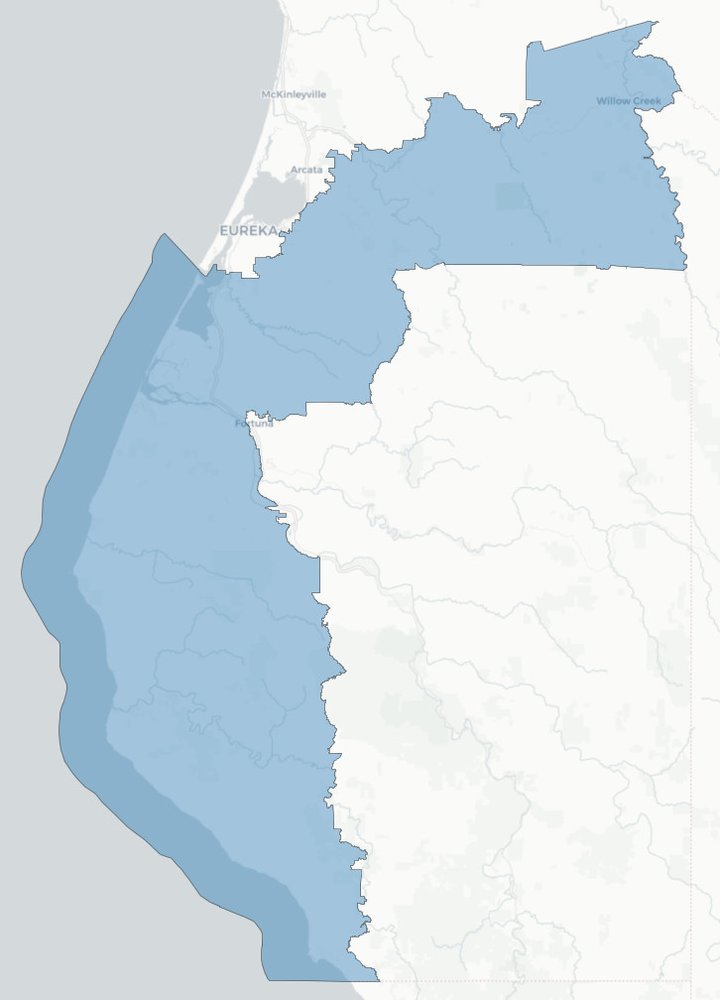
Draft Plan C is very close to the current 2010 map, with a couple of small adjustments. Eureka dashes out eastward a little bit to take in more of the Myrtle Avenue corridor and the First District is, for some reason, lopped off somewhere north of Petrolia, which moves into the Second. (That strip of blue you see running south is pure ocean.)
Plan C’s Fourth District.
With these low-resolution maps, it’s not clear to me where the First makes up for that loss of population in the Mattole. (UPDATE: Now, with the new maps it is clear — the new First takes in part of Fortuna.) But in addition to being the least radical option on the table, Redistricting Partners calculates this to be the most population-balanced of the maps, with the largest variance being within 2.2 percent of the ideal. (The Arcata-centric district has 2.2% more people than would be ideal.)
On October 8, 2021, at about 8:12 p.m., officers with the Eureka Police Department
responded to the 3300 Block of Broadway for the report of a pedestrian collision
involving multiple vehicles.
The pedestrian suffered critical injuries as a result of the collision. Humboldt Bay Fire
and City Ambulance responded and provided emergency medical care and
transportation to the hospital. At this time, the male pedestrian remains in critical
condition and has not yet been identified. The pedestrian appears to be a white male
possibly in his 30’s, reddish brown facial hair, and no obvious tattoos.
Based on the preliminary investigation, it appears the pedestrian was struck by three
separate vehicles, one that was traveling northbound and two that were traveling
southbound. All three drivers remained at the scene and were evaluated for DUI.
Impairment does not appear to be a factor.
This is an active and ongoing investigation. Any witnesses to the collision or anyone
with information on the possible identity of the pedestrian is asked to contact the
Eureka Police Department at (707) 441-4060.
At about 9:15 p.m., while investigating the aforementioned unrelated critical injury
collision on Broadway, additional officers with the Eureka Police Department responded
to the intersection of Broadway and W Henderson Streets for the report of a semi vs
bicyclist collision.
Officers located the male bicyclist down in the road and began life saving efforts.
Humboldt Bay Fire and City Ambulance responded and continued emergency medical
care and transportation to the hospital where he was ultimately pronounced deceased.
Next of kin has been notified and the pedestrian has been identified as 49-year-old
Michael Wray Robinson of Eureka.
The driver of the semi-truck remained on scene and was found to not be under the
influence after voluntary sobriety tests. This is an active and ongoing investigation and
anyone with information is asked to contact the Eureka Police Department at (707) 441-4060.
The Eureka Police Department would like to thank the Humboldt Bay Fire Volunteers
and the Community Emergency Response Team (CERT) for assisting during this
incident.
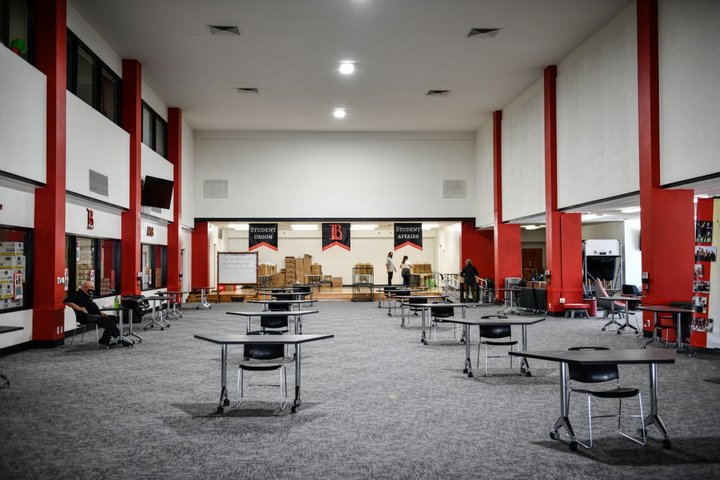
Tables are seperated for social distancing measures inside the student affair’s building at Long Beach City College, Liberal Arts Campus, on June 8, 2021. Photo by Pablo Unzueta
###
For California’s higher-education system, the seemingly endless summer of good budget news came to a screeching halt Friday night when Gov. Gavin Newsom vetoed the most consequential legislation to college financial aid reform in a generation.
With Newsom’s dissent, Assembly Bill 1456 won’t become a reality, rebuffing a Legislature that unanimously supported the legislation. It would have increased by about 150,000 the number of community college, Cal State, University of California and private college students eligible for the Cal Grant — the state’s chief financial aid program. It would have done this by expanding eligibility to students who are low-income but for various reasons can’t access the grant today. Cal Grants last for four years of full-time enrollment for all students.The veto affects community college students far more than any other, though. Roughly 110,000 more students at community colleges would have become eligible for the Cal Grant. Without it, they lose out on $1,648 a year while in community college and free tuition at a Cal State or UC. And though Cal State and UC students are also affected, another financial aid plan in the works will include them, but not community college students.“This bill results in significant cost pressures to the state, likely in the hundreds of millions of dollars annually” and should have been included in the annual state budget process rather than as a standalone bill, the governor wrote in a veto statement. It landed in reporters’ inboxes Friday evening while much of the state was glued to the first playoff battle between Major League Baseball archrivals the Los Angeles Dodgers and the San Francisco Giants.
Evidently, Newsom was unpersuaded by the appeal from the bill authors — who are Democrats like he is — as they urged him to sign the legislation. “We cannot wait for another budget windfall,” they wrote for CalMatters this month. “The state must do this now.”
They vow to come back next year with a similar bill and try again.But Cal Grant reform “cannot be accomplished solely through the budget process,” the authors wrote in a statement Friday, countering Newsom. “2021 should have been the year that we enacted debt free college, and California has missed that unique opportunity.”
This setback may be the most grueling yet for champions of the bill. For several years lawmakers failed to prime the financial aid pump as major bills fell short due to their ambition and price tag. With California awash with cash, this year was supposed to be different. But concerns grew about the bill’s chances after Newsom’s Department of Finance came out against it in August, citing its huge expenses.
Bill costs sank it
The bill’s backers initially said it would costabout $83 million a year plus an extra $58 million over the first three years of the program. After the state budget in July poured more money into higher education, a key bill supporter said the annual cost of the proposed aid infusion was fully covered by the new money lawmakers committed to college students. But the Finance Department disagreed, writing that the bill would require about $175 million a year in new state spending on top of the $58 million in one-time costs.
“A nearly $200 million difference of opinion on how much a bill costs is quite a lot,” you might reasonably be thinking. The disconnect comes down to budgetary assumptions. The California Student Aid Commission, which oversees the Cal Grant, argues that the bill’s new costs are baked into the existing budget. Because the Cal Grant is an entitlement, anyone newly eligible for the grant would get it in the future, so the cost of the program rises by default. But the Department of Finance thought the aid commission’s projections overstated the existing costs of the Cal Grant, making the bill seem less expensive than it really is.“So we think (the aid commission’s)comparison is a little bit of apples and oranges,” said H.D. Palmer, the department’s spokesperson.
It’s a difference of methodological opinion that ultimately felled the bill.
That the department opposes a bill isn’t a sure-fire death sentence. It also didn’t back a major bill this year that overhauled how students transfer to a Cal State or UC. Newsom signed that one this week anyway, but its costs — about $130 million one-time — were minor compared to what the department said this Cal Grant bill would cost.
The bill’s death is an unceremonious final note to this year’s extraordinary deluge of cash — a whopping $47 billion in total money — for the state’s college students and the schools they attend. Most of the increased spending compared to last year is one-time in nature though, fueled in part by federal stimulus that compelled Sacramento lawmakers to try out new programs that don’t have to be funded annually. The Cal Grant, however, is an ongoing state expense — and governors would rather dole out cash for one-time projects to manage the state’s coffers.Newsom “had the resources and chose not to invest in students shut out from opportunity who have been pleading for greater assistance for years,” Brian Rivas, director of policy and government relations for the research and advocacy group Ed Trust West, said in a statement. “This hurts.”While much of the $3.3 billion in new general fund money from this year’s budget went to the institutions themselves, students also directly benefit from the bonanza:
$500 million for the state’s public colleges to build affordable rental units for low-income students, with plans to spend $2 billion total in three years (a sum experts say is nowhere near enough);
$500 millionin education grants of up to $2,500 for workers who lost their jobs due to the economic fallout of the COVID-19 pandemic starting in 2022;
A “debt-free” grant for low- and middle-income students that, if funded next year, will cost $632 million annually and may swell to three times that once fully in effect.
Debt-free grant versus expanded Cal Grant
It’s possible that Newsom felt that a promise of a debt-free grant makes another bill to expand the Cal Grant unnecessary. He cited the debt-free program, an expansion of the Middle Class Scholarship, in his veto message as one of the many goodies heading students’ way.
But the debt-free grant has one glaring omission: It doesn’t plan to provide any aid to community college students, even though they have the same housing and food costs that Cal State and UC students do. One analysis shows that low-income students on average pay more to attend community colleges than nearby Cal State or UC campuses because students at those four-year systems get more financial aid overall. Excluding community colleges saves the state money, though; a previous debt-free bill for community college students was estimated to be as high as $1.4 billion annually.
Community college students who receive more types of federal and state aid are more likely to continue their studies, according to an analysis by a research group at UC Davis. That doesn’t mean it’s for sure the case that more money leads to better academic results, the researchers cautioned. Students who can figure out how to qualify for a grant may also be better at sticking it out in school.
About 276,000 Cal State students and 100,000 UC students would receive aid in the first year of the debt-free program’s existence, according to legislative staff. Cal State students would initially get an average annual award of $2,050 and UC students $1,795. Those amounts would triple if the debt-free program is fully funded in the coming years as the Legislature intends.
What this veto means for community college students
The governor’s veto of the Cal Grant bill doesn’t affect the changes lawmakers and the governor approved earlier in the summer, which removed age and time-out-of-high school eligibility rules — ones experts have long said deny aid to tens of thousands of financially needy students.
But the veto leaves in place a confusing Cal Grant system that technically has seven different grants with their own eligibility criteria. It also keeps a GPA requirement to access the Cal Grant money that’s a particular problem for older students. Because 40% of community college students are 25 and older, many may be unable to get their transcripts from high schools. Removing the GPA requirement would have eliminated the need to hunt for old high school grade records, especially for students who last attended high school decades ago in a different state.
With the veto, those 110,000 community college students are locked out of other perks that come with a Cal Grant such as the extra $4,000 for being a full-time student and additional money for students with children. The veto also means those students won’t be automatically eligible to receive free tuition at a UC or Cal State if they transfer.
There’s still a chance some of those 110,000 students would end up with a Cal Grant eventually. After a year of taking classes, students would be able to show their GPAs and then qualify for the grant. But with the grade point average rule in place, students would need to post a minimum GPA of 2.0 or 2.4 annually, depending on whether they want to transfer.
###
CALmatters.org is a nonprofit, nonpartisan media venture explaining California policies and politics.
Your President of Positivity invites you to a kick off your week in Trinidad because that’s what friends are for!
One friend making the beach day even greater is Rose Gale Zoellick, executive director of the local Breast and GYN Health Project, who reminds us of some of the many services her organization offers. It is Breast Cancer Awareness Month, after all, and Rose is wants to make sure everyone knows what resources are available for Humboldt people facing cancer concerns. Click on over to the BGHP website for more details.
Press release from the Humboldt County Sheriff’s Office:
On October. 10, 2021, at approximately 12:51 p.m., Humboldt County Sheriff’s deputies were dispatched to the area of Taylor Way near the Mad River Levee in Blue Lake for the report of a deceased male near the trail close by the levee.
Upon arrival to the area, deputies located a deceased male adult. The man’s cause of death is still under investigation and is considered suspicious at this time.
The Humboldt County Sheriff’s Office Major Crimes Division is investigating this case.
Further information will be released when available and appropriate.
Anyone with information about this case or related criminal activity is encouraged to call the
Humboldt County Sheriff’s Office at (707) 445-7251 or the Sheriff’s Office Crime Tip line at (707) 268-2539.