

MONDAYS WITH MICHAELE: ‘Not Ewe’ For You
LoCO Staff / Monday, Sept. 20, 2021 @ 8 a.m. / Mondays With Michaele
Did you know that your President of Positivity is a rockin’ double electric bass virtuoso? Well, maybe not yet. But she’s been recently inspired to better hone her shred by her new non-sheep musical friends from local band Not Ewe. It’s a pun, see?
Sadly, the Not Ewe boys have not been able to assault the masses with their musical vision during pandemic times, so Michaele thought she’d pay them a visit in an effort to deliver Humboldt a menacing Monday morning wake up call. Get up, you (not ewes)!
Not Ewe is:
- Doy - vocals/guitar
- Jeff- bass guitar
- Joe- drums
- Brian-lead guitar
# # #
Perhaps You’d Like to Explore Previous Mondays With Michaele For Some Reason!
BOOKED
Today: 3 felonies, 8 misdemeanors, 0 infractions
JUDGED
Humboldt County Superior Court Calendar: Today
CHP REPORTS
Us101 / Anchor Way (HM office): Live or Dead Animal
Us101 / Sandmine Rd (HM office): Trfc Collision-1141 Enrt
Unnamed Street (HM office): Traffic Hazard
ELSEWHERE
RHBB: Magnitude 3.7 Earthquake Centered East of Hydesville
RHBB: Motorcyclist Injured in Solo Crash at 14th and California in Eureka
RHBB: Southbound Highway 101 Traffic Backs Up From Richardson Grove to Benbow
RHBB: Woman Suffers Possible Leg Fracture in Dyerville Loop Road Motorcycle Crash
Victorious in Recall, Newsom Refocuses on California Housing Crisis
Manuela Tobias / Monday, Sept. 20, 2021 @ 7 a.m. / Sacramento

Gov. Gavin Newsom presents the 2020-21 state budget at a press conference at the state Capitol on Jan. 10, 2020. Photo by Anne Wernikoff. CalMatters
###
Gov. Gavin Newsom just signed some of the biggest housing bills in years, including a measure that allows more than one house to be built on the single-family lots that comprise the vast majority of California’s developable land.
“The housing affordability crisis is undermining the California Dream for families across the state, and threatens our long-term growth and prosperity,” Newsom said in a bill-signing statement on Sept. 16 . “Making a meaningful impact on this crisis will take bold investments, strong collaboration across sectors and political courage from our leaders and communities to do the right thing and build housing for all.”
Two days after Californians gave him a vote of confidence by rejecting the recall, Newsom chose to return to the state’s housing crisis as his first significant policy action, with 700-odd bills on his desk awaiting action.
But what do these new laws mean for housing affordability in a state whose median home prices have already shot past $800,000?
Not as much as the governor promoted, according to Dan Dunmoyer, president and CEO of the California Building Industry Association.
“We’re not going to build, like, 500,000 homes next year. We’re still going to build 100,000, and we need 180,000 just to break even,” he told CalMatters. “So as far as production moving enormously, that’s not going to happen, because there are so many other levers.”
“It signals that lawmakers are willing to take on the traditional sacred cows of housing and single-family zoning.”
— David Garcia, policy director at the Terner Center for Housing Innovation
It’s going to take a few years to translate the legislation into ramped-up construction, but this is a meaningful start, according to David Garcia, policy director for the Terner Center for Housing Innovation at UC Berkeley.
“It signals that lawmakers are willing to take on the traditional sacred cows of housing and single-family zoning. From a political standpoint, that’s a pretty significant shift in the housing landscape,” he said.
The League of California Cities urged Newsom to veto the bill, calling it a “top-down mandate that disregards local voices and decision-making.” After the bill signing was announced, the league said it would “explore all options to ensure local governments have the necessary tools and resources to plan for the types of housing actually needed in their communities.”
Opponents calling themselves Californians for Community Planning are already seeking to qualify a proposed constitutional amendment for the November 2022 ballot to reassert local control over zoning and land-use decisions.
More sweeping bills to reduce local control over zoning and create more affordable housing failed in 2018, 2019 and 2020.
What’s allowed under the new law?
Senate Bill 9 — introduced by Senate leader Toni Atkins, a San Diego Democrat, as the centerpiece of her affordable housing package — will allow most homeowners to build two homes or a duplex on a plot zoned for a single house, and in some cases, split their lot and build two additional homes, starting on Jan. 1. The total number of units on a single lot is limited to four.
“It shows the governor is walking the walk as it relates to this housing crisis,” said Kendra Noel Lewis, executive director of the Sacramento Housing Alliance, who has been campaigning to allow duplexes, triplexes and fourplexes throughout the city. “This takes a little pressure off at the local level.”
The criteria for eligible homes is pretty lengthy, and notably excludes those in environmentally-sensitive areas and in historic districts, as well as those that are subject to deed restrictions or rent control, or that have been occupied by a tenant in the last three years. To split a lot, neither of the parcels can be smaller than 1,200 square feet, and the homeowner must sign an affidavit they will remain in the house for the subsequent three years — designed as a guardrail against potential speculation.
While a city could deny some projects, specifically those which pose a threat to health or safety, it would have to issue findings that meet a whole host of criteria, too, according to Moira O’Neill, a law professor at UC Berkeley.
“It shows the governor is walking the walk as it relates to this housing crisis.”
— Kendra Noel Lewis, executive director of Sacramento’s Housing Alliance
Given current land and construction costs, the Terner Center estimates the new law could lead to about 660,000 new housing units across the state over several years — a sizable fraction of the 1.8 million to 3.5 million units that experts say California needs to meet its housing shortage.
But it would be up to eligible homeowners to decide to turn their house into a duplex or fourplex.
And despite opponents’ warnings that the law will radically remake the traditional single-family neighborhoods the state is so famous for, the same study estimates less than 5% of the state’s 7.5 million single-family lots will be changed.
Ritu Raj Sharma, a senior planner with Bay Area-based DAHLIN Group Architecture Planning, predicts mostly older homeowners will take advantage of the law.
“It will give them an opportunity to stay in the same neighborhoods without having to move out, because previously, the option was you would cash out and move to a different neighborhood or a different state,” Sharma said.
But the new law doesn’t cap the cost of the new units, leading vocal opponents to argue it will only exacerbate the state’s affordability crisis. The law’s supporters, however, argue that adding a unit affordable to a middle-class family opens up a less expensive unit for a family one step below them on the economic ladder. And keeping it illegal to build housing in most areas of the state won’t necessarily block gentrification, either.
A historic investment
In signing the bill to address the California housing crisis, Newsom also promoted the $10.3 billion for housing in his “California Comeback Plan,” which he said would produce 40,000 housing units. That plan also includes $12 billion to create more than 44,000 new housing units and treatment beds for people experiencing homelessness.
Newsom also signed SB 10, authored by Sen. Scott Wiener, a Democrat from San Francisco. It allows a city to bypass environmental review to build as many as 10 units on a single-family parcel near a transit hub or urban infill developments.
This new law will likely have a considerably smaller impact, Sharma predicts, because the onus to take advantage of it is on the very cities that usually oppose more dense development.
“It seems a little counterintuitive that we have this problem created by the same folks, and now we are asking them to make that change,” he said.
“Berkeley wants to zone for fourplexes in single-family neighborhoods, so they may use SB 10 to expedite that. But I bet you have other places that may go all the way up to 10 units in some neighborhoods and we just don’t know where they’re going to decide to do that,” Garcia said.
And the governor signed SB 8, which extends through 2030 an existing law that accelerates the approval process for housing projects and limits fee increases on housing applications at the local level.
Dunmoyer, from the California Building Industry Association, said he believes this more technical bill might have the biggest impact by making building more predictable, “which encourages investment, which encourages purchase production,” he said.
“It doesn’t have any of the gnashing of teeth that SB 9 or SB 10 did, but SB 8 is a positive continuation of a new approach to housing production and approval, and we think it’s starting to have some positive effect,” he added.
###
CALmatters.org is a nonprofit, nonpartisan media venture explaining California policies and politics.
Students With Disabilities Across California Stuck in Limbo
Joe Hong / Monday, Sept. 20, 2021 @ 7 a.m. / Sacramento
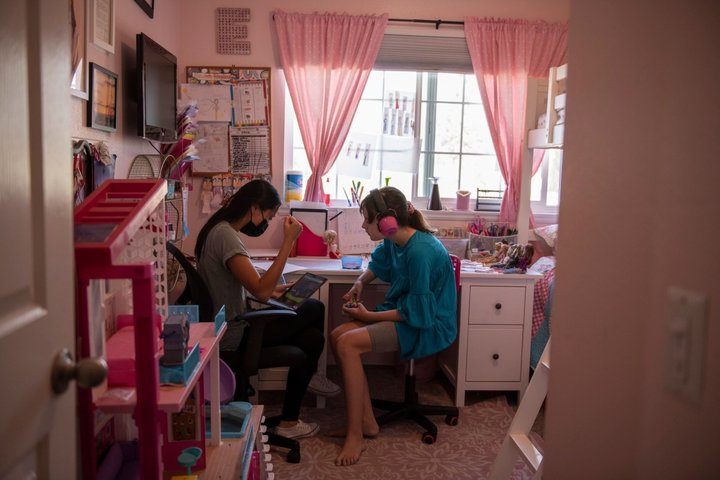
Ellie sits in her room with a behavioral therapist during class time in Monrovia, on Sept. 15, 2021. “There is no way to go back with 37 kids in a classroom,” Julie Fitzgibbons, the mother of triplets, said. “With masks and not being able to communicate very well, and autism, there is just no way we can go back like normal.” Photo by Pablo Unzueta for CalMatters
###
The school year at Duarte Unified School District, 20 miles east of Los Angeles, started a month ago, but Brady, Ellie and Jack Fitzgibbons have yet to receive any instruction from their teachers.
The 13-year-old triplets are on the autism spectrum, and their mother Julie Fitzgibbons didn’t feel safe sending them to school because she doubted her kids would keep their masks on all day.
“They struggle with masks. They won’t be able to be in a class with 36 kids wearing masks,” Fitzgibbons said. “Communication is important for autistic kids. They can’t talk with masks.”
But the district has delayed making accommodations for their disabilities through independent study, the only option for remote learning this year. So far, the triplets have lost four weeks of instruction.
Across the state, other parents are being placed in a similar position after more than a year of distance learning during which students with disabilities fell behind disproportionately. Meanwhile, the legislators who designed the recently passed independent study laws say this form of remote learning might not be able to accommodate all students’ needs.
Last year, California’s public schools offered remote instruction through distance learning in response to the coronavirus pandemic. Teachers were required to provide “daily live interaction.”
This school year, with vaccines available to adults and children age 12 and older, live, in-person instruction is the expectation. Parents who want to keep their children learning virtually need to apply to their district for independent study, an option predating the pandemic primarily intended for special cases like traveling athletes or child actors.
The situation is even more complicated for parents of students with disabilities. Those parents work with districts to create what’s called an Individualized Education Program for their children. These programs aren’t set up for distance learning.
Hence Julie Fitzgibbons’ dilemma.
At the beginning of the school year, Fitzgibbons asked the district to place her triplets in independent study. The district, however, said virtual instruction was incompatible with the needs of the triplets and the services they require.
Some educators across the state say even if they can provide special education services through independent study, they’re wholly inadequate.
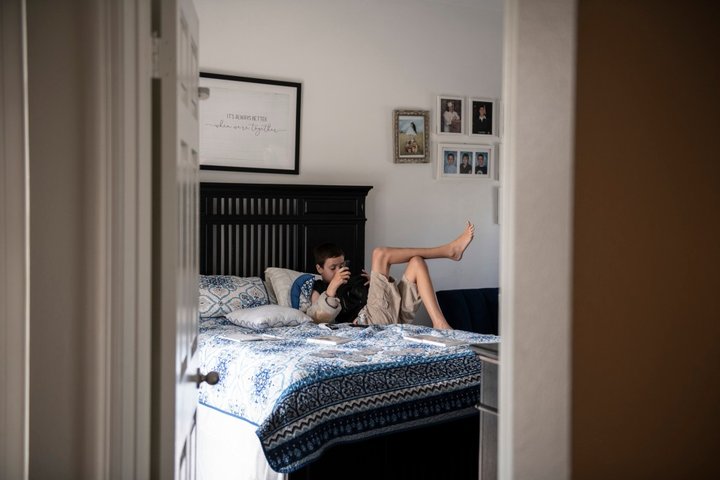
Brady takes a break from doing his schoolwork and watches educational videos on a tablet in Monrovia, on Sept. 15, 2021. “There is no way with three kids at home I could have been in all the rooms,” Julie Fitzgibbons, who expressed relief with having behavioral therapists at home, said. Photo by Pablo Unzueta for CalMatters.

Julie Fitzgibbons, the mother of triplets all on the autism spectrum, tries to get her son, Brady, 13,1 to come back to his desk in Monrovia, on Sept. 15, 2021. “This has been hard on parents,” Fitzgibbons, who had to enroll her kids’ in independent study, said. Photo by Pablo Unzueta for CalMatters.
But Fitzgibbons said she was forced to decide between her kids’ safety and academic progress. If she kept her kids at home, she would have to forfeit their special education services like speech therapy, occupational therapy and extra help in the classroom. If she sent them back to campus for in-person instruction, they would be at greater risk of COVID-19.
The district and Fitzgibbons eventually reached a compromise that would allow her kids to get at least some of the services they received last year, which included six hours a day of one-on-one help and an hour a week of speech and occupational therapy. Fitzgibbons declined to provide details about the new agreement because it still needs to be approved by the Duarte Unified school board.
“Special education is so individualized. There are cases where it is an easy fit with independent study,” said District Superintendent Gordon Amerson. “There will be other cases where other options need to be discussed.”
Uneasy returning to campus
In Northern California, Connie Nakano has three children who attend school in the Elk Grove Unified School District, about 15 miles southeast of Sacramento. Her youngest and oldest children, aged 7 and 10, are both on the autism spectrum.
Nakano opted for all of her children to be in independent study this year instead of returning them to campuses. She said she was most concerned about the spread of the Delta variant, unmasked kids sitting together for lunch and quarantines disrupting her children’s learning.
But she said her middle child, who does not have a disability, has had a much easier time in independent study.
“There are some inequities here. Parents are allowed to choose between in-person and online,” Nakano said. “However, those two options don’t translate to students who have disabilities.”
She said Elk Grove Unified denied her request for remote special education services. Nakano said she’s still negotiating with the district. In the meantime, she placed them in independent study so they don’t fall further behind. But so far, her two children on the autism spectrum are already having trouble keeping up with school.
“We’re having to make a choice between services and safety,” Nakano said.
Anne Rigali, director of special education at Elk Grove Unified, said special education has been challenging to merge with independent study. But she said the district is hoping to find creative solutions for all of their students who aren’t ready to return to campus.
“We’re working with the families to see how we can best support their child,” she said. “We’re trying to address each family and hold these conversations.”
Some parents want a return to distance learning
While most parents across the state had a negative experience last school year, both Nakano and Fitzgibbons said distance learning worked for their kids. Last year, Nakano’s children received extra help from teachers’ aides through Zoom. Her kids also got more real-time instruction compared to this year in independent study.
Fitzgibbons said her school provided therapists who worked remotely with her triplets.
“We’re worried we’re gonna lose our service providers and our time slots,” she said. “These people have worked with our kids for 20 months now. Our kids did really well with distance learning.”
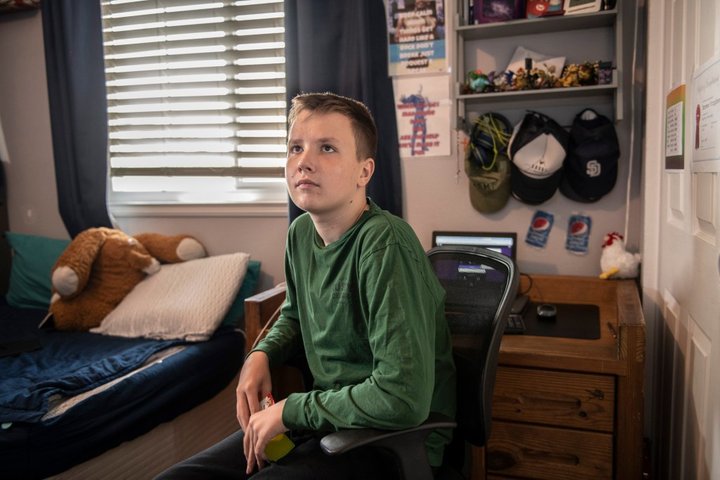
JJack watches a video related to his schoolwork in Monrovia, on Sept. 15, 2021. “There is no way to go back with 37 kids in a classroom,” Julie Fitzgibbons, the mother of triplets, said. “With masks and not being able to communicate very well, and autism, there is just no way we can go back like normal.” Photo by Pablo Unzueta for CalMatters.
Fitzgibbons is currently going through her family’s insurance to pay for private instructors and therapists while her triplets wait for the district to finalize their agreement for special education services.
In response to questions from CalMatters, California State Assemblymembers Kevin McCarty and Phil Ting issued a joint statement that said special education services can be delivered through independent study.
“However, the student’s (Individualized Education Program) is required to be updated first, to make sure the student is not receiving a lower standard of services,” they said. “There may be a determination in the IEP that the student cannot be served in independent study and get their needs met, and that would be a group discussion.”
They added that a new state guidance to be released as early as this week “will dispel many of the myths that are causing confusion about independent study for families, including the rights of special education students to independent study.”
Special education incompatible with independent study
Meanwhile, school district officials are struggling to reconcile the federal laws that govern special education and the state laws that govern independent study and remote learning. As a result, students with disabilities across California are either waiting to get their special education services or forfeiting them for independent study.
“The legislators put us between a rock and a hard place,” said Patty Metheny, an administrator who oversees special education in multiple school districts in San Bernardino County. “Because those are the only two options, the consequences are great.”
According to the federal Individuals with Disabilities Education Act, public schools must offer all students a free appropriate public education by providing any services required to accommodate a disability.
But as the name suggests, independent study requires a degree of independence, and some students aren’t able to work on their own. As a result, certain students with disabilities who aren’t ready to return to campuses might not be receiving a free appropriate public education in independent study.
“It’s very difficult to address all of the goals and needs students have through independent study,” said Amanda Brooke, a deputy superintendent at the Imperial County Office of Education. “We’ve even seen general education students fall behind.”
“There are some inequities here. Parents are allowed to choose between in-person and online. However, those two options don’t translate to students who have disabilities.”
— Connie Nakano, Elk Grove Unified parent
The language in the independent study laws don’t specify exactly how many hours a day students must receive real-time, or synchronous, instruction. They only state that students in transitional kindergarten through the third grade must receive daily synchronous instruction. For grades 4 through 12, students must receive weekly real-time instruction.
On the other hand, individualized education plans for students with disabilities contain much more detail. The plans often state the number of hours of specialized instruction or therapy that a student must receive each week.
At the Imperial County Office of Education, special education teacher Jazmin Carrillo said her students are getting between 2 and 3 hours of real-time instruction daily. But even then, she struggles to help them make progress in both their learning and their behaviors.
“I typically am there to help regulate their behaviors. I need to be there in person to show them,” Carrillo said. “Sometimes they just turn their cameras off and that cuts me off from them.”
Nakano said her children are meeting with their teachers for about 30 minutes every day through Zoom.
“It’s a brief check-in,” she said. “It’s not exactly instruction.”
During distance learning last year, her two children on the autism spectrum got more than two hours of real-time instruction every day, Nakano said. While that still doesn’t beat in-person instruction, she’s worried her children on the autism spectrum will fall behind even more if they don’t get the services they need.
“We want to make sure we get them up to speed so they don’t have to repeat a grade,” she said. “For our family, we think about it every day.”
###
CALmatters.org is a nonprofit, nonpartisan media venture explaining California policies and politics.
OBITUARY: Roger Neal Coleman Sr., 1960-2021
LoCO Staff / Monday, Sept. 20, 2021 @ 6:56 a.m. / Obits
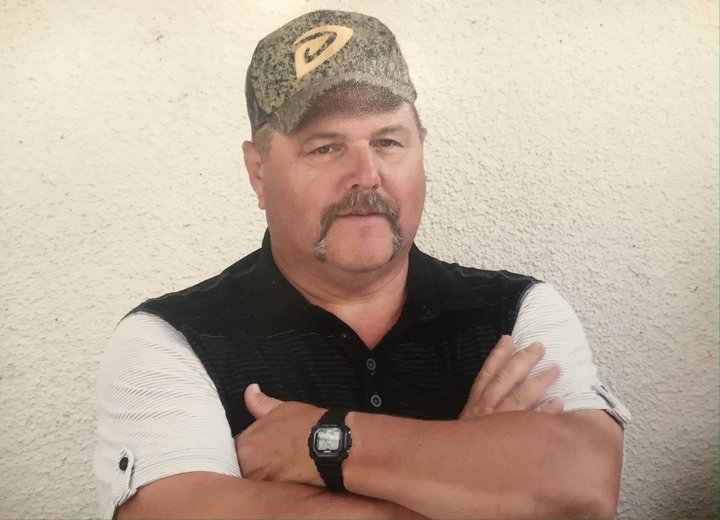
Roger Neal Coleman Sr. passed away August 3, 2021 at Petaluma Valley Hospital from sudden illness, at the age of 61. He was born on July 23, 1960 to Larry and Veltha Coleman of Blocksburg. Roger grew up in Blocksburg and went to Casterlin Elementary School. He attended South Fork High School after, where he played football and wrestled, graduating in 1978. He spent his summers going to rodeos riding bulls, working on local ranches and one summer, working for CDF fighting fires. Roger loved the excitement of fighting fires. He eventually went on to do logging for Lonnie Johnson.
Roger met his wife, Bonnie Baskin, through mutual friends in 1980 and they were married in December of 1981. They lived in Orleans where their three children were born. In October of 1990, when the logging outfit Roger was working for moved to Idaho, he and his family followed. They stayed in Idaho for five years, soaking up all the outdoors had to offer…hunting, fishing and horseback riding. When Roger wasn’t working or in the outdoors, he was busy watching his children play sports. The love he had for his children was big!
In the fall of 1995, he moved his family back to Blocksburg and continued logging. Roger and his two brothers had their dreams come true in 2003, when they started their own logging business. Roger also helped to start the Alderpoint Fire Department in 2007, becoming a founding member. At the time of his passing, he was still an active member of the fire department. Helping others was very important to him and he would give the shirt off of his back to anyone who needed it.
While his kids were growing up, Roger always supported them, going to every sporting event, even cheerleading for his daughters. You would never see him in the bleachers, instead he was on the sidelines, rooting his kids on. Many friendships were formed on the fields in Miranda that became like family. Roger loved spending time with his family! Anytime someone would ask “what do you want for your birthday?” he would simply say that he wanted time with his kids and grandkids. He enjoyed metal detecting and loved taking his grandkids with him to find ‘treasures’. Being a grandpa was Roger’s pride and joy! He would do anything for his grandkids. He supported them and went to all of their sporting events, from basketball and t-ball to softball and ballet recitals. Roger loved taking all of the grandkids to the Humboldt County Fair, soaking up every moment with them that he could, spoiling them “just as Grandpa should!”
Roger had planned on retiring when he was 62, spending his days in the garden, on the lake and with his grandkids. One of his favorite pastimes was fishing and going to tournaments with his son Roger Jr. He and his son did good in many of the tournaments they attended and often came home with trophies, which Roger proudly hung on his living room walls. Anytime spent on the lake with his kids or his grandkids made Roger happy. He was the best cook and could often be found by the BBQ at get-togethers and family dinners. His meat was always cooked to perfection and delicious. Roger was also ‘Mr. Fix It’. If anyone needed anything fixed, from small items to big diesel engines for the logging company, they would come to him and he could fix it. He would fix broken toys to stop the tears of children and anything around the house. Roger could also sew and had hurts dogs brought to him to be stitched up on more than one occasion. There was nothing Roger couldn’t fix! He was a hard worker, providing for his family in ever way he could. Roger was a true hero to many!
Roger is survived by his wife Bonnie, his son Roger Jr. (Cheyenne), his daughters Stacy (Jed) and Amanda (Calvin), and by his grandkids Mackenzie and Leila Coleman, Brooklyn and Keegan Willis, and Ailana, Taylor and Sterling Kercher. He is survived by his mom Veltha Coleman, his brother Ricky (Kelly) Coleman, his sisters Jackie (Glenn) Lipscomb, Shanna Humphrey, Sharon (Kevin) Walker and by numerous nieces and nephews, along with great-nieces and great-nephews, and friends. Roger is proceeded in death by his father Larry Coleman, his brother Russell Coleman and his sister Rebecca Coleman.
A celebration of life will be held on October 17, 2021 at the Alderpoint Firehall at 1 p.m. in the afternoon. Meat will be provided, please bring a side dish. The family requests that anyone who is sick or has been around someone who is sick, as much as you want to attend, please stay home to keep others healthy.
###
The obituary above was submitted on behalf of Roger Coleman’s loved ones. The Lost Coast Outpost runs obituaries of Humboldt County residents at no charge. See guidelines here.
OBITUARY: Michael John Paulus, 1942-2021
LoCO Staff / Monday, Sept. 20, 2021 @ 6:56 a.m. / Obits
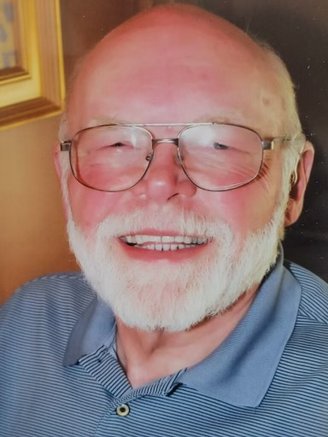
Michael
John Paulus
April
28,1942 - September 15, 2021
Michael Paulus died peacefully of multiple complications on September 15, 2021.
Michael was born to Kathryn and Talbot Paulus in Los Angeles. At the age of seven his family moved to the small mountain community of Wrightwood, California where his father opened the local grocery store – Tal’s Market. The store was a whole family operation. Michael, always a very hard worker, was known to frequently say, ”I’ve been working since I was seven-years-old!” Michael loved Wrightwood and had many stories of his adventures there, especially with his dear friend Steve Carbaugh.
Michael had no idea what he was going to do after high school. He decided to join the Army and throw himself into it totally. He always took pride in having made sergeant faster than Elvis Presley did! Fortunately, he was assigned to psychiatric services where he found his career love and direction. After the Army he began college to pursue his goal of becoming a psychotherapist. He completed his BA and MA at San Jose State. Michael next attended University of California Berkeley where he received a Master of Social Welfare degree. Michael developed and directed the Psychiatric Technician training program at West Valley College in Saratoga, California from 1973 to 1977. He was eager to next begin private practice.
It was in graduate school at San Jose State he met the love of his life, Jan Van Atta Paulus. This was truly love at first sight! Jan and Michael celebrated their 50th anniversary December 29, 2020.
Jan and Michael moved to Humboldt County in 1977 to escape the crowds and smog of the Bay Area. Michael first set up practice at Redwood Memorial Hospital where he remained for 18 years. He then moved his practice to Mad River Hospital where he worked for 17 years. He loved doing therapy and was dedicated to his clients.
Michael and Jan loved living in Humboldt County having access to all sorts of travel from back packing and kayaking to touring the world. Michael and Jan loved traveling with best friends Al Raddi and Julie Booth. The foursome traveled the world together. Michael enjoyed music, cooking, and working in his yard. Michael had a wonderful connection with animals and has had many cat and dog companions through the years. His two Siberian Forest cats Mark and Martha will truly miss him.
In 2008 Jan and Michael joined the Immanuel Lutheran Church and have grown to love this wonderful Christian community. Jan and Michael so appreciate Pastor David Groe and his support both through the years and now.
Michael had the privilege to have received the benefit of the skill and dedication of many medical providers that allowed him to lead a full and rich life in spite of medical challenges. Michael’s family is especially appreciative of the following providers: Dr. Chris Lee, Dr. Samer Kabbani, Dr. Huy Trieu, Dr. Tom Taylor, Dr. Phil Alway, Dr. Melissa Robinson (University of Washington), Dr. William Fearon (Stanford University), Angela Smith, NP, and physical therapist Terry Kramer.
Michael was preceded in death by both of his parents, his brother Bryan, and his mother and father-in-law, Neil and Eileen Van Atta. He is survived by his wife and soul mate, Jan, his beloved daughter Lisa Moore and her husband Geoff Moore, and his grandchildren of whom he was so proud, Sophia Moore and Maceo Moore. He is also survived by his cousin-in-law, Vivian MacKay. He has always been very close to Bryan’s daughters and their families, Deanna (Jerry) Larson and Kathleen (Kevin) Quick, as well as his sister-in-law Marie Paulus. His long-time special friends, Steve and Jerry Carbaugh; Marian and David Vasilevich, Theresa and Morey Montoya; and of course, Al Raddi and Julie Booth.
In lieu of flowers, memorial donations to Immanuel Lutheran Church (3230 Harrison Ave, Eureka, CA 95503) or Amputee Coalition would be welcomed.
The Celebration of Michael’s life will be on September 26, 2021 at 10 a.m. at Immanuel Lutheran Church (3230 Harrison Ave., Eureka, CA). This service will be available on Zoom and all unvaccinated friends and family are invited to attend via Zoom. Vaccinated friends and family are invited to attend either in-person with facial coverings and physical distancing or on Zoom. The Zoom meeting number is 846-5558-7701 and the password is 00000. Click here to automatically take you to the zoom meeting.
###
The obituary above was submitted on behalf of Paul Maisenbach’s loved ones. The Lost Coast Outpost runs obituaries of Humboldt County residents at no charge. See guidelines here.
OBITUARY: James Cruz, 1926-2021
LoCO Staff / Monday, Sept. 20, 2021 @ 6:56 a.m. / Obits
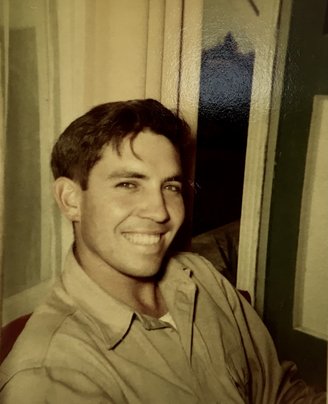
On March 18, 1926, James Cruz was born in Eureka to Jose and Rosalina Cruz, natives of Obidos, Portugal. On September 17, 2021 on a Friday night, after a long week of love, surrounded by dozens of his offspring and with his devoted wife Colleen Cruz by his side, Jim took his last breath, and went to join his family in heaven. Jim was 95 and a half years old.
Jim was the youngest of six children born to Jose and Rosalina. His older brothers Joe and Mario were both born in Portugal before his parents were separated by World War I. Jose immigrated to the United States before the war, and then immigration was halted until the war ended, meaning Rosalina was left behind in Portugal with her two young boys. When Rosalina was finally able to reunite with her husband, she made that trip alone with her son Joe, as young Mario had passed away at age six from the Spanish flu.
Jim recalled, thinking of his mother during her travels, “Just think of that trip from Ellis Island. She came all the way to Eureka on the train. Without any English. Joe was only seven; he didn’t have much English. She must have had to make quite a few connections on her own.”
Rosalina and Jose Cruz settled in Samoa, California. They went on to have four more children, Frank, Jack, Mary and Jim, the youngest.
Jim was well known as an expert carpenter, a successful contractor, an avid gardener, a faithful servant to his beloved parish Sacred Heart Church, a lifelong volunteer of Saint Vincent de Paul, and best of all the father of thirteen kids, and ‘Grandpa Jim’ to oh about seventy or so grandkids, great grandkids and two great-great grandsons.
Jim was a proud veteran having served in the US Navy in World War II.
One night shortly after he got out of the service in May, 1946, Jim’s life changed. He went to a dance with his friend Max, and met a dashing beauty by the name of Colleen Atwell.
Colleen’s sparkling eyes and mischievous smile caught Jim’s eye, and that rascal of a girl told young Jim that she was seventeen (she was really fourteen!). On June 7, 1947 at “about 9 p.m.” Jim and Colleen had their first date at a Portuguese festa.
According to Colleen, “He was too shy to come over and meet my mom and dad for a while. My mother took one look at him and said, ‘Oh! He’ll want to marry her!’ My dad liked him because he was a carpenter.”
Jim and Colleen Cruz have been sweethearts for seventy-five years.
Regarding their engagement, Colleen recalls, “He got me a ring for my birthday, He came over with that chicken sh*t grin, and I knew he had something going on.”
Jim said, “She wanted to get married sooner, but her dad wouldn’t let her. He wanted her to finish high school.”
So that vixen Colleen finished high school a full year early, graduated on a Friday and got married the next morning at 10 a.m.
Jim and Colleen were married at St. Bernard’s Church, in Eureka on June 11, 1949. This past June they celebrated their 72nd wedding anniversary, those show offs!
On April 4, 1950, their first daughter, Jeanette was born. Joined (shortly) after by a row of beautiful little girls, Vera, Marla and Connie. Then in 1956, their first son Mark was born. Jim and Colleen went on to have thirteen kids in all, Dan, Tim, Andrea, Matt, Teresa, Tony, Monica and their final baby boy Jeremy Jon was born in 1971.
It is said that what you leave behind is not what is engraved in stone monuments, but what is woven into the lives of others. Well, Jim Cruz did a lot of weaving in his ninety-five years, and his family and friends will carry his love in their hearts forever.
Jim Cruz is survived by his wife Colleen, his sisters-in-law Anita Brazil and Joan Golbov, his daughters Jeanette Cruz (Marc Matteoli); Vera Cruz; Marla Sanders; Constance Mangels; Andrea Murillo; Teresa Rasmussen (Jeff); Monica Barnum (Bill); and sons Mark Cruz (Liz); Dan Cruz (Terrie); Tim Cruz (Julie); Matt Cruz; Tony Cruz (Ida); and Jeremy Cruz (Kate). He is survived by grandchildren Mason, Maria, Janna, Jaime, Mario, Jordan, Joelle, Michella, Bethany, Ryan, Tara, James, Aleta, Kenny, Katie, Cody, Jed, Mickey, Tyson, Jake, Joe P. Jesse, Kelsie, Emily, Lindsey, Brandon, Ross, Alyssa, Joe C., Amanda, Chase, Jarae, James Q., Aurelia, and Sofina. Jim is survived by thirty-four great grandchildren and two great-great grandsons (and counting!).
A celebration of Jim’s life will occur at Sacred Heart Church in Eureka on Saturday, September 25, 2021 at 10 a.m.
In lieu of flowers, donations can be made in Jim’s name to St. Bernard’s Academy.
###
The obituary above was submitted on behalf of James Cruz’s loved ones. The Lost Coast Outpost runs obituaries of Humboldt County residents at no charge. See guidelines here.
OBITUARY: Wilma Jean Mendes, 1935-2021
LoCO Staff / Monday, Sept. 20, 2021 @ 6:56 a.m. / Obits
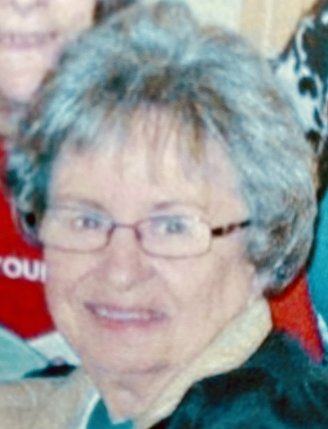
Wilma Jean Mendes
Dec. 28, 1935 - Sept. 16, 2021
Born and Raised in the Port Kenyon area of Ferndale, a loyal Ferndale Wildcat and retired Bank of America employee, Wilma “Dinkie” Mendes was a loving mother, grandmother, and great-grandmother. She will be remembered with love long after her passing.
Wilma passed away on September 16, 2021, at home at the age of 85, after a courageous battle with cancer, surrounded by loved ones who will strive to honor her memory by living their lives to the fullest.
Wilma was a Christian and was excited to meet her Lord, our Savior. She was proud to be Portuguese and it was an honor for her to be named the “Queen” at the Ferndale Portuguese Celebration earlier in life. She loved High School Football and insisted on wearing red and sitting on the side of the Wildcat’s during the “Milk Can” games against the Fortuna Huskies, even when her own grandchildren played for the Huskies. She got a real kick out of that! She was often seen with a group of ladies, some who have already predeceased her, also in red wearing red hats. At first glance you would think they were the founding mothers of the Red Hat Society. However, you would soon hear that cowbell ring and quickly realize it was a group of gal’s with hometown pride. She always enjoyed going to church, potlucks or any type of social gathering, she enjoyed making her pistachio salad and devilled eggs. She had a huge heart when it came to any animal, especially all her cats throughout her years. One thing is for sure, all of her grandchildren and her great-grandchildren truly brought her the most joy of all. This was her life’s legacy.
Wilma is survived by her children Paul Mendes, Lannae Marshall, and Alan (Shelly) Mendes. Her grandchildren Heidi Mendes, Alyssa Mendes, Derek (Megan) Mendes, Travis (Brittany) Mendes, Tanner Mendes, Alayna Mendes. Her great-grandchildren Kira Steele and Treveon Jackson. There is so much more family, nieces, nephews, and cousins out there, too numerous to name.
The family would like to give a special thank you to Hospice of Humboldt for all of their care, comfort and kindness not only to Wilma, but to the family as well. In lieu of flowers, please make a donation to Hospice of Humboldt or any organization that has made a special impact in your life.
HOSPICE
OF HUMBOLDT
3327
Timber Falls Court
Eureka,
CA 95503
“GO WILDCATS GO”
###
The obituary above was submitted on behalf of Wilma Mendes’ loved ones. The Lost Coast Outpost runs obituaries of Humboldt County residents at no charge. See guidelines here.


