

OBITUARY: Eli Jurkovich, 1929-2021
LoCO Staff / Monday, Sept. 20, 2021 @ 6:56 a.m. / Obits
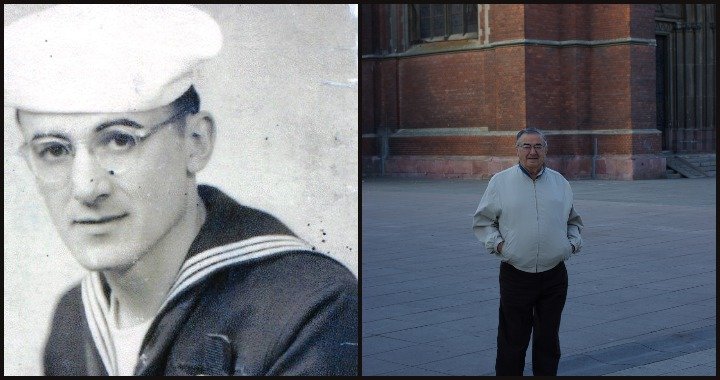
Eli Jurkovich went with God, during his sleep, early morning September 6, 2021, at the age of 92 at his home, in Eureka.
Eli and his 10 siblings were 1st generation born Americans to immigrant parents – Vaso Jurkovich and Stana Perovich from Montenegro and Serbia. He was born in Red Lodge, Montana, August 19, 1929. His father worked as a coal miner in Red Lodge and nearby Washoe.
Eli started working when he was around 10 years of age setting pins at the local bowling alley and that work ethic stayed with him his entire life.
Other childhood jobs included working in a bakery with a deaf mute who taught him sign, picking and sorting coal, and selling newspapers. After graduating high school, he went to work at the Yellowstone Inn, where he met his future wife and mother of his children, Patricia Ann Kinsella. When the Inn closed for the winter, Eli bell hopped at the exclusive Goodyear Resort in Goodyear. Arizona.
When the Korean War broke out, Eli volunteered for the U.S. Navy. Before going to sea, he married Patricia in San Diego, December 23, 1950, at the Naval Training Station.
After four years in the US Navy, Eli took a job with Stuart Floor Company, located in Redwood City, as a hardwood floor sander and finisher. Within a short period of time, he became foreman of a crew 100 strong, who floored much of the post-war South Bay area growth explosion.
Eli was not only the hardest worker in his day job; he took a second job cooking burgers at night to get ahead. His frugal wife saved and they were able to buy into partial ownership of Eureka Floor Company in 1959. With his hard work and drive to succeed, the business thrived.
He retired at age 65 and pursued a new love in life – horse racing. For a decade and a half, he was a fixture at the Turf Club where he made new group of friends. In the weeks preceding his death, he attended the horse races at the Humboldt County Fair – He loved the long shots and the trifectas.
Eli was generous with many charities. He particularly liked helping fellow veterans. If anyone is moved to make a donation in his name, The Veterans of Foreign Wars would be a good one.
He is survived by his ex-wife Patricia Kinsella, his eldest son Mike Jurkovich, his daughters Patty Hoskins, Mary Ann Wick, Marty Jurkovich Curtis, his youngest son Robert Jurkovich, his youngest brother Nick Jurkovich, 8 grandchildren, and 14 great grandchildren. And, his loving companion for over 30 years, Barbara Randle.
There will be no funeral or memorial service as per his wishes. His family will take his ashes back to Red Lodge, Montana to be buried in the family plot with the ashes of his heart dog Joey.
Every time Eli would leave his mother’s home, she would always tell him “Go with God.” It is hard to know if it was just a coincidence that his final journey occurred on Labor Day.
He will forever be in our hearts.
###
The obituary above was submitted on behalf of Eli Jurkovich’s loved ones. The Lost Coast Outpost runs obituaries of Humboldt County residents at no charge. See guidelines here.
BOOKED
Today: 3 felonies, 8 misdemeanors, 0 infractions
JUDGED
Humboldt County Superior Court Calendar: Today
CHP REPORTS
Us101 / Anchor Way (HM office): Live or Dead Animal
Us101 / Sandmine Rd (HM office): Trfc Collision-1141 Enrt
Unnamed Street (HM office): Traffic Hazard
ELSEWHERE
RHBB: Magnitude 3.7 Earthquake Centered East of Hydesville
RHBB: Motorcyclist Injured in Solo Crash at 14th and California in Eureka
RHBB: Southbound Highway 101 Traffic Backs Up From Richardson Grove to Benbow
RHBB: Woman Suffers Possible Leg Fracture in Dyerville Loop Road Motorcycle Crash
(VIDEO) HUMBOLDT OUTDOORS: The Covered Bridges of Humboldt County
John Ross Ferrara / Sunday, Sept. 19, 2021 @ 12:30 p.m. / Our Culture
What better time to visit Humboldt’s hidden gems than during a pandemic?
Local amateur videographer Ray Olson told the Outpost that he’s hoping to inspire people to explore Humboldt County with his new monthly video series “Humboldt Outdoors.”
In this episode, Olson takes a look at all three of Humboldt’s historic covered bridges: Brookwood, Berta’s Ranch and Elk River.
Olson records the series for Access Humboldt and also shares them on social media. So far, he’s also produced informative videos on the Ma-le’l Dunes, Big Lagoon, Patrick’s Point, the Arcata Community Forest and Janes Creek.
Rain Aids Firefighters Battling McCash Fire
LoCO Staff / Sunday, Sept. 19, 2021 @ 9:15 a.m. / Fire
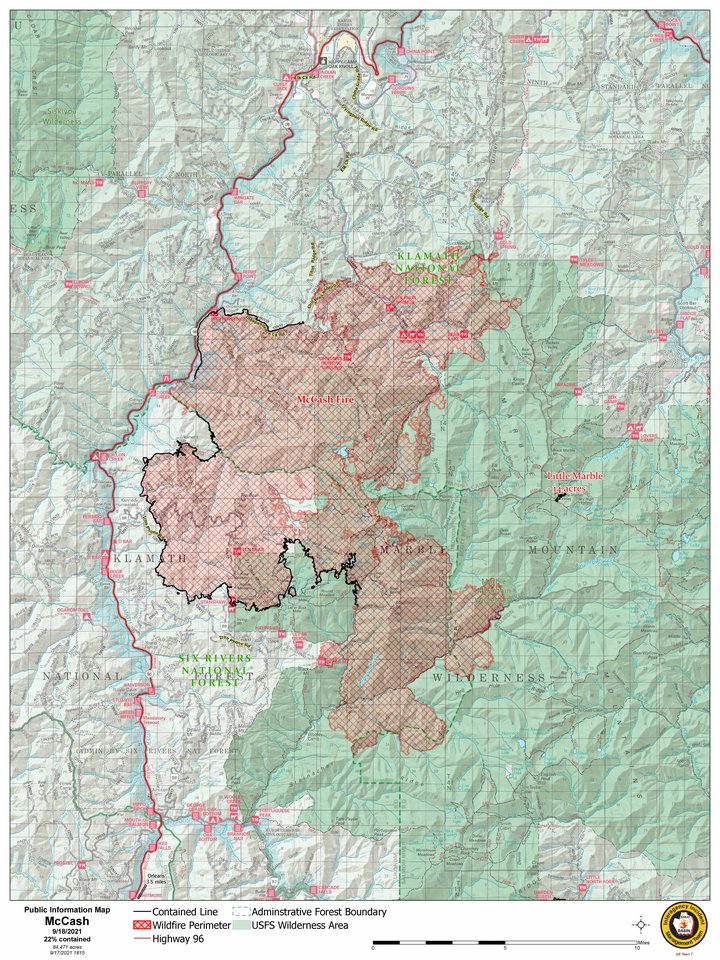
Latest Map of the McCash Fire. | USFS
U.S. Forest Service press release:
The McCash Fire does not have an updated acreage. It was last mapped the evening of Sept. 17 at 84,471 acres. Containment decreased to 22 percent because of fire growth that occurred before rain came through Saturday.
Yesterday, cool, wet weather tamed the fire and brought relief to firefighters. Rain showers brought almost an inch over some areas of the fire. The weather also brought debris and rock slides that will have to be cleared by heavy equipment from the roadways. Firefighters continue to patrol the fire area and engage where they can.
Rain showers are expected to continue through the morning, then dissipate in the afternoon. Fire activity will be minimal today and likely the next few days. Logs and trees will continue to smolder and burn. Another week of hot, dry weather is expected, which will awaken the fire. Firefighters will take advantage of the subdued fire by directly engaging it, specifically along Titus Ridge, and reinforce containment lines.
Today, Great Basin Incident Management Team 7 will begin transitioning with Alaska Incident Management Team 1. Thank you for welcoming us into your community. Alaska IMT 1 will assume command of the fire Monday, Sept. 20 at 6:30 a.m.
Total Personnel: 675 | Crews: 12 | Engines: 22 | Dozers: 5 | Masticators: 4 | Watertenders: 10 | Aircraft: 8
Evacuations: Evacuations that were implemented Friday, Sept. 17 south of Mile Marker 2 on Elk Creek Road have been downgraded to a warning. Siskiyou County Sheriff’s Office Facebook: @SiskiyouCountySheriff
Closures: The Six Rivers National Forest and Klamath National Forest have implemented a closure for the McCash Fire area. This includes the Marble Mountain Wilderness. Please respect the fire closure for your safety and firefighter safety. To view the closure order and map visit the McCash Fire Inciweb website.
Fire Restrictions: Fire Restrictions remain in place. Please visit forest websites for more information.
(AUDIO) HUMBOLDT HOLDING UP: Recent GQ Magazine Article Subject Richard Evans on the Back to the Land Movement, Stained Glass and Why He’s Still a Hippie Idealist
LoCO Staff / Sunday, Sept. 19, 2021 @ 8 a.m. / Humboldt Holding Up
(AUDIO) Richard Evans is Holding Up

Richard Evans, still a dreamer
Last week Humboldt was featured prominently in a lengthy article by GQ Magazine—for something other than weed, if you can believe it! The piece, “The Last Glimpses of California’s Vanishing Hippie Utopias,” takes the reader on a tour of some of the aging and forgotten communes manifested by the generation of idealists associated with what we know nowadays as the back to the land movement.
These days Richard Evans, one of the article’s subjects, makes his home in the booming metropolis of Eureka, but back in the early ‘70s he and his cohorts fled the Bay Area for a more idyllic, communal country existence on a property in far-flung Southern Humboldt. On this week’s episode of Humboldt Holding Up — LoCO’s always-idealistic podcast — Evans shares with us his recollections of his back-to-the-lander days. Topics include:
- A discussion of what individuals who found themselves swept up in the back to the land movement were seeking
- Evans’ involvement in the March on Washington and gay liberation activism in the ‘60s
- his trek up to Humboldt in search of land and subsequent country livin’ out in Ettersburg and Alderpoint
- His time as an adventurous stained glass artist
- The difficulties of being a gay black man in rural SoHum
- His work as part of the team that converted an abandoned school into Eureka’s Jefferson Community Center
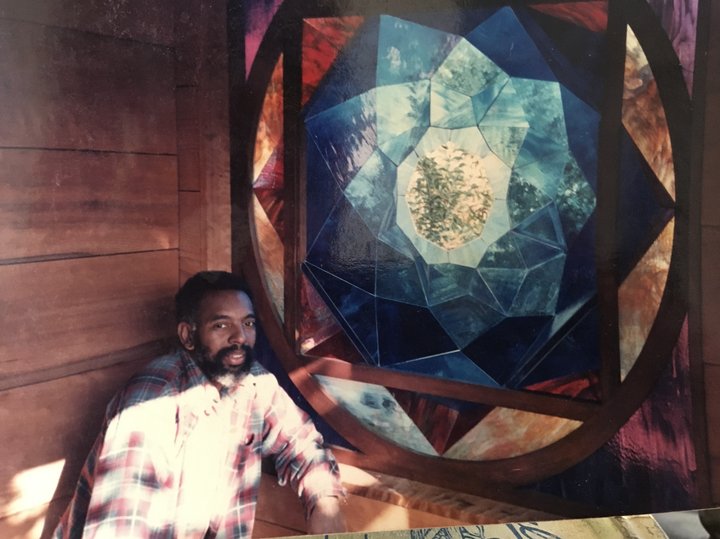
ABOVE: A young Evans sits next to a window he installed at Tommy and Karen Hessler’s Humboldt home. He was bummed that GQ didn’t include a picture of the other side of the window, so we’ve included that below
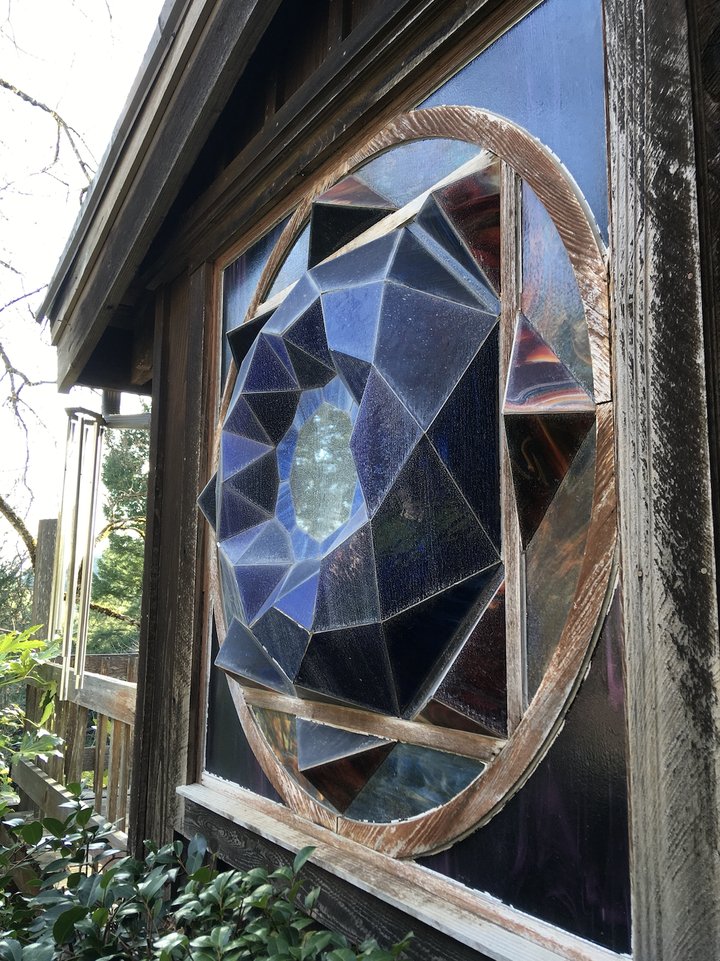

Evans was part of the team that crafted this stained glass entryway that once welcomed visitors to a State of California building in San Francisco
Click the audio player above to listen to Evans’ chat with the Outpost’s Stephanie McGeary and Andrew Goff or click on over to Apple Podcasts. And if you’d like to one-way meet even more Humboldt people from the comfort of your headphones, take a scroll through past Humboldt Holding Up guests below.
PREVIOUS GUESTS:
- #66 NCRT’s Calder Johnson
- #65 TV Newsman Dave Silverbrand
- #63 Housing Policy Specialist Brian Heaton
- #62 Muralists Blake Reagan and Lucas Thornton
- #61 Arcata City Councilmember Emily Goldstein
- #60 Kayak Guide Eric Stockwell
- #59 Eureka City Councilmember Natalie Arroyo
- #58 Wiyot Cultural Center Manager Marnie Atkins
- #57 Humboldt County Growers’ Alliance’s Natalynne DeLapp
- #56 RREDC Executive Director Gregg Foster
- #55 Dell’Arte’s Michael Fields
- #54 Llama Wrangler Keagan Trischum
- #53 Crabs President David Sharp
- #52 Ferndale Organic Dairy Farmers Kristina Radelfinger and Dorice Miranda
- #51 Former Arcata Mayor Alex Stillman
- #50 Cooperation Humboldt’s David Cobb
- #49 Ink People Center for the Arts’ Libby Maynard
- #48 Humboldt Bay Social Co-Owner Amy Cirincione O’Connor
- #47 Musician Lyndsey Battle
- #46 Mad River Brewing CEO Linda Cooley
- #45 LoCO Editor Hank Sims
- #44 Humboldt Republic’s Jason Brandi
- #43 Table Bluff Farmer Hannah Eisloeffel
- #42 Logger Bar Owner Kate Martin
- #41 Teacher/Rapper Zach “Zigzilla” Lehner
- #40 Madaket Captain “Zippo” Libby Tonning
- #39 Event Planner Alegria Sita
- #38 Food For People’s Anne Holcomb
- #37 AHHA President Nezzie Wade
- #36 Performance Artist Noël August/Tucker Noir
- #35 Eureka Mayor Susan Seaman
- #34 Eagle House Owner Jennifer Metz
- #33 Absynth Quartet Drummer Mike “Tofu” Schwartz
- #32 HACHR Executive Director Lasara Firefox Allen
- #31 Alchemy Distiller Owner Amy Bohner
- #30 Eureka City Councilmember Kati Moulton
- #29 Eureka City Councilmember Scott Bauer
- #28 Ungraceful Ager Barry Evans
- #27 Arcata City Councilmember Sofia Pereira
- #26 HumBrews Music Booker Laurel Weston
- #25 Eureka City Councilmember Kim Bergel
- #24 Film Commission’s Cassandra Hesseltine and Nate Adams
- #23 Marble Maker Topher Reynolds
- #22 Arcata Playhouse Director Jacqueline Dandeneau
- #21 Humboldt Political Junkie Eric Kirk
- #20 Rio Dell Mayor Debra Garnes
- #19 Second District Supervisor Estelle Fennell
- #18 Arcata Food Aficionado Jada Calypso Brotman
- #17 Body Piercer Jackie Silva
- #16 Dick Taylor Chocolate’s Adam Dick
- #15 FUHS Teachers Mark Thom and Inma Thompson
- #14 Eureka City Manager Miles Slattery
- #13 Savage Henry Co-Founder Chris Durant
- #12 Eureka Street Art Festival Organizer Jenna Catsos
- #11 SCRAP Humboldt Founder Tibora Bea
- #10 Gym Owner Tyler Parr
- #9 Six Rivers Brewery Co-Owner Meredith Maier
- #8 Multicultural Skincare Therapist Levia Love
- #7 Annie’s Cambodian Server and Social Worker Joshua Coppock
- #6 Eureka City Councilmember Austin Allison
- #5 HSU Professor Deidre Pike
- #4 Pastor Bethany Cseh
- #3 Singer/Songwriter Chris Parreira
- #2 Eureka City Councilmember Leslie Castellano
- #1 Arcata City Councilmember Paul Pitino
GROWING OLD UNGRACEFULLY: Loleta Tunnel
Barry Evans / Sunday, Sept. 19, 2021 @ 7 a.m. / Growing Old Ungracefully
I published a book a few weeks back, The Humbook, shamelessly promoting it right here. I figured if the great Chron columnist Jon Carroll could write — regularly, repeatedly! — about his cat Pancho, I could be allowed to indulge in a tad of self-hype. (Carroll’s last column appeared in 2015, after 33 years on the job.) [And never sold his cat. —Ed.]
Where was I? Oh yes, my book. I’ve been fielding questions about the contents, including those dealing with one of my favorite local subjects, the Loleta Tunnel. It’s such a good story — I’ve written about it elsewhere — it bears retelling. Not to mention, it makes for a fun afternoon excursion, walking the mile up from Loleta town to the southwest tunnel portal, then a third of a mile through the tunnel. It’s still in pretty good shape, especially after the major renovation in 1960, which included an extension of the southwest portal. Tracks still run through it, although the Timber Heritage Association’s speeder, which (in “normal” summers) occasionally runs up from Loleta, stops short of actually entering the tunnel.
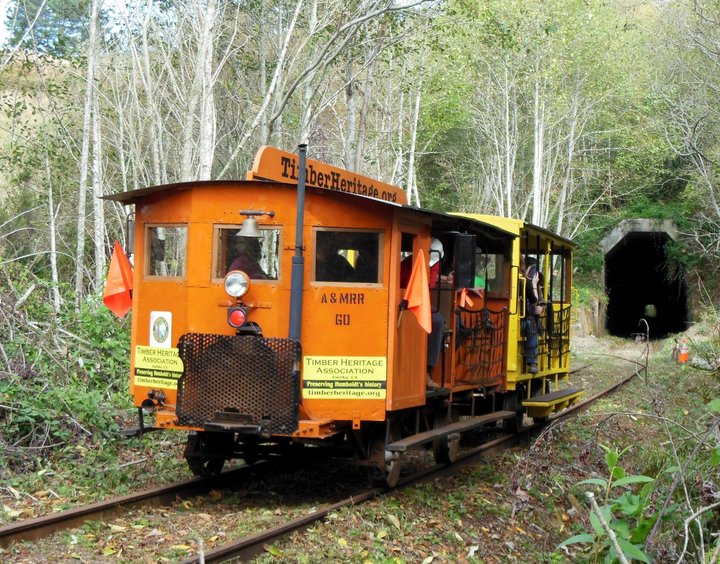
Timber Heritage Association’s speeder near the southwest portal. (Mike Kellogg, used with permission)
It was originally built to allow the Pacific Lumber Company, which owned huge tracts of redwood in the Eel valley, to bring logs to their huge new Scotia mill. Previous attempts at circumnavigating the ridge (anticline) under which the tunnel runs had been unsuccessful. The most ambitious of these was a five-mile-long mule-powered, wooden-track railroad that ran around the western end of Table Bluff, from McNulty Slough to the then-new settlement of Southport Landing, a couple of miles southwest of Fields Landing (below the present-day Wiyot reservation). Built in 1873, the wooden railroad barely survived for five years, and a huge storm in the winter of 1878 permanently wrecked it.
Soon after, several lumber barons, including William Carson (Carson’s Mansion) and Captain Henry Buhne (boo-ner) (Eureka’s oldest building, Waterfront and F), joined forces to create the Eel River and Eureka Railroad in 1882. Work on the tunnel began almost immediately, and by the summer of 1884 the job was done. For 114 years, the tunnel was a vital conduit for countless trains bringing lumber from the Eel River basin to Fields Landing to awaiting ships. It continued to operate after 1907, following reorganization of local railroads, at which time the Northwestern Pacific Railroad took it over — hence its formal designation today: NWP#40.
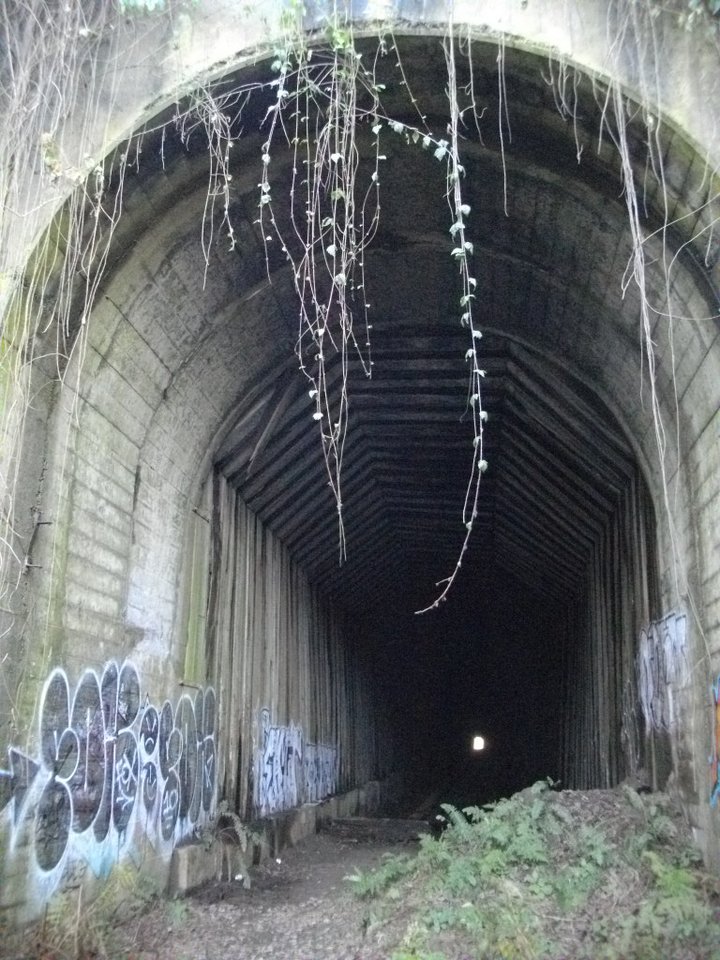
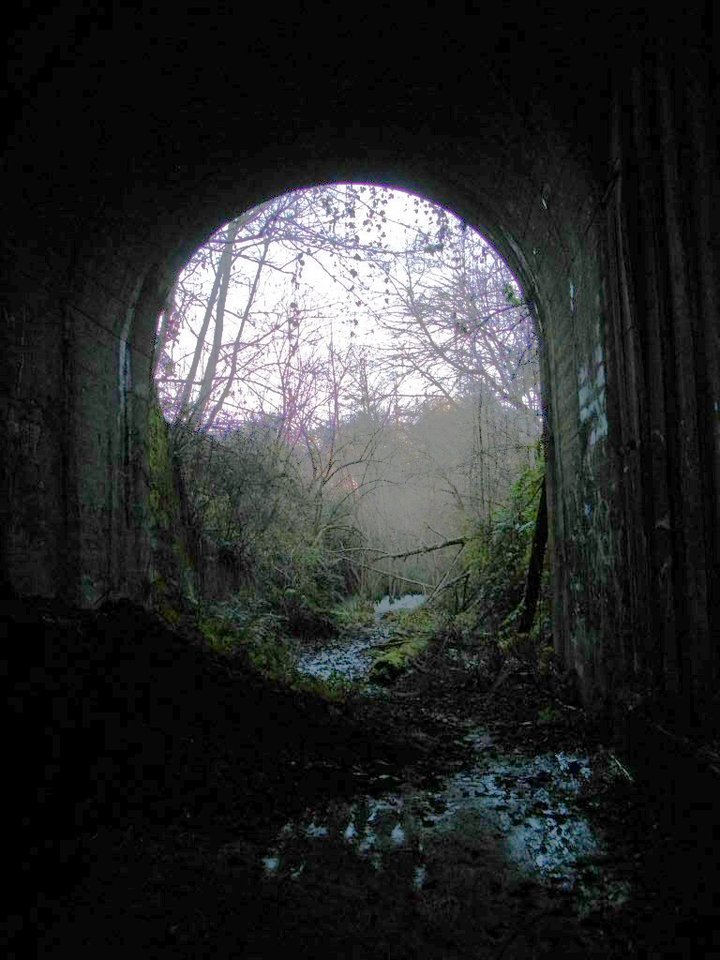
Northeast portal, from inside and outside the tunnel (Barry Evans)
Want to check it out? From downtown Loleta, walk northeast up the tracks to the southwest portal. Boots and flashlight recommended for the full through-the-tunnel experience!
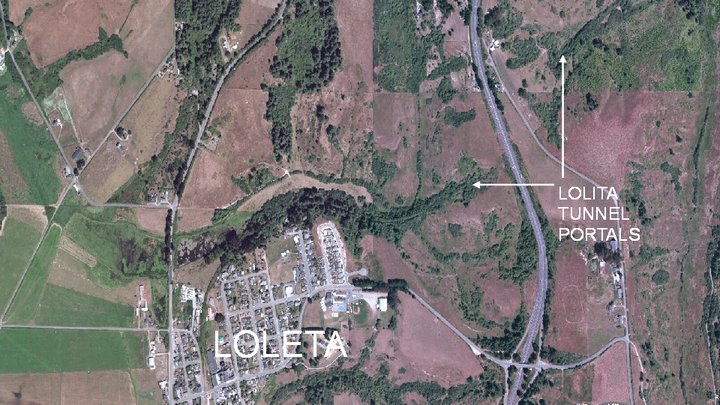
Map annotations by Barry Evans, who can spell “Loleta” correctly but flubs “the Loleta Tunnel” for some reason.
South Fork of the Eel Not Connected to Main River Due to Extreme Drought Conditions
LoCO Staff / Saturday, Sept. 18, 2021 @ 10:25 a.m. / Environment
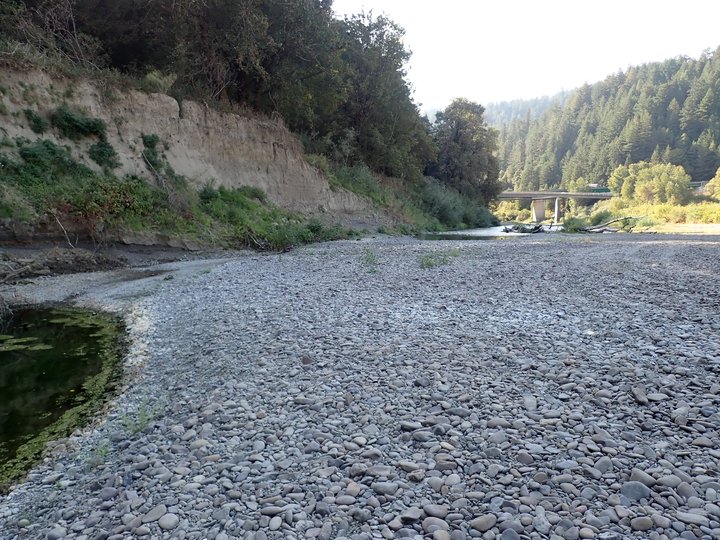
The bed of the South Fork Eel River with no connecting flow below Highway 101 at Dyerville | Photos from the ERRP
Press release from the Eel River Recovery Project:
The current record two-year drought is causing record low Eel River flows, according to U.S. Geologic Survey flow gauges, but on Friday, September 17, the Eel River Recovery Project discovered a condition in the field that would not be revealed by flow gauges. The South Fork Eel River was not connected to the main Eel River, and in fact the bed was mostly dry below Highway 101 at Dyerville, which is an unprecedented condition.
An examination of USGS flow gauge results for all Eel River stations on September 17 indicated that the main Eel River flow at Scotia was 26.3 cubic feet per second (cfs), while the historic low for this location was 16 cfs in 1924. The latter year ushered in a 25 year-long drought that precipitated the Dust Bowl, but no other gauge in the Eel River watershed goes back to that date. The Van Duzen River, a large tributary that converges with the main Eel near Fortuna, was at record low with a flow of 2.54 cfs at Bridgeville. The previous low of 2.65 cfs was on the same date in 2014, also the second year of a major drought.
The main Eel River at Ft Seward tells a different story, where the historic low of 7.4 cfs came in 2002, and the present flow level is 15.4 cfs. Interestingly, the Middle Fork Eel River flow at Dos Rios of 7.4 cfs is more than four times the all time low of 1.64 set in 2014. Why would there be so much flow in 2021 when the rainfall years were similar or worse. The answer is the August Fire, where flows were depleted in 2014 because the over-stocked forest of the watershed was causing a decrease in baseflow, as well as creating huge fuel loads that fed the fire. The reduction in trees and evapotranspiration have increased flow in the Middle Fork and North Fork Eel River, and help feed flows at Ft Seward.
On the South Fork, the headwater tributary Elder Creek is an old-growth watershed with well-studied hydrology. On September 17, Elder Creek flow was 0.5 cfs and the record for the date is 0.40 set in 2007. From there downstream, it is all record lows. At Leggett, the flow was 6.98 cfs, less than the previous historic low of 8.86 cfs in 2002. The flow of the South Fork at Miranda of 7.07 cfs was also a record, and barely more than at Leggett, while the previous low of 12.1 cfs was in 2008. Historically, the South Fork Eel River was geologists call a gaining stream, but altered watershed hydrology combined with severe drought is causing flow to diminish in a downstream direction, this year causing it to be dry at the mouth.
Bull Creek feeds the lower South Fork Eel just above Dyerville and the USGS gauge indicates that it is currently at a record low flow of 0.03 cfs, which is barely flowing at riffle crests. The previous low flow was 0.10 cfs in 2014. The Bull Creek watershed was half clear-cut in the 1950s and 1960s before it was acquired as part of Humboldt Redwoods State Park. A long-term flow study of the Eel River by Eli Asarian for Friends of Eel River found that the flow of Bull Creek had decreased 50% from 1950 to 2015. Forty to 60-year-old overstocked forests in the watershed are transpiring water back to the atmosphere and depleting baseflows. This is a pervasive condition across the watershed where ever clear-cut logging took place.
Drought conditions in the Eel River basin are not uniform, and the drought is more serious in the south in the Mendocino and Lake County portions of the watershed. A large stationary high has recurred over the last two years, pushing the jet-stream north, and storms that would otherwise hit the North Coast, are going towards Canada. This deflection results in more robust rainfall in the Fortuna area and the Van Duzen River sub-basin, but far less in southerly interior basin watersheds. Lower flows there have biological implications because they keep salmon from reaching optimal spawning grounds in headwater tributaries.
The Eel River Recovery Project is non-profit organization that assists citizen monitoring throughout the watershed. We also assist communities with water conservation and restoring forest and grassland health in order to improve base-flows and biodiversity, to reduce the risk of catastrophic fire, and to create jobs in restoration. See www.eelriverrecovery.org for more information. Call ERRP Managing Director Pat Higgins, if you have questions or want to participate in citizen monitoring at 707 223-7200.
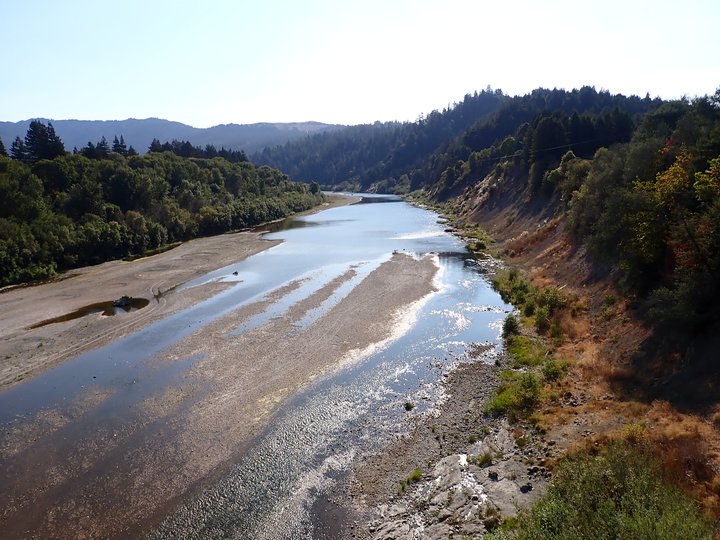
Eel River at Scotia running 26.3 cfs on Sept. 17
ECONEWS REPORT: What Smells at Stinky Beach?
The EcoNews Report / Saturday, Sept. 18, 2021 @ 10 a.m. / Environment
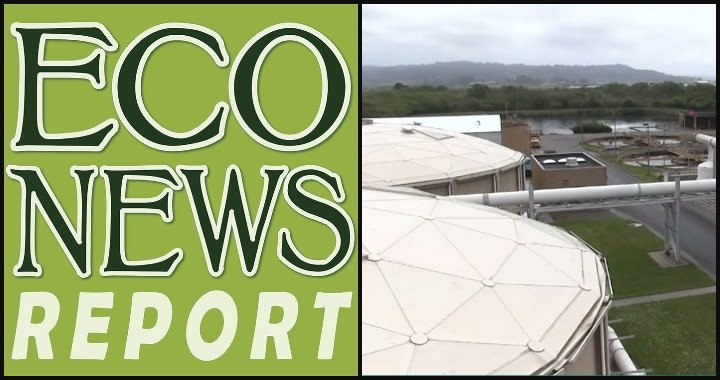
Eureka’s wastewater treatment plant. File photo.
###
The City of Eureka’s wastewater treatment
facility releases its treated wastewater into Humboldt Bay near its
facility by the Elk River. Nearby, surfers play at Stinky Beach and
Humboldt Bay residents collect seafood.
The
City had been operating on the assumption that the treated sewage
discharged from its Elk River Wastewater Treatment plant washes out
to sea, but a 2014 study determined that much more of the treated
sewage remains in Humboldt Bay than was previously understood. In
2016, the City was ordered by the North Coast Regional Water Quality
Control Board to “cease and desist” discharging into Humboldt Bay
and move to an ocean discharge by 2030. The City is instead asking
for an exemption to existing water quality rules so it can continue
pumping up to 12 million gallons of treated sewage into the bay near the Elk River Spit.
Surfrider Foundation and Humboldt Baykeeper are requesting the City to thoroughly examine the feasibility of moving to an ocean discharge or to commit to significant upgrades that will improve water quality in Humboldt Bay and that they hold at least one public workshop on the matter. Jen Kalt of Humboldt Baykeeper and Delia Bense-Kang of the Surfrider Foundation join the show to talk about where your waste goes when you flush and the impacts to Humboldt Bay.
AUDIO:


