Press release from the Humboldt County Sheriff’s Office:
On Sept. 1, 2021, at approximately 6:56 a.m., Humboldt County Sheriff’s deputies were dispatched to the area of Elk River Road and Herrick Avenue for the report of a man possibly in need of medical aid.
Upon arrival to the area, deputies located a deceased male adult. The man’s cause of death is still under investigation and is considered suspicious at this time.
The Humboldt County Sheriff’s Office Major Crimes Division is investigating this case.
Further information will be released when available and appropriate.
Anyone with information about this case or related criminal activity is encouraged to call the Humboldt County Sheriff’s Office at (707) 445-7251 or the Sheriff’s Office Crime Tip line at (707) 268-2539.
The Humboldt County Sheriff’s Office issued a statement minutes ago asking community members to stay out of vicinity of the Knob fire after the U.S. Forest Service reported numerous civilians interfering with firefighting efforts.
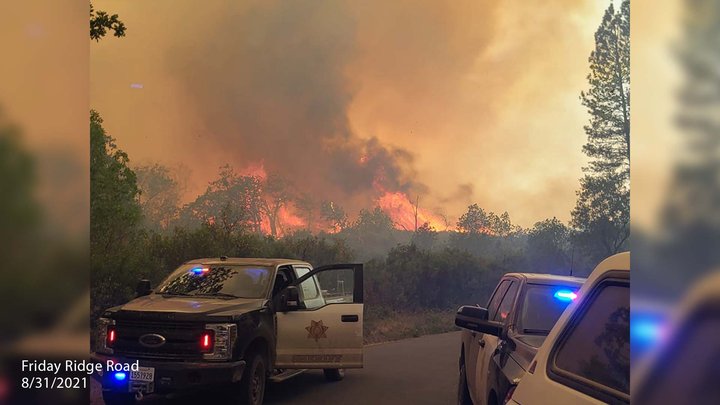
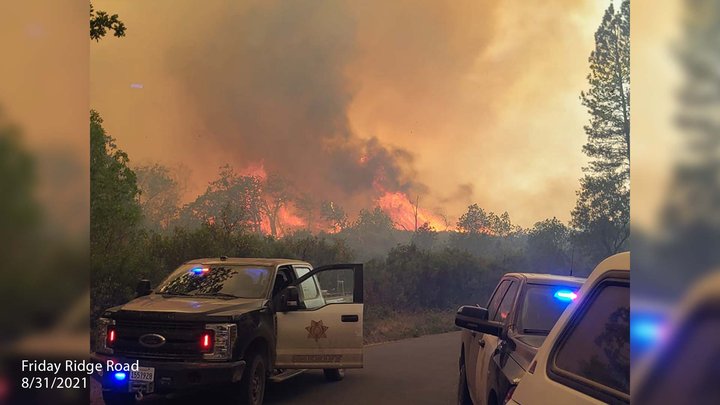
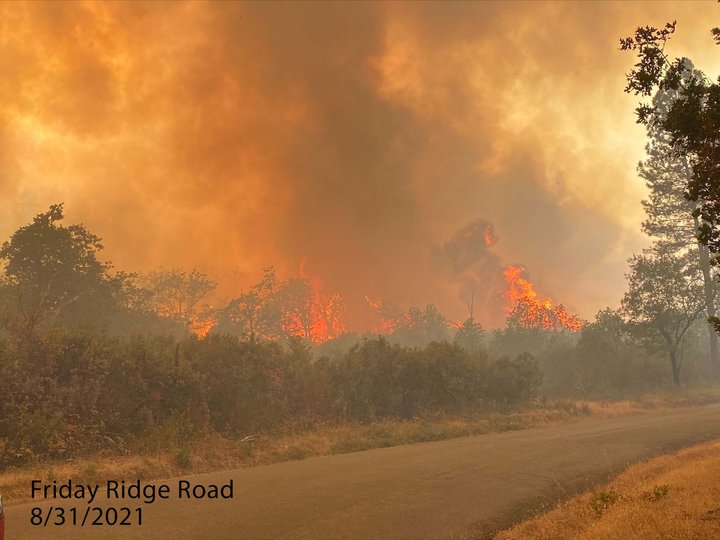
The statement is seemingly in response to calls to action put out on social media by community members and from groups like the Humboldt County Growers Alliance — which issued its own statement earlier today claiming that firefighters were doing little to help protect cannabis farms on Friday Ridge Road.
In the statement, the HCGA called for community members to meet at the bottom of Titlow Hill at 11 a.m. From there, community members planned to caravan into the Friday Ridge area to help protect properties.
Read the full statements from the Humboldt County Sheriff’s Office and the Humboldt County Growers Alliance below.
Humboldt County Sheriff’s Office:
We have been receiving multiple reports from USFS of community members interfering with firefighting operations at the Knob Fire.
We understand the community’s want to help and defend neighborhoods. As well-intentioned this effort is, it is interfering with firefighting efforts and drawing needed resources away from the fire to ensure civilian safety.
No community groups have been authorized to access or conduct firefighting operations within the evacuation order zones. To be mobilized as a firefighting resource, you must be part of a state recognized agency. A great way to get involved is to join your local volunteer fire department. Do not attempt to bring in heavy equipment or pump river water to fight the Knob Fire. Please allow the firefighters to do their jobs. If you have questions about this or how you can help, please contact the USFS Incident Management Team who is coordinating resources for this fire at: 530-628-0039.
Today’s statement from the Humboldt County Growers Alliance:
Call to Action Willow Creek needs your help! The Knob Fire is getting dangerously close. They need assistance now. Chainsaws, extra blades and fuel, chippers, excavators, on the go meals, and abled bodied people with a good attitude.
Lindsey Jones from Aloha Humboldt is leading people into the Friday Ridge area of Willow Creek at 11 a.m. today. The meeting place to caravan is at the bottom of Titlow Hill. If you can’t make it now, no problem!
Directions are easy and there is cell service 90 percent of the way. Many of the farms on Friday Ridge Road have zero fire support. Cal Fire was at Emerald Queen for 10-minutes and left. If you can, show up. If you can’t, maybe make some sandwiches and send them in with someone that can. Willow Creek is working hard to save their community. Time is of the essence. Friday Ridge today through ….? Oak Knob/South Fork once Friday Ridge is secure.
Text Linsey Jones, Aloha Humboldt, 707-834-5375 or Ryan Jones, Aloha Humboldt, 707-834-5374.
Press release from the Humboldt County Sheriff’s Office:
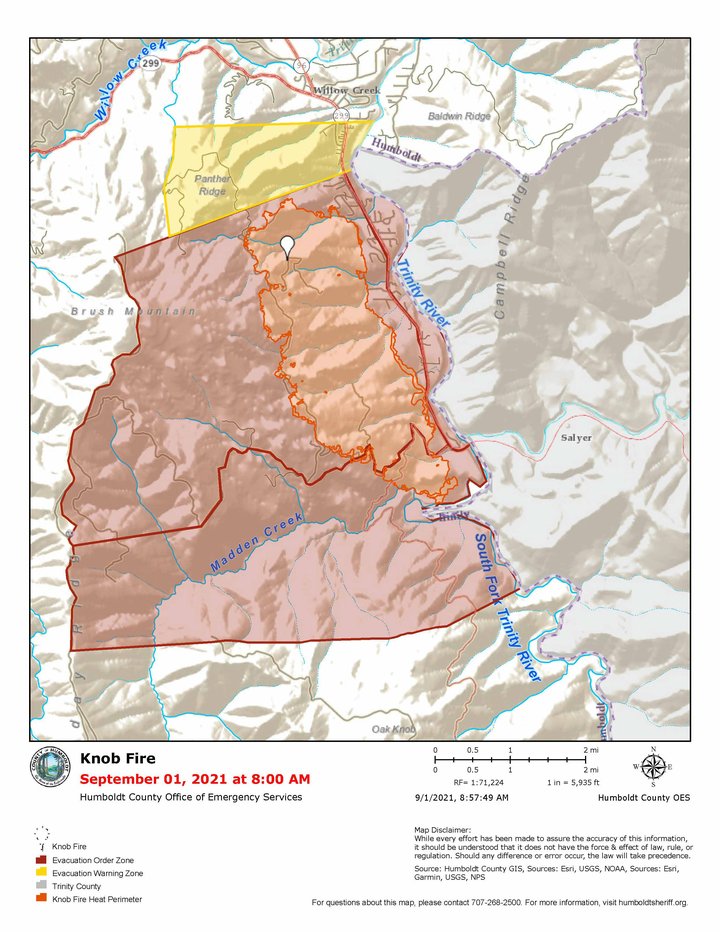
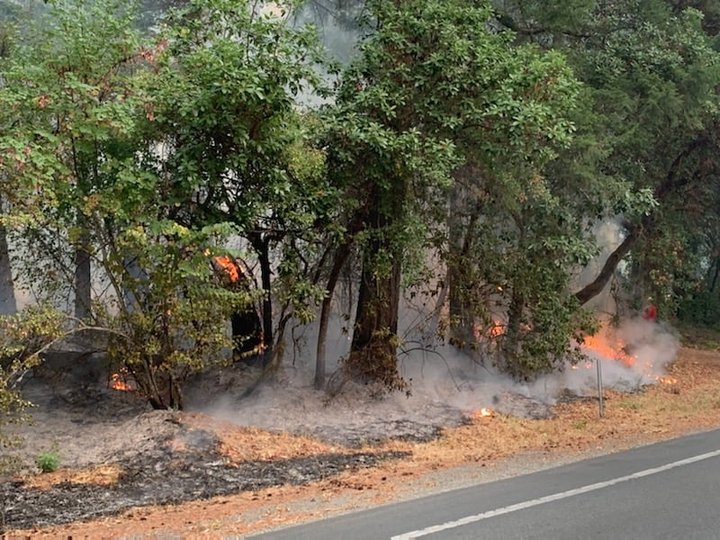
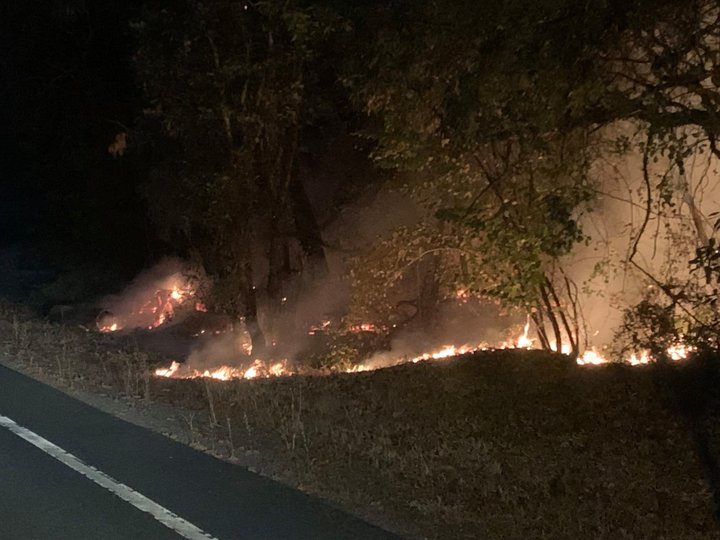
Evacuation warnings and orders remain in effect for the China Creek and Friday Ridge areas as fire crews work to contain the Knob Fire near Willow Creek.
CURRENT SITUATION
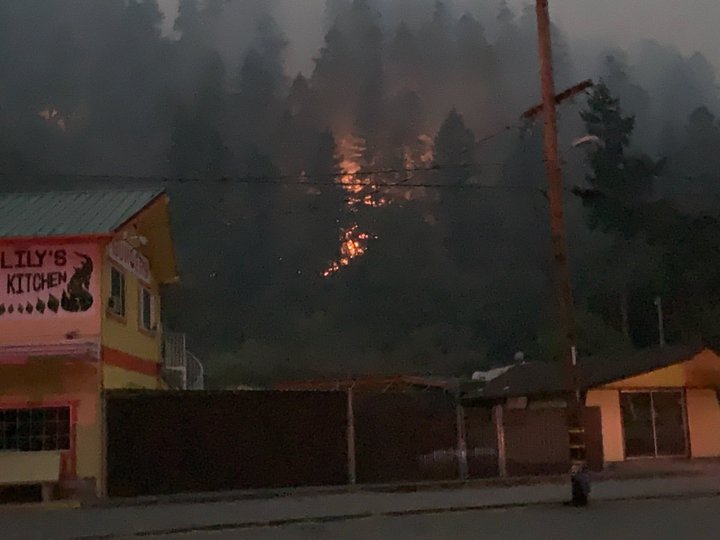
The Knob Fire originated Sunday, Aug. 29, 2021 between 4 and 5 p.m. It is burning in timber, brush and grass. The U.S. Forest Service (USFS) is leading fire suppression efforts. According to California Incident Management Team 5, as of 5 p.m. August 31, the Knob Fire was approximately 1,000 acres and 0% contained. Fire suppression efforts and favorable weather overnight kept the fire west of Highway 299 and the South Fork Trinity River. Due to heavy smoke impacting air resources, the current total acreage of the fire is unknown. Weather conditions forecasted for this afternoon present the potential for fire growth to the south and east.
According to the Pacific Gas and Electric Company, approximately 1,200 customers are without power as of 8 a.m. September 1. See outage map: https://pgealerts.alerts.pge.com/outages/map/
Humboldt County Sheriff’s deputies continue to patrol the mandatory evacuation zones and liaise with the fire Incident Management Team to ensure the safety of residents.
EVACUATION INFORMATION
An EVACUATION ORDER remains in effect for:
Areas east of Brushy Mountain Lookout Road/Forest Route 6N08A to the Trinity River, south of Butterfly Creek Road to the end of Forest Route 6N20.
An EVACUATION WARNING remains in effect for:
Areas east of Boise Creek to the Trinity River, South of Panther Creek Road to Butterfly Creek Road
The following road closures are in effect related to the Knob Fire:
China Creek Road at Hodgson Road;
Burwood Drive;
Gypo Lane;
Friday Ridge Road;
Butterfly Creek Road.
The above routes are closed to entering traffic, but may be used by residents to leave the area in compliance with the evacuation order.
State Route 299 is currently open to one way controlled traffic in the fire area. Road conditions are subject to change based upon fire activity and public safety. Residents are encouraged to visit http://quickmap.dot.ca.gov/ to check for state highway closures.
RESOURCES FOR THE COMMUNITY
An Evacuation Center remains open at the McKinleyville Seventh Day Adventist Church, located at 1200 Central Avenue, McKinleyville, for evacuees. Resources available at this location include:
Overnight sheltering;
Restrooms;
Water;
Red Cross services.
Domestic and large animal sheltering is available at the Hoopa Rodeo Grounds, located on Pine Creek Road in Hoopa.
County residents are encouraged to sign up for county emergency notifications via Humboldt Alert at humboldtgov.org/alerts. Residents must opt-in to receive evacuation notifications via phone or email.
If having trouble signing up for Humboldt Alert online, please contact the Humboldt County Sheriff’s Office of Emergency Services at 707-268-2500
FOR MORE INFORMATION
Additional updates will be issued via press release as needed.
For more information regarding the Knob Fire, current impact and evacuation areas, please go to humboldtsheriff.org, visit @HumCoOES on Facebook and Twitter, or call 707-268-2500.
A group of locals put out the word today to organize a posse to help communities threatened by the fire.
The Humboldt County Growers Alliance issued a statement saying that many cannabis farms along Friday Ridge Road are receiving little fire protection.
Read the Humboldt County Growers Alliance’s full statement below:
Call to Action Willow Creek needs your help! The Knob Fire is getting dangerously close. They need assistance now. Chainsaws, extra blades & fuel, chippers, excavators, on the go meals, and abled bodied people with a good attitude.
Lindsey Jones from Aloha Humboldt is leading people into the Friday Ridge area of Willow Creek at 11 a.m. today. The meeting place to caravan is at the bottom of Titlow Hill. If you can’t make it now, no problem!
Directions are easy and there is cell service 90 percent of the way. Many of the farms on Friday Ridge Road have zero fire support. Cal Fire was at Emerald Queen for 10-minutes and left. If you can, show up. If you can’t, maybe make some sandwiches and send them in with someone that can. Willow Creek is working hard to save their community. Time is of the essence. Friday Ridge today through ….? Oak Knob/South Fork once Friday Ridge is secure.
Text Linsey Jones, Aloha Humboldt, 707-834-5375 or Ryan Jones, Aloha Humboldt, 707-834-5374.
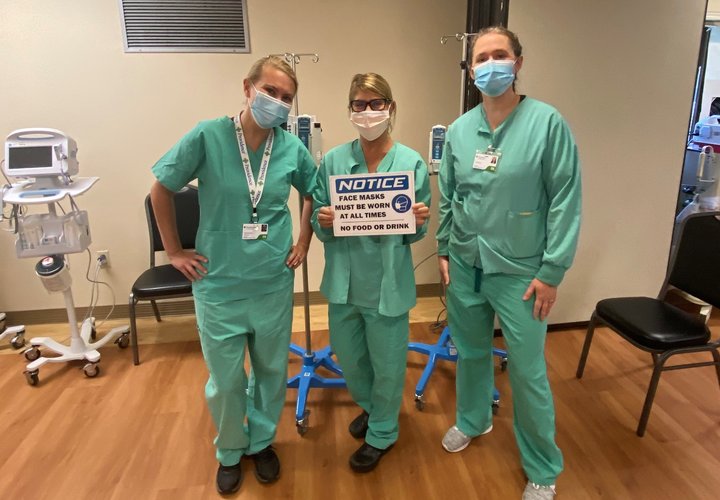
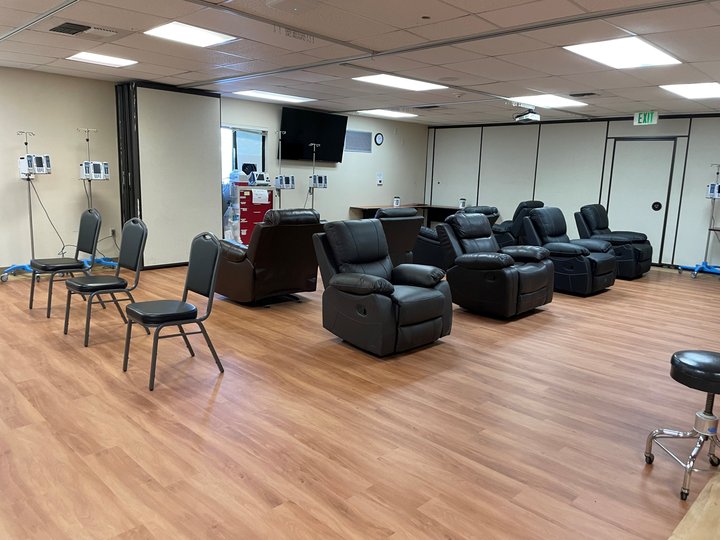
Providence St. Joseph Hospital in Eureka announced today that it has launched a monoclonal antibody therapy (MAB) clinic (Regen-Cov) and will administer the treatment at a newly repurposed area of the hospital. The clinic, which opened on Tuesday, is an outpatient program and will treat eligible patients who have tested positive for COVID-19, experiencing early mild to moderate symptoms that occurred in the last 10 days, and are at high risk for more serious symptoms and potential hospitalization.
Operated by hospital staff and by appointment only, the clinic will be open from 8:00 a.m. to 4:00 p.m., Monday through Friday. The monoclonal antibody therapy needs an order from a physician or licensed Advanced Practice Provider. Patients who are eligible need an order from their provider to get a referral for treatment.
“As an organization dedicated to health equity, Providence’s COVID-19 response in Humboldt County has focused on providing innovative, compassionate care to our community,” said Roberta Luskin-Hawk, MD, chief executive for Providence in Humboldt County. “Two weeks ago, this was just an idea. It’s a testament to the dedication of our staff to be able to mobilize and operationalize this critical treatment program to help us fight this terrible disease in such a short time. I could not be prouder of our staff who continues to answer the call for their patients.”
The infusion treatment takes 20-30 minutes, then patients (18 years of age or older) are monitored for an hour for any side effects that may occur following the infusion. There is no cost to the patient and treatment is offered regardless of immigration status or health insurance.
“We know that monoclonal antibody treatments may help patients avoid progression of mild symptoms into severe disease requiring hospitalization or leading to death,” said Travis Sewalls, MD, chief medical officer for Providence in Humboldt County. “The availability of this clinic offers Providence another tool in combating the devastating effects of this pandemic and in alleviating the burden of the county’s health care infrastructure. We’re excited to share that our first patient has already completed treatment.”
In addition to introducing the new MAB clinic, Providence St. Joseph Hospital also welcomed eight new traveling caregivers to their ranks earlier this week – six intensive care unit RNs and two respiratory therapists. The additional staff were sourced through the Medical Health Operational Area Coordinator (MHOAC) as part of the hospital’s exhaustive and ongoing efforts to improve staffing to better care for the community during the increase in hospitalizations due to the Delta variant.
“ICU nurses and respiratory therapists are critical in the care of COVID-19 patients,” said Luskin-Hawk. “These additional caregivers will be met with open arms and gratitude as they enter our hospitals. Even with these additional resources, vaccination is our best defense against COVID-19.”
Welcome
back for the second episode of Land Use and You, a new series that
explores the latest in cutting edge and good old fashioned land use
policy. Last month we explored how bringing back traditional small
lots (and the small single-family homes that go along with them) can
help Humboldt’s housing affordability crisis. Recent news from
Sacramento is also assisting in this effort: SB 9, a bill that would
allow lot splits in all single-family zones in California, has been approved by both houses of the State Legislature and is heading to
the Governor’s desk for signature. If the bill is signed into law
this fall, this important housing creation tool will be available
throughout all of the cities and towns in Humboldt County (and not
just in Eureka).
This
month, however, we turn our attention to the country-fried cousin of
the small-lot subdivision: the conservation subdivision. A
conservation subdivision is one in which new homes are clustered
together in one portion of the overall site so that a large area of
forest, gulch, or agricultural land can be preserved as-is into the
future. Conventional subdivisions, in contrast, attempt to spread all
of the houses out evenly which often leaves little in the way of open
greenspace.
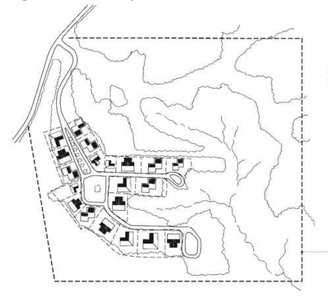
It might look kinda like this.
Conservation
subdivisions (also called cluster subdivisions) were originally
created for farmland preservation purposes. People were displeased to
see entire farms, one after another, turned from crops to suburban
tract homes. Seeking a compromise, the conservation subdivision
offered a way to build the same number of homes while preserving 50%
or more of the land.
Applied
in the context of Humboldt County, this development pattern offers
the same advantages and more. The following are some of the reasons
why your next subdivision might best be a conservation subdivision.
Hard-to-Develop
Parcels. Most land available for purchase today in Humboldt is hard
to build on. Read the fine print on most ads and you’ll often see
the majority of the property consists of steep slopes, creeks, and
wetlands. Attempting to develop on top of site constraints such as
these can be impossible to permit (sometimes prohibited by law) or
ruinously expensive (imagine custom engineered foundations and
enormous retaining walls). A conservation subdivision allows you to
carefully arrange homes on the portions of the lot that are actually
realistically buildable.
Lower
Utility Infrastructure Costs. Clustering development in one portion
of the site means that you’ll need to construct less lineal feet of
water/sewer pipe, curb/gutter, and asphalt streets. This can mean the
difference between a development that pencils out — and one that
doesn’t.
Minimum
Lot Size.
Conservation
subdivisions can have very small lot sizes. A new two-story, 2,000 square-foot house might be built on a 2,000 square-foot lot. Lot coverage might
exceed 80 percent. Ordinarily, figures like this would only be seen on dense
development in urban areas. However, in the context of conservation
subdivisions these compact standards are required to facilitate a
development that works with the unique local site constraints.
Number
of Lots. A conservation subdivision can result in as few as
two lots (i.e. a lot split) all the way up to 100+ lots for a large
development.
House
Size and Setbacks. Home sizes in conservation subdivisions are often
the same square footage as in conventional subdivisions. Building
setbacks, however, tend to be a bit shorter and yards minimal. For
example, the front of a house in a conservation subdivision might sit
closer to the street on account of the steep gulch drop-off at the
back of the lot. Correspondingly, the home’s “backyard” might
consist of nothing more than a large wraparound deck (w/outdoor
kitchen and hot tub) that looks out over a private (and protected)
view of the gulch.
Overall
Density. The overall density of a conservation subdivision is no
different than a conventional subdivision. Density is expressed in
the General Plan as the number of homes allowed per acre. For
example, a four acre parcel subject to a maximum density of eight
dwelling units per acre can only contain thirty-two homes total. A
conventional subdivision might result in 32 5,000 square-foot lots
whereas a conservation subdivision might create 32 2,500 square-fool lots and 2.2 acres of open space.
Conservation
Area Requirements. In order to qualify for the compact development
standards of a conservation subdivision, a minimum percentage of the
total site area must be permanently set aside for open space,
recreation, agricultural, or habitat conservation purposes. In
Eureka, the minimum is 50%. The conservation area must be protected
from future development by dedicating a conservation easement to a
public agency or public interest land trust, by dedicating the land
in fee-title to a public agency, or by recording a deed restriction.
At the discretion of the developer, the conservation area can be
opened for use by the general public or reserved for private use by
the residents of the development. Gulches are great places for shared
walking trails. On farmland, the conservation area can remain in
production or be repurposed to community garden space for residents
of the development (or heck, open to anyone).
Affordability.
Conservation
subdivisions result in brand-new, market rate homes — which are not
cheap. That’s okay. Humboldt needs more housing at all income
levels. Building more market rate housing doesn’t mean that we’re
building less affordable housing. Just think — that Santa
Rosa-based gastroenterologist considering moving to Humboldt just
might be tempted by a nice new home created via a conservation
subdivision.
Well,
there you have it, the key takeaways of conservation subdivisions.
Ask for them by name.
If
for some reason your town doesn’t allow conservation subdivisions,
be advised that amending the zoning code to allow them need only take
a few months. Remember, conservation subdivisions don’t increase
density beyond what is already allowed in the General Plan. Call your
representative and explain why you think conservation subdivisions
should be allowed.
###
Brian Heaton is a local pro-housing advocate with a professional background in city planning. Views expressed are his own and do not represent those of any government.
Across California, a substitute teacher shortage is causing administrators to take desperate steps to make sure there’s an adult in the classroom when teachers are absent due to Covid-related quarantines. Photo by Anne Wernikoff, CalMatters.
###
Kelly Rhoden, the principal at Nevada Union High School, spent her morning Monday scrambling to find substitutes for her absent teachers.
The school, about 60 miles northeast of Sacramento, has 86 teachers. Thirteen were out on Monday.
“We have quite a few teachers out either because they’ve tested positive, they’re symptomatic, or they have their own children who are in quarantine,” she said. “At the end of the day, we just don’t have enough substitutes.”
Across California, the substitute teacher shortage is another burden in an already challenging school year. Administrators are taking desperate steps to make sure there’s an adult in the classroom when teachers are absent, resorting to using non-teaching staff who have their own critical responsibilities during the typical school day, especially during the first fully in-person school year of the pandemic.
Nevada Union High and the rest of the Nevada Joint Union High School District share a pool of substitute teachers with eight other districts in Nevada County. Last year, the pool was stretched so thin that Nevada Joint Union shut down schools due to a sub shortage. District officials are worried it’ll happen again.
“Last October, we had to go back to distance learning because I ran out of substitutes,” said Brett McFadden, superintendent of Nevada Joint Union High. “Not because we didn’t have enough protective equipment. I ran out of adults.”
McFadden said even he has had to sub for a class.
According to County Superintendent Scott Lay, the county went from having about 200 substitute teachers before the pandemic to less than 70 today. As a result, principals like Rhoden are forced to place counselors and administrators in classrooms. Even then, Rhoden fell short three substitutes on Monday.
The substitute shortage is worsened by an underlying teacher shortage. Several district officials interviewed by CalMatters said they started the school year with some classrooms being assigned a long-term substitute.
In hopes of attracting more subs, districts have increased their pay rates, triggering similar raises at neighboring districts. But administrators say money won’t create more educators.
“You get to a point where you’re just begging and borrowing people from all over the district,” McFadden said. “I love my students dearly, but I’m not gonna leave 30 of them alone in a room.”
How bad is the sub shortage?
California has seen declining numbers of new substitute teachers every year, according to the California Commission on Teacher Credentialing, the agency that licenses full-time and substitute teachers.
In the 2018-19 school year, the agency issued about 64,000 substitute teaching permits. In 2020-21, it issued close to 47,000.
Prospective substitute teachers need to hold a bachelor’s degree and meet the “basic skills requirement” either by providing a standardized test score or by having B’s or better in college-level reading, writing and mathematics courses.
“It’s not terrifically challenging to get a sub permit in California,” said Mary Sandy, the executive director of the Commission on Teacher Credentialing. “But the need is utterly critical.”
At San Bernardino City Unified, the number of substitutes at the district’s disposal shrank from 1,000 before the pandemic to 700.
Marcus Funchess, who oversees human resources for the district, said only about 92% of teacher absences are covered each day.
“Right now our substitute teacher shortage is a concern due to the number of teachers who might need to quarantine,” he said. “On one day we could have up to 45 jobs uncovered.”
Why is the substitute teacher force shrinking?
Aaron Estrada, a substitute in the Chula Vista Elementary School District, said many substitutes left the profession last year because the pay wasn’t worth the risk of being surrounded by unvaccinated students and staff.
“It’s difficult to try to make a living off substitute teaching,” he said. “For a lot of people, it didn’t seem worth it.”
Some school districts, especially those in rural communities, rely heavily on retired teachers to work as substitutes. But for those older educators, the risk of returning to the classroom is even greater.
“Retirees have their own fears,” said Rhoden, the principal at Nevada Union High. “They want to keep their own health at the forefront.”
Mike Teng, CEO of Swing Education, a company that helps over 200 school districts find substitute teachers, said the sub shortage is consistent with staff shortages in the service sector.
“It’s tough. Substitute teachers have left and haven’t come back,” he said. “And we’re potentially trying to compete with all the other industries for workers.”
Rosi Martinez, the president of the local teachers union at Chula Vista Elementary, said former substitute teachers are reluctant to return because they’re making more money from unemployment benefits.
“At one point we were only filling about half of teacher absences,” she said. “That’s pretty much unheard of.”
Rising pay and lowering barriers
In an effort to entice substitute teachers back into the classroom, the administration at the Chula Vista Elementary School District held an emergency meeting in early August to increase pay for subs.
The district increased pay for short-term subs from $122 to $200 a day. For long-term substitutes, the pay went from $180 to $283 a day. In response, the neighboring Sweetwater Union High School District increased its rate from $160 to $240 a day.
“You can say it’s a bidding war, but that’s just the market,” Teng said. “But substitute teachers still aren’t paid enough.”
“Some other states don’t require a bachelor’s degree to be a substitute teacher. It’s worth a discussion here.” — Marcus Funchess, human resources at San Bernardino City Unified
Elk Grove Unified has proposed raising its substitute pay rates, especially for current and retired teachers and counselors. These substitutes could make $350 a day, once the district’s school board approves the raises.
At San Bernardino City Unified, the district gave substitutes a 2% raise and paid $12,000 for digital billboards to advertise its substitute positions on the freeways. Funchess said the district would increase pay if this aggressive advertising campaign doesn’t attract enough substitutes.
Apart from raising pay, district leaders said the Commission for Teacher Credentialing could take steps to remove other barriers like the $100 fee and the requirement for a bachelor’s degree.
“We could use any temporary reprieve,” Funchess said. “Some other states don’t require a bachelor’s degree to be a substitute teacher. It’s worth a discussion here.”
A sub shortage on top of a teacher shortage
The substitute shortage is just a symptom of an ongoing teacher shortage, according to district administrators. Because some districts across the state started the school year with unfilled teaching positions, some students have only had a substitute teacher in the weeks since school started.
In the 2020-21 school year, 13,558 of California’s teachers retired, 1,000 more than the previous year, according to data from the California State Teachers’ Retirement System.
Mary Sandy at the Commission on Teacher Credentialing said the agency must credential about 20,000 teachers a year to keep up with the staffing needs of districts across the state. Last year, only about 14,000 teachers received their credentials.
And while this year’s state budget includes a historic amount of funding for California’s schools, no amount of money can overcome the bottom line of a personnel shortage.
“I don’t know if another pay raise would work to be honest. I just don’t think there’s enough teachers out there.” — Kelly Rhoden, principal at Nevada Union High School
At Nevada Joint Union High School District, Superintendent Brett McFadden said despite raising the daily rate from $100 to $150 per day, finding substitutes continues to be a challenge especially in more rural and remote parts of the county.
“I don’t have a money problem,” he said. “I have a resource problem.”
Until district and state officials find more effective ways to recruit qualified teachers, principals like Rhoden will start their days rushing to put an adult in every classroom.
“I don’t know if another pay raise would work to be honest,” Rhoden said. “I just don’t think there’s enough teachers out there.”
###
CALmatters.org is a nonprofit, nonpartisan media venture explaining California policies and politics.