

That Student in Your Community College Class? They Could Be a Bot.
Emma Hall and Charlotte West / Thursday, Sept. 2, 2021 @ 7 a.m. / Sacramento
On the first day of spring term this year, an aeronautics professor came to administrator Laura Hope to share something suspicious: Most of the students in his virtual class weren’t participating at all.
Hope, the head of instruction at Chaffey College, a community college in Southern California’s Inland Empire, dove into the college’s records to find out why.
The shocking answer? These weren’t real students, but scammers likely out to bilk taxpayers of millions of dollars in financial aid. Faculty and staff caught onto the scam before any dollars went out, Hope said. If they hadn’t, about $1.7 million would have landed in the hands of fraudsters.
Chaffey is not the only California community college to report such a scam, according to a CalMatters investigation. Officials with the 116-college system say they are seeing a spike in cyberattacks since the pandemic, which they suspect is because the scammers are targeting federal COVID-19 relief grants along with traditional financial aid. At least 10 districts or individual colleges have told CalMatters they’ve had increases in fake applications, registrations, financial aid filings, or some combination of the three. The Chancellor’s Office estimates that about 20% of the traffic coming to the system’s online application portal is from bots and other “malicious” actors.
Bots are filling up classes, in some cases preventing real students from enrolling. And identifying and blocking the fake student accounts is taking up considerable staff time, college officials say. They say the system is being targeted partly because it is open enrollment and does not have an application fee.
“It’s a well-orchestrated, analytically led assault on the weaknesses in our system,” Hope said.
This week, the California Student Aid Commission told the Los Angeles Times it had identified more than 65,000 applications for aid from purported community college students that appear to be fake, lending credence to the idea that scammers are seeking to get their hands on state grants.
And in a memo to colleges Monday, the community college system’s vice chancellor for digital innovation and infrastructure, Valerie Lundy-Wagner, announced new security measures to combat the threat.
Scammers seek student email addresses, federal aid
While reports of fraud have increased recently, cyberattacks on the state’s community colleges aren’t new — and the perpetrators don’t necessarily have to be sophisticated hackers.
A quick search on YouTube shows countless videos detailing how to make fraudulent student accounts to get a .edu email address for free or discounted access to software, online shopping and digital music.
In a video from “Targetter,” a YouTuber who appears to be based in India, he walks his 70,000 viewers through the process of obtaining a .edu email using a bot downloadable from his account bio.
“It’s all automated, you don’t need to do anything,” the YouTuber says as code scrolls in a pop-up window. Another pop-up screen provides options to “enroll” at one of four listed California community colleges — Contra Costa College, Mt. San Jacinto College, San Francisco City College and Sacramento City College.
“All I have to do now is just sit back and relax,” he says as the bot populates a Contra Costa College application with fake personal information. Within seven minutes, “Targetter” had enrolled at Contra Costa College as Ivan N. Atkinson for the fall 2020 term.
In a follow-up video, he mentions that the bot is no longer functioning due to security updates to the community colleges’ website, but encourages viewers to make their own changes to the code.
“The thing about this is that it’s not hard to do,” said Nick Merrill, a cybersecurity research fellow at UC Berkeley. “The code is obviously floating around to do this to a handful of colleges.”
The influx of federal emergency aid and the shift to remote learning — which makes it easier for scammers to hide behind a screen rather than appear in person — have made the community college system even more attractive to bad actors, college officials say. That, coupled with college administrators’ desire to get the money out as soon as possible to students walloped by the pandemic’s economic effects, creates a tough balancing act for officials charged with protecting taxpayer money while doling out vital aid.
Across three rounds of federal emergency relief, California’s community colleges will receive at least $4.3 billion, of which $1.75 billion will go directly to students.
The tell-tale signs of fraud at Chaffey were evident as soon as Hope started investigating the professor’s concerns. One so-called student enrolled in an aeronautics and nursing course. “Those are not programs that cross over,” Hope said. Those classes do, however, have high unit loads, moving students closer to becoming eligible for the maximum amount of financial aid.
Officials at the college found roughly 500 accounts they deemed were fake – and their student data profiles carried similar red flags. One giveaway: the applications that these students submitted came from the same IP address – an online identifier that shows where someone is located. Many of the applications had the same email addresses. Few had corresponding phone numbers.
Other colleges reported dramatic surges in applications during the 2020-21 school year, despite an eventual drop in enrollment. “We get about 33,000 applications a year. This year we got 75,000,” said Brandon Moore, executive dean of institutional effectiveness at Mt. San Jacinto College in Riverside County. ”Most of those are not real students.”
The Contra Costa Community College District flagged nearly 40,000 fake applicants in fall 2020, up from 12,000 in 2019. Other colleges that identified false accounts during the pandemic include College of the Sequoias, Citrus College, Compton College, College of the Siskiyous, Southwestern College and Ohlone College, CalMatters found.
In some cases, college officials identified fraud right before they would have disbursed financial aid — like at Fullerton College, which had to stop payment on more than $1 million in Pell Grants this summer after identifying some 3,000 fake student accounts, said financial aid director Greg Ryan.
The Peralta Community College District also reversed $4,800 in fraudulent summer financial disbursements after discovering more than 125 fake applications, according to a report from the district’s chancellor’s office to its board of trustees.
Impact on real students
In Kathryn Maurer’s anthropology class at Foothill College in Silicon Valley, 23 out of 50 students were fake, filling the class right away. Because community college classes are open access, said Maurer, she couldn’t remove students from the roster until the start of class when students were able to use Canvas, the college’s online learning system.
Even then, there was some participation in class. She was suspicious of some “students” because they would only answer the first question on a quiz. In an assignment asking students to introduce themselves, Maurer said that some of the posts listed the exact same information with only the name and place changed.
But by the time fraudulent accounts were purged, it was too late for real students to enroll, Maurer said.
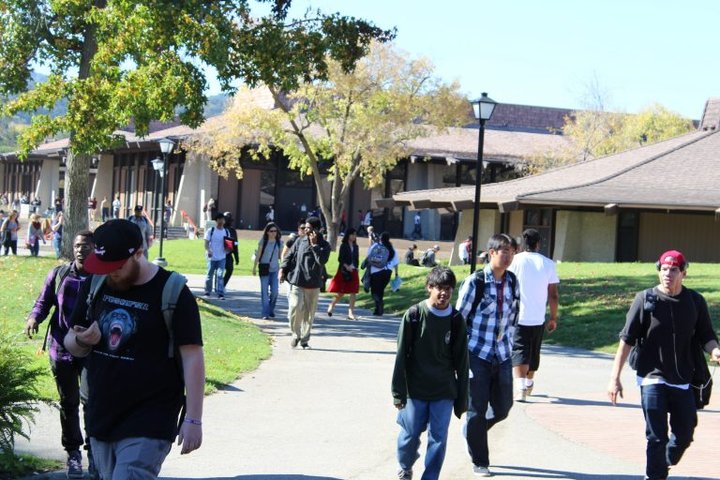
Students walk the campus of Foothill College in Los Altos Hills. The community college has tightened security after seeing an increase in fraudulent applications for financial aid. Photo courtesy Foothill College
Fake students accounted for 2-3% of Foothill’s enrollment in the past two quarters, said Anthony Cervantes, the dean of admissions. The college has put in hundreds of hours investigating potential fraud, Cervantes said, and real students sometimes get caught in the dragnet.
“We’re trying to get back to those students that are real as soon as possible,” he said. “We’re trying to prevent enrollment by these fraudulent groups, so they don’t take the seats out from students.”
After identifying 1,600 fake federal financial aid applications within the last two quarters — which likely involves identity theft as it requires a real Social Security number — the college started requiring suspicious accounts to digitally upload an ID to prove they are real students. Most fraudsters disappear at that point, college officials said.
Administrators at several colleges said they’re worried about the potential impact of fraud on real students when the community college system as a whole is battling enrollment declines. “To know that we possibly disappointed students or turned students away of course doesn’t feel good, and especially when enrollment is more precious than ever,” Hope said.
A national pattern of cyberattacks
The scams may be part of a national trend; cyberattacks on U.S. educational institutions have increased 15% since the beginning of 2021, according to data from Check Point, a cybersecurity firm with a research arm.
The Chancellor’s Office has reported the uptick in fraud to the U.S. Department of Education’s Office of the Inspector General, said spokesperson Paul Feist. A spokesperson for the Inspector General said that it can confirm an increase in fraud reporting for both the California community college system and those in other states, but is “unable to provide any additional data as it could relate to current cases.”
Chancellor Eloy Ortiz Oakley told the Los Angeles Times Monday he was “alarmed” by the threat.
“There’s lots of unscrupulous players right now trying to access and exploit benefits, not unlike what’s happened with unemployment insurance and any number of other benefits that have been made available recently because of the pandemic,” Oakley said. “But I’m confident that the colleges have been able to identify the activity and are working to mitigate the risk to campuses.”
Creating a fake student account is just the first step. For fraudsters to breach the gates and run off with federal student aid, a lot has to happen.
First, they have to bypass the filters that colleges have been urged by the Chancellor’s Office to set up to detect suspicious accounts. Next, the scammers would have to regularly participate in classes to avoid the scrutiny of professors who are trained to look out for suspicious online student profiles that don’t engage in class material.
Then there’s making it past the financial aid office. Under the Biden administration, the federal COVID relief aid is open to virtually any student, even those without financial aid applications on file. At some community colleges, students must pick up grant checks in person using a federal or state ID that matches their student profile. But others have waived that step during the pandemic.
Fighting the fraud
Faculty play a key role in combating fraud, because they are responsible for dropping students from class if they aren’t participating by about three weeks into the term, when the college does a formal enrollment count, known as census.
“It is vital that faculty remove non-attending students by the Census date to significantly reduce the likelihood that financial aid is disbursed fraudulently,” wrote Lundy-Wagner, the vice chancellor, in another memo to colleges in June.
But with much instruction still taking place online, that can be difficult to monitor, say instructors like Maurer, who sometimes teaches as many as 200 students each quarter.
“This should not be on the faculty’s plate,” she said.
In the past, much of the burden to detect fraud has fallen on individual colleges. But this summer, the California Community Colleges Chancellor’s Office rolled out a new bot detector to catch malicious traffic to its application website.
Starting this month, any student accounts associated with fraudulent activity will be suspended. The statewide college system will also begin requiring campuses to submit monthly reports detailing suspected and confirmed registration and financial aid fraud, including any dollars erroneously paid to scammers.
By October, students will be required to use multi-factor authentication that requires confirmation of an email or phone number before they can complete an application.
Patrick Perry, the California Student Aid Commission’s director of policy and research, described the state’s response so far as a “success story.”
Despite the surge in attempted fraud, “the system worked as it should: numerous folks at numerous levels caught this and figured it out,” he said.
But Merrill, the cybersecurity expert, said an ongoing, centralized defense by the community college system would be important to stem the tide of bot students.
“The only way to make this scale is to use the same repository, the same tools across many colleges and many applications,” he said.
###
CALmatters.org is a nonprofit, nonpartisan media venture explaining California policies and politics.
BOOKED
Today: 3 felonies, 8 misdemeanors, 0 infractions
JUDGED
Humboldt County Superior Court Calendar: Today
CHP REPORTS
4827 Valley West Blvd (HM office): Hit and Run No Injuries
9700 Mm1 N Men 97.00 (HM office): Trfc Collision-No Inj
ELSEWHERE
RHBB: Magnitude 3.7 Earthquake Centered East of Hydesville
RHBB: Motorcyclist Injured in Solo Crash at 14th and California in Eureka
RHBB: Southbound Highway 101 Traffic Backs Up From Richardson Grove to Benbow
RHBB: Woman Suffers Possible Leg Fracture in Dyerville Loop Road Motorcycle Crash
OBITUARY: Hal V. Petersen, 1954-2021
LoCO Staff / Thursday, Sept. 2, 2021 @ 6:56 a.m. / Obits
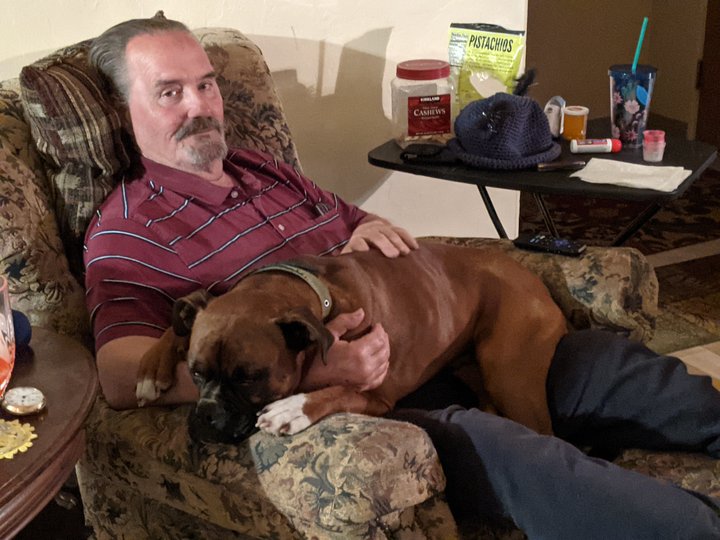
Hal
V. ‘Vern’ Petersen
Sept. 28, 1954 - Aug. 15, 2021
Vern, a.k.a “Tiny,” left this world to join his Lord and Savior, Jesus Christ, on August 15, 2021.
Vern fought valiantly against leukemia and so many other health challenges over the past six years. Some would say he was a determined soul – others, stubborn. What we know for sure is he overcame each of those challenges with a determination that was amazing.
Vern was born in Corvallis and was adopted by Dr. Hal and Norma Petersen. He spent his childhood in Chico. He loved living in Chico. The Butte Creek Canyon was a favorite place for bottle digging, gold mining/dredging, spelunking (the exploration of caves) and shooting. Most summers were spent with his beloved Aunt Marian, Uncle Daryl and cousin Steven in Southern California, learning so many cool things and riding horses. He attended Chico Senior High where he met his ‘Queen,’ Kimberly. They married in 1975 and have been together ever since. They moved to Humboldt County in 1979. He loved the beauty – hated the beach (just the sand part!)
Vern had many vocations in his life: backhoe operator and truck driver in SoCal, school bus driver for Scotia School, Chico City bus driver and owner of “Papa’s Chopper Shop” in Oroville. He restored and built houses in Humboldt and was the owner of California Training Center, a computer training school in Eureka.
But the things he loved the most were his family == his wife and three children. Each child had a special song composed by him. He would dance and/or rock them to sleep with his favorite music. He loved making special times come together — camping and boating at Ruth Lake for two weeks every summer, made extra special by building our ‘tent city,’ star gazing on the boat ramp and taking ‘monster walks” together.
His second love was his motorcycle. He had several variations over his lifetime, his favorite being his 1976 custom Shovelhead, his pride and joy. It was the main driving force motivating him to keep going through many of his physical challenges. He vowed to ride it again even after losing his leg. In the meantime, he rode his 2007 Softail trike. He told everyone that his Queen got it for him. They rode their motorcycles together as often as possible. They have been riding together since they were teenagers. These are some of the things that helped to combat his depression.
His most recent miracle was adding his boxer dog, Bridger, to the family. Getting him was an absolute God thing.
All the while, God was working in his life. He gave his life to Christ in the 90s. He knew he had been the recipient of many miracles. His Christian friend, Paul, said of him, “Tiny takes tiny steps.” Vern was an honest person and wanted to make sure his experiences with God were the real deal.
He became a member of The Journey Church in 2020 and joined a class on the Prophetic there this year. It intrigued him and he valued the knowledge and relationships he gained from that class.
In 2020, Vern’s brother-in-law, Russ Schmidt, organized “Tiny’s Lost Coast Run” to celebrate how much Vern had overcome. They decided to make it an annual event. Friends from all over California came to Humboldt County again this year to cruise the beautiful Lost Coast and the Giant Redwood Forest. He was honored to be the leader of the pack and pray over the riders. He was so looking forward to next year’s ride, but it was not meant to be. Next year will be a memorial run dedicated to him.
He is preceded in death by his parents, Dr. Hal and Norma Petersen, grandfather Verner Britton, grandmother Bessie Britton, father and mother-in-law Gerald and Beverly Schmidt, uncle and aunt Darryl and Marian Harris and brother-in-law Ed Hogg.
He is survived by his wife, Kimberly Petersen, their children, Ian Petersen, Drew Petersen (Jillian) and Rebekah Klinetobe (Greg). Grandchildren, Samson Petersen, Trynity Petersen and Emma Petersen. Brother-in-law, Russ Schmidt (Brenda), sister-in-law, Kristin Boddie (Lewis), sister-in-law, Andrea Davis, sister-in-law Hillarie Hunt (Daniel). Cousin Steven Harris (Kathey). Nieces, Sara Avakian (Eric), Gina Quinn, Kristine Alaways (Jeremy), Alyssa Davis, Jennifer Pierman (Kyle) and Melanie Nunes. Nephews, Grant Gillum (Terra), Michael Cantrall (Julie), Jeffrey Schmidt and James Davis. And many wonderful great-nieces and nephews.
Our family thanks you for all of your prayers and support at this time.
Celebration
of life will be held at The Journey Church, 95 Belleview Avenue in
Rio Dell on September 4 at 2 p.m. All are welcome.
###
The obituary above was submitted on behalf of Hal Petersen’s loved ones. The Lost Coast Outpost runs obituaries of Humboldt County residents at no charge. See guidelines here.
OBITUARY: Jeanne Kay Bryant, 1939-2021
LoCO Staff / Thursday, Sept. 2, 2021 @ 6:56 a.m. / Obits

Jeanne Kay (Patenaude) Bryant
passed away on August 21, 2021, at the age of 82. During the past year and a half of
medical events she fought back with grace and dignity. Regardless of
her condition she always had her smile, her whit, and charm.
Jeanne was born in Arcata and attended local schools and Humboldt State College, receiving her elementary school teaching credential. While at Humboldt State she met her husband, Patrick Bryant. Jeanne and Patrick were married in 1957 at St. Albans Church in Arcata.
Jeanne spent her career enriching and mentoring the lives of children at multiple schools. Besides finding creative ways of using play and art for children to learn, she shared these lessons with her grandchildren and their friends. Vacations with her grandchildren were coupled with travel, adventures, and history lessons. Not only did Jeanne teach and raise children, she and Patrick always had an open door at their house for their children’s friends. Multiple friends stayed days, months or even years and judgement was never passed.
During their first fifteen years of marriage, weekends were spent at dance clubs, camping, and house boating on Trinity Lake with friends and family. Later after retiring, they lived in Willow Creek and tended the summer garden growing some of the sweetest tomatoes you ever tasted Having retired early they had the opportunity to travel to thirty-seven countries. The final years were spent in Eureka to be near family.
Jeanne was preceded in death by her parents, Arthur and Bethyl Patenaude, her husband Patrick Bryant, her sister Marlene Hover and brother- in-law, William Hover, her great-grandson Brayden Ford and his father, Travis Ford.
Jeanne
is survived by her two children Linda (Fred) Sundquist, Mike (Nanci)
Bryant, her grandchildren, Renee Ford, Andy (Catherine) Sundquist,
Zack Bryant (Nikki Shaieb) and her great-grandchildren Jeran Ford,
Chezney Sundquist and Preslee Sundquist. Nieces, Tamee (Pete) Hover,
Bethyl Hover, and nephew Willie (Donna) Hover.
A special thank you to Gabby, Mandy and staff at Timber Ridge, and Scotty at Hospice for their care and dedication during her illness. In lieu of flowers please consider a donation to Hospice of Humboldt or The Brayden Allen Ford Foundation, in care of Humboldt Area Foundation.
A celebration of life will be held at a future date.
###
The obituary above was submitted on behalf of Jeanne Bryant’s loved ones. The Lost Coast Outpost runs obituaries of Humboldt County residents at no charge. See guidelines here.
McCash Fire Grows to Nearly 45,000 Acres; Structure Assessment to Begin Soon
LoCO Staff / Wednesday, Sept. 1, 2021 @ 4:15 p.m. / Fire
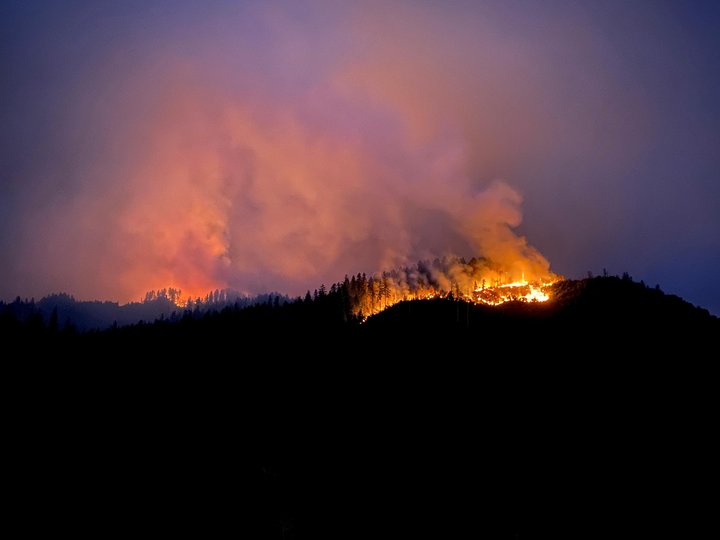
The McCash Fire is seen from Highway 96 near Independence Creek on Aug. 31. | InciWeb
U.S. Forest Service press release:
Total Personnel: 465, Crews: 4, Engines: 27, Dozers: 5, Water Tenders: 7, Aircraft: 4
An infrared flight Monday night over the McCash Fire showed the fire is 44,977 acres. This was the first infrared flight over the fire in nearly 48 hours due to a mechanical issue. The fire is 1 percent contained. There are 465 people assigned to the incident.
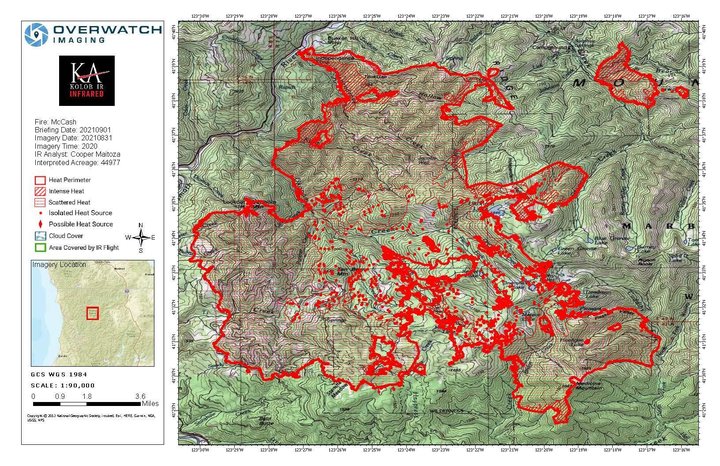
Latest map of the McCash Fire. | InciWeb
There will be a community meeting in Somes Bar tonight, Sept. 1, at 6:30 p.m. The meeting will be held outside at Junction Elementary School. Representatives from Great Basin Team 3 and the U.S. Forest Service will provide information and answer questions about the McCash Fire. The meeting will be recorded and posted on the Six Rivers National Forest Facebook page.
Crews spent Monday working to secure the northern contingency line in the Independence Creek area following Sunday’s firing operation. They mopped up the line, looking for hot spots and extinguishing them from Johnson Hunting Grounds to the Independence Bridge. The mop up operation carried over into night shift and will continue today.
Firefighters identified three spot fires north of the contingency line: one south of Tinkham Creek, one near Bishop Creek and one west of Lick Creek. Crews on the ground, supported by water drops from helicopters, worked throughout the day Monday to contain those spot fires. They will continue this work today.
The Highway 96 Structure Group spent Monday supporting the mop up operation along the contingency line in the Independence Creek area. They will do the same today until they are no longer needed, and then will move to Happy Camp to begin structure assessments. Likewise, the Elk Creek Structure Group will head to Happy Camp to begin assessing structures once their work in Elk Creek is finished. This could happen as early as today.
Crews working in the Ti-Bar and Patterson areas are continuing to extinguish hotspots, adding more depth to the containment lines yesterday on the southwest edge of the fire near Ti-Bar Road. In the Patterson area, crews have nearly finished prep work on the Iron Phone Road (13N11) all the way to the point where the road is washed out. This work will provide a contingency line inside the 2017 Haypress burn scar for firefighters to use should the McCash Fire move further south.
A new division has been created on the northeast side of the fire. Division November encompasses the area around Norcross Campground and Buckhorn Bear, where a spot fire estimated at 1,000 acres is burning. The resources assigned to the division will scout the area today to develop a plan for suppression of the spot fire. The division will be staffed with additional resources to implement that plan as other sections of the fire are contained or as new resources are assigned to the fire.
Smoke may settle into the valleys along the Highway 96 corridor at times today. Please continue to use caution as you drive through the fire area for your safety and the safety of others, including firefighters.
Weather: Weather is expected to be hot and dry again today. Temperatures are predicted to reach the upper 80s in the Klamath Valley with a minimum humidity of 18 percent and wind gusts up to 10 mph.
No Drone Zone: A temporary flight restriction remains in place over the McCash Fire. Flying a hobbyist drone over a fire puts everyone at risk and hinders firefighting suppression efforts. If you fly, we must ground all aircraft, due to the dangers unauthorized drones pose to firefighting aircraft.
Smoke: Smoke from the McCash Fire and neighboring fires in northern California is impacting local communities. For air quality information go to https://fire.airnow.gov or https://bit.ly/SiskiyouWildfireSmoke.
Evacuations: For the most current and accurate evacuation information for Siskiyou County, please visit the Siskiyou County Sheriff’s Office Facebook page at: https://www.facebook.com/SiskiyouCountySheriff or the county evacuation map at https://bit.ly/SiskiyouEvacMap.
All residents are encouraged to sign up for CodeRED Emergency Alert at: https://bit.ly/CodeRedSiskiyou
Construction: Caltrans is beginning bridge work today at mile marker 37.3 on Highway 96 east of Orleans. One-way traffic control will be in effect. Drivers should expect a 5-minute delay. Road information can be found by calling 1-800-427-7623 or on the Caltrans website https://roads.dot.ca.gov/
Visit the following sites for specific Forest Closure information:
U.S. Forest Service Region 5 https://bit.ly/R5ForestClosures
Six Rivers National Forest https://bit.ly/SRNFNotices
Klamath National Forest https://bit.ly/KNFNotices
For further information about the McCash Fire, please visit the following links: https://inciweb.nwcg.gov/incident/7757/
Arcata City Council Will Decide How to Spend $4.4 Milion in COVID-19 Relief Funds; Lobby Group Wants the City to Prioritize Reducing Carbon Emissions
Stephanie McGeary / Wednesday, Sept. 1, 2021 @ 4:02 p.m. / Local Government
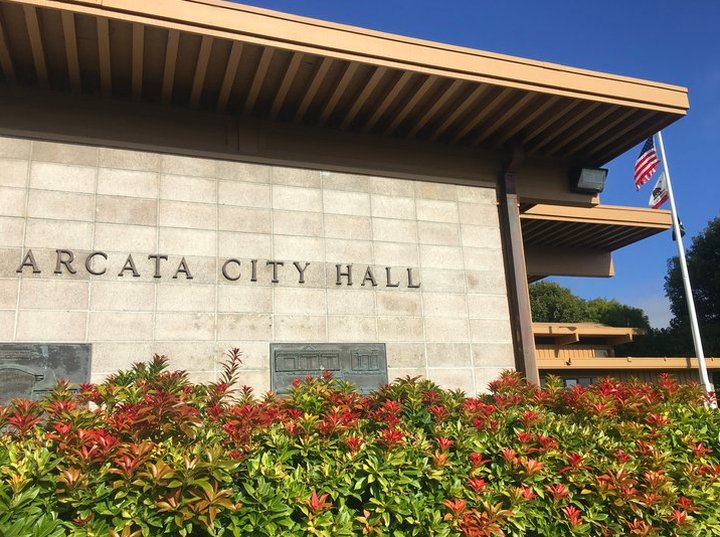
Arcata City Hall may soon switch to an electric heating system | File photo: Stephanie McGeary
During tonight’s meeting, the Arcata City Council will discuss how to spend more than $4.4 million in COVID-19 relief funds local environmentally focused political action group, Redwood Coalition for Climate and Environmental Responsibility (RCCER) is urging the council to use a hefty chunk of that money to fund projects that will help reduce carbon emissions in the city.
“The City of Arcata faces many severe impacts from the climate crisis, ranging from sea level rise to wildfire smoke to the inflow of climate refugees from other regions,” RCCER wrote in a letter to the council. “These and other impacts will only increase as we continue to pump greenhouse gases into the atmosphere from our vehicles, buildings, waste disposal, and other sources. The City can no longer afford to make any spending decisions without consideration of how those investments mitigate or exacerbate the climate crisis.”
The $4,409,087 in funding comes from the American Rescue Plan Act (ARPA) — specifically the state and local fiscal recovery funds, which allocate about $350 billion in aid to governments to meet pandemic response need and help “rebuild a stronger, and more equitable economy as the country recovers,” according to the U.S. Department of the Treasury website. This can include a wide range of projects, such as supporting public health expenditures, providing premium pay for essential workers and investing in water, sewer and broadband infrastructure.
Arcata city staff has outlined some potential uses for the funds (you can see the full list of projects here), including allocating $217,500 to Valley West neighborhood support, $150,000 toward the city’s beautification and economic recovery fund — $25,000 of which would go toward beautification of G and H Streets near the Plaza, $500,000 toward an economic grant fund, $550,000 toward refilling frozen city staff positions and $1.2 million to support the the city’s Mobile Intervention Service Team (MIST) that will respond to mental health calls that come through 911.
Additionally the city is proposing $1 million of the ARPA funds be set aside for additional review. “It is prudent to set aside a share for 12 months to assess progress on the Council’s key goals and ensure funds are available to complete priority projects,” the staff report states.

It’s pronounced “rocker”
RCCER, which was formed earlier this year, is requesting that $1.65 of
these funds be used toward projects that focus on reducing Arcata’s
carbon emissions. Colin Fiske — executive director one of the founding members of RCCER and executive director of the Coalition for Responsible Transportation Priorities — says this can include things like public transportation improvements, establishing a no interest loans revolving loan funds for low-income homeowners to help
them electrify their homes and support programs for affordable infill
housing development.
Rather than establishing new projects, Fiske said that RCCER also supports the council waiting to use some of these funds until it has adopted its Climate Action Plan. Fiske mentioned that Humboldt County staff has been working with the county’s incorporated cities — including Arcata — to establish a Regional Climate Action Plan, which should be released soon.
Fiske also wanted to point out that Arcata is already planning to use some of the ARPA funds for projects that will reduce carbon emissions, such as converting city hall’s heating and ventilation to an all electric system. RCCER also supports the city’s plan to use funding for improvements to the Valley West neighborhood, Fiske said, adding that the revitalization of Valley West could also reduce carbon emissions by making more resources available to the people who live there and improving transportation options in the area.
“Valley West is historically underinvested in,” Fiske said, “We need to provide Valley West with more social destinations — not just shopping, but parks and areas for recreation.”
The Arcata City Council meets tonight, Wednesday, Sep. 1, at 6 p.m. over zoom.
You can view the full agenda and directions on how to participate here.
Knob Fire Now Estimated at 1,961 Acres; Monument Fire Nears 175,000 Acres
LoCO Staff / Wednesday, Sept. 1, 2021 @ 1:25 p.m. / Fire
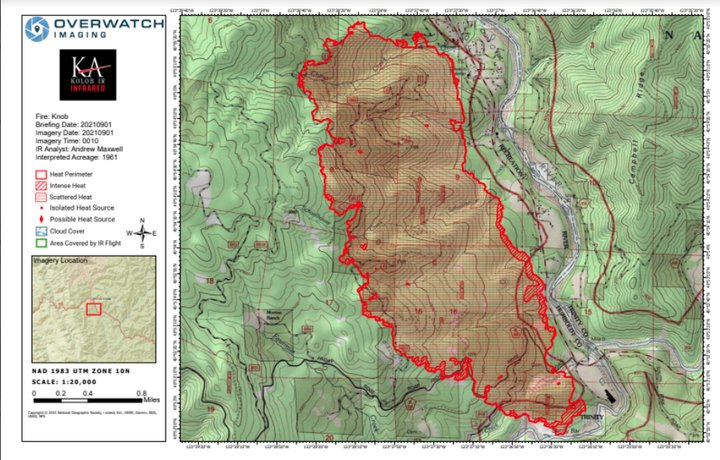
The latest map of the Knob Fire. | USFS
U.S. Forest Service press release:
RESOURCES: 2362 personnel, 36 hand crews, 165 engines, 20 helicopters, 56 dozers, 56 water tenders, 19 masticators.
CURRENT SITUATION: The Monument fire is estimated at 174,706 acres and 29% contained. The Knob Fire is estimated at 1,961 acres and 0 % contained. Today, fire resources will focus in two areas; the Knob Fire and in the southwest portion of the Monument Fire along the Hyampom Road.
VIRTUAL PUBLIC MEETING: California Interagency Incident Management Team 5 and CAL FIRE Team 5 will hold a virtual public meeting tonight, September 1, 2021 at 6:00 P.M. The meeting can be viewed at the Shasta-Trinity National Forest, Six Rivers National Forest and CAL FIRE Shasta-Trinity Unit Facebook pages, on Zoom https://usfs.zoomgov.com/j/1610820265?pwd=QnFPdUw3ZE9hU2FFR2pDWnpJN01ZQT09 or youtube.com//watch?v=5ef7etA_epU. You may also listen to the meeting by calling 1 669-254-5252, ID#161 082 0265. We encourage you to submit your questions prior to the meeting my sending them via email to 2021.monument@firenet.gov
Monument Fire North Zone: Fire behavior moderated overnight with a little fire activity in the Miners Creek area. The priority is to keep the fire north of Hyampom Road and to improve contingency lines to the south. Firefighters are also monitoring activity on Big Mountain and its movement towards the New River as well as monitoring activity in the northeast portion of the fire near the North Fork of the Trinity River to ensure it does not spot over the river. Smoke conditions, as experienced in the past several days, may result in limited air operations. The fire still has enormous potential for significant uphill runs when increased afternoon winds and topography align.
Monument Fire South Zone (including the communities of Weaverville, Hayfork and Junction City): Please visit the CAL FIRE Shasta -Trinity Unit Facebook page at https://www.facebook.com/CALFIRESHU
Knob Fire: The Knob Fire was active overnight and crews were able to keep the fire within the footprint of the previous day. Today, we expect the fire to continue to back down to SR Highway 299 where firefighters will engage to protect structures and keep it on the west side of the South Fork Trinity River. Crews are also focused on building containment lines and incorporating existing roads on the northern perimeter.
SR HIGHWAY 299: The highway has reopened with restrictions on the times public travel is allowed through the fire area. Five times a day, starting at 7:00 A.M. and ending at 7:00 P.M. pilot cars will lead vehicle caravans in the section between Burnt Ranch and Helena. These groups will leave from both sides every three hours. Residents may also travel this section of highway between 7:00 P.M. and 7:00 A.M. by showing proof of their address.
WEATHER: Today, light winds over the fire area will hamper smoke dispersal. In the late afternoon, up canyon winds will increase fire behavior.
EVACUATION ORDERS:
Monument Fire: On Monday August 31st, many areas within the Monument Fire area had changes to the evacuation orders and warnings. At 7 pm last night, the following evacuation order was announced for West Hayfork: all areas along the south side of Hyampom Rd, from Nine Mile Bridge, east to Cedar Gulch Rd, this includes Drinkwater Gulch, Phares Lane, Doctor Lane, Turkey Track Rd, Old Haywagon Rd, and Digger Rd are now under an Evacuation Order. Please refer to the Trinity County Sheriff’s Office Facebook page for detailed information on closures at Trinity County Sheriff’s Office Facebook page.
Knob Fire: All areas east of Highway 299 to the Trinity River, south of Butterfly Creek Road to Friday Ridge Road. Areas west of Highway 299 to the end of China Creek, south of Butterfly Creek Road to Christian School Road, excluding residents of Christian School Road. Areas west of Forest Road 6N33 to the end of Fourmile Creek, south of Christian School Road to Friday Ridge Road. All of South Fork Road in Salyer, south of Highway 299, to the end of South Fork Road.
EVACUATION WARNINGS:
Monument Fire: On Sunday August 30th, many areas within the Monument Fire area had changes to the evacuation orders and warnings. Please refer to the Trinity County Sheriff’s Office Facebook page for detailed information on closures at Trinity County Sheriff’s Office Facebook.
Knob Fire: Areas east of Highway 299 to the Trinity River, south of Panther Creek Road to Butterfly Creek Road. All areas east of Brushy Mountain Lookout Road/Forest Road 6N08A to Highway 299, south of Butterfly Creek Road to the end of Forest Road 6N20. Areas east of Highway 299 to the Trinity River, south of Butterfly Creek Road to Christian School Road, including residents on Christian School Road. Areas east of Forest Road 6N33 to the Trinity River, south of Gypo Lane to Friday Ridge Road. All of South Fork Road in Salyer, south of Highway 299, to the end of South Fork Road.
EVACUATION CENTERS: Monument Fire: McKinleyville Seventh Day Adventist, 1200 Central Avenue, McKinleyville, CA.and Fireman’s Hall Pavilion, 9 Park Street, Fortuna, CA. Knob Fire: McKinleyville Seventh Day Adventist, 1200 Central Avenue, McKinleyville, CA.
FOREST CLOSURE: Due to extreme fire conditions and lack of additional fire resources, the USDA Forest Service has temporarily closed all National Forests in California, including the Shasta-Trinity and Six Rivers National Forests. Questions can be directed to https://www.fs.usda.gov/main/r5/about-region/offices or by calling 707-562-9113 or email SM.FS.R5inquiries@usda.gov.
ANIMAL EVACUATIONS: Domestic Animals: Trinity County Animal Shelter, located at 563 Mountain View St., Weaverville, CA (530- 623-1370) Domestic + Large Animals: Hoopa Rodeo Grounds on Pine Creek Road, Hoopa, CA.
CLEAN AIR CENTERS: Trinity County has established a Clean Air Center at the Trinity County Library, 351 Main Street, Weaverville. Hours are Monday, Wednesday and Friday from 1-6 p.m. and Tuesday and Thursday from 10 A.M. to 6 P.M.
PROPERTY DAMAGE ASSESSMENTS: Damage assessment teams have confirmed 50 structures have been destroyed. For questions or information regarding the status of your property, call Trinity County Office of Emergency Services (OES) at 530-623-8223.
TODAY in COURT: Trial Dates Set for Hikshari Murder Suspect, Eureka Attempted Murder Suspect, Suspect in Shooting of Fortuna Juvenile
Rhonda Parker / Wednesday, Sept. 1, 2021 @ 1:09 p.m. / Courts
A March trial date was set today for Daniella Patricia Moore, accused of torturing and murdering a 19-year-old Eureka woman who was repeatedly stabbed with a pair of scissors.

Moore.
Deputy District Attorney Stacey Eads and Deputy Public Defender Casey Russo agreed on March 7 for Moore’s jury trial and Feb. 7 for a trial confirmation hearing. A separate hearing was set for Sept. 14 to discuss a report due from a doctor who evaluated Moore. She has pleaded not guilty and not guilty by reason of insanity.
The trial is expected to last at least four to six weeks, “possibly longer,” Russo told Judge Kaleb Cockrum this morning.
Moore is charged with murdering Hannah Hayhurst, whose mangled body was found in a parking lot at the foot of Hilfiker Lane in Eureka. According to the doctor who performed Hayhurst’s autopsy, several of her vital organs were ripped out during the attack.
A surveillance video shows Hayhurst getting into Moore’s car on July 3, 2019, after Moore approached her in a local mini-mart. Hayhurst’s body was found just hours later.
Moore, the mother of young twins, remains in custody at Humboldt County Correctional Facility.
PREVIOUSLY:
- Eureka Woman Arrested in Connection With Early Morning Homicide Near Hikshari Trail
- Eureka Police: Victim in July 4 Homicide Was 19-Year-Old Eureka Woman; Suspect Will Be Held on Torture Charges
- Eureka Woman Held Without Bail for Alleged Torture, Murder of 19-Year-Old Woman
- COURT ROUNDUP: Supporters Turn Out for McKinleyville Murder Suspect Who Claims He Acted in Self Defense; Eureka Murder/Torture Case Delayed
- TODAY in COURT: Trial of Rancher Raymond Christie Set to Start Later This Month; Torture, Murder Suspect Declines to Show for Hearing
- TODAY in COURT: Latest on the Rio Dell, Manila, Hikshari Trail Murder Cases; Trial of Accused Eureka Sex Trafficker Delayed
- TODAY in COURT: Accused West Del Norte Shooter Pleads Not Guilty; Sex Trafficking Suspect Hopes for Deal; Waterfront Murder Trial Delayed Again
- (GRAPHIC) Doctor Provides Testimony Detailing Autopsy Performed on Victim in Hikshari Trail Murder
- Suspect in Hikshari Trail Murder Must Stand Trial, Judge Rules
###
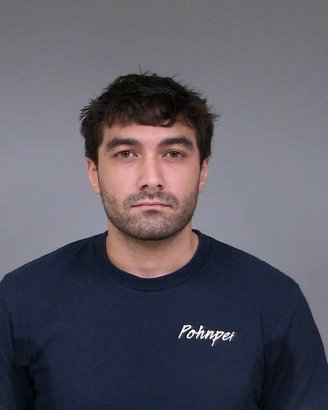
Mamea.
A March trial date also was scheduled today for Arcata resident Tory Tasi Parker Mamea, who is charged with attempting to murder a man who was stabbed multiple times as he slept on a Eureka street.
Judge Kaleb Cockrum set Mamea’s trial date for March 28, with a trial confirmation on Feb. 22.
No time estimate was given for the trial.
The alleged attack occurred during the early morning hours of Sept. 24, 2020.
Deputy District Attorney Trent Timm will be the trial prosecutor, with Deputy Public Defender Casey Russo representing Mamea. Mamea, 28, remains in custody.
PREVIOUSLY:
- Eureka Police Arrest Arcata Man for Attempted Murder After Investigation Connects Him to September Stabbing
- Law Enforcement Looking For Suspect in Eureka Stabbing, Who Had Been Released From Jail
- Attempted-Murder Suspect Back in Jail After Being Freed on Supervised Release
- Arcata Resident Pleads Not Guilty to Attempted Murder in Stabbing of a Man Sleeping on Eureka Street
###
In other court news, the preliminary hearing has been delayed until next month for Fortuna resident Erik Keith Wood, charged with shooting a boy who was among a group of kids knocking on Wood’s door and then running away.
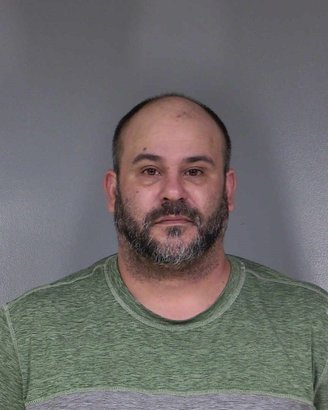
Wood.
Wood’s preliminary hearing was scheduled for today, but Judge Kaleb Cockrum granted a defense request to continue and rescheduled it for Oct. 21.
Defense attorney Zack Curtis told the judge he was not prepared because he had expected to be in trial on another case today.
Due to the number of people expected to testify, the hearing is expected to take four hours.
“We do have nine witnesses,” Deputy District Attorney Roger Rees said.
The boy was shot in the leg with a 12-gauge shotgun on May 24. He was treated and released at a local hospital.
Curtis argued at Wood’s bail hearing that the juveniles in question had been terrorizing Wood’s children, and police did not respond to his complaints.
Wood, 42, is out of custody on bail and attended the hearing this morning. In court he was served with a restraining order warning him to stay away from the alleged victim. Curtis said Wood is not familiar with the boy named in the complaint
“He doesn’t know who he is,” Curtis said.


