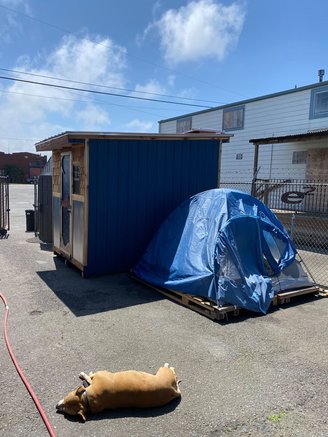
The tiny house, or micro shelter, now providing someone a home on St. Vincent de Paul’s Third Street site | Images from SVDP’s Facebook page
###
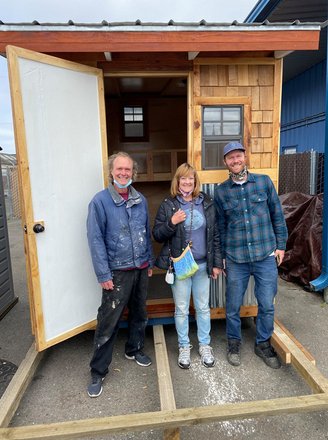
Thanks to the recent donation of a brand new tiny home to St. Vincent de Paul in Eureka, one less person is sleeping outside. Last week, the first of at least two planned tiny shelters was installed in the courtyard of SVDP’s Third Street dining facility — home of the nonprofit’s daily free meal — providing housing for a longtime free meal volunteer, Christy, and her dog.
St. Vincent de Paul Board Member and Volunteer Coordinator Bob Santilli told the Outpost on Wednesday that the tiny shelter was built and donated by Dan Faulk and his son, Sequoyah — operators of the Walden Project, which promotes the installation of “micro houses” for unhoused folks in Humboldt County. “They donated this house out of good will,” Santilli said. “[Dan] is very much a kindred spirit.”
Dan, Sequoyah and new resident, Christy
The innovative shelter is only 70 square feet in size. The house includes a bed, a sink, a solar panel — generating enough power to charge a phone or tablet — and a sink, which is operated by a small water pump attached to a five-gallon bucket of potable water.
Getting the structure onto the site was a little tricky, Santilli said, and required some “ingenuity and several people” to get it off of the flatbed of a tow truck. Pacific Towing transported the house free of charge and Dick Taylor Chocolates lent the nonprofit a forklift for the move. Luckily, Santilli said, the structure was not damaged at all during the process.
Santilli said that the nonprofit plans to have another tiny shelter installed, but he is not exactly sure how soon that will happen. Though the Faulks were generous enough to completely donate the first shelter, the second time the nonprofit will at least need to cover the cost of materials. The first one cost about $2,500 to build, Santilli said, but the price of lumber has since increased and he suspects the second will cost closer to $4,000 — maybe more. Santillii is currently looking for grant funding to cover the cost, he said. The non-profit would like to install a third shelter as well, but Santilli said that there may not realistically be space in the courtyard.
The project is a partnership between St. Vincent De Paul and the City of
Eureka and the Eureka City Council approved the courtyard as an
emergency shelter site by amending the City’s Shelter Crisis
Declaration. The residents of the tiny homes will receive meals and
support services from SVDP, with support from the city’s Community Services Engagement Team (CSET) and the UPLIFT program. Eureka City Manager Miles Slattery said that this was the same process used to approve Betty Chinn’s Blue Angel Village, and the use of the Crowley Site for a coming Betty Chinn transitional housing project.
Though the SVDP courtyard has limited space, both Slattery and Santilli said that they see this project as a pilot program, and hope that it will serve as a framework for similar housing projects in the future.
Santilli wanted to thank the city, the Faulks, Pacific Towing, Dick Taylor and everyone else who helped with this project, adding that the humble nonprofit has long depended on the donations, contributions and volunteer help of the community.
“Our organization is blessed in many ways,” Santilli told the Outpost. “As small as our budget is — we basically have two paid staff — we’ve been here 40 years and have served 3.5 million meals.”
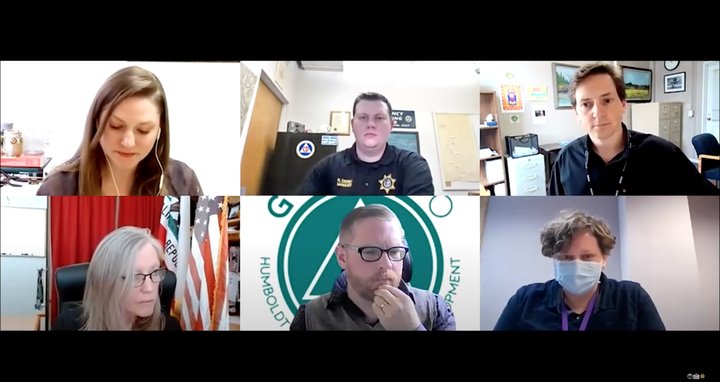
Clockwise from top left: Humboldt County Vaccine Task Force member Lindsey Mendez, Emergency Services Manger Ryan Derby, Public Health Officer Ian Hoffman, Joint Information Center spokesperson Mariah Miracle, Economic Development Director Scott Adair and Board of Supervisors Chair Virginia Bass, at a recent press conference discussing local COVID-19 response.
###
To
those following it closely, last week’s COVID-19 news hit like a
barrage of punches to the gut.
Cases
spiked to levels not seen since the post-holiday surge, with 34
reported April 19, followed by 10, 28, 38 and 20 in the ensuing days,
making 130 for the week. That was up from 71 the week before, itself
a more than doubling from the prior week, all as test-positivity
rates doubled then redoubled. Sixty-eight cases were confirmed the
following Monday, April 26, capping an eight-day period that saw 198
cases reported, along with eight hospitalizations and one
COVID-related death, offering a stark reminder that any gains
Humboldt County has made against the disease remain fragile,
dependent on continued vigilance in following public health
directives.
Against
that backdrop of escalating case counts came the news that Humboldt
County’s vaccination efforts appeared to be hitting a wall, with
Public Health sending out repeated calls for residents to sign up for
a slew of open appointments at mass vaccination clinics in Arcata.
Then came news that health officials had worked frantically to ship
1,000 doses of Pfizer vaccine to San Francisco before they expired,
with local efforts to find arms to put them in having come up empty.
Then, on April 23, the county announced it would be receiving an
allocation of 4,140 COVID-19 vaccine doses this week — down from
more than 7,400 the previous week and less than half the 11,000 doses
the week before that. And perhaps more alarming was the announcement
that Public Health had turned down an additional 1,000 doses of
vaccine — declining a state allotment for the first time because
officials feared local demand wouldn’t meet the supply, even with
tens of thousands of local residents having become newly eligible to
receive the vaccine just a few weeks earlier.
All
together, the picture looked alarming, with case counts doubling at
an alarming rate and vaccination efforts — which health officials
at all levels have deemed our best tool to beat this pandemic —
seemingly having stalled, with 41 percent of the population having
received at least one dose. But while there is indeed plenty of cause
for alarm, some believe the slowing vaccination rates simply indicate
that mass vaccination clinics have largely served their purpose and
it is time for a strategy shift— and quickly — as the vaccination
effort is effectively a race against the virus and its ability to
mutate.
Stakes
are High
In
the closing minutes of an April 21 news conference with officials at
the forefront of Humboldt County’s COVID-19 response, the Journal
asked each to offer their views on what they see at stake in the
county’s race to get shots into as many arms as possible as quickly
as possible.
“I
think people don’t realize there is a real danger we can still go
backward,” said Board of Supervisors Chair Virginia Bass, who
earlier in the meeting had said the board will discuss re-opening all
county government offices next month and looks forward to the day it
can return to in-person meetings. “We are not immune from going
backward.”
And
going backward — whether that means the implementation of more
COVID-19 restrictions or increased disease circulation prompting more
schools, businesses and other organizations to close or modify
operations — could have dire impacts on local children, families
and local governments’ tax bases, she said.
Economic
Development Director Scott Adair agreed, saying many economists
believe consumer confidence is the best measure of economic health,
noting that consumer confidence plummeted at the onset of the
pandemic.
“I
think everyone has heard the phrase that the best remedy for the
economy is a cure for the disease,” he said, later noting the
vaccines are that cure. “If consumers feel unsafe, then they’re
less likely to engage in economic activity, or at least less likely
to engage in local physical economic activity and may
over-participate in online economic activity, which isn’t always
local. … The more vaccines we can get out into the community, the
more safe consumers will feel, and the safer they feel, the more
likely they are to spend money and to spend it locally.”
Emergency
Services Manager Ryan Derby, who earlier in the press conference
talked about how the county’s Emergency Operations Center hopes to
wind down in June, putting pandemic response back entirely under the
purview of Public Health in preparation for the coming fire season,
said Humboldt County’s transition to recovery hinges on the
vaccination effort. “To be frank, everyone is sick of this —
everyone is tired of dealing with the pandemic,” he said. “And
the best way to get through this, to get over the pandemic, is to get
vaccinated.”
Linsey
Mendez, a member of the county’s vaccine task force and a nurse
family practitioner, said when she thinks about the stakes of this
effort, she thinks of Humboldt County’s children, many of whom have
already lost an entire year of in-person learning, sports, dance
recitals and playdates with friends.
“We
do not want to go backward,” she said. “We do have a mental
health crisis. We have a housing crisis. We have many things that are
competing with the pandemic right now that are not sustainable for
many households and many community members. Everyone is feeling that
heat. I know right now it’s really hard to see the forest for the
trees … but (the reason we’re trying to) get vaccine out and
empty our freezers is because we want to end this pandemic. We want
children back in school next year. We want children playing sports.
We don’t want them to have to lose all their friends. We want
families to be able to do vacations together and to see each other
around the holidays. And that’s how we’re going to do it — by
emptying our freezers of vaccine every single week.”
Vaccination
Rates Slow
The
week of April 19, Public Health planned five consecutive days of mass
vaccination clinics at the Arcata Community Center, with messaging
daily on social media platforms and in press releases urging all
residents age 16 and older to show up and get vaccinated. In all,
there were 3,769 appointments available, according to the Joint
Information Center. When the week was over, 2,551 of them — roughly
68 percent — went unfilled.
Through
the first months of vaccine rollout in Humboldt County, the focus was
almost entirely on supply, as far more local residents were eligible
to receive their shots and clamoring to get them than supply allowed.
People showed up uninvited at clinics hoping to get leftover doses
and accusations of line jumping flew. The first signs the paradigm
was shifting from a climate of “scarcity” to one of “abundance,”
as Health Officer Ian Hoffman put it, came April 8, when the county
issued a press release noting it had “hundreds” of appointments
open for upcoming clinics. The following day, it announced it was
jumping ahead of the state and opening eligibility to all county
residents 16 and older, making tens of thousands of people eligible
overnight, with many people’s expectation being that would keep
clinics bulging for weeks to come.
That
didn’t turn out to be the case and perhaps that should not have
come as a surprise.
“Mass
vaccine clinics depend on people going out of their way to go
someplace and get a thing,” explained Candy Stockton, chief medical
officer at the Humboldt Independent Practice Association. “For the
50 percent of people who have been desperately waiting for their turn
to get a vaccine, who have been calling around asking if they can get
on waiting lists or stand in lines in case there are extra doses,
that’s great. They’ll do that. But if you’re talking about
individuals who are homebound or maybe a bit more skeptical and want
to talk to someone they trust and ask a bunch of questions before
they get vaccinated, those clinics aren’t going to work for those
people. … I think everybody recognizes that to get maximum vaccine
penetration, mass vaccine clinics aren’t going to do it in this
area.”
Disparities Abound
Perhaps underscoring Stockton’s point, a Journal analysis of county vaccination data by ZIP code found some profound disparities in vaccine uptake.
Some of the areas of the county where residents are being vaccinated the fastest, according to the analysis, included Trinidad, Bayside and Blue Lake — where median home prices are nearly double the county average and residents have received an average of about a dose of vaccine per person. In these affluent areas, residents on average face fewer roadblocks to getting to a vaccination clinic — they can get time off work, have access to transportation and are less likely to face language barriers — and are more likely to have access to a primary care physician who can answer questions they have about the vaccines.
Some of the county’s outlying areas, however, are clearly falling behind. While Trinidad, Bayside and Blue Lake have seen an average of nearly one vaccine dose administered per resident, outlying areas like Redcrest, Carlotta and Alderpoint have seen less than 0.3 doses administered per resident, well below the countywide average of 0.41.
There also appear to be some data holes in the county’s dashboard, which uses data from the CAIRS reporting system. For example, the dashboard lists Hoopa as having administered just 0.13 doses per resident, which would be by far the lowest vaccination rate in the county. And that would be despite the tribe’s having opened vaccination to eligibility to all residents age 16 and older weeks ahead of the county.
But Allie Hostler, an operations section chief for the Hoopa Valley Tribe’s Office of Emergency Services COVID-19 Incident Management Team, said those numbers are simply inaccurate. An April 24 vaccination summary document from the tribe indicates it had administered 2,608 doses, which would be an average of about 0.75 doses per resident.
Still, Hostler said vaccination efforts have not been as successful as officials had hoped. The tribe held a mass clinic March 27 and invited anyone 16 and older in the region — from Willow Creek to Happy Camp and Lord Ellis to Burnt Ranch — to attend, hoping to create a “preventative bubble” around the reservation. She said officials planned to administer 1,000 doses but only 310 people showed up.
While Hostler said the tribe, having deemed the vaccine an appropriate response to the pandemic, has held question and answer educational forums and a “vaccines save lives” ad campaign, there’s a cultural distrust that’s difficult to overcome.
“There’s been a long history of mistrust between tribes and government-led healthcare initiatives,” Hostler said, adding that the tribe won’t be holding more mass vaccination clinics but will instead look to interface with families through school settings, the K’ima:w Medical Center and other opportunities to educate residents about the safety and efficacy of the vaccine and answer their questions.
New
Approaches
While
the county’s approach to vaccinating Humboldt’s general
population has largely centered on mass clinics, that’s likely
changing. At last week’s press conference, Mendez said the county
will be deploying its mobile medical unit to do smaller-scale
vaccination clinics in outlying areas, while also partnering with
fire departments, schools and other organizations in an effort to
meet people where they and with familiar faces.
Stephanie
Dittmer, immediate past-president of the Humboldt-Del Norte Medical
Society who practices family medicine while working in local
hospitals and a local nursing home, said this is absolutely the right
approach to overcome some of the vaccine hesitancy she’s seen
locally. She said she’d like to see vaccinations offered where
people feel comfortable — whether that’s the farmers market or El
Buen Gusto Market in Fortuna.
“We’re
going to have to use our individual relationships now, which means
we’re really going to have to partner with our physicians and our
community organizations,” she said. “People in that vaccine
hesitancy group are more likely to get the vaccine if the person who
presented them information about it is trusted and respected and
someone seen as aligning with their interests.”
Stockton
said the Humboldt IPA is currently working with the state medical
association in an effort to remove some barriers that would allow
smaller provider offices to administer the vaccine, making it easier
for local physicians to get their patients vaccinated. Noting that
Humboldt’s problems “aren’t local problems,” Stockton said
the regulations that qualify a provider to administer COVID vaccines
are overly burdensome for offices in rural areas. For example, she
said one was that providers maintain a 24-hour business line staffed
by a live person who can be contacted with questions, noting that not
even the county’s largest providers have that. (Some providers were
grandfathered into the system after being approved by county Public
Health, she said, which is why Open Door, Mad River Community
Hospital and St. Joseph are approved to administer vaccines.)
She
said the IPA ran the numbers on what it would take to meet state
requirements and found it would demand a minimum of 200 hours in
additional staff time, which is just not feasible for most offices.
But
Stockton said the bottom line, she believes, is that most of the 40
percent of people that national polls show as being “vaccine
hesitant” aren’t necessarily opposed to the vaccine, they just
have lots of questions and want to get answers from someone they know
and trust and who knows their medical history.
Personally,
Stockton said she asks all her patients about the vaccine and, if
they’re hesitant or even opposed, if she can share information with
them.
“I
say, ‘I’m not here to make you do something you don’t want to
do, but I want to make sure you’re making decisions based on good
information and I’m worried for you,’” Stockton said, adding
that she talks patients through concerns about everything from the
complications of signing up online and potential side effects to
whether the vaccines use stem cells. (Pfizer and Moderna do not.)
And
perhaps most importantly, Stockton said she shares her personal
views.
“I
talk freely with my patients about how my entire family is
vaccinated,” Stockton said. “I say, ‘Not only is this something
we’re recommending, but it’s something I believe in so strongly
that I couldn’t wait for my son to get a chance to get vaccinated.’
Those kinds of conversations with people make the difference for
people who are hesitant.”
Dittmer
agreed, saying it’s the power of these conversations between people
that keep her from feeling “doom and gloom” about reports that
vaccination clinic appointments are going unfilled. The bottom line,
she said, is that the trials and the data show these vaccines are
“insanely effective and really safe,” noting that a person is
5,000 times more likely to die of COVID-19 than a vaccine
complication and the vaccines have shown to prevent serious illness
or death due to COVID-19 in 95 to 97 percent of cases.
“That’s
the most effective vaccine in history,” she said.
But
Dittmer said there’s a lot of urgency to this conversation, noting
that every infection provides a chance for the virus to mutate and
potentially create variants that the vaccines aren’t as effective
against, making it imperative to get as many people vaccinated as
quickly as possible.
“We’re
racing against this super bug that no one has ever seen before, no
one has ever dealt with before, and historically humans haven’t
done very well with that,” she said. “This is a race.”
###
Editor’s note: This story was updated to include additional vaccination data provided by the Hoopa Valley Tribe received after initial publication.
###
Thadeus
Greenson (he/him) is the Journal’s
news editor. Reach him at 442-1400, extension 321, or
thad@northcoastjournal.com. Follow him on Twitter @thadeusgreenson.
The
Community Voices Coalition is a project funded by Humboldt Area
Foundation and Wild Rivers Community Foundation to support local
journalism. This story was produced by the North
Coast Journal newsroom with
full editorial independence and control.
On Wednesday, April 28th, 2021 agents
with the Humboldt County Drug Task Force (HCDTF), with the assistance
of the Humboldt County Sheriff’s Office (HCSO), and Hoopa Valley
Tribal Police Department (HVTPD), served one search warrant and
conducted two probation searches in the Hoopa Valley. These
investigations were not related to each other.
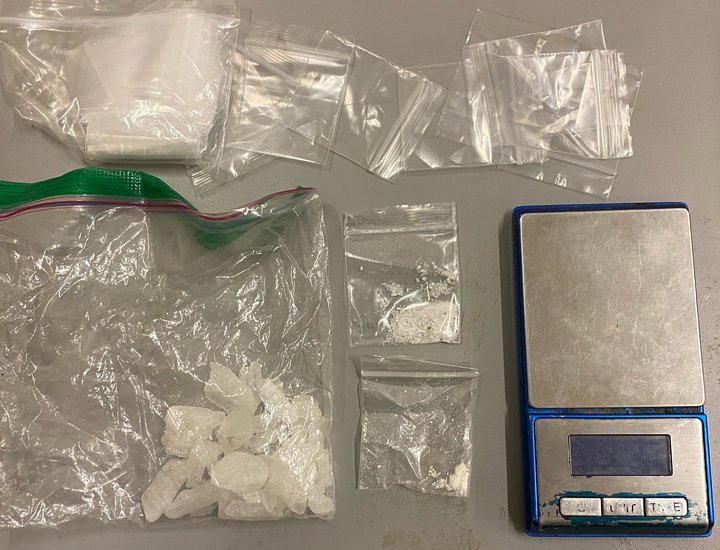
Nelson search warrant. Photos: HCDTF.
Search
Warrant:
At
approx. 1045 hrs. agents served a search warrant on a 17-year-old
juvenile on Pine Creek Rd. in Hoopa. This investigation was a follow
up to a previous Fentanyl overdose death that had occurred in Hoopa.
Agents collected electronic evidence related to the overdose
investigation.
A
relative of the juvenile, Greg
Nelson (64 years old), was
found to be in possession of one ounce of methamphetamine, a digital
scale, and packaging. The following charges will be forwarded to the
Humboldt County District Attorney’s Office for Nelson
H&S 11366 Maintaining or operating
a drug house
H&S 11378 Possession of
methamphetamine for sale
Probation
Search #1:
McCovey probation search.
As
a result of multiple community complaints of suspected drug activity
agents conducted a probation search on Madelyn McCovey (39 years old)
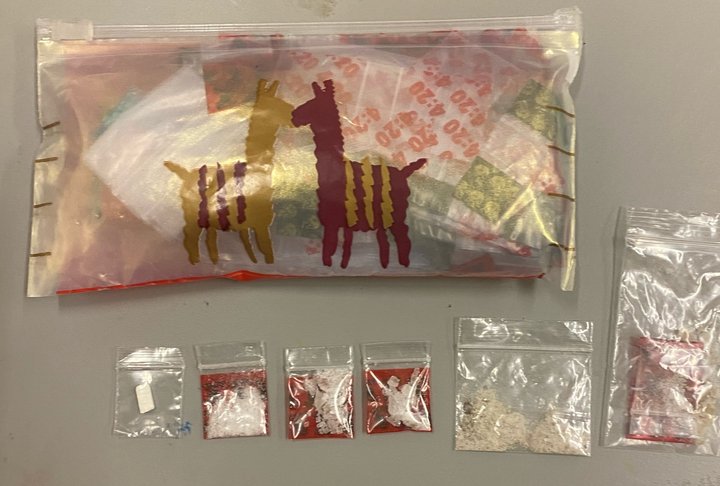
on Carpenter Ln. in Hoopa. Inside of McCovey’s bedroom agents
located 5 pre-packaged bags of methamphetamine and additional
packaging material. These bags are commonly referred to as “20
sacks” on the street as they are small amounts that sell for $20 a
bag. The following charges will be forwarded to the Humboldt County
District Attorney’s Office against McCovey:
H&S 11366 Maintaining or operating
a drug house
H&S 11378 Possession of
methamphetamine for sale
Probation
Search #2:
Perry probation search.
As
a result of multiple community complaints of suspected drug activity
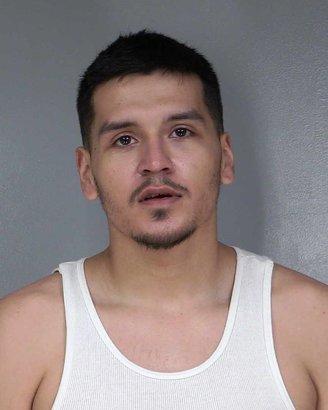
agents conducted a probation search on Thomas
Perry (28 years old) on Big
Hill Rd. in Hoopa. Perry was currently out of jail on bail for a
felon in possession of firearm arrest in early April. During a search
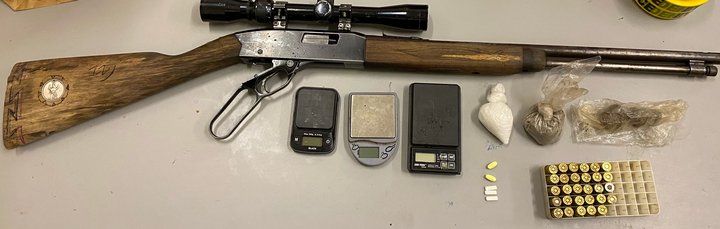
of the residence agents located one ounce of methamphetamine, one
ounce of heroin, Xanax pills, 3 digital scales, a .22 caliber rifle,
and ammunition for a .45 caliber handgun.
Thomas
Perry was arrested and transported to the Humboldt County Jail for
the following charges:
H&S 11366 Maintaining or operating
a drug house
H&S 11378 Possession of
methamphetamine for sale
H&S 11351 Possession of controlled
substances for sale
PC 29800(a)(a) Felon in possession of a
firearm
PC 30305(a) Felon in possession of
ammunition
PC 12022.1 Committing a felony while
out on bail
The
HCDTF would like to thank the HCSO & HVTPD for their assistance
with this investigation. Anyone with information related to this
investigation or other narcotics related crimes are encouraged to
call the Humboldt County Drug Task Force at 707-267-9976.
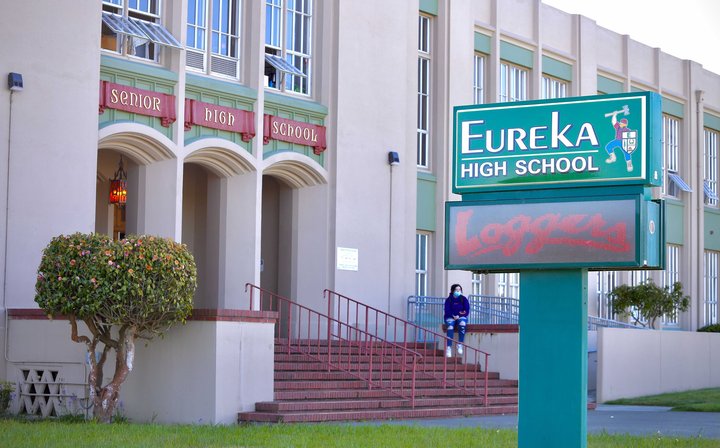
Welcoming students into her classroom for the first time last month
was a special moment for Rebecca Baugh, a chemistry teacher at Eureka
High School.
“We
had never met in real life before, and they reminded me of, you know,
our youngest elementary learners. They walk in and they’re like,
‘Your classroom is so big! It’s so pretty! You’re so tall!’”
Baugh told the Outpost a few weeks later. “The things that
were so mundane and mediocre, that you took for granted in the past,
are the things that are almost like these beautiful new experiences
in the classroom.”
Opening
up campuses has been a months-long undertaking that, at times, seemed
impossible. But this month, every Humboldt public high school campus
officially reached that goal. From whether teenagers can be trusted
to keep safety protocols in mind to whether the extensive efforts to
get back in the classroom were worth it at all, folks in the thick of
it have mixed feelings.
There
are teachers like Baugh, who are comfortable with the risk and
thrilled with the opportunity to teach in person once more. Some
teachers returned with a mix of apprehension and eagerness, others
somewhat begrudgingly, while a percentage of both students and
teachers have opted out of in-person classes altogether. And while
the move has been, for the most part, positive, some aspects of
having everyone back on campuses just aren’t beautiful like Rebecca
Baugh’s classroom.
For
instance, the bathroom. “That’s a place where, most of the time,
there’s not teachers,” Bella Volz-Broughton, an Arcata High
senior, told us before the district opened up its campuses early this
month. Worried about students behaving carelessly in the normally
teacher-free zone, she wondered “how are we supposed to regulate a
pandemic, like, in the bathroom?”
How
indeed? Roger Macdonald, superintendent of the Northern Humboldt
Union School District, which includes Arcata and McKinleyville high
schools, told the Outpost this week that the bathroom
situation specifically “doesn’t appear to be an issue right now.”
With combined efforts from administrators, teachers and non-teaching
staff, they have extra people walking the halls and popping into
bathrooms to make sure kids are staying safe in and out of the
classroom. That, and everything else, is actually going well,
Macdonald said.
High
school campuses are open, but most are not full. At both Eureka City
Schools and the Northern Humboldt Union High School District (which
are the two districts that supplied sources for this article), only
about a third of students are on campus at a time, creating a “stable
group” of a few hundred students. Both districts split students
interested in classroom learning into two groups that alternate
learning on campus week-by-week (NoHum) or every two weeks (Eureka
High). Meanwhile, about a third of students from each decided to stay
in distance learning, or were enrolled in independent study and
therefore didn’t have the choice to go on campus. Teachers
interviewed for this article reported in-person class sizes of three
to 12 students.
Trusting
kids to keep it together in tricky-to-monitor spaces is just one
concern folks have voiced during conversations about opening campuses
throughout the past year. At Eureka High, “there’s not enough staff
and faculty to walk around and patrol [the students]. So there’s a
certain amount of responsibility on the kids, you know, to follow the
safety guidelines,” Tim Olson, a Spanish teacher at Eureka High
School, told the Outpost a few weeks after the district opened
up campuses. “So far it has not been an issue.”
Volz-Broughton
can’t herself return to campus because she opted to learn by
independent study at the beginning of the school year. As a school
board student representative, though, she’s been very vocal about
reopening, aiming to accurately portray concerns raised by herself
and fellow students.
“So
much is going on every day,” Volz-Broughton said. Though she’s
hopeful that students who are in-person “are going to be those
people who want to be there and are going to maintain safety
protocols,” she wondered if that’s feasible based on her
experiences at school. “I just feel like there are so many racial
issues that go unnoticed. So I just feel like it’s going to be very
hard for the teachers and the staff members to actually take action
if someone pulls down their mask. Like, if you guys can’t call out a
student when they use slurs and stuff, how are you guys supposed to
maintain students wearing their masks?”
Volz-Broughton’s
fellow student trustee, Avery Arbaugh, who chose to stick with
learning from home to protect family members, trusts that the “vast
majority” of students can follow protocols. “But it only takes a
couple people acting inconsiderately to potentially cause an
outbreak,” he said.
The
teachers and students interviewed for this article said that masking
hasn’t really been an issue.
Baugh
said that going back, she was worried about monitoring students. But
“when they’re in class, there are no reminders needed,” she said,
and the few times she’s had to remind students to wear their mask
properly or keep their distance, they’re polite and cooperative
about it. There’s been “no controversy or anything like that.”
Many
say that distancing in the hallways and outside often isn’t quite
six feet.
“In
the hallways, you can see them getting closer than six feet apart,”
said Wendy Zamboni, a math teacher at Arcata High. “But in the
classroom, they’re doing a great job.” However, she’s worried it
might not last. “We haven’t seen these kids enough times for them
to get comfortable enough to misbehave yet.”
Isabella
Sundberg is a McKinleyville High senior who has been advocating for a
return to campus all year as a student board rep, fearing that the
social isolation has been harmful to her peer group. She did,
however, anticipate from the start that proper social distancing
wouldn’t be possible on campus, and when the high school
distributed safety guidelines before students returned, she actually
laughed. “I was like, no way are these students going to keep six
feet,” she said. She ended up being right; during the 15-minute
breaks between each class (intended to give students at home a rest
from their screens), Sundberg has observed some clustering between
friends, but it doesn’t bother her. “I would deem [that behavior]
pretty safe, because, I mean, you see those people every day most
likely.”
Teenagers
are hanging out off campus. “After they’ve been good about keeping
their distance all day long, you see six of them load up in the same
car together and take off,” Zamboni said. “I think we’re trying
to put protocols out there to mitigate the pandemic. But when it
comes down to it, people are still making choices outside of the
confines of the school that may or may not be supporting these
separate groupings and the idea that we’re not cross-contaminating.”
High
schoolers 16 and up now have access to vaccines, but most aren’t
yet fully vaccinated (just over 4 percent in Humboldt are). Sundberg
assumes that most kids have been seeing their closest friends
in-person anyway, while Arbaugh and Volz-Broughton speculated that a
chunk of their peers don’t seem to stay up-to-date about
coronavirus-related news or local case numbers.
“There’s
like two worlds of coronavirus. A lot of students just don’t care
anymore. And then another portion of students see people not caring
and do feel concern,” Arbaugh said. “I think there’s becoming
less and less stigma by the day for people meeting up.”
###
Now
that schools are open, what does it look like? In terms of safety,
classrooms are outfitted with HVAC filters, and teachers keep the
windows and doors open at all times. Students must complete a health
checkpoint each day before entering campus, and NoHum told us they’ve
been utilizing rapid testing for certain activities. And, of course,
everyone is masked and is trying to social distance.
“It’s
definitely not what I expected, just compared to how it used to be,”
said Hannah Haraldson, a Eureka High senior. But “it was actually
kind of exciting. I was really glad just to be able to be back in
person at all.”
For
the most part, Eureka High and NoHum schools kept the modified
schedules they created for distance learning — a four-day week with
three classes per day instead of six, with a minor decrease in class
time at NoHum. But the shift has been a massive one for teachers,
because, for the first time, they need to teach students in-person
and online simultaneously.
“‘I
said, ‘kids you’re gonna have to give me some grace,’” Tiffany
Bullman, a social sciences and culinary teacher at McKinleyville
High, told us before campuses opened. “This will be my third new
teaching style in a year. My brain is full.”
Many
teachers are approaching the challenge by continuing what they’ve
been doing all year, just inside the classroom. “The term that I’ve
heard thrown out there, that seems to fit pretty well, is “zoom in
the room,’” Dorian Koczera, a math and landscaping teacher at Six
Rivers Charter High School in the NoHum district, told the Outpost
prior to the opening. Especially for his math class, “it doesn’t
seem appropriate to, you know, completely overhaul how things have
been running to this point,” he said.
Simultaneously
teaching students in-person and online raised equity concerns for
JoAnn Moore, an English teacher at Arcata High School. “We have to
equitably provide this same education for those students that are
sitting in a classroom and those students who are on Zoom, and you
can’t do that by doing different things,” she said during an
interview prior to the shift to hybrid. (Since the shift, she’s
transitioned to teaching distance learning students only through the
district’s Independent Study program.)
The
few students we talked to for this article said that the distance
learning feels similar to how it was before the shift to hybrid. “The
only difference is that teachers have two things to juggle,” said
Steven Hadley, a senior at Eureka High School who chose not to return
to campus because he didn’t feel it was safe. “So there are
definitely situations in which the teacher will focus more on one
group than the other,” adding that he feels like teachers got “the
short end of the stick.”
Most
teachers, based on Moore’s assessment, are continuing with the
distance learning framework inside the classroom — in-person
students sit at their desks with a computer in front of them, while
their teacher does the same. But for classes that are more hands-on,
some teachers are trying to bring a more interactive experience to
kids who are in class, while still engaging with virtual students and
delivering them an equally rich experience. “Hands-on,” however,
is obviously difficult right now — according to safety guidelines,
students shouldn’t be touching the same equipment without
sanitizing in between.
At
Eureka High, Baugh thinks she’s figured it out. Her in-person and
distance students do the same lab simultaneously, using materials
that distance students pick up beforehand. She also projects her
distance students onto the board so that all students can see each
other during the class.
Baugh’s
in-person students wear disposable gloves during the labs, wear their
own safety goggles, and are masked and socially distanced. “We
really do feel really safe in the lab,” she said.
###
Rather
than opening up for hybrid instruction, Moore would have preferred
identifying struggling students — those who live in a distracting
environment, are contending mental health difficulties, have internet
issues, or haven’t been attending virtual classes for other reasons
— to bring only them back instead. “We completely understand that
distance learning does not work for a body of students,” she said.
Zamboni
reported that many of those struggling students chose not to return
to campus. “It wasn’t universal,” she said, but “it’s the kids
that were succeeding with distance learning, that had the A’s and
B’s, that are coming back to campus. And the ones that weren’t
succeeding, many of them chose to stay on distance learning. And
that’s concerning, because, you know, I can’t push them forward as
easily when they’re on the other side of the screen.”
In
addition to equity issues, Moore worried that changes in the schedule
and learning modality will ultimately pile on more learning loss. The
district had to decrease class time a little to make the shift work,
which worried Moore because instructional minutes were already half
of what is standard during normal times.
“So
the question becomes, well, does that really justify upending the
schedule?”
Because
of the week-on-week-off in-person stable groupings, high school
students throughout the county will only have about 12 or fewer
in-person sessions of each class (except for Eureka High seniors, who
are allowed on campus at all times, and high school students enrolled
at schools that have been open for most of the school year, like
Fortuna and Ferndale). Meanwhile, the work that has gone into these
efforts — every teacher and administrator we’ve talked to have
worked more this year than ever before — combined with the potential
impacts that might accompany the shift, beg the question: Was it
worth it?
“Prior
to doing it, I would have said, ‘no, it’s not worth it,’”
Zamboni said. “I still believe that this change was really based on
public demand, and not necessarily about what’s the best for
education.” However, “for some kids, I think it’s making a huge
difference.”
At
McKinleyville High, Bullman was more vocal about supporting on-campus
learning than most of her colleagues leading up to the shift to
hybrid. Most teachers who spoke publicly opposed the decision. “I
think that is not a good look for the public because they would just
think, ‘Oh God, all the teachers don’t want to come back.’” But
Bullman, who is union president, assessed that most teachers are, in
fact, OK with returning.
“Do
I necessarily think this is the best thing to do academically for the
students? Not really,” she said. But some kids need “to be around
adults they trust, so that way, if something is going on, they can
actually talk to us in person rather than, you know, through a
computer screen.” Returning to campus is necessary for those
students, she said.
It’s
a tricky question, Moore said. If no one gets sick, maybe. “But if
one person gets sick, is it worth it? No, to me, it’s not worth it if
one person gets sick.”
In
Eureka, Baugh represents another group of teachers. “It’s 100
percent worth it,” she said. “Getting to meet them is just
wonderful, and getting to have that kind of in-person exchange with
teaching makes it worth it. I think it’d be worth it if it was the
last month of school.”
Diana
Lynn Dickerson Clark was born in Anderson, Indiana
on December 29, 1953, to Eugene Dickerson and Opal Cole Dickerson.
She went home to be with her Lord and Savior when she passed away at
home in McKinleyville on Thursday, April 8, 2021 at 2:45 a.m. Her
mother, Opal, husband Pastor Chuck Clark and their son, Benjamin were
with her.
“Diane,”
or “Di”, as she preferred to be called, was diagnosed with
pancreatic
cancer
in March of 2018, after dealing with several symptoms for nearly a
year. She had many chemo treatments along with the Whipple surgery at
Sutter Hospital in San Francisco. She endured every procedure without
complaint and her lifelong faith in the Lord Jesus Christ was evident
throughout the four years of symptoms and illness. She and good
friends Matt and Vicky Larsen planted the large Wesleyan Memorial
Garden and Di spent many hours working in the soil and lovingly
cultivating various plants and flowers.
Di
served faithfully for nearly 50 years as a pastor’s wife. She sang
with her husband and in various groups and choirs with her beautiful
alto voice. She and Chuck pastored churches in Ridgway and Oil City,
Penn.
They served churches in Huntington, Geneva and Fort Wayne, Indiana,
Daytona Beach, Florida,
San Manuel, Arizona
and
McKinleyville. The past 17 years she served faithfully as First Lady
at the Wesleyan Church of the Redwoods, and in spite of her illness
she never relinquished her duties. She was an expert in organizing a
quick meal for guests at the parsonage or she could organize the
church ladies to prepare for a special gathering at church. Though
often tired, she never complained and never faltered.
Di
grew up in the small town of Summitville, Indiana where she attended
the local school. While she was a senior at Madison Grant High School
she met Chuck Clark through Diane’s older sister Genie Dickerson,
at Frankfort Wesleyan College in Frankfort, Indiana.
After their first date, Chuck told his fellow dorm-mates that he had
finally met the girl he was going to marry. After just six
weeks of dating, he popped the question and she said “yes”! She
graduated HS in May and they were married in the Summitville Wesleyan
Church on October 16, 1971. Diane was a joyful gal, and lived life to
the fullest in spite of her illness.
Di
is survived by her husband, Chuck and their three children, Dr.
Kristine Clark, of Rochester, New
York,
Scott and Jennifer Clark of Avondale, Arizona
and Benjamin Clark, Intercultural Studies student at Hobe Sound Bible
College, Hobe Sound, Florida.
She is survived by Scott’s children, Nathan, Harley and Bastian
Clark.
Diane’s
father, Gene, preceded her in death in 1991. She is survived by her
mother, Opal Dickerson, older sister Genie Dickerson, younger sister
Anita Ballard and husband Leroy, and brother Steve Dickerson and wife
Brenda. She loved her many nieces and nephews.
We
are very grateful to the wonderful nurses and staff at the St. Joseph
Oncology center and for Hospice of Humboldt and the wonderful care by
Adriana, Kara, Rebecca and Steve. A very special Thanks goes to
special friend Jill Taillon who was there for Diane for most of her
care….Thanks to Linda Drouilliard, Bonnie Acosta, Vickie Childress,
Charlotte Jacobson, Penny Jacobson, Maile Cortez, Vee Sorenson, Lisa
Buck and so many others who brought meals to us when we were too
exhausted to prepare our own. To anyone whose name we missed, please
accept our apology!
Many
thanks to the church board and leaders, Bob Buck, Lou Agliolo and
Associate Pastor Doug Brower for taking care of the needs of the
church. We are also grateful to Jean Durbin and Tracie Ahlberg for
helping rehome Diane’s pets.
Suggested
memorials to the Wesleyan Church of the Redwoods, Hospice of Humboldt
or to a pet shelter/rescue of your choice.
An
outdoor Worship Service was held on Sunday, April 11, at 10:30 a.m.
in the Wesleyan Memorial Garden, 1645 Fischer Avenue, McKinleyville.
###
The obituary above was submitted on behalf of Diana Clark’s loved ones. The Lost Coast Outpost runs obituaries of Humboldt County residents at no charge. See guidelines here.
Dan House passed away from cancer at home with family by his side at the age of 86 on April 17, 2021. He was a proud veteran who served in the Navy, and then went on to retire from Caltrans.
Since then has enjoyed spending his time with his family. He got the biggest kick out of all of his grandkids, and was always telling stories about what one of us has done. He was so proud of his family — he always said “This is what it’s all about.” He was the best husband, dad and papa, and we were blessed that he was ours. The hardest thing is saying goodbye, but we will see you again.
For now he is reunited with his son Dallas House, who is greatly missed. He is survived by his loving wife Barbara House of 68 years; his daughter Ronda and Willy Morrow; grandkids Chad and Jenny Morrow, Candice and Scott Lackey; great-grandkids Hope and Jordan Caylor, Kelsey Morrow and Levi Fulton, Garret and Lily Lackey, Ashlynn and Kaitlynn Lackey; and three great-great grandkids, Lane and Colby Caylor and Ryleigh Fulton.
Due to Covid we will be having a private service and a celebration of life in the future.
Thank you to Hospice of Humboldt. We appreciate all of your help.
###
The obituary above was submitted on behalf of Dan House’s loved ones. The Lost Coast Outpost runs obituaries of Humboldt County residents at no charge. See guidelines here.
Whether you drive on a scenic highway or a congested freeway, motorcycles are all around. As such, motorcycle-involved crashes in California continue to be a major concern for the California Highway Patrol (CHP). From January 2019 through December 2019, provisional statistical data revealed there were 25 injury crashes involving motorcycles and 2 fatal crashes involving motorcycles in the CHP Humboldt jurisdiction.
In an effort to reduce the number of motorcycle incidents or crashes resulting from unsafe speed, following too closely, unsafe lane changes, improper turning, and other violations by both motorcyclists and other drivers, the CHP Humboldt Area will deploy additional officers on US-101 State Route 36 and State Route 299. In support of Motorcycle Awareness Month, the operation will commence on May 31, 2021.
To assist the CHP in this traffic safety effort, the Office of Traffic Safety, through the National Highway Traffic Safety Administration, has awarded a grant titled “Get Educated and Ride Safe III.” With the grant-funding, the Humboldt Area will continue to deploy additional enforcement efforts through September 30, 2021.
If you have any questions or need additional information, please contact Public Information Officer Paul Craft, at 707-822-5981.