

Man Assaulted and Robbed After Falling Asleep in His Vehicle in McKinleyville, Sheriff’s Office Says
LoCO Staff / Thursday, April 22, 2021 @ 9:37 a.m. / Crime
Press release from the Humboldt County Sheriff’s Office:
On April 21, 2021, at about 7:12 p.m., Humboldt County Sheriff’s deputies were dispatched to the Hammond Trail Parking Lot near Letz Avenue in McKinleyville for the report of a robbery that had just occurred.
Deputies arrived at the location and contacted the 34-year-old male victim who exhibited minor injuries from the incident. The victim told deputies that he had fallen asleep in his vehicle when he awoke to two unknown male suspects physically assaulting him. The suspects removed the victim from his vehicle and demanded the victim’s wallet. At some point during the altercation, the suspects reportedly brandished a knife at the victim. The suspects stole personal belongings from the victim and then reportedly fled the area in a white SUV.
The suspects are described as follows:
- Suspect #1: A white male adult, approximately 5 feet 10 inches tall with a medium build, short hair and a clean-shaven face.
- Suspect #2: A white male adult, approximately 5 feet 5 inches tall with a small build, a mustache and a beard.
The suspect vehicle is described as a white, possibly late-1990s model SUV – similar to a Toyota RAV4 or Highlander- with Oregon license plates and an empty wheel mount on the back.
This case is still under investigation.
Anyone with information about this case or related criminal activity is encouraged to call the Humboldt County Sheriff’s Office at (707) 445-7251 or the Sheriff’s Office Crime Tip line at (707) 268-2539.

BOOKED
Yesterday: 7 felonies, 9 misdemeanors, 0 infractions
JUDGED
Humboldt County Superior Court Calendar: Today
CHP REPORTS
5345 Walnut Dr (HM office): Trfc Collision-1141 Enrt
ELSEWHERE
Mad River Union: Flight Path
Mad River Union: McK not-a-tree cell tower project bumped
Mad River Union: Arcata council decides this, decides that
Mad River Union: Porchfest 3 evolves with new prep, participation
Eureka Man Arrested, Suspected of Trafficking Fentanyl Into Humboldt From Bay Area
LoCO Staff / Thursday, April 22, 2021 @ 8:27 a.m. / Crime
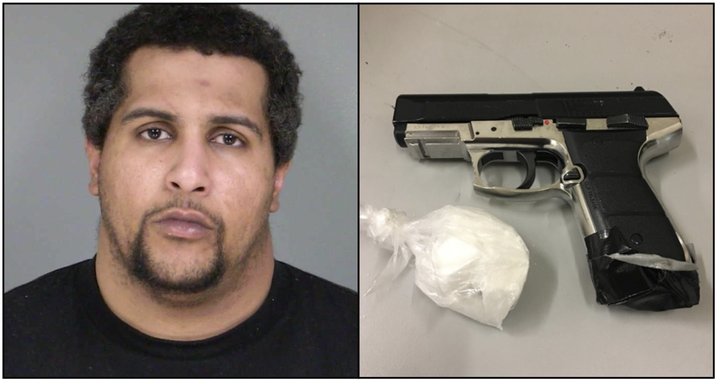
Levi Jones | HCDTF
Humboldt County Drug Task Force press release:
On April 22nd, 2021 at approx. 5:00am agents with the Humboldt County Drug Task Force (HCDTF) made a traffic stop on a vehicle in the 1600 block of Railroad Dr. in Eureka. Agents had been investigating the driver, Levi Jones (29 years old from Eureka), for trafficking Fentanyl into Humboldt County from San Francisco. Agents had previously obtained a search warrant for Jones and his vehicle.
During the service of the search warrant agents located approx. 1.5 ounces of Fentanyl and a replica handgun in the vehicle. Jones was currently out of jail on bail for a previous arrest. Jones was arrested and booked at the Humboldt County Jail for the following charges:
- H&S 11352(a) Transportation of controlled substances for sale
- H&S 11352(b) Transportation of controlled substances across non-contiguous counties
- H&S 11351 Possession of controlled substance for sale
- PC 12022.1 Committing a felony while out on bail
Anyone with information related to this investigation or other narcotics related crimes are encouraged to call the Humboldt County Drug Task Force at 707-267-9976.
Washington Man Arrested for Allegedly Driving Boat Under the Influence in Humboldt Bay Marina After Crashing Into Another Vessel, Piling
John Ross Ferrara / Thursday, April 22, 2021 @ 7:55 a.m. / Crime
A man from Camas, Washington was arrested for allegedly boating under the influence in Humboldt Bay on Monday after his boat plowed into another vessel and a wood piling near Coast Seafoods.
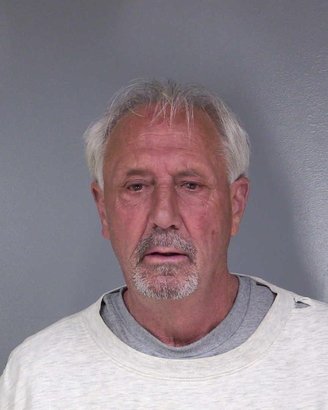
Carroll Richard Johnson. | HCSO
Captain Patrick Foy of the California Department of Fish and Wildlife told the Outpost that 67-year-old Carroll Richard Johnson was taken into custody by numerous police agencies at approximately 2:30 p.m. after he was combative with the first marine enforcement officer on scene.
“A member of the public called the Coast Guard and they alerted the [CDFW Marine Enforcement Division],” Foy said. “Because the subject was not compliant and combative, he asked for assistance from the Eureka Police Department and the U.S. Coast guard.”
While Johnson’s main address is in Washington, Foy said that he also maintains a P.O. box in Eureka. However, due to the ongoing investigation, Foy was unwilling to say whether or not Johnson operates a fishing vessel in the Humboldt area.
Johnson was booked into the Humboldt County Sheriff’s Office on charges of disorderly conduct while under the influence and probation violation for a previous DUI offense.
State’s ‘MyTurn’ Website Bypassed for Most Vaccine Appointments
Barbara Feder Ostrov / Thursday, April 22, 2021 @ 7 a.m. / Sacramento
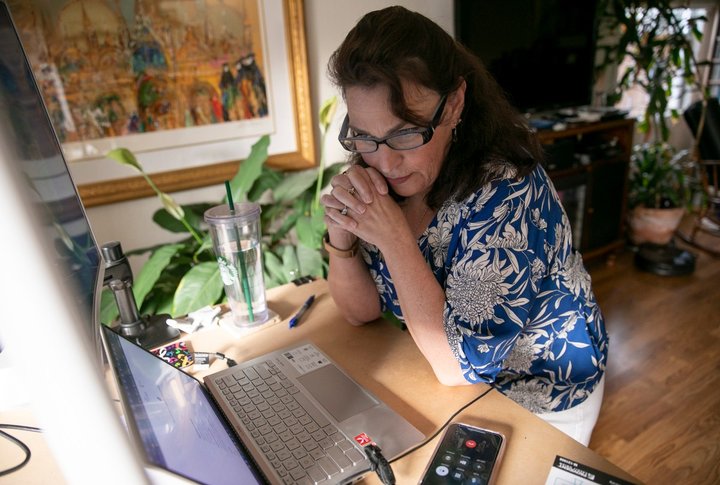
Alyssa Jenkins uses the state’s MyTurn website to try to book a vaccination appointment for someone on April 19, 2021. Photo by Anne Wernikoff, CalMatters
###
For months, Alyssa Jenkins logged countless hours on MyTurn, California’s COVID vaccine registration site as she searched for precious appointment slots for her fellow teachers.
“I’d become obsessed,” said Jenkins, who teaches high school English in Pacifica. “I was living in the system.”
When MyTurn debuted in mid-January, it was supposed to be a one-stop shop, a place where every Californian could register to be notified when they became eligible for the COVID vaccine and eventually make an appointment for their shot.
Instead, it’s become a lightning rod for many Californians frustrated by their inability to get vaccinated quickly and return to a normal life.
Appointments booked on MyTurn — an average of about 100,000 each day — account for only about 27% of the vaccinations given each day across the state, according to data from the California Department of Public Health.
MyTurn was developed with unusual speed for a government website.
State officials told CalMatters that they spent $50 million building the site. A contract obtained by CalMatters shows up to $18 million will be paid to multinational consulting giant Accenture. Of that, $6.9 million was spent on development, but there’s another $5.7 million management cost in the first year and another roughly $6 million a year for two more years. Accenture used technology from Salesforce, a San Francisco-based software company, and was assisted by a workforce management consulting company called Skedulo.
MyTurn isn’t just an appointment clearinghouse. It has other critical functions: It tracks vaccine orders and distribution, collects reams of vaccination data and helps organize volunteers statewide. It can also transmit data to California’s immunization registry, which maintains confidential vaccination records.
But it is the public side of MyTurn that has drawn the most criticism.
San Francisco County Supervisor Matt Haney said “it’s better to have a statewide vaccine site than nothing at all” but “MyTurn has at times been glitchy.”
“I’m disappointed that we never created a pre-registration system (like) a lot of other states have had. Instead, people have to check the site multiple times a day,” he said.
“It’s so unnecessarily inefficient. I do believe it’s creating a lot of stress and anxiety, and it creates equity issues.”
so, so frustrating! FWIW I brought it up with the UCD Health staff when I went for my 💉 #2 this morning and they said they’d look into it. but it seems to be a systemic issue with MyTurn, not a one-off glitch 🤬
— Ted Flynn (@TedFlynn) April 16, 2021
A confluence of problems with MyTurn continues to frustrate many Californians: The technology was hastily deployed, leading to inevitable glitches because it wasn’t vetted enough before it was unveiled. It can’t reliably cope with the state’s constantly changing rules and wide variety of local eligibility qualifications. And the vaccine supply hasn’t kept up with demand, so until very recently, appointments were unavailable for most people.
MyTurn has systemic problems, too. It does not incorporate doses sent by the federal government to pharmacies, and various systems from health care providers haven’t yet signed up or aren’t integrated.
In essence, creating a one-stop vaccination app isn’t as easy as booking a delivery through DoorDash.
“There’s an expectation that everything’s as convenient as a Google app, but nothing’s as complicated as what we’re doing.”
— Matthai Chakko, spokesman for the city of Berkeley
For weeks, state health leaders have urged patience as Californians flocked to MyTurn, noting that MyTurn is a work in progress and that it’s one — but not the only — way to sign up for COVID-19 vaccinations.
“We have made great progress in making MyTurn the ‘Front Door’ for those seeking COVID vaccine,” said Darrel Ng, a spokesman for the state’s COVID-19 Vaccine Task Force.
Rather than build on the state’s existing vaccine registry, California’s health department created a new one from the ground up. California maintains online systems to track childhood vaccines and flu shots, but nothing that could handle managing vaccinations for up to 40 million people.
The system is largely overseen by Blue Shield of California, which was tapped by Gov. Gavin Newsom in a no-bid contract to manage statewide vaccine distribution.
“Everybody’s doing the best they can, but (the technology) needs a lot of support,” said Matthai Chakko, spokesman for the city of Berkeley, which runs its own public health department. “There’s an expectation that everything’s as convenient as a Google app, but nothing’s as complicated as what we’re doing.”
Some technology and health care experts have been highly critical of MyTurn, blaming it on the state’s lack of technological expertise.
“Everybody is making this up on the fly. MyTurn, in particular, is a usability nightmare. The site clearly favors already tech-savvy users and doesn’t appear to have been properly vetted,” Arien Malec, senior vice president of research and development at Change Healthcare, told Kaiser Health News.
Indu Subaiya, president and cofounder of Catalyst@Health 2.0, a digital health consulting firm, said her research has shown that “there isn’t a one size fits all” solution that works nationwide. “Different populations of folks, based on health literacy, access to broadband and technology literacy, will have different needs,” she said.
Bewildering results for faraway sites
MyTurn can schedule appointments for mass vaccination sites, such as Moscone Center, and for some sites run by county health departments. But it cannot schedule appointments for the retail pharmacies and grocery stores in California that receive vaccine doses directly from the federal government. It can’t make appointments for homebound seniors, and it doesn’t include most nonprofit community clinics.
MyTurn also can’t directly schedule appointments for large medical providers like Sutter Health, Stanford and Kaiser Permanente because their data systems can’t talk to MyTurn’s systems. Instead, the website directs people to outside websites, where they have to go through the same process all over again.
As a result, some MyTurn searches return bewildering results that would daunt all but the most persistent vaccine seekers.
For instance, searching for Berkeley ZIP codes on the site brings up faraway vaccination sites in Novato and Stockton. Berkeley created a how-to video to help people use MyTurn because of its confusing interface.
In another example, a recent search for an appointment in many Santa Clara County ZIP codes yielded a “No Appointments Available” message. Most people don’t know that if they scroll down, they’ll see links to numerous sites in the county with available appointments that can’t be booked on MyTurn, including the Levi Stadium mass vaccination site.
“If you have a site you’re directing everyone to, but it’s missing key locations, that creates confusion,” said Haney, who frequently posts on social media to alert people to open vaccine appointments.
Entering the ZIP code for Dodger Stadium into MyTurn, for example, fails to turn up the mass drive-through vaccination site at the stadium. That’s because it’s managed by Carbon Health, which doesn’t interface with MyTurn.
Different qualification restrictions in counties make it hard for people to know where they can schedule an appointment, as some vaccine venues restrict their appointments to people in certain counties or even neighborhoods, Haney said. That’s particularly challenging in the Bay Area, where many people live in one county and work in another.
Blue Shield, under pressure to speed vaccinations, particularly for vulnerable Californians, now requires vaccine providers to sign up with MyTurn to more closely monitor how quickly doses are going into arms – with the threat of not getting weekly allocations if they don’t comply.
Some counties, including Santa Clara County, resisted and ultimately signed less restrictive agreements with Blue Shield. Santa Clara County kept its own vaccine appointment system, making its clinics and the Levi Stadium mass vaccination site far less visible on MyTurn.
MyTurn was revamped earlier this month as all Californians ages 16 and older became eligible to be immunized. About one million users came to the site on April 15, the day eligibility expanded to people 16 and older.
Bigger vaccine allotments have made it easier for people to get appointments. Blue Shield officials promise that more vaccine providers will be added to the site as California’s vaccine supply continues to expand.
For people without Internet access or who encounter problems online, the system includes a phone number, 833-422-4255, that people can call, including language translation, to make appointments.
‘Vaccine fairies’ drop in to help
“Vaccine fairies” and other volunteers have emerged to help less computer-savvy Californians, particularly seniors. Many of them bypassed MyTurn.
Sunil Patel, a 39-year-old Oakland resident who works in the pharmaceutical industry, joined the national nonprofit “Vaccine Fairy” network to help book COVID vaccine appointments for others. He said he’s booked about 60 appointments in California, but only two were on MyTurn.
“It’s just rarely the best option,” Patel said. “I don’t blame people for thinking there was no vaccine available,” Patel said.
Jenkins, the teacher from Pacifica, wouldn’t call herself a vaccine fairy, but she spent so much time on MyTurn that her son Adam, a software developer, built her a bot to refresh it automatically in hopes of surfacing newly available appointments as soon as they dropped.
It is one of a number of automated computer programs that enterprising developers created to make vaccine searches on MyTurn and other sites a slightly less Herculean task.
“I could not bear to watch. She was just refreshing the site all the time and I just thought to myself, there’s got to be a better way,” said Adam Jenkins, who is 24.
When he got an email from California’s chief information security officer, he thought it would be a cease and desist order. Instead, the official lauded his work and offered him an API key that lets MyTurn recognize the bot as friendly — an implicit recognition that its site was so problematic that it needed such outside aids.
Alyssa Jenkins said she’s booked more than 400 appointments for others.
“The system’s convoluted, we gave people almost too many choices, we didn’t explain rules of road, then we change the rules of the road,” she said.
“No wonder people want to throw their computers out the window.”

Alyssa Jenkins’ notes show she has made vaccination appointments for more than 400 people, many of whom she has never met, since February. She said this is her way of connecting to the Jewish concept of Tikkun Olam, which means to repair the world. Photo: Anne Wernikoff, Calmatters.
Ryan Gruver, director of the Nevada County Health & Human Services Agency, said there were “hiccups” when his rural county in California’s gold country first joined MyTurn. “It went up incredibly fast,” he said of the system.
The site isn’t helpful for some of the county’s most remote residents, where Internet service can be unreliable.
But he said the ability to draw data from the site about who has been vaccinated will help the county fine-tune its efforts to reach people.
“The first couple of months was about keeping up with demand,” Gruver said. “Now we’re making sure we don’t leave anyone behind.”
###
CalMatters COVID-19 coverage, translation and distribution is supported by generous grants from the Blue Shield of California Foundation, the Penner Family Foundation and the California Health Care Foundation.
CALmatters.org is a nonprofit, nonpartisan media venture explaining California policies and politics.
Bonta Vows as California’s Top Cop He’d Be Tougher on Policing
Robert Lewis / Thursday, April 22, 2021 @ 7 a.m. / Sacramento
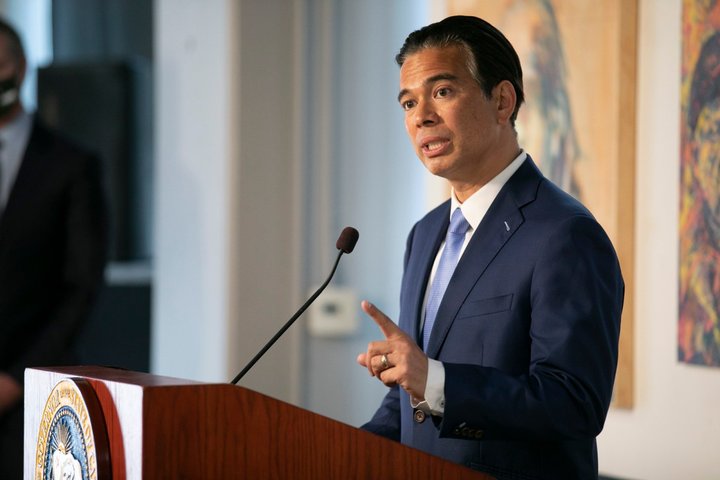
Rob Bonta, in confirmation hearings to be California’s next attorney general, laid out his priorities to hold police more accountable. Photo by Anne Wernikoff, CalMatters
###
State Attorney General-nominee Rob Bonta at his confirmation hearings yesterday vowed to take a tougher hand in policing the police — ensuring misconduct records are released to the public, thoroughly investigating officer-involved shootings and using the AG’s office to pursue civil rights probes of local law enforcement agencies.
His comments came one day after a Minnesota jury convicted ex-officer Derek Chauvin of second degree murder in the death of George Floyd, whose killing sparked nationwide protests and calls for criminal justice reform.
“We need to rebuild trust between law enforcement and communities. And I believe that law enforcement are invaluable parts of our communities and that the vast majority want to build and earn that trust. Accountability is part of that trust,” state Assemblymember Bonta, a Democrat, testified before the Senate Rules Committee.
The confirmation of Bonta, who has represented the East Bay since 2012, seems all but certain. After hearings in the Senate and Assembly today, committees voted to send his nomination to the floor of both chambers, which are controlled by Democrats, for a vote as early as Thursday.
Still, despite the broad support in the Legislature and his vows for stronger reforms, Bonta is likely to face close and continuing scrutiny from progressives, who’ve accused the state Justice Department in recent years of failing to hold police more accountable.
Assemblymember Reginald Jones-Sawyer, a South Los Angeles Democrat, told Bonta that the next attorney general must meet the demands of the moment. The verdict in the Floyd case, he said, “underscores what communities of color have long requested — accountability for bad officers.”
While the Legislature has enacted important law enforcement reforms over the past several years, Jones-Sawyer said, the department must “serve as a backstop and final arbiter in cases of abuse or misconduct by law enforcement. Too many Californians die or have their lives forever altered by the actions of bad law enforcement officials.”
Bonta’s nomination last month came after Xavier Becerra stepped down to become U.S. Secretary of Health and Human Services. Becerra, who earned praise for confronting the Trump Administration on immigration and other key issues, frustrated progressives when it came to police reform in the wake of controversial deaths at the hands of police officers throughout the country, including California.
Under Becerra, who received substantial campaign donations from law enforcement unions, the AG’s office was hesitant to prosecute police officers involved in controversial shootings of unarmed civilians, dragged its feet on investigations of alleged civil rights abuses by some law enforcement agencies, and fought the release of police misconduct records despite a state law that opened certain disciplinary files to the public.
State Sen. Sydney Kamlager, a Los Angeles Democrat, asked about that lack of disclosure under a law that opened records pertaining to police use of deadly force and certain misconduct findings.
Bonta pledged that his office would be more transparent.
“I supported that bill as a legislator, and I know its letter and I know its intent,” he said. “And it is designed specifically to provide for increased disclosure and more transparency, and which will hopefully lead to greater oversight and accountability.”
During today’s two hearings, Bonta touted his progressive record as a five-term Bay Area lawmaker.
Among other law enforcement measures, he co-authored legislation approved last year requiring state prosecutors to investigate officer-involved shootings that result in the death of an unarmed person. Forming a division to handle an estimated 40 shooting investigations a year, he said, would be one of his most important initial priorities.
Becerra had resisted calls to become actively engaged in investigating force-related deaths in California’s police agencies, a job he insisted should remain mostly with local authorities.
“The attorney general’s office has not in the past generally investigated large numbers of officer involved shootings,” Bonta said. “Those who are grieving the loss of life of family members who died during interactions with law enforcement, anyone who’s being investigated, the Legislature in California, all deserve that we get it right, that it be thorough and accurate and comprehensive and reliable and full of integrity, so that when an investigation is complete, the results are trusted.”
Bonta also is co-author of pending Senate Bill 2, which would allow the state to decertify officers — effectively kicking them out of law enforcement — for misconduct. California is one of a handful of states without such power, allowing some officers even convicted of crimes to move from department to department.
“California talks often about how we lead, we’re first, we’re bold. Not when it comes to decertification,” Bonta told the Assembly committee. “This is not — should not be — a controversial concept that we’re talking about.”
Progressive groups congratulated Bonta after the announcement of his nomination and called on him to continue helping to change the justice system. And numerous organizations, including the Western Center on Law and Poverty and the Anti-Recidivism Coalition, called in to the virtual confirmation hearings today to support the nomination.
Still, it’s unclear just how far Bonta can — and will — push police reform measures.
Bonta will need to start running immediately if he wants to keep the job in the 2022 election in a state with a history of conservative, voter-supported criminal justice policies like the three-strikes law. Law enforcement groups gave nearly $5 million in donations to California political candidates from 2015 through 2018, and nearly $7 million in independent expenditures including about $230,000 to re-elect Becerra, according to a CalMatters analysis.
The Peace Officers Research Association of California, the state’s largest law enforcement association, initially congratulated Bonta on his nomination, and its president said in a statement that the organization looks “forward to working with him to address the many important challenges and opportunities facing California’s law enforcement community today.”
Before voting to approve Bonta’s nomination, Assemblymember Tom Lackey, a Palmdale Republican, said it’s hurtful and unfair to broad-brush all of law enforcement because of the conduct of a few bad officers.
“I’m hoping you’ll be able to partner with law enforcement” on solutions, Lackey told Bonta during the Assembly hearing.
That Assembly committee moved his nomination forward on an 8-1 vote; two Republicans voted with the Democrat majority, and one — Megan Dahle from Bieber — opposed him. The Senate committee did likewise with three Democrats in favor and two Republicans abstaining.
Bonta fielded questions about a range of topics including illegal marijuana grows, gun rights and hospital mergers. But his message throughout was the same:
“An injustice against one is an injustice against all,” he said. “It’s why I decided to become an attorney, to fight for those who have been wronged, who are scared, who are hurt, who are mistreated and needed someone to fight for them. And it’s that fight for justice for all Californians that motivates me today.
###
CALmatters.org is a nonprofit, nonpartisan media venture explaining California policies and politics.
OBITUARY: Taos Proctor, 1981-2021
LoCO Staff / Thursday, April 22, 2021 @ 6:56 a.m. / Obits
Taos
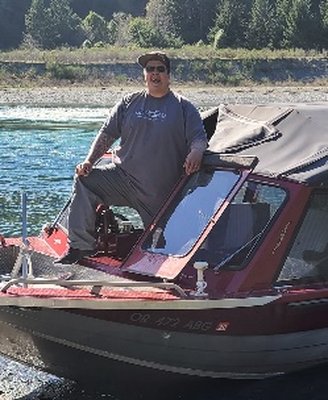
Proctor, a fisherman, logger, builder and artist passed
over to the Spirit World on Thursday, April 15, 2021
doing what he loved most. Taos was born in Sacramento on August
6, 1981 and was raised on the Klamath River, where he resided in the
beautiful heart of his Yurok people, the Glen. He lived his
beautiful and loving life with his family on the water’s edge, in the
high country, along the mountain ridges and engaging with all of the
elements of his homeland and people. He established home on the
river, where he spent all of his time eating his ancestral foods and
making a beautiful family and beautiful things of redwood, i.e., like
his old-growth planked sweathouse, beautifully-detailed stools and
many more amazing creations. Taos loved life and loved to fully
define himself in being a loving husband, dedicated son, devoted
father and giving friend. He lived life in an established and
adventurous manner who was always there to give a hand and heart to
his community, family and friends. His best of friends were his
boat, net and saw. He loved being in the water and on the land.
Taos comes from the villages of Waukell, Wautek, Mettah and Pecwan.
He will forever be remembered for his big heart and contagious
laughter.
He is survived by his loving children Talise, Cheygoon and Candralia and amazing wife Kelly, aka “Musk”. His mother Jeannette (and very late father Jack Scott) of Klamath., father Jimbo Proctor, brother James (Stacey) Proctor, Juanita (Joey) of Gustavus, AK , Tony Scott of Clear Lake, Calif., Shasta Scott of Medford, and Jamie Proctor of Klamath. Grandmother Jeannette Eberhardt and favorite auntie Jolleanne (Jeff, Mike, Takota, Phillip) Brittain of Crescent City, and numerous loving family members.
Thursday, April 22, 2021, a wake will begin 6 p.m. at the Riverfront House (26 Riverview Drive) at his home, 41 Laurel Lane in Klamath. On Friday, April 23, 2021. Services will begin at Requa, 11 a.m. for his last boat ride with his family and friends. He will be laid to rest and interned at the Aawok Scott-Gibson Family Plot, 511 Au Minot Creek Road in Klamath, and we will close with a potluck gathering at the newly-built Aawok Ada Charles Memorial (in honor of his late grandmother) Building at Klamath Townsite.
The pallbearers are: Cheygoon Proctor, Jimbo Proctor, Jeff Brittain, James Proctor, Takota Brittain, Mikey Jones, Fred Tuttle, Tim Sterbentz, Jason Ford, Albert Jasso, Brian Hendon, Keith Ray, John Donahue, Tony Scott, Richard Nelson, Dave Santer, Robert Ray Sr., Ryan Ray Sr., Steven Osburne , James Coddington, Mauain Johnson, Tyler Gibson, Micah Gibson, Blake Lopez, John Lien, Benjamin Proctor, John Proctor, Daniel Proctor, Lance Bates, Colin Latulippe, Nantsvn Scott, Trenton Thompson, Richard Sallee, Jay Bates and Joey Harvey.
###
The obituary above was submitted on behalf of Taos Proctor’s loved ones. The Lost Coast Outpost runs obituaries of Humboldt County residents at no charge. See guidelines here.
The City of Arcata Wonders: Should Papa Murphy’s and Chester’s Chicken Really be Considered ‘Formula Restaurants’?
Stephanie McGeary / Wednesday, April 21, 2021 @ 3:51 p.m. / Food , Local Government
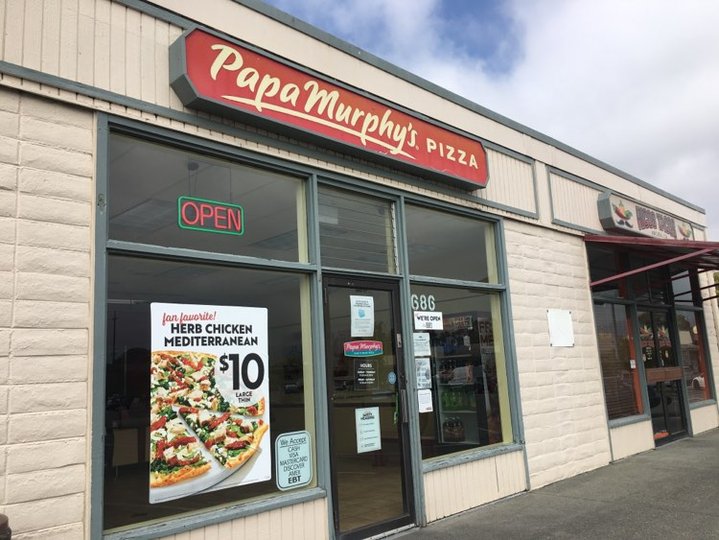
Papa Murphy’s in Arcata’s Uniontown Shopping center. It’s a chain, but is it really a restaurant?
After recently reexamining the City of Arcata’s Formula Restaurant Ordinance — which caps the number of chain restaurants at nine and allows them only in certain neighborhoods — city staff has noticed some inconsistencies, and is now asking the Arcata City Council to weigh in on an important question: Should longtime food establishments Papa Murphy’s and Chester’s Chicken really be regulated as “formula restaurants?”
According to the staff report, there are currently two prospective formula restaurants (the report does not give names) looking to open in Arcata, which prompted the reevaluation of the ordinance and made staff realize that Chester’s and Papa Murphy’s — both included on the city’s list of formula restaurants — don’t exactly fit the criteria. Here are the definitions, from the staff report:
Restaurant, Cafe, Coffee Shop: A retail business selling ready-to-eat food and/or beverages for on-or off-premise consumption. These include eating establishments where customers are served from a walk-up ordering counter for either on-or off-premise consumption (“counter service”); and establishments where customers are served food at their tables for on-premise consumption (“table service”), that may also provide food for take-out.
Restaurant, Formula: A restaurant that is required by contractual or other arrangement to offer any of the following: standardized menus, ingredients, food preparation, decor, uniforms, architecture,signs or similar standardized features and which causes it to be substantially identical to more than 11 other restaurants regardless of ownership or location.
Although Chester’s Chicken — located inside of the Chevron Gas Station in Valley West — does technically meet most the criteria of being a “formula restaurant,” it is not run as an independent establishment. It is owned by the gas station and shares sales with it, and does not have its own till or employees. If the city considers Chester’s a formula restaurant, then it would also have to consider some other establishments — such as the deli inside of the Safeway — to be a formula restaurant, the staff report says.
As for the Papa Murphy’s in the Uniontown Shopping Center, those wonderfully cheap take-n-bake pizzas are not “ready-to-eat food,” which is included as part of the “restaurant, cafe, coffee shop” definition. “Strictly speaking, Papa Murphy’s is not a restaurant by the Code definition,” the staff report states.
So, what does this mean for these restaurants and for the City? The two businesses could simply be excluded from the formula restaurant regulation. To be clear, it wouldn’t affect their ability to stay open — they would just no longer be considered “formula restaurants” by the City. But this brings up questions on how formula restaurants should be regulated moving forward.
Also, removing these businesses from the cap would allow for two more formula restaurants to open in the City — one in Uniontown Shopping Center and one in Valley West. (The ordinance allows a new formula restaurant only if it replaces an existing formula restaurant, and allows for a maximum of five formula restaurants in Valley West, two in Uniontown, one on Janes Road and one in Northtown.) So staff is suggesting that the Council decide if it thinks these to businesses should be considered “formula restaurants” and, if so, how the language can be clarified.
Staff is also suggesting that the council consider eliminating the geographic restrictions for formula restaurants, except for in the downtown neighborhood. “This would remove the potentially unfair market conditions set by the geographical restrictions and allow competition among property owners for such restaurants,” Community Development Director David Loya writes in the staff report. “In addition, there may be social justice implications regarding the current distribution of fast food restaurants as codified — implications for access for HSU students, as well as other unintended consequences of this now 20-year-old regulation.”
The Arcata City Council meets virtually tonight at 6 p.m. You can view the full agenda and directions on how to participate here.


