

Wildberries Kicks Down Mass Mac ‘N’ Cheese Donation to Food For People
LoCO Staff / Friday, Feb. 5, 2021 @ 11:17 a.m. / Food
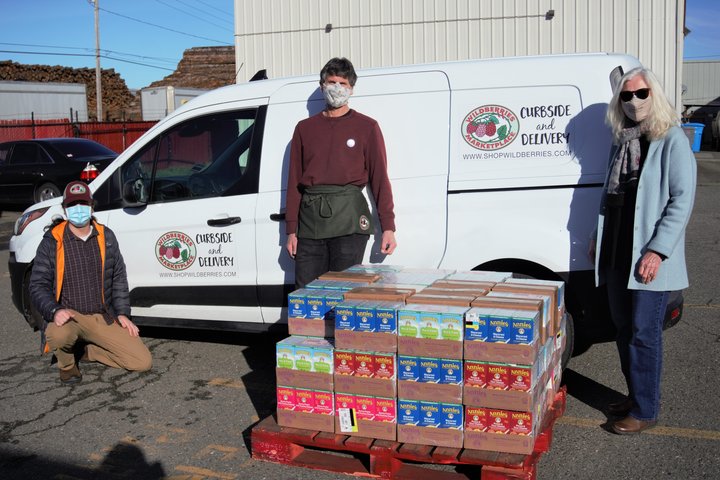
Wildberries’ Vince Graves-Blandford and Aaron Gottschalk drop off 850 boxes of Amy’s Annie’s Mac and Cheese with Food for People’s Executive Director, Anne Holcomb. Photo: Food for People.
###
Press release from Food for People:
Wildberries Marketplace joins the fight to end hunger by donating 850 boxes of Annie’s Mac and Cheese to Food for People, the Food Bank for Humboldt County.
“We are motivated to serve and support the food bank with a pure and unadulterated donation,” said Aaron Gottschalk, General Manager of Wildberries to Anne Holcomb, Food for People’s Executive Director. This is a brand new order they made just for Food for People to help those in need. As a local business that has been able to remain open during the pandemic, unlike others that have sadly had to close down, Wildberries wanted to show their support and give thanks back to the community that has supported them. Wildberries plans to continue to donate to Food for People as a way to further serve the community during these challenging times.
The effects of Covid-19 have created an increased need for food assistance in Humboldt County. Food for People and their supporters have stepped up to meet that need. With a network of 17 food pantries Food for People serves more than 12,000 people each month, distributing food to over 3,600 children and 2,500 seniors and providing food for nearly 100 partner agencies every year. Food for People meets the emergency food needs that arise locally during a natural disaster, emergency, or global pandemic. Ending hunger and improving the health and wellbeing of our community is their main priority.
BOOKED
Today: 7 felonies, 9 misdemeanors, 0 infractions
JUDGED
Humboldt County Superior Court Calendar: Today
CHP REPORTS
Us101 N / Wildwood Ave Ofr (HM office): Live or Dead Animal
Us101 / Sr162 (HM office): Assist CT with Maintenance
ELSEWHERE
Governor’s Office: Governor Newsom signs most comprehensive data center laws in the nation, providing communities more control on water, electricity, and land use
Governor’s Office: Governor Newsom proclaims state of emergency to bolster statewide El Nino preparedness, protect California
100% Humboldt, with Scott Hammond: #131. What Good Local Journalism Is Supposed to Do | Ted Pease
RHBB: After Redway Tree-Cutting Controversy, Planning Commission Approves Removal of 88 Trees Near Eureka
Public Health Supervising Nurse Hava Phillips Takes Media Questions on the State of the County’s Vaccination Efforts
LoCO Staff / Friday, Feb. 5, 2021 @ 9:48 a.m. / COVID-19 and Humboldt
Yesterday, registered nurse Hava Phillips — a member of Humboldt County’s Vaccine Task Force and supervisor of the county’s public health clinic — took questions from the media on vaccination efforts and other local public health efforts on topics such as travel and school reopening
Video above. Media questions, and timestamps relating to the point in the video in which they are asked and answered, can be found below.
###
(0:00) 1. From the North Coast News: Can you explain why being vaccinated is not a free pass to travel? (And will you please reiterate the quarantine guidelines for travelers who come into Humboldt from out-of-county and out-of-state?)
(1:30) 2. From the North Coast News: Are there any updates from officials on if the vaccination protects against transmission? If not, how can schools reopen safely even if teachers are vaccinated, with the general public still at risk? I.e. families of students and teachers?
(2:30) 3. From the Redheaded Blackbelt: Are local CVS or Walgreens going to be offering vaccines to the public, and if so, how do people go about setting up an appointment? Who is currently eligible to be vaccinated within the scope of “essential workers” beyond caretaking staff or medical first responders?
(3:30) 4. From the Redheaded Blackbelt: What percent of local first responders have been vaccinated? Have there been instances of local first responders declining to take the vaccine when it was made available?
(4:15) 5. From the Redheaded Blackbelt: Where does Public Health stand on the issue of vaccinating teachers prior to reopening schools that have been maintaining distance learning options?
(4:50) 6. From the Redheaded Blackbelt: When will the county be adding vaccination data to the county dashboard? Will the county COVID-19 dashboard include the number of vaccinations given locally, what type of vaccine, and any additional demographics regarding who in the community has been vaccinated- similar data as with the testing statistics presented?
(5:30) 7. From the Times-Standard: How many approved local vaccinators are there in the county?
(5:40) 8. From the Times-Standard: When does the county expect to begin receiving supplies in greater volume or at an increased frequency, if at all? What is this dependent upon and has the state, pharmaceutical companies or the CDC given any indication of when this might happen?
(6:30) 9. From the Times-Standard: How long does Public Health expect it will take to administer the 6,000 second doses of vaccine? How much will this slow down first doses? Specifically, how many first doses per week can county residents expect to be administered and for how many weeks will that last?
(7:45) 10. From the Times-Standard: Can you reiterate the process of acquiring vaccines? Is the process automated so the county receives the level of supply it initially asked for or do counties need to resubmit order forms?
(8:25) 11. From the Times-Standard: At the current rate of vaccine administration, how long would it take for the county to vaccinate all of its residents?
In Race to Vaccinate, Could California See Another Surge?
Ana B. Ibarra / Friday, Feb. 5, 2021 @ 7:21 a.m. / Sacramento
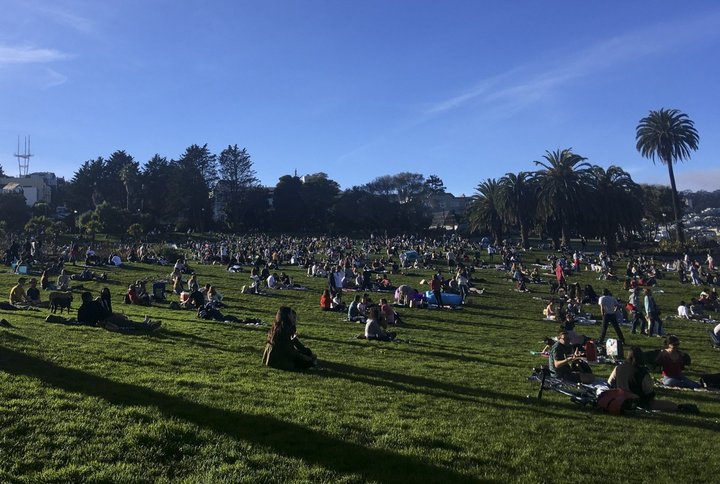
Crowds gather to enjoy the unseasonably warm weather at Dolores Park on Jan 16, 2021. Photo by Anne Wernikoff, CalMatters
###
During some of the darkest days in the pandemic, Gov. Gavin Newsom offered some optimism: the winter surge of COVID-19 would be it. Liquid gold — the first batch of vaccines — were just days away.
“This is the final surge,” Newsom said on Dec. 3, urging people to stay home and save lives.
Health experts continue to hope that steep spikes in infections and hospitalizations are a thing of the past. But a bumpy vaccine rollout, new, more contagious forms of the virus, and an expected increase in social activity following California’s exit from the stay-at-home order all beg the question: Will the state see another wave of COVID-19?
“The chance for another surge in California is real; it’s still circulating, COVID is in our communities,” Dr. Mark Ghaly, the state’s health secretary, said on Tuesday. “Our case rates are down, but they’re not low.”
Ghaly warned against gatherings on Super Bowl Sunday, noting that in the most recent surge, illnesses and hospitalizations increased after World Series celebrations. The upward trend was exacerbated by holiday gatherings. He also advised people to wear higher grade and better fitted masks because new strains of the virus are proving to be more contagious and require better protection.
Ghaly warned against gatherings on Super Bowl Sunday, noting that in the most recent surge, illnesses and hospitalizations increased after World Series celebrations.
Given that California is just coming down from a brutal wave of infections and hospitalizations, some health officials and experts were perplexed when Gov. Gavin Newsom lifted the stay-at-home order for the entire state on Jan. 25. The governor pointed to projections that all of the state’s five regions would have ICU capacity well above 15% in four weeks. That’s the threshold the state set for exiting the order and resuming activities like outdoor dining and businesses including nail and hair salons.
According to this week’s projections, by March 1, hard-hit Southern California will have close to 44% of its ICU beds available and the San Joaquin Valley will have about 35% available. Current capacity hovers around 10% for both regions. The Sacramento region is projected to have about 31% of its ICU beds available by then, compared to the 18.4% available now.
Such projections don’t mean the pandemic is easing, cautioned UCLA epidemiology professor Shira Shafir. They only mean that if someone were to become severely sick, there will be a bed for them.
“Even with stringent control measures in place we still saw a massive surge,” Shafir said, referring to the stay-at-home order. “We have now loosened those restrictions…and people might think well, if X is open, then X is safe, and that’s not the case.”
If social activity increases while new versions of the coronavirus take hold, higher rates of transmission could threaten the recent decline of cases and hospitalizations and impact the state’s ICU capacity, she said.
“We have now loosened those restrictions…and people might think well, if X is open, then X is safe, and that’s not the case.”
— Shira Shafir, UCLA epidemiology professor
California had detected the B.1.1.7 strain, better known as the U.K. variant, in 133 people as of Tuesday, Ghaly said. This specific variant is about 50% more infectious, according to the U.S. Centers for Disease Control and Prevention. Recent analyses also suggest that the U.K. variant is associated with more severe illness. The California or West Coast variants, dubbed B.1.429 and B.1.427, have been found in 1,057 cases in the state.
It is still unclear exactly how much more contagious the West Coast variants are compared to the standard form of the virus, said Dr. Benjamin Pinsky, the medical director at Stanford’s Clinical Virology Laboratory. But in early January, finding these homegrown variants was rare, and now they’re found in about a third of the samples screened in his lab, he said.
His lab has also detected the Brazil P.2 variant in one person. This is different from the closely-watched Brazil P.1 variant, Pinsky said.
Still, those numbers are just a small sampling of what’s really out there, experts say. There simply isn’t enough genomic sequencing yet to stay on top of new variants taking place in the state or the country, said Dr. Michael Buchmeier, UC Irvine professor of medicine and infectious disease expert. The U.S. is number 43 in the world when it comes to genomic sequencing, although CDC officials recently said they are working to significantly scale this up.
California leads the country in sequencing after screening just under 12,000 samples, Newsom said on Wednesday. But ideally, you’d want to be screening at least 10% of cases for a more accurate picture, Buchmeier said. At that rate, the state would have screened more than 300,000 samples by now.
Yet even the smaller number of new coronavirus strains discovered in the screenings show the urgent need for California to boost its pace of vaccinations, Buchmeier said. The more the virus replicates, the more it mutates. The good news is early studies show that even against these newer variants, available vaccines and even some pending approval still protect people from severe illness. The fear is that ongoing changes to the spike proteins of the virus, in particular, could eventually render vaccines ineffective.
“Because of the mixing that we know happens with increased activities and because of these new variants that are more contagious, it won’t be surprising if we have a spring uptick.”
— Dr. Rais Vohra, Fresno County health officer
While vaccine allocation is expected to ramp up across the country in coming weeks, widespread protection is likely many months away, experts say. California had received 6.4 million doses and administered 3.9 million as of Thursday.
That leaves some county health officers preparing for the next surge even as they still are coming down from the winter rush. They are reinforcing public messages about safety and risk, emphasizing that masks and physical distancing continue to provide needed protection.
“Because of the mixing that we know happens with increased activities and because of these new variants that are more contagious, it won’t be surprising if we have a spring uptick,” Dr. Rais Vohra, Fresno County’s health officer, said in a recent press briefing. “That’s really what I’m looking ahead to, asking, how can we prepare for another surge?”
###
CalMatters COVID-19 coverage, translation and distribution is supported by generous grants from the Blue Shield of California Foundation, the California Wellness Foundation and the California Health Care Foundation.
CALmatters.org is a nonprofit, nonpartisan media venture explaining California policies and politics.
OBITUARY: Mike Mora, 1953-2021
LoCO Staff / Friday, Feb. 5, 2021 @ 6:56 a.m. / Obits

Mike Mora passed away peacefully at home on January 31, 2021 after a
four-year battle with cancer. Mike was born on August 19, 1953 in
Scotia. He was taken home to Holmes Flat until the 1955 flood moved
the family to Newburg, where he grew up. This is where Mike and his
two brothers, Lee and Randy, learned to ride, fish, hunt and ranch.
The family ran sheep at the Newburg Ranch (now Buena Vista and
Newburg Park). The family purchased Humboldt Auction Yard in 1968,
where Mike learned the cattle business. Graduated from auctioneer
school in 1975. He loved to sell at local schools and benefit
auctions. One of his favorite sales was the Junior Livestock Auction
at the Humboldt County Fair for over 30 years.
Mike was extremely proud that his 3 sons were continuing the Mora family tradition of ranching becoming the fifth generation of Moras to ranch in California – with the sixth generation following in their boot steps.
In 1996 Mike and long-time friend Lou Bugenig started the West Coast Rodeo Company. They produced many rodeos throughout California and were known to have some of the best stock on the West Coast. Mike loved traveling to rodeos and making a bunch of lifetime friends along the way. One of his proudest moments in the rodeo company was when they got to take bulls to the Professional Bull Riders events.
Mike also delivered mail for many years from Garberville to Eureka. He enjoyed stopping at all the post offices and give the all the postmasters a hard time. He made many friends during this time, no one more than Tami Taylor.
Mike is survived by his wife, Byrd, of 44 years, sons Justin (Marla), Cody (Becca), and Ty (Randi). Mother Marilyn Mora. Brothers Lee (Eileen) and Randy (Joan). Sister-in-laws Linda Burwick, Cathy (Bobby) Rubbo. Grandkids Colter, Teal, Claude, Levi, Wade, Trey and Rudi and many nieces and nephews.
He was preceded in death by his grandparents Rudy Mora Sr. and Jackie Mora, father Rudy Mora Jr. brother-in-law Jerry Burwick, sister-in-law Teese Martinez.
The family would like to give a special thank you to Beckie McCanless, Laurie Newman, Brian and Kathy Hall and Hospice of Humboldt for all their love and support. In lieu of flowers the family asks that donations be made to District 2 High School Rodeo Association. 4575 Luke Court Eureka, CA 95503.
The family will have a private graveside service in Paso Robles. There will be a celebration of life in Humboldt at a later date.
Mike Mora rode through the pearly gates of Heaven to a place where the grass is always green and the cows always fat. Where the bulls always buck and the broncs never duck. To an arena where the calves forever run straight, and the breakaway ropers are never too late. Where the ground is consistently good and the barrel racers through the gate. To a box where the bulldoggers get out on time and the team ropers finally don’t whine. A place where the crew is still getting their butts chewed and will never win because someone has to give Mike his well-known grin.
###
The obituary above was submitted on behalf of Mike Mora’s loved ones. The Lost Coast Outpost runs obituaries of Humboldt County residents at no charge. See guidelines here.
OBITUARY: Berry Goad, 1933-2021
LoCO Staff / Friday, Feb. 5, 2021 @ 6:56 a.m. / Obits
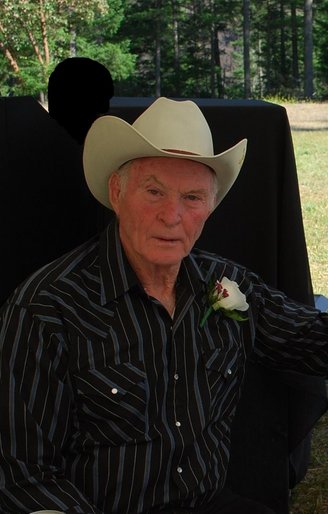
It is with heavy heart we announce the passing of Berry Goad on Jan. 15, 2021.
Berry was born in Pilot Mountain, Tennessee on April 16, 1933. He was the third child of 11 children. He met the love of his life, June, when he was just 17 and they were married on Sept 5, 1950. Berry and June had five children, Fredrick, Deborah, Veronica, Michael and Richard.
In 1965 they moved from Tennessee to Blue Lake, where Berry found a job working at the Macintosh Mill. He worked there for several years until going to work for Guynup Ranches, where he became the ranch foreman for 20 years. Many stories can be told of Berry wrestling cattle, building fences, riding horses or just everyday ranch life.
“Papaw,” as he was so fondly called by all his grandchildren, loved to stay busy and enjoyed hard work. Ranch life suited him. He retired from the ranch in 2001 and lived with June in Blue Lake enjoying family life, gardening, and staying busy around their house until he died with his boots on, the only way he would have wanted to go.
Berry is survived by his sister Macel Lewallen, wife June Goad; children, Deborah Rasmussen (Ed), Veronica Peltier (Zak) Richard Goad; grandchildren, Bridget Steeves (Nathan), Justin Goad, Jessica Swanlund, Josh Rasmussen (Lucy), Chad Swanlund (Megan), Charity Hetz (Shay), Laquessa Goad, Chanda Goad and several great-grandchildren and great-great-grandchildren.
He is proceeded in death by sons Fredrick Goad, Michael Goad; father and mother James and Delia Goad; siblings Hazel Taylor, Reba Catron, Maxi Shoopman, Albert Goad, Robert Goad, Helen Cooney, Alvin Goad, James Goad Jr and Howard Goad.
A celebration of life will be announced later when COVID restrictions are lifted.
Cards can be sent to P.O Box 27, Blue Lake, CA, 95525.
###
The obituary above was submitted on behalf of Berry Goad’s loved ones. The Lost Coast Outpost runs obituaries of Humboldt County residents at no charge. See guidelines here.
OBITUARY: Mary Ethel Cudney, 1932-2021
LoCO Staff / Friday, Feb. 5, 2021 @ 6:56 a.m. / Obits
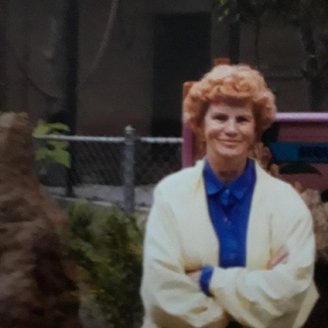
Mary Ethel Cudney was born in Craigville, Minnesota on December 10, 1932 to Daniel Bernard and Mary Gertrude Combs. She moved to California in 1950, where she met Joel Frederick Cudney and married in 1952 in the St. Mary’s Church in Arcata.
Mary and Joel moved to Eureka in 1953, where they raised their family of six boys and three girls. Mary was very proud that all her children attended St. Bernard’s school and later Eureka City Schools.
Mary wanted to leave behind this message in her obituary:
“I have always had a very happy life. Born into a family of 5 sisters and 2 brothers. My husband and children and extended family are my whole life and happiness. My faith in God is my greatest love and most precious gift! I am very thankful to God for my husband, family, friends and all my blessings! My grandchildren and my great grandchildren are a special blessing! My greatest wish and prayers are for all our loved ones to return to their Catholic faith and that we all meet in heaven some day.”
Mary will be laid to rest February 8, 2021 at 2 p.m. at the St. Bernard’s Cemetery.
###
The obituary above was submitted on behalf of Mary Ethel Cudney’s loved ones. The Lost Coast Outpost runs obituaries of Humboldt County residents at no charge. See guidelines here.
Arcata City Council Passes Vacation Rental Ordinance, Reduces Permit Cap to 100 Units
Stephanie McGeary / Thursday, Feb. 4, 2021 @ 3:53 p.m. / Local Government
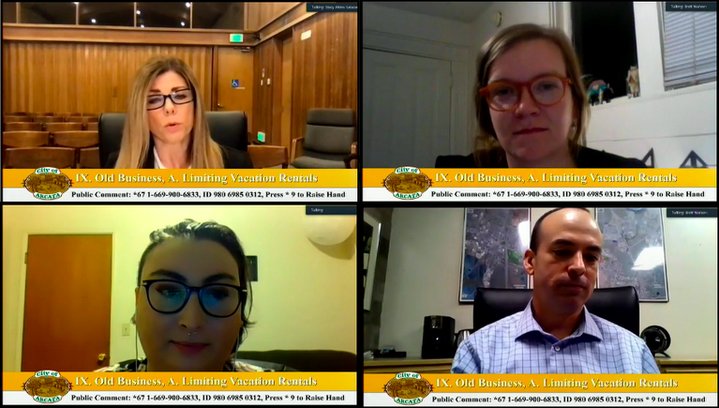
Arcata City Council members (clockwise from top left) Stacey Atkins-Salazar, Sarah Schaefer, Emily Goldstein, Brett Watson (Sofia Pereira recused herself on this discussion)
###
During Wednesday night’s meeting, the Arcata City Council passed an ordinance that places stricter regulations on vacation rentals and caps the number of these rentals allowed in the city at 100. The vote was 3-1, with Councilmember Sarah Shaefer dissenting. Mayor Sofia Pereira recused herself because she rents an AirBnB and felt it would be a conflict of interest.
Under the new ordinance, vacation rental owners will have to apply for a permit and complete a building inspection (costing around $220) if a building official believes there may be any violations on the property, in addition to purchasing a business license and paying transient occupancy tax — both already required by the City. Folks who are currently operating a vacation rental will be given a six-month grace period to apply for the permit before new ones are issued. Initially the ordinance required owners to have operated the rental within the last 12 months to be eligible, but council requested an exception for owners who have had to temporarily close their rentals due to the pandemic.
“If the vacation rentals operations had been discontinued during the previous 12-month period due to the COVID-19 pandemic, the owner may demonstrate vacation rental operating income from activity occurring in 2019 in order to qualify for the limitation exemption,” the ordinance states.
Additionally, the ordinance requires owners to post a contact number somewhere that is visible by the public, so that people can call with concerns about noise or other issues without having to always resort to calling the police.
Several community members spoke during the meeting, most of them vacation rental owners themselves who were opposed to the idea of imposing a cap on these types of rentals.
“I want to object to the idea that there’s a lack of housing here,” Patrick Swartz said to the council, adding that he owns a property that he had difficulty keeping occupied by long-term renters. “Putting a cap on this is stopping potentially tourism, which is so important for our small community — we need to embrace this.”
Several of the speakers also took issue with the requirement that owners post their contact information, saying that this could pose privacy issues. Councilmember Stacey Atkins-Salazar pointed out that people who are concerned about this could set up a Google phone, like most of the council members have.
While all the council members felt that AirBnBs and other vacation rentals do serve an important role in providing lodging and promoting tourism, they also felt that having a cap on the number of these rentals was important to help regulate the housing stock and maintain the character of neighborhoods.
Vice-Mayor Brett Watson Councilmember Emily Grace Goldstein requested that the cap — which was initially set at 125 — be reduced to 100, a number that represents about 1.2 percent of Arcata’s current housing stock. The cap does not apply to “owner-operated” vacation rentals — meaning the owner lives on the property and only rents out a portion of it. Most of the other council members agreed to the cap of 100, which the council can raise at a later date.
“I have a feeling that there’s going to be plenty of space,” Vice Mayor Brett Watson said during the meeting. “I think people’s concerns are a little bit overblown. I think it’s a good stop gap to move forward with this ordinance and then we can reassess.”
Councilmember Sarah Schaefer explained that her dissent was due to the abrupt change in the cap, which she felt required further discussion. “My vote was not out of overall opposition for the ordinance,” she wrote to the Outpost. “I am happy with the modifications staff made to the ordinance and think it reflects the needs of renters and the housing market in Arcata. However, I would have liked more discussion of the cap number and the choice to amend it.”
PREVIOUSLY:
- Arcata City Council To Consider Placing Cap, Stricter Regulations on Vacation Rentals
- Arcata City Council to Again Discuss a Vacation Rental Ordinance, Plus Hear an Update on the City’s Strategic Arts Plan
###
CORRECTION: This article originally stated that all vacation rental permits require a building inspection and has been changed to reflect that the inspection is only required if the City determines it is necessary. The article also has been changed to reflect that Councilmember Goldstein suggested the 100-unit cap, not Watson. The Outpost regrets the errors.


