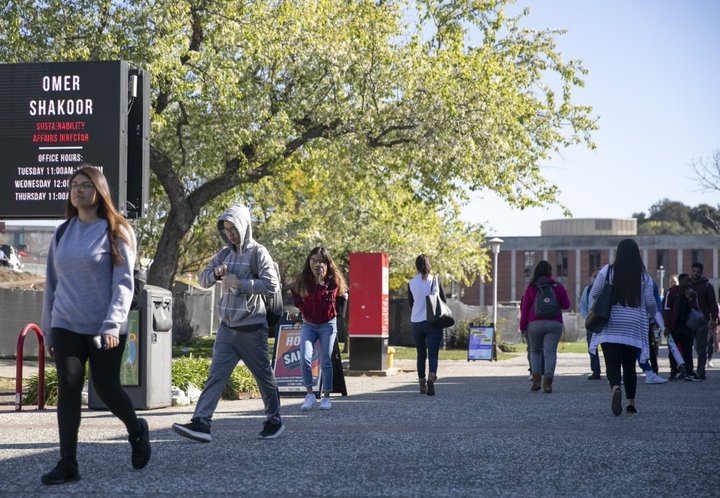
Students at California State University can look forward to at least one thing next school year: Chancellor Joseph Castro says no tuition increases. Photo by Anne Wernikoff for CalMatters
###
California State University students will not see their tuition rise for the upcoming 2021-22 academic year, promising rare good news for the system’s nearly 500,000 students battered by a year like no other.
“I want to make sure all of our students hear that, and all the students that are thinking about the CSU hear that: No increase in tuition for 2021-22,” said new Chancellor Joseph Castro during the bimonthly CSU Board of Trustees meeting Tuesday afternoon.
It’s the first time the CSU has committed itself to such a goal for 2021-22, continuing a decade-long trend in which the system raised tuition only once, most recently a $270 hike in 2017-18.
Gov. Gavin Newsom’s January budget proposal includes a 3% increase in ongoing funding to the CSU, but with conditions, including keeping tuition flat. The proposed increase — about $145 million — is still about half of the amount that state lawmakers and the governors lopped off from the CSU in the current state budget they approved last year.
Though CSU’s finances took a hit during the COVID-19 pandemic, federal aid partially shored up CSU losses. The system reported losses and increased costs of more than $758 million in Spring and Fall 2020. Federal relief, known as the CARES Act, sent the system $262 million and an equal amount to its students for emergency aid. The most recent federal relief package is expected to mete out even more aid to the system, about $854 million, according to a CalMatters review of federal data. At least $262 million of that is supposed to go to students as emergency aid grants.
Castro also vowed to protect CSU employees and faculty, saying that “if our assumptions for state and federal support hold,” he will not support a systemwide furlough program and “do everything we can to avoid additional layoffs of permanent CSU staff or faculty due to a lack of state funds.” About 130 workers were laid off this month belonging to the system’s largest employee union, a spokesperson for CSU Employees Union confirmed.
The pause on spiking tuition is a far cry from the last time California endured a recession, when tuition doubled in a few short years after state funding plunged as a result of the 2007 Great Recession.
But student tuition is only one portion of the total cost of attending the CSU. While current tuition stands at $5,742, each campus is free to raise mandatory campus fees, which range from $901 at Fresno State to $4,329 at Cal Poly San Luis Obispo. Unlike systemwide tuition, mandatory campus fees have been rising annually, sometimes by hundreds of dollars at a time, since 2011-12. While the CSU Board of Trustees has the authority to raise systemwide tuition, campus presidents set campus fee rates. At two Cal States, mandatory campus fees more than doubled in the past decade. Some campuses were faulted for not following protocol in setting campus fees, a state auditor found last year. In several cases, campuses failed to consult with key groups or explain why they needed the fee increases.
That Castro promised to hold systemwide tuition steady matches his reputation for minding costs as former campus president of Fresno State, where mandatory fees are the lowest in the system and have risen only $110 in the past decade.
At least one campus, Humboldt State, plans to keep their mandatory campus fees flat, spokesperson Grant Scott-Goforth said over email. The campus releases its fee updates in March or April.
Castro also doubled down on the CSU reopening most of its classes in the fall for in-person learning, which may sweeten the pot for students to continue to enroll at CSU. While nationally enrollment at four-year universities cratered, Cal State and the University of California have maintained their enrollments during the pandemic.
The president of the CSU faculty union sounded less thrilled about in-person instruction. During public comment at the Trustees meeting, California Faculty Association President Charles Toombs said the system must address matters such as vaccines, sanitation protocols, the ability to continue teaching remotely, and more.
Public health will guide the CSU’s decisions about in-person learning in the fall, Castro said. “If the course of the virus, the data, vaccine availability and the medical and public health experts indicate that our planning approach is no longer feasible, we will adjust.”
###
CALmatters.org is a nonprofit, nonpartisan media venture explaining California policies and politics.
Fred
Allen Moon Sr. December
14, 1939-January 22, 2021
Fredrick
Allen Moon Sr. was born in Hoopa to Charlie Moon Jr. and Myrtle
Elizabeth Nixon Moon on December 14, 1939.
Fred
Moon Sr. passed away peacefully at home on January 22, 2021
surrounded by family. He is proceeded in death by his Father Charlie
Moon Jr, Mother Myrtle Elizabeth Nixon Moon, Son Fredrick Allen Moon
Jr, Son Clyde Moon Jr. Siblings: Joseph Moon Sr., Idell Brock,
Richard Moon, Delores Mercado, Leland Moon, and Dorothy Lincoln,
Granddaughter Dee-Faye Moon, Grandson Billy Dee Carter, Granddaughter
Serenity Hope.
He
is survived by his wife of 64 years Carmen Louise Moon, his brothers
and their wives Melvin and Kayo Moon, Clyde Moon Sr. and Donna, and
sister-in law Syd Carroll, his children: Ronalda Jordan (Danny),
Delores Moon, Richard Moon (Tamela), Marjorie Moon, Lila Lucero
(Chris), Jimaica McLaughlin. Grandchildren: Carmeli Begay (Nolan),
Leland Jordan, Christina Risling-Moon, Virgil McLaughlin, Medero Moon
Sr., Analisa Cavil (Rashauna), Liles Cavil (Yvonne), Richard Moon,
Meagen Baldy (Guy), Darrell Moon Sr. (Ernestine), Jasmine Booth
(Elexis), Travis Moon (Chernabyl), Nena Macias, Shaleen Carlson,
Damon Cross, and Aaron Cross (Rochelle). Great Grandkids: Raymond,
Helena, Rylan, Melia, Eric, Raymond A., Dianna, Richard, Fredrick,
Naschewen, Kayrich, Kaycen, Dolly, Medero, Mederiona, Emony, Prince,
Diauni, London, Brookelyn, Liles Jr., Queenz, Robert, Emily, Raymond
B., Riley, Anjelica, Issac, Antonio, Santiago, Jayceonrmen, Darrell
Jr, Anthony, Malachi, Jordan Ch’inso:n, Michael, Chai, Faith,
Woodsie, David, Kylie, Kalissa.
Fred
was a proud member of the Hoopa Valley Tribe. Fred started his career
as a logger in the logging industry at the age of 16 years old. He
also met the love of his life, Carmen McCovey, along with her
daughter, Ronalda, in Hoopa. Fred and Carmen married October 28, 1956
and welcomed their first-born son, Fredrick Allen Moon Jr., and he
was followed by Delores Moon, Richard Moon and Marjorie Moon. The
Moons soon took an adventure to Hawaii, where Fred worked in steel
mill at Pearl Harbor. Fred often spoke of this time especially when
he had to swim out in the ocean to save his sons Fred and Richard
from being swept out to China. During this time Fred enjoyed living
like the locals in Hawaii but decided to move his family back Hoopa.
Once back in Hoopa, there was a lot of youth who came through that
became family but the two who were biggest in their hearts were Fred
and Carmen’s double niece and nephew Lil’ Clyde and Lila, who
Fred considered his own.
Fred
then went to barber
college
in the late ‘60s in Long Beach. This is where Fred began his
lifelong career as a barber. Fred started his first job as an
apprentice in Sacramento. He then moved back into Humboldt County and
cut hair in Elgar’s Barber shop in Blue Lake, which led
him to moving into McKinleyville, where he started Moon’s Barber
Shop in the early ‘70s. This is when Fred found his lifetime
career. Not only did he cut hair for numerous community members, he
cut most of his grandchildren hair throughout the decades. Fred then
moved into his family home on Moon Lane.
Fred
served as a councilmember for the Hoopa Tribe during the ‘90s and
served as Vice Chairman. Carmen ran the Natives Fire Crew, which
enabled him to accompany his wife on for numerous years where he met
a lot of young men and woman who considered him as their mentor and
also as their praying Papa Fred. On this crew throughout the seasons,
he always said that Carmen was in charge out there, but once we we’re
home it’s all me!
Fred
Moon was a die-hard San Francisco Forty-Niners fan. He enjoyed
watching football with all his family. Fred also enjoyed his trips to
the Lucky Bear aka Hungry Bear Casino throughout the years.
Fred
has left a rich legacy for his family and an example on how to walk
as a Hupa person with respect and keeping his family together.
Services
will be as followed: Wake at the Hoopa Assembly of God Wednesday,
Jan. 27, from 5 p.m to
10 p.m. (Mask required and
limited family and community allowed). Graveside services
Thursday, Jan. 28, 11
a.m. at Moon Family Cemetery (dress warm and COVID
protocols in place)
Pall
Bearers: Richard Moon, Darrell Moon Sr., Travis Moon, Damon Cross,
Aaron Cross, Leland Jordan, Antonio Correa, Santiago Moon, Robert
Baldy, Raymond Baldy, Riley Baldy and Michael Te’odecki.
Honorary
Pall Bearers: Clyde Moon Sr., George Moon, Danny Jordan, Raymond
Begay, Richard Barry Moon, Sonny Pratt, Paco Garcia, Robert “Kash”
McCovey, Loren McCovey, Mike Orcutt, Kevin Orcutt, Nick Mercado,
Liles Cavil, Medero Moon Sr., Medero Moon Jr., Price Richards, Walt
Lara, Tim Casey, Blaze Carpenter.
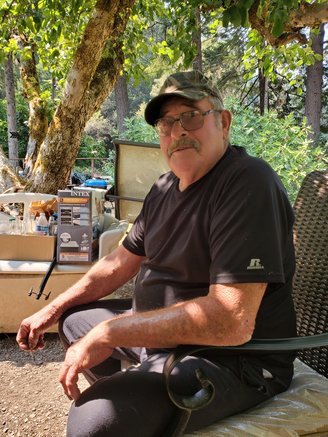
Luther
Earl ‘Pete’ Vaughn November
3, 1944 - December 31, 2020
Luther
Earl “Pete” Vaughn passed away on December 31st, 2020 in
Eureka. He was born to James Cicero and Gertie Vaughn, on November
3rd 1944 in Pritcher, Oklahoma. He was the 4th and youngest son of
eight children.
When
Pete was six years old his family moved to Northern California. He
attended Leggett School in Mendocino County before moving to Humboldt,
where he met his wife Ella “Marie” Vaughn.
Pete and
Marie married in 1961, at age 17, and had five
children. They remained dedicated and loving to each other through
their 39 years of marriage, until Marie’s passing in 2000.
He
lived in many of the small towns of Humboldt, before settling in
Orick. Pete was a family man that loved his kids, grandkids, and
great-grandkids.
All
of his life Pete Vaughn made his living off of the land and sea. He
was a commercial surf fisherman for most of his years. If you wanted
to find out if fish were running, you’d see what Pete was doing. He
was a skilled hunter and trapper, and woodsman. He had taught and
handed these skills down to not only his kids but grandkids and great-grandkids. He kept bees and made sweet jars of honey, all while
wearing a tank top. He had an excellent green thumb. He loved growing
tomatoes and his grandkids say he grew the best strawberries they’d
ever had. He liked to find gold, he would say, just as a hobby. Pete
was a friendly and kind-hearted person that will be greatly missed by
anyone that had the pleasure of knowing him.
Pete
was preceded in death by his parents Gertie and Cicero Vaughn,
brothers Gerald Vaughn and James Presley “J.P.” Vaughn, his
loving wife Ella Marie Vaughn, grandsons Jason Bachus, and Facundo
Gifford, and also his second wife Gail Grafflin. He is survived by
sisters Leona Walker, Betty Stacy, Linda Overly, Sharron K Woods,
Barbara Nalley, and Andrea. Children, Verna Fernheart, Kathy Gifford,
Glenda Hall, Lawrence, and Ronnie Vaughn. His grandkids Robert and
Raymond Dickerson, Tyrone Bachus, Jessica and Fannie Gifford, John
and Michael Hall, Ronnie and Derek Vaughn, Tyler, Samantha, Lauren,
Abby, Calvin and Bella Vaughn. And his many great-grandkids. He was
also survived by his friend and love of his life Shirley Dixon.
Arrangements
were made by Paul’s Chapel in Arcata. If you would like to join the
family for a prayer there will be graveside services in Trinidad on
Saturday January 30,
2021 at 2 p.m. Please note that COVID-19
restriction and social distancing will apply. A celebration of life
will be announced later when COVID
restrictions are lifted.
###
The obituary above was submitted on behalf of Pete Vaughn’s loved ones. The Lost Coast Outpost runs obituaries of Humboldt County residents at no charge. See guidelines here.
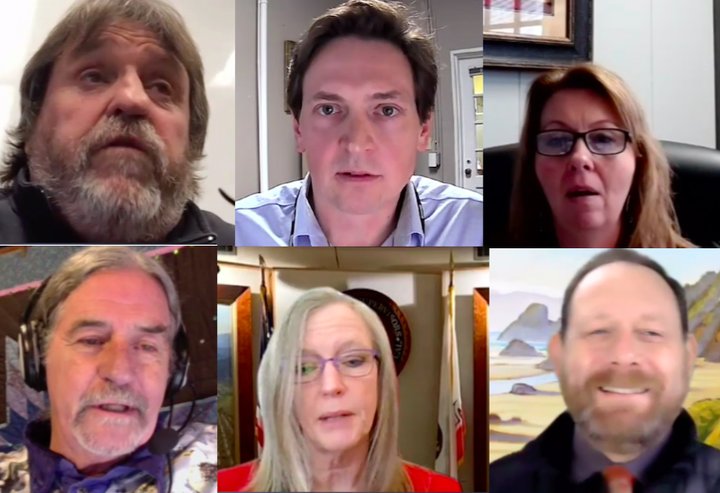
Screenshots from Tuesday’s Board of Supervisors meeting (clockwise from top left): Supervisor Rex Bohn, Health Officer Dr. Ian Hoffman, Supervisor Michelle Bushnell, Supervisor Mike Wilson, Supervisor and Board Chair Virginia Bass and Supervisor Steve Madrone.
###
Tuesday’s virtual meeting of the Humboldt County Board of Supervisors offered a snapshot of the various trials and tribulations facing the community in early 2021, from the messy national rollout of COVID-19 vaccines to a corporate media beef that’s robbing local customers of local programming to continuing internal drama surrounding fiscal management.
Below you’ll find a summary of the major topics discussed.
Early in the meeting, Humboldt County Health Officer Dr. Ian Hoffman provided his latest update on local COVID 19 conditions, saying the virus is widespread in our community and vaccination efforts are not going as smoothly as hoped.
While the state has lifted regional stay-at-home orders (which were never triggered here in Northern California), Hoffman said Humboldt County’s epidemiological data puts us firmly in the purple tier, indicating widespread COVID-19 infections, and we’re likely to remain at that level for several weeks.
“We’ve been seeing many outbreaks across all sectors of Humboldt County,” Hoffman said, indicating that these outbreaks are “almost always associated with gatherings,” including those at workplaces, churches and, increasingly, schools. He reminded locals that with so much COVID-19 in the community, any gathering is risky.
As for the vaccination effort, Hoffman said the supply coming into the county has been “variable and very limited,” with only 1,000-2,000 first doses arriving weekly “despite promises we will get more.” (Both the Pfizer-BioNTech and Moderna vaccines require two doses, administered weeks apart. Hoffman said the county is getting enough second doses to ensure nobody is left hanging after receiving the first.)
The county and its public health partners — including hospitals, pharmacies and primary health care providers — now have significantly more capacity than vaccines to administer, Hoffman said, and county staff has gone back to the drawing board on its vaccination plan. They’re now moving toward a mass-vaccination effort, looking to set up sites to inoculate large numbers of people in short periods of time — in some cases via drive-through clinics.
“It is a challenging time, for sure,” Hoffman said. “We’re all working extraordinarily hard to get this vaccine out. We will continue to have to change and pivot. Hopefully in the future we’ll have a solid, stable plan that won’t change from week to week.”
The subsequent Q-and-A between Hoffman and the supervisors got a bit testy. First District Supervisor Rex Bohn and Second District Supervisor Michelle Bushnell, in particular, peppered Hoffman with questions, and his replies were sometimes curt.
Bushnell wanted to know exactly how many county residents have been vaccinated to date and Hoffman couldn’t provide the answer. “We’re working hard to figure that out,” he said, explaining that the state’s database has not been tracking vaccinations accurately, so the county has been attempting to collect the information from its various vaccinating partners. But he could only hazard a guess. The county has finished moving through phase 1A, which consisted of 10,000 people (not all of whom received the vaccine, though a majority did, he said) and has now moved into phase 1B, which contains about 7,500 people.
Bushnell alleged that teachers have been moved down the county’s vaccine priority list, but Hoffman strongly denied that, first by interjecting “Not true” and later by reading directly from the county’s website.
Bohn, who said he was merely repeating the questions that get asked of him, pressured Hoffman to say when local teachers can expect to receive their vaccine shots. Hoffman said that given the variability in supply he was hesitant to give an exact date.
“We were told we’d get more vaccine in February, [but] that’s not happening,” he said. “We see what we have and then plan the clinics accordingly. … I do feel confident we’ll have the teachers [vaccinated] in the [coming] weeks.”
Third District Supervisor Mike Wilson and Fifth District Supervisor Steve Madrone attempted to lower the temperature a bit, with Wilson noting that the pandemic has created “a pressure cooker” of anxiety while Madrone said the end is in sight.
“This is the exact time to take a deep breath and realize that help is coming,” he said.
Cable Company Squabble
Local cable subscribers have been up in arms lately after contract negotiations between two media conglomerates resulted in both KIEM (the local NBC affiliate) and KVIQ (the local CBS affiliate) getting removed from the channel lineup, blacking out local news broadcasts, NFL playoff games and other programming.
Deputy County Administrative Officer Sean Quincey and Access Humboldt Executive Director Sean McLaughlin were on hand to provide background on the situation, which cable companies Suddenlink (parent company: Altice) and Cox Media Group blame on each other.
Quincey explained that a 2014 state law called the Digital Infrastructure and Video Competition Act left local governments mostly powerless to intervene in such cases.
The board wound up approving two letters — one to be sent to California Senators Dianne Feinstein and Alex Padilla, the other to be sent to Rep. Jared Huffman — calling for action from both the media companies and Congress.
“We call upon those corporations to consider the impact on local communities,” the letters state. They go on to argue, “Ultimately, these absentee corporations are negotiating
a cost that will be born by local cable subscribers in our region.”
The letters point the finger at media consolidation, suggesting that corporate profits have come at the expense of local control and healthy competition.
“Ultimately,” the letters read, “we need our federal and state policymakers to recognize the essential role that
local media play to meet local needs for: public health and safety; education; economic and
community development; culture and arts; and civic engagement. Local governments and
our communities stand ready to take back local media and rebuild our information
ecosystem to secure competition, diversity and localism in the marketplace of ideas.”
Budget Review and Outlook
Staff does this every year — prepares a review of the previous fiscal year’s budget along with a look forward to the upcoming year’s and brings them to the board for review and approval. Recently, though, every fiscal issue in the county seems to center on Auditor-Controller Karen Paz Dominguez, and the staff report for these budget items does just that.
The report notes that as of last Thursday, the Auditor-Controller had yet to close the books on fiscal year 2019-20, making it difficult to plan for the coming year and costing the county hundreds of thousands of dollars in state and federal funding, among other repercussions.
The report also says the Auditor-Controller’s Office has yet to submit a Cost Allocation Plan to the state for approval, which threatens to cost the county another $15.5 million in state and federal reimbursements.
“This would place the county in a self-made financial crisis, one that could result in service reductions … to the public and lay-offs of
county staff,” the report states.
Paz Dominguez has complained publicly on numerous occasions that her office has been chronically understaffed. The board recently approved two new accountant positions for her office.
The board spent most of it’s budget-talking time discussing how to distribute the nearly $800,000 that remained unclaimed in revenue from Measure Z, the half-cent sales tax earmarked for public safety and essential services.
That dollar amount doesn’t include more than half a million dollars from the fund balance that staff recommended be carried forward for previously approved projects, including:
$364,208 for local fire chiefs to complete projects
$127,882 for Orleans Volunteer Fire to complete the construction of a fire station
$18,259 for KMUD to complete an emergency broadcast upgrade, and
$17,155 for the county to finalize its Measure Z audit
After a lengthy discussion, the board settled on the following expenditures:
$353,996 to the county’s Public Works Department for road repairs
$200,000 to Public Works and the City of Eureka for resurfacing and repairs on Harrison Ave.
$80,000 to Public Works to remove illegal dumping on county properties
$7,600 to pay a security person at the Garberville Town Square
$1,748 to Access Humboldt for a backup system and
telephone link for power
outages and emergencies
$10,000 to New Directions for safety gear and homeless encampment cleanup
$7,900 to the College of the Redwoods Foundation to fund courses for the Community Emergency Response Team (CERT) Coalition
$46,100 to the 2-1-1 Humboldt Info & Research
Center for various equipment
$33,488 to Rio Dell for police department clerical support, and
$58,498 to the Fortuna Police Department for a Drug Task Force agent
After the board had assembled this list of expenditures, a member of the Measure Z Community Advisory Committee, Ernie Branscomb, called in to say that he and his fellow committee members worked hard to develop a ranked list of recommendations, which the board had deviated from somewhat.
Both Bohn and Wilson agreed with his argument and initially voted “no” on a motion to accept the above list, which required four-fifths approval to pass. Wilson wound up changing his vote to “yes” in order to move the matter along but suggested giving greater deference to the advisory committee next time around.
Press release from the Humboldt County Joint Information Center:
The California Department of Public Health (CDPH) today outlined a new statewide approach to COVID-19 vaccine distribution.
The new plan does not address the challenge of vaccine supply but does define three strategies intended to improve vaccine distribution as doses become available:
Simplifying which groups are prioritized for vaccination
Utilizing a statewide notification system for vaccine availability
Contracting with a third party to distribute doses directly to vaccinators.
In an attempt to simplify prioritization, the state will shift to age-based eligibility after vaccinations have been scheduled for those in Phase 1B Tier 1—people 75 and older and those at risk of workplace exposure in the education, child care, emergency services and food or agriculture sectors. The state said it expects that change to take effect by mid-February.
The state today officially launched myturn.ca.gov, an online portal designed to register for notifications of vaccine availability based on priority group. The state anticipates adding a scheduling tool for appointments to the site next month, though the site is not yet operational for much of California, including Humboldt County. This portal is similar to Humboldt County’s “COVID-19 Vaccine Interest Form.” Public Health officials urge residents to continue filling out the local form (humboldtgov.org/InterestForm) until the state’s system is functioning.
CDPH also announced that it will work with a third party to distribute vaccine doses directly to provider networks, including Public Health, pharmacies, public hospitals and community health centers among others.
All aspects of the new plan are dependent on vaccine availability, and many of the proposed changes will not begin until next month.
Humboldt County Public Health officials said much is still unknown about how these changes will be implemented locally, and there will be a transition period during which CDPH representatives will meet with Public Health to better understand conditions on the ground. Officials stressed that scheduled vaccination clinics and appointments will go on as planned for at least the next few weeks until the state puts in place a reliable system for Humboldt County residents to schedule and be notified of appointments.
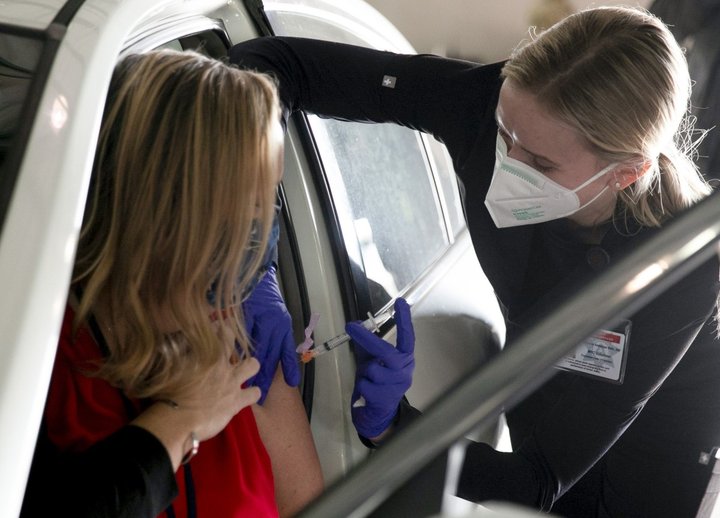
Nurse Lynnen Svensson, left, receives the Moderna COVID-19 vaccine from medical reserve corps nurse Katherine Ambrose at a drive-thru distribution site at Cal Expo in Sacramento on Jan. 21, 2021. Photo by Anne Wernikoff, CalMatters
###
Educators, childcare workers, food and farm workers and first responders will join Californians age 65 and over who have priority to qualify for the coronavirus vaccine, state officials announced today.
After that large group is vaccinated, the next priority group will be based on age — and middle-aged Californians are likely to be next in line.
The new statewide standard takes effect mid-February and will apply to all 58 counties in an effort to scale up California’s low vaccination rate. It’s unclear how long it will take to vaccinate this new group, but the announcement dovetails with Gov. Gavin Newsom’s effort to reopen schools and small businesses.
“In a well-meaning effort to achieve equity, we are creating systems so complex and messy that they can thwart the goal of equity. Simpler is better,” said Dr. Robert Wachter, chair of the department of medicine at University of California, San Francisco, who has advocated for a vaccine eligibility system based on age. “People at the highest risk of dying should come first.”
The new system emphasizes age rather than people with chronic medical conditions, such as cancer and heart disease, that make them vulnerable to severe effects of COVID-19.
“I am 22, disabled, and immunocompromised. Because of the pandemic, I no longer have access to regular medical care, and COVID-19 could kill me if I got it,” Stanford University student Ariela Algaze wrote on Twitter Tuesday. “Gavin Newsom just sent me to the back of the line to get vaccinated.”
The standards upend months of careful planning by a working group of experts convened by state health officials to develop statewide eligibility rules for counties. The group sought to develop a distribution order that balanced competing aims: vaccinating as many people as possible as quickly as possible, keeping society functioning by protecting essential workers first and assuring fairness in distribution.
Sickened, scared, and enraged for disabled folks in California. Shame on @GavinNewsom for creating a plan that completely ignores high risk folks with chronic conditions. #CripTheVote
Some health advocates worried that that vaccine doses would not go first to people most at risk of contracting COVID-19 — primarily lower-income Latino and Black Californians – but rather to the wealthy and powerful.
Their concerns appear to be warranted: Racial disparities in vaccination rates have emerged nationwide, although it’s impossible to tell whether such disparities are occurring in California. The state has not publicly released vaccination rates by county, race or age, although it is required to report that data to the federal government.
Variety, an entertainment trade publication, reported that Hollywood elites have jetted to Florida where eligibility criteria are less strict, or sought vaccine from pricey “concierge” doctors. In the California desert city of Rancho Mirage, Eisenhower Medical Center invited wealthy donors – albeit over 65 – to be vaccinated at a “test clinic” not open to the public, the Desert Sun reported.
The eligibility guidelines come a day after Newsom ended the virtually statewide stay-at-home order and returned to the color-coded county reopening system launched last summer.
Outdoor dining, outdoor gym workouts and haircuts may soon resume in some counties, depending on the orders issued by local public health officers. Monday’s announcement took many business owners — and state lawmakers — by surprise.
For weeks, Newsom and other state officials have drawn withering criticism for a chaotic vaccine rollout in which they largely deferred logistics and eligibility decisions to counties.
Californians spent hours fruitlessly navigating online registration and notification systems managed by county and city governments, hospitals and even supermarkets — only to find there were no vaccine appointments available. Some online platforms have buckled under the strain, going dark for hours at a time.
Earlier this month, state officials quietly launched a statewide vaccine registration website called MyTurn (myturn.ca.gov) allowing Californians to sign up to be notified when they are eligible for vaccination, and in some cases, register for an appointment. For now, the site is in pilot mode. While residents in some counties now can register to be notified of their turn, the site only allows appointment sign-ups in Los Angeles and San Diego counties.
###
CALmatters.org is a nonprofit, nonpartisan media venture explaining California policies and politics.
Press release from the Humboldt County Sheriff’s Office:
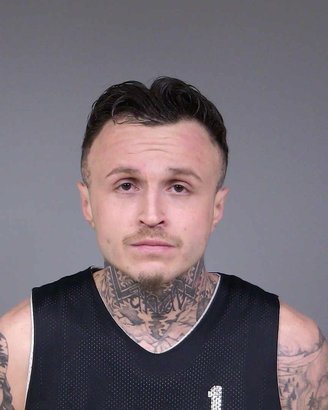
On Jan. 25, 2021, at about 9 p.m., the Humboldt County Sheriff’s Office received information that wanted attempted murder suspect Byron Dean Titus Jr., age 29 of Hoopa, was outside a business on the 3300 block of Broadway Street in Eureka.
Deputies contacted Titus outside the business, and he was taken into custody without incident. Titus was booked into the Humboldt County Correctional Facility on charges of attempted murder (PC 664/187(A)), felon in possession of a firearm (PC 29800(A)(1)), exhibiting a firearm (PC 417(A)(2)) and parole revocation (PC 3000.08(F)).
Anyone with information about this case or related criminal activity is encouraged to call the Humboldt County Sheriff’s Office at (707) 445-7251 or the Sheriff’s Office Crime Tip line at (707) 268-2539.