Press release from the Humboldt County Sheriff’s Office:
On Jan. 13, 2021, at about 10:20 a.m., Humboldt County Sheriff’s deputies were dispatched to an RV Park located on the 4000 block of U.S. Highway 101, in the county’s jurisdiction of Eureka, for the report of suspicious circumstances.
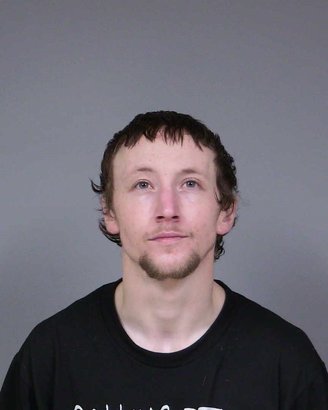
Deputies learned that residents of the park had reportedly seen three suspicious persons possibly casing the area and committing theft. Deputies arrived on scene and made contact with one of the individuals, later identified as 28-year-old Lucas Trinidad Urbano of Fortuna. Urbano was found to have two felony warrants for his arrest.
Urbano was placed under arrest for his warrants. During a search of Urbano incident to arrest, deputies located numerous stolen items, including stolen EBT and debit cards. Upon further investigation, deputies learned that some of the items had been stolen from a vehicle parked on the property.
Urbano was booked into the Humboldt County Correctional Facility on his warrants for burglary (PC 459/461(b)) and violation of probation, in addition to fresh charges of possession of stolen property (PC 496(a)) and petty theft (PC 488).
Deputies were unable to locate the two additional individuals and they have not been identified at this time.
This case is still under investigation. Anyone with information about this case or related criminal activity is encouraged to call the Humboldt County Sheriff’s Office at (707) 445-7251 or the Sheriff’s Office Crime Tip line at (707) 268-2539.
The price of college textbooks is often top of mind for college students, for understandable reasons, but also the governor, apparently.
Gov. Gavin Newsom called textbooks a “racket” during his press conference unveiling his budget proposal last week, saying he was “committed” to addressing the “usurious costs associated with textbooks.” “And so we’re going to do more this year… on open source textbooks,” he said. The typical full-time college student in California spends $800 on textbooks and related materials annually.
As part of Newsom’s record-breaking $227 billion spending plan, the governor wants to commit $15 million to create free alternatives to commercial textbooks — a $3.2 billion industry — that colleges and universities can adopt for entire majors. These textbooks, called open-educational resources, are typically online and are some combination of currently available instructional content and new learning materials that professors develop.
“We in California have an obligation to disrupt that entire system nationwide,” Newsom said.
Funding free books
This is Gov. Newsom’s second attempt to fund free textbooks for whole majors. His budget proposal last year in January sought $10 million to develop majors with zero-cost textbooks, but with the state’s finances in a projected freefall, his final budget removed that item as the state sought to balance the budget by cutting higher-education funding and walking back numerous spending programs.
The $15 million proposed in his budget builds on recent state funding, which has steered $19 million to higher education since 2012 through several laws aimed at promoting open-educational resource measures, free textbooks and encouraging faculty to adopt them.
The price of textbooks has been something Newsom has been interested in for some time, according to Hal Plotkin, a senior scholar at ISKME, an education nonprofit that promotes open-educational resources and their usage.
“We in California have an obligation to disrupt that entire system nationwide.” — Gov. Gavin Newsom
In an interview with CalMatters, Plotkin recalled a meeting he took with then-Lt. Gov. Newsom nearly a decade ago when Plotkin was policy advisor at the U.S. Department of Education. The talk focused on community colleges and open-educational resources.
“It’s just wonderful to see it go from that initial conversation to the very significant support that he’s included in the next state budget,” Plotkin said.
Last year’s proposal, which is similar to the one Newsom introduced this month, received mixed reviews from the Legislative Analyst’s Office, which said that while the initiative could pare down the roughly $800 in textbook and related costs college students in California spend annually, evidence is unavailable that previous funding for the community college system to develop majors with free textbooks made a difference.
That’s partially because the community college chancellor’s office was supposed to file a report outlining the various impacts free textbooks made after getting funding for them in 2016, but no such report has been submitted, according to the office of Assembly Budget Committee Chairman Phil Ting, and a spokesperson for the community college system couldn’t confirm whether the report has even been written.
An open library
While California’s community colleges receive the direct funding for open educational resources, the textbooks and other materials created end up in the California Digital Open Source Library, which both the California State University and University of California can access as well. The focus on community colleges is a matter of steering money to the system with the most need and most students: California’s community college system enrolls more than 2 million students, more than the UC and CSU combined, and nearly half of those students receive fee waivers because of their low-income status.
If open source textbooks get adopted widely, students could complete their college majors without ever having to spend money on textbooks, saving thousands of dollars over the course of their time pursuing degrees. Seen as one battle in the fight to reduce the total cost of college, majors with free textbooks can be particularly meaningful to low-income students.
“Their limited financial aid can be applied for other things that are the necessary expenses that students encounter,” Plotkin said. And unlike state support for food, housing and other essential student needs, investing in free or low-cost virtual textbooks has a multiplier effect, because one such textbook can be used by hundreds or thousands of students.
Student savings
A 2015 law is responsible for some of the state’s current progress, said Jill Leafstedt, an associate vice provost at CSU Channel Islands. It gave CSU and community colleges $3 million to bring more open source textbooks to the classroom by funding the many academic meetings and stipends needed for professors to adopt the materials. Often, the entire class must be redesigned to fit a new textbook, which can be a lengthy process.
Channel Islands now has three majors that can be completed using only open-source materials — no pricey textbooks — and more in the works. Not every course section in the major will have a free textbook option, but there’s at least one class in the major where free options are available. On the whole, students taking courses with open source textbooks perform no differently academically than students using commercial works, various studies show.
“(The $3 million) is the only reason that we were able to get here,” she said.
Since 2016-17, the number of courses offering reduced-price or free textbooks shot up from 73 to more than 400 in 2019-20, according to Channel Islands campus data. The university estimates that students have collectively saved $4.1 million in that time span.
“Their limited financial aid can be applied for other things that are the necessary expenses that students encounter.” — Hal Plotkin, senior scholar at ISKME
But Leafstedt wants more money for the CSU directly. Funding for the community colleges is a strong start, especially for lower-division courses that are transferable to the CSU and UC, which means that professors at those universities teaching the same courses could use the instructional material community colleges develop. But upper division professors at the CSU and UC need to create open content, too, which is where state support can come into play.
Leslie Kennedy, who heads the CSU’s open-educational resources efforts, said that so far state support for the CSU has funded awareness campaigns to adopt open-educational resources, but none exists now for the creation of the content itself. In 2012 state lawmakers approved $5 million for the community colleges, CSU and UC to develop those resources for popular courses.
Still, two other CSU campuses, Humboldt and Bakersfield, are in the latter stages of rolling out majors that will have free textbook options, Kennedy said. In many cases, the content for free textbooks exists either in the growing network of virtual warehouses that feature open-educational resources, including one at CSU, and at campuses libraries that are home to a plethora of academic material.
“There’s a lot of activity and it builds each year,” Kennedy said.
###
CALmatters.org is a nonprofit, nonpartisan media venture explaining California policies and politics.
Linda
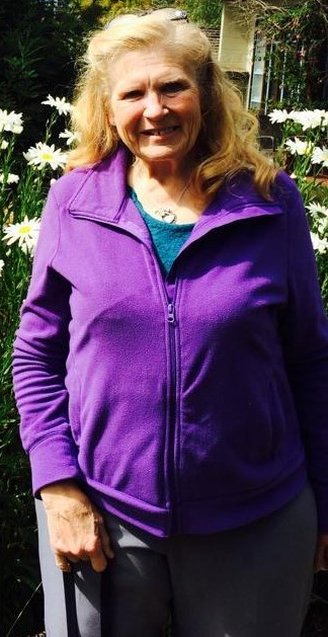
Vann Hills went to rest in the arms of Jesus November 11, 2020.
Linda
was born November 16, 1940 in South Dakota to John and Lillian Vanden
Bos.
Linda
grew up in Southern California and graduated Colorado Women’s College
in 1962 and the University of Hawaii in 1964, with a double major in
Dental Hygiene and Home Economics.
She
married John Walter Hills May 31, 1968. After spending time in
Germany, they moved back to the United States, where their two boys,
John Jr. and Andy, were born. They moved to Eureka in the
late 1970s.
Linda
worked for many years as a dental hygienist for Dr. Norman Ball in
Eureka and at The Open Door Clinic in Arcata. During this time Linda
also took care of John Sr. who had multiple sclerosis and her two
boys.
Linda
was involved with local churches, including Bethel Church, Sequoia
Bible Church, and Faith Center, where she sang in the choir. Linda’s
interests were in sewing, fashion, cooking, reading, gardening,
animals, Bible study and spending time with her dear family and
friends. Linda was proud to also, at one time, have a pilot’s
license. Linda was an amazingly accomplished woman who was always
gracious in sharing her skills and knowledge. Linda’s kindness and
charity was tremendous, and she touched many lives with her
generosity.
In
later years, Linda did shopping and transportation for friends and
others in the area. She was a natural caretaker for the needs of
others.
We
will all remember Linda’s loving greetings and huge smile. She leaves
a legacy of unconditional love, grace, courage, and humor.
Linda
was preceded in death by her sister Marta, brother John, husband John
Sr., and son John Jr.
Linda
is survived by her son, Paul Andrew Hills, his children Brody, Julia
and Violet, her grandson Cody Randall Hills, granddaughters Arianna
Hills, Adriena Spaulding, Ashten Phillips, great grandchildren
Journey and Juliana, and two special friends, Cody’s mom Dalene
Zerlang, and longtime friend Jeanne Peterson.
No
service will be held at this time.
###
The obituary above was submitted on behalf of Linda Vann Hills’ loved ones. The Lost Coast Outpost runs obituaries of Humboldt County residents at no charge. See guidelines here.
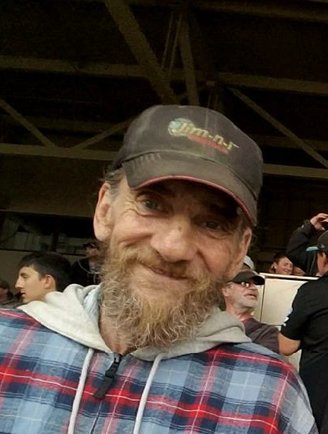
Allan Roger Anderson, born July 25, 1953, passed away on December 24, 2020, surrounded by friends and family.
Allan always had a smile on his face. He was full of adventure and loved the outdoors. He built many life long friends and made many good memories.
Allan is survived by sons Allan and Matt Anderson, brothers, sisters and grandchildren. Proceeded in death by his parents and brother.
Outdoor service to be held in Fortuna at the Sunrise Cemetery on Saturday January 23 at 2 p.m.
###
The obituary above was submitted on behalf of Allan Anderson’s loved ones. The Lost Coast Outpost runs obituaries of Humboldt County residents at no charge. See guidelines here.
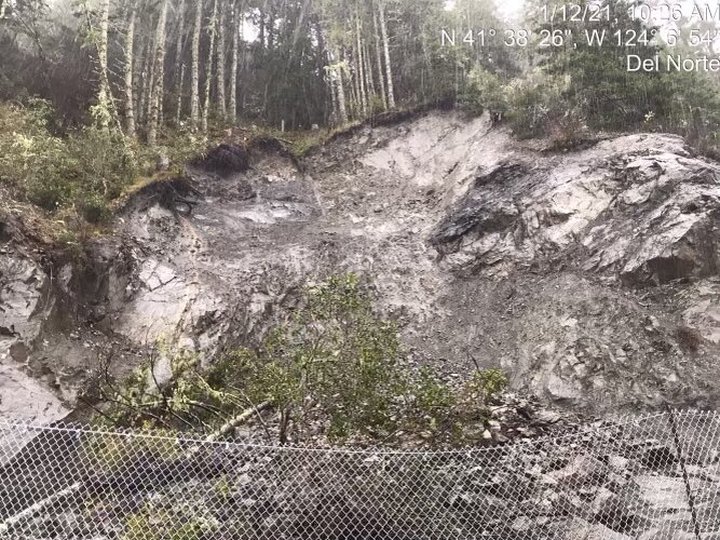
Crescent City resident Jeffry Simmons had a front row seat to the slide that shut down Highway 101 at Last Chance Grade yesterday morning, and his camera was rolling.
Simmons told the Outpost that his van was stopped at a traffic-controlled area of Last Chance Grade when he noticed something was wrong.
“I was heading to Klamath but I was right there when it happened,” Simmons said. “I saw some Rocks sliding down once the last semi-truck passed the mountain. That’s when it happened.”
Simmons’s video shows a trickle of dirt falling from the hillside, followed by a rush of debris that spilled into a concrete barrier below, knocking it back several feet.
Caltrans eventually opened the highway back up to one-way traffic control. But, Simmons said that he was stuck at the closure for at least an hour and a half.
Starting Sunday, Caltrans will enforce nightly closures of Highway 101 at Last Chance Grade between 8 p.m. and 6 a.m. The overnight closures will end on January 23.
Photo of the slide taken by Caltrans, provided by Senator Mike McGuire.
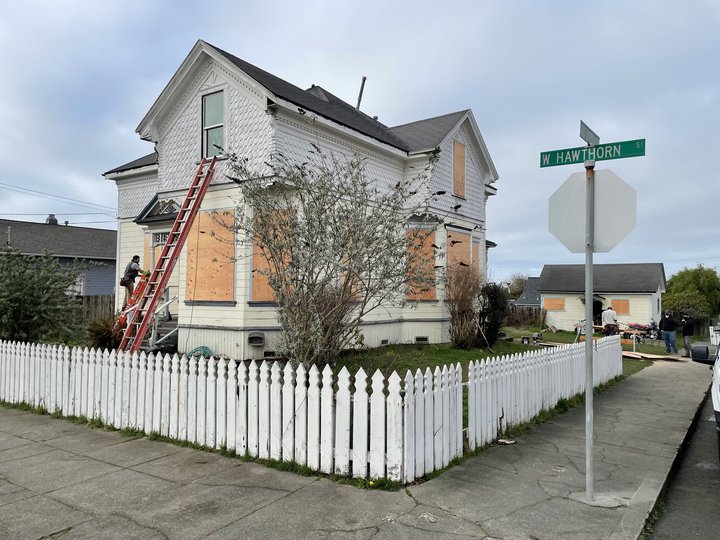
On Wednesday morning members of the City of Eureka Code Enforcement and Problem Oriented
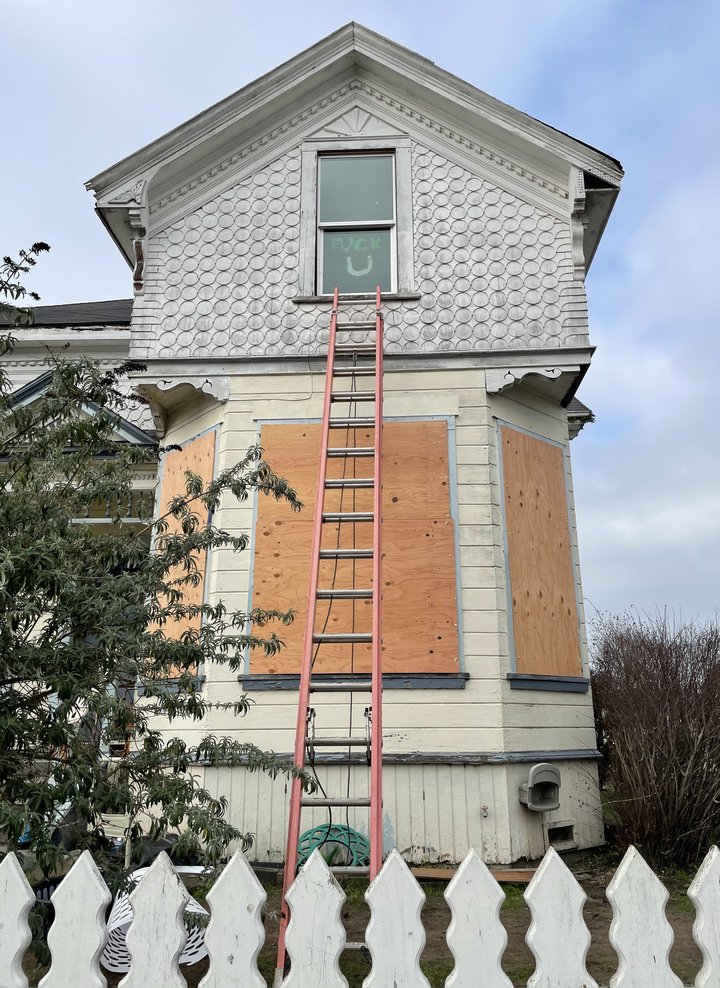
Police (POP) units served an inspection and abatement warrant at 204 West Hawthorn.
The house,
which is owned by Floyd and Betty Squires, has been the site of more than 57 calls for service to
EPD since March 2020 for drug activity and criminal behavior. In addition to police complaints,
Eureka Code Enforcement received numerous complaints for accumulations of garbage, rat
infestations, and other nuisance violations.
During service of the warrant, City officials found unsafe and unsanitary conditions that were
deemed to be an immediate danger to the occupants and the surrounding community. As a result,
the structure was vacated and secured against entry. Cleanup efforts are ongoing.
Abating problems at nuisance properties is often complicated and time-intensive. The City thanks
neighbors of 204 W. Hawthorn for their role in monitoring and reporting conditions at the
property, as well as their patience as the process has played out.
California is opening COVID-19 vaccines to all residents 65 and older — an announcement that comes amid a slower-than-expected vaccination rollout and growing frustration among seniors most vulnerable to the virus.
State health officials had previously ordered that California focus on vaccinating health workers and nursing home residents, with seniors 75 and older and certain essential workers to follow. But people over age 65 make up the majority of hospitalizations and nearly three-quarters of the COVID-19 deaths.
Next week, the state will launch a text-and-email notification system so Californians can keep track of when they’re eligible to sign up for their shot, according to the state’s public health department.
The announcement comes a day after the U.S. Department of Health and Human Services Secretary Alex Azar declared that the federal government would no longer reserve doses for the second shot — both the Pfizer and Moderna vaccine require two doses.
Production has reached a point where there is now enough to start releasing more doses to states as they become available, Azar said. He directed states to open vaccinations to people 65 and over and to people under 65 with a preexisting condition, noting that many states were being “too prescriptive” and not distributing vaccines fast enough.
California’s new guidelines do not include people under 65 with preexisting conditions. State health officials have not yet explained why.
“Part of the process we’ve set up in California — really thoughtful, trying to focus on risk and exposure and equity — have led to some delays in getting vaccines out into our communities.” — Dr. Mark Ghaly, Secretary of Health and Human Services
As of Tuesday, California had administered just over 816,600 doses — about 30% of the doses it has in its possession, according to the state’s public health department. A federal tracker shows that most states are vaccinating people at a faster rate than California.
Last week, Gov. Gavin Newsom set a goal to administer an additional 1 million vaccines by this weekend, enlisting four mass vaccination sites: Disneyland Resort in Anaheim, Dodgers Stadium in Los Angeles, Petco Park in San Diego and Cal Expo in Sacramento.
The new guidance throws the state off its meticulously designed vaccine tier system, but more vaccine allotment is good news for the state, said Dr. Mark Ghaly, the state’s health secretary, in a press call on Tuesday.
“Having more vaccines, inviting more to be vaccinated, will allow California to go faster and quicker through our population and get that vaccine out of our freezers and into the population to get that protection,” Ghaly said.
Berkeley residents Carly and André Rivers. Carly received her COVID-19 vaccine last week but Andre is still awaiting hers. Photo courtesy of Andre Rivers
This announcement could provide some much needed clarity to seniors who for weeks have sought answers.
André Rivers, for one, is anxious to get her COVID-19 vaccine. The 74-year-old has asked her primary care doctor and her rheumatologist when she’ll be able to get one. Neither has been able to provide an answer.
Her wife, Carly Rivers, who has Alzheimer’s, got hers last week through the Berkeley PACE Center, part of a state program that helps seniors coordinate care so they can live in their own home instead of a skilled nursing facility.
“Now that Carly has it, it makes sense that I should have it; we do everything together,” Rivers said. “When I do go out, she goes with me.”
Instead Rivers, like many other seniors in California who have spent the last 10 months mostly isolated from friends and family, has been patiently waiting her turn. The frustration and anticipation growing.
COVID-19 has taken the biggest toll on older adults. Early in the pandemic, seniors were advised to shelter in place because of their vulnerability, even before the entire state went on lockdown. In California, close to 75% of all COVID-19 deaths are of people 65 and older.
Soon after vaccines began to arrive in California, counties reported they were inundated with calls from older residents seeking information.
“If you try to be too micromanaged, too tailored, too focused, you let the perfect be the enemy of the good in mass vaccine campaign like this.” — Alex Azar, U.S. Department of Health and Human Services Secretary
From day one, California vowed to distribute vaccines in a fair manner, carefully targeting people based on risk. But those equity efforts hindered distribution.
“Part of the process we’ve set up in California — really thoughtful, trying to focus on risk and exposure and equity — have led to some delays in getting vaccines out into our communities,” Ghaly said.
Secretary Azar said states are being confined by the original guidance from the Centers for Disease Control’s immunization advisory committee, which recommended that states target health workers and nursing homes first.
“Some governors have overreacted and have taken them in an overly prescriptive manner and this is a logistical issue, it’s an operational issue,” he said. “If you try to be too micromanaged, too tailored, too focused, you let the perfect be the enemy of the good in mass vaccine campaign like this.”
Some counties did not wait for state instruction. Following the federal announcement, Orange County announced on Tuesday it would start offering vaccines to residents 65 and over.
Orange County’s public health officer, Dr. Clayton Chau, said he made the decision after reviewing hospital and mortality data. According to the county’s findings, 72% of patients in intensive care units are 60 and older.
“My aim is to reduce hospitalizations and deaths as rapidly as possible, and we must prioritize our vaccine allocation to protect the most vulnerable in our community,” Chau said in a statement.
Orange County urged residents not to show up to its distribution sites without appointments, noting sites already were being overwhelmed.
###
CalMatters COVID-19 coverage, translation and distribution is supported by generous grants from the Blue Shield of California Foundation, the California Wellness Foundation and the California Health Care Foundation.
CALmatters.org is a nonprofit, nonpartisan media venture explaining California policies and politics.