

Heavy Rain, 45-MPH Winds and 25-Foot Waves Possible Along the North Coast Tomorrow
John Ross Ferrara / Sunday, Jan. 3, 2021 @ 3 p.m. / How ‘Bout That Weather
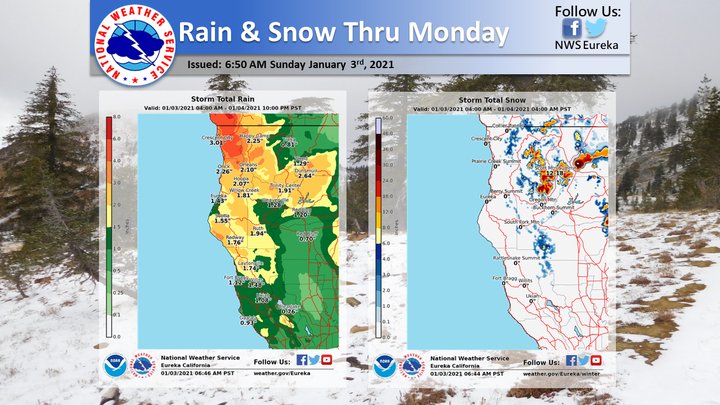
Graphics provided by the NWS.
Stormy winter weather is forecast to hit the North Coast tomorrow.
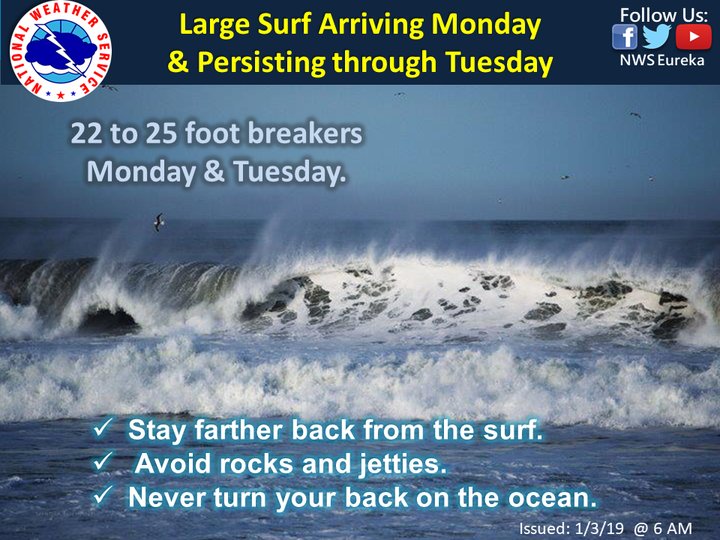
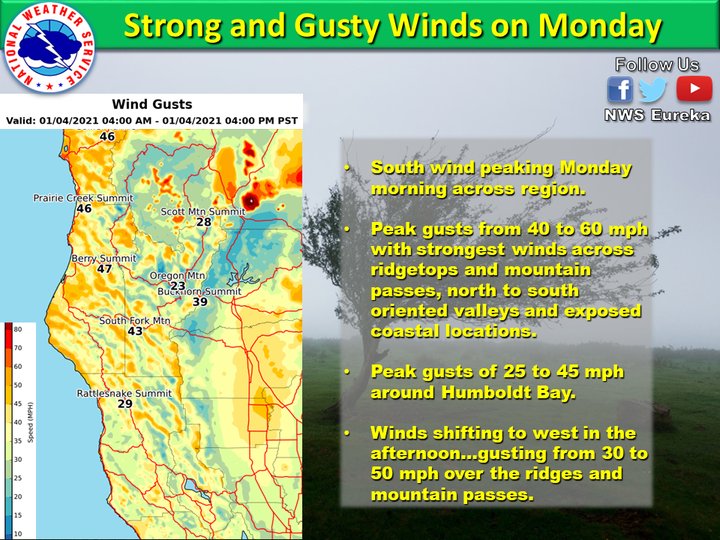
Eureka’s National Weather Service office reports that heavy rain, 25 to 45-mph southerly winds and 22 to 25-foot waves will impact coastal areas tomorrow. Gusts of 40 to 60 mph will be possible along ridgetops and mountain passes.
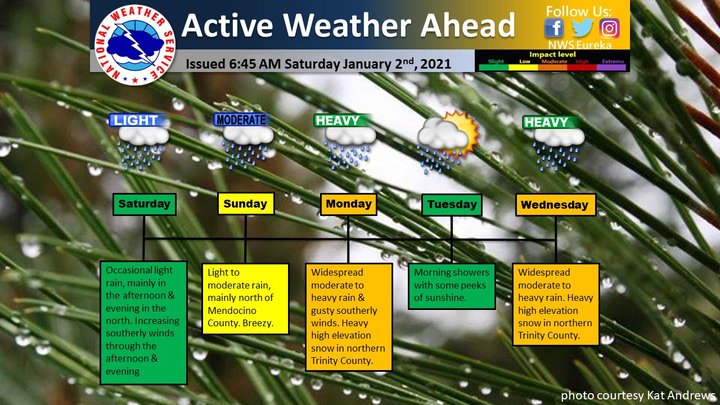
“Active weather is expected for first week of the new year as a series of systems move across the area,” the NWS stated on social media. “The worst weather is expected to occur on Monday and Wednesday, when widespread moderate to locally heavy rainfall is expected.”
Heavy snow is also forecast to fall in high-elevation areas of northern Trinity County tomorrow.
The stormy weather is expected to taper on Tuesday before returning on Wednesday with more heavy coastal rains and mountain snow.
BOOKED
Yesterday: 11 felonies, 15 misdemeanors, 0 infractions
JUDGED
Humboldt County Superior Court Calendar: Friday, Oct. 2
CHP REPORTS
2960 MM162 E MEN 29.60 (GG office): Trfc Collision-1141 Enrt
149-1056 Waddington Rd (HM office): Trfc Collision-No Inj
2960 MM162 E MEN 29.60 (HM office): Trfc Collision-1141 Enrt
ELSEWHERE
RHBB: Miranda’s Rescue Says It Hopes to Reopen After County Suspends Its Permits Again
RHBB: Injured Woman Airlifted After Ettersburg Fall; Local Volunteers Among Responders
RHBB: Missing Man in Del Norte County
Coalition for Responsible Transportation Priorities: It’s the Week Without Driving!
GROWING OLD UNGRACEFULLY: Who Gets the Vaccine First?
Barry Evans / Sunday, Jan. 3, 2021 @ 7 a.m. / Growing Old Ungracefully
I’ve been following the medical-ethics debate on setting priorities for Covid-19 vaccinations, and thought I had a good handle on it, when I read this provocative comment in the Senior News from Julie Fulkerson, ex-mayor of Arcata and much else:
“I could even argue that those who refuse to wear masks should be higher on the list. At least they could get the vaccine and save a lot of others from infection.” Rewarding those who put the rest of us at risk? That sucks—and makes total sense! (That’s assuming a vaccine, in addition to preventing infection, will also stop transmission—currently unproven.)
So how do we figure out who gets the vaccine first…and second, and third? The Center for Disease Control (CDC) lost credibility, in my book, with their late endorsement of masks, delaying their recommendation until April, three months after the virus arrived in this country. Still, the CDC is all we’ve got as far as suggesting a nationwide policy for vaccine priorities, issuing an advisory to states on December 23: “…initial supplies of COVID-19 vaccine [should] be allocated to health care personnel and long-term care facility residents.” The recommendation was in line with the CDC’s threefold goals: to decrease death and serious disease as much as possible; preserve functioning of society; and reduce the extra burden COVID-19 is having on people already facing disparities.
No question, of course, about prioritizing the nation’s 21 million health care personnel. Other than the obvious ethics here—they’re the ones in daily contact with actual or potential Covid carriers—the “put your own oxygen mask on before helping someone else” airplane safety rules apply. Keep the medics healthy so they can take care of us if we get infected!
More controversial is, why are the three million (in the US) long-term care facility residents prioritized? Rather than minimize lives lost, shouldn’t we be trying to save years of life lost? This is Peter Singer’s “utilitarian” argument. (Utilitarianism, you recall, is the theory of morality promoting actions that result in the happiness of the greatest number of people.) Singer is an Australian moral philosopher (now at Princeton) whom I greatly admire—his 1975 book Animal Liberation prompted me to give up eating meat many years ago. In a recent—and fascinating!—discussion printed in The New York Times Magazine on the subject of vaccine priorities, he said, “The objective that we should aim for is to reduce years of life lost. I know a lot of people are talking just about saving lives. But I do think that it’s different whether somebody dies at 90 or 50 or a younger age still.”
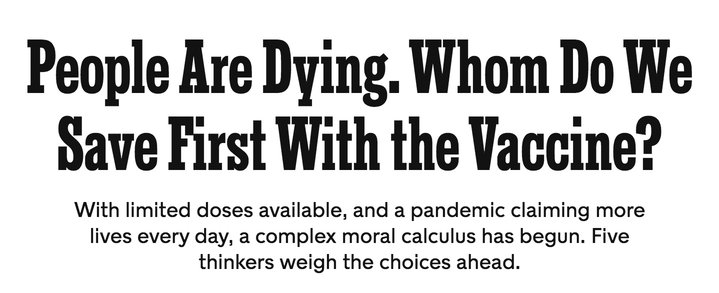
The New York Times Magazine article that prompted this column.
So: do you give priority to a 90-year-old with an expected lifespan of 4-5 years, who has a high risk of dying if they contract Covid; or to a 50-year-old, anticipated lifespan 30-33 years, with a low risk of dying if they’re infected? (I’m 78, in excellent health. According to this, I can expect to live another nine-odd years. Why should I get the vaccine ahead of someone in their childbearing years?) Here are more questions for your consideration:
Prison populations: Like elder care facility residents, prisoners are stuck inside in potentially risky environments. Not even potentially: all of California’s 35 state prisons report having Covid, with over 32,000 cases to date. These are people with, on average, much longer projected lifespans than care facility residents—what about giving them priority?
Race and Ethnicity: According to the CDC, Black, Latino and Native Americans are nearly three times as likely to die from Covid infections as white and Asians. Should they be given priority?
Teachers: Along with all front-line workers and those delivering essential services, isn’t vaccinating teachers a no-brainer? Education is critical! Teachers (6.6 million in US public schools) are largely responsible for the next generation—what children know, what they value, what life is about. Plus, of course, we currently have countless parents—who would otherwise be working—taking care of their kids at home.
Rest of the World: Pandemic means worldwide. We’d be really stupid—not to say unethical—if nationalism in this country (and other high income countries) got in the way of immunizing people in the many poorer countries, especially in the Global South (where most of Earth’s young people live). Yet that’s what’s happening: we have dibs on enough vaccines to inoculate our entire population four times over, as does the UK; Canada has lined up six times what’s needed for its population; the European Union twice its population. All at the expense of less fortunate countries. Shouldn’t we be focusing on the whole world, rather than our corner of it?
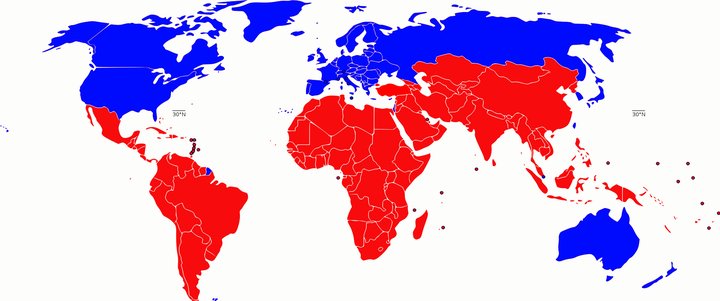
The “Global South”, in red, is replacing the old “Third World” value-laden designation.
These are some of the questions that decision makers are wrestling with. What’s your take?
LETTER FROM ISTANBUL: Lost in the City
James Tressler / Sunday, Jan. 3, 2021 @ 7 a.m. / Letter From Istanbul
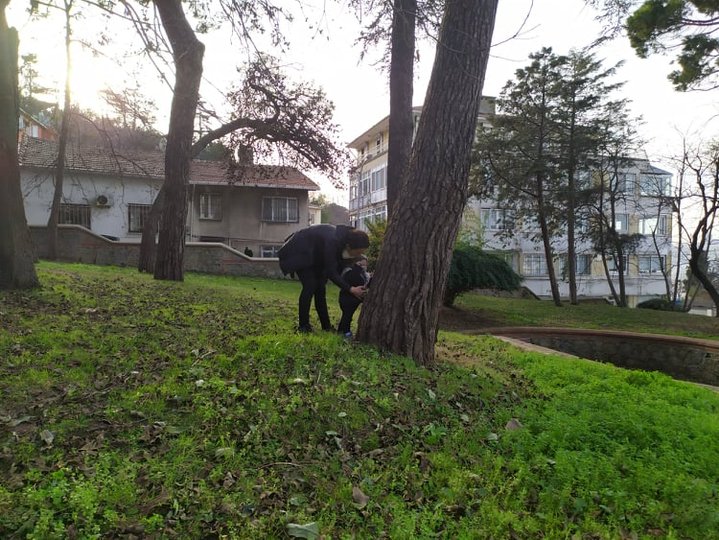
I’ve been living in the city for ten years now.
And for nearly a decade I have written these letters, to capture my experiences, but also as a way to stay in touch with folks back in America and especially the Lost Coast, which gave me some of the most vital and important years of my life in the Nineties and in the early years of the new millennium.
Together we have taken ferryboats across the Bosphorus, witnessed tumult and unrest in the Gezi Park protests in 2013, the failed coup attempt three years later (when even the roar of fighter jets shook our apartment late in the night), and this past year the raging, relentless onslaught of coronavirus that has left no city or town or village immune, not even the mighty former Constantinople. Oh, and don’t forget about Syria. We had refugees, whole families, on the sidewalks in our neighborhoods, holding up hand-written placards asking for help, the children playing on the sidewalks while the mothers hung freshly washed laundry (God knows how and where they washed the clothes) up on nearby shrubs and bushes in the shadow of a busy shopping mall. By and large, most of the Syrians disappeared from the streets, and many either opened up businesses or moved on to Europe and elsewhere. Ten years on, those children I saw on the streets are nearly high school age now, fluent in Turkish and perhaps English as well as their native Arabic. What a story they will have to tell someday!
But there have been good things too. Visiting places like the site of Troy, the honeyed waters of the Mediterranean and Aegean, and sipping wine near an ancient fortress on the island of Bozcaada. Meeting my wife Ozge, dancing atop a ferry on our wedding night with the stars shining over the Black Sea; witnessing the ever-transforming cityscape – a new international airport, a third span bridge; negotiating the Marmaray metro that runs beneath the waters of the Bosphorus; purchasing our small apartment in Üsküdar, with its generous view of the Martyrs’ Bridge and skyscrapers in Levent and Maslak, and Dolmabahce Palace were my wife works; being there for the birth of our little boy Leo Emre.
It’s hard to begrudge a city that has given so many things, especially as a writer.
###
The question that has surfaced over the years, both with readers and with myself, is why and how did I end up in Turkey? I always answer: Istanbul. I didn’t choose Turkey, in other words, I chose Istanbul. As much as I loved the Lost Coast and California, in my heart, I think I always knew that I would one day live in a big city, a really grand city. For years, I thought it would be New York. But suitable circumstances never presented themselves, despite three trips to the Big Apple and even a personal visit to the offices of The New York Times, where I was told the metropolitan editor, “Doesn’t really ‘see’ people.” So I went to Prague instead.
In 2009, when the world was spinning into the financial crisis, and millions (including several very talented people I knew) were out of work, there I was with a job offer in Istanbul. Istanbul! It’s not every day you get a job offer from Istanbul so naturally I jumped at the chance. A friend and former student in Prague gave me a lift to the airport. With a final handshake and “Na shledanou!” from my Czech friend, I departed the Golden City and set off for the shores of the Golden Horn.
###
Istanbul. I fell in love with all the things people who love Istanbul usually fall in love with. The crowded, (yes, labyrinthine) streets, the teeming markets and stalls, the salty air of the sea that reminded me of California, the clamor and din of immense, deeply lived urban life, the sense of urgency in the cry of the gulls. The sound of parties on nearby rooftops, a woman’s voice singing a melancholy tune somewhere in the night, expressing the universal sadness that can perhaps best be expressed by the Turkish word “üzün,” as Orhan Pamuk reflected in his Istanbul memoirs …
Anyway, the prospect of so many lives, conflicts, dramas, stories. The proximity of history, which was no further than my doorstep, the stories that lurk under every stone, as Elif Şafak told a CNN reporter on a visit back in 2010. The street cats, always on the prowl, maintaining their vigil over the soul of the city. The point is: as a writer, if you can’t find something to write about in Istanbul, a city that offers more stories per square meter than perhaps any city in the world, then you should consider changing your trade.
###
It was so easy to get lost in it, lost in the city. I think deep down that was all I ever wanted, to find a great city and to fall in love with it, deeply in love, and to get lost in it, lost in the multitudes. To be a stranger emerging from the metro out into the sun, or rain or fog. To be that old man we saw the other day on our walk. He was in his late sixties, rough skin, a white mustache and white hair parted on the side. I wondered if he was retired. Probably. Widowed? Possibly. I wondered if the gentleman had always imagined this scene as his retirement, the privilege of sitting in a park in the middle of the day, reading a newspaper and not having anyone bother him?
A false spring bathed the park in reassuring sunlight. Most of the benches were empty. Presently a quartet of young people, two boys and two girls, all wearing young lovers have. They had bought burgers and fries at a nearby Burger King and were evidently going to have a picnic at the top of the hill, a rendezvous. I watched them as they traversed the zig-zagging steps to the top of the hill, where they could escape Covid and find a place where they could enjoy being young together. I couldn’t blame them, could you? Lord knows youth doesn’t last long. Could you imagine being young in these times?
Anyway, the gentleman was sitting on a park bench alone, crouched over a newspaper. A newspaper! Not a phone. He was deeply engrossed in the newspaper, and in his solitude – so much that I almost hated to disturb him. Let him have the park to himself, I almost thought. But Leo, our boy, needed to get out of the house. For New Year’s the city was going to be shut down for four days. And Leo loves the park. Ozge lets him practice standing in the moist grass, with all the pinecones and the all the crisp fallen leaves and he leans against a tree, rejoicing and wondering as his small hands travel along the bark. I envy him, almost remembering when I too could be entranced by such things. A little while later, after we took Leo to watch the water in the fountain, I looked for our gentleman, but of course he was gone.
Reading over what I just wrote, I see that I was wrong. It was not a city I wished to fall in love with, nor any place, though these things can be worthy of love. I look at my son, and my wife Ozge, and I realize that the city, as great as it is, and the park, and that gentleman on the bench reading his newspaper, and the young masked lovers going up the hill for their picnic, and the Bosphorus itself, winking back at us in the false spring sun – none of these things would mean anything without my wife and son.
Ten years on, I guess I have become lost in the city, and happily so, as I always wanted. In this great city, and in this lostness, I have found a great many things: A new home and a family, a great family. I know it’s lame and cliché to end a story on a quote, so I won’t. Instead, I’ll just try to remark upon something Emerson once observed, but try to say it in my own way:
The times in life we tend to think as wasted can often prove to be, upon reflection, our most productive. Let’s hope the past year, and the new one, turn out to be among those times.
###
James Tressler, a former Lost Coast resident, is a writer and teacher.
MUSIC VIDEO ROUNDUP! LoCO Presents the Latest Videos Sent To Us by Humboldt Artists
Stephanie McGeary / Saturday, Jan. 2, 2021 @ 4:10 p.m. / Music
Happy New Year, Humboldt! Today LoCO is pleased to present you with a trio of local music videos representing an eclectic selection of genres and film styles and showcasing many different parts of our local landscape.
Above, the video for “A Drunk Paycheck” from artist Kenny Bowling is shot in Old Town Eureka and prominently features the Siren’s Song Tavern. The “Red Giant” music video from local rappers Alexander the Greatest and Ruffian highlights our coastal redwoods, beaches and vistas. The last — and by far the strangest — of the videos “Itchy Throat” from Over Yonder appears to be shot in the dunes.
WARNING: The “Itchy Throat” video contains some slightly graphic content — some fake blood and guts being eaten by the band members. If that type of thing bothers you, maybe don’t watch that one.
Otherwise, go ahead and give these videos a click! With three very different styles, your bound to see and/or hear something you like.
New Law in 1 Minute: California Businesses Must Report COVID Outbreaks
Nick Roberts and Laurence Du Sault / Friday, Jan. 1, 2021 @ 7 a.m. / Sacramento
Millions of Californians continue to risk COVID-19 infection by showing up in person at work during the pandemic.
But the state and federal governments have never required companies to share information about outbreaks with their employees — or to health authorities.
More than nine months after Gov. Gavin Newsom issued the first shelter-in-place order, a new state law will require businesses — and the State Health Department — to report more COVID data.
The law requires businesses to notify employees within 24 hours if they’ve been exposed at work.
And companies have to report outbreaks — defined as more than two positive cases within two weeks — to health authorities.
The law gives more enforcement power to CalOSHA, the state’s workplace safety agency, including the ability to shut down businesses if they find workers in imminent danger.
It’s still unclear how the data will be presented to the public.
While unions backed a provision that would have required the state to disclose every workplace outbreak online, business interests — led by the California Chamber of Commerce — argued the move would only shame companies.
So, the bill was watered down. It requires the state to report workplace outbreaks — not by employer or location, but by industry.
Assemblymember Eloise Gomez Reyes, who introduced the new law, says she wants the state to disclose every workplace outbreak online.
For now, California’s businesses must follow new regulations set by Cal/OSHA to protect workers from getting coronavirus on the job.
Fewer new laws that usual will kick in, given that the coronavirus pandemic shortened and dominated the Legislature’s 2020 session.
###
CALmatters.org is a nonprofit, nonpartisan media venture explaining California policies and politics.
New Law in 1 Minute: California Offers Tax Credits to Some Undocumented Workers
Nick Roberts and Jackie Botts / Friday, Jan. 1, 2021 @ 7 a.m. / Sacramento
In 2019 Governor Gavin Newsom more than doubled how much money the state spends on its tax credit for low income workers.
But since its establishment in 2015, the credit has been unavailable for undocumented workers who pay taxes, until now.
Depending on a household’s size and income, the California Earned Income Tax credit can range from hundreds to as much as 4,000 dollars for families with young kids.
But until recently, it was only available to workers with a Social Security Number, which excluded the state’s over one million undocumented workers.
The pandemic has been particularly difficult for those workers.
COVID-19 related job loss spiked in industries with large undocumented workforces, like food service, retail, childcare, farmwork and landscaping.
But unlike many other workers, undocumented Californians can’t get unemployment benefits or food stamps. They also were left out of the federal government’s pandemic response, like the stimulus check. So California created a program to give $500 to undocumented adults but there was only enough for 150,000 people.
The new law allows anyone with an Individual Taxpayer Identification Number to qualify for the credit — making undocumented workers eligible to receive hundreds or thousands of additional dollars each year.
Keep watching CalMatters.org for more in-a-minute videos about other new laws taking effect in 2021. Fewer new laws than usual will kick in, given that the coronavirus pandemic shortened and dominated the Legislature’s 2020 session.
###
CALmatters.org is a nonprofit, nonpartisan media venture explaining California policies and politics.
OBITUARY: Albert Vaughn Carpenter, Jr., 1958-2020
LoCO Staff / Friday, Jan. 1, 2021 @ 6:56 a.m. / Obits
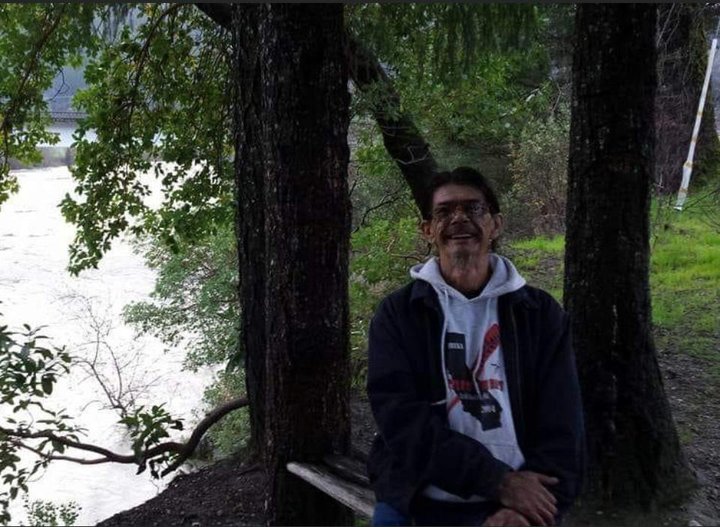
In Loving Memory
Albert
Vaughn Carpenter, Jr. (Scal)
November
27, 1958 - December 26, 2020
Albert was born in Hoopa, at the Old Indian Hospital, to Suzanne Dorene Little and Albert Vaughn Carpenter, Sr. He entered into rest in Eureka, at St. Joseph Hospital. Albert was a member of the Hoopa Valley Tribe and also a descendant of the Yurok and Karuk Tribes.
Albert is survived by his daughter Naomi (Billy) Matilton, grandchildren Jacob and Josie Matilton, siblings Susie (Glenn) Sanchez, Chuckie (Shelly) Carpenter, Richard Carpenter, Debra (Ronnie) Webster, Tonea (Alden) Yazzie, Antone (Mary Jane) Aubrey III, his life partner Sylvia Carpenter, granddaughter Charlene Juan, his Uncles Rodney Vigil Sr., Philip (Gloria) Vigil, David (Nadine) Vigil, Merlin (Janice) Tripp and numerous nieces and nephews that he loved dearly.
Albert is preceded in death by his grandparents Amos and Audrey Little and Charlie and Pauline Beach. His parents Suzanne Little and Albert Carpenter, Sr., brother Duane Carpenter and numerous relatives and friends.
Pallbearers: Manuel Warrior Sanchez, Glen Sanchez Jr., Billy Aubrey, Amos Ashley, Kevin Norton, Blaze Carpenter, Duane Carpenter, Ralph Peters III, Danny Vigil, Rodney Vigil, Jr., and R.T. Jones.
Honorary Pallbearers: Chuckie Carpenter, Richard Carpenter, Antone Aubrey III, Glenn Sanchez Sr., Ronald Webster, Ralph Peters Jr. Ticmil Ashley, Aaron Cloud, Amos Carpenter, Billy Matilton, Andrew Dunlap, Michael “Wabs” Ashley, Eric Matilton, Jr., Calvin “Vin Vin” Ashley, Dean Powell, Tim Casey, Arthur Jones, Robby Moon, Harold Campbell, Jr., Dwight Van Pelt, Amos Pole, Ryan Jackson, Rodney Robbins, Ronnie Robbins, John Robbins Jr., Matt Moore, Ron Reed, Marvin Mullens, Zachary Potts, Curt Dempewolf, Travis Juan, and Gary Juan Jr. We sincerely apologize if we have left anyone out as Scal had many, many friends and family.
Services will be graveside only at the Hoopa Tribal Cemetery on Friday, January 1, 2021 at 1:30 p.m. Masks and social distance per CDC requirements will be in place.
###
The obituary above was submitted on behalf of Albert Carpenter Jr.’s loved ones. The Lost Coast Outpost runs obituaries of Humboldt County residents at no charge. See guidelines here.


