In the early morning hours of December 4th, 2020, Humboldt Bay Fire responded
to 2 reported Structure Fires within 10 minutes.
The first fire was reported at 0223
hours at the 1900 block of Fairfield Street and caused minor damage to a multi
family residence due to a malfunctioning electric clothes dryer. The second fire
was reported at 0231 hrs at the 300 block of 3rd St and caused major damage to an
unattached storage structure at a large residential over commercial occupancy.
The cause of this fire is still under investigation. The two fires were unrelated.
There were no firefighter or civilian injuries. Damage is estimated at $16,000
between both fires.
Humboldt Bay Fire responded with 3 Engines, 1 Truck and 1
Chief Officer to the first fire. Upon dispatch of the second fire, the fourth Humboldt
Bay Fire Engine and a second Chief Officer were dispatched, as well as a
Battalion Chief and Engine from the Arcata Fire District.
A quick knockdown of the
first fire allowed for a rapid redeployment of resources to the second fire. Arcata
Fire District was redeployed to provide coverage to Humboldt Bay Fire jurisdiction
during the incidents.
Humboldt Bay Fire would like to thank the Arcata Fire
District, PG&E, and City Ambulance for their assistance during the incident.
Multiple multi-unit calls can tax the resources of any fire department, which
validates the need for mutual aid agreements with neighboring agencies. This
ensures that sufficient resources can be provided to emergency scenes. In the
Humboldt Bay Fire jurisdiction, 35% of the time when one emergency call is
dispatched, a second unrelated emergency call is also dispatched.
Humboldt Bay Fire would like to remind community members to check your smoke
detectors and fire alarms, as well as evaluate your homes for unique areas like
detached buildings that may call for early warning systems.
Press release from the Humboldt County Sheriff’s Office:
On Dec. 3, 2020, at about 8:47 a.m., Humboldt County Sheriff’s deputies were dispatched to a business on the 121,000 block of U.S. Highway 101 in Orick for the report of a female brandishing a knife.
According to the male victim who is an employee of the business, the female suspect, later identified as 25-year-old Amber Marie Rountree, was reportedly illegally camping in front of the business. The victim contacted Rountree and asked her to leave the property. At that time, Rountree reportedly brandished a knife at the victim and threatened to kill him. The employee retreated into the business and Rountree reportedly followed, entering the business while still brandishing the knife. Rountree then fled on foot.
Due to extended response times, deputies requested the assistance of officers with the California State Parks to begin searching the area for Rountree. Deputies and State Parks officers searched the area but were unable to locate Rountree.
Later that afternoon, at about 2:40 p.m., State Parks officers located Rountree in the area of US Highway 101 and Lundblade Street in Orick. Deputies responded to the scene and placed Rountree under arrest.
Rountree was booked into the Humboldt County Correctional Facility on charges of exhibiting a deadly weapon other than a firearm (PC 417(a)(1)), assault with a deadly weapon other than a firearm (PC 245(a)(1)) and criminal threats (PC 422).
The Humboldt County Sheriff’s Office would like to thank California State Parks for their assistance with this case.
Californians will likely see the first doses of Pfizer’s new COVID-19 vaccine arrive between Dec. 12 and 15, Gov. Gavin Newsom said today as he unveiled the state’s distribution plans for its initial allotment of 327,000 doses.
The coveted first batch is reserved for health care workers directly caring for COVID-19 patients in hospitals, including psychiatric and prison hospitals, residents and staff in long-term care facilities, paramedics and other emergency medical responders, and workers in dialysis centers, according to priorities set by state and federal health officials.
Others also could be prioritized for early doses depending on their risk levels, including home health care workers, laboratory employees, pharmacy staff and workers in community clinics.
“Help is on the way,” Newsom said at an otherwise bleak Thursday briefing where he also announced the strictest new “stay-at-home” measures in months to stem the state’s alarming surge in COVID-19 cases. “We have light at the end of the tunnel. This is not a marathon any longer, this is a sprint.”
California’s intensive care units are filling up, with parts of the state expected to reach capacity in the next few weeks. By Christmas Eve, California could be at 112% of ICU capacity, Newsom said earlier this week.
The state’s vaccine priorities align closely with those of a federal advisory panel that voted Tuesday to put health workers and nursing home residents first in line for the earliest vaccine doses.
Initially, though, there won’t be enough vaccine even for those in the priority groups.
California has more than 2 million health workers, including more than a million employed by acute care hospitals and another 333,000 who care for residents in nursing homes and assisted living centers.
As many as 400,000 Californians live in long-term care facilities like skilled nursing or assisted living. More than 5,000 Californians in skilled nursing facilities have died of COVID-19 since the start of the pandemic.
State and local health officials, and hospital leaders, will need to prioritize even among those most in need. For example, they may first immunize only front-line health workers over the age of 65 or those with chronic conditions that put them at higher risk of dying if infected.
Newsom warned today that the state would “be very aggressive” in enforcing that the first vaccine doses only go to high-priority groups and not the rich and well-connected.
“Those that think they can get ahead of the line, those that think that they have resources or relationships that allow them to do it, we’ll be monitoring that very closely,” he said. “The real heroes are frontline health care workers … the folks we must protect.”
The Wall St. Journal reported today that because of supply chain obstacles, Pfizer expects to ship only about half of the 20 million doses it had originally projected to be available by year’s end. But Newsom said today he has “absolute confidence” that California will still receive all of the 327,000 doses allotted for its first shipment.
“Those that think they can get ahead of the line, those that think that they have resources or relationships that allow them to do it, we’ll be monitoring that very closely.” — Gov. Gavin Newsom
Those doses will be divided among six regions in the state. The highly populated Southern California region, including Los Angeles County, will be allowed nearly 127,000 doses while a region of 13 mostly rural counties must share about 8,600 doses.
The logistics of distributing and storing hundreds of thousands of doses of vaccine, while keeping it extremely cold, are daunting.
Under the oversight of California health officials, vaccine manufacturers will distribute the first Pfizer doses to county health departments and approved hospitals and health care systems that have the appropriate freezers and equipment to store the vaccine.
When the Moderna vaccine becomes available, it will be distributed through an intermediary company, McKesson Corp., Newsom said today.
Counties and health providers also will need to track immunizations, report them to state health officials and monitor for any severe side effects.
Separately, the federal government will deliver the first vaccine doses directly to long-term care homes through several commercial pharmacies, including Walgreens and CVS, under a program managed by the U.S. Centers for Disease Control and Prevention. The pharmacies will also provide staff to administer the immunizations and report them to the state public health department.
“This is a great first step,” Craig Cornett, CEO and president of the California Association of Health Facilities, a skilled nursing facility industry group, said of the decision to prioritize long-term care residents and staff. “The lack of prioritization for nursing homes at the beginning of the pandemic led to devastating losses, and we cannot let that happen again.”
Beth Biggs, vice president of client care for Consonus Healthcare, an Oregon health company specializing in pharmacy services for nursing homes, said her firm would likely deliver vaccine to about 80 California long-term care facilities, all existing clients, by the week before Christmas. The company had to stock up on ultra-cold freezers, she said.
“We’re full steam ahead,” Biggs said.
“I’m gravely concerned that the federal approach to disseminating the vaccine is poorly thought out and could potentially worsen vaccine hesitancy.” — Dr. Mike Wasserman, former president of the California Association of Long Term Care Medicine
But geriatrician Dr. Mike Wasserman remains concerned about the federal rollout of the vaccine for long-term care residents and staff. He cited the botched federal rollout of rapid-testing machines in nursing homes; California facilities could not use them at first because of state regulations.
“I’m gravely concerned that the federal approach to disseminating the vaccine is poorly thought out and could potentially worsen vaccine hesitancy,” said Wasserman, immediate past president of the California Association of Long Term Care Medicine.
State health officials are expected to announce priorities for other essential workers and at-risk Californians in the coming weeks as more vaccine doses become available.
At a vaccine community advisory group meeting Monday, Dr. Oliver Brooks, co-chair of California’s vaccine Drafting Guidelines Workgroup, said he understood the frustrations of those desperately advocating for early doses to go to teachers, farmworkers, the disabled, and others severely affected by the pandemic.“If we had more,” Brooks said, “we’d give more.”
Shira Shafir, a UCLA associate professor of community health sciences and epidemiology, said the work is just beginning now that the vaccine finally is in sight for Californians. Health officials also must convince a potentially skeptical public that the vaccine is “safe and effective and necessary,” she said.
“We’ve only crossed the first hurdle,” Shafir said. “We have a Ssisyphean task ahead of to make sure it gets into the arms of those who need it the most initially, and all of us eventually.”
###
CalMatters health care coverage is supported by grants from the Blue Shield of California Foundation, the California Health Care Foundation and the California Wellness Foundation. CALmatters.org is a nonprofit, nonpartisan media venture explaining California policies and politics.
On December 3, 2020, Detectives with the Eureka Police Department’s Problem
Oriented Policing Team (POP), assisted by the Humboldt County Drug Task Force
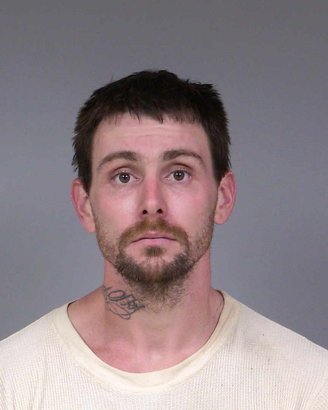
(HCDTF), executed a search warrant on 29-year-old Christopher Sovereign and the
residences associated to him.
Sovereign.
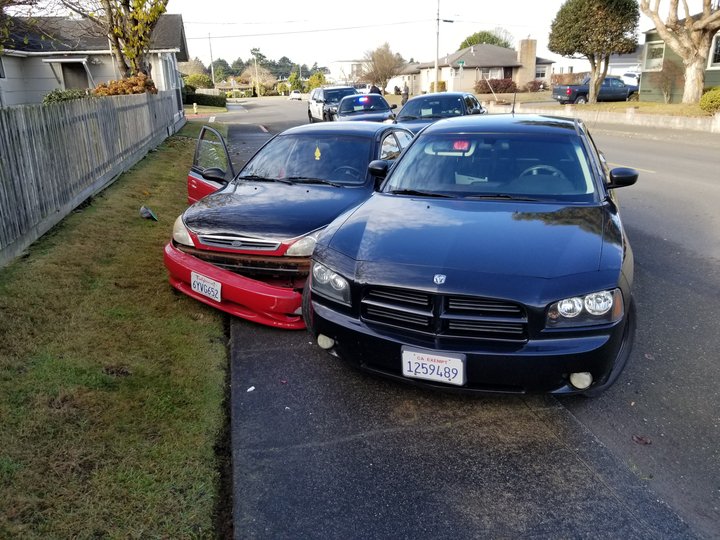
At approximately 10:07 a.m., Sovereign was observed leaving a residence in a vehicle
near the 3300 block of F Street. A POP detective attempted to conduct a traffic stop
on Sovereign. Sovereign attempted to flee so a second detective attempted to get in
front of Sovereign to block his escape route. Sovereign’s vehicle collided with the
second detective’s vehicle at a slow speed. The detective, in the overall interest of
public safety, forced Sovereign’s vehicle to the curb and eventually up onto the
sidewalk. Sovereign then tried to accelerate in reverse and struck an additional
detective’s car. Detectives merged on the car and detained Sovereign and the female
passenger without further incident.
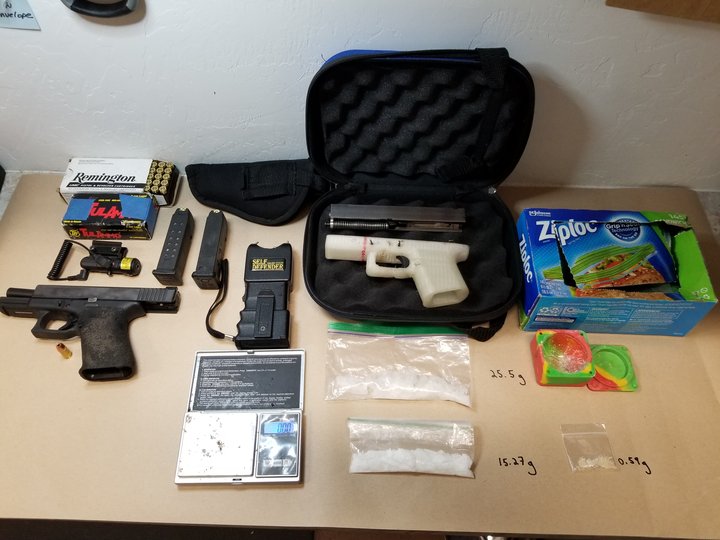
During the search of Sovereign’s vehicle, detectives located a loaded Glock 9mm
handgun, which was reported as stolen out of residential burglary in Arcata, 41 grams of
suspected methamphetamine, as well as other drug sale paraphernalia. Sovereign was
arrested and booked into the Humboldt County Correctional Facility for assault with a
deadly weapon, felon in possession of a firearm, possession of a controlled substance for
sale, transportation of a controlled substance, felon in possession of ammunition,
evading a peace officer, possession of controlled substance while armed, and a parole
violation warrant.
There were no injuries to officers or involved parties as a result of the collision. The
female passenger was detained and released.
From the Humboldt County Joint Information Center:
California
Gov. Gavin Newsom today announced the state will enact new
restrictions on business sectors based on regional intensive care
unit (ICU) capacity to limit spread of COVID-19 and protect health
care systems.
The
“Regional Stay Home Order” takes effect for at least three weeks
if a region’s cumulative ICU capacity falls below 15%. The order is
lifted when ICU capacity meets or exceeds 15%, at which time each
county is reassigned to a tier based on its local COVID-19 data under
the state’s “Blueprint for a Safer Economy.”
The
state is divided into five regions, with Humboldt County assigned to
the Northern California region which also includes Del Norte, Glenn,
Lake, Lassen, Mendocino, Modoc, Shasta, Siskiyou, Tehama and Trinity
counties. The Northern California region is expected to have less
than 15% capacity by early December, based on state projections.
Humboldt
County Deputy Health Officer Dr. Josh Ennis said that in pre-pandemic
emergency response, neighboring counties could rely on each other for
mutual aid. Now, the entire state is feeling the impacts of COVID-19.
“The
regional approach is sensible,” Dr. Ennis said. “Waiting until
your most precious resource is gone and you need to lean on others
could be catastrophic. Full hospitals transferring patients
out-of-county accelerates the filling of surrounding hospitals. In
this regard, patients needing critical care — COVID and non-COVID
alike — can get the care they deserve.”
The
regional order requires people to stay home as much as possible and
prohibits private gatherings of any size. Essential activities such
as accessing health care and grocery shopping are allowed. Masking
and physical distancing will be required at all times in all sectors
that remain open.
If
the ICU threshold is met and the order takes effect in a region, the
state requires the following business sectors to close:
Outdoor
and indoor dining at restaurants; take-out and delivery still
allowed
Indoor
and Outdoor Playgrounds
Indoor
Recreational Facilities
Hair
Salons and Barbershops
Personal
Care Services
Museums,
Zoos and Aquariums
Movie
Theaters
Wineries,
Bars, Breweries, Distilleries
Family
Entertainment Centers
Cardrooms
and satellite wagering
Live
Audience Sports
Amusement
Parks.
Additional
sectors will be required to put in place additional safety measures,
including:
Outdoor
recreational facilities: Allow outdoor operation only without any
food, drink or alcohol sales. Additionally, overnight stays at
campgrounds will not be permitted.
Retail:
Allow indoor operation at 20% capacity with entrance metering and no
eating or drinking in the stores. Additionally, special hours should
be instituted for seniors and others with chronic conditions or
compromised immune systems.
Shopping
centers: Allow indoor operation at 20% capacity with entrance
metering and no eating or drinking in the stores. Additionally,
special hours should be instituted for seniors and others with
chronic conditions or compromised immune systems.
Hotels
and lodging: Allow to open for critical infrastructure support only.
Restaurants:
Allow only for take-out, pick-up or delivery.
Offices:
Allow remote only except for critical infrastructure sectors where
remote working is not possible.
Places
of worship and political expression: Allow outdoor services only.
Entertainment
production including professional sports: Allow operation without
live audiences. Additionally, testing protocol and “bubbles” are
highly encouraged.
The
following sectors can remain open when a remote option is not
possible as long as facial coverings and physical distancing measures
are in place at all times:
Critical
infrastructure
Schools
that are already open for in-person learning
Before we get to the damn point, right off the top, let’s define one term possibly in question. For Humboldt residents who steer well clear of the more whimsical and free-spirited pockets of the county — your Arcata Community Forest, your College Cove, for example — you might not have ever encountered the art of slacklining. What it be, you ask? Great. Slacklining is a sport for people with enviable abs who bounce up and down on a thin, stretchy nylon rope stretched between two points (preferably sturdy redwood trees). Slackliners do this for fun, exercise and to impress each other. LoCO has never tried it, but it looks incredibly difficult, so we probably never will.
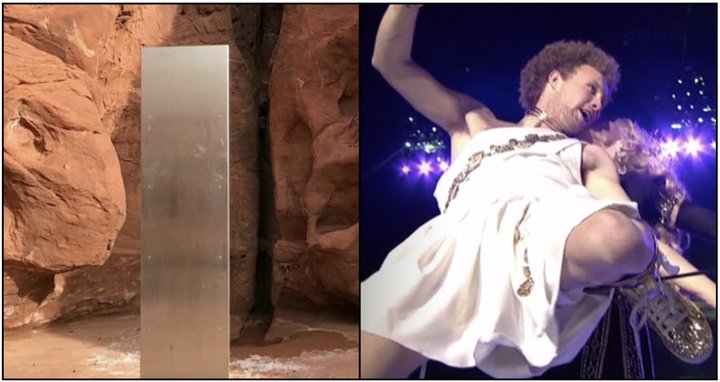
If you aren’t hip to slacklining, don’t feel bad. The skill is obscure enough that when Madonna featured a slacklining performance as part of her 2012 Super Bowl Halftime Show, major publications (New York Times, Slate, TMZ) rushed to explain the practice to their mystified readers. The toga-clad performer who Madonna chose to introduce slacklining to the masses is a man named “Sketchy” Andy Lewis. (See a clip below.) So important was Andy’s widely viewed contribution to the sport, it is mentioned in the “History” section of the slacklining Wikipedia page. Good job, Andy.
Andy had a fun moment in the sun
Another reason you may choose to care about Andy is that during his moment of glory, when he was giving interviews to folks around the world, he also spoke with a young reporter writing for Humboldt State University’s student magazine. He did this because he is a 2008 HSU graduate (Recreation Administration). Hey, the Times-Standard got him too!
Geez! Why are we talking about this, LoCO! OK! OK! We bring all this up because this week Andy Lewis is very famous again! You know that silly Utah monolith story that lots of people in your timeline shared because it blissfully had nothing to do with Trump and/or COVID? What a mystery that was! Yeah, that thing is gone now, for better or worse. And this week we learned that one of the people who helped remove it is none other than Humboldt grad Sketchy Andy Lewis! Hooray (for us, kinda)!
These days Lewis is a BASE jumping guide in southern Utah who holds strong “Leave No Trace” beliefs when it comes to exploring the Southwest’s vast expanses. He maintains a YouTube account, “Mr. Slackline,” where he posted video of himself and some friends dismantling the world-captivating metal structure, loading it into a wheel barrow and hauling the thing off under cover of night. Observe:
How does this group justify depriving the world of this selfie-worthy oddity? One of Lewis’ friends, Sylvan Christensen, who was also involved in the covert monolith extraction, took to his Instagram account to explain the thinking behind the operation. In short, their reasoning was that doesn’t go there:
“We removed the Utah Monolith because there are clear precedents for how we share and standardize the use of our public lands, natural wildlife, native plants, fresh water sources, and human impacts upon them. The mystery was the infatuation and we want to use this time to unite people behind the real issues here— we are losing our public lands— things like this don’t help.
Let’s be clear: The dismantling of the Utah Monolith is tragic— and if you think we’re proud— we’re not. We’re disappointed. Furthermore, we were too late. We want to make clear that we support art and artists, but legality and ethics have defined standards— especially here in the desert— and absolutely so in adventuring. The ethical failures of the artist for the 24” equilateral gouge in the sandstone from the erecting of the Utah Monolith, was not even close to the damage caused by the internet sensationalism and subsequent reaction from the world.
This land wasn’t physically prepared for the population shift (especially during a pandemic). People arrived by car, by bus, by van, helicopter, planes, trains, motorcycles and E-bikes and there isn’t even a parking lot. There aren’t bathrooms— and yes, pooping in the desert is a misdemeanor. There was a lot of that. There are no marked trails, no trash cans, and its not a user group area. There are no designated camp sites. Each and every user on public land is supposed to be aware of the importance and relevance of this information and the laws associated with them. Because if you did, anyone going out there and filming the monolith and monetizing it without properly permitting the use of the land— would know that’s an offense too.”
Area law enforcement have stated that they are probably not going to investigate the sculpture’s removal. So that, likely, is that. Goodbye, monolith.
All that to say, this is the small way in which the Utah monolith craziness related to Humboldt. That’s it. There are more important things happening today but LoCO thought you might like to know about this.
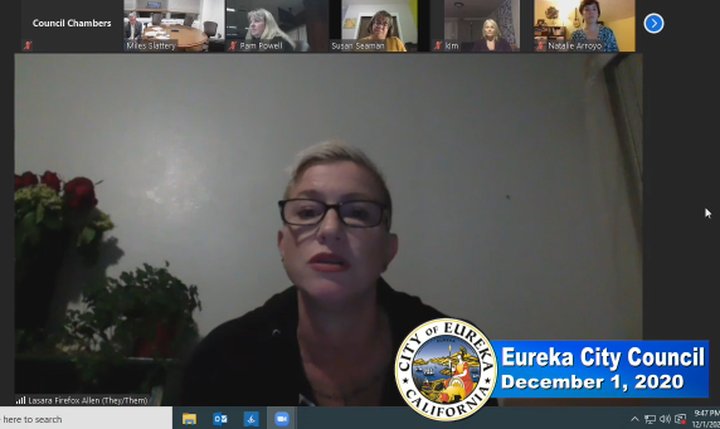
HACHR Executive Director Lasara Firefox Allen | Screenshot from the Eureka City Council meeting held via Zoom
###
During a nearly five-and-a-half-hour meeting on Tuesday night, the Eureka City Council rejected a proposed settlement agreement between the city and the Humboldt Area Center for Harm Reduction (HACHR) that would require HACHR to transition to a mobile-only syringe exchange program.
The vote was 3-2, with Councilmembers Leslie Castellano and Natalie Arroyo voting to approve the agreement and Coucilmembers Austin Allison, Heid Messner and Kim Bergel dissenting. The council then agreed to hold a continued meeting tonight to allow for reconsideration of the vote.
The agreement proposal came out of a formal mediation session attended by representatives from the City, HACHR and Open Door Health Services. By accepting the proposal, HACHR would agree not only to move its syringe exchange to a mobile program, but also to install a fence around its Third Street center and hire a monitor to regulate activity in and around the facility.
HACHR Executive Director Lasara Firefox Allen told the council that the agreement would require HACHR to transition to a mobile exchange by June 1, 2021, giving the non-profit and the city time to obtain a vehicle for the mobile delivery. HACHR agreed to hire a monitor immediately to help regulate the center’s rules and regulations. It would probably take some time to install the fence, Allen said, which Open Door agreed to pay for, pending approval of the agreement.
The Third Street center would still offer the other harm reduction services, such as overdose education and prevention, clothing distribution and free HIV and Hepatitis C testing, Allen said.
The City and HACHR’s relationship has long been fraught, with many council and community members expressing concerns over the syringe exchange program and some residents complaining about the activity at the Third Street site. Tensions recently culminated in a months-long undercover investigation of the Third Street Facility by the Eureka Police Department, during which the EPD allegedly observed HACHR staff knowingly allowing drug sales and use on the site.
Though HACHR denied the allegations, the Eureka City Council sent a letter to the state, formally opposing the state’s reauthorization of HACHR’s syringe exchange program. The California Department of Public Health did reauthorize the program, but excluded the city of Eureka, giving the city more regulatory control.
But for some council members, the agreement proposal didn’t seem like it would hold HACHR accountable for its actions. Councilmember Bergel expressed concern about what would happen over the next six months before HACHR transitions to a mobile exchange.
“Good faith is not going to work for the community,” Bergel said.
Councilmember Castellano moved to approve the settlement agreement proposal, which was voted down. After that there was a bit of confusion about what would happen next.
There was some discussion of temporarily prohibiting HACHR from offering the syringe exchange over the next six months. But City Manager Miles Slattery explained that this would require amending the city’s syringe exchange program ordinance and would be a complicated process.
Ultimately, the council voted unanimously to reconsider the vote at an extended meeting, which will be held tonight at 7:30 p.m.
You can view the agenda and directions on how to participate here.
Allen said that none of the proposed changes can occur until an agreement is reached, adding that they are willing to do what it takes to make that happen.
“Gaining trust is a two way street, as has been said here on a number of occasions,” Allen said earlier in the meeting. “We’re doing our best to walk hand in hand with the city council, with Miles, with the city of eureka to address concerns that are being brought.”
###
In other business, the council voted 4-1, with councilmember Leslie Castellano dissenting, to adopt an ordinance that prohibits camping in city parks, near city trails and in some commercial districts within the city.
The ordinance replaces the city’s existing camping ordinance, which was rendered moot by a court ruling in the 2019 Martin v. City of Boise case, in which the Ninth Circuit Court of Appeals overturned Boise’s camping ordinance on the grounds that it criminalized homelessness.
The new ordinance allows for “involuntary camping” — meaning camping when no other shelter is available to the person — in most parts of the city during nighttime hours, specifically precluding the “the period from fifteen minutes after sunrise to fifteen minutes before sunset.”
Camping is not allowed any time day or night in city parks, within 75 feet of city trails or anywhere in the Downtown/ Old Town Business District, the Waterfront Business District, the North Gateway District or Henderson Center.
Councilmember Castellano said that she felt that it was not the right time to pass this ordinance, during the COVID-19 pandemic, when the CDC has advised against clearing encampments. “I would advise waiting on this until we have measures in place that can address the health risk,” Castellano said.
But other councilmembers felt that this ordinance was necessary as a tool to help guide unhoused people to shelters. The penalty for breaking the ordinance would be an infraction and punishable by a fine. But Eureka Police Chief Steve Watson City Attorney Bob Black assured council that the ordinance is meant to only be used as a last resort, only to be enforced by a police officer after they have exhausted all other possibilities.
Councilmember Arroyo said that it did not “feel good” to vote for this ordinance, but that she felt it was necessary to deter public camping in some areas where it is not appropriate, especially immediately near businesses.
“This is something that can be appropriately used as needed in districts where [camping] is wearing people out and it’s wearing people’s good nature out,” Arroyo said. “And I even am feeling that.”