

Sheriff Honsal Requests Copy of DOJ Investigation, Vows ‘I Will Hold Those Employees Accountable for Their Actions’
Ryan Burns / Thursday, Dec. 3, 2020 @ 3:38 p.m. / News
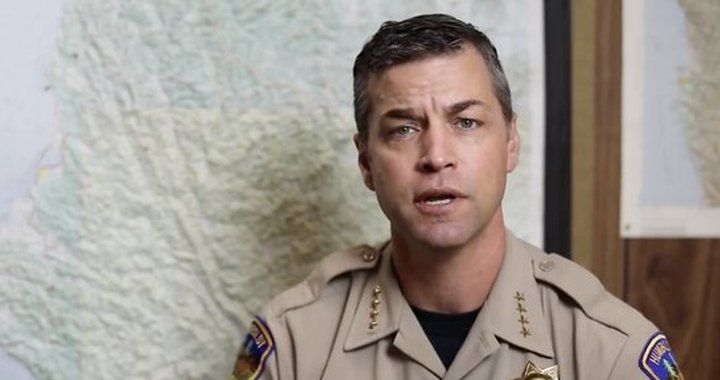
Humboldt County Sheriff William Honsal. | File photo.
###
The California Department of Justice’s three-year investigation into the Humboldt County Public Administrator’s Office came to an anticlimactic and unenlightening conclusion on Monday with the public release of a three-sentence memo from Senior Assistant Attorney General James Root to District Attorney Maggie Fleming. The message basically said that the state had completed its investigation and would not be pursuing criminal charges.
This resolution leaves a lot of questions unanswered, and many local residents expressed frustration — in our comment section and on social media — that county employees would apparently get away scot free despite records showing that for years they’d been allowed to purchase vehicles, electronics, firearms and other valuables from estates of the recently deceased, estates entrusted to the county’s own Public Administrator Bureau.
As previously reported, such self-dealing violates California government code section 27443, making it a crime punishable by a $1,000 fine, up to a year in the county jail or both. And the law says, “Upon conviction of this section a person forfeits his office.”
But Humboldt County Sheriff William Honsal says he’s not done looking into this matter. In response to questions from the Outpost he sent an email Thursday morning saying, “Once I have all the facts, I will hold those employees accountable for their actions.”
Honsal said he has requested that the Department of Justice forward a copy of its criminal investigation to his office for review. “Once I have that investigation, I will complete my internal investigation and review of this case,” he wrote. “The DOJ interviewed several people (past and present employees), collected evidence, conducted an audit of the [Public Administrator] books, as well as reviewed reports. I need to get all of that information before making a final determination.”
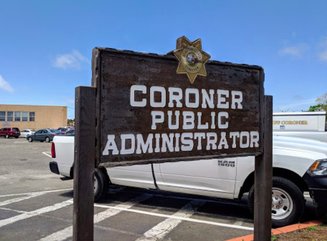
The Humboldt County Sheriff’s Office assumed jurisdiction over the Coroner-Public Administrator Office in February of 2015. An Outpost investigation into estate sales receipts found that the pattern of illegal transactions dated at least as far back as 2013, under then-Coroner/Public Administrator David Parris, and continued through the tenure of former Sheriff/Coroner/Public Administrator Mike Downey. During that time, former Coroner/Public Administrator and Eureka Mayor Frank Jager returned to the office to work as executor of estates. He later purchased a 2001 Chevrolet S10 pickup from an estate being liquidated by the Public Administrator.
A handful of the illegal purchases were made by sheriff’s deputies who remain employed by the Humboldt County Sheriff’s Office.
In Humboldt and other counties throughout the state, the Public Administrator is assigned to manage estates in a variety of circumstances, including those in which there’s no will and no heirs of the deceased can be located. They also take responsibility when assigned by the court or when an heir names the Public Administrator as executor.
Honsal took over as sheriff-coroner-public administrator in May 2017, and this controversy came to light the following month. One of Honsal’s first responses was to order all Sheriff’s Office deputies to return items purchased from Public Administrator-handled estates since February 2015, when the Sheriff’s Office was consolidated with that of the Coroner/Public Administrator.
Those items, including a 70-inch TV, a computer, a 1976 Corvette, a 2001 Toyota 4-Runner and a Ford F150 pickup, have been kept in storage ever since, much to Honsal’s frustration. Asked what will happen to those items now, Honsal the estate cases, which have been held in probate, “will now be opened up for the property to be sold according to our policy and procedures and probate code. Once all the property is sold, the estates will be closed and the assets will be distributed to the person entitled to them.”
We asked Honsal a few more follow-up questions. How does his office ensure that estate items are sold at fair-market value? Are public auctions held? What kind of public notice does his office give for sales of estate items?
In response he copied-and-pasted the relevant portions of his department’s updated Public Administrator policy and procedures manual. Among those policies is a provision that all estate property received by the Public Administrator Bureau will be documented via digital video and cataloged with receipts.
The manual further says that all firearms, jewelry and cash will be photographed in the place where they were discovered, then packaged for storage at the Public Administrator’s office. Some more provisions:
- Cash will be counted in front of a witness. If no witness is present at the scene, the cash will be sealed and documented with the responding officer’s signature along with the time and date collected, stored, and subsequently counted with a witness at the PA Office.
- All firearms seized will be entered into CLETS [the California Law Enforcement Telecommunications System] as stored property associated with the specific estate within 24 hours.
- All other property will be stored at the decedent’s residence, if applicable, or in a rented storage unit.
- All vehicles will be stored at a designated storage location. … [and] sold “as is.”
- The Public Administrator shall sell decedent’s personal property at public auction unless specific factors make sale at public auction impractical, i.e. the cost of holding an auction exceeds the estimated value of estate property.
- Official notice of estate sales must be posted at the County Courthouse, the Coroner’s Office and in a local newspaper of general circulation.
The manual also says that, regardless of value, no estate property entrusted to the Public Administrator can be sold, transferred, or given away to any of the following people:
- Employee, former employee, or current volunteer of the Humboldt County Sheriff’s Office
- Relatives or domestic partners of any employee of the Sheriff’s Office
- Any person or company that has an active contract with or performs a duty for the Public Administrator’s Office
- Any person whose receipt of the property may pose a potential “Conflict of Interest,” either actual or perceived
- Any county public official
Asked how his employees search for heirs, Honsal said they use several state, local and internet databases and may also employ investigative firms.
###
PREVIOUSLY:
- SHERIFF’S OFFICE: Sheriff’s Office Launches Investigation of Sheriff’s Office’s Practice of Selling Dead People’s Stuff to Sheriff’s Office Employees
- ‘No Reason to Think This Hasn’t Gone On For Years’: Sheriff Honsal Speaks on Corruption Inquiry
- At Least Four Sheriff’s Office Employees Bought Dead People’s Belongings Through Public Administrator; They’ve Now Been Asked to Return Them
- DA Maggie Fleming Calls In FBI, State Attorney General for Sheriff’s Office Corruption Investigation
- Eureka Mayor Frank Jager Was Employed by Coroner’s Office and Acting as Executor of Estates During Period Under Investigation for Corruption
- California Department of Justice Agrees to Take Over Investigation of Humboldt County Public Administrator’s Office
- Outpost Investigation Finds Illegal Sales Through Public Administrator’s Office Date Back to at Least 2013
- As State Continues to Investigate Humboldt’s Public Administrator Bureau, Sheriff Honsal Outlines New Anti-Corruption Policies
- The State Corruption Investigation Into Humboldt’s Public Administrator Bureau Seems to Have Fallen Into a Black Hole
- State Won’t Pursue Charges in Corruption Investigation Into Humboldt County Coroner-Public Administrator Bureau
BOOKED
Yesterday: 4 felonies, 7 misdemeanors, 0 infractions
JUDGED
Humboldt County Superior Court Calendar: Today
CHP REPORTS
(XXX) XXX-XXXX67 Us101 (HM office): Trfc Collision-Unkn Inj
ELSEWHERE
RHBB: Nov. 3, 2026 General Election Vote Center and Ballot Drop Box Locations
RHBB: Mendocino Railway President And Ceo Robert Jason Pinoli Elected To Aslrra Board Of Directors
RHBB: Wildfire Burning Near Highway 101 South of Laytonville
COVID Outbreak: 30 People at Granada Skilled Nursing Facility in Eureka Test Positive; 29 are Residents
LoCO Staff / Thursday, Dec. 3, 2020 @ 2:39 p.m. / COVID-19 and Humboldt
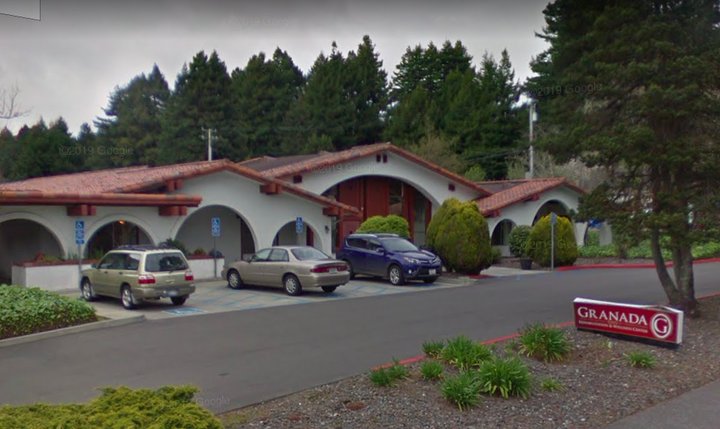
Granada Rehabilitation and Wellness Center | Google Street View.
###
Press release from the Humboldt County Joint Information Center:
Routine testing of staff led to discovery of COVID-19 cases at Granada Rehabilitation & Wellness Center in Eureka. Thirty people in the facility have tested positive, including one staff person and 29 residents.
Skilled nursing facilities and other long-term care facilities are required by the state to test all staff on a weekly basis. A positive result from that routine testing activates a set of responses outlined by the California Department of Public Health (CDPH).
Following the initial positive result from the most recent round of routine testing, Humboldt County Public Health expanded testing this week to every person in the facility, which has so far turned up 29 additional cases in residents. Experts in infection control from Public Health and CDPH are assisting the facility in containing the outbreak, including on-site support. Public Health will provide ongoing testing of all staff and residents and additional expertise as needed.
Humboldt County Deputy Health Officer Dr. Josh Ennis said this outbreak demonstrates the difficulty in keeping the vulnerable safe from COVID infection once community transmission is so widespread.
“We have a level of disease circulating right now that compromises our ability to conserve our hospital beds and ultimately protect the vulnerable,” he said.
“These residents are beloved community members, family of somebody you may know, often with deep roots in Humboldt, and our thoughts are with them right now,” Dr. Ennis said. “It’s time for all of us to step up and connect our everyday actions to life real-life consequences. Mask, distance, wash hands and don’t gather.”
Administrators at Granada are following recommended containment strategies and are working closely with Public Health and CDPH to closely monitor residents’ health.
For the most recent COVID-19 information, visit cdc.gov or cdph.ca.gov. Local information is available at humboldtgov.org or during business hours by contacting covidinfo@co.humboldt.ca.us or calling 707-441-5000.
Prosecutors Offer Plea Deal to Man Accused of 2018 Stabbing Murder Outside Arcata Bar
Rhonda Parker / Thursday, Dec. 3, 2020 @ 2:11 p.m. / Courts
The District Attorney’s Office has made a final offer to murder suspect Brandon Matthew Watson: go to trial and risk a murder conviction or plead guilty to voluntary manslaughter and be sent to prison for 16 years and eight months.
Today Deputy District Attorney Roger Rees outlined the proposed deal to Judge Christopher Wilson, who then warned Watson that first-degree murder carries a penalty of 25 years to life and second-degree murder means a term of 15 years to life.
If Watson rejects the manslaughter offer, jury selection for his estimated 30-day trial will begin Monday.
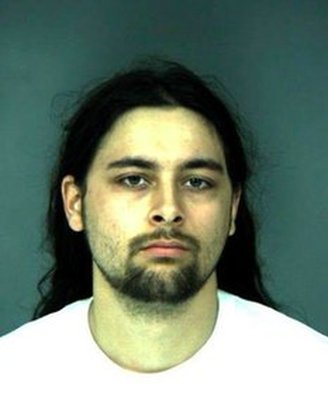
Watson.
Watson is accused of stabbing and seriously injuring two men outside a bar in Eureka in February, then fatally stabbing Peter “Bo” Triantos behind a bar in Arcata in October 2018. The men attacked in 2016 came forward when they recognized Watson from media coverage of the Triantos killing.
According to witnesses who testified during the preliminary hearing, both fights began when Watson walked up and started bragging about being in a gang.
Defense attorney Andrea Sullivan told the judge today that she will speak with Watson about the prosecution’s latest offer. He is scheduled to be back in court tomorrow morning.
Watson was in the courtroom jury box today, wearing an orange jumpsuit, a mask and gloves.
Rees had said earlier this week that his office was unwilling to reduce the murder charge to manslaughter, and Watson was unwilling to accept a life term.
Watson, 29, has been in Humboldt County Correctional Facility for more than two years. As part of the plea bargain he would have to agree to give up credit for time served.
###
PREVIOUSLY
- Suspect in Arcata Stabbing Identified, Named
- Arcata Police Arrest Suspect in Thursday’s Stabbing Murder
- TODAY in COURT: Suspect in Arcata Plaza Stabbing Gets New Lawyer; Hearing Postponed for Woman Accused of Murdering Teen in Eureka Cemetery
- Eureka Man Accused of Stabbings Outside The Jam and The Pearl Will Stand Trial
- TODAY in COURT: Trial Date Set for Man Accused of Stabbing Another Outside Arcata Bar; Latest on Rancher’s Animal Cruelty Retrial, Eureka Attorney Accused of Trafficking
- TODAY in COURT: Eureka Attorney Scheduled for March Trial on Drug Trafficking Charges; Old Town, Rio Dell Murder Cases Move Forward
- Murder Trial Scheduled For Suspect in 2018 Arcata Bar Stabbing, Even Though Pandemic May End Up Delaying It
Newsom Implements Regional Stay-At-Home Order Tied to ICU Capacity
Ana B. Ibarra and Lauren Hepler / Thursday, Dec. 3, 2020 @ 1 p.m. / Sacramento
Gov. Gavin Newsom’s press conference this afternoon.
In the face of a “surge on top of a surge,” Gov. Gavin Newsom announced today the strictest measure in months for a regional stay-at-home order tied to the number of ICU beds as hospitals near their capacity in the face of a statewide coronavirus surge.
Though no region has met the threshold, the governor is warning parts of California could cross the new threshold for mandating people stay within their households as much as possible when a region’s ICU capacity drops below 15%.
“We are at a tipping point in our fight against the virus and we need to take decisive action now to prevent California’s hospital system from being overwhelmed in the coming weeks,” Newsom said in a statement.
Under the order, people will have to stay home as much as possible, although they can still go out for essential things like groceries, exercise and doctor appointments. K-12 schools that have reopened can remain open, and retail stores can operate indoors at 20% capacity. If triggered, the stay-at-home order will be applied for three weeks by five regions: Northern California, Bay Area, Greater Sacramento, San Joaquin Valley and Southern California.
California is kicking off what could be the worst month of the pandemic yet. California’s intensive care beds are filling up. At least one county, Imperial, is again transferring patients to hospitals outside county lines, according to the California Hospital Association. In the spring, Imperial County sent more than 500 patients to hospitals as far as Sacramento and the Bay Area. Now, the fear is that holiday gatherings will add fuel to the current spike in new infections.
“The effects of Thanksgiving, they have not yet been felt,” Newsom said. “They will be felt in a number of weeks.”
By Christmas Eve, 112% of the state’s ICU beds could be occupied if current trends continue, Newsom said earlier this week. On Wednesday, the state recorded more than 18,500 new cases, Newsom said — the most in a single day since the pandemic began. With the new restrictions, he said the state hoped to head off “too much concentrated retail activity” during what is normally the busy holiday shopping season.
For businesses and their workers, the big test will be whether keeping their operations going at limited capacity will be “productive enough” to prevent mass closures and job losses, said Julien Lafortune, a research fellow who has studied unemployment during the pandemic for the Public Policy Institute of California. The state’s jobless rate dipped back into single digits in October at 9.3%, down from a high of 16.4% in April, but many businesses are confronting months of accumulated losses just as the virus explodes.
“We can keep businesses open right now,” Lafortune said, “but a lot of people wouldn’t go out.”
The new stay-at-home order is softer than what Newsom announced in the spring. On March 19, California came to a standstill after Newsom declared the country’s first statewide shelter-in-place order. All schools closed their doors and resorted to Zoom lectures; restaurants and bars ceased operations, leaving many workers in limbo; and those who could, began their working-from-home odyssey.
The new shutdown order comes at a precarious moment for the California economy. Home prices have surged to record highs, and declining unemployment decline has fueled what economists at UCLA called “an unequal economic recovery.” Though vaccine optimism has boosted the stock market in recent weeks, those gains could recede this winter as the virus surges, UCLA Senior Economist Leo Feler cautioned in a forecast released this week.
For many caught up in job cuts — which have disproportionately hit Black and Latino Californians, as well as women pushed out of the workforce to care for children — the next few weeks were already going to be stressful. Some 750,000 state residents will lose federal unemployment benefits on Dec. 26 if current deadlines hold, and more than 700,000 households are in danger of losing their rental homes as eviction moratoriums lift weeks later.
“The pandemic has been an inequality bomb,” said Micah Weinberg, CEO and president of progressive advocacy group California Forward. “What people want to see is a plan for an equitable economic recovery that is as serious, as well thought out and as well-funded as the plan to shut everything down.”
Another stay-at-home order could help alleviate pressure on the frontlines, said Stephanie Roberson, government relations director with the California Nurses Association.
“We’ve been calling for another shutdown since 41 out of 58 counties were in purple,” Roberson said. Now 52 counties fall in the purple, most restrictive tier. “I think now is the time. We can try to piecemeal this out, but it’s so widespread we need to take a statewide approach.”
Even before Newsom’s announcement, experts were betting a lockdown order in December would look different than what the state saw in March.
Exactly how the stricter regulations play out for businesses will likely come down to legal battles already underway. Earlier this week, a judge ordered Los Angeles County officials to provide more health evidence for shutting down outdoor dining in addition to indoor restaurants and retail. The lawsuit was backed by the California Restaurant Association, one of several business groups to demand more specifics about how regulators are evaluating public safety and calibrating restrictions.
At the same time, the state has attempted to respond to ongoing concerns about a lack of enforcement for worker safety protocols by issuing new emergency rules for employers. The standards, which went into effect earlier this week, by the Department of Industrial Relations call for site-specific health plans, reporting instances of multiple infections to public health officials and providing masks to all workers. Santa Clara County has also added new quarantine requirements for businesses that ask workers to travel long distances.
In the meantime, the stalemate drags on over whether Californians will see another major round of individual stimulus checks or business loans. The state announced new tax extensions and $500 million in small business grants this week, but Congress remains divided over offering more federal aid before the end of the year, setting the stage for a state battle in the year ahead over how to redirect limited funds to struggling businesses, workers and others.
“We can’t expect the federal cavalry will arrive and bail us out of all of this,” Weinberg said. “The state will have to deal with some budgetary cuts, but it’s actually more our straightjacket budgeting systems that are the problem here.”
Newsom, meanwhile, said the state is focused on stemming the tide of the virus with another round of restrictions now, just months before mass vaccinations could begin.
“There is light at the end of the tunnel,” he said.
###
Reporter Jackie Botts contributed to this story. CALmatters.org is a nonprofit, nonpartisan media venture explaining California policies and politics.
Family Thanks Unknown Man for Saving Four-Year-Old From Sneaker Wave the Day Before Thanksgiving
Stephanie McGeary / Thursday, Dec. 3, 2020 @ 11:39 a.m. / Feel Good

George’s three children playing at the beach, with four-year-old Aeris on the left | Photos provided by Sincee George
###
When Sincee George and her family were hit by a sneaker wave near Clam Beach the day before Thanksgiving, George thought that she was going to lose her four-year-old daughter and it was the scariest moment of her life.
“She was like 50 feet out in a matter of seconds,” George told the Outpost in a recent phone interview. “I was holding on to my son and I could just see her getting pulled out all the way. I thought my daughter was gone.”
George, her husband and their three children — a seven-year-old son, four-year-old daughter and a 16-month-old baby — were playing on the beach near Vista Point, where the mouth of the Mad River meets the Pacific Ocean, when they were struck by the sneaker wave. George’s husband was, luckily, holding their baby and able to protect him from the impact. But her other two children were knocked down, rolling into the water. George said she scrambled to grab them both, but was only able to grip on to her son and her young daughter was swept out of her reach.

This pic was taken just moments before the family was struck by the wave
Then, almost immediately, George saw a man run past her. She was holding on to her son, who was vomiting up water, and looked up to see a pair of long legs moving out towards her little girl. “I didn’t see what happened,” she said. “I just saw that he brought her back to me. I feel like God put him in the right place at the right time to save us.”
The whole family was soaking wet and cold. A woman who was at the beach with this man wrapped her scarf around George’s son and placed her hat on George’s baby. George is so grateful for the warmth and kindness that these two strangers showed that day, especially for the man who saved her daughter from the ocean.
George and her family, members of the Yurok Tribe, have lived in McKinleyville for nearly 10 years, she told the Outpost. They have spent a lot of time at the many local beaches, George said, and she is well aware of the risk of sneaker waves. These disproportionately large waves that appear without warning can be incredibly scary, dangerous and sometimes deadly. Many of the nearby beaches have signs warning people of the risk of sneaker waves, but George said she did not see a sign posted at this particular beach.
Even so, George feels incredibly guilty for putting her family at risk. And she knows that by telling this story some people may accuse her and her husband of being careless. But that is fine with her, George said. All of her children are safe now, and that is all that matters. She is willing to face the criticism if it means that she can publicly thank the man who saved her daughter from being swept out to sea.
This is why George reached out to the Outpost. With no social media, George said she was not sure how else to get in touch with her rescuer. She is hoping he will read this and know how thankful she and her entire family is that he was there that day and that he helped them without hesitation.
“It all happened so fast, I didn’t even think to ask his name,” George said. “We just wanted to sincerely thank you and may God bless you.”
EPD Provides Information on Last Night’s Fatal Head-on Collision on Broadway in Eureka
LoCO Staff / Thursday, Dec. 3, 2020 @ 11:09 a.m. / Traffic
Eureka Police Department press release:
On Dec. 2, 2020, at about 10:07 p.m., officers of the Eureka Police Department (EPD) responded to the intersection of Broadway and W. Wabash Avenues for the report of an injury vehicle collision.
Upon arrival, Officers located both vehicles (a white sedan and a white pick-up) still in the intersection. The driver and sole occupant of the sedan was found on the ground and was being given CPR by an uninvolved citizen. Also located at the scene was the driver and sole occupant of the pick-up, along with multiple witnesses.
An officer took over CPR and continued lifesaving efforts until the arrival of medical personnel. The 62-year-old driver of the sedan was quickly transported by ambulance to St Joseph’s ER, where she was pronounced deceased.
The driver of the pick-up was uninjured and was evaluated at the scene. Alcohol or drugs do not appear to be a factor in his involvement in the collision.
Based on the preliminary investigation and statements, it appears that prior to the collision the sedan was stopped at a red traffic light, northbound on Broadway at W. Wabash Avenue. At about the same time, the pick-up was stopped for the red traffic light in the eastbound turn lane of southbound Broadway at W. Wabash Avenue.
When the traffic light turned green for the pick-up, it began turning eastbound onto W. Wabash Ave. For unknown reasons, the sedan did not remain stopped for her red light and instead began traveling northbound into the intersection. As a result, both vehicles impacted head-on into one another.
At this time, it is unknown if alcohol, drugs or an underlying medical condition played a part in this collision. The identity of the deceased is being withheld, pending next of kin notification by the Humboldt County Coroner’s Office.
The collision and cause of death remain under investigation. Anyone with information regarding this investigation is asked to contact Det. Corrie Watson at (707) 441-4032.
Below: North Coast News was live at the scene.
THE CAR SNORKEL! Creative Local Develops DIY Pandemic Device For Those Times When You Gotta Have Someone in Your Vehicle
Jacquelyn Opalach / Thursday, Dec. 3, 2020 @ 10:58 a.m. / COVID-19 and Humboldt
From
the beginning, there has been no shortage of resourceful efforts to
reclaim the simple luxuries of that sweet old COVID-free life we all
reminisce about.
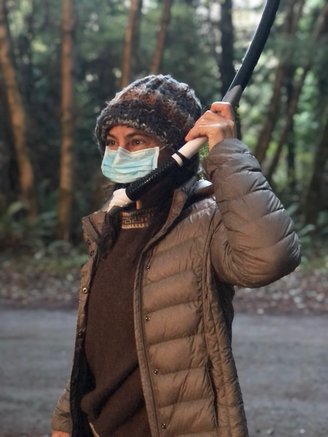
Humboldt local Julie Sylvia has been innovative as a matter of necessity. She’s an applied behavioral analysis (ABA) technician, and her job sometimes requires being in the car with a client. Until recently, she wasn’t sure how to lower the risk of transmitting potentially virus-infected droplets to or from her passenger.
She weighed a few ideas. “I thought, ‘What can I do? Maybe I could just take some plastic and make a little divider in my car.’ And as I looked at my car, I thought — ‘that’s crazy hard,’” Sylvia told the Outpost recently. “Then I thought maybe I could put myself inside a huge trash bag and then air it out the window. And then I’m like, ‘that sounds really dangerous.’”
The Centers for Disease Control and Prevention released guidelines for this very predicament, recommending face coverings, backseating passengers, opening the windows and using the outside air setting for ventilation rather than the recirculated air option.
But Sylvia and her family weren’t on board with those precautions, plus her client isn’t comfortable with having the windows down.
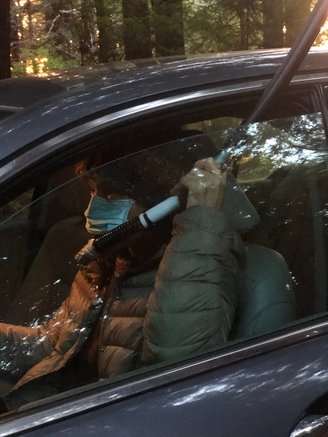
Enter the “Car Snorkel,” a homemade breathing device fashioned from a snorkel, PVC (polyvinyl chloride) pipe and some duct tape. To make it, Sylvia stuffed a snorkel into a PVC pipe (by warming the plastics with the help of her stovetop, but she recommends that fellow Car Snorkel DIY-ers try a blow dryer instead) and reinforced the bind with duct tape. The device is a few feet long, and took only 10 minutes to assemble, Sylvia said.
In use, the invention involves inhaling through the snorkel mouthpiece while it’s threaded out her cracked driver’s side window. Meanwhile, Sylvia resituates her mask to cover her nose and exhales thataway.
“If you breathe in and out through your mouth, into the snorkel, which is such a long snorkel, you’re going to end up breathing back in your own air,” Sylvia explained. “Which will eventually make you dizzy, and that’s not safe for a driver.”
Using it takes a bit of concentration, Sylvia said.
Cons? She can’t talk while she’s using it, plus a little water gets in the car and in the snorkel pipe on rainy days. It also might be embarrassing for your passenger, Sylvia warned. She’s gotten a few funny looks here and there, but more often than that other drivers honk or flash a thumbs-up in COVID-safety (or maybe just comedic) solidarity.
But the pros? “It really works!” Sylvia said. “You can feel very confident that you’re not breathing any contaminated air.” She’s been using the Car Snorkel for two weeks now, and highly recommends it to others who can’t avoid commuting with folks from other households.
Of course, the only way to guarantee safety from COVID is to stay home. Out in the world, we all know it’s best to practice social distancing and avoid indoor interactions. Obviously, neither are really possible in a car, so if you are someone who must drive with others, you should probably follow those CDC recommendations. (It should go without saying that neither the CDC nor the World Health Organization nor anyone else in authority has yet endorsed the Car Snorkel as an effective coronavirus containment device.)
Have you dreamt up any nifty adaptations to COVID obstacles like this? If so, we want to know! Write jacquelyn@lostcoastoutpost.com.


