PREVIOUSLY:
- MUSICAL MEMOIR: Playing with Hubert Sumlin and Sunnyland Slim at Arcata’s Jambalaya Club, 1976
- MUSICAL MEMOIR: The Night Dan Hauser and Wes Chesbro Presented a Couple of Blues Greats With Keys to the City
###
Author’s note: This is the first story of a three-part series.
###
When the Sunnyland Slim Band drove into a white-out blizzard on Interstate 80 it was just the beginning of the 2,100 miles of troubles ahead.
The band left Blytheville, Arkansas the day before on October 28 after playing an all-night show at a juke joint with our leader, legendary Chicago blues pianist/singer, Sunnyland. The group included me on drums, Harry Duncan on harmonica and vocals and Chicago bassist Joe Harper.
We were going to meet up with the famous white blues guitarist Mike Bloomfield for a month of dates in the San Francisco Bay Area starting the first day of November.
A Chicago native, Bloomfield had played with Sunnyland as a young man. He told Harry that Sunnyland was the first Black Chicago bluesman to invite him onstage to play on a Southside night club stage. He went on to play with the influential Paul Butterfield Blues Band in the mid-1960s, formed the San Francisco-based Electric Flag and recorded Super Session with Al Kooper.
Bob Dylan recruited him to play on his ground-breaking album Highway 61 Revisited, which included “Like a Rolling Stone.” He considered Bloomfield the best blues guitarist in the country, as did many others. I listened to all those albums over and over while in college.
I was 21. I bought my first drum set two years earlier. I started learning how to play while a full-time student at the University of Wisconsin in Madison. I dropped out at the end of my junior year to become a professional drummer. That was in May and now I was on the road in October with Sunnyland, the man who gave Muddy Waters his recording career start in Chicago in 1947. He brought Muddy into Aristocrat Records – which later became Chess Records – as a sideman guitarist when he recorded on two of Sunnyland’s songs.

Harry Duncan, left, and Paul DeMark at Riverwood Inn, Phillipsville, California in 1979.
Sunnyland, 65, drove his mid-1960s Oldsmobile station wagon while Harry and I took turns driving a 1964 Ford Fairlane we had bought for $50 a month earlier.
Sunnyland argued with the 22-year-old Harry Duncan that we should take the southern route from Arkansas on Highway 66 to Los Angeles and then drive to San Francisco. Slim worried about possible bad weather.
Harry won the battle. He visited a Triple A Insurance office in Wisconsin. They gave us a small “flip book” with maps detailing the road from Blytheville to San Francisco.
We left Arkansas on October 28. The first show with Bloomfield was set for November 1, 1972 in Santa Cruz, California, four and a half days away. We drove through winding two-lane highways in Missouri and into Kansas.
It was too late to head south. We continued through Kansas into Colorado heading north. It was snowing in Denver when we pulled over at a gas station parking lot to sleep in our freezing cars for a few hours.
“I told you we should take Route 66,” a highly irritated Sunnyland said to Harry. “You got us driving on these pig trails!”
By the time we were driving west on frozen Interstate 80 through Wyoming, we could only drive about 15-20 mph. It was almost impossible to see the highway in such a fierce blizzard. Luckily, growing up in Wisconsin, I had driven in these conditions before. We saw numerous cars and trucks that had slipped off the highway and left abandoned on the side of the road.
We white-knuckled it. Harry and I taking turns driving our car and Sunnyland driving solo. Bassist Joe Harper didn’t drive, which angered Sunnyland to no end.
“The man doesn’t even drive,” Sunnyland complained to us in front of Harper. “You can’t be like that. I need 300-mile drivers.” On the road, he rated sidemen on how far they could drive without needing a rest.
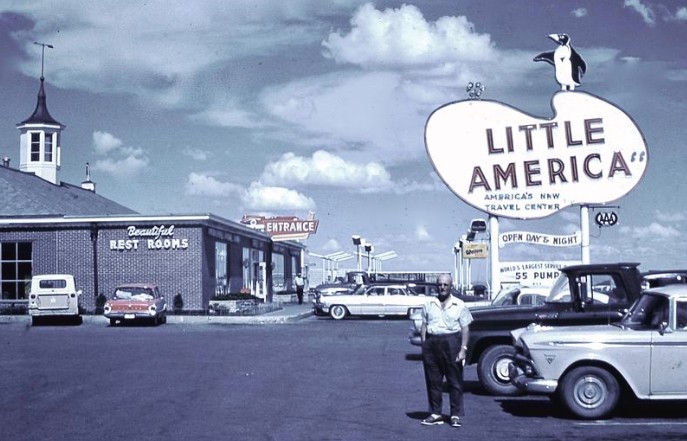
Little America, Wyoming.
We had a deadline to meet so we kept driving through the blizzard almost the entire state of Wyoming to the famous Little America Truck Stop on the western edge of the state. It was the biggest truck stop of its kind in the U.S. The Wyoming Highway Patrol blocked drivers from going west at that point because of the treacherous conditions.
Scores of truck drivers and travelers like us had to stay the night. The motel rooms were all taken. Dozens of people, including me, slept on the grimey, well-worn carpet of the lounge area outside Little America’s bathrooms. Using my jacket as a pillow, I managed to get a few hours of sleep.
I remember thinking, “Can it get any worse than this?”
The next morning the highway patrol let drivers head west. About 100 miles from Little America, smoke started pouring out of our Ford Fairlane’s engine. Luckily, we found a service station near the highway. A mechanic said our antifreeze was empty and we’d damaged the radiator. He assured us it could be fixed in a couple of hours.
“Harry and Paul, you’re babies on the road,” Sunnyland said with disgust. “You don’t even put antifreeze in your car.”
The station had a pool table for fun while customers waited. Sunnyland talked his way into playing a game of pool for money with two Wyoming men wearing cowboy hats. Sunnyland could disarm anyone with his friendly manner.
We went through parts of Utah and then down into Nevada. We stopped and ate at a Chinese-American restaurant in Elko. It was the first time I remember stopping at a restaurant to eat. We were beyond exhausted.
The only time we stopped to rest was at Little America. Harry and I took turns driving while the other one slept. On the other hand, Sunnyland in his Oldsmobile station wagon, with no help from Harper, drove all 2,100 miles with almost no sleep.
Sunnyland had no patience for Harper who, in addition to not helping with the driving, was always complaining about feeling sick.
While we waited for our food to arrive, Joe complained about being cold. Sunnyland sat straight up, looked hard at Joe and said in a menacing, low voice, “Joe, you say one more word, l’ll cut you.”
That shut us all up. Harry and I looked at each other warily as if to say, “Is he serious?”
From that point we drove to San Rafael. California greeted us with a perfect, sunny first day of November. We arrived at a motel late in the morning and were able to get some rest before our first show with Bloomfield at the Opal Cliffs Inn in Santa Cruz later that night.
The Santa Cruz show started at 9. We arrived in plenty of time to set up our equipment. The downtown club was packed with a menagerie of California long-haired counterculture people smoking pot, drinking and getting ready to free dance the night away. As a college student in the early 1970s in Madison, I was part of the counterculture there. But this was California and it felt a lot wilder.
When I set up my four-piece Ludwig drum kit, sound technicians converged to set microphones up on my drums. We were going to be broadcast live on a local radio station, a first for me.
The band sound-checked without Bloomfield. Finally he stormed through the back door of the club, 10 minutes before show time. He held his Gibson Les Paul guitar and cord in one hand, no guitar case in sight. We were introduced and hit the stage. He plugged into his Fender amplifier and off we went.
Bloomfield — wild curly hair, blue jeans and flannel shirt — sometimes played with the fury of a tornado and then sweetly and sadly behind Slim’s slow blues. He was tremendous playing the blues with emotion and skill. It felt like a jolt of electricity playing with him.
Fifteen shows in 30 days. The tour had begun.
###
Thanks to Pamela Long for editing and Julian DeMark, photo-scanning.
CLICK TO MANAGE