
A combination of King Tides and an intense storm surge flooded King Salmon at the beginning of the month. | Photos: Fields Landing King Salmon Living with Water
###
Nearly two weeks after King Salmon and Fields Landing were inundated with record-breaking floodwaters, many residents are still struggling to recover, with some facing tens of thousands of dollars in property damage.
Among them are Linda and James Carter. The pair moved into their King Salmon home — a little light blue house just a stone’s throw away from the beach — shortly after they were married in 2010. In their 15-plus years in King Salmon, the Carters have seen their neighborhood flood countless times during storms and high tides, but they never worried much about their own home because a brick retaining wall surrounds the property.
“That property has never flooded before,” Linda told the Outpost during a recent phone interview. “But on the morning of Jan. 2, we saw [the floodwaters] actually breaching our walkway and coming onto the property, but it didn’t come into the house or anything. Then on Jan. 3, the water had actually breached our wall, and within about 10 minutes, it was in the house. We only had about 10 minutes to get things up, and out of the water … [which got to be] just shy of a foot high.”
The floodwaters damaged sheetrock and the flooring throughout their house, destroyed two refrigerators, a stand-up freezer, a dishwasher and totaled one of their cars. Linda also lost a photo album her mother had made for her when she was a kid.
“We were so depressed about what we had already lost, we just quit looking for more stuff,” James said. “It was just beating us down. Those first three days, we were just in survival mode.”

King Salmon is no stranger to flooding. At just three feet above sea level, the tiny bayside community has grown accustomed to the swollen canals, flooded streets and soggy lawns that come with winter rains, but this year was different.
On Jan. 2, a combination of record-breaking King Tides, heavy rains and an intense storm surge pushed Humboldt Bay beyond its shores, inundating King Salmon with seawater. The tide gauge at the North Spit peaked at 10 feet that morning, breaking the previous record of 9.8 feet set in 2005, according to data from the National Weather Service in Eureka. On Jan. 3, a new record of 10.37 feet was set.
The National Weather Service issued several weather alerts ahead of the storm-fueled King Tides and Humboldt County Office of Emergency Services (OES) shared flood safety tips and resources for people living in low-lying, flood-prone areas. On Jan. 2, Humboldt OES issued a notice urging people to avoid King Salmon due to extreme flooding, but residents were never asked to evacuate.
“People who have lived here their whole lives are saying they’ve never seen anything like this,” said Kelsey McMahan, a King Salmon resident of five years. McMahan and her family live in a big two-story house that’s split in two; she and her two youngest children live in the back of the house, and her daughter and her three kids live in the front. “Our house was built in 1953, and the guy we bought it from — his parents built the place — said it’s never flooded.”
McMahan anxiously watched the streets filled with seawater on Jan. 2, but the water eventually receded. “We went and got a ton of sandbags and thought we could stop the water by blocking all the entrances,” she said. “I was up all night checking the water, checking the water, and I had fallen back asleep right before it came in the house.”
She was woken up by a family member who said the water was coming up through the floorboards.
“I got up and started running around, picking things up off the floor and just grabbing anything I could to take upstairs,” she continued. “All of the flooring downstairs is ruined, along with appliances and furniture. … We had an adjuster come out from our flood insurance provider … and he was throwing around figures, like $50,000 to $70,000 in damages. The vacuum cleaner, the internet router and my kids’ shoes were all ruined. It just adds up.”
Fortunately, McMahan and the Carters have flood insurance, but claims can take months to sort out.

A back patio submerged in seawater.
‘I don’t know why we haven’t declared any kind of disaster’
While King Salmon and Fields Landing grappled with widespread flooding, the rest of the county was gripped by a devastating fire in downtown Arcata that destroyed seven local businesses, reducing half a city block to a pile of rubble. Emergency resources from across the county responded to the critical incident, and Humboldt County Sheriff William Honsal declared a state of emergency to bring in state and federal aid for the fire victims.
However, an emergency declaration has not been made for the communities of Fields Landing and King Salmon.
Estimates from Humboldt Community Organizations Active in Disaster (COAD) and the Fields Landing King Salmon (FLKS) Living with Water Project indicate that, of the 200-odd residences in King Salmon, at least 37 houses were flooded on Jan. 3. Another 27 properties were inundated, but floodwater didn’t get inside any buildings. There are still dozens of properties that haven’t been assessed.
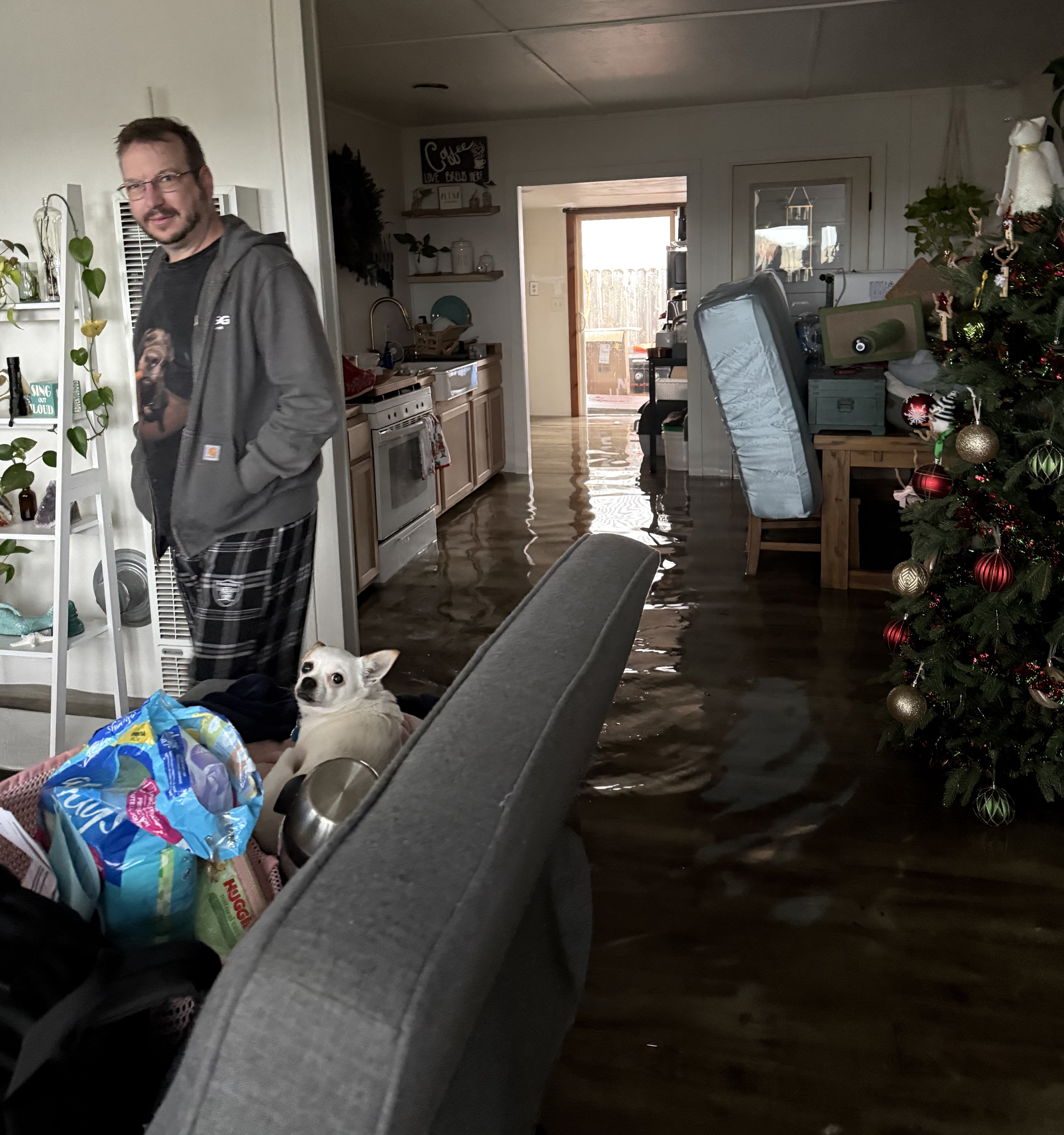
King Salmon resident Ben Jayes wades through his waterlogged home. That’s Lola on the couch.
“I mean, the damage is really bad,” McMahan said. “If there’s a local, state or national disaster, there’s help for people through FEMA [Federal Emergency Management Agency]. Even if it’s just a local disaster, you can get help from different agencies in California to help with building supplies or repairing the electrical or whatever needs to happen. I don’t know why we haven’t declared any kind of disaster, because there’s a lot of people down here who’ve lost a lot.”
Reached for additional comment via email, Sheriff Honsal told Outpost that he must consider the following criteria before declaring a local emergency:
The incident presents conditions of extreme peril to the safety of persons and property. The situation is of such severity and magnitude that effective response is beyond the capabilities of normal county operations. Extraordinary measures are needed to protect life, property, and public health, and to mobilize resources in a way that cannot be done through normal processes. There is also a clear need to activate emergency authority, mutual aid, emergency procurement, sheltering operations, or emergency protective measures on a scale that warrants a declaration.
Honsal explained that a local emergency declaration is “intended for situations where impacts exceed the routine capabilities and resources of the county.” The flooding in King Salmon “did not warrant such a declaration from an OES perspective” as there were “no significant impacts to roads, utilities, public facilities, or critical services.”
“All reports we received indicated that high tides flooded several homes in the King Salmon area,” Honsal continued. “The flooding was temporary due to the high tides, and temporary road closures were implemented. The flooding was not sufficient to justify evacuations due to the risks to the public. If evacuations had occurred, the area would have been inaccessible, preventing homeowners from returning to their homes and accessing their property.”
Staff with several county departments (public works, health and human services, planning and building, etc.) and representatives of the American Red Cross were sent out to evaluate the flood damage, Honsal said. However, none of the agencies asked for additional support or mutual aid.
“Our OES role is to coordinate and support, not to replace the primary response agencies,” he said, adding that OES is responsible for educating and preparing the public before an emergency occurs. “We focus on keeping the public informed, helping connect residents to available resources, and ensuring county partners are supported on response actions.”
Honsal also passed along a fact sheet from California OES outlining the process for emergency proclamations, linked here.

Staff with the Humboldt Community Services District pump seawater out of the system.
Coordinating Local Resources
When floodwaters spilled into the streets on Jan. 2, Cal Poly Humboldt Professor Laurie Richmond and her students, Kailin Sepp and Clara Riggio, were among the first to respond.
For the last two years, Richmond and her students have studied flood impacts in Fields Landing and King Salmon for the FLKS Living with Water Project to get a better understanding of how sea level rise will impact North Coast residents. Through interviews and community workshops, they’ve gotten to know the community and understood that the recent flooding was completely unexpected.
“This happened three days in a row — Friday, Saturday and Sunday,” Richmond said. “It wasn’t something where you could be like, ‘Well, the tides out, it’s done!’ It was kind of like being re-traumatized three times, and knowing that you can’t start cleaning up or doing anything until the tides have worked their way through the system. It was a really prolonged experience, and I think that’s really important to understand.”

Clara Riggio (left) checks on a resident of the RV park.
When the flooding began, the Humboldt County Community Services District quickly dispatched a few employees out to King Salmon. First District Supervisor Rex Bohn and some sheriff’s deputies were on scene as well.
That evening, the Humboldt Grange #501 in Humboldt Hill opened its doors to anyone who needed a free meal and a place to stay, but they didn’t have any takers that first night. When the tide rose the following morning, Richmond and her team packed up the food and made their way into the flood zone make sure folks were fed.
“A lot of folks weren’t able to leave their houses to go to the Grange, so we put it into containers, and just walked through the community asking, ‘Do you need any food?’ Some people said they were fine, but some people took us up on it because their refrigerators had broken and their food had spoiled,” Richmond said. “A lot of folks decided to stay in their houses, though I don’t know if that was the best choice [because of mold].”

Kailin Sepp navigates the flooded streets of King Salmon.
Once the floodwaters began to recede, Richmond and her students went door-to-door to check on folks. As Sheriff Honsal said, the American Red Cross sent out a few members of its Disaster Action Team to help assess the severity of the damage and distribute cleanup kits, blankets and toiletries.
“We have been in the community on four occasions so far to continue connecting with people in need of cleanup kits,” said Janeen Hess, Red Cross community disaster program manager for Humboldt, Del Norte and Trinity counties. “[At] that time, the Red Cross also began responding to individual requests for assistance. … Humboldt County did not ask the Red Cross to open a shelter at any point during the several days of king tide flooding.”
Still, Richmond felt the emergency response was lacking.
“It took a minute to really get the response activated,” she said. “I would have liked to see a [faster] response, but I don’t think there’s anyone to blame or anything like that. I think what’s really stark is that the biggest tide was on Saturday morning, which was the [day after] the Arcata fire. Seeing the differences in response and fundraising efforts has been really interesting, and [highlights] the relative privilege of those two places.”
Richmond acknowledged that she’s not extremely well-versed in the “disaster universe,” but felt an emergency declaration could help those affected.
In the meantime, Humboldt COAD has stepped in to bridge the gap between residents and regional resources. Humboldt COAD helmed the earthquake recovery effort in Rio Dell after the magnitude 6.4 earthquake in December 2022.
“We’re stepping in to help coordinate the relief efforts amongst different organizations and agencies,” said Humboldt COAD Executive Director Nick Bown-Crawford. “It’s a little different than earthquake recovery because we don’t have a big pot of money to work off of. In the absence of that recovery funding, we’re stepping in and trying to meet each resident one-on-one to try to identify their needs and what their situation is. … We work to fill the gaps with services and resources that the government either doesn’t have or can’t activate fast enough for the community.”
Humboldt COAD can help residents navigate insurance claims and legal assistance. They’re also working with the South Bay Family Resource Center, Pay It Forward Humboldt and other local organizations to coordinate fundraising efforts.
Want to donate? Humboldt COAD is taking donations at this link. If you’d like to donate to a specific service or program, you can contact the organization directly here.
‘We’ve been very lucky’
For the next three weeks, the Carters are housesitting for some friends who are traveling abroad. They’re not sure where they’ll go while they wait for their insurance company to sort out their claim. Still, they’re optimistic about the future.
“We’ve been very lucky,” Linda said. “I know that there are some newer people who moved into our neighborhood who were pretty shocked and really devastated by [the flood], but my attitude has got to be that out of 365 days a year, we have about 15 crappy ones because of this kind of stuff. We’ve still got 350 great days in King Salmon.”
CLICK TO MANAGE