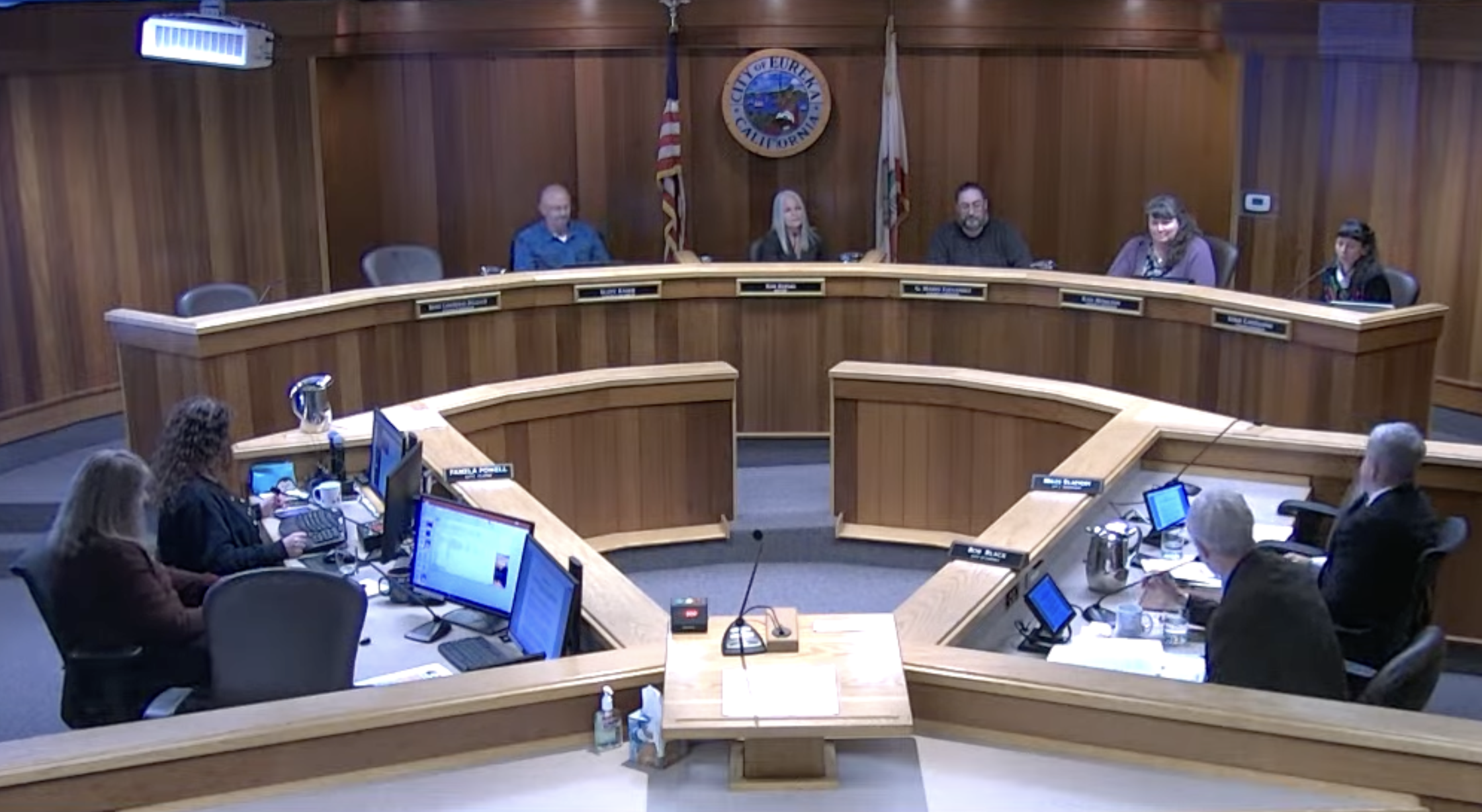
Screenshot of Tuesday’s Eureka Council meeting.
###
Eureka is now a sanctuary city for transgender people.
At last night’s meeting, the city council unanimously voted to approve a resolution declaring Eureka a sanctuary city for transgender people and providers of gender-affirming health care.
The move, which comes in response to President Donald Trump’s repeated efforts to roll back protections for LGBTQ+ people, reinforces the city’s commitment to being a safe and welcoming community for all, regardless of gender identity or sexual orientation. While the resolution is largely symbolic, it emphasizes that people seeking gender-affirming health care in Eureka “should be protected from attempts to impose criminal punishment, civil liability, administrative penalties, or professional sanctions based on the laws of other states.”
“[S]tudies have shown that gender transition, including access to gender-affirming healthcare, improves the overall well-being of transgender people and access to gender-affirming healthcare for youth is associated with better mental health outcomes and lower risks of suicide,” the resolution states. “[O]ver 90 percent of LGBTQ+ youth surveyed by the Trevor Project in late 2024 said recent politics have negatively impacted their mental health. [I]n that same survey, 61 percent of transgender and nonbinary youth who were on gender-affirming hormones were concerned about losing access to this care.”
Speaking at last night’s meeting, City Manager Miles Slattery proposed a small amendment to the resolution that would change “WHEREAS, a majority of U.S. adults agree that transgender minors should have access to gender-affirming care” to “WHEREAS gender-affirming care involves comprehensive social, psychological and medical support, and access to such evidence-based care for minors is best determined through a private patient/physician/parent relationship, rather than political intervention.” The council agreed.
Before heading into public comment, Councilmember Kati Moulton asked if there would be any fiscal impact associated with the resolution.

Moulton | Screenshot
“Currently, right now, no,” Slattery said. “We did become part of the class action suit … for DEI (Diversity Equity Inclusion) programs [in response to] the federal government withholding funding for certain entities. That hasn’t happened to us yet, but we entered it because it potentially could. But as far as us being a sanctuary city — whether it was for transgender or for undocumented citizens — we have not lost any funding.”
Looking to clear up confusion about the intent of the resolution, Moulton emphasized that the city is “declaring what the city can and cannot spend resources on.”
“In this case, we’re declaring that the city cannot spend resources to support the persecution of trans people,” Moulton said. “I wish that we could actively protect people, but it’s more like … we are refusing to actively participate in harming people.”
The vast majority of the nearly two dozen people who spoke during public comment expressed enthusiastic support for the resolution, though some felt it didn’t go far enough to protect transgender people.
“To be clear, this is not a law,” said one speaker who identified herself as Miss Cooper. “This is a resolution, not a binding ordinance, but a formal opinion. It offers no legal protection of us, our care, nor our sensitive, private information. You cannot stop a federal subpoena with an opinion. Characterizing these resolutions as protections or ‘sanctuary’ or even support is legally dishonest. … I fear this effort has been co-opted by those who are afraid of liability but remain eager to use my community for a PR win, as if they took risk all along. Don’t use us for a press release — give us actual protection.”
Speaking to the subject of gender-affirming care for minors, local pediatrician Pippa Coulter pointed to a study commissioned by the Utah legislature that determined “policies to prevent access to and use of gender-affirming hormone treatment for treatment of gender dysphoria in pediatric patients cannot be justified.” However, Utah chose to ignore the findings of the study, she said.

Colter | Screenshot
“I feel in danger doing my job, even though it’s legal. I feel my patients are in danger,” Coulter continued. “This is a beautiful resolution, [but] it’s not going to take away all that danger. … For me, this resolution is more like what Dr. Cornel West said: ‘Justice is what love looks like in public.’”
Other speakers shared heart-wrenching stories about having to hide their identities to avoid being harassed. Vincent Feltner said he made the difficult decision to leave his family in Wisconsin in search of a more welcoming community here in Humboldt.
“My life was one of lonely survival. Keep your head down, stay quiet and be grateful for what you’re given,” he said. “Humboldt County has been full of nothing but the most kind and supportive people. I’ve made so many friends [and gotten] so many opportunities to just be Vincent and not a freak. … Eureka is already a trans sanctuary city in spirit, might as well put it on paper.”
There were at least two people who not only urged the council to reject the resolution but condemned the very existence of trans people. One speaker pulled a quote from the Bible and asserted that homosexual people “have committed a terrible sin [and] they must be put to death.” Another called transgender teens “delusional,” adding, “there’s no way that a child can be born in the wrong body.”
Following public comment, Councilmember G. Mario Fernandez made a motion to approve the resolution, including the amendment proposed by Slattery. Fernandez asked to add the following lines to the end of the document:
Now therefore be it resolved that the city council and the City of Eureka is committed [to the] rights, equal protections and dignities afforded to each person in its community, and declares itself a sanctuary city and a place of safety for transgender people.
Now therefore be it resolved that no city resources, including but not limited to time spent by employees, officers, contractors or subcontractors while on duty or the use of city property, shall be utilized for detaining persons, for seeking or providing gender affirming care, nor the aiding of it.
Moulton seconded the action. Addressing a previous comment about the city using the sanctuary resolution as a PR move, Moulton said she doesn’t care what people think about her or the city council. “I care what trans people think about themselves and their community.”
“Attitude and messages are important,” she continued. “It was just over two years ago that Nex Benedict, a nonbinary teenager, was beaten to within an inch of their life in their school bathroom in a state with a bathroom law. And I can’t help but think that it was the attitude of leadership written into law that made those teenagers feel like that was okay. … Later, Nex succumbed to the main killer of trans teenagers, which is … suicide. Trans teenagers commit suicide at a rate seven times that of their peers, and anything we can do to show them that they are valued in this community is right by me.”
The resolution was passed in a 4-0 vote, with Councilmember Renee Contreras-DeLoach absent.
###
Other notable bits from last night’s meeting:
- Eureka Police Chief Brian Stephens is launching a public education campaign to improve tsunami preparedness. During the last two tsunami warnings in December 2024 and August 2025, many confused residents opted to drive out of the tsunami zone rather than walk, gridlocking traffic on Highway 101 and the Samoa Bridge. Many others simply didn’t know if they were in the tsunami zone. Stephens said EPD will work with local business owners, agencies and other community partners to establish a protocol for getting people out of the tsunami zone during an emergency. Not sure if you’re in the tsuanmi zone? Check this map.
- Eureka Planning Commissioner Michael Kraft provided the council with an update on the state of the local fishing industry, which is struggling to get the massive quantities of ice needed to keep their catch fresh. Currently, ice facilities are located in the building leased by Pacific Choice, “which isn’t operational very much,” Kraft said. Not only that, but their ice is $350/ton — about $100-$160 more per ton than other nearby ports. Pacific Choice’s lease isn’t up until 2032, and even if someone were to build a new ice plant, Slattery said it would be difficult to find the revenue to sustain it. The council didn’t take any action on the item, but agreed that it would prioritize the fishing industry when reviewing the Local Coastal Plan, which is slated for approval later this year.
- The council also received a strategic visioning report outlining the city’s priorities for the coming year. The city will host a town hall in the coming months to share the report and get input from the community.
- The council also received an update on recent changes to the Brown Act, which was recently updated to include changes to teleconferencing rules and social media use for city officials. The council agreed to receive and file the report.
###
CLICK TO MANAGE