A public hearing on a proposed increase to Arcata’s water rates has been pushed back until March.
If you didn’t know: for a whole variety of reasons, Arcata’s city council voted several months ago to raise the price it charges to deliver water for 6,600 customers and remove wastewater from 5,600 customers. When a city does that, it has to hold a public hearing where people can lodge complaints and learn more about the process.
Originally scheduled for this Wednesday, Jan. 7, it’s been rescheduled for March 18. An informational meeting that was supposed to follow the day after will now be held late this month or in early February.
If more than 50% of people representing the affected parcels complain, Arcata can’t legally raise the water rates. Those complaints must be either made in-person or sent to city hall (with the address or an assessor’s parcel number and the name and signature of the customer; they also must be hard copies. Emails or faxes don’t count).
Various posts floating around online community nexuses like Nextdoor or Facebook claim that the rates will go up by 44% if approved. That’s partially true — the water charge, measured by the hundred cubic feet (HCF), will go up from $7.15 to $10.33 in April if the change is made. However, there will no longer be a wastewater fee if a customer uses more than four HCF in a month. Arcata will instead only charge flat fees for single-family homes. Users may pay less for their wastewater than they do now.

Tables detailing the proposed increases. All screenshots from Bartle Wells Associates.
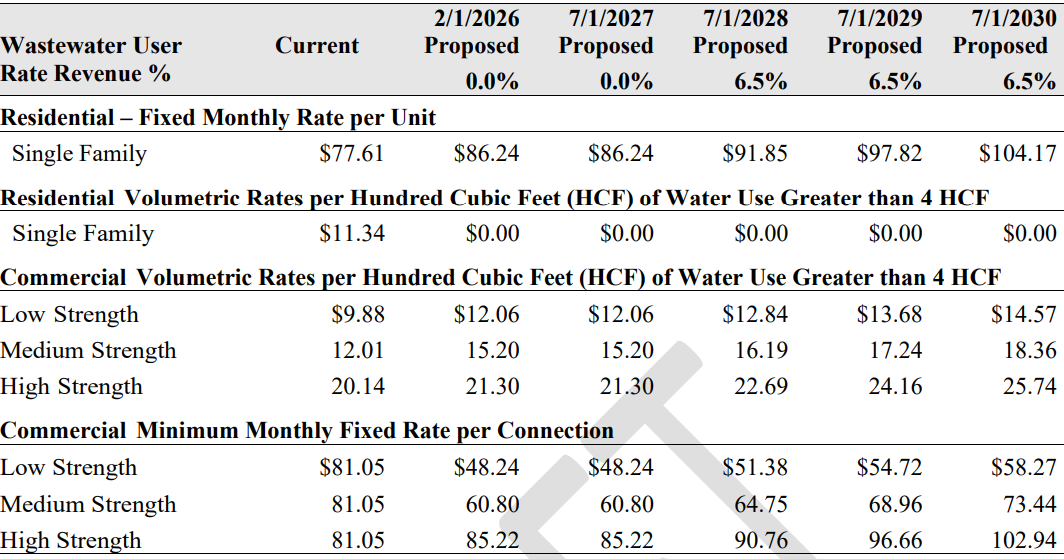
Arcata residents’ water bills are split roughly 35/65 between their water and wastewater charges, so the city predicts that the total cost of the average bill will only increase by about 14%.
Commercial customers will still be subject to charges if they use more than 4 HCF of wastewater service.
The flat wastewater charge will be $86.24 monthly if the plan is approved. Both the variable water rate and the wastewater fee will rise again in 2028, 2029, and 2030. The last comparable increase was in 2021, when Arcata raised its water rates 37%.
When the rates cease increasing in 2030, the water rate will be $13.50 per HCF and $104.17 for the wastewater fee every month for single-family homes, plus a $23.58 monthly charge for customers with ⅝ and ¾ inch meters.
Right now the average single-family household in Arcata pays $136.93 monthly for all of their water usage. In 2030, they’ll pay an average of $155.94 if the rate increase goes into effect. The current rates are comparable with the area average, though the increase will make Arcata’s water services some of the most expensive in the North Coast.
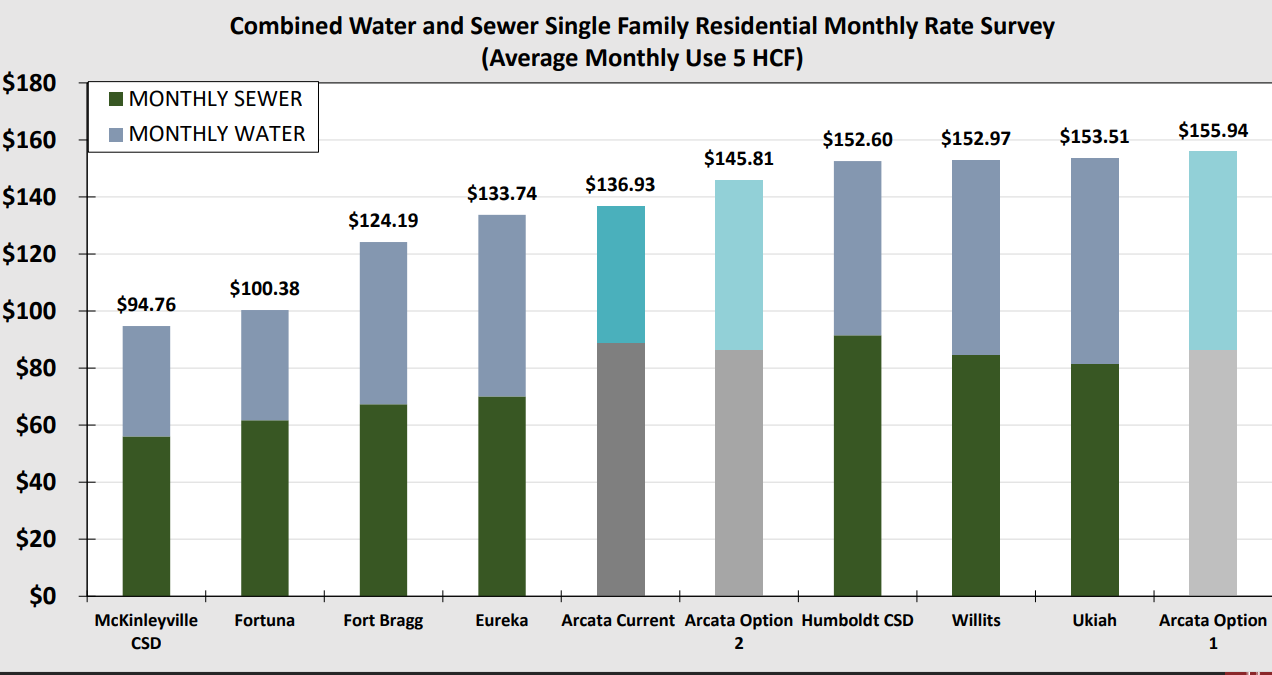
Arcata’s water costs vs. other nearby city’s. The city council selected the option at the far right in October.
In California, cities can’t collect more revenue than they need to keep their services afloat. Arcata feels the increase is necessary because much of its water infrastructure is aging and needs to be replaced (the current steel waterline replacement project accounts for around $12 million of it); it’ll cost around $36 million over the next five years to repair it all, according to public finance advisors Bartle Wells Associates, who performed the water rate study that Arcata is basing the increase off of. Arcata will likely take on roughly $30 million in debt to pay for much of it, though the water rate increases will help cover some of the cost. Increasing the water rates will help the city stay on top of paying off the debt.
The city also wants to stay ahead of rising inflation and labor and materials costs.
By 2030, Arcata expects to have $8.5 million in the water fund. Right now, it holds around $5.9 million.
Not everyone is thrilled about the plan. One Nextdoor post called the increase “absurd,” focusing on the 44% water rate increase, and encouraged people to lodge complaints with Arcata.
That’s not universally the case.
“I thank my lucky stars that I am blessed enough to live in a place where all the fresh water I need comes right out of the tap on demand, and that all the waste goes away without having to think about it,” said another commenter. “The systems that allow all this to happen and the maintenance involved are massive, and if it’s not kept up with we wouldn’t be able to live the privileged first world luxury and miracle that it is.”
CLICK TO MANAGE