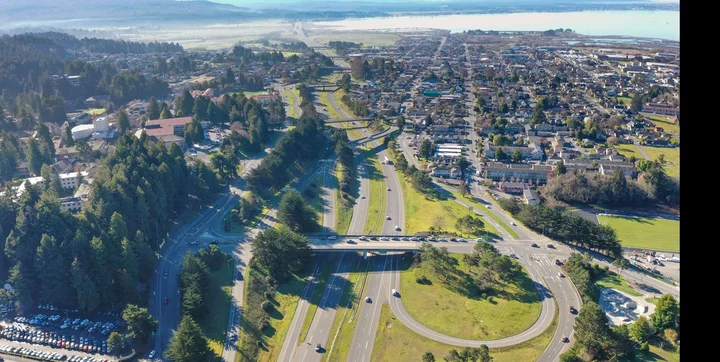
Arcata. Photo courtesy of the City of Arcata.
It slipped under the radar last week, an Arcata City Council consent calendar item freezing all hiring for unfilled city jobs. It was approved without comment. Enacting the freeze only affected one job, a city planning position that opened up a few weeks ago after a resignation — but its passage means the city is in a tough spot financially. Why is it necessary?
Like every complicated economy-related problem, the city felt it was the right move for a few reasons, the city’s finance director, Tabatha Miller, told the Outpost. The city’s being squeezed in multiple directions. Revenues are down, expenses are up. Freezing hiring seemed like one of the best options available, though the savings represent only a drop in the bucket towards making ends meet. City planners for Arcata make between roughly $50,000 and $70,000 annually, and Miller said the city was, at one point, staring down a $5.6 million deficit for the next fiscal year. The number-crunchers stuffed about $4.4 million back into the budget, but the remainder will have to be yanked from general fund reserves.
Cutting the first $3 million was simple, Miller said, mostly just “cleanup” and moving expenses around, taking a few capital expenditures out of the budget. Work on the Reconnecting Arcata project slowed down to a near-halt; road paving and work on the Sunset Avenue roundabouts was delayed. (Money for the Annie and Mary Trail got a pass. The city’s $484,000 let it leverage a further $7 million in grant funding to finish work.) But the next $1.6 million wasn’t as neat; city accountants assessed every expenditure, cut part-time staff by 10%, sliced off $250,000 just in supplies and materials.
“That was just to be more realistic,” Miller said. “It’s, like, ‘OK, this is what we spent last year. There’s no room for any extras.’”
Though the freeze only affects the one job, she said there were likely going to be some retirements on the horizon, which would save the city a few more bucks when their jobs stay unfilled. It was better than furloughing employees — making them work 10% fewer hours for a 10% reduction in pay — because it’s not a very “efficient” solution, especially for first-responders like police.
“We’re taking a more conservative approach,” Arcata City Manager Merritt Perry told the Outpost. “I think we’re going further than some jurisdictions by estimating a 5% decrease in sales tax. What we’d rather do is make some adjustments sooner rather than later if the economic conditions continue to be worse than we think…and be responsible, to estimate those revenues in line with where we think they’re going to be, not in an optimistic manner.”
The vast majority of the city’s jobs are filled, Miller said, almost fully staffed in every department. That’s pretty new, Miller said. In the past, the police department struggled to fill all of its roles, but after a long push to attract more employees, they’re actually slightly overhired. It’s not a situation unique to Arcata. Nationwide, fewer and fewer people are changing jobs.
Miller said the city has no desire to do a round of layoffs.
Much of the blame can be placed on two factors: a decline in the city’s tax revenue, and an increase in health insurance. The 10% tax Arcata levies on hotel guests and Airbnb renters took a large hit, as did all of the various forms of sales tax money Arcata earns, a projected 5% decrease. Some had it worse than others: earnings from measures H and G, which add a combined 1.5% to most purchases made in the city, dropped 13.7% last quarter, the largest decrease Miller said she’d seen in her tenure with the city.
Some of that decline can be attributed to the completion of several construction projects on Cal Poly Humboldt’s campus, which had been propping the revenues up for a few years. The partial destruction of Hensel’s Ace Hardware in the Jan. 2 fire also didn’t help, Miller theorized. It was always in the top 25 highest-paying contributors in sales tax to the city’s coffers, and losing two-thirds of their retail space was tough for both the business and Arcata.
Expenses are also climbing. Inflation is rising, a problem the world over, much of it here due to rising gas prices caused by the Iran War. Although higher gas prices could theoretically make more money for the city through higher sales tax revenue, that hasn’t been the case, as consumers often spend less money elsewhere after being robbed at the pump. However, more residents may choose to vacation locally this summer because jet fuel is so much more expensive than normal.
“I think there’s always this idea, especially here in Humboldt County, that you’d like to be more self-sustained and not impacted by the greater world,” Miller said. “And that’s somewhat true, but it’s just not reality.”
Locally, city hall was also slammed with rising health insurance prices. REMIF, the insurance provider for about a dozen municipalities in Northern California, jacked its premiums up 50% in one year, a $1.2 million increase for Arcata if it had kept using REMIF as a healthcare provider. The increase was mostly caused by employees in cities further south choosing to opt in to cheaper, less extensive plans, leaving mostly the sicker people on the REMIF insurance, which drove the cost way up. (REMIF doesn’t operate like a normal insurance carrier; all of the members pool their money together to pay for health care claims.) Miller called it the “death spiral,” a bottleneck that only rewards areas with better choices and punishes those that don’t. Arcata switched providers to CalPERS before it got slammed with the full brunt of the rising costs, but was still hit with a $700,000 increase from the previous year. Fortuna and Eureka have also dealt with the same problem.
Amy Conley, REMIF’s executive director, confirmed that the plan most Arcata employees are on was due to experience a large increase (almost 30%) for the upcoming plan year.
“Costs are driven primarily by the actual health care claims and prescription drug expenses incurred by the covered population,” Conley wrote in a statement sent to the Outpost. “Like many employers and health plans across California and the nation, the REMIF program has experienced significant increases in health care and prescription drug costs in recent years. These challenges are not unique to REMIF and have contributed to rising health care costs throughout the public and private sectors.”
Liability insurance prices also went up 29% last year, following two consecutive years of large increases.
It looks rough, but Miller said there was reason to be optimistic. The city has applications out for several infrastructure grants, many of which have money included for staff expenditures. Later in the year, when the city knows how well it did this quarter, they’ll take a look at unfreezing hiring.
It’d be easy to cheat, Miller said, shuffle things around on paper so it looks like there’s no deficit, close ranks and wait a few years until maybe things get better. But long-term that’s idiotic.
“The council has done a really good job of building reserves over the last five years and being supportive of us putting money aside for rainy days,” Miller said. “We don’t want to just blow that because we put our heads in the sand.”
CLICK TO MANAGE