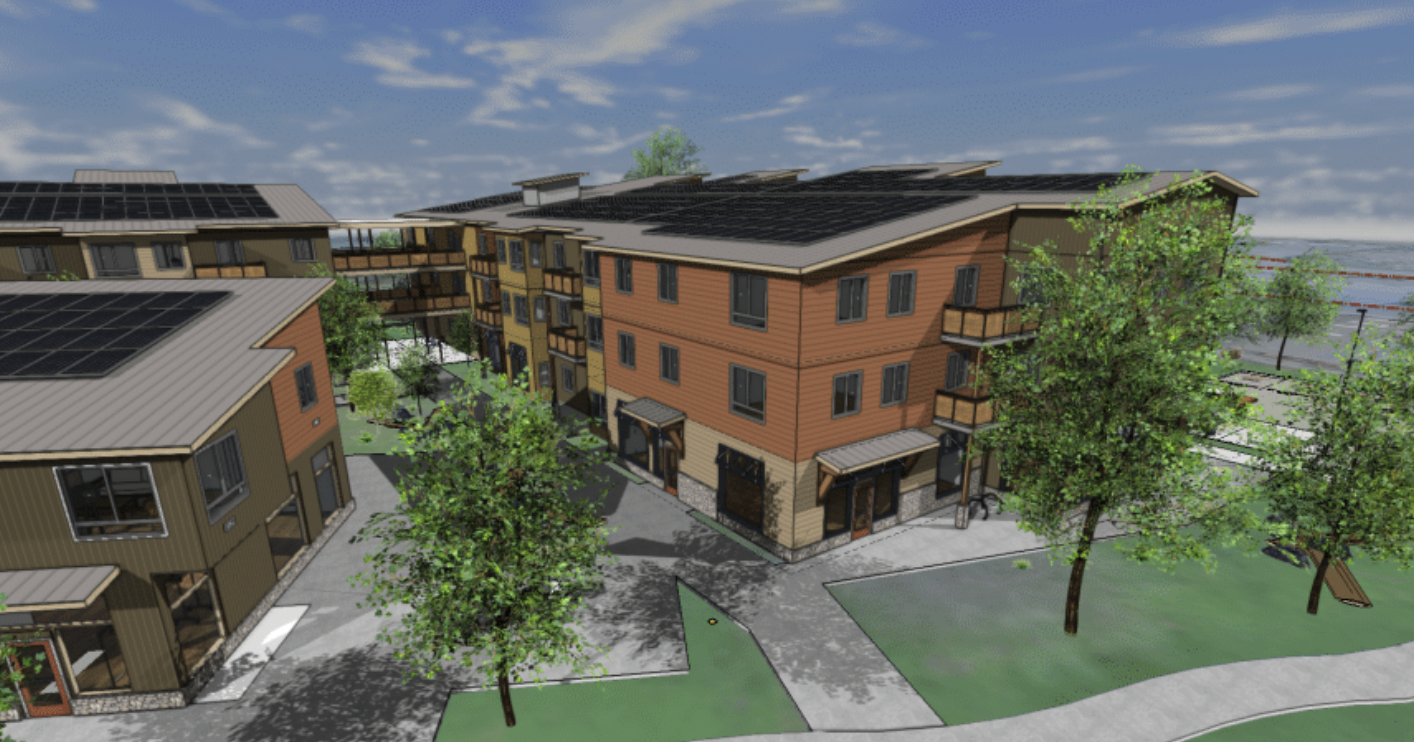
A rendering of the proposed Baduwa’t Community Project, terminated by the city of Blue Lake earlier this year. | Image courtesy of Danco
###
After the city of Blue Lake terminated an agreement for a planned affordable housing project, the developer is now pushing back on the city’s claims that the company failed to meet an agreement to move the 40-unit Baduwa’t Community Project forward.
In April, the city issued a notice of termination for the mixed-use project proposed by Danco Communities, which had been working with the city on the development in the Powers Creek District for years.
The company responded to the city in a May letter saying this termination wasn’t supported by fact.
“The Developer believes that the Notice of Default and Notice of Termination are without factual basis and were delivered in bad faith,” said Chris Dart, president of Danco, in a letter to Blue Lake City Manager Jennie Short.
The company also believes in doing so, the city broke state housing laws that require municipalities to approve housing developments that comply with objective planning rules.
City officials now believe litigation is possible in a dispute surrounding the time and money Danco invested in the proposed project that would host affordable residential units and commercial space near the city’s bike and skate park.
The three-acre project has officially been in the works since 2022, when the city signed a Disposition and Development Agreement with Danco Communities to build the project. The original agreement was for a ground floor level of commercial/retail space that could include light manufacturing, offices or warehouses. The above two floors of residential units would be rented to low income seniors or families who make no more than 60% of the Area Median Income for Humboldt County.
But in March, as reported by the Eureka Times-Standard, the city manager presented to the council a draft of a legal notice by the city that declared Danco Properties in default on plans for the development.
At the time, the city said the company had changed the project’s plans substantially, by decreasing commercial space and increasing the number of residential units by nine — effectively reducing commercial space by 55% to 10,944 square feet.

The project would have two floors of residential units and a ground floor of mostly commercial space. Image courtesy of Danco
###
The city also said Danco had not met deadlines in the agreement, particularly by not securing land use entitlements, tax credit or other financing.
In April, the city followed up with the notice of termination of the project, according to Danco.
But according to the May letter from Danco’s Chris Dart, the city itself has prevented the company from meeting these milestones.
He disputed city claims that the company had violated the agreement.
In the letter, he said Danco couldn’t obtain financing or close escrow without completion of the entitlement and environmental review processes, “both of which remained under the City’s control and had been substantially delayed by the City’s own procedural changes, review delays, staffing turnover, and failure to advance the project to hearing.”
And on decreasing the project’s commercial space, Dart wrote this was something city staff understood would be changed after a meeting.
According to McKenzie Dibble, Danco’s project manager for the development, the project would have penciled out better for nabbing tax credits with more residential units — plus Blue Lake has a spread of existing, unfilled commercial spaces. The units would be built in a way to preserve “the ability to convert those areas back to commercial space in the future,” Dart said in the letter.
But Dibble said they’d since directed their architect to revise plans to meet this request. In the most recent plan, the project includes 19,027 square feet of commercial space.
This wasn’t the only change Danco complied with to keep Blue Lake happy — there was a lengthy back and forth between the city and company on the project.
Dart’s letter says initially, the city said the project was exempt from the California Environmental Quality Act (CEQA), which comes with environmental study requirements that can be expensive and time consuming. But in 2023, city staff said a full initial study would be required.
According to the letter, the company funded and completed all technical studies, including biological assessments, cultural resource investigations, traffic analyses, drainage reports and soil and groundwater management plans. Danco said these studies were later revised multiple times based on new city comments and site plans.
“Despite Danco’s cooperation and continued responsiveness, the City did not complete or circulate a draft [Initial Study/Mitigated Negative Declaration] for review, even after more than ten months had elapsed following the shift in CEQA strategy,” the letter states.
Alongside these delays, Danco also points to city “planning staff turnover, inconsistent review timelines, shifting procedural expectations, and prolonged periods without substantive progress toward public hearings or approvals,” including a failure to schedule the project for a hearing before the Planning Commission.
The letter said Danco has repeatedly submitted revised plans, supplemental materials and updated studies to satisfy “changing review expectations” and continue advancing the project.
In the letter, Dart said the city’s actions amount to constructive discretionary disapproval — in other words, the project was effectively denied by inaction on the city’s part.
“I’ve never had it take this long,” said Dibble, when asked about the length of time the development has been in the planning process.
She said the company had been ready for over a year to be heard at the planning commission, but did not had the cooperation to schedule the hearing.
The Powers Creek District, where the project was planned to be located, has long been planned as an area ripe for development in city planning documents.
Dibble pointed out the property is zoned “by right” for the development — meaning the planning phase of this kind of project typically is relatively straightforward. It’s located in the O-Zone, or opportunity zone, which allows for mixed use commercial and residential.
State laws have also been tightened over the past few years, in response to the state’s housing crisis, with special rules for housing development.
This includes the 1982 Housing Accountability Act, which requires local governments to approve a housing development project (including mixed-use projects that dedicate at least two-thirds of their square footage for residential use) that complies with objective rules in the general plan, zoning ordinance, subdivision ordinance and design standards.
This project formerly was seen as key to meeting state housing requirements. The city needs to plan for 23 units of housing in the 2019-2027 cycle.
In the letter, Danco claims the company formally requested an additional 12-month extension on the agreement through May 31, 2026, but they never heard back.
“In that request, Danco explained that the extension was necessary because the entitlement process and financing process could not be completed absent further City action and completion of the environmental review process.”
Danco also claims the notification process for termination set forth by the agreement wasn’t met, and company representatives “made clear to the City Manager that it was their intention to work to cure the alleged defaults,” in a meeting on the notice of default, the letter said.
The letter points to significant costs associated with the project. An accounting total attached to the letter listed $324,681.14 in costs.
After demanding reimbursement of Developer Reimbursable Costs in the amount of $200,000, the letter concludes by stating Danco is prepared to move forward with the development of the project and is committed to seeing it through to completion.
“We are open to discussing a recission of the Notice of Termination with the City and the renewal of the DDA,” the letter said.
The company has yet to hear back on the letter.
Dibble said she was particularly excited about the project, and said it would be a “gem” for Blue Lake.
“We’ve spent years and hundreds of thousands of dollars developing phases for a really great affordable housing project with lots of community input, with really thoughtful design,” said Dibble.
She said the company would be bringing in millions of dollars of public improvements alongside the project, including water looping infrastructure, trail paving, traffic calming and updating of intersections.
But this would be leveraged as community investment only if the affordable housing program happens, she said.
“The fear that’s surrounding it is unfounded and it’s keeping our community from being healthier and happier,” she said.
The Blue Lake City Council will discuss significant exposure to litigation on this topic during closed session Wednesday at 6:30.
When asked if the company is pursuing litigation, Dibble said via email they are considering options.
According to the pro-housing legal group California Housing Defense Fund CalHDF, under the Housing Accountability Act, the applicant, a housing organization or someone who would have been eligible to live in the project can bring a lawsuit forward.
Blue Lake’s city manager did not return an emailed list of questions before publishing time.

The proposed Baduwa’t Community Project. | Image courtesy of Danco
CLICK TO MANAGE