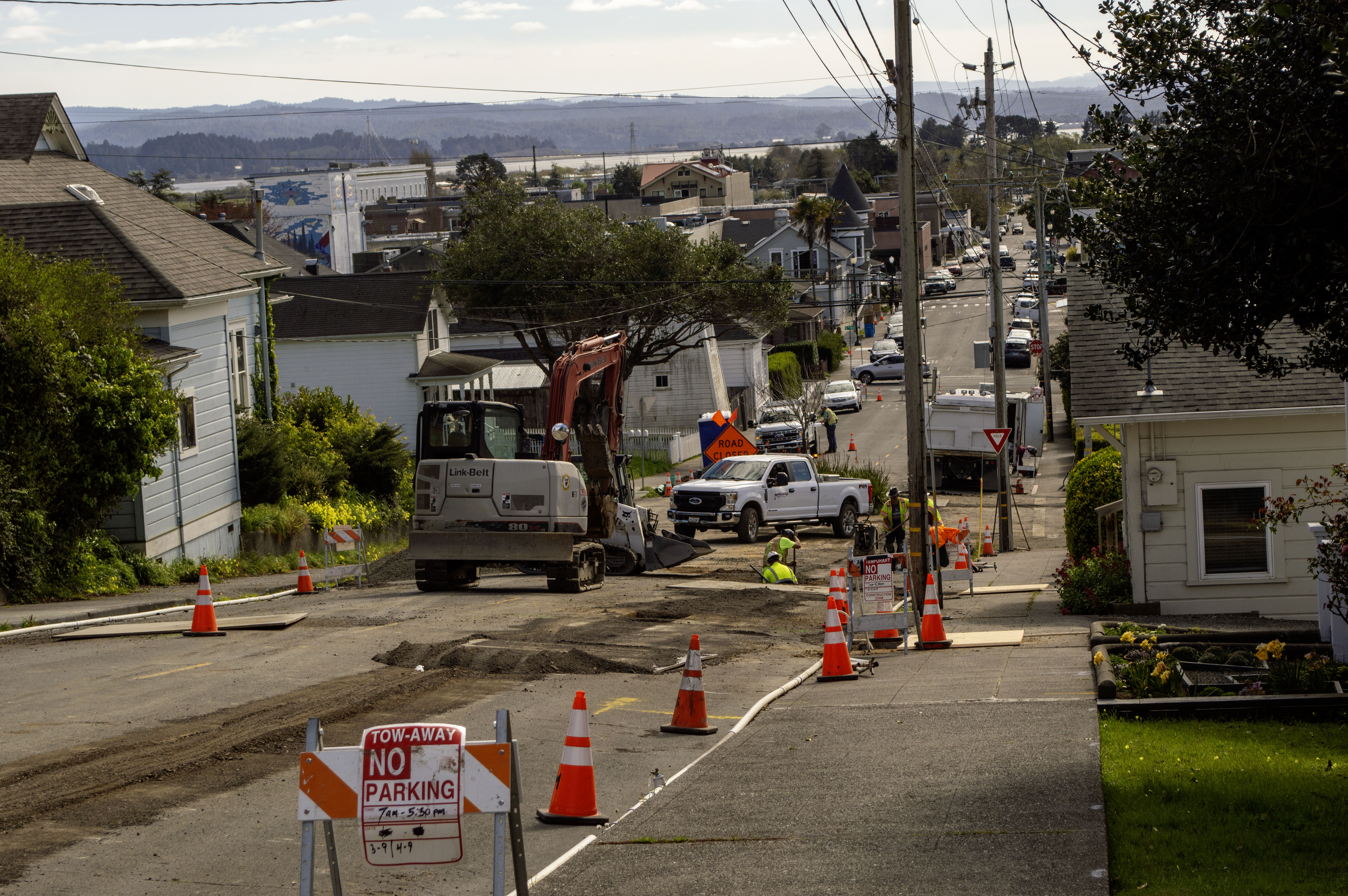
Los trabajadores laboraban en el proyecto de reemplazo de la tubería de agua de acero, 13 de marzo. Fotos de Dezmond Remington.
Las casas antiguas tienen muchos problemas. Tuberías con fugas, cimientos agrietados, mala calefacción y peor aislamiento hacen que la vida sea difícil. Pero un antiguo medidor de agua puede realmente ahorrarles dinero a los propietarios, a costa de la ciudad.
La oferta de viviendas en Arcata está llena de ellos. Alrededor de 6,600 medidores en toda la ciudad miden el agua que usan los residentes, y todos necesitan ser reemplazados. (Alrededor de 680 ya lo han sido). Cuando un medidor tiene aproximadamente 15 años, deja de medir con precisión el uso de agua, casi siempre a favor del cliente, a veces subestimando en grandes márgenes. Arcata no recupera costos de hasta un tercio de los $1.7 millones que gasta en agua comprada al Distrito Municipal de Agua de la Bahía de Humboldt y revendida a costo, le dijo la Directora Financiera Tabatha Miller al Outpost. Arcata pierde entre $300,000 y $500,000 anuales, aunque las pérdidas se han acumulado con el tiempo a medida que más medidores se deterioran. Parte se pierde por infraestructura con fugas o de hidrantes de incendios, como los 2.5 millones de galones que los bomberos vertieron en el incendio del 2 de enero de este año, pero alrededor de la mitad es por la subestimación de los medidores de agua. 271 clientes activos han pagado las tarifas planas mensuales mínimas sin que se les cobre nada por el uso de agua en los últimos cuatro meses, dijo Miller, aunque la ciudad cree que están usando agua.
“Es mucha agua”, dijo Miller. “Y es mucho dinero. Se puede ver por qué esto es importante para mí.”
Los miembros del consejo municipal y el personal intercambiaron anécdotas en una reunión hace varias semanas, cuando decidieron intentar obtener fondos estatales para reemplazar los medidores. La concejala Stacy Atkins-Salazar dijo que había escuchado que la ciudad estaba perdiendo un montón de dinero anualmente debido a medidores defectuosos; algunos clientes no pagan nada y eso “no le sentaba bien”. Los otros miembros del consejo estuvieron de acuerdo. “Cuando escucho que alguien que puede pagar el agua [facturas] tiene una lectura de medidor en cero, eso me vuelve loco”, dijo el concejal Alex Stillman. Reemplazar incluso unos pocos medidores ha tenido un impacto; Miller dijo que algunos clientes con medidores nuevos se quejaron al departamento de finanzas, indignados porque su factura de agua había aumentado. El personal de finanzas les hizo algunas preguntas sobre su uso: cuántas personas vivían en la casa, con qué frecuencia estaban allí, y les mostraron que se habían estado beneficiando de un medidor defectuoso.
Ya necesitaban ser reemplazados desde hace tiempo. Durante años, Arcata no tenía el efectivo. El ayuntamiento buscó oportunidades de financiamiento para otros proyectos a medida que surgían, subvenciones para mejoras en calles y transporte, $67 millones para la planta de tratamiento de aguas residuales. Miller dijo que aprovecharon lo que estaba disponible y avanzaron desde allí. El enfoque en proyectos de infraestructura más críticos, como el reemplazo de la tubería de agua de acero, también dejó a un lado el reemplazo de medidores. Reunir el dinero para el proyecto también habría sido impopular, dijo Miller.

Algunos compañeros trabajando duro en el proyecto de la línea de agua de acero.
“A nadie le gusta que se aumenten las tarifas”, dijo Miller. “Si puedes posponerlas uno o dos años porque nada está realmente mal, sucede… Y la gente lo odia cuando rompes sus calles y calles, y se quedan sin agua. Es un gran problema.”
Los medidores son parcialmente responsables del inminente aumento de las tarifas de agua de la ciudad. Según la ley de California, los ingresos que Arcata obtiene de su servicio de agua van directamente al fondo de agua, no a su fondo general. Arcata está aumentando principalmente las tarifas de agua para amortiguar los costos de la continuación del reemplazo de la línea de agua de acero y otras actualizaciones de infraestructura, alrededor de $36 millones en total, pero más dinero en el fondo de agua habría permitido aumentos mucho más bajos. (Varios miembros del consejo municipal han dicho que considerarían reducir las tarifas en 2030 si se reemplazaran los medidores).
Miller estimó que costará alrededor de $13 millones reemplazar todos los medidores. No es tan fácil como aflojar algunos pernos y cambiarlos; los nuevos transmisores de lectura automática son más grandes que las antiguas cajas del medidor, que están incrustadas en la calle. El concreto alrededor de las cajas tiene que ser destruido y vuelto a verter. Si la ciudad lo consigue, los fondos de CDBG por los que están solicitando cubrirán $2.9 millones, y el estado y el gobierno federal podrían aportar los otros $10 millones a través de una combinación de varios subsidios diferentes. Si todo va según lo planeado, el proyecto llevará alrededor de dos años y medio para completarse, terminando en algún momento de 2029.
Los medidores que planean reemplazar con los $2.9 millones de financiamiento de CDGB estarán en áreas de bajos ingresos de la ciudad, determinadas por datos de distritos censales. Miller estuvo de acuerdo en que era contraproducente que Arcata esté aumentando efectivamente sus tarifas antes de enfocarse en personas que tendrán más facilidades para pagar, pero los fondos de CDGB deben usarse para áreas de bajos ingresos. Y los nuevos medidores también pueden decirles a los residentes si sus tuberías tienen fugas, lo que potencialmente les ahorra dinero a largo plazo.
“Si podemos obtener dinero para pagar por la infraestructura que la hace uniforme y justa en todos los ámbitos en cuanto al uso y las facturas de agua”, dijo Miller, “es una victoria para los clientes, y eso afecta a casi todos en la ciudad.”
CLICK TO MANAGE