
Trinidad’s water tanks can hold a combined 400,000 gallons. Photos: Carrie Peyton-Dahlberg.
The calls rang out over and over, in the dispassionate water system codes that meant unmistakably: “Something’s wrong. I need you. Help.”
Like a little kid pleading for someone – anyone — to respond, the alarm calls on that rainy January morning went to three different phone numbers at 3:02 a.m., 3:04 a.m. and 3:06 a.m. Then minutes later calls went again to all three phones, and yet again, before roping in a fourth phone by 3:35 a.m.
No one answered.
While 70,000 gallons an hour rushed from a broken pipe, two key Trinidad city workers slept, each thinking the other was supposed to be on call that night.
The ensuing water crisis shuttered restaurants for days, dented Trinidad’s water reserve funds and prompted fresh conversations about a long-smoldering pipeline debate.
More than that, though, Trinidad’s waterfall of water loss underscores a national reality that policy analysts have acknowledged for decades: Many of America’s water systems are broken, too fragmented to be relied on, especially in rural areas.
Humboldt County alone has 51 different water systems, including at least four that are “failing” and four that are “at risk,” according to a list that’s updated daily by the state Water Resources Control Board.
Among the failing, the state water board says, is the Scotia Community Services District, which just last week, on March 5, told residents to boil their water before drinking it. The others are the Redway Community Services District, the Weott Community Services District and the tiny Palomino Estates Water Company near Garberville.
The biggest “at risk” system in Humboldt County, the state says, is the city of Trinidad, which provides water to around 1,000 people, restaurants and businesses within and beyond city limits. (The other three at-risk systems are much smaller: Alderpoint County Water, Moonstone Heights MWA and Trinidad Extended Stay RV.)
“Running a modern, safe, reliable, resilient, sustainable water system is hard,” says water distribution expert Manny Teodoro, a professor of public affairs at the University of Wisconsin, Madison. And while catastrophic failures like the one in Trinidad can happen anywhere, he says, “your probability of catastrophic failure is much higher when you’re small.”
Teodoro, who has edited a new book looking at 50 years of water policy, can summarize decades of studies finding that small districts have more trouble meeting safe drinking water standards. As a group, he says, they charge more for lower quality systems.
One of the benefits of these rural water enclaves, though, is a sense of place, rooted in local history and local control, says Kristin Dobbin, a UC Berkeley professor who focuses on water policy research and community outreach.
To preserve that, she says, tiny water systems scramble to maintain equipment and pay workers, struggle to save for emergencies, and often have a lone water source that makes them especially vulnerable to fire, landslide or drought.
The state of California has been a leader in encouraging small districts to meld into larger ones, and has fostered well over 200 consolidations since 2015, she says. But that push isn’t always welcome.
“There are places that are really concerned about consolidation because they’re concerned about growth,” Dobbin says. “Or what I hear more often, people really don’t want to give up control of their local decisions.”
In Trinidad, local control has come at a high cost. The city burned through its entire water system capital improvement budget, more than $1 million between 2021 and 2024, just to cover operating expenses, including outside contractors who had the required licenses to run a water plant. It raised rates in 2024 and was just clawing back toward a solid reserve fund when trouble hit.

Kyle Shipman at Trinidad’s water plant.
A dark and stormy night
The failure began when a 6-inch PVC pipe, which lay buried near a slowly sliding section of Scenic Drive, began to crack. Water plant records show first a trickle of loss around 1 a.m., and then a flood, likely when the crack forced open a wide horizontal wedge along the top of the pipe.
The city’s SCADA (“supervisory control and data acquisition”) system began sending out more and more alarms. But the city worker who had volunteered his work cell number for the primary alarm phone had handed off the on-call job that night to another worker – or thought he had.
“There was a misunderstanding there. There was a mishap,” said Kyle Shipman, Trinidad’s public works supervisor.
Such misunderstandings are not trivial. For a water plant operator, neglecting an alarm call is like a fire department picking and choosing which fire alarms it responds to, says Michael Sims of the California Rural Water Association.
“If they are a state water operator, certified by the state, they have to pick up the call. That’s their job,” says Sims, the water association’s lead specialist in leak detection training. “They are supposed to pick up. They are supposed to shut it down.”
People familiar with small water systems say the logical thing to do after such an alarm that would be to go to the water plant, consider isolating one or more tanks to preserve some water supply, then drive first to areas with known weaknesses to look for leaks. Good places to start looking would be areas with past leaks or with known slides or earth movement.
In this case, though, Shipman said that an immediate response wouldn’t have helped much. Someone would still have had to get dressed, drive to the plant to check its systems, then drive to the water tanks to verify levels were really dropping so drastically, and finally drive to potential leak sites, find the leak and turn the right valves to seal it off. That all would have taken three hours at best, he and his staff have estimated.
None of that was even attempted at 3 a.m. though.
Instead, the water flowed on, eventually forming a slurry that oozed through a slope below Scenic Drive, where it was spotted by a Trinidad Rancheria worker in the morning’s light. That worker called Interim City Manager Gabe Adams at 7 a.m.
Adams dispatched a city staffer to the site, who isolated the leaking pipe by turning two valves, in two separate but nearby locations. Shutting both valves only took about 20 minutes, Shipman said. By then it was too late.
Both of Trindad’s water tanks, with a combined capacity of 400,000 gallons, had drained away.
That level of detail was missing from the presentation given to the Trinidad City Council on Jan. 13, during its first meeting after the water leak.
To prepare for their upcoming March 10 meeting, council members were just sent a much more detailed account, which stresses that the fastest possible leak fix would have taken three hours. The report called Trinidad’s water team “heroes” and said in part: “Considering the unprecedented set of circumstances surrounding the incident, including the fact that our team of young operators have never experienced a leak of this size and scope, the response was outstanding.”
Even after reading past council minutes and talking with city council members, Trinidad Eatery owner Betsy Musick has been among those frustrated by the city’s response.
“I don’t think it’s clear what happened between the team getting those first alarms between 3 or 3:30 and being boots on the ground between 7 and 7:30,” Musick said. “There’s clearly a breakdown here. If it’s human that’s OK but that needs to be admitted.”
Musick has surveyed business owners and believes that over the five days that a boil water order was in effect, forcing restaurants and the grocery deli to close or partially close, $150,000 was lost. That includes lost revenues, spoiled food and lost wages and tips for employees.
As a business owner, her concerns are threefold. “I want to hear what actually happened, where the fault lies so it doesn’t happen again; how is the city learning from the situation: and is there anything they can do for us financially.”
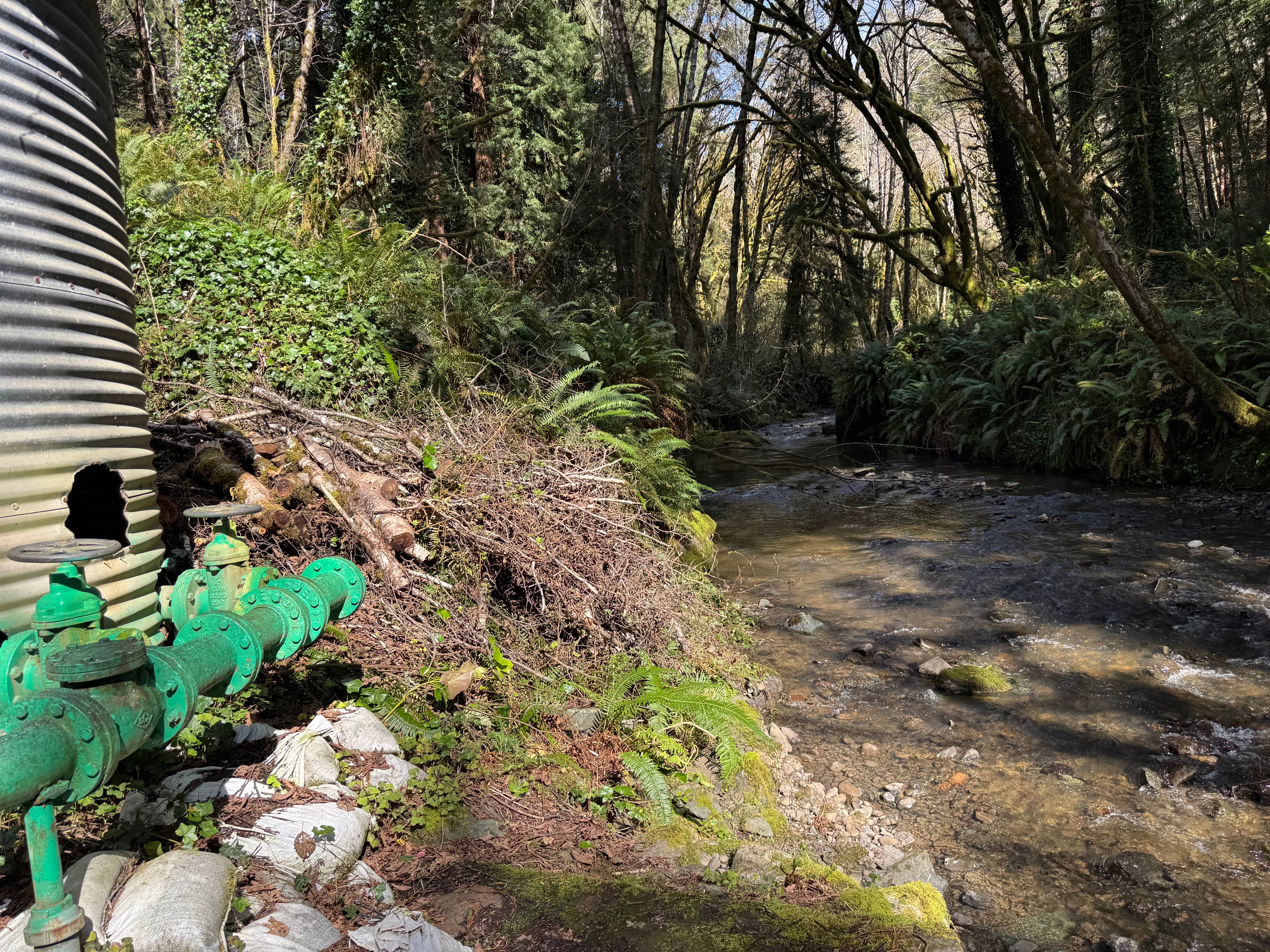
Water intake area at Luffenholtz Creek.
From creek to table
Trinidad’s water comes from a mossy bend of Luffenholtz Creek, a little inland from where the creek runs under the freeway and tumbles toward Luffenholtz Beach. Water is pumped up from a gravelly bed about 10 feet below the creek, and shunted through a series of tanks and treatments, filters and a flocculator to remove sediment and screen out anything you wouldn’t want to drink.
“It’s archaic — this is like 1970s technology,” says Carl Anderson, who is working toward getting a “T3” license that will allow him to serve as chief plant operator, eliminating a need for outside contractors.
Well, perhaps not archaic, public works chief Shipman qualifies during a recent water plant tour. But, he says, “It’s very finicky. It likes what it likes.”
The finickiness, a storm that sent churning muck down through the riverbed to where the pumps lay, and a failed motherboard in a key sensor all slowed efforts to get clean water back to Trinidad’s taps.
For days, a convoy of water trucks fed the water system’s tanks, at a cost of close to $20,000. City staffers shared shifts around the clock, racking up substantial overtime. “No matter what we did, it wasn’t looking right,” Shipman said.
When Trinidad first imposed a boil water order that Saturday morning, the city said it hoped to restore service in 48 hours. Instead, the order wasn’t lifted until that Wednesday evening.
At council meetings since, council member and public comments have ranged between praise for herculean work from 7 a.m. that Saturday morning onward to questions about what, if anything, could have helped – including a much-debated pipeline.
Pandora’s pipeline
Trinidad Rancheria has long yearned to build a hotel beside its The Heights casino, just outside Trinidad town limits. One roadblock has been water supply, although a lawsuit from opponents has put fire protection criteria in play, too.
Back in 2020, the rancheria asked the Humboldt Bay Municipal Water District to consider sending some of its supply north, via a new pipeline.
People who hate the idea of a five-story hotel rising up above coastal cliffs, and even some who might tolerate it, hate the pipeline idea even more. They’ve flooded local and regional meetings in protest, and filed a lawsuit that forced more consideration of fire risks.
For almost as long, the city of Trinidad has gone back and forth over whether to even study the implications of connecting to that pipeline if it is built.

Kyle Shipman and Say-gep Brown at Trinidad’s water plant.
Opponents predict that if water comes, sprawl would infest the green ridges from northern McKinleyville to Trinidad, peppering vacation rentals throughout Moonstone Heights, Westhaven and beyond. The Pandora’s pipeline would gush with multiple misfortunes -– higher water rates, swarming crowds at the local market, a casino gas station that could rob the city of revenue.
To opponents of the pipeline, even asking -– as one Trinidad council member did in January -– whether a pipeline could make Trinidad’s water more secure is like asking if you could save your kid’s school by firing every teacher.
Nonetheless, the question is there.
The answer, interim manager Adams told the council, is that a big pipeline from the south could have supplied far more water, and that Humboldt Bay’s much larger staff of operators, working overnight, would have made it far easier to respond to the leak quickly.
The pipeline itself is no slam dunk, and years of deliberation by multiple regulatory bodies lie ahead, whether Trinidad chooses to join in or not.
Still, Trinidad’s five-day boil water episode has put a fresh focus on what kind of water system it wants, and what tradeoffs it might make to get there.
“Those who want the pipeline are absolutely going to try to take this to the bank,” says Steve Madrone, the Humboldt County Supervisor whose district includes Trinidad. (Full disclosure: I volunteered for Madrone’s supervisorial campaign in 2018.)
Madrone is chair of the Local Agency Formation Commission, one of several government boards that would ultimately consider the pipeline, and as such he says he cannot take a position on the issue.
But in general, Madrone says, merging small water districts into larger ones tends to be a remedy for repeated water safety violations, and Trinidad has not had repeated water safety issues. What Trinidad has had instead, he says, are serious management issues.
“If I were a city resident or a ratepayer, I’d be lividly pissed about their mismanagement,” Madrone says, particularly under prior city managers whose tenures saw big contracting bills and the departures of some water staffers.
Council member Kati Breckenridge bristles at that criticism as unfair and poorly informed. “Our staff works so hard, and the councilors do too,” she says. The water leak was rough on staffers, rough on local businesses, expensive, and potentially scary, she says.
“It increased the feeling, at least for me, that we really need a feasibility study about our water processing and whether it’s wise to continue the path we’re on or to make a change,” Breckenridge says.
Community soul-searching is a sound starting point, says UC Berkeley expert Dobbin.
“If a community wants to grow that’s great,” Dobbin says, “and if a community doesn’t want to grow that’s great. But there has to be a plan for investing in the system.”
What people in any small water district, from Scotia to Trinidad, should ask themselves is whether the water district they have is able to do the job they want.
The questions Dobbin recommends include: Does my district have enough money for regular maintenance? Does it have enough funds to cover emergencies? And does it have enough sources of water to handle an uncertain future?
If those answers lean toward no, she recommends a crucial next step: How can the community find ways to keep its local voice, while exploring some kind of connection, physical or managerial, to a larger agency?
Like Luffenholtz Creek in winter, that conversation will keep churning on.
CLICK TO MANAGE