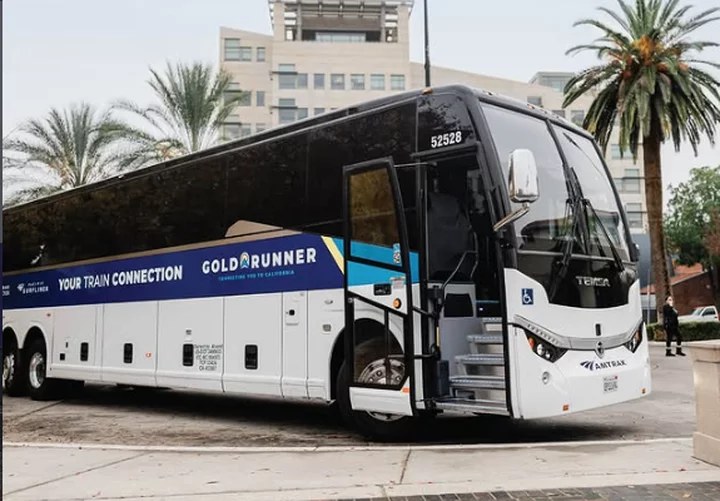
A Gold Runner bus. Photo from @goldrunnerca on Instagram.
PREVIOUSLY
###
A flood of comments from local transit advocates reoriented the entity that controls Amtrak’s Gold Runner bus line away from cutting some runs to Humboldt County.
The Gold Runner spans 13 routes, and one runs from Arcata to Martinez, in the East Bay, where travelers can hop on trains that run as far afield as Chicago. Although Amtrak operates the route and the state partially funds it, a coalition of 10 local governments from Bakersfield to Oakland, the San Joaquin Joint Powers Authority, do the day-to-day management. It’s in charge of making sure the route is cost-effective, and although quite a few people ride it — more than 46,000, from October 2024 to September of 2025 — the authority spends more on it than it makes ($1.9 million to $3.2 million, during the same time period). Out of all the Gold Runner’s routes, the Humboldt run is the third-most expensive.
The way the state calculates its revenue is a little byzantine: the amount earned from bus riders, plus the amount those riders then spent on a train ticket, divided by the amount spent on the route. Plug in the numbers from a well-performing route, and it should be more than 1. Route 7’s is 0.6.
It’s expensive to operate for a few reasons, the Humboldt Transit Authority’s general manager Katie Collender told the Outpost last month. It’s a long route with few stops for people to get on or off, and Amtrak has to lodge their drivers in a hotel overnight once they hit Arcata. (A recently completed study noted “disproportionately high operating costs due to its length.”) Many Route 7 riders don’t hop on a train to other parts of the country, either; they stop in the Bay Area, or catch another bus further south, thus decreasing the “train revenue” side of the sum. There are few daily commuters on the route, which means few constant, repeat customers. The cost of operating Route 7 has increased by 146% since 2022. The number of riders has only risen 47%.
The authority had been considering slashing a few runs per week to balance the books; the run to Arcata was one of the routes that required the “greatest need for improvement,” staff wrote. Route 7’s biggest days are Fridays, Saturdays, and Sundays, and the number of people riding drops on Tuesdays and Wednesdays, so those are the first days they’d consider decreasing service on, San Joaquin JPA’s Manager of Regional Initiatives Dan Leavitt told the Outpost during a phone interview last month. But dozens of Humboldt residents — around 50 — wrote in to protest the move, perhaps spurred on by a local transit advocacy group’s call to action.
They need it, many of them said. They’re old. They don’t drive, or can’t. They’re college students, far from home, and the bus is the only way they can get back. They’re sick, feeble, dying — their medical team is in Santa Rosa or the Bay Area. Making it harder to travel south on the bus — at all — would hurt them.
“These changes are a disaster for people like me who need medical care only available outside our area,” Eureka resident Winifred Creamer told them. She has to travel round-trip from Eureka to Santa Rosa every 4-6 weeks to treat her macular degeneration, she wrote. She can’t drive after her doctors inject medicine into her eyeball, and cutting a run might force her to stay in Santa Rosa overnight. Several other residents with similar ocular issues said the same. “The bus is my lifeline. I understand that the finances don’t add up to profit on the route, but access to medical care from Humboldt County is important to many people besides me. Please consider options other than closing the route.”
Eureka Mayor Kim Bergel also asked the authority to scuttle their plans to decrease the runs. “Route 7 is a literal lifeline for our residents,” she wrote.
The deluge of opposition changed the agency’s plans. The authority’s original draft of a report that studied the Gold Runner system suggested chopping a few runs, but an altered version presented to its board on Friday removed the idea.
Leavitt acknowledged that the responses were the cause. “They’ve really talked about how essential this is to them,” he said Friday. “…This is a lifeline to a number of people throughout the state.”
The agency instead flipped 180 degrees and recommended that it improve service on Route 7 by focusing on improving its timeliness or by moving stops to increase convenience. It may still look at halving daily runs from two to one on the days fewer people ride it, or research contracting with Humboldt’s bus provider to take over the northern portion of the route. (Which may be difficult to pull off; the Humboldt Transit Authority doesn’t have the funds or capacity for it, it’s said.) But they’ve pivoted away from completely axing trips a few days of the week.
Colin Fiske, a local transit advocate, said he was happy they’d changed lanes.
“Humboldt spoke, and our voices were heard!” he wrote in a statement sent to the Outpost. “Local residents made clear how important the Amtrak bus is for our region…This is a great win for the whole region.”