
Attendees listen to testimony from an immigrant in Humboldt County at the Church of the Joyful Healer. | Photo courtesy of Larissa Nowak.
###
Every parent must plan for who’d take care of their child if the unthinkable happened. What trusted adult would take over in case of a death or a medical crisis?
For many residents of Humboldt County, another hypothetical is looming. Who would care for your child if you were detained by ICE?
In a meeting Thursday, police and school officials made clear commitments to immigrants in Humboldt County, who are watching a rise in family separations across the U.S. from heightened enforcement of immigration laws.
One key promise by the Humboldt County Office of Education was to help parents plan for who’d take temporarily care of their children, if they were seized by ICE.
“One thing I appreciate about education in California is, we don’t ask questions. All students are welcome through our doors,” said Michael Davies-Hughes, Humboldt County superintendent of schools during his remarks.
He said, as an immigrant himself, the issue is deeply personal to him. He said the responsibility of school districts is to ensure all students feel safe.
The standing-room only meeting in a McKinleyville Methodist church came after months of meetings and research from True North Organizing Network. Immigrants told the organization they were terrified of federal immigration enforcement, particularly the thought of their family being split up.
Organizers met with local school districts and police departments to find what protections exist for immigrants, in an evolving landscape characterized by mass deportations of migrants with no criminal records under the Trump Administration.
For immigrant families “these conversations can be particularly difficult right now,” said Leticia Padilla, a family support navigator for First 5 Humboldt, during her remarks.
Schools play a key role in supporting kids through family separations, said Padilla, because school staff need to understand a state law that allows for a caregiver to be appointed if parents are detained or deported.
Schools should know how to respond when a caregiver comes forward during a crisis, she said.
Under state law, parents can pick a temporary caregiver in the case of deportation, without giving up their parental rights. AB495, a law that went into effect on January 1, expanded this system while adding other protections in California schools.
Parents can fill out a form called a Caregiver’s Authorization Affidavit (CAA). These caregivers would be granted certain rights, like enrolling kids in schools and taking them to the doctor.
Padilla emphasized planning for this was necessary to avoid an emergency turning to a crisis. A CAA, she said, is an important tool to ensure the child’s stability and continued education.
Superintendent Davies-Hughes agreed the department would dedicate staff to work with True North to organize workshops on family preparedness. Two superintendents similarly agreed to move towards building up family preparedness planning for immigrants, as well as posting bilingual signs so families know how they’d respond if ICE officers arrived on campus.
Roger Macdonald, Superintendent of Northern Humboldt Union High School District, told attendees the district is “relatively uncooperative” with ICE as it stands. The district doesn’t track immigration status, and if ICE showed up to a school, staff have been trained on how to respond, he said.
Julie Giannini-Previde, superintendent of McKinleyville Union Elementary School District, said the district has identified public space where federal immigration enforcement can and cannot be on campuses, in line with state law.
Both officials emphasized they wanted to make immigrant families feel welcome.
“We have a lot of support to make sure we’re protecting families,” said Giannini-Previde.
Through anonymous testimonies shared with the roughly 200 attendees (a crowd that included elected officials First District Supervisor Rex Bohn, Fifth District Supervisor-Elect Mary Burke and Arcata Mayor Kimberley White) immigrants shared their terror at the prospect of being deported, or caring for a family member if their parents disappeared.
“As a mother, I cannot imagine what my life would be like without my children. This is a very complicated and painful situation, and it is difficult to explain to children, no matter their age,” one wrote.
Another woman, a mother of two, urged other immigrants to choose a temporary caregiver.
“Just as we are taught how to prepare for earthquakes, tsunamis, and other emergencies, we must prepare for the possibility of being separated from our children,” she said in her testimony.

Humboldt County Sheriff William Honsal emphasized he wants to continue to build trust with the community.
Organizers brought local law enforcement officials to address another concern: how local police would respond during federal immigration activity.
Humboldt County Sheriff William Honsal, Arcata Police Chief Chris Ortega, and Eureka Police Department Commanders Wayne Rabang and Leonard La France spoke on their departments’ policies in the case of ICE activity.
They each made commitments to not use their resources or personnel to assist civil immigration enforcement — in line with state, county and city sanctuary laws in place.
Sanctuary laws prohibit certain collaborations between local police and federal law enforcement. In California, local police can’t ask about immigration status or make arrests for civil immigration enforcement. A county ordinance, Measure K, requires the Humboldt County Sheriff’s Office to compile reports on detentions and communications with ICE.
In the Humboldt County Correctional Facility, people can’t be held in jail longer just so immigration agents can pick them up. HCSO can notify ICE if an inmate is set to be released if they’ve been convicted of a serious crime.
“The fact is, that we want open communication, we want to educate the whole community of what we do in law enforcement,” said Honsal.
He acknowledged the fear immigrants face. While he can’t take the fear away, he said, law enforcement can educate people on what police can and can’t do. Previously, Honsal has committed to uphold local and state sanctuary policies.
Eureka Police Commander Rabang read a statement by Chief Brian Stephens, who was unavailable to attend but sent two senior officers in his place.
In the statement, he emphasized that EPD’s goal is to keep people safe and follow the law. EPD officers will respond to calls from everyone, he said, and immigration enforcement is not the responsibility of EPD. The department does not track people’s immigration status and does not detain people for ICE.
But police also explained the limits of what local police could do.
With significant ICE operations in Minneapolis causing the deaths of two U.S. citizens and an escalation of tactics by federal officials, people at Thursday’s meeting asked: What would local law enforcement do to respond to threats of public safety during a possible ICE operation?
Police representatives said, of course, they’d respond to a threat to public safety.
But local police can’t interfere with the activities of ICE agents, under the Supremacy Clause. Stephens noted, in the statement, EPD will not interfere with federal officers. Ortega pointed to limitations in local authority, while emphasizing the department’s concern is public safety.
All departments committed to working with the community to build trust surrounding ICE activity, and to help inform the community about their rights.
Together, attendees sang “Lean on Me” to close out the event.
Organizers said the commitments of these school and police officials meant something.
“It’s fantastic. It’s the product of a lot of hard work with the community and with allies,” said Carmen Elena L’Annunziata Monge, a True North leader.
She said getting the commitments is a start, but there’s more to go. Particularly important, she said, is building connections with school districts.
“If we, as school districts, as adults, as organizations, can relieve a little bit of that perpetuating trauma, it will be amazing. Can you imagine if we can make children, immigrant children, have this sense of belonging?” said Padilla from First 5 Humboldt.
While ICE activity in Humboldt County since Trump began his term in office has so far been limited, people remain concerned.
“I don’t feel like we should be relying on the redwood curtain to protect us. Just like any emergency or natural disaster, we need to be prepared,” said L’Annunziata Monge.
And to face this fear, many at the event said relationships — the community of Humboldt County — was the way to prepare and keep immigrants safe.
Terry Supahan, executive director of True North, said he heard clearly police said they would uphold the law, and that police don’t work for ICE or the federal government, but for us.
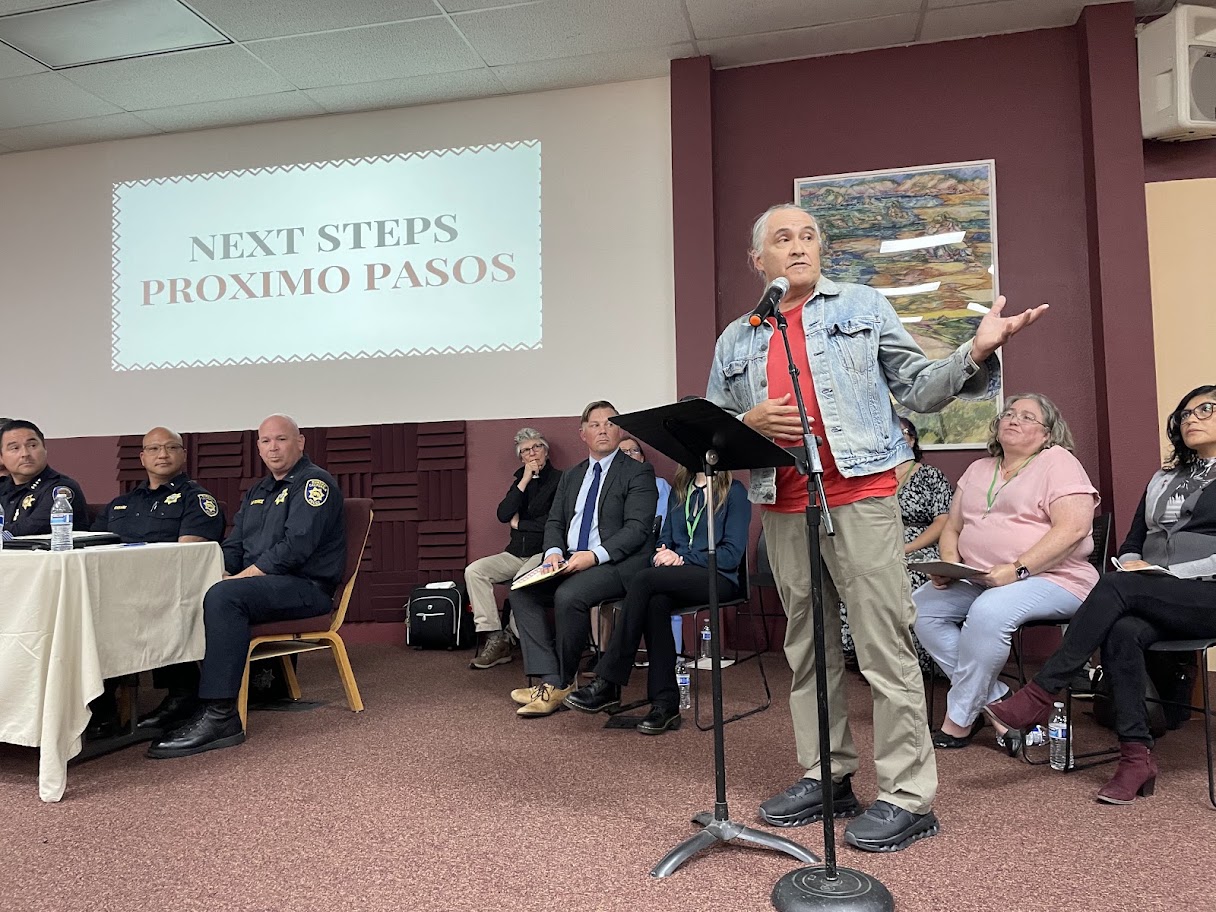
Terry Supahan, who noted his great-grandfather was stolen by federal agents and sent to an American Indian boarding school, urged attendees to not only think about the law, but to consider what is right and wrong.
Speaking of ICE raids in other parts of the country, “I expect this community to make sure that doesn’t happen up here,” said Supahan during his remarks.
“If somebody is treated poorly or unfairly — targeted, discriminated — it’s up to all of us to stand up for that person and listen to their story. Everybody has a story, and for me personally, as a follower of Jesus, loving my neighbor comes before immigration law,” said Tony Giraud, lay minister at the Church of the Joyful Healer and True North leader.
To learn more about planning for immigrant families, see resources on First 5 Humboldt’s website at this link.
CLICK TO MANAGE