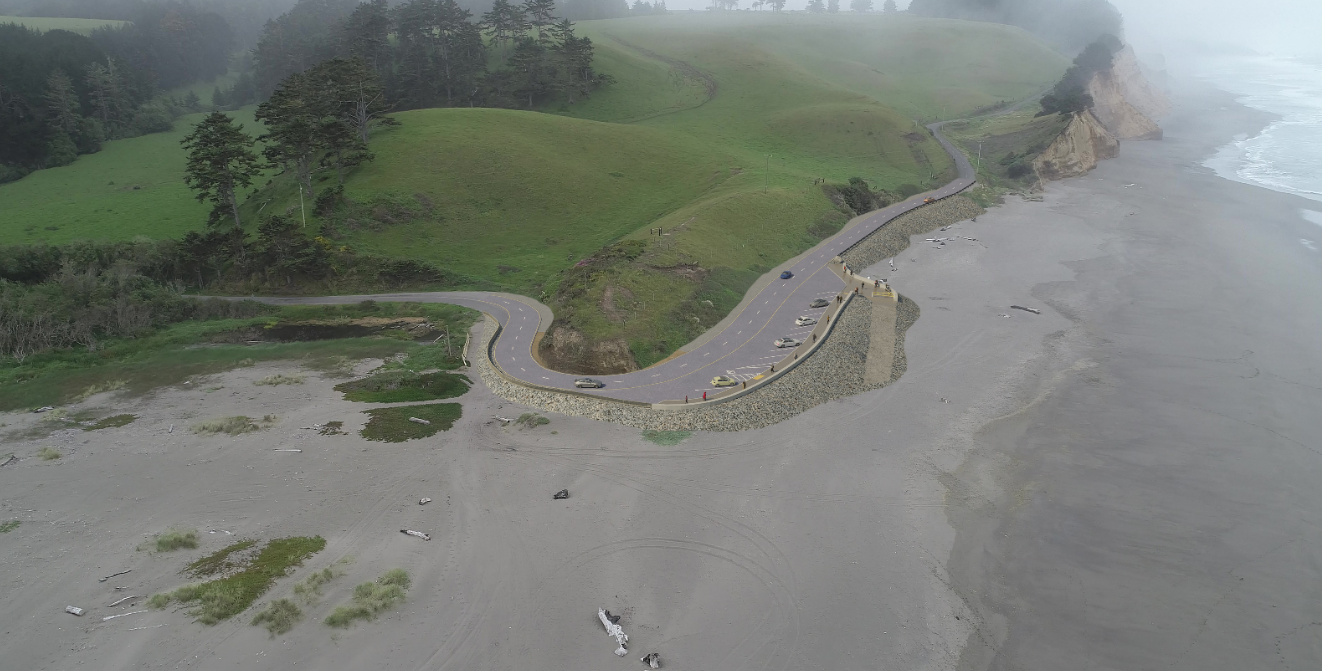
A visual simulation of what the project would look like, estimated to stop waves from hitting the roadway until 2050. A small parking lot, and access ramp for beach wheelchairs and emergency access, is also planned. | Rendering courtesy of Humboldt County Public Works.
###
Over the decades, the only way to reach Centerville Beach and miles of the Lost Coast has been gradually falling apart.
Ocean action and erosion have taken out a parking lot at Centerville Beach County Park. Sand, pushed by big ocean swells in winter, swallows the concrete on the tight and winding Centerville Road, requiring a county loader to clear the way most years.
“I don’t think it’s exaggerating to call it ground zero for dynamic coastal change along the coast of Humboldt County,” said Hank Seemann, deputy director of Humboldt County’s Public Works department.
These dynamic forces could soon cause the failure of a county road people use to access miles of breathtaking coastline, eight residences and agricultural land.
Humboldt County Public Works has been cooking up a project for years that would armor and raise part of Centerville Road while adding a 12-space parking lot. This is a stop-gap measure to keep the road intact while studying a longer-term solution.
The department has federal and state funding secured and a plan worked out, and hopes to tackle construction as soon as next year, if it’s approved.
But in order for the county to begin construction, the project needs approval from the California Coastal Commission, the government agency that regulates the Pacific coastline. And the Commission is looking for a couple changes — including a controversial requirement for Humboldt County to prohibit motorized vehicles from driving on the beach.
The Commission will hold a hearing on the project next week in Eureka.

Centerville Road in 2017, during a series of storms that prompted disaster road repair funding from the state and federal governments. | Photo courtesy of Humboldt County Public Works.
The road is particularly challenging for Public Works to plan for because of the dynamic geography, said Seemann. Centerville Beach, alongside a 180-degree turn in the road, seasonally shrinks by roughly 100 feet from summer to winter.
“High erosion rates coupled with the seasonal change in beach width change put the subject roadway at the project site at a very high risk of being damaged each winter by as early as 2030. Evidence suggests that the road is at severe risk of being destroyed by a combination of chronic retreat and storm driven erosion within the next five years,” according to a Commission staff report.
In a perfect world, the road would be rerouted to higher land. Public Works pursued this, but reached a block. Private landowners along a proposed alignment were not willing to provide right-of-way, at least at that time.
Still, with a possible catastrophic failure of infrastructure on the horizon, county staff landed on a solution to raise the road (in one section by nine feet) and shore it up.
The proposed parking lot and road would be armored along a length of 880 feet with rock, something that’s estimated to prevent waves from flooding the roadway until about 2050.
The County still wants to move the road inland, and would immediately need to start planning for the long term after building this project.
But getting funding, hosting discussions with community members and getting right-of-way from landowners would take a long time. Seemann estimated in a letter to Commission staff this would take at least 20 years to pull off.
“This project will buy time until we can continue working on a more permanent retreat alignment that will provide road access to that area,” said Seemann.
The notoriously unstable bluffs south of the park are another concern. A cliff that once hosted the Bureau of Land Management’s Fleener Creek trailhead nearby fell into the ocean in a 2024 landslide, taking much of a parking lot with it.
The project has an estimated construction cost of $3,932,893, coming mostly from federal and state emergency funds from a series of 2017 storms.
Given the instability of the land, Public Works wants to start as soon as possible.
“If the board decides to go forward with this project, then we would put it out to bid in early 2027 with the goal of constructing it next construction season 2027, and be complete before the winter of 27/28. So it’s going to have to hold up another winter, and there’s definitely uncertainty in terms of that area because it’s so dynamic,” said Seemann.
Coastal Commission staff want to maintain public access to the beach, noting that otherwise seasonal access of the segment of road is expected to be lost as early as 2030 and year-round access by 2050.
Staff are recommending approval, but are looking for a couple of conditions.
The Commission would require a Public Access Management Plan for gates and barriers to prevent motorized vehicles from driving on the beach.
Seemann said ending motorized vehicle access is a policy decision the Board of Supervisors should weigh in on, a proposed change that will likely spark differing opinions.
Coastal commission staff pointed to vehicles driving on sand and dunes, which hosts habitat for threatened western snowy plovers and sensitive native plants.
“There’s also been historic use of people driving at excessive speeds and trespassing, and impacting the dunes and private property,” said Seemann. County policy restricts driving to the wave slope, but in practice, vehicles are known to drive around everywhere, including private property and in sensitive dune areas.
But at the same time, he said, people have historically used the access point with ATVs and pickups. People drive to the ocean for perch fishing, hunting waterfowl and to have fun with their families.
Raquel Maytorena, a Ferndale resident and farmstand owner, is incensed the Coastal Commission would require the county shut out motorized access, something she likened to extortion.
She told the Outpost this morning people have been driving on the beach for generations. “I moved here in ‘95, and the first thing I did was buy 2 ATVs,” she said.
She said cutting off motorized beach access would hurt Ferndale’s economy, with visitors often staying in the historic town to fish on the beach. Locals often park their trucks, load gear into ATVs and drive down to the ocean to fish. “I’ve never seen anyone misuse the beach,” she added.
First District Supervisor Rex Bohn feels similarly.
“What they’re doing is solving a problem that is not there, for their own personal beliefs, I feel,” he said.
He said this is a major project for the county, and requiring the end of motorized beach access doesn’t feel right.
He expects a few people will be opposed to this at the Commission meeting.
“They always want to get their pound of flesh. Or their pound of sand, in this case. They want a pound of sand, and I want them to pound sand,” he said.
Other Commission conditions include a longer-term plan studying sea level rise, hazards and realignment options. The Commission would require the removal of the historic Centerville Beach Cross, a historical marker for the shipwreck of the SS Northerner in 1860.
Bohn said it’s unclear at this time where the cross will be moved — ideally somewhere near the beach, but otherwise in the city of Ferndale. The marker was previously moved in 2017 when the last site began eroding.
The Coastal Commission will consider the application for the Humboldt County Public Works Centerville Road Reconstruction Project in Eureka next week. Later, Public Works plans to bring the Commission’s conditions to the board of Supervisors.
The item will be heard at the Adorni Center for Wednesday, September 9th, beginning at 9:00 a.m.
Click here for the full agenda.

A 2026 photo of the park. | Photo via Public Works.
CLICK TO MANAGE