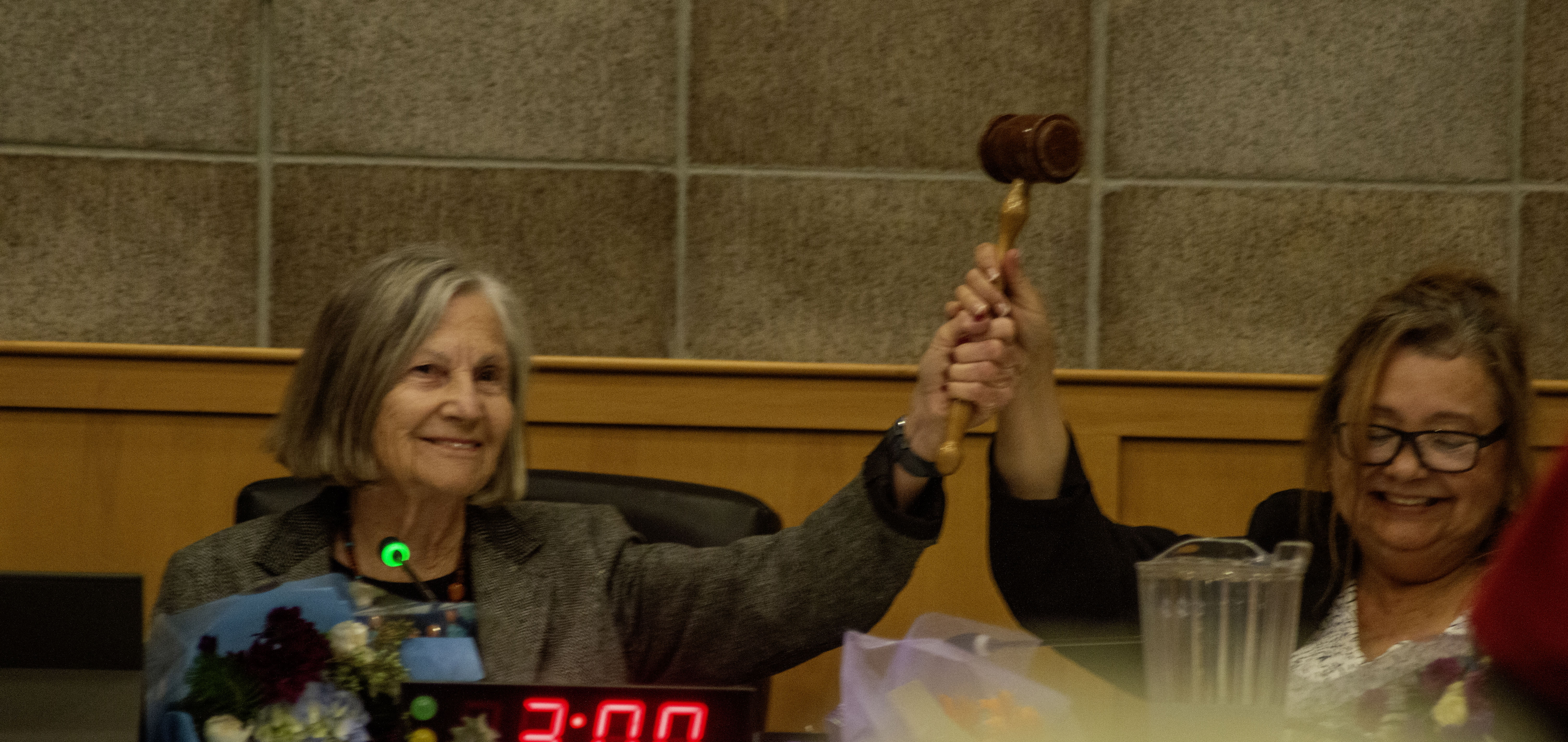
Alex Stillman, left, and Kimberley White exchanging the mayor’s gavel. By Dezmond Remington.
Arcata city councilmember Kimberley White got her flowers last night (both a bouquet and bountiful praise) when she was unanimously appointed to be Arcata’s new mayor at a special city council meeting.
“Kimberley, I’m so happy for you,” councilmember Sarah Schaefer said. “I’m so excited that you get to step into the seat and continue to do great things that we’re doing and bring your passions to the position of mayor as well.”
As the former vice mayor, Arcata’s rotational system all but guaranteed that she’d be the next mayor. In Arcata, it’s mostly a ceremonial position. They can:
Act as chair for every city council meeting;
Set agendas;
Declare special meetings;
And “facilitate discussion, gauge direction, and listen for majority support prior to calling a vote,” according to the city officials’ protocol manual.
The mayor does not possess any veto power. Mayors are allowed to make and second motions under California law, but, according to the city officials’ protocol manual, Arcata tradition discourages this.
Vice mayors step in as a replacement if the mayor is unable to attend a meeting, or if they resign the position.
As the councilmember with the most experience, Stacy Atkins-Salazar was appointed to be the vice mayor. She will (almost certainly) become Arcata’s next mayor next December, a position she last held in 2022.
White has served on the council since 2022, and is the only member on the council who hasn’t yet been mayor yet.
Councilmembers and public commenters also spent much time praising former mayor Alex Stillman, who told the Outpost several months ago 2026 would be her last year serving on the council. Stillman was the first woman to serve on the council when she was elected in 1972, and has served on-and-off since then: a total of 19 years on the council.
“I think your lifetime of service to Arcata might be unrivaled,” Atkins-Salazar said. “…And it’s through this assignment here that we got to know each other. And I appreciate you. You are such a generous and kind person, and I’m honored to be your colleague and serve with you and also to be a friend.”
After accepting the gavel and moving into the mayor’s seat, White listed off some of Stillman’s accomplishments and all of the years she was elected.
“Well, I would like to thank everyone for their kind words and for acknowledging me and my years of service,” Stillman said. “And now you can add it up and figure out how old I am.”
“Nevertheless, I really appreciate it,” she continued after the audience and the councilmembers stopped laughing. “I love Arcata. My mother always said, ‘Wherever you live, you have to give back to your community, no matter what.’ And I feel like that was a goal — my mother put that in my head, and I feel like I have done that…I really appreciate all of your kind words, and I’m not going to stop working for Arcata.”
Press release from the University Police Department:
On
Thursday, Dec. 4, 2025, at approximately 6:05 am, the University
Police Department (UPD) received a report regarding an unknown male
subject who had exposed himself and masturbated in front of two
female students in the forest on Granite Avenue Extension on campus.
Officers
responded and were unable to locate the suspect. During the
investigation, UPD discovered that the same subject had been
peering into multiple windows of a residence hall on campus.
24-year-old Victor Phetsomphou, who is not a student at Cal Poly
Humboldt, was identified as a person of interest in the incident.
On
Thursday, Dec. 11, 2025, UPD, with the assistance of the Arcata
Police Department, served a search warrant and an arrest warrant at
Phesomphou’s residence in Arcata. Several evidentiary items were
collected, and Phetsomphou was taken into custody without incident.
He
was transported to the Humboldt County Correctional Facility, where
he was booked on PC 314.1 Indecent Exposure; PC 185 Being Masked
While Committing a Crime; PC 647(a) Lewd Acts in Public; and PC 647
(J) (1) Peeping.
Phetsomphou’s
bail has been set at $85,000.
This
investigation is ongoing. If you have any information regarding this
case, please contact the University Police Department at (707)
826-5555.
Press release from the Humboldt County Sheriff’s Office:
On Dec. 11,
2025, at approximately 12:04 a.m., Humboldt County Sheriff’s
deputies were dispatched to a residence on Corbett Ranch Ln., in
Carlotta, regarding a domestic violence incident.
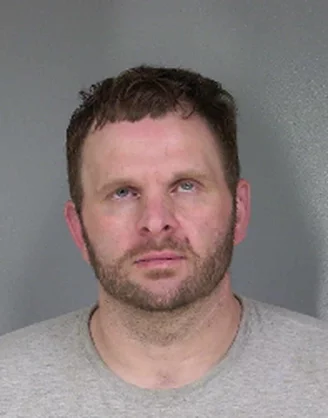
Miller. Photo: HCSO.
As deputies were
responding to the residence, the Humboldt Emergency Communications
Center advised the suspect, 37- year-old, Clayton Lloyd Miller, had
physically assaulted his 36- year-old girlfriend. A witness reported
the victim was able to escape from Miller and fled the residence in
her vehicle and that Miller fled the scene in a White Cadillac
Escalade.
Deputies
contacted the victim at the Kenmar Park and Ride in Fortuna and based
upon her statement and injuries, it was determined that the victim
had been violently assaulted over the previous 36 hours. Emergency
Medical Services responded to the scene and transported the victim to
a local hospital for treatment. She was treated for
non-life-threatening injuries.
Deputies
searched the surrounding area and Hwy 36 for Miller, but he and the
vehicle were not located. A county wide bulletin was issued for the
arrest of Miller.
At approximately
11:48 a.m., deputies were dispatched back to the residence after the
Humboldt County Emergency Communications Center received a report
that Miller had returned to the residence and physically assaulted
the female victim once again. Deputies were dispatched and Miller
fled the scene in the stolen white Cadillac Escalade onto Highway 36.
Deputies located
Miller driving the Cadillac on Highway 36 and attempted to conduct a
traffic stop. Miller refused to stop, and a vehicle pursuit was
initiated. Units pursued Miller east on Highway 36 until his vehicle
was unable to proceed any further within the slide construction zone
near Grizzley Creek. Deputies issued repeated commands for Miller to
exit the vehicle, but he refused to comply. He attempted to continue
to flee and rammed a patrol vehicle. A chemical agent was deployed
into the Cadillac and deputies were ultimately able to take him into
custody. He was arrested and transported the Humboldt County
Correctional Facility and booked on the following charges:
PC 273.5:
Domestic Violence
PC 245(a)(1):
Assault with a deadly weapon
PC 422(a):
Threaten crime with intent to terrorize
PC 549(b)(1):
Vandalism ($400 or more)
PC 236: False
Imprisonment
PC 1203.2 (a):
Probation Violation: rearrest/revoke
PC 243(e)(1):
Battery: spouse/ex-spouse/dating relationship
PC 646.9(a):
Stalking
PC 496(d)(a):
Possess stolen vehicle
VC 10851: Motor
Vehicle Theft
VC 2800.2(a):
Evade peace officer with wanton disregard for safety
VC 2800.4: Evade
peace officer/wrong way driver
VC 12500(a):
Drive without a license
Miller is well
known to local law enforcement and has been in numerous vehicle
pursuits and has committed many violent crimes within our community.
At the time of his arrest, Miller was on formal probation for some of
the same charges he was arrested for, along with being on CDC Parole
for more of the same charges. Due to this case being a serious
violent felony, and he is on parole for a violent offense, The
sheriff’s office has significant public concern and has elected to
release his booking photo.
The Humboldt
County Sheriff’s Office is dedicated to keeping our community safe
and will continue to prioritize public safety by taking as many
violent repeat offenders off the streets as possible.
Anyone
with information about this case or related criminal activity is
encouraged to call the Humboldt County Sheriff’s Office at (707)
445-7251 or the Sheriff’s Office Crime Tip line at (707) 268-2539.
This story was originally published by CalMatters. Sign up for their newsletters.
###
At a California State Senate committee hearing this year, the director of CalTrans, Tony Tavares, showed a simple chart that might have caused the assembled lawmakers some alarm.
It was a series of black bars representing the death toll on California’s roads in each of the past 20 years.
Fatalities had been falling until 2010, when the bars started getting longer and longer. A blood-red arrow shot up over the growing lines, charting their rise, as if to make sure nobody could miss the more than 60% increase in deaths.
“We are working to reverse the overall trend,” Tavares said.
No legislators asked about the chart. No one asked the director what, exactly, his agency was doing about it.
Over the next three hours, the Senate Transportation Committee members asked instead about homeless encampments along roads, gas tax revenue, gender identity on ID’s and planning for the 2028 Olympics in Los Angeles.
The chart presented by then-CalTrans Director Tony Tavares at the March 11, 2025 Senate Transportation Committee hearing.
The committee chair said it was the legislature’s first informational hearing on the state’s transportation system in more than a decade. Yet only two senators — both Republicans with little legislative power in a state controlled by Democrats — even asked about dangerous driving, one following up with questions about a deadly stretch of road in her district and the other about a small California Highway Patrol program to target egregious behavior behind the wheel.
Over the past decade, nearly 40,000 people have died and more than 2 million have been injured on California roads. As an ongoing CalMatters investigation has shown this year, time and again those crashes were caused by repeat drunk drivers, chronic speeders and motorists with well-documented histories of recklessness behind the wheel. Year after year, officials with the power to do something about it — the governor, legislators, the courts, the Department of Motor Vehicles — have failed to act.
The silence, in the face of a threat that endangers nearly every Californian, is damning.
California has some of the weakest DUI laws in the nation. Here, DUI-related deaths have been rising more than twice as fast as the rest of the country. But this fall, a state bill to strengthen DUI penalties was gutted at the last minute.
When it comes to speeding — one of the biggest causes of fatal crashes — again the legislature has done little. For two years in a row, bills that would have required the use of speed-limiting technology on vehicles have failed.
Lawmakers did pass legislation a couple years ago that allows the use of speed cameras. But it’s just a pilot project in a handful of jurisdictions.
Marc T. Vukcevich, director of state policy for advocacy group Streets For All, considers it a win — but a modest one.
“This shit is not enough to deal with the size and severity and the complexity of the problem we have when it comes to violence on our roadways,” Vukcevich said.
Erika Pringle, at right, embraces Allison Lyman, whose son died in a collision, during a candlelight vigil as part of The World Day of Remembrance for Road Traffic Victims at the Capitol in Sacramento on Nov. 16, 2025. Photo by Fred Greaves for CalMatters
Gov. Gavin Newsom declined an interview request. Last year, he vetoed a bill that would have required technology that alerts drivers when they’re speeding.
The state DMV, which is under his authority, has wide latitude to take dangerous drivers off the road. But it routinely allows drivers with extreme histories of dangerous driving to continue to operate on our roadways, where many go on to kill.
Steve Gordon, whom Newsom chose to run the agency in 2019, won’t talk about it. He has declined or ignored CalMatters requests for an interview.
The agency simply released a statement from him in March, after our first interview request, touting modernization efforts that reflect an “ongoing commitment to enhancing accountability and transparency while continually refining our processes to ensure California’s roads are safer for everyone.”
Neither Newsom nor Gordon has announced any major changes since then.
How a bill to fight DUIs fails in Sacramento
For a brief moment earlier this year, Colin Campbell thought the state might finally do something about the scourge that changed his life one night in 2019.
A repeat drunk driver slammed into his Prius on the way to the family’s new home in Joshua Tree, killing his 17-year-old daughter, Ruby, and 14-year-old son, Hart.
Campbell, a writer and director from Los Angeles, began advocating for California to join most other states and create a law requiring in-car breathalyzers for anyone convicted of a DUI.
At first he was encouraged when the bill coasted through two legislative committees. But then came the roadblocks.
The ACLU opposed the measure, calling it “a form of racialized wealth extraction,” according to a Senate Public Safety Committee report from July. In California, people forced to use the devices have to pay about $100 a month to a private company to rent them, though there’s supposed to be a sliding fee scale based on income.
Then the DMV told lawmakers that it could not “complete the necessary programming” for the law, citing possible technology delays and costs of $15 million or more.
The bill was gutted. California couldn’t do something that nearly three dozen other states could.
Campbell called the sudden reversal a shameful example of forsaking public safety for bureaucracy.
“Our lives were destroyed that night,” he said. “If these people’s children had been killed by a drunk driver, there is no way they would be objecting to this.”
Even if the law had passed, DMV data suggests that California judges would have mostly ignored it.
State law says judges have to require in-car breathalyzers for people convicted of repeat DUIs. Last month, the DMV issued a report reinforcing what a similar report laid out two years earlier. Judges across the state ordered the devices just one-third of the time for repeat offenders. In 14 counties, they ordered the devices less than 10% of the time for second-time DUI offenders. The counties are: Alameda, Colusa, Glenn, Lassen, Los Angeles, Madera, Mono, Plumas, Sacramento, San Luis Obispo, Santa Cruz, Sierra, Tulare and Yuba.
DMV officials did not answer questions about what, if anything, the agency was doing about it.
We reached out to all 14 counties’ courts. Only eight responded to questions.
Chris Ruhl, executive officer for the Glenn County Superior Court, said the court is looking at local changes.
“Given the light CalMatters is bringing to this issue … the Glenn Court will review its current DUI sentencing practices,” according to a statement.
Glenn was one of a number of counties — including LA, Alameda and San Luis Obispo — that also suggested it wasn’t their judges’ responsibility to issue a court order. They said they only needed to notify the DMV of the convictions.
However, the law is clear: It’s the judge’s job to order the offender to use the device, said Jerry Hill, the retired Bay Area Democrat who wrote the bill.
When he worked in the Capitol, Hill said he also saw little urgency to rein in intoxicated driving.
“If you ask any legislator, they are going to say it’s a terrible, terrible thing,” he said.
But he said committee chairs and staff members who set the tone and write analyses often shied away from increasing criminal penalties.
“That’s where we see a lack of understanding, in my view, of the devastating effect of drunk driving in California,” he said.
Lawmakers say next session could bring change
A number of lawmakers said they are aware of the carnage on our roadways and plan to do something about it this coming legislative session, maybe.
Sen. Bob Archuleta, a Democrat from Norwalk who sits on the Transportation Committee, lost his granddaughter to a drunk driver just before Christmas last year. He said he recently met with representatives from Mothers Against Drunk Driving and is considering possible bills.
“This is not a Republican issue, a Democrat issue, an independent issue — or political issue. This is a life-saving issue,” he said. “We should all take it as seriously as the family that lost a loved one.”
Democratic Assemblymember Nick Schultz of Burbank said he is considering introducing at least one measure next year to address loopholes and weaknesses in state law.
Schultz, who started his career prosecuting DUI cases in Oregon and now chairs the Assembly’s Public Safety Committee, said he is weighing several potential measures that would address issues CalMatters highlighted in its reporting this year, including lengthening license suspensions after fatal crashes, lowering the bar to charge repeat drunk drivers with a felony, strengthening breathalyzer requirements and making sure vehicular manslaughter convictions get reported to the DMV.
“People are tired of seeing the needless loss of life on our roadways,” Schultz said. “There’s no way to legislatively make someone make the right choice. But what we can do is create an incentive structure where there are consequences for bad decisions.”
In the absence of more leadership at the state level, road safety advocates — many of whom joined the cause after losing a loved one to a preventable car crash — are taking it on themselves to try to force change. They’re meeting with lawmakers and officials, holding public events, telling their stories.
First: At far right, Fumiko Torres speaks about losing Rayanna Diaz while standing alongside other family members during a candlelight vigil as part of The World Day of Remembrance for Road Traffic Victims event at the Capitol in Sacramento on Nov. 16, 2025. Last: Allison Lyman stands at a table honoring her son Connor, who was killed in a traffic collision, before the start of a candlelight vigil as part of the World Day of Remembrance for Road Traffic Victims at the Capitol in Sacramento on Nov. 16, 2025. Photos by Fred Greaves for CalMatters
Jennifer Levi started working with MADD after her son, Braun, was killed in May while he was out walking with friends in Manhattan Beach. She said they’d only recently relocated to the area after the family home burned down in the Palisades fire, destroying “all of Braun’s pictures, videos from when he was born.”
The driver who killed her son was allegedly intoxicated and had a prior DUI arrest.
“The worst day of my life is now my life’s work. I will not stop until California changes,” Levi said.
In the months since her son’s death, Levi said, she’s met with any officials or influential people she could — current and former lawmakers, district attorneys, local council members, a lobbyist, and members of the media. Among the changes she wants: to make it easier to charge repeat DUI offenders with murder when they kill someone, to make fatal DUIs a violent felony and to increase penalties for hit-and-run fatalities. As CalMatters reported in October, California law often treats drunken vehicular manslaughter as a nonviolent crime with minimal time behind bars.
Levi calls her push to reform the system “Braun’s Bill.”
Many grieving families share a similar goal: for those they lost to be remembered by a state and society that seem indifferent. That desire was on display last month during an event in Sacramento to mark the World Day of Remembrance for Road Traffic Victims.
On a cold Sunday evening in mid-November, after a break in the rain, dozens of relatives of people killed in car crashes gathered on the dark steps of the state Capitol for a candlelight vigil. They fought to keep photos on posterboards upright in the gale-force winds. Family by family, they ascended the steps, stood above a display of orange cones lit with strands of white lights and addressed the onlookers, talking about their loved ones and what was lost — children left without their mother, mothers without their children, a wife left without the love of her life.
“Every day I live and I wake up and I pretend like I’m happy. Every day I wish my stairs would make noise. I miss being called mom,” said Angel Dela Cruz, whose 17-year-old son Edward Alvidrez Jr. was hit by a truck while riding a dirt bike in Madera County in 2022.
“I hope we all get justice,” she said.
The event ended with a moment of quiet reflection and a prayer before the families put away their pictures and walked off, the Capitol behind them locked, silent.
This story was originally published by CalMatters. Sign up for their newsletters.
###
President Trump signed an executive order today to discourage state governments from regulating artificial intelligence and urge Congress to pass a law preempting such regulations.
The order is likely to hit hardest in California, which since 2016 has passed more laws to regulate artificial intelligence than any other state, according to a Stanford report from earlier this year. California is also home to the world’s leading AI companies, including Anthropic, Google, Nvidia, and OpenAI.
Trump’s order would require the heads of the Federal Communications Commission, Federal Trade Commission, and Department of Justice to challenge state AI laws. It also calls for the development of model AI legislation to preempt or supersede state law unless those laws address children’s safety, data center infrastructure, state government use or AI, or other yet-to-be-determined areas.
For states that continue to regulate AI, the order instructs federal agencies to explore whether they can restrict grants to them, including by revoking funding known as Broadband Equity, Access, and Deployment. California has a potential $1.8 billion in broadband funding at stake, much of which was committed to specific projects earlier this month and is set to deliver internet access to more than 300,000 people.
In a social media post earlier this week and remarks from the Oval Office today, Trump said the executive order was written to prevent businesses from needing to comply with laws from multiple states and that having to do so threatens America’s competitive advantage over other nations. Investors in tech startups, such as the Menlo Park venture capital firm Andreessen Horowitz, have urged the president to restrict state AI regulation and celebrated the president signing the order.
Trump’s order specifically criticized a Colorado law that requires testing and disclosure of AI that makes consequential decisions about people’s lives and seeks to prevent discrimination, a standard California lawmakers may revisit next year.
Among recently-passed California laws that federal agencies may challenge are:
A requirement that the makers of AI supply the public with tools to identify AI-generated photos, videos, and audio so that they can better spot fakes.
Members of Congress routinely call California an example of AI regulation run amok, but lawmakers from both major parties have supported regulating AI, with more than 70 laws passed by 27 states this year, according to a report by the Transparency Coalition. California again led the nation with the passage of roughly a dozen laws as Texas, Montana, Utah and Arkansas followed with the most AI bills signed into law this year.
The executive order comes on the heels of a second attempt in Congress to preempt state AI laws, which fell short last week. Republican members of Congress first attempted to ban AI regulation by state governments for 10 years this spring, an initiative derailed in part by concerns about the fate of a law that protects country music musicians in Tennesse and others that seek to block child sexual abuse material.
Polls show Californians and Americans support AI regulation. A Carnegie Endowment California poll released in October found that nearly 80% of Californians strongly or somewhat agree that, when it comes to AI, safety should be prioritized over innovation. A September Gallup poll also found that four out of five Americans want lawmakers to prioritize safety over innovation, even if that means the technology is developed more slowly.
In addition to endangering the lives of children, artificial intelligence can lead to false arrests, discriminate against job applicants and employees and deny people government benefits or health care that they’re entitled to. The technology is also power hungry, potentially driving up electricity rates and endangering clean energy goals. It also needs large amounts of fresh water for the cooling systems in data centers. Center for Biological Diversity, an environmental group that sued to stop a California data center project one year ago, called the executive order an early Christmas gift to big tech
Opponents of the executive order say it leaves Californians vulnerable to harm.
“Make no mistake: this order doesn’t create new protections, it removes them. That’s not governing. That’s a dereliction of duty wrapped in yet another distraction from a fracturing MAGA movement and a president who doesn’t understand the real dangers of rapidly advancing tech,” State Sen. Tom Umberg, a Democrat representing Santa Ana, said in a statement last month, when a draft of the executive order leaked to the press.
In the California Legislature enthusiasm for regulating AI shows little sign of abating. More than 100 film industry workers from groups like the Animation Guild and SAG-AFTRA showed up at a committee hearing earlier this week about protecting the work of creatives. Many spoke in support of a bill requiring AI companies to disclose what copyrighted material they use to train their models.
Animation Guild president Danny Lin said at the hearing that AI threatens nearly 40,000 jobs in California’s film, television, and animation industries.
“L.A. is bleeding out before my very eyes,” Lin told state lawmakers.
In response to the executive order Lin told CalMatters calling out a Colorado law that seeks to prevent discrimination and protect working class people doesn’t give her confidence that the legislation the president is calling for will address the concerns of creatives whose work is used to train generative AI models.
“It’s pretty apparent that if we had a federal government that was actually focused on regulating this technology then the states would not feel the need to step in and create state specific legislation,” she said.
An administrative draft of an updated Regional Transportation Plan produced by the Humboldt County Association of Governments shows how all references to “climate crisis” have been changed to say “climate change.”
That’s HCAOG’s main deal: transportation. It’s a Joint Powers Authority comprising the County of Humboldt and all seven of its incorporated cities (Arcata, Blue Lake, Eureka, Ferndale, Fortuna, Rio Dell and Trinidad). And the guiding document for HCAOG’s governing board on this front is the Regional Transportation Plan.
As a policy document, the RTP guides transportation priorities and funding decisions, influencing everything from road maintenance and safety improvements to public transit, bike and pedestrian facilities and planning for zero-emission vehicles, as HCOAG explained in its recent press release.
While that may sound like the greenest of environmental agendas, local enviro group leaders are raising a skeptical eyebrow toward HCAOG after getting a look at the latest Regional Transportation Plan draft.
The RTP gets updated every four years, and HCAOG recently released a draft of its latest version, which has been given the zippy title, “Varieties in Rural Options of Mobility (VROOM) 2026 – 2046.”
The public comment period on this document is now open, and will remain so until Monday, Dec. 29. An HCAOG official tells us that an online survey — accessible through this link — had received only 100 responses through Wednesday afternoon, and the agency is urging more people to weigh in.
“Community input — whether made in-person, by email, or through the online survey — will directly inform strategies to make travel safer, more efficient, and more accessible for everyone but especially for vulnerable users such as seniors, youth, people with disabilities, pedestrians, bicyclists, and transit riders,” the agency said.
The draft plan identifies more than $1 billion in funding needs for local streets and transportation infrastructure projects such as road rehabilitation, trails, bridges, interchanges, roundabouts and bike lanes. The agencies of HCAOG hope to increase the frequency and availability of public transportation and modernize the fleet of public vehicles.
So why are environmental groups upset? Because, for one thing, the new draft of the RTP eliminates every prior instance of the phrase “climate crisis.” As shown in the image above, each reference to “crisis” has been crossed out and replaced with “change.”
While that editorial choice may strike many as subtle, groups including EPIC (the Environmental Protection Information Center), CRTP (the Coalition for Responsible Transportation Priorities) and 350 Humboldt all see it as a rhetorical downgrade that minimizes the urgency of human-caused climate upheaval. And they say there’s evidence to support that argument elsewhere in the document.
Screenshot of another edit to the RTP’s wording.
“The watering down of the plan’s language is matched by backsliding on Safe and Sustainable Transportation,” the groups say in a joint press release issued yesterday. “The plan proposes an unnecessary and harmful delay to HCAOG’s target for the construction of non-car-dependent housing, as well as delays to electric vehicle charging station targets and other needed climate actions.”
The groups identified a more fundamental concern, too: The new plan would eliminate a policy calling for “project funding consistency.”
“In other words,” they say in their press release, “HCAOG is removing the only policy that held it accountable for the projects it funds being consistent with its own climate and safety goals. Without implementation, a plan is just words on paper, and funding consistency is one of the key reasons for a regional transportation plan to exist. To ensure that the region’s transportation projects save lives and help stabilize the climate, HCAOG must put its money where its mouth is.”
As for the edits to terminology, an HCAOG staff report on the draft RTP acknowledges switching all references of “Climate Crisis” to “Climate Change.” It says that change was recommended by the authority’s Transportation Advisory Committee “based on [a] desire to use more conventional language.”
The Outpost recently emailed HCAOG Executive Director Brendan Byrd for more information. He stressed that, since this is a draft document, the change is only a potential revision. He also elaborated on the reasoning proffered by the technical committee members thusly:
[O]ne of our committee’s recommended that the Board consider the change from ‘Climate Crisis’ to ‘Climate Change’, the thought being that ‘climate change’ is more conventional/familiar language, is more consistent with other planning documents, and that the wording may reach or speak more directly to a broader cross section of our many stakeholders as we seek to address this critical issue through our RTP.
Colin Fiske, executive director of CRTP, said in an email to the Outpost that he doesn’t think this explanation stands up to scrutiny. From Fiske:
The claim that “climate crisis” is not conventional/familiar language is contradicted by its widespread use in documents and public statements from local, state, national, and international agencies for the last several decades. It’s become so common in recent years that the current AP style guide recognizes it for use in news coverage.
The claim that it is more “consistent” with other documents to omit the term “climate crisis” is curious, since it’s never been specified which documents it should be consistent with and why such consistency in language would matter. Furthermore, terms like “climate change,” “global warming,” “climate crisis,” and others are all commonly used in planning documents at all levels. …
The claim that the term “crisis” is polarizing and doesn’t appeal to all stakeholders deserves a little more consideration than the other two justifications, but in the end doesn’t make much sense either. Polarization on this issue has already reached such a point that the federal government is literally scrubbing all references to climate science from federal documents and websites, no matter what terms are used. Will HCAOG’s next move be to follow suit and erase all references to climate in local government documents to pander to federal science deniers? Euphemisms can only get you so far. In the end, we have to acknowledge reality, and the reality is that climate change is a crisis of massive proportions.
The biggest problem here is that HCAOG has for years accurately acknowledged the climate crisis, and now wants to reverse itself. That decision is even more damaging than other documents and agencies that fail to use the word “crisis” in the first place, because it suggests to the public that:
(a) climate change used to be a crisis, but isn’t anymore, which is the opposite of the truth; and/or
(b) that HCAOG isn’t taking climate as seriously as it once did.
The link at the end, there, takes you to a letter to HCAOG leadership from the three environmental groups.
To reiterate, HCAOG is inviting local residents to submit their own feedback on the draft RTP. Here, again, is the link to the draft document, and here’s the link to the community survey.
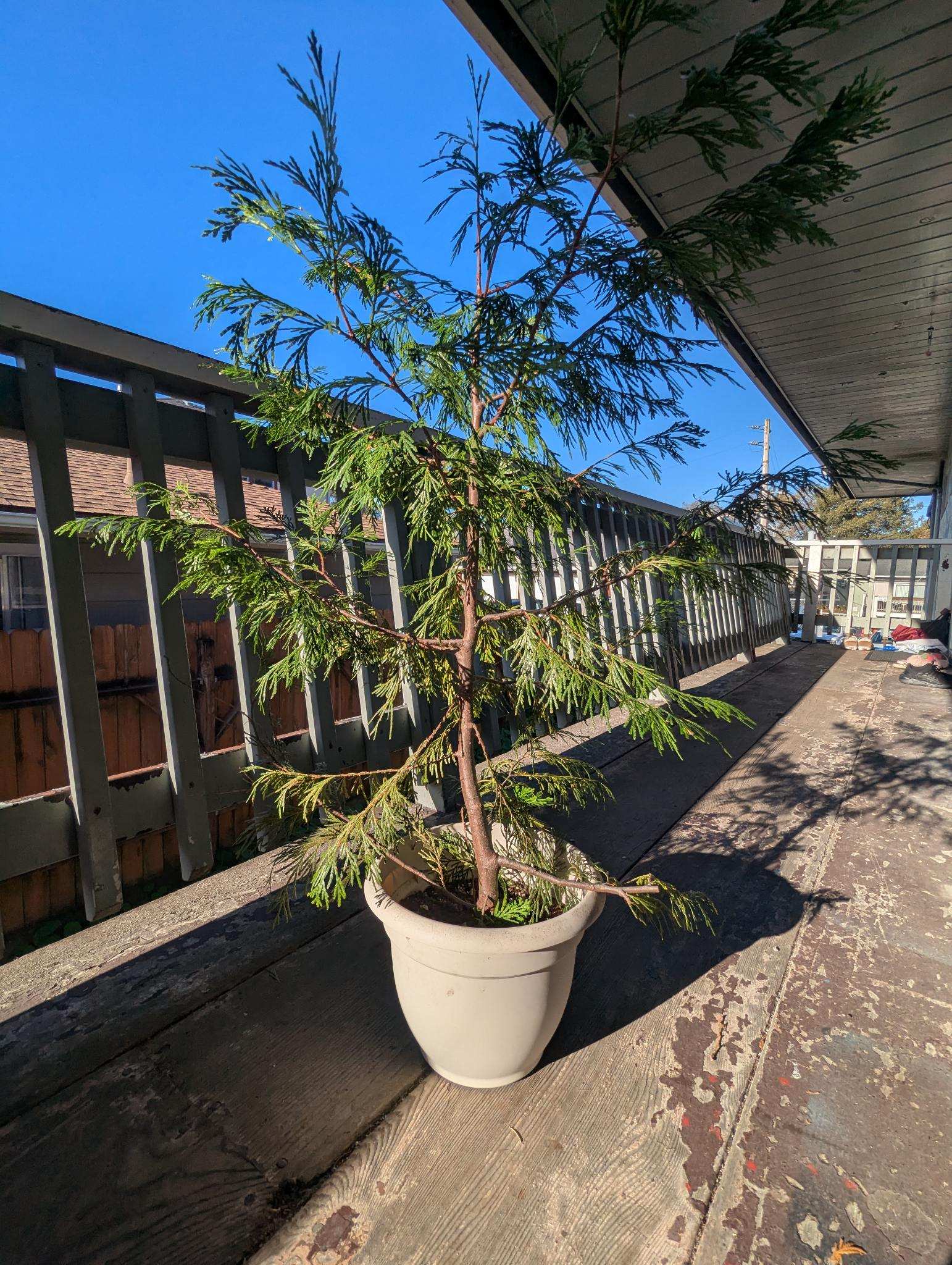
My own rinkydink Douglas Fir I reaped from Horse Mountain last weekend. Photo by Shea Daly.
Lotta trees in them there hills. They’re blanketed in the things, and this time of year, when every good girl and boy get a yen to put some of the outside inside, people flock to them like ants to a picnic to carry off some prime specimens.
In fact, if you bought a permit and went out there sometime in the last couple weeks and harvested yourself a tree, you bought one out of 2,649 Six Rivers National Forest Christmas tree-cutting permits the Forest Service has sold since they went on sale in November, according to a Forest Service spokesperson who talked to the Outpost today. (If you haven’t bought a permit but want to, get one here.)
To cut a tree down, it must have a diameter smaller than six inches and be farther than 100 feet away from a paved road or 50 feet from a dirt road. Just cutting the top off of a tree isn’t allowed. There are also some areas you’re not allowed to take from, so make sure to consult the maps on the webpage linked above before you go.