

OBITUARY: Michele ‘Mickie’ Harris, 1956-2026
LoCO Staff / Monday, Jan. 26 @ 7:39 a.m. / Obits

Michele “Mickie” Harris
November 13, 1956 – January 1, 2026
Michele “Mickie” Harris passed away peacefully on January 1, 2026, after a second courageous battle with cancer. She was at Stanford Hospital in Palo Alto, California, surrounded by family, and with her daughter by her side in the final moments.
Michele was very particular about her name, always insisting that Michele had only one “L,” and Mickie was “ie” not “ ey” like Mickey Mouse, a correction she made often and with humor. True to form, she even made sure those caring for her at Stanford corrected the spelling, giving everyone a laugh along the way.
Michele was born on November 13, 1956, in Scotia, California, to Prudence Versell Baker and Everett Harris. As a young child, she lived in Redding, California, before moving back to Bridgeville in the mid-1960s. She later graduated from Fortuna Union High School in 1974.
After high school, Michele attended DeVry Institute of Technology in Phoenix, Arizona, at a time when the computer industry was just emerging. That experience later led her to Sunnyvale, California, where she became one of Apple’s earliest employees, working with a small team assembling early Apple computers during the company’s formative years. Michele later returned to Humboldt County, where she met Robert. Together, they had one daughter, Alexis.
Michele devoted many years to caring for others in the medical field, including at Eureka Internal Medicine and later Redwood Urgent Care in Eureka, California. She deeply valued her longtime boss, Steve Mielke, and the coworkers who became like family to her and her daughter. She loved her patients and the connections she made through her work. Out of respect and care, she often left messages in obituary sections when former patients passed, honoring their lives and the bonds she had formed.
Suntan Glen and the river were home to Michele.She preferred a quieter life and felt most at home along the river.
She was a member of Jobs’s Daughters, which, to her youngest brother Chip, appeared highly suspicious. From his point of view, it involved long dresses, secret meetings, and climbing stairs into a room above Sequoia Gas, leaving him convinced for years that she had joined a cult. He has never fully ruled it out.
Family relationships were central to Mickie’s life. She and her brother Scooter were known as the “Gerber Babies,” picture perfect and inseparable. As they grew older, they argued like the Hatfields and McCoys, loud and relentless, but always out of love. Their bond bent, but it never broke.
Michele was a fantastic cook, well known for feeding family, friends, and anyone who happened to be nearby. She was a loyal and enthusiastic supporter of family sporting events, rarely missing a game. Her presence was unmistakable, thanks in part to her legendary whistle. It echoed through river valleys and gymnasiums and cut through packed crowds like a train horn. Everyone could hear it .
She was also an exceptional swimmer, moving through the river like a dolphin, fast and effortless, impossible to keep up with. She taught her daughter and many of the kids of Suntan Glen how to swim. Many learned before the age of four to swim in deep water without floaters because of her love for water ,and the importance to know how to swim if living near a lake, river or pool . She taught everyone a life lesson in team work if things went wrong.
Michele loved music and movies and was a hippie at heart. Her youngest brother Chip would often call her from concerts just to let her hear the music through the phone, knowing she would understand without a word spoken.
She had a fondness for collecting socks, the brighter and more mismatched the better, and enjoyed collecting fossils along the river. She loved to dance and sing, even if she wasn’t especially good at it, which only made it more endearing to those who knew her best.
As a mother, Michele was deeply devoted and supportive. Many of her daughter’s friends even called her “ Mom” or “ Lexi’s Mom.” If there were an “above and beyond” in motherhood, Mickie met it every day . She believed it took a village to raise a child and raised her daughter largely on her own with the help of a network she formed in order to work and provide.
Michele was deeply loved and will be greatly missed. She will be remembered for her smile, kindness, generosity, humor, heart, and especially, for being supportive and a great mother and role model.
She was preceded in death by her parents, Prudence Versell Baker and Everett Harris, along with other loved ones who went before her.
She is survived by her daughter, Alexis “Lexi” Harris (Ramer); her siblings Curtis “Scooter” Harris, Paige Harris (Asbury), and Marvin “Chip” Stewart; and many nieces, nephews, extended family members, and longtime friends.
A Celebration of Life will be held at a later date to honor both Michele and her mother, Prudence Versell Baker. Prudence passed just 7 months prior.
The family extends a sincere “ Thank you “ to the many care teams , physicians and doctors who cared for Michele with compassion and humor during her final journey.
A GoFundMe titled Honoring Michele Harris’ Life and Legacy has been established for those who wish to contribute toward Celebration of Life and final arrangements.
Mahalo and God Bless.
###
The obituary above was submitted on behalf of Mickie Harris’s family. The Lost Coast Outpost runs obituaries of Humboldt County residents at no charge. See guidelines here. Email news@lostcoastoutpost.com.
BOOKED
Today: 8 felonies, 8 misdemeanors, 0 infractions
JUDGED
Humboldt County Superior Court Calendar: Today
CHP REPORTS
623 Mm101 N Hum R6.20 (HM office): Trfc Collision-No Inj
ELSEWHERE
KINS’s Talk Shop: Talkshop October 12th, 2026 – Michael Davies-Hughes
RHBB: Prepare for El Niño Impacts
RHBB: City of Arcata Auctioning Off Surplus Assets
RHBB: Fire Near Broadway and Henderson in Eureka Closed Northbound Highway 101 Temporarily
OBITUARY: Ruth Villier, 1931-2026
LoCO Staff / Monday, Jan. 26 @ 7:32 a.m. / Obits

Ruth Villier passed away on January 16, 2026, less than one month after her 94th birthday. She was the last surviving member of her generation in our family.
Margaret Ruth Neathery Schieberl Villier was born on December 25, 1931, in Sulphur, Oklahoma, to Bert Elmer Neathery and Frances Bertie “Tommy” Garrison Neathery. A few years later, they welcomed their son, Robert Lee “Bobby” Neathery.
In the early 1940s, the Neathery family moved from Oklahoma to California in search of a better life, settling in Santa Rosa. It was there, at just 16 years old, that Ruth met the handsome Ed Schieberl. They were married on December 4, 1949.
While Ed served on the front lines during the Korean War, Ruth remained in San Leandro, California, caring for their three young children—Ted, Jan, and Mike. In 1956, Ed followed his oldest brother to Humboldt County to work for the Al Nicholson Scale Company, and Ruth faithfully joined him as they began a new chapter together.
With true pioneer spirit, Mom and Dad built their first home on Greenwood Heights in the mid-1950s. A few years later, with Margie and Lucie added to the family, they built their final home on Myrtle Avenue in Eureka. During this time, Ruth cared for the household while also managing the bookkeeping—and occasionally running heavy equipment—for their newly formed business, Green Bay Scale Company. She continued this work until 1981.
Ruth was deeply involved in her children’s education. She volunteered regularly at Freshwater School as a classroom aide, brought snacks, helped teachers, and supported students in countless ways. Even after her own children moved on, she continued volunteering—first in kindergarten classrooms and later as an associate librarian. She was entrusted with some of the school’s first personal computers, which she took home, taught herself to use, and then taught others. At home, she discovered a fondness for Solitaire, which became a bit addictive. She also helped run voting booths during official elections and, alongside Ed, belonged to local horseshoe-pitching and square-dancing clubs. Mom loved to dance.
Ruth had a lifelong love for dogs, especially poodles and German Shepherds. She had many over the years, but two held special places in her heart. After Ed passed away in 1987, her German Shepherd Baron became her lifeline—getting her out of bed each morning and helping her through deep grief. Later, she welcomed a teacup poodle named Harley, who was rarely far from her side. They adored each other.
Ruth’s parents were deaf, and she served as their lifelongRuth Villier interpreter and liaison to the hearing world. She learned to speak by listening to the radio. In the 1960s and 1970s, she was a founding member of the H.I.G.H. Club (Hearing Impaired of Greater Humboldt) and was always available to assist the deaf community. She served as an on-call interpreter for courts and hospitals and taught American Sign Language courses at College of the Redwoods. She accomplished all of this without formal higher education—only grit, compassion, and life experience.In the early 1980s, Ruth traveled with her father, Bert Neathery, to Greece and Germany to attend the Oberammergau Passion Play, a once-in-a-lifetime experience she treasured.
After losing the love of her life in 1987, Ruth met life’s challenges with strength, poise, and dignity. She continued working at Freshwater School as paid staff and later found great joy when her grandchildren attended the school and she was able to see them daily.
In the early 1990s, Ruth met Vern Villier at a singles dance. They married, she sold the family home on Myrtle Avenue, retired from the school, and began a new chapter. Together, they stayed active volunteering at the Arcata Police Department, participating in the Model A Club and the Moose Lodge, and attending many social outings. Ruth especially loved dressing in period costumes for dances.
Many in the McKinleyville area knew Ruth and Vern through Ben Hurd’s Tree Farm, where they baked enormous quantities of cookies and often worked behind the cash register during the busy weeks before Christmas.
Ruth’s greatest love was her family. She is survived by her five children: Ted, Jan, Mike, Margie, and Lucie.
- Ted (Alice): Kevin and Sarah, and two great-grandchildren
- Jan: Lorraine, Olivia, and Clint, and two great-grandchildren
- Mike (Karen): Clarissa, Lilly, and Rachel
- Margie (Dave, deceased): Maricica and Timothy, and two great-grandchildren
- Lucie (Randy): Kathryn, Bethany, Leslie, Alex, Roger, Juliana, and Deborah, and 22 great-grandchildren
In total, Ruth leaves behind 17 grandchildren and 28 great-grandchildren—so far.
Whenever we spoke with Mom, she always wanted to know how her family was doing. She lovingly called us “her many blessings.” “She called us her blessings, but she was ours.
In every act of kindness, every quiet sacrifice, every moment she chose love, she shaped who we are. Though we say goodbye today, we carry her with us— in our hands, our hearts, and in the family she built so well. To be loved by her was one of life’s greatest gifts.
A memorial service for Ruth will be held on January 31st 2026 in Arcata, CA. To RSVP for catering purposes and location details, please email: ruthschieberlvillier@gmail.com
###
The obituary above was submitted on behalf of Ruth Villier’s family. The Lost Coast Outpost runs obituaries of Humboldt County residents at no charge. See guidelines here. Email news@lostcoastoutpost.com.
PHOTOS and VIDEO of Sunday’s ‘ICE Out’ Protests in Eureka and Ferndale
Ryan Burns / Sunday, Jan. 25 @ 4:51 p.m. / Politics
###
Hundreds of people turned out to the latest “ICE Out” protest in Eureka today. The event was quickly organized after Border Patrol agents shot and killed 37-year-old nurse Alex Pretti in Minneapolis Saturday morning. That killing came just 17 days after ICE agents shot and killed 37-year-old Renée Good.
There was also a demonstration down in Ferndale. Lost Coast Communications Inc.’s own Janet Carney submitted a few photos of that event, which you’ll find below the following shots of the Eureka protest by LCCi’s Shane Mizer.


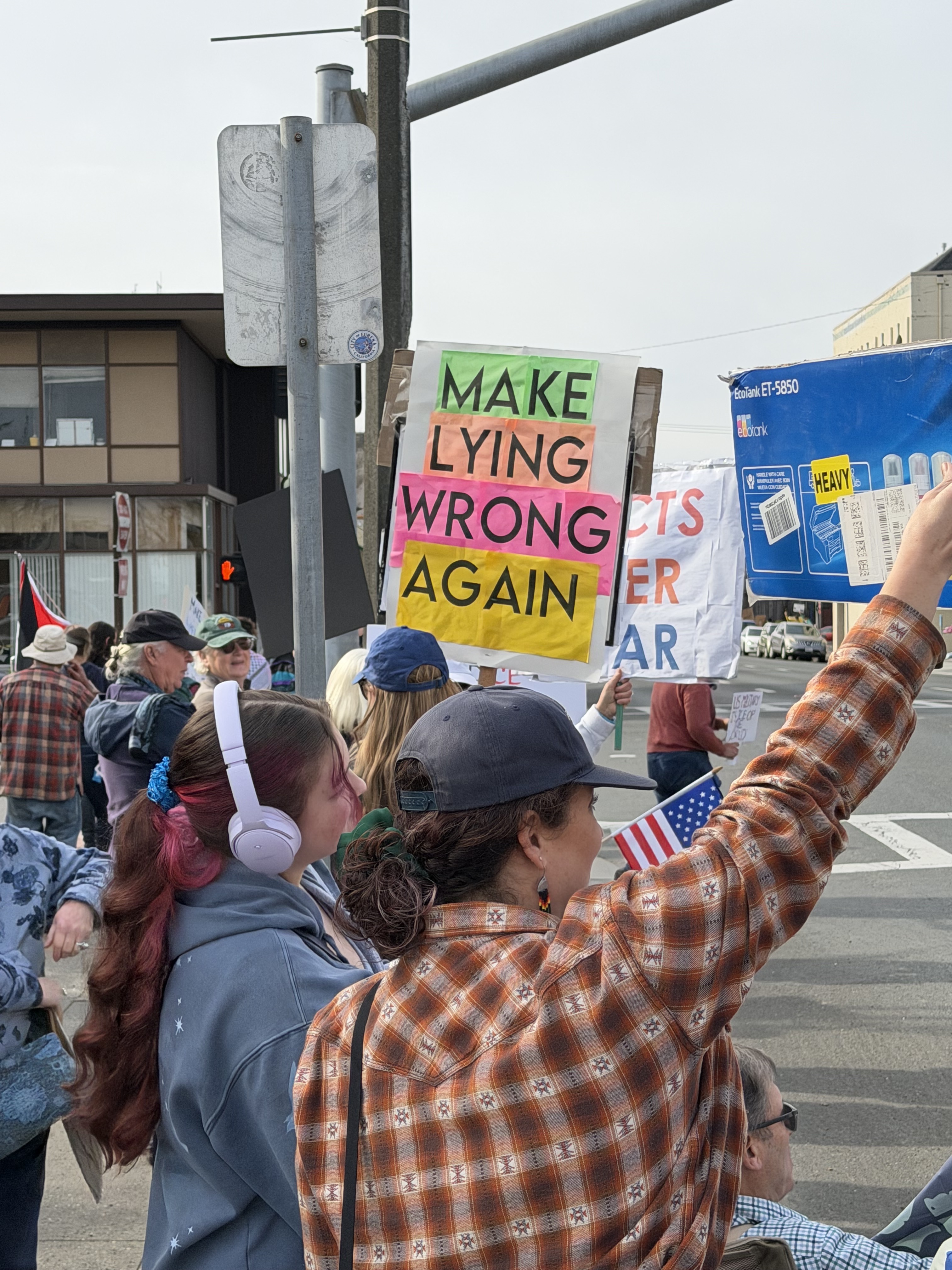
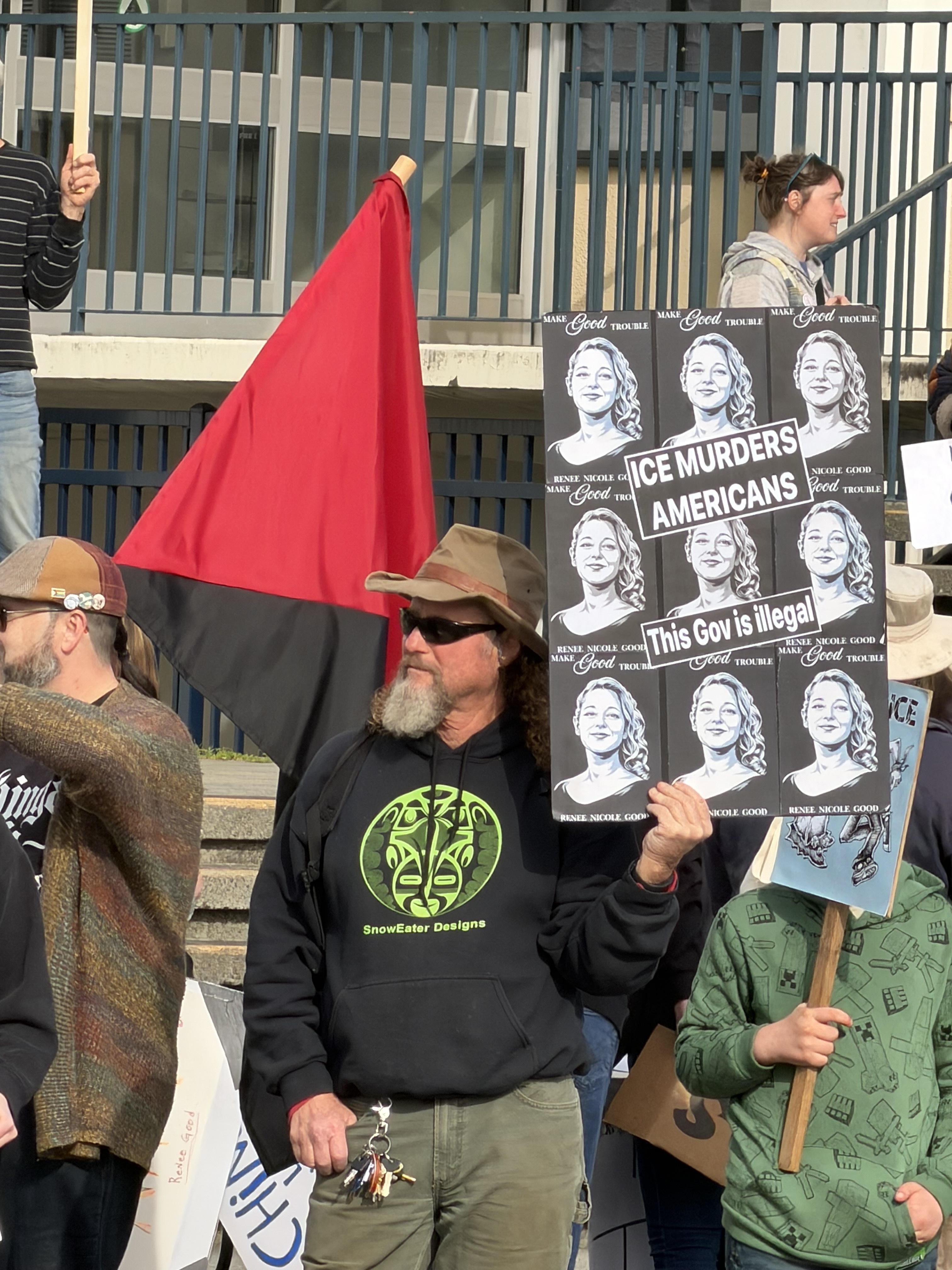


And from Ferndale:


House Lost to Fire in McKinleyville Today; Investigators Determine Arsonist to Blame
LoCO Staff / Sunday, Jan. 25 @ 11:47 a.m. / Fire
Press release from the Arcata Fire District:
At approximately 4:07 a.m. on January 25, 2026, units from the Arcata Fire District, Fieldbrook Fire Department, and CAL FIRE Trinidad were dispatched to a reported residential structure fire in the 2700 block of Martin Road in McKinleyville.
Humboldt County Sheriff’s Deputies patrolling the area notified the CAL FIRE Emergency Command Center that the structure was well involved, with a partial roof collapse occurring prior to the arrival of fire units.
The first-arriving Arcata Fire District engine encountered heavy fire in the front half of a vacant structure, with flames extending into the attic. Portions of the roof had already collapsed, and additional sections were actively failing.
Firefighters initiated an exterior attack and quickly knocked down the main body of fire. Crews then transitioned to interior operations to extinguish remaining hot spots and confirm the structure was unoccupied.
The fire was brought under control within approximately 20 minutes. Fire investigators determined the cause of the fire to be arson. The investigation remains ongoing. Anyone with information related to this incident is encouraged to contact the Arcata Fire District at (707) 825- 2000.
No injuries were reported.
The vacant structure was deemed a total loss, with damages estimated at approximately $200,000.
The Arcata Fire District would like to thank its partner agencies for their assistance and cooperation during this incident.
PLAN AHEAD! The Samoa Bridge Will Be Closed for the Next Few Nights to Accommodate Bridge and Broadband Work
LoCO Staff / Sunday, Jan. 25 @ 8 a.m. / Traffic

You shall not pass (between 8 p.m. and 6 a.m. til Jan. 29)! | Photo: Caltrans District 1
###
Notice from the Caltrans District 1 Facebook page:
Route 255 in Eureka is scheduled to be closed overnight from 8 p.m. to 6 a.m., beginning Sunday evening, Jan. 25, and wrapping up Friday morning, Jan. 30. The closure will be in effect from U.S. 101 (Fourth Street) to just south of Woodley Island, with a turnaround available for southbound travelers heading toward Eureka.
Crews will be conducting bridge and broadband work during the overnight hours. Due to the nature of the work and the limited space available to keep workers safe, a full closure is necessary rather than one-way traffic. Travelers should plan accordingly. U.S. 101 is available as a detour.
###
HUMBOLDT HISTORY: Las Memorias del Gran Fuego — My Immigrant Family Lived in the Dean Victorian When it Caught Fire
Maria Romero Delaney / Saturday, Jan. 24 @ 7:30 a.m. / History

Although Joe and Teresa Romero (who were married in 1948) retired to Guadalajara in 1964, the Victorian still remains in the family, lovingly cared for by Dominga Cabrera’s grandson. Photos via the Humboldt Historian.
###
The dramatic story of the house once known as the “Dean Victorian,” after its architect, began in 1895 when it was towed on a barge across Humboldt Bay from Arcata to Eureka by its original owner.
One of my earliest recollections is of a second dramatic event in the life of that Victorian. My grandmother, Dominga Cabrera, had purchased the house at Sixth and N Streets (which by that time was called the “Sevier House” after the Eureka attorney who had owned it), and I was living there, with my parents, on April 2, 1933, when at 3:50 a.m. fire broke out.
Loud noises! Bright lights! Voices shouting! I was two years old; I remember a blanket covering me as my father carried me across the street to safety in his strong arms. Those are my memories of that early morning blaze that destroyed the roof and the entire top floor of the house.
Across the street, Zelma Cooper hurried to help our family, offering my parents her home as a refuge. John Cooper. Jr., then eleven, recalls: “I was watching the fire from our front room windows as my mother went to get your family to come here.”
When the blanket was lifted from my face, I saw — and I can still see in my mind’s eye — the most wonderful array of dolls around the bed upon which I was lying. Jean Cooper, the older Cooper daughter, had given up her bedroom for me.

Maria Romero, in her Eureka High graduation photo.
My grandparents, Dominga and Quirino Cabrera, had only been married for ten years when the influenza epidemic reached their ranch in Santa Catarina, Jalisco. Mexico. Grandfather Quirino died, leaving seven children. They were: Beatriz (my mother), Santos, Josefina, Jose, Maria, Jesus (later changed to John), and Francisca (Frances).
My Aunt Josefina (the first to leave the family) married Alvaro Toscano. Josefina would often tell me that revolutionary unrest in Mexico motivated them to make their way to the United States. They arrived in Samoa to work in the Hammond Lumber Company. Their neighbors, Filiberto and Cecelia Carranco, lived directly across from the Toscanos. I used to play with Helen Carranco. We graduated together from Eureka Senior High School in 1948. I remember Eva, an older daughter, and Lynwood. Lynwood became a highly respected authority on Humboldt County history, and was, at one time, president of the Humboldt County Historical Society.
What brought my grandmother, my mother and her sisters and brothers to California? Alvaro, Josefina’s husband, was killed in an accident at the Hammond Lumber mill in 1921. Josefina was left alone with a son, Ruben. She sent to Mexico for her mother, Dominga, who came alone in February 1922. Josefina then helped bring four of her siblings. In March 1922, Beatriz, Maria, Francisca and John crossed the border on the El Paso Railway, at El Paso, Texas, each having paid the eight-dollar “head tax.”
After a short while, Dominga moved her young adult children to a house on A Street in Eureka. There, the Cabrera girls helped their mother sew men’s fine linen shirts as well as dainty brides’ trousseaus. Jose, who by this time had also joined the family, worked for the Hammond Lumber Company. John also worked in the mill for a short time: he later left Eureka for San Francisco and a career as a cosmetologist.
Dominga moved into the Sevier House in 1923 with her sons, Joseph and John, and her daughters, Beatriz, Mary and Frances. Daughter Josefina stayed in Samoa; she later married Alexander Mason, a Russian immigrant. Son Santos visited Eureka but did not stay long. He moved to Chicago and never returned.
All the Eureka Cabreras, including the matriarch Dominga, were enrolled in Miss Lena Guidery’s English and Americanization classes. Those classes were popular. My father Joseph met my mother, Beatriz (which she changed to the English spelling of Beatrice) at one of Miss Guidery’s class socials.
My adventurous father had left his town of Santa Maria de Los Angeles, also in Jalisco, with his father Maximiano’s blessing and eighteen shiny silver pesos in his pocket. He was eighteen years old. In 1922. he arrived in Eureka after having heard that there was work at the huge lumber mill across the bay.
As there was no Mexican community in Humboldt County, and the climate was quite different from Jalisco, Dominga had to learn how to cook without the usual Mexican ingredients. Instead of tortillas made from corn, she did what Josefina already had been doing, making her tortillas out of flour. However, Dominga had brought her old worn grinder (molcajete) with her from Jalisco to make her own salsa.
Many traditional dishes changed with creativity and resourcefulness and were — and still are — delicious. Aunt Frances Burger made the very best tamale pie ever. I remember my grandmother planting flowers beside artichokes, cabbages. carrots, potatos and raspberries behind the house. She and my dad also kept rabbits and chickens.
Traditions and family celebrations, too. took on new aspects. At all my Burger cousins’ birthdays, my aunt Frances carefully filled a soft cardboard box with nuts, oranges, apples and little candies. Uncle Ernest tied a rope around the box. heaved the long end of the rope over the top of the family’s swing and pulled up and down while we took turns trying to hit and break the box to release the contents. That was our piñata! What fun!

The Cabrera family in front of the Sixth Street Victorian, circa 1931 — before the fire. From left: Beatriz Cabrera Romero, Domingo Cabrera, Maria Cabrera Whynott (holding nine- month-old Maria Romero). In front is cousin Rose Ann Burger (Hurst).
In my family, our religious traditions remained intact. We had a devout respect and love for Our Lady of Guadalupe, and Dominga’s statue of the Madonna always had a prominent place in our home.
In Eureka, I was the only child whose parents were both Spanish-speaking Mexicans. I remember my first day in kindergarten at the Nazareth Convent Catholic School. I was so happy that my cousin Arthur was in the class. I did not understand the directions to the class that Sister Gertrude was giving. I remember how embarrassed I was when I lined up behind Arthur discovered it was the boys’ time for a potty break! Sister Gertrude gently took me aside and put me in the girls’ line. That first day I learned the English word “lavatory.” However. I soon had the glorious distinction of being the official translator for my grandmother.
Another Spanish-speaking Maria (Mary) family in Eureka was the Lopez family. Mr. Lopez was from Mexico and Mrs. Lopez was from Spain. Their daughter. Virginia, and was an accomplished pianist and became a prominent bilingual legal secretary. My parents always looked forward to meeting with the Lopez family.
Except for Josefina, all of Dominga’s daughters lived in Eureka after they married. In addition to my mother. Beatriz, who married Joseph Romero, married James Whynott of Canadian ancestry. Mary died in 1939, leaving James and little son Robert.
Aunt Frances married Ernest Burger, an immigrant of Swiss-German descent. They had one daughter, Rose Ann Hurst, and three sons: Arthur, John, and Thomas. My Burger cousins all live in Eureka. Dominga’s son Santos did not marry. Son Joseph married Martha Simpson and had Ramon. (They later divorced and Joseph married Teresa Flores from Guadalajara, Jalisco. Mexico.) In San Francisco, John married Lucy Llanos from Culiacan, Mexico. Their children were John Jr,. Richard and Susan.
Joe Cabrera and his son, Ramon, moved into the renovated Victorian in 1937 when Dominga died. My father had previously started building a smaller home on the adjacent Sixth Street lot which he completed that same year. This house became the Romero family home and remained so until 1978. By that time my retired and failing parents had come to live with me in Sunnyvale. My father died in 1978 and my mother, in 1980. Both are resting in Eureka in the family plot overlooking Humboldt Bay. The Victorian and the Romero house still stand side by side on Sixth Street.
The Victorian still remains in the family. One of Dominga’s grandsons, John Burger, and his wife, Arlene, are the caring owners now.
###
The piece above was printed in the Summer 2004 issue of the Humboldt Historian, a journal of the Humboldt County Historical Society. It is reprinted here with permission. The Humboldt County Historical Society is a nonprofit organization devoted to archiving, preserving and sharing Humboldt County’s rich history. You can become a member and receive a year’s worth of new issues of The Humboldt Historian at this link.
OBITUARY: Joyce Louise Jury, 1935-2026
LoCO Staff / Saturday, Jan. 24 @ 6:56 a.m. / Obits

Joyce Louise Jury passed away in the comfort of her home on January 20, 2026 surrounded by her family who she loved beyond measure. She was born April 14, 1935 in Martinez, California to the late Dora and Hugh Rodgers. She later moved to Anderson, California where she met her high school sweetheart and the love of her life, the late Boyd Jury Jr.
They were married on November 21, 1953 and had three beautiful children before moving to Hoopa in 1969, where Joyce and her husband partnered with Pritch Jordan as owners of Jordan’s Shopping Center. After the shopping center burnt down in 1987, they partnered with their son and daughter-in-law, Gary and Tina Jury, to open Jury’s Ace Hardware. This helped solidify Boyd and Joyce’s role as economic pillars of the community. While running the hardware store they employed and served many individuals where they built lifelong friendships. Joyce and Boyd then opened the Jury’s Mini Storage in 1991 and later took over Weitchpec Nursery, now lovingly known as Jury’s Nursery. Being business owners meant a great deal to both Joyce and her husband, and Joyce reminisced often about these days and the great visits she had with so many community members.
It was important to Joyce to be involved in her community, and she carried many roles during her lifetime. In the early 1970’s she was a girl scout leader, which is where she met her lifelong best friend Elinor Foust. She was part of the Hoopa High Boosters club where she worked with her husband and many others to raise money for the kids, and was instrumental in getting the first set of lights at the Hoopa High Football field. From 1991 to 2020 Joyce was a dedicated Coast Central Credit Union Board member, where she always advocated for the Hoopa community and ensured Hoopa High students were eligible for the Coast Central Scholarship.
When she wasn’t busy supporting the community she was having enormous amounts of fun with her husband and friends, from traveling North America in their RV, to making a splash at their houseboat on Trinity Lake, and always supporting Dreamquest. She loved to take her great grandchildren to all the youth sporting events and volunteered as much as possible. Although she retired in 2000, she consistently supported her daughter as the new owner of Jury’s Nursery for as long as she lived.
Joyce was a caring and thoughtful woman. She was also a woman of strong morals, dignity, grace and stubbornness. Her happiness was contagious and her smile brightened up every room she entered. She could almost always be found chatting with an old friend, whether it was on her daily trips to the Post Office, Ace Hardware, or at her daughter’s nursery. When she wasn’t out visiting she could often be found at home with family watching her 49ers with her loving cat, Stuffy, on her lap. She was also a member of the Willow Creek Bible Church where she found strength in praying to the Lord and also built many lasting friendships.
Joyce made it known that the highlight of her life was her family. She and her husband raised their three children in a home filled with love and light. They then became grandparents and showed their grandchildren and great grandchildren just how big their hearts were. Joyce spent the majority of her life raising her family who returned the love she gave to them with open arms. Not only was Joyce an amazing mother to her children, she also played a very significant role in raising her grandchildren Rhianna Lynn, Shaonna Chai and Leah Rose and her great grandchildren Michael Allen, Sharissa Rose and Danielle Ray. Joyce also enjoyed having lunch with her son Gary and her visits with her grandchildren Gary Jr and Julia, and great grandchildren Ryker and Violet. She loved the children in her life like no other and could often be found spoiling them rotten in many different ways. Throughout her life she found an immense amount of happiness in tending to her family and the best parts of her will live on through all of the children she raised.
Joyce is survived by her daughter Bonnie Sergeys; son-in-law Michael “Ejon” Sergeys; son Gary Jury and Tina Jury; grandchildren Rhianna Sergeys (Willy Boy), Shaonna Sergeys Chase (Phil), Leah Sergeys (Paulos), Gary Jury Jr. and Julia Jury (Matt); great-grandchildren Michael Montgomery (Ana), Sharissa Sergeys (Tony), Danielle Frank, Rian Tracy, Ryker and Violet Jury; bonus great-grandchild Juliana Pole; loving cat Stuffy Jury; sister-in-law Gayle Grafe; and brother-in-law Bob Jury. She also leaves behind numerous nieces and nephews and lifelong friends Diana Vanduzer, Ginnie and John Larson, Greg and Michele Leitner, Danny Casebier, Norma McConnell, Karen Johnson and many others who held a special place in her heart.
She is preceded in death by her loving husband Boyd Verner Jury Jr.; son Danny Ray Jury; parents Hugh and Dora Rodgers; brother Bob Rodgers and Jeannie Rodgers; sister-in-law Gloria Matthews and Frank Matthews; brother-in-law Paul Grafe; sister-in-law Carmen Jury; grandson-in-law Joel Chase; bonus daughter Laurie Gray; and lifelong best friends Elinor and Bill Foust, Anna Sparks, Gene Champlin and many others.
Pallbearers: Michael Montgomery, Michael “Ejon” Sergeys, Gary Jury Sr, Gary Jury Jr, William “Willy Boy” Magana, Paulos Ghebre-Ab, Antonio “Tony” Meza, Phil Elcock, Rian Tracy, Greg Leitner, Danny Casbier, Darrel Jury, Terry Grafe and Carl Avery Sr.
Honorary Pallbearers: Bob, David, and Ron Jury, Barry Grafe, John Larson, Rod Johnson, Jan Meyer, Gene Avery, Zane Grant Sr, Walter “Bud” Gray, Augie Montgomery, Robert “Bob” Davis, Stuart “Stu” McConnell, and Glen Pitsenbarger.
Special thank you to all of the amazing medical professionals who cared for Joyce throughout her journey; Fortuna Redwood Memorial Hospital, Providence St. Joseph Hospital, Dr. Young, Nurse Melissa Kane, and CHR Vivian McCovey Tello at Kimaw Outreach, and Rod Johnson at the Hoopa Ambulance Station.
Funeral services will be held at the Willow Creek Bible Church at 1 p.m. on Tuesday, January 27, 2026 with a viewing prior from 11:30 to 12:30 p.m. A gathering will follow.
Arrangements are under the direction of Goble’s Funeral Home, and flowers can be ordered at Country Living Florist in Arcata.
###
The obituary above was submitted on behalf of Joyce Jury’s family. The Lost Coast Outpost runs obituaries of Humboldt County residents at no charge. See guidelines here. Email news@lostcoastoutpost.com.


