
FISH ON! After Three Years of No Salmon at the Klamath Salmon Festival, A Limited Number of Plates Will Once Again be Graced With Chinook This Weekend
LoCO Staff / Monday, Aug. 10 @ 1:39 p.m. / Our Culture
Press release from the Yurok Tribe:
After four long years, the Yurok Tribe will be serving traditionally cooked salmon at the 62nd Annual Klamath Salmon Festival on Saturday, August 15.
“We are especially excited about this year’s event because the return of salmon and the Klamath River’s continued recovery give us much to celebrate,” said the festival’s co-organizer Maya Mace. “We invite everyone to join us in celebrating the mighty Klamath River salmon.”
The 2026 Salmon Festival is free to attend and open to all. The family-oriented event offers something fun for everyone. The festival includes a Ney-puy Fun Run/5K, a parade, live music by Blue Rhythm Revue, Indian Card Game, Stick Game, basketball, softball, horseshoe and disc golf tournaments and more than 170 vendors selling high-quality gift items.
The salmon lunch will be served at noon. It will include a piece of juicy salmon prepared over an open fire, chili beans, fresh fruit, a roll and a drink for $15. The Tribe harvested a moderate number of fish for the event. Supplies may run out early, but there will be 20 different lunch vendors, including an Indian taco booth and multiple food trucks. Yurok elders will receive a free salmon lunch, subject to availability.
This year, the recreational and commercial salmon fisheries opened on a limited basis after an unprecedented three-year closure, due to low runs on the Klamath and Sacramento Rivers, the two largest salmon-producing rivers in California. Set by the Pacific Fishery Management Council, the Tribe’s closely managed salmon quota is similarly constrained.
Currently, the Klamath River is healing from the removal of four dams in 2024. Salmon have already begun repopulating the newly accessible 400 miles of previously blocked habitat within the mainstem of the Klamath and its tributaries above the former dams and Upper Klamath Lake. This alone is reason to celebrate as the Klamath River continues to rebound.
The 62nd annual Klamath Salmon Festival starts at 9 a.m. with the Ney-puy Fun Run/5K, which is followed by the parade. The Indian Card Game tournament begins at 10 a.m. Registration for the basketball tournament starts at 9:30 a.m. The first game is at 11 a.m. Registration for the horseshoe tournament is at 9:30 a.m. The brand-new horseshoe pits are located next to the Ada Waukell Charles Community Center. Registration for the Disc Golf Tournament starts at 8:15 a.m. The disc golf course is near Redwood RV Park off Alder Camp Road on the north side of the Klamath River. The arm wrestling tournament starts at 12 p.m. The Archie Thompson Memorial Softball Tournament starts at 8 a.m. on both days. All other tournaments are happening on Saturday only.
The event’s secure parking and highly efficient shuttle service are located off the Terwer Valley exit (Exit 769). Please take the Terwer Valley exit and follow the salmon signs.
This year’s Salmon Festival received generous support from MERK Construction, the Yurok Telecommunication Corporation, LACO, Intake Screens and Friends of Auburn Ravine.
*Please leave pets at home. Service animals are permitted.
*All vendors must be set up before 9am.
BOOKED
Today: 10 felonies, 12 misdemeanors, 0 infractions
JUDGED
Humboldt County Superior Court Calendar: Today
CHP REPORTS
9180 Mm1 N Men 91.80 (HM office): Traffic Hazard
Summer Ln / E Washington Blvd (HM office): Defective Traffic Signals
Poppy Dr / Sherwood Rd (HM office): Closure of a Road
ELSEWHERE
County of Humboldt Meetings: Behavioral Health Board - SUD/Dual Recovery Committee - Sept. 10, 2026
County of Humboldt Meetings: Behavioral Health Board Executive Committee Meeting - July 1, 2026
RHBB: Judge Overturns Search Warrant in Student Activist Case: Devices Ordered Returned
RHBB: Multi-Vehicle Crash Closes South Fortuna Boulevard Near Strongs Creek Plaza
(UPDATE) Highway 96 Still Closed By Milepost 18 Fire, Which Has Ballooned Up to 1,500 Acres
Hank Sims / Monday, Aug. 10 @ 7:39 a.m. / Fire
Fire map as of this morning. The red squares are the most recent hot spots as detected by satellite.
###
UPDATE, 4:30 p.m.: Highway 96 will stay closed all tonight, per Hoopa OES.
###
UPDATE, 2 p.m.: The Humboldt County Sheriff’s Office has expanded rhe evacuation warning to include HIA-E003, the zone north of the Trinity River and East of Pine Creek and French Camp roads. Details here.
“Residents should be ready to evacuate at a moment’s notice if fire behavior and weather conditions worsen,” according to the Hoopa Office of Emergency Services. “Residents are advised to prepare for potential evacuations, including gathering personal supplies and overnight accommodations. More information will follow if an Evacuation Order is issued.”
###
Original post: Just a quick note to say that Highway 96 is still closed between Hoopa and Weitchpec this morning, due to the Milepost 18 fire.
This fire is measured at 1,500 acres at the moment, with 10 percent containment. The Hoopa Valley Tribe fire department is still in command of the fire response.
As noted in our last post, much of the reservation east of the Trinity River is under a evacuation warning — meaning, authorities are recommending that people in those areas get themselves ready to go, if necessary. Monitor the Hoopa Valley OES Facebook page and the Genasys platform for updates.
Temperatures in the Hoopa Valley are expected to reach 103 degrees today. The Hoopa Valley Tribe maintains a clean air center at the Neighborhood Facility, and it’s open from 10 a.m. to 6 p.m.
###

Photo: Caltrans.
Would You Trust Your Boss With Data About Your Brain? California Moves to Regulate Neurotech
Khari Johnson / Monday, Aug. 10 @ 7:23 a.m. / Sacramento

Illustration by Adriana Heldiz, CalMatters.
###
This story was originally published by CalMatters. Sign up for their newsletters.
###
Brain sensors and implants are giving people the ability to control computers, robots and wheelchairs without moving a muscle. Paired with algorithms, the devices can also predict when people are most likely to be productive and when to take a break.
It’s a technology few Californians have used and many likely don’t know exists. But neurotechnology and brain data privacy is increasingly a target for regulation in the California Legislature.
Two years ago, lawmakers extended state digital privacy law protections to brain data. This year, a bill to restrict how employers use the data has cleared the Assembly and made most of its way through the Senate, as has another measure blocking the sale of brain data and other sensitive personal information. In January, new privacy agency rules go into effect that will protect more people from businesses that use AI to make significant decisions about their lives including systems that utilize brain data and the kind made to operate in the workplace.
Neurotech systems gather information using computer chips implanted in the brain or sensors packed into devices like earbuds, headbands, wristbands, or via augmented reality headsets.
Some uses are clearly beneficial: Helping blind people see, people with paralysis speak, and people with neurological disorders work and communicate.
But policymakers and critics of the technology are concerned about its potential to monitor people and make predictions about them, especially in the workplace. For example, brain data can be analyzed to detect mental health disorders like depression and PTSD, potentially allowing for discriminatory hiring or firing decisions. The technology can also be used to predict words or images that form in a person’s mind, raising the possibility that in the future managers could utilize brain data to get the upper hand in salary negotiations or short-circuit union organizing. Some people concerned about the technology describe themselves as part of a mental privacy movement.
Currently, neurotechnology in the workplace is often used to detect focus or fatigue. Hitachi’s SmartCap brain-monitoring headbands are designed to keep tabs on the alertness of people working in sensitive industries like trucking and mining. Employees at an electric power company in China have reportedly been sent home or removed from critical posts if a warning is issued based on neural sensors in their hat.
Many neurotech companies call California home, including brain-implant makers Neuralink and Science Corporation and augmented reality startup Cognixion. California-based tech giant Meta is exploring ways to integrate brain data into its smart glasses.
California lawmakers are looking to regulate the nascent sector before societal harms become commonplace as they did with AI and threats to digital privacy. Other states are also regulating neurotech: Colorado, Connecticut, Montana and Vermont already protect brain data to some extent. And this year Alabama, Illinois, New York, Vermont and Virginia are considering bills to regulate, or further regulate, the use of brain data. A United Nations body introduced the first global standards for how to treat neural data last year, and in February, Canada moved to protect the brain data of its citizens.
In California, Assemblymember Isaac Bryan, a Democrat from Inglewood, is pushing Assembly Bill 1883, which seeks to regulate the use of what’s known as bossware in the workplace and prohibits the collection of brain data by employers unless that data is used for safety. Another bill would expand state privacy law to prohibit the sale of sensitive personal information, which includes neural data.

Assemblymember Isaac Bryan on the Assembly floor at the state Capitol on March 27, 2023. Photo by Miguel Gutierrez Jr., CalMatters
Bryan said his bill is about ensuring that surveillance technology does not make the workplace hostile to people who are just trying to make a living.
“Much of what’s in our bill is cutting-edge technology or technologies that are emerging in real time, and we are trying to address easily predictable concerns before they hit the workplace,” he said. “You’d rather not have horror stories.”
Bryan’s bill drew opposition from major employers, including local governments and groups that represent assisted living facilities, grocers, hospitals, and wine growers. Opponents argue the measure is too broad and would prevent them from using tools that ensure safe driving, detect theft and stop inappropriate behavior toward customers.
The regulatory interest comes as Meta’s Neural Band begins to connect with smart glasses and neurotech startups seek to integrate their tech with Apple’s Vision Pro augmented reality headset. Meanwhile, the U.S. Food and Drug Administration has extended breakthrough device designation to many neurotech companies, which allows businesses to market hardware that’s in clinical trials and gives them an expedited path to commercial availability.
Nita Farahany is a Duke University professor who advises lawmakers on mental privacy protections. She fears that without adequate protections, workers may self-censor by avoiding thinking about things that could upset their employers like organizing a union. She said workers at neurotech companies have told her their employers are deciding their business model now, in particular whether to sell subscriptions, sell expensive devices or sell cheap devices and monetize the brain data of their customers.
“We’re at a critical decision point for most of the neurotech companies,” she said. “Privately all of them are grappling with this right now.”
Legislation like the bill that would prohibit the sale of neural data and other sensitive information may make that decision for small companies, Farahany said, but that won’t make a difference for tech giants like Meta if they choose to keep brain data for their own purposes such as personalized advertising.
Virtually all companies developing non-invasive forms of brain-computer interface technology have poor privacy practices written into their terms of service, according to a study by Stephen Damianos of the Neurorights Foundation, which supports more regulation of neural data. The 2024 study found that two-thirds of companies surveyed allowed data sharing with third parties.
Damianos said data collection is poised to ramp up as devices and the algorithms they use to interpret brain data improve. Without regulation, “enormous new risks emerge that can lead to people getting excluded from jobs or penalized by insurance companies or monitored at work,” he added. “So there’s an urgent need to act now before it becomes the norm that brain data is accessed without consent or used to influence decisions.”
California startups building brain tech
California-based makers of neurotechnology emphasized the benefits of their products and said they are involved with international efforts to adopt standards for the use of brain data in an ethical way.
Cognixion, which is based in Santa Barbara, makes headsets that can overlay useful information on top of a view of a user’s surroundings, technology known as augmented reality. Cognixion’s headset is also packed with brain data sensors, allowing people with neurological disorders like ALS to use their head movement, mind and eyes to interact with apps like Slack to communicate with coworkers or Outlook to send emails. Founder and CEO Andreas Forsland told CalMatters that neurotechnology developed for people with ALS could make life better for everyone, in much the same way that providing automatic doors and curb cut outs for people in wheelchairs aids everyone’s mobility.
He believes it’s inevitable that brain data will be broadly used “either for understanding and optimizing human performance or providing an alternative to hands-on control.”


The Cognixion ONE Axon-R headset. Images via Cognixion
Emotiv, based in San Francisco, makes earbuds with sensors that measure electrical activity in the brain. The company then uses algorithms to predict what these signals mean. Emotiv designs its earbuds to give people insights into how to go about their entire day. It wants to help users find and choose appropriate interventions for when they are stressed or tired, said Emotiv Chief Commercial Officer Kim Old.
The company also is working to make its products useful in workplaces and to the corporations that run them. The company says SAP used Emotiv tech to personalize employee training based on brain activity, Dell used brain data to personalize employee break schedules, and real estate company JLL used brain data to explore whether office layouts influence employee performance. Each of those projects were experiments, Old said, and Emotiv maintains that brain data deserves sensitive treatment, should be collected with consent, and people deserve control over how their brain data is used or shared.
“We do not believe neural data should be used for covert or coercive workplace surveillance,” Old told CalMatters in an email in June.
Alexander Kies is a postdoctoral researcher at RWTH Aachen University in Germany who studies how consumers react when interacting with employees that use neurotech to do their jobs. He thinks neurotech that doesn’t require surgery will spread first in the workplace and that employers will start with monitoring brain data to help prevent worker fatigue then move on to using brain data to inform management decisionmaking. Once that happens it will become increasingly difficult to tell whether managers collect data to protect your well-being or control every part of your life.
“My take on this is these management tasks would creep in,” he said. “We’re taking away agency from employees.”
Guarding brain data in California
Though California lawmakers have been pioneers in regulating the use of neural data, last year there was a retreat. A bill regulating the use of automated decision systems in the workplace was amended to remove references to neural data in order to garner enough votes to pass. The watered-down measure was ultimately vetoed by Gov. Gavin Newsom, who said it would have placed overly broad restrictions on businesses.
The challenge that lawmakers and regulators face, said the bill’s coauthor, Stockton Democratic Sen. Jerry McNerney, is how to put guardrails in place that protect workers from harm but still allow employers to explore potential opportunities of the technology they can take advantage of. The measure Newsom vetoed, Senate Bill 7, included brain data, he said, because “that’s the most personal thing you have, your brain.”
“We want to make sure that neural data isn’t used to predict behavior that would cause you to punish an employee so no predictive algorithms are allowed,” he said during a panel conversation hosted by CalMatters at James Irvine Foundation offices in San Francisco last year.
Sara Flocks of the California Labor Federation, which supports bills to regulate the use of worker brain data, said brain data has the potential to be used to repeat mistakes made during the Industrial Revolution, when initiatives to squeeze performance efficiency out of employees led to poor working conditions.
That mistake can be repeated in the future with brain data and today with AI, she said, pointing to a recent survey that found that one in five managers use automation for hiring, firing, or promotion decisions, and a 2023 survey found that three out of four employers use some form of employee surveillance or bossware.
Farahany said neural data isn’t today revealing as much about workers as other information, such as their keystrokes, social media activity or heart rate. But that may change as improvements are made to the hardware that taps into brain data and the AI that translates that data.
Any gains from neurotechnology could be undermined by a loss of trust and autonomy among employees if they feel their privacy and mental self determination are negatively impacted, Farahany argued in her book, The Battle for Your Brain.
What’s at stake, she said, is not just the invasion of your privacy or the possibility that AI deployed by your employer may predict how often you have negative thoughts about your boss. Without privacy protections, this technology can undermine cognitive freedom and your ability to function as an autonomous, independent person.
“There’s an urgent need to protect mental privacy and self determination,” she told CalMatters. “It’s part of a bigger picture that needs to be addressed.”
An Oil Field Became California’s First Carbon Vault. Who’s Responsible if Something Goes Wrong?
Alejandro Lazo / Monday, Aug. 10 @ 7:16 a.m. / Sacramento

An oil pump at the Elk Hills Power Station along Elk Hills Road on March 29, 2024. The Elk Hills oil field is the site of the new carbon capture project that captures carbon emissions from oil and gas facilities and then injects them underground. Photo by Larry Valenzuela, CalMatters/CatchLight Local
###
This story was originally published by CalMatters. Sign up for their newsletters.
###
Nearly four years ago, California lawmakers ordered state regulators to prepare for an industry that promised a new way to fight climate change: permanently burying carbon dioxide underground.
The law called for rules governing how companies would monitor stored carbon and respond if something failed. It set a January 2025 deadline to address how companies would prove they could pay for cleanup and other costs, and to establish a single application coordinating permits across agencies.
Paid to bury carbon
Carbon storage doesn’t turn a profit on its own. At Elk Hills, CRC and its affiliates could draw on four public funding streams worth billions:
- Federal tax credit, $85/ton: At the current pace (~100,000 metric tons/year), about $8.5 million a year. At a faster pace, one that would fill the reservoir within the credit’s 12-year window, Elk Hills’ first phase alone could yield $3.2 billion — and CRC and its affiliates could take in as much as $30 billion if the company’s statewide plans scale up.
- Low Carbon Fuel Standard credits, $72/ton: CRC has applied to qualify buried carbon under this program, normally reserved for cleaner transportation fuels. It would likely cover fewer tons than the project actually buries, since capturing and storing the carbon spends emissions of its own. The benefit may go to a related company, not CRC itself.
- Cap-and-invest, $29/ton: Still-unwritten rules will decide whether buried carbon counts as reduced pollution. If it does, a company could cut costs — or end up with surplus permits, since oil and gas producers get free permits based on production, not emissions. Again, the benefit may not go to CRC itself.
- Manufacturing Decarbonization Incentive, a $4 billion pool: A new slice of cap-and-invest allowances — the same pot that funds transit, drinking water, and affordable housing — set aside for companies investing in tech like carbon capture.
More than 19 months after that deadline, California has not adopted its carbon storage rules.
In May, California’s largest oil producer, California Resources Corp., began burying carbon at Elk Hills, a vast, century-old oil field in rural Kern County. With its injections, the project became an important test run: the U.S. Environmental Protection Agency, which approved the injections, could point to no other project like it in the United States.
Without its own rules in place, California can’t hold companies like CRC to a tougher standard than the federal government, or make sure for itself that the carbon — a gas that suffocates people in high concentrations and drives climate change — stays in the ground.
“If something does go wrong, there are a lot of really important questions about who would actually address those concerns and impacts,” said Michelle Ghafar, an Earthjustice attorney representing groups suing to stop the project. “And we have a history of oil companies not taking responsibility for cleaning up their messes.”
State leaders have championed the Elk Hills project. Gov. Gavin Newsom has called the Elk Hills injections “proof that innovation and ambition are the California way.” State Sen. Anna Caballero said she never meant the law she authored, which ordered the rules, to stall projects already in progress.
The state is counting on carbon capture to meet its ambitious climate goals. Advocates long described the technology as a fix for industries that are hard to clean up, such as cement plants. But the California Air Resources Board, the state’s main climate regulator, has told CalMatters it likely can’t cut emissions to 85% below 1990 levels without using carbon capture far more widely, including potentially at gas-fired power plants.
The task of writing the carbon storage rules falls to the air board. Two other agencies already oversee parts of the project: the Geologic Energy Management Division, or CalGEM, which regulates oil and gas wells, and the U.S. EPA, which permits the injection wells under federal drinking-water law.
But questions about who has authority over the project remain unresolved. It’s not clear which agency is in charge if carbon escapes through one of the oil field’s older wells, for instance. CalGEM regulates those wells, but the company’s emergency plan requires notifying the EPA when something goes wrong.
Air board officials said staffing issues kept them from getting the rules done in time. They pointed to the oversight that exists, which includes the federal permit designed to keep drinking water safe and a Kern County approval whose environmental review is being challenged in court.

A 26R manifold pad where carbon dioxide is transported to the injection wells. Image courtesy of the California Resources Corporation
The financial stakes are high. The project could earn billions in public money — funded partly by federal tax credits, partly by California drivers — if the project scales up as planned.
“If you’re a driver, you should care how this money is being spent,” said Danny Cullenward, a climate expert and vice chair of an independent committee that reviews the carbon market. “You are also paying a lot of money for very large oil companies to experiment with these technologies in the absence of a regulatory framework.”
The company sees its storage business as both aligned with the state’s goals, as well as an opportunity.
“Our goal is to be a partner to the state as it transitions into the future that it envisions for itself,” said Jas Sajjan, the company’s senior vice president of government affairs.
Depleted reservoirs pierced by drilling
Amid the scrub-covered Elk Hills west of Bakersfield, an oil field worker in a hard hat turned a green valve by hand. On a nearby sign, red digits glowed like a scoreboard, tallying the tons as California’s largest oil producer began pumping carbon dioxide deep underground.
The scenes, captured in promotional photographs the company released of the May injections, were among the company’s chosen images of the moment. The Elk Hills project is the first of a joint venture called Carbon TerraVault that CRC formed with New York investor Brookfield Asset Management to pursue its carbon capture projects.
For decades, oil companies have injected carbon dioxide into aging fields to squeeze out more crude, a practice banned in California called enhanced oil recovery. At Elk Hills, the carbon is injected solely for permanent storage — the only known project of its kind in the U.S., the EPA said.
The company, federal regulators and state officials see the field’s vast, depleted reservoirs as well suited for storage because they held oil and gas for millions of years.
But the field’s appeal as a storage site is its own risk. It’s been drilled since 1910, and old wells could give carbon dioxide a path back to the surface. The nearest community, Valley Acres, sits less than four miles away.
FracTracker Alliance, a nonprofit that maps oil and gas development, identified 913 oil and gas wells within a mile of the project’s four injection wells, in a new analysis for the advocacy group Consumer Watchdog. Most of them are unplugged, and even plugged wells can deteriorate, said Kyle Ferrar, the group’s western program director. The count may understate the total, since old records may omit wells entirely, he added.
The concern isn’t new. In 2024, a retired federal geoscientist who reviewed the project warned that 204 wells pierced the rock layer meant to seal the reservoir now receiving injections and could become escape routes for carbon dioxide.
The project’s emergency plan and the permit behind it rest on the Safe Drinking Water Act, but also require surface air monitoring and a plan to inform the public of an emergency.
But that leaves a gap, experts say: federal rules require regular integrity tests only on the injection wells themselves, not the hundreds of older wells around them, said Forrest Smith, a petroleum engineer who spent six years as the National Park Service’s sole engineer overseeing thousands of aging oil and gas wells. That leaves much of the burden on the company to police itself.
“There’s not a lot of going back and checking these old wells until they become a problem,” he said. “It’s really making sure that the companies doing this are staying on top of it.”
The company declined to comment on the FracTracker analysis or the geoscientist’s earlier concerns, but said the risks have been addressed. Before injection began, the EPA required the company to plug or replug about 200 wells, the agency said in a press release. It relied on records from CalGEM, the state’s oil and gas regulator, said Mikayla Rumph, an EPA spokesperson.


First: A worker opens a wellhead valve on a well for the first injection at the CRC carbon storage project in the Elk Hills oil field. Last: A sign tracks the first tons of carbon dioxide injected into the ground. Images courtesy of the California Resources Corporation
CalGEM confirmed it reviewed the wells ordered plugged by the EPA. The state retains authority over other wells in the field, including observation wells tied to the project, but won’t regulate the injection wells themselves, said Jacob Roper, a spokesperson for CalGEM.
The rules were never meant to delay projects
California released its first outline of its carbon capture rules in May, and environmentalists say it falls short of the law. The air board expects to finish the rules this year.
Oil industry and business groups want the already-delayed process finished, not expanded.
The air board’s outline requires companies to monitor their sites, disclose results, and prove they can pay to fix a leak or plug a well for 100 years after injection ends. But because the air board hasn’t finished the rules to enforce that standard, it’s unclear whether the 100-year requirement applies to Elk Hills now, or the shorter federal standard governs in the meantime.
The outline also does not say whether companies’ monitoring work would be independently verified, or spell out when a leak or earthquake would require warning nearby residents.
CRC has told the EPA it plans to monitor groundwater quality and track the underground carbon dioxide plume for 50 years after injection ends. The company has also posted a $9.1 million letter of credit to plug wells and care for the site afterward, and bought a separate $24.6 million insurance policy to cover the cost of responding if something goes wrong.
It has asked the air board to define what added coverage the second 50 years would require, arguing the risk is lower once the plume has settled.
At an online public meeting in June, Jon Kendrick of the California Chamber of Commerce urged the air board to avoid duplicating federal rules. In written comments, CRC asked the board not to impose broader California-specific requirements.
Katie Valenzuela, an environmental justice policy advocate, said the air board’s outline leans too heavily toward shifting responsibility onto the companies themselves. “What’s the point of having standards and rules if there’s no mechanism in place to ensure those things are being met?” she asked at the meeting.
Matthew Botill, a division chief for the air board, said Senate Bill 905, the 2022 law ordering the rules, never gave the air board power to override agencies already permitting projects. In a separate interview with CalMatters last year, Botill said his agency didn’t have the budget to hire the experts needed to write the rules on time. Even if rules were in place, Botill told CalMatters, his agency would not have the authority to approve or block projects. Doing so is “outside” the state’s “direct regulatory purview,” he said.

A capture and metering facility for the Carbon TerraVault I (CTV I) project. Image courtesy of the California Resources Corporation
That was intentional: As the law moved through the Legislature, its author, Caballero, sent a letter telling agencies not to let the coming rules delay projects already underway.
Caballero, in a statement to CalMatters, said the law was meant to coordinate existing agencies. California needs projects like Elk Hills to hit its climate goals and create jobs.
“We want to encourage the kind of investment that helps California meet its climate goals while creating and protecting jobs,” she said.
A technology that could spread
With billions in public money on the table, carbon storage projects could spread across California.
CRC is injecting carbon captured from its cryogenic gas plant in Elk Hills which cools gases to extremely low temperatures to separate them.
The company also intends to draw carbon from a nearby natural-gas power plant, opening another source of carbon for the project.
The company is pressing state utility regulators to let natural gas plants fitted with carbon capture count as clean power. If regulators agree, utilities could sign long-term contracts for that electricity, opening a new market for the company, a prospect chief executive Francisco Leon called “a game changer,” and “an incredible opportunity” in May.
The company has also signed agreements to bury carbon dioxide from other businesses, part of a plan to turn its statewide storage sites into hubs for the state’s industrial emissions.

A network of pipes, valves and infrastructure for the carbon capture process. Image courtesy of the California Resources Corporation
A statewide build-out would likely need pipelines to move that carbon to the wells. California lifted its moratorium on those pipelines last year, and new rules adopted by the Office of the State Fire Marshal went into effect last month. Those rules don’t require the gas to be given an odor, leaving people near a leak no way to smell it, said Liza Tucker, a researcher with the group Consumer Watchdog.
In a new report, Tucker argues that carbon storage is a lifeline for an industry the state is supposed to be winding down.
“All it does is entrench us and invest us in keeping fossil fuels alive far longer than we ought to be,” Tucker said.
For now, the company is injecting carbon at Elk Hills while an environmental lawsuit over the project remains unresolved. The suit, brought by a coalition of Kern County community groups and environmental organizations, argues the project’s environmental review never grappled with where all the carbon will come from: the capturing and piping of carbon from industrial sources into a region already among the most polluted in the country.
Ghafar, the Earthjustice attorney representing groups challenging the project, said no single agency is examining the project’s full range of risks. Federal regulators focus largely on drinking water, while state agencies oversee separate pieces of the project, leaving unanswered who would take charge if carbon dioxide escaped aboveground, she said.
“It’s really alarming that they’ve started injection when we don’t have a decision yet from the court on these really important questions about whether the risk of leaks, disasters and proper regulation have been fully addressed,” Ghafar said. “There really is no one agency or one entity that is looking at the full scope.”
OBITUARY: Lana Maria Crutchfield, 1947-2026
LoCO Staff / Monday, Aug. 10 @ 6:59 a.m. / Obits

Lana Maria Crutchfield was born on August 29, 1947, and was a proud Yurok tribal member who spent much of her life on the beautiful Klamath River near Ke’pel. She passed at her home on McKinnon Hill on August 2, 2026.
Lana was a truly kind, loving, and compassionate person whose warmth touched the lives of everyone she met. She had a remarkable gift for making others feel welcomed, loved, and valued. Her generous and infectious spirit, caring heart, and unwavering kindness will never be forgotten. Her memory will continue to live on in the hearts of all who were fortunate enough to know and love her.
Family was the center of Lana’s life, and she devoted herself wholeheartedly to those she loved. She was a proud member of the Auxiliary Club, a loyal fan of the 49ers, Giants, and Warriors. Lana enjoyed flagging, her Native fire crew, gardening, and sharing laughter with family and friends. She treasured attending crab games with her mother and spending time with her “Twisted Sisters,” creating countless memories filled with laughter and love. She was known for her deep love of family, her beautiful flowers, working in the yard, being at the kepel spring and for enjoying the view on her porch with a cold beer or with good company.
She leaves behind her children; Dick Robbins, Tyke Robbins, Maria Robbins (Toby). Additional children; Jennifer C, Lila R, Tracy C, Jerry Jean M, Teresa S, Carleen S, Bill C. Siblings; Kimberly Koch, Jenny Smothers(Mike), Eddie Koch, Nick Koch (Susie). Nieces; Jocelyn, Ella Rose, Hayley, Tawnee, Lisa. Nephews; Justin, Dylan, Justus, Eddie Jr, Tyler, and Donovan. Grandchildren: Rena Gibbens (Bubba), Star Gibbens, Son- Son Robbins (Bianca), Merk Robbins (Janette), Crissy Robbins, Grizzly Robbins (Kehala), Mardi Attebury, Aurelia Alatorre (Cristian), Dolli McCovey (Junior), Cecelia Robbins, Rocky Robbins (Jazzy), Samantha Crutchfield, Honeys Simms (Willie), Brendan Crutchfield, Brett Robbins, Trayce Crutchfield, Presley Robbins, Alex Perry (Micole), Travis Perry (Yiannoula), Tristan Perry, Dana Perry (Austin), Devin Price, Roman Price, Karen Lewis, Landon Madison, Rebecca Ramsey (Dave), Heather Kellogg, Zachariah Friedland (Jackie), Hannah Surbaugh, Nina Surbaugh (Gus), Jonathan Marsh (Prudence), Rachel Briones (Oscar), Jeremiah Hannon;Great Grandchildren; Vanessa, Bella, Wayne, Kion, Lovayah, Nicky, Joe-Joe, Dahlia, Merky, Osiria, Iverson, Kenny, Talon, Ulyis, Adalie, Aaralyn, Aaron, Lana, Mikey, Willie Jr, Kepel, Wyatt, Albert, Cruz, Steven, Iva, Jordahlea, Andie, Faron, Rey-Go’Oh, Sister, Falcon, Joaquin, Ana, Meskwoh, Little Grizzly, Bean, Cristian Jr, Amias, Aria, Dean, June, Jonah, Rocky Jr, Rori, Issabella, Mayghan, Brandon, Macy, David, Nathaniel, Mathew, Sadie, Rhys, Zoe, Ryker and Israel. Her dear close friends; Bonnie Clayton, Donna Parker, Susan Hillman and Kim Stevens.
Lana was preceded in death by: Parents: Viola Koch, Edwin Koch and Gilbert Moore; Husband Bill Crutchfield; Sister; Terri Lovell; Daughter; Jeannette Robbins; Step-Daughter Guyla Pierson; Grandkids Chee-shep Robbins, Brenan McCovey, Steven Lewis and Stephanie Lewis; Close friend Carmen M.
A celebration of Lana’s life will be held on Friday, August 14, at 10 a.m. at the Legion Hall. Address is 174 Legion Way, Hoopa, CA 95546. Feel free to bring appetisers and/or desserts. Family and friends are invited to gather in remembrance, celebrate her life, and honor the lasting legacy of love and kindness she leaves behind. In honor of Lana’s love for red roses, guests are invited to bring a red rose to the service as a tribute to her beautiful life. You are also welcome to dress to impress, as Lana always did.
Paulbearers: Grizzly Robbins, Son-Son Robbins, Merk Robbins, Brett Robbins, Tristan Perry, Trayce Perry, Brendan Crutchfield, Travis Perry, Albert Perry, Rocky Robbins, Willie Sr, Willie Jr, Meskwoh Robbins, Axel Erickson, Eddie Koch Sr, JoeJoe Nix, Wayne King,
Honarary : Rocky Erickson, Roger Sanderson, Ronnie Robbins, Rowds Robbins, John John Robbins, Willard Carlson, Michael Cady, Nathaniel Cady, James Brown, Justin Brown, William Crutchfield Jr, Toby Vandlandingham, Nick McCovey, Bobby Pete, Hunna Borden, Gunner Erickson, Eddie Koch Jr, Cory Hicks, Antonio Padilla, Seadog Gibbens, Bubba King, Cristian Allatorre, Bub Mckintosh, Victor Knight, and Lenny Reed.
We apologize for anyone we missed. She was close to more then we can name.
###
The obituary above was submitted on behalf of Lana Crutchfield’s loved ones. The Lost Coast Outpost runs obituaries of Humboldt County residents at no charge. See guidelines here. Email news@lostcoastoutpost.com.
OBITUARY: Reva Nell Grant, 1945-2026
LoCO Staff / Monday, Aug. 10 @ 6:54 a.m. / Obits

Reva Nell Grant (George), aka Sneezy, was born on September 14, 1945 in Eureka to Elmer Gray George and Winnifred (Baldy) George. She passed away on August 4, 2026 at home surrounded by her loved ones at the age of 80. She was a beloved grandmother (GMA), mother, sister, auntie, and friend to many. Reva was a rare gem of a person that you only come across every so often. She had a vibrant personality and had friends from all walks of life.
The youngest of three children, she grew up on the Baldy/George Farm at K’inchiwhq’it “on the nose place” near Norton Field on the Hoopa Valley Indian Reservation. Her childhood was spent running around on Baldy Flat with her siblings, Rosalia Mott, Mervin George Sr., and cousin Andrew Andreoli. Reva attended Hoopa Valley Elementary School and then Hoopa Valley High School graduating with the Class of 1963. One of her favorite memories from high school was being crowned Queen of the “Sweetheart Ball.”
After high school, Reva moved to the Bay Area to attend Heald’s Business College to study accounting under the Federal Indian Relocation Act. She had many fond memories of her time spent in the Bay Area, but unfortunately had to quit school and move home before she was able to finish the program. She then returned to Hoopa, and eventually attended a secretarial school to learn bookkeeping and typing. In 1973, she obtained her first position within the Hoopa Valley Tribe as a Tribal Bookkeeper Trainee. Reva worked various jobs throughout the tribe, eventually working her way up to serve as the Human Resources Director. In 2018, after 45 years of service, Reva retired.
Reva’s first marriage resulted in the birth of her only son, George. Reva and Wayne Grant found one another upon his return home from proudly serving in the United States Navy, and began a lifelong partnership. The couple was married in 1973 in Virginia City, Nevada, at the Silver Queen Hotel & Saloon wedding chapel. Together they built a life, raised their son George, and made many lasting memories.
The Hupa World Renewal Ceremonies were an integral part of Reva’s life where she participated in key support rolls over the years as a camp cook, her hosting and waitressing skills always making for pleasant visits; helping her mother Winnie in her time, as well as the later generation, with the processing of acorns; helping her brother Merv and husband Wayne at times with splitting cedar. She and her family participated as regalia owners; and in her latest years she inherited the camp matriarch role, missing very few dances and opportunities for prayers and for feasting with her family, friends, and community.
Reva was a very proud supporter of Hoopa Valley Warriors Basketball, traveling many miles to watch the team play. One of her greatest joys in life was making sure basketball players had money for food, travel, basketball shoes, and a cold drink on the court. After her son’s tragic passing in 1997, she along with her family, helped coordinate the George Grant Memorial Basketball Tournament for a span of 10 years.
Preceded In Death By:
She is preceded in death by her husband of 51 years Wayne Grant, her parents, Elmer and Winnifred George, her beloved son George, her brother Merv George Sr., sister Rosalia Mott and brother in law Francis Mott Sr., her aunt Edith Fogus, uncles Ray Baldy, Milton Baldy, and Newton Baldy. Her nieces Edie Norton, Vicki Cole, nephew Newt Grant, and her great Uncle Rudolph Socktish
Survived By
Her daughter, Brenda Grant (Troy). Granddaughters Harlee Grant (Tahn), Tristen Ferris (Ray), and Kennasyn Wilder. Her great-grandchildren Ma’ninay Ferris, Cecilia Ferris, Tuuek Blake, Irihuukva Ferris and Beau Blake. Sister-in-laws, Laura Lee George, Vivienna Masten, Melissa Morton, and Millie Grant. Nieces June Reckord, Brittney Britton (Ana), Jennifer George, Melodie George-Moore (Glenn), Tawnee Kane, Tory Morton, Toni Colegrove (Kevin), Jeanine Resendez (Leo), Cheryl Beck, Tammy Peters, Ellen Grant, Regine Halfmoon, Roxanne Russell, Darcy McCovey, Terri Hall (Rick), Leslie Grant, Crystal Potts, Maggie Pearson (Ted). Nephews Merv George Jr. (Kendall), Francis Mott Jr., Jeff Hodge (Twids), Bob Kane (Ella), Gary Grant (Joy), Zane Grant (Nita), Stan Griffin, Leonard “Elrod” Masten (Sue), Thomas Masten, Henry Masten, Ed Masten. Reva had many great nieces and nephews, each one holding a special place in her heart. We apologize if anyone was left out.
Reva and the family would like to thank the people that helped take care of her and make her comfortable throughout the last years of her life. Thank you to Dr. Mathews, aka the wizard and Reva’s “hero”, the staff at Redwood Renal, the dialysis staff of Fresenius in McKinleyville and Eureka, including her favorites, Christine and Sabi. We would like to also thank the caring staff at St. Joseph’s Hospital and Granada Rehabilitation Center.
We would like to give a special thank you and shout out to Merri Mae Marshall for her wonderful care of Reva and Wayne, including their countless trips to dialysis and many hilarious adventures. Thank you to her cousin Steve Baldy for being her faithful Wednesday driver. Thank you to Glenn and Melodie for always being available to drive her through any storm, even road closures did not stop them from getting her to dialysis. Thank you to Jennifer Ropp, who worked hard to keep Reva’s house tidy and warm. Thank you to the outreach team at KMC, including Riveriera, NP and Melissa Kane, who went out of their way to make sure Reva was comfortable at home throughout her last days. The family truly appreciates every friend, former co-worker, classmate and family member that helped her live out her final days just as she wished.
See you when we see you, Reva.
Casket Bearers
Merv George Jr., Louis George, Roger Sanderson, Glenn Moore, Eric Wright, and Cole Kane
Honorary Casket Bearers
- JD Gerstner
- Troy McCullough
- Raymond Ferris
- Ma’ninay Ferris
- Tahn Blake
- Chance Carpenter III
- Chance Carpenter IV
- Ed Carpenter
- Merv George III
- Lewis Scott
- Chuck Begay
- Robert Masten
- Ronnie Robbins
- Rowdy Robbins
- John E Robbins Jr. (aka Johnny George)
- Fillmore Harvey
- Bob Kane Sr
- Bob Kane Jr
- Curtis Kane
- Gary Grant Allan Grant
- Nolan Colegrove Sr
- Nolan Colegrove Jr
- Shawn Turner
- Kenek Turner
- Donald Moore
- Augie Valdez
- Pepe Euan
- Adrian Euan
- Augie Montgomery
- Bautista Pacheco (Cheeto)
- Karl Norton
- Jeff Lewis
- Marion “Inker” McCovey
- Marion “Buck” McCovey
- Romeo McCovey
- Everette Colegrove
- Kevin Britton
- Ronnie Green
- Bubs Jackson
There will be a viewing from 3-6pm on Sunday, August 9 at Sanders Funeral Home in Eureka. Funeral services will be held at 11 a.m. on Monday, August 10, 2026 at the Hoopa Neighborhood Facilities Building (NF) with burial to follow at the Baldy/George Family Cemetery. There will be a food reception after burial at the Hoopa Valley High School Cafeteria. Flowers can be sent to Sanders Funeral Home before Sunday at 2 p.m.
###
The obituary above was submitted on behalf of Reva Grant’s loved ones. The Lost Coast Outpost runs obituaries of Humboldt County residents at no charge. See guidelines here. Email news@lostcoastoutpost.com.
[UPDATE: Evacuation Warnings Issued] Fire North of Hoopa Reaches 380 Acres; Highway 96 Closed; Power Out in the Area
Hank Sims / Saturday, Aug. 8 @ 10:28 a.m. / Fire
UPDATE, 1:48 p.m.:
The fire has grown to 380 acres, and evacuation warnings have been issued.
From the Humboldt County Office of Emergency Services:
Due to fire activity on Mile Post 18 the Humboldt County Sheriff’s Office has issued an EVACUATION WARNING for the following zone[s]:
Residents should prepare to evacuate
HIA- E002
- NORTH OF Oil Springs Road
- SOUTH OF California Highway 96
- EAST OF Bigfoot Scenic Byway
- WEST OF Oil Springs Road, Forest Route 10n02
HIA-E004
- NORTH OF Mill Creek Road
- SOUTH OF HWY 96, Carpenter Ln
- EAST OF Pine Creek Road, Moon Lane
- WEST OF Mill Creek Road
HIA-E014-A
- NORTH OF Tish Tang A Tang Ridge
- SOUTH OF Hostler B Rd
- EAST OF Mill Creek Rd, Tish Tang Rd
- WEST OF Long Ridge Rd
At a moment’s notice if fire behavior and weather conditions worsen. Residents are advised to prepare for potential evacuations, including gathering personal supplies and overnight accommodations. More information will follow if an Evacuation Order is issued.
Conditions are subject to change at anytime. Please visit protect.genasys.com for a full zone description.
For more information regarding the Mile Post 18 Fire, current impact and evacuation areas, please go to humboldtsheriff.org/emergency, visit Humboldt County Office of Emergency Services or call 707-441-5000.
For the latest verified fire information, including acreage and incident updates, visit the CAL FIRE incident page: https://www.fire.ca.gov/

Map via Cal Fire.
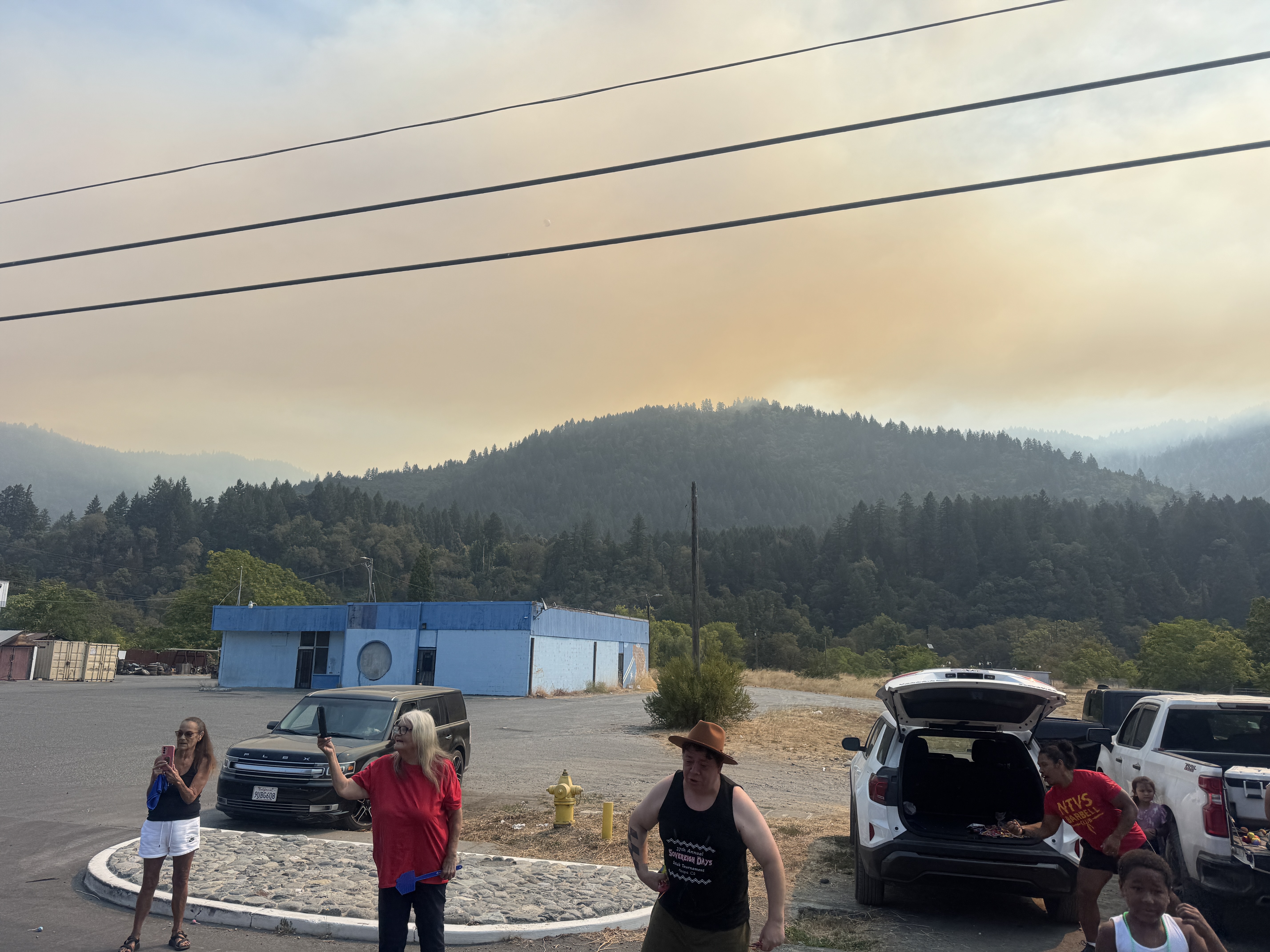
Photo by Toby Tullis.
###
Original post:

There’s a 300-acre-and-growing fire in the Hoopa Valley at the moment. The fire’s on Highway 96 between Hoopa and Weitchpec. The highway’s closed at the moment, and power’s out in the region.
The “MP18” Fire started yesterday at around 4:30 p.m. and blew up overnight. It’s currently being attacked by from the air with a tanker.
Calfire is maintaining a page on the incident. The Hoopa OES Facebook page is being frequently updated. The county has a large portion of the Square east of the river under an evacuation warning — the lowest level of alertness. (See map here.)
It’s forecast to get up to 104 degrees in Hoopa today. Avoid the area, and stay safe, everyone.

Evacuation warning in the eastern half of the reservation.


