Crowds gather ‘round Eugene Ely’s airplane at New Day Park. Photo: Freeman Art Company, via the Humboldt Historian.
###
The first airplane to reach Humboldt
County, came in over the bar on a ship. It
was a French built biplane, the Flying
Bird, which was to be piloted July 4,
1910, by Frank Free. It was removed
from its crate and made ready for the
big day at Eureka’s South Park on
Broadway.
With 5,000 Humboldters on hand to
watch the aviator get the machine airborne, the aircraft failed to cooperate.
The first mishap was a broken axle.
When this was mended the propeller
blades broke. Disillusioned flight fans
went home that day believing little in
flying machines.
The next year another airplane came
in over the bar on the steamer Iaqua. It
was accompanied by a well-known,
experienced pilot, Eugene Ely, a pioneer of flight. He was scheduled to fly
his craft on May 27 and 28, 1911, in
recognition of Aviation Day. This was
Ely’s demonstration of his pusher-type
(propeller rear of the pilot) aircraft, and
the type he would use to become famous
that year by flying from a makeshift
flight deck on the U.S. battleship Pennsylvania, and thus accomplish the
world’s first carrier take-off.
Ely in Humboldt. Photo: Freeman Art Company.
In Humboldt County, Ely had the aircraft rolled off the laqua onto the dock at
Fairhaven, and he and four mechanics
conditioned it for several demonstration
flights at New Era Park, on the bay side
of the north peninsula. Eli admitted the
ocean voyage caused him to arrive as a
seasick passenger.
This time the airplane flights were
successful and aviation enthusiasts
were not disappointed even though
early fogs caused cancellation of late
afternoon flights.
The first airplanes to fly into the
county arrived in a field near the old
Lafayette School in Eureka in 1918. The
World War I surplus Curtis JN4 “Jennies” were part of a trial flight to see if
an airmail route could be established
into Humboldt County.
After the three planes departed, Dayton Murray, who had been a flight
instructor in World War I, bought his
own Jenny and used the same field for
pioneer air work. He later moved his
planes to today’s small airport on Highway 101 just north of Eureka.
The first airplane constructed in
Northern California was the monoplane
built by Blaine Selvage, a mechanic at
the Pacific Garage. He was also the pilot
of this homemade aircraft which soared
aloft in early November 1909. His first
flight of less than a mile took one and a
half minutes. It was near a place called
Woods’ Resort on the Old Arcata Road.
It flew well but the wheels buckled on
the first flight.
Selvage was considered an inventor
and soon had several patents pending.
He used a 40-horse-power engine of four
cylinders which he made himself. He
devised a new system of lubrication in
the Selvage engine which helped to prevent overheating. His steering and
balancing devices were said to be far
superior to others being used.
He was besieged by offers to put on
exhibitions elsewhere. Selvage left
Eureka with his plane on the steamer Elder, bound for San Francisco and
Los Angeles. He was accompanied by
Dave Jackson. After participating in
contests they planned to return to
Eureka to engage in the manufacture of
their airplane engine.
Selvage continued flying after leaving Eureka. He carried passengers in
his private flying service, working out of
Santa Rosa. He also was employed there
as a building contractor. He continued
building planes and watched the development of airplanes until his death on
July 4, 1967.
According to long-time county flight
observer Dave Zebo, construction on the
site of today’s Eureka-Arcata Airport
began in 1941 and was accomplished by
the U.S. Navy for $6 million. When
completed in wartime 1942, it was used
to train Navy pilots and to do experiments in fog dispersal. At the time it
was considered the third-foggiest airport in the world.
It was first known as Auxiliary Naval
Air Station — Alameda. Wildcat fighters and Hellcat dive bombers came in
during the war to target practice in the
Big Lagoon area, north of Eureka.
Following the war, in 1946, the field’s
name was changed to Landing Aids
Experiment Station (LAES) and was
under contract to the U.S. Bureau of
Aeronautics and Transocean Airlines
for experiments using the slope line,
strobe lighting and Project Fog Intensity Dispersal Of (FIDO) equipment.
Congress continued supplying funds
until 1950 at which time the airport was
given to Humboldt County and renamed
Arcata Airport. The Humboldt County
Department of Aviation was created at
the time with Zebo as aviation administrator. In 1956 the name was changed
again. This time it was called Arcata-Eureka Air Terminal. The next year the
Department of Aviation was transferred to the Humboldt County Department of Public Works.
When the Federal Aviation Agency
suggested “remoting” the airport (handling air traffic control from a distant
center) early in 1964, Zebo presented it
with a fact-filled report underlining the
necessity for keeping it intact. He noted
this was the only airport on the coast
between San Francisco and Canada
with a 6,000-foot runway plus facilities
necessary to service aircraft. He felt
that it would be a great aid during
emergencies and he was soon to be
proved right.
Eight months later the airport was in
full swing with landings and takeoffs
(one a minute during daylight hours).
Disastrous floods had hit all of Northern
California. All other modes of transportation had come to a complete standstill.
Roads and railroads were out and the
sea was filled with logs and lumber for a
distance of five miles. As helicopters
went on rescue missions, airplanes
brought in much-needed medicines and
supplies. The airport was the salvation
of the county.
###
The piece above was printed in the January-February 1986 issue of the Humboldt Historian, a journal of the Humboldt County Historical Society. It is reprinted here with permission. The Humboldt County Historical Society is a nonprofit organization devoted to archiving, preserving and sharing Humboldt County’s rich history. You can become a member and receive a year’s worth of new issues of The Humboldt Historian at this link.
Your Eureka candidates (left to right): TOP ROW: Ward 1 candidates Jason McCutcheon, Victor Garcia and Audra Sisson. MIDDLE ROW: Ward 3 incumbent G. Mario Fernandez and challenger Janelle Jackson, plus Ward 5 candidate Jeff Leonard; BOTTOM ROW: Mayor Kim Bergel and challengers Anil Dwivedi and Casey Dresser.
###
The Eureka City Council and mayoral candidate lineup is nearly set!
We say “nearly” because of Councilmember Renee Contreras DeLoach’s last-minute announcement that she won’t be seeking reelection. That means there is no incumbent in the city’s Fifth Ward, and per state election law, that gives prospective candidates a few extra days to throw their hat in the ring.
Thus, anyone who’s interested in challenging former Eureka Councilmember Jeff Leonard for that open seat has until 4 p.m. Wednesday, Aug. 12, to get the necessary nomination signatures and paperwork to City Hall.
In the meantime, here are the candidates that have qualified to run for councilmember and mayor in the City of Eureka, plus contact/website info where available.
Ward 1
Jason McCutcheon (email: jasonmccutcheon55@gmail.com)
A construction project expected to take two years will bring multiple kayak launches and open public access to the Eel River Estuary Preserve. Photos by Sage Alexander.
###
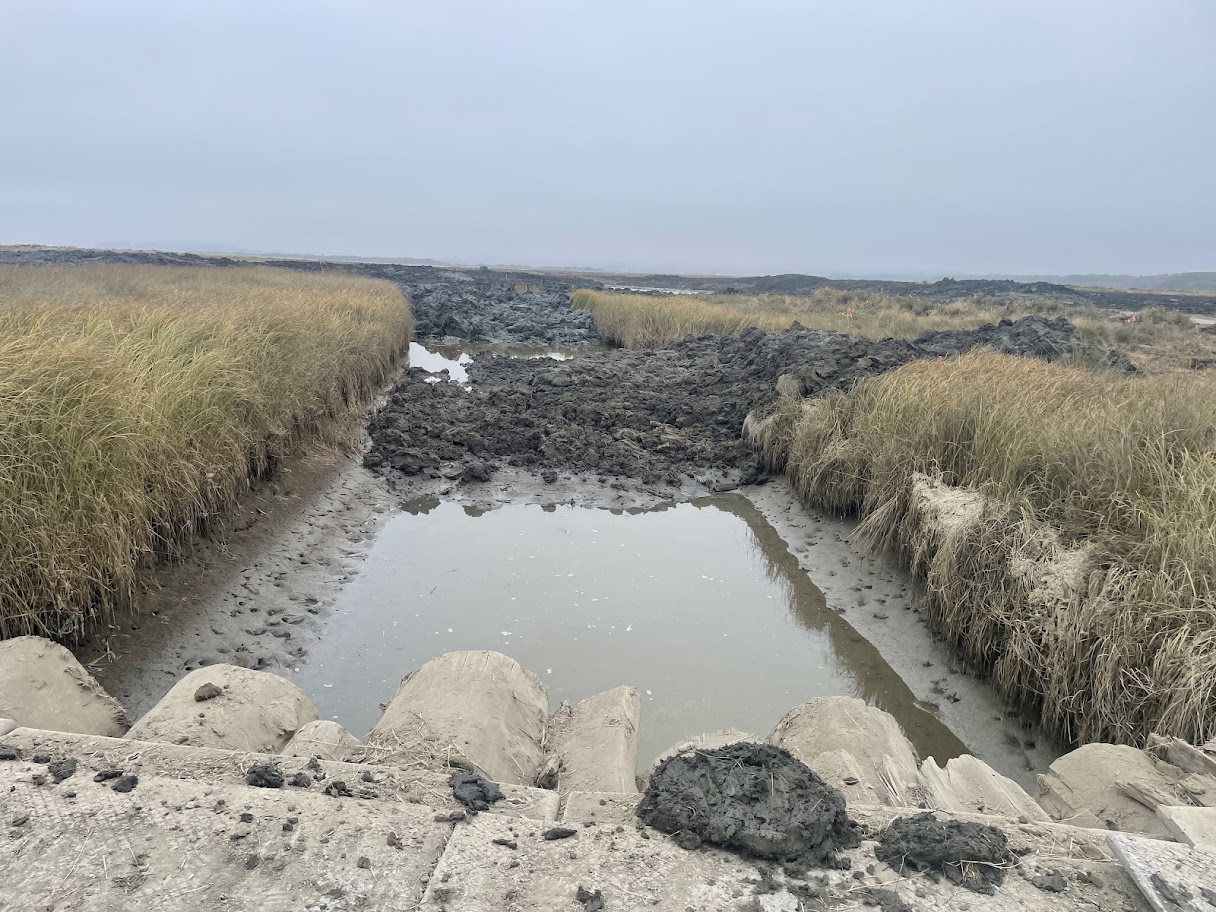
Down a winding levee road, deep into the marshy flats near the mouth of the Eel River, the landscape suddenly turns to an expanse of brown sludge. Nearby, heavy-duty equipment that has been ripping out a new 200-foot-wide channel that will reconnect floodplains and tidal habitat, sat idle near the mud.
Emily Afriat, North Coast Regional Director of the Wildlands Conservancy, is relieved work is finally happening.
“I’ve been waiting 10 years to get kids out here,” she said. “So for me, that’s going to be the best part.”
The Russ Creek and Centerville Slough Restoration Project, envisioned in some form for decades, has entered its first year of construction. It’s at the roughly 1,500-acre Eel River Estuary Preserve, a narrow stretch of beach and marshland between Centerville Beach County Park and the mouth of the Eel River.
It’s one of the largest tidal marsh restoration projects in California and aims to reconnect tidal processes across 550 acres. The effort will soon expand free public access on the stunning wetlands. (Before, the preserve required advance reservations.)
Folks working on the project took reporters and Congressman Jared Huffman on a tour of the site Thursday.
Rep. Jared Huffman inspects a map of the project.
We started at a parking lot surrounded by pasture, traversing a levee road that passes through the network of waters ripe with birds and mosquitoes. The broken remains of coastal dunes follow us.
Afriat pointed to spots where kayakers will one day launch to explore serpentine channels and sloughs. Paddlers will explore four and a half miles of slough channels, and tons of side channels, in a few years. People will be able to hike and bike along levee berms.
“Keep an eye out for river otters,” she said — they enjoy eating crabs and drink fresh water out of troughs left out by the preserve’s caretakers.
This estuary is dynamic. It’s shaped by the wily Eel River, tectonic activity, sea level rise and legacy dikes and levees put in by ranchers generations ago. Sediment has clogged some channels.
This adds layers to the project’s planning phase.
“It’s a really complex landscape because we have a lot of sediment coming off the [ridge] in these streams, which tends to fill this area,” said Conor Shea, GHD engineer for the project, as we passed meandering channels. “And just in the last 100 years, you can see that the fan, the alluvial fan, is just this big deposit of sediment that’s moved out onto this surface. Then we also had a system of coastal dunes that eroded out, and that’s what caused some of the overwash.”
Historically, the river would change course, shifting its route through the estuary, which acts as a nursery for fish, including juvenile salmon and an endangered species of goby.
But much of the marshland was blocked off, as people cut up wetlands to use for cattle grazing, adding dikes and levees.
“A lot of what we’re doing here is trying to remove this, from being a diked and drained wetland, to being a wetland that’s allowed to adjust with sea level processes and flood processes from the Eel and the sediment coming off the hillsides,” said Shea.
The project also has flood control measures aimed at protecting neighboring land.
Jay Russ, whose family has been on the land for five generations, said he noticed in the 1990s that salt water was washing over dunes onto pasture land.
“Once the pastures are flooded with salt water, it kills the fresh water grass species,” he said. If fresh water can wash the salt water away again, it grows back. But the salt water would get trapped on some agricultural pastures because of changes over the years.
He said the restoration project, which includes about 200 acres of the family’s land, seemed like a solution to changing conditions.
“This is basically restoring the natural function while protecting the remaining agricultural land,” he said.
The work involves building and lowering levees, realigning creeks, invasive plant removal (particularly Spartina grasses) and changing tidal gates so fish can pass through.
“Much of this project area is isolated from the main stem of the Eel,” said Shea. “We are recreating a slough system that was here historically, which will restore nursery habitat for marine species and also provide rearing habitat for juvenile salmonids.”
The project site is mostly land acquired by the Wildlands Conservancy back in 2008, a few decades after a Fish and Wildlife report found the site was ripe for restoration. It includes a few private landowners and a partnership between the Wildlands Conservancy, Humboldt County Resource Conservation District, Natural Resources Conservation Service and the U.S. Fish and Wildlife Service.
Construction is scheduled to take two years. This work is limited by the nesting season of snowy plovers, an endangered population.
“It’s nice to see something productive and beneficial happening,” said Congressman Huffman, after the tour.
“It’s great to celebrate the partnership that is necessary to do something this ambitious, and to know that, you know, although it’s a pretty frustrating time for most of us, politically and existentially, good things are still happening, and this is one of them,” he said.
Huffman, Shea, and others at the site of a new channel.
The funds for the project includes about $11 million from the federal government and $10 million from the state. According to people working on the project, they need $2.3 million more to complete the work.
Press release from the Humboldt County Sheriff’s Office:
On August 6, 2026, deputies with the Humboldt County Sheriff’s Office Marijuana Enforcement Team (MET) served a search warrant to investigate illegal cannabis cultivation in the Willow Creek area. The Trinity County Sheriff’s Office and the California Department of Fish and Wildlife assisted in the service of the warrant.
The parcel had previously been licensed through the California Department of Cannabis Control to cultivate cannabis commercially but had since been suspended for a litany of issues, including not possessing the required County of Humboldt permits to cultivate. During ongoing aerial surveillance efforts, MET deputies were able to determine that this parcel had active cultivation occurring in violation of state law.
During the service of the warrant, deputies eradicated approximately 6,057 growing cannabis plants and seized and destroyed over 480 pounds of cannabis shake. Deputies also located and seized one rifle.
Additionally, four individuals were located on scene working at the cultivation site. Through the investigation, it was determined these individuals were not being properly compensated, as required by state law, for their labor. Deputies also documented unsafe and inadequate living conditions at the site. Resources and support were provided to these individuals through the Northern California Coalition to Safeguard Communities (NCCSC).
Assisting agencies identified the following violations:
Water diversion violations (up to $8,000 fine per day, per violation)
Water pollution violations (up to $20,000 fine per day, per violation)
Depositing trash in or near waterway violations (up to $20,000 fine per day, per violation)
Additional violations with civil fines are expected to be filed by the assisting agencies.
Elvecio Machado, 54, of Lafayette, CA, was arrested and booked into the Humboldt County Correctional Facility on the following charges:
H&S 11358(d)(3)(c) — Felony Marijuana Cultivation
H&S 11366 — Maintaining a place for illicit drugs
PC 166(a)(4) — Disobeying a court order
FG 1602(a) — Streambed Alteration
FG 5652 — Littering in a waterway
LC 370005 — Failure to properly pay employees.
This investigation highlights that not all cannabis cultivation operations are operating legally or in compliance with state and local regulations. MET deputies and assisting agencies continue to investigate illegal cultivation sites where violations extend beyond the cannabis plants themselves, including environmental crimes, labor exploitation, and other associated offenses.
Anyone with information about this case or related criminal activity is encouraged to call the Humboldt County Sheriff’s Office at (707) 445-7251 or the Sheriff’s Office Crime Tip line at (707) 268-2539.
A worker suits up before entering the cleanup zone. | Photo: Dezmond Remington.
###
Less than two weeks after debris removal began, cleanup crews have made significant progress on clearing out rubble from the Jan. 2 fire in downtown Arcata that destroyed seven local businesses.
An update from Environmental Remedies, the hazardous materials abatement company hired by the three affected property owners, reports that the cleanup project is “approximately 75%” complete and projected to wrap up by the end of next week.
Emailed statement from Environmental Remedies via the City of Arcata:
This week we reached approximately 75% of completion on the fire cleanup project. During debris
removal, we were able to identify and salvage items of tenants’ personal property, which they greatly
appreciated. We continue to monitor for additional personal property as we load and sift through debris to
ensure anything recoverable is set aside.
A third-party certified industrial hygienist conducted air monitoring at the site on Monday and Tuesday of
this week as part of our ongoing safety and compliance measures.
At our current pace, we anticipate full project completion by the end of next week, which is roughly half
the time originally projected.
Arcata, CA, August 7, 2026 – The deadline for candidates to file nomination papers for a four-year term on
the Arcata City Council has been extended to Wednesday, Aug. 12.
On Tuesday, Nov. 3, a General Municipal Election will be held for two seats on the Arcata City Council for
terms of four years. One incumbent City Council member has not submitted nomination papers. Because an
incumbent has not submitted papers, the California Elections Code requires the filing deadline be extended
by five calendar days so that other candidates may be nominated.
Nomination papers for the City Council seats are available by appointment only, Monday, Aug. 10,
through Wednesday, Aug. 12, 9 a.m. to 5 p.m. at the City Manager’s Office in City Hall, located at 736 F
St. Issuance of nomination papers can take up to an hour and appointments are required. To make an
appointment, please call (707) 822-5953.
Qualifications for individuals who wish to run for a seat on the Arcata City Council include that they must
be at least 18 years old, must live within Arcata city limits and are registered to vote at their Arcata
residence address.
Nominees must also obtain at least 20, but no more than 30, signatures of registered voters who reside
within Arcata city limits and are registered to vote at their Arcata residence.
For more information, please visit cityofarcata.org or call (707) 822-5953.
The following is a guest opinion from McKinleyville residents Michael Welch and Anne Dawkins.
###
This
weekend hosts an event at the airport which never should have been
permitted in the first place. Some people love it, but do they really
understand how disturbing it is for the community near the airport? A
more normal air show would be more appropriate, but this event
originated from a good ol’ boys kind of influence over policy
makers that is hard to counter.
What’s
wrong with it (from our perspective, and living 1.5 miles due east of
the airport)? We don’t decry the normal use of the airport –
commercial air transportation is crucial to the community.
First,
it glorifies war. We’re so appreciative of what our vets and
civilians did and sacrificed for the world in stopping the Nazis and
imperialist Japan. Michael is proud that his dad was a belly gunner
in one of those bombers that flew many missions in the European
theatre and Anne is proud of her father who was a fighter pilot in
the Pacific theatre. But those days of necessary war are many decades
in the past, and our nation now needs to end its own imperialism and
war-making, and be much more cognizant of the need for peace.
The
event burns huge amounts of fossil fuel, thus belching tons of CO2
and contributing to human-caused climate change at a high rate, and
contributing to other environmental problems – strictly for
non-artistic entertainment. And this year, they’ll even have a
fire-breathing, jet-powered 1950s Chevy truck spewing pollution.
We
worry for the critters. The explosions scare the heck out of pets and
the forest critters (and many human critters, too). If you’re an
animal lover too, this event should make you as upset as we are.
The
explosions and over-flights also trigger PTSD in folks, like for many
combat vets and other victims of violence. This alone should be
enough reason to not hold the event.
The
dozens of noisy, low-altitude overflights by large prop-driven and
jet-propelled war machines are quite disturbing. Likewise the
high-performance cars that drive back and forth on the runways (yes,
they’re even noisy way over here). The flyovers even bother areas
as far east as Blue Lake, which we can attest to as we were there on
the Saturday of the first year the event was held.
Our
Humboldt County tax dollars help subsidize this event. And we wonder
who paid for the many firefighters and fire engines both at the event
and at this week’s prescribed burn at the airport. Taxpayers? What
are the fees to the airport and government that the organizers are
required to pay, are they enough to cover the costs to the community
and government? They certainly don’t help us neighbors out in any
way.
We
have lots of reasons to hate it, but the smoke from this year’s
prescribed burn just added to them – we literally could not see the
trees across the creek gully from our home – just a couple hundred
yards away. We had to stay indoors to stop the burning eyes and
throats. The air quality control board let this happen based on old
info from the Eureka weather service (at least that is what their air
quality specialist let slip when we called to complain). They did not
properly do their job.
Even
more bothersome than the rubber-stamped approvals from the air
quality control board, as soon as the fire fighters saw that air
movement was practically nil that morning, they should have
disallowed the burn right then and there. Did they even bother
looking at the still air sock right in the middle of the airport
before torching the field? We did. There was not enough breeze to
clear the air properly, so the smoke wafted right up our little
watershed and hung there for hours.
Don’t
get us wrong, we’re not against prescribed burning. It is an
important wildfire prevention tool and valuable for keeping our lands
and forests in good shape, but it’s not appropriate for merely
facilitating human entertainment. They could have just mowed the
grass and weeds – just like the rest of us must do; and just like
they will do for the rest of the airport’s fields. Hell, the
organizers were so “special” that they could just burn the area,
while the rest of us are under burn permit suspension.
Enough
of our rant – just know that we absolutely hate this event for good
reasons, as do hundreds of other people who live in the vicinity of
the airport and beyond.