Old Town Steward Kimberly Keisling and Free Meal Guest Chris show off the Connections Club sign. | Photos contributed by Hannah Ozanian.
###
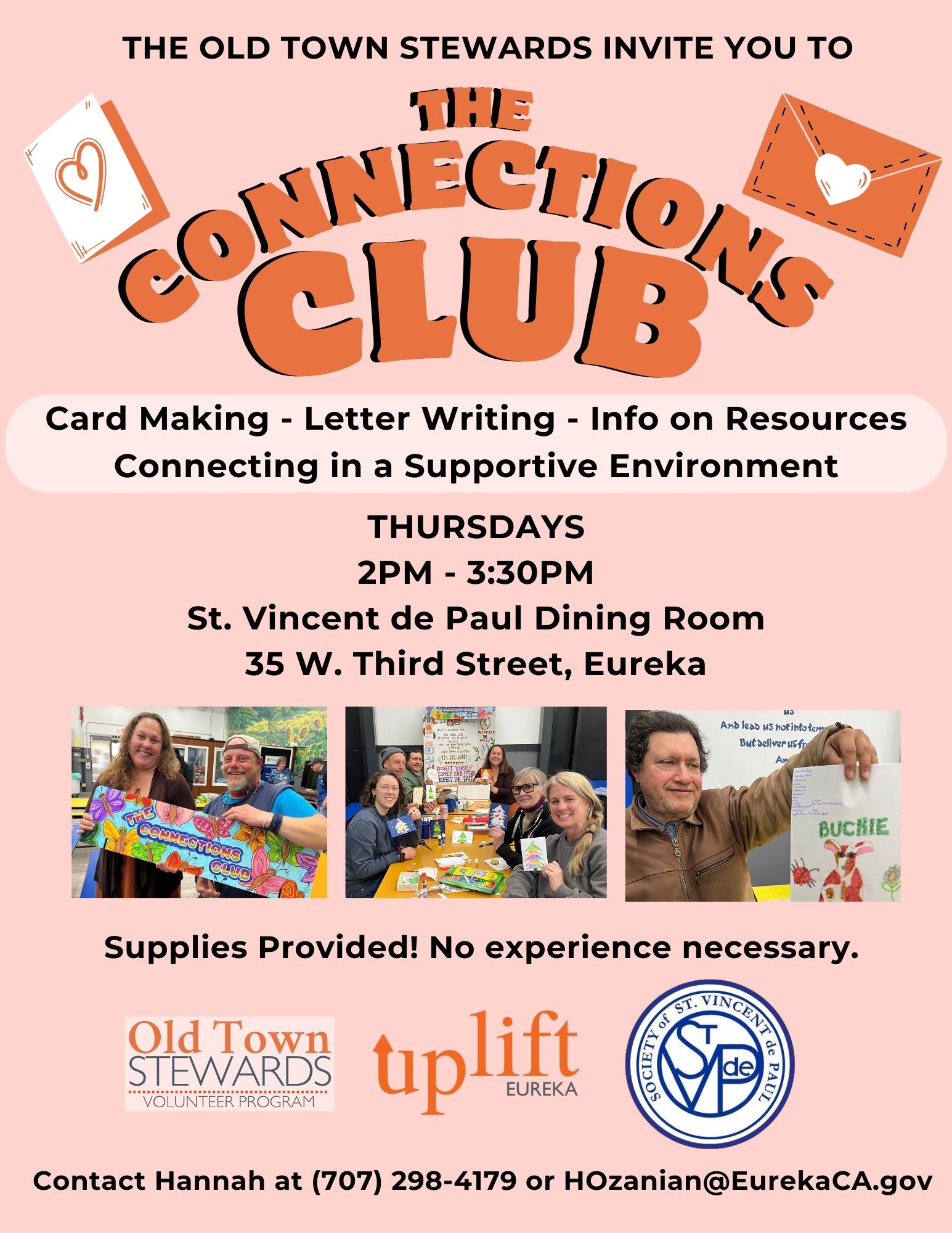
Every Thursday for the last six weeks, a group of local homeless folks and volunteers has gathered at St. Vincent de Paul’s dining hall in Old Town Eureka for a community-building crafts session with the Connections Club, an outreach project of the city’s Old Town Stewards Program.
“We make cards, write letters and really just provide a space for people to connect,” Hannah Ozanian, a social services coordinator with UPLIFT Eureka, told the Outpost during a recent phone interview. “We’re trying to create a warm, welcoming space – not just for those folks that are struggling on the streets but also for our volunteers – where people can be together, meet with service providers and try to problem solve with this very challenging homelessness issue we have locally.”
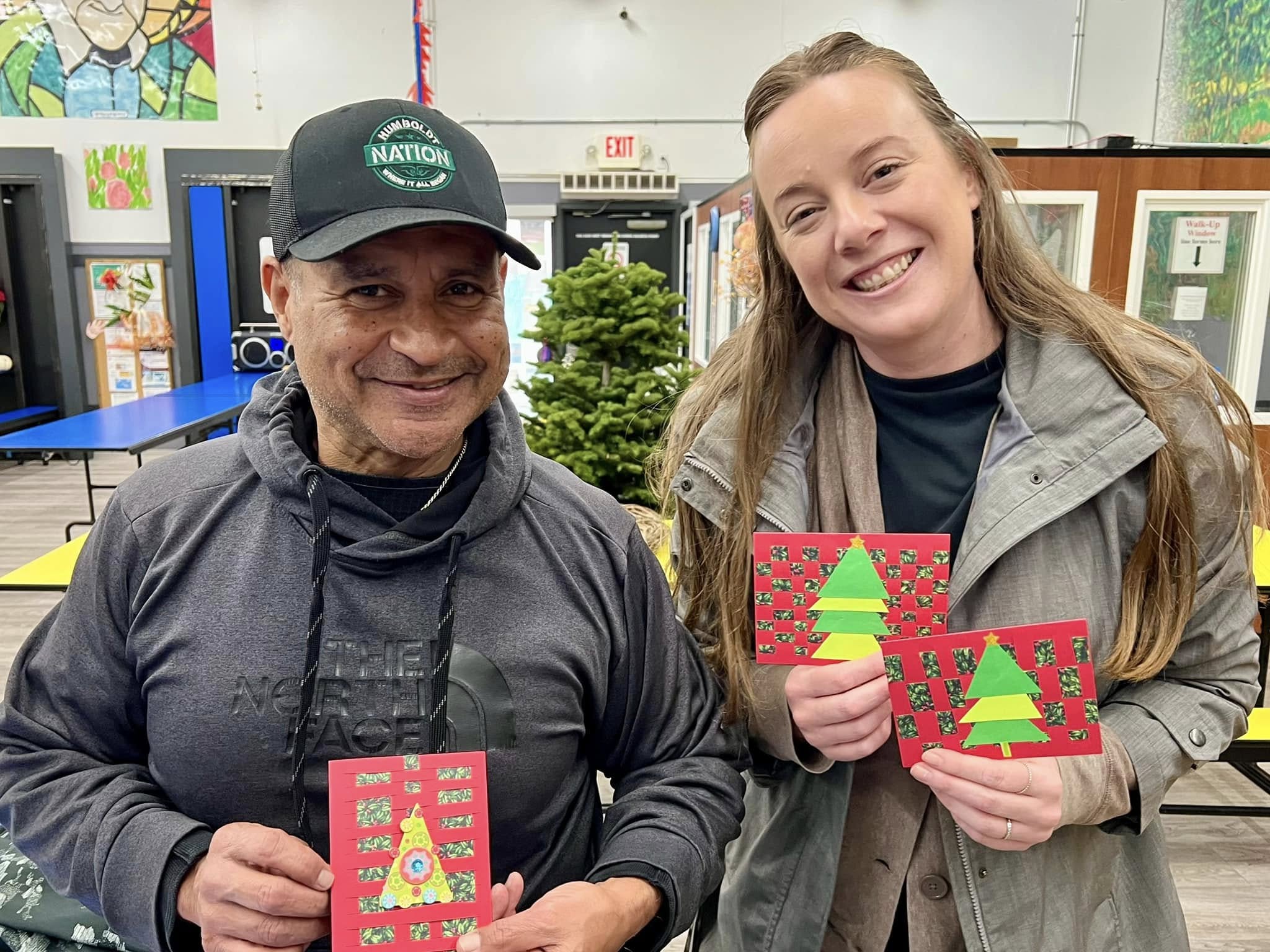
Volunteers Douglas Carbonel and Logan Caswell show off their holiday tree cards.
###
The Connections Club meets every Thursday after Free Meal from 2 to 3:30 p.m. Before each meeting, Ozanian designs a themed card for attendees to use as inspiration, but everyone is encouraged to do their own thing.
“It’s usually just people socializing and coming together for a coloring circle,” she said, adding that they have stamps on hand if people want to send a card to a friend or family member. “Folks that are unhoused don’t really have time or space to sit down and write. To give them an opportunity to send a card to their family back home or give a card to whoever they’re camping with is really powerful. Last week, we had this guy who busted out, like, 12 cards to his family back in the Midwest. It was such a cool thing to see.”
The program is still in its early stages but, eventually, Ozanian hopes to expand the Connections Club to five days per week at various other locations around the city to get more people involved. Anyone and everyone is welcome to join.
“Just being together, I mean, that in itself is kind of revolutionary,” she said. “There’s a kind of awkwardness in it – even for the volunteers. They’re learning to be together, to listen to people and to value people. It’s important to have people come down to St. Vinny’s and meet people where they’re at. There aren’t many opportunities where people can have that experience, and I think everyone has something to offer up to this issue.”
If you have some extra craft supplies lying around, the Connections Club sure could use ‘em! Right now, they’re looking for blank greeting cards, envelopes, stamps, pens, pencils, markers and construction paper. They’re also looking for more volunteers.
“We have so many volunteers during the holidays and there’s a huge lull afterward,” Ozanian said. “There are still a lot of people that are in need of services after the holidays, maybe even more so. We’re trying to keep the momentum up and keep our presence alive.”
Interested in volunteering? You can fill out a volunteer interest form here. Have a few things you’d like to donate? Contact the Connections Club at oldtownstewards@eurekaca.gov.
Press release from the Humboldt County Sheriff’s Office:
On Dec. 18 at about 10:15 a.m., a Humboldt County Sheriff’s deputy was on patrol in the area of Singley Hill Rd. in Loleta. The deputy conducted an investigative traffic stop on a vehicle whose registration returned to Ryan Hill, age 39, of Ferndale. Hill had an outstanding warrant for his arrest.
The deputy contacted the driver, who was identified as Ryan Hill. Hill was subsequently placed under arrest for his outstanding warrant and his vehicle was searched pursuant to his probation terms; Hill’s probation terms include no firearms, weapons, or ammo, and to not use, possess, or traffic drugs. During the search, deputies located a clear baggie containing methamphetamine, drug paraphernalia, a large bag containing marijuana, a loaded starter pistol, and a lock picking kit.
Deputies measured and weighed and tested the methamphetamine, which totaled 15g, and the marijuana, which was 35.4 oz. Hill was taken to the Humboldt County Correctional Facility (HCCF) and booked for the following charges:
Possess a controlled substance—HS 11377(a)
Possess marijuana over 28.5g—HS 11357(b)
Probation violation: rearrest/revoke—1203.2(a)
Anyone with information about this case or related criminal activity is encouraged to call the Humboldt County Sheriff’s Office at (707) 445-7251 or the Sheriff’s Office Crime Tip line at (707) 268-2539.
Right around noon today the Outpost spoke via phone with Rep. Jared Huffman — calling from Washington, D.C. — about the looming prospect of a federal government shutdown, which appears increasingly likely after President-elect Donald J. Trump denounced a stopgap spending bill, leaving Republicans without a strategy to fund the government.
GOP House Speaker Mike Johnson had managed to strike a bipartisan deal to keep the government running temporarily, but Trump publicly denounced the agreement after billionaire Elon Musk — the world’s richest man and Trump’s pick to run a new non-government agency called the Department of Government Efficiency — “spread misinformation about the deal and vowed political retribution against any lawmaker who supported it,” according to the New York Times.
The government will shut down this weekend if a deal is not reached.
Here’s our interview with Rep. Huffman, which has been lightly edited for clarity.
###
LoCO: Hi, Congressman Huffman. How are you?
Huffman: Well, it’s a frustrating day today in Washington.
Yeah, what’s the latest?
We were supposed to be voting on a bipartisan government funding deal that was worked out this week, and the goalposts have moved thanks to Elon Musk and Donald Trump.
Yeah, I was reading about Elon Musk tweeting a lot of misinformation about the deal yesterday. Is it your understanding that [those tweets] are what scuttled the deal?
Yeah. I mean, it was a combination of Musk and Trump, and you have all these feckless House Republicans who definitely value the demands of these two billionaires more than their oath of office.
If a deal is not struck by this weekend, can you talk about what effects that might have on on your constituents here on the North Coast?
Well, it’s serious, and unfortunately, I’ve lived through it twice before, so I have a pretty good idea. You’re going to be impacted in a whole bunch of different government services. Active duty military will cease to be paid. Veterans will have their benefits delayed, their claims with the VA [U.S. Department of Veterans Affairs] and other things are going to grind to a halt.
Federal agencies are finalizing plans right now to begin shutting things down, and so some of our public lands may cease to be accessible to the public; trash will pile up in parks; and basic sanitation and maintenance and things like that will cease to happen.
Do you have any indication of how there might be a path forward to reach a solution, or is it your prediction that this is going to indeed be a shutdown?
The obvious path forward is to put the deal that we reached, the bipartisan deal, up to a vote. It would pass, and this would quickly be over. So I’m hoping that after flirting with this terrible idea of a government shutdown, the grownups in the Republican caucus will realize this and bring that vote up.
You say it would pass, but Speaker Mike Johnson is in a position where the majority of his party has indicated that they are going to follow along with Trump’s wishes. You believe it would indeed pass if it was put to a vote today?
Yeah, it would, because Democrats would honor the deal. … We hold a majority in the Senate, and we hold enough votes in the House that, together with a few dozen Republicans, we could do it.
Do you have any hope that Speaker Johnson will call for a vote?
You know, it depends on whether he values his obligation to govern more than his political desire to hold the speaker’s gavel. That’s what this is all about. He’s in a pretty delicate position right now, because doing the right thing and funding the government may cost him his speakership.
Do you have any sense of whether he’s prepared to take such a stand?
It would be a rare profile in courage but, you know, hope springs eternal.
Is there anything else you’d like our readers and your constituents to know about the situation?
Just that I’m going to try to provide real-time updates on how the how any potential government shutdown could affect them, and my offices will stay open to help constituents with problems caused by a government shutdown. We’ve done this before. We work all the way through, and hopefully we’ll get the lights back on if this happens as quickly as possible.
NOTE: Rep. Jared Huffman declined via his communications director to comment on this lawsuit.
Press release from the group Taxpayers Against Genocide:
On Thursday, December 19, more than 500 federal taxpayers across 10 Northern California counties, represented by Szeto-Wong Law, filed an unprecedented class action lawsuit against their Congressional Representatives Jared Huffman and Mike Thompson.
The lawsuit charges that Rep. Huffman and Rep. Thompson illegally abused their Tax and Spend authority when they voted to allocate $26.38 billion in military aid to Israel on April 20, 2024. By doing so, the lawsuit alleges, they violated the U.S. Constitution, the United Nations’ Convention on the Prevention and Punishment of Genocide, and U.S. federal laws.
Thompson and Huffman did this in the face of massive opposition by their own constituents and of overwhelming evidence that the Israeli military was carrying out genocide in Gaza with U.S.-provided weapons and munitions.
On January 26, 2024, the International Criminal Court of Justice (ICJ) ruled that the charge of genocide against the Israeli government should not be dismissed and that the case should proceed for ongoing litigation.
On February 26, Amnesty International, the largest human rights organization in the world, issued a finding that the Israeli government was defying provisions in this ICJ ruling. On March 24, Francesca Albanese—the UN Special Rapporteur on the occupied Palestinian territories—issued a comprehensive report that found the Israeli government had unequivocally crossed the “threshold” and was actively committing genocide in Gaza.
The hundreds of class members from all 10 counties include people from a wide variety of backgrounds, the young and the elderly, educators and healthcare workers, Jewish and Palestinian Americans, and many more. They share in common extensive and well-documented efforts prior to April 20 to appeal to Rep. Huffman and Rep. Thompson to stop funding and arming Israel’s genocide in Gaza.
Class action members, like Humboldt County resident Robie Tenorio, have lost trust in their representatives. “I trusted Congressman Huffman to call for a ceasefire and to demand that the U.S. follow our own laws in addition to International Law,” Tenorio said. “But despite overwhelming documented and corroborated evidence, Congressman Huffman voted in April 2024 to send Israel more offensive weapons, all paid for by U.S. taxpayers.”
In the words of Laurel Krause, a class member from Mendocino County: “Over the last 14 months I have watched elected officials remain completely unresponsive despite the public’s demands to end the genocide.”
By abusing their Tax and Spend authority, the plaintiffs contend, Huffman and Thompson have illegally forced their constituents into being complicit in genocide. This has caused extensive “moral injury” and other forms of harm to members of the class.
Carol Bloom, a class member from Sonoma County, explained: “The moral injuries that I and countless other constituents of Representative Huffman have suffered resulting from his vote to arm the genocide in Gaza are immeasurable,” she stated.
Leslie Angeline, a class member from Marin County who as of today is on Day 31 of her hunger strike for Gaza, describes intense feelings of heartbreak and trauma as a result of our forced complicity. “I wake each morning worrying about the genocide that is happening in Gaza, knowing that if it wasn’t for my government’s partnership with the Israeli government, this couldn’t continue.”
Judy Talaugon—a class member and an Indigenous elder and activist in Sonoma County—expresses the empathy driving class members’ outrage over the genocide: “Palestinian children are all our children, deserving of our advocacy and support. And their liberation is the catalyst for systemic change for the betterment of us all.”
The hundreds of class members feel empowered by the ability to take meaningful action, and it’s far from over. Maria Barakat, a Palestinian-Lebanese American and class member from Sonoma County, explains: “This class action is only the beginning of the people’s exercise of power against the violence of the American government and our refusal to be complicit.”
Prescribed burn file photo from Redwood State and National Parks.
###
Press release from Green Diamond Resource Company:
Weather conditions permitting, Green Diamond Resource Company plans to conduct prescribed burning for fuel hazard reduction today, December 19th, 2024 approximately 9 miles east of Trinidad in the Headwaters of Maple creek near Redwood National Park. Burning operations are implemented in coordination with CAL FIRE and the North Coast Unified Air Quality Management District. Please note that smoke may be visible in surrounding areas, including Highway 101 near Big Lagoon and from Bald Hills Road, while burning is being conducted. Green Diamond staff will be onsite monitoring prescribed burning and fuels reduction operations.
In stark contrast to the spring, when hundreds of students were arrested and suspended for violating campus policies, far fewer participated in protests this fall. Campuses had warned students they would be enforcing these policies much more strictly than they had in the spring, when rallies and pro-Palestinian encampments protesting the Israel-Hamas war grew unchecked.
As protests emerged this semester, campus police departments quashed any that broke the rules. In all, at least six students have been arrested and 12 have been suspended at universities around the state.
Throughout October, which marked one year since the start of the Israel-Hamas war, campuses reacted swiftly to violations of protest rules — known on campuses as time, place and manner policies.
While there have been some rallies and protests, no campus has seen the mass demonstrations, or encampments, that swept across California campuses last spring. That’s when, according to a CalMatters analysis, around 560 people, largely students and faculty, faced discipline or arrests. Some student protestors erected tents and other structures that remained on campus for several days or, in some cases, multiple weeks before universities intervened. In light of legal actions and pressure from lawmakers, campus administrators are tightening enforcement.
“I think students are still definitely riled up and ready to have their voice heard,” said Aditi Hariharan, president of the University of California Student Association. “Whenever they take steps to share their voice, I think the administration takes an opposing step and is trying to push them back.”
Meanwhile, some students and faculty are still facing charges related to last academic year’s demonstrations. And now some who were arrested are suing their campuses.
New year brings emphasis on enforcing protest policies
While many of today’s protest policies were in place prior to last spring, campus administrators showed discretion in the past over when or whether to respond.
Universities’ varied approaches to dealing with the encampments led state lawmakers and system administrators to seek uniform enforcement of policies governing where and how students can protest. Signed by Gov. Gavin Newsom in September, SB 1287 requires the University of California and California State University systems to update their policies and create training to educate students on “what constitutes violent, harassing, intimidating, or discriminatory conduct that creates a hostile environment on campus.”
“Even when dealing with divisive issues, all student voices have the right to be heard and none should be silenced,” said now former state Sen. Steve Glazer, an Orinda Democrat, speaking in support of the bill in an Assembly judiciary committee hearing. “I believe this legislation will restore an environment of civil discourse on our campuses.”
Pro-Palestinian student protesters gather at both sides of the entrance of a solidarity encampment at the UCLA campus in Los Angeles on May 1, 2024. Photo by Ted Soqui for CalMatters
First: Pro-Palestinian protesters wait in folding chairs in a taped-off area after being arrested by Los Angeles Police Department during a protest at the University of Southern California. Last: A Los Angeles Police Department officer holds out their baton behind police lines during the protest in Los Angeles, on April 24, 2024. Photos by Jules Hotz for CalMatters
In response to the new law, the leadership of both the UC and Cal State systems communicated the need for consistent time, place and manner policies for the start of the academic year. Michael Drake, the UC president, wrote a letter to the 10 UC campuses outlining policies on free speech and protests, including a complete ban on camping and erecting encampments, blocking campus facilities, and refusing to identify oneself. The letter largely banned actions already enshrined in laws and campus policies.
At UCLA, university police officers arrested four people Nov. 19 during a protest the campus’ Students for Justice in Palestine organization announced as a “Nationwide Student Strike.” According to acting UCLA Chief of Police Scott Scheffler, the protestors violated time, place and manner policies after they attempted to block access to the campus walkway through Bruin Plaza. This case is still under investigation.
Also at UCLA, one person was arrested Oct. 22 for failing to disperse during a student rally of about 40 people. The campus police department posted on X that the rally violated the school’s protest policies against erecting unauthorized structures on campus.
At UC Santa Cruz, police arrested one student who was using a megaphone during a demonstration on Oct. 7, according to an eyewitness who spoke to LookOut Santa Cruz. Santa Cruz County Sheriff’s Office public arrest reports show one person was arrested on the Santa Cruz campus for obstruction of a public officer and battery without injury that day.
While no arrests were made, Pomona College has suspended 12 students for the remainder of the 2024-25 academic year following an Oct. 7 demonstration in which they entered, damaged and vandalized a restricted building, according to the student newspaper. The college also banned dozens of students from the four other campuses of the Claremont Colleges, a consortium that includes Pomona.
Private colleges have implemented their own policy changes. Pomona College now requires students and faculty to swipe their ID cards to enter academic buildings. Since last semester, students and visitors entering USC are also required to show a school or photo ID.
Some students are still facing charges from last year’s protests
Few charges have been filed after UCLA’s encampment made headlines in April, when counter-protestors led an attack on encampment protesters while law enforcement did not intervene for several hours. The following day, 254 people were arrested on charges related to the protest encampment.In October,two additional people were also arrested for participating in the counter-protester violence.
The Los Angeles County District Attorney’s office is pursuing three felony cases against individuals arrested at UCLA in relation to violence during last spring’s protests.
Meanwhile, the city attorney’s office is reviewing 93 misdemeanor cases from USC and 210 from UCLA, according to information it provided to CalMatters last month.
Lilyan Zwirzina, a junior at Cal Poly Humboldt, was among the students arrested in the early morning of April 30 following protesters occupying a campus building and ignoring orders to disperse from the university. Law enforcement took her to Humboldt County Correctional Facility where she faced four misdemeanor charges, including resisting arrest. Zwirzina thought she’d have to cancel her study abroad semester, which conflicted with the court date she was given.
“I was pretty frustrated and kind of freaked out,” Zwirzina said. Authorities dropped the charges against her in July.
Pro-Palestinian protesters demand police officers go home during a protest outside of Siemens Hall at Cal Poly Humboldt in Arcata on April 22, 2024. Photo by Mark McKenna for CalMatters
The Humboldt County District Attorney’s Office didn’t pursue charges against 27 of the 39 people arrested, citing insufficient evidence. The 12 remaining cases were referred to the Cal Poly Humboldt Police Department for investigation. Those cases remain under investigation, according to the university.
For 13 people, including students, arrested at Stanford University in June, the Santa Clara County District Attorney Jeff Rosen has not pressed charges as of Nov. 20, according to information his office provided CalMatters.
Elsewhere across the state, some district attorneys are pursuing misdemeanor and felony charges against student protesters. Orange County District Attorney Todd Spitzer is pursuing misdemeanor charges against 50 people, including two UCI professors, a teaching assistant, and 26 students, stemming from a protest at UC Irvine on Oct. 22, 2023. Charges include failure to disperse, resisting arrest and vandalism.
At Pomona College, 19 students were arrested April 5 on charges of trespassing after some protestors entered and refused to leave an administrative building. Students arrested either had their cases dismissed or have accepted community service in lieu of further legal action. James Gutierrez, the attorney representing the arrested students, said he asked that the college drop charges against its students, citing their right to protest the use of paid tuition dollars.
“They are righteously demanding that their colleges, the ones they pay tuition to and housing fees and pour a lot of money into, that that university or college stop investing in companies that are directly supporting this genocide and indirectly supporting it,” he said.
Students fight back against campus protest policies
As administrators face the challenge of applying protest policies more uniformly and swiftly, the truer test of California public higher education institutions’ protest rules will be playing out in court.
In one already resolved case, UC leadership agreed in August to comply with a court order requiring the campus to end programs or events that exclude Jewish students. A federal judge ruled some Jewish students in support of Israel who were blocked from entering the encampment had their religious liberties violated — though some Jewish students did participate in UCLA’s protest encampment.
Now, students have filed at least two lawsuits against their campuses and the UC system for violating their rights while ending student encampments last spring. In September, ACLU NorCal filed suits against the UC and UC Santa Cruz for not providing students due process when they immediately barred arrested students from returning to campus.
“Those students should have gotten a hearing, an opportunity to defend themselves or to explain themselves, and the school would have shown evidence of why they created a risk of disturbance on campus,” Chessie Thacher, senior staff attorney at ACLU of Northern California, said.
UC Santa Cruz spokesperson Scott Hernandez-Jason said the university “appreciates the court’s careful deliberation” and that the university “is committed to upholding the right to free expression while also protecting the safety of its campus community.”
In October, ACLU SoCal filed lawsuits on behalf of two students and two faculty members against the UC and UCLA alleging the actions the university took to break down the encampment violated their free speech rights.
UCLA spokesperson Ricardo Vazquez told CalMatters via email that the university would respond in court, and that UCLA “fully supports community members expressing their First Amendment rights in ways that do not violate the law, our policies, jeopardize community safety, or disrupt the functioning of the university.”
“The encampment that arose on campus this spring became a focal point for violence, a disruption to campus, and was in violation of the law,” Vazquez said in the email statement. “These conditions necessitated its removal.”
###
June Hsu and Lizzy Rager are fellows with the College Journalism Network, a collaboration between CalMatters and student journalists from across California. CalMatters higher education coverage is supported by a grant from the College Futures Foundation.
CalMatters.org is a nonprofit, nonpartisan media venture explaining California policies and politics.
Traffic traveling down Highway 99 near Parkway Drive in Fresno on Feb. 25, 2023. Photo by Larry Valenzuela, CalMatters/CatchLight Local
The year 2025 is shaping up to be a confusing one for Californians unlucky enough to buy a new or used car that turns out to be a clunker.
Starting Jan. 1, car buyers who purchase a faulty vehicle will have to navigate a new version of California’s “lemon law” that for five decades has given consumers the right to demand car companies fix or replace defective vehicles they sell.
That is, unless lawmakers quickly pass a law that allows some of the car companies to opt out of the new requirements.
Newsom said it was important to address the problem of California’s courts getting clogged with lemon law cases, even as critics said the bill significantly watered down consumer protections.
But Newsom said he signed it only after lawmakers said they’d introduce legislation next year to make the reforms voluntary for automakers.
Lawmakers have already introduced legislation that they say meets Newsom’s demands. It’s now anyone’s guess how long it will take the bill to make it through the Senate and the Assembly and get Newsom’s signature. Meanwhile, portions of the new lemon law take effect Jan. 1; others in April.
Adding to the confusion, a month after Newsom signed the new lemon bill, Assembly Bill 1755, the California Supreme Court ruled that the state’s lemon law doesn’t require manufacturers to honor a car’s warranty when it’s re-sold as a used vehicle. Before the Supreme Court’s ruling, courts had interpreted the lemon law to require manufacturers to replace or repair a defective used car or truck if the clunker was sold within the window of its original new-vehicle warranty.
The justices said that if Californians have a problem with how they’ve interpreted the statute, state lawmakers are welcome to write a new bill.“Those arguments are best directed to the Legislature, which remains free to amend the definition of ‘new motor vehicle’ to include used vehicles with a balance remaining on the manufacturer’s new car warranty,” the court wrote in its Oct. 31 opinion. At least one lawmaker has suggested to CalMatters he and his colleagues could take the court up on that suggestion.
As the Legislature sorts this out, Rosemary Shahan of Consumers for Auto Reliability and Safety said car buyers next year are going to have a tough time figuring out what to do if they drive a lemon off the lot.
“It’s going to be really confusing for consumers,” she said.
Lemon law cases clog California courts
California’s lemon law defines a “lemon” vehicle as one that has serious warranty defects that the manufacturer can’t fix, even after multiple attempts. The lemon law applies only to disputes involving the manufacturer’s new vehicle warranty.
If the manufacturer or dealer is unable to repair a serious warranty defect in a vehicle after what the law says is a “reasonable” number of attempts, the manufacturer must either replace it or refund its purchase price, whichever the customer prefers, according to the California Department of Consumer Affairs.
Disputes can be resolved through arbitration or in court if a consumer sues. The new lemon law was a compromise between U.S. automakers, consumer attorneys and judges who came together to address a growing backlog of lemon law cases in the state’s courts.
The number of such cases in California courts climbed from nearly 15,000 in 2022 to more than 22,000 last year. In Los Angeles County, nearly 10% of all civil filings are now lemon law cases.
Proponents argue the bill Newsom signed will speed up the process of getting consumers a working vehicle, while setting new procedural rules for the litigation process that will ease the burden on courts.
But Shahan and other critics argue the changes will primarily benefit U.S. car companies, since they’re the ones most commonly sued under the state’s lemon law at the expense of consumers. Foreign car companies largely opposed the measure.
Shahan says the statistics on lemon law cases show why U.S automakers wanted the rule changed. U.S. car companies have a significantly higher number of lemon law cases in California than their foreign counterparts.
It’s also why, if lawmakers pass the bill Newsom wants, the foreign companies are likely to choose to abide by the original version of the lemon law.
In the meantime, until lawmakers pass the pending legislation, buyers who purchase any defective new vehicle will have less time to sue, and they’ll get less money from rebates, according to Shahan and other critics.The new rules also shrink the period they can use the lemon law to just six years instead of the entire life of a vehicle’s warranty, which can last longer, Shahan said.
And because of the Supreme Court’s ruling that said new vehicle warranties do not cover the car once it’s resold used, plaintiffs such as Mariana Alvarado Rodriguez are now feeling the squeeze.
“It’s going to be really confusing for consumers” — Rosemary Shahan , Consumers for Auto Reliability and Safety
Court ruling impacts used lemon vehicle disputes
In 2021, Alvarado Rodriguez, a seasonal farmworker who lives in Tulare County, purchased a 2018 GMC Sierra 1500 with 40,002 miles from a Fresno County car dealer for $25,000, according to court records.
Almost immediately after she drove it off the lot, she said the truck started having mechanical problems that she claims should have been covered under the vehicle’s warranties. But she said the car’s maker, General Motors, refused to honor them.“I kept making payments,” she said in Spanish. “Then … I finally decided to get an attorney and told the dealership, ‘That truck, it just doesn’t work.’ ”
A Fresno County judge tossed her lawsuit a year later after the Fourth District Court of Appeal ruled in a separate case that warranties that would apply to new cars don’t carry over if the vehicle is sold again. The Supreme Court affirmed that judgment.
Alvarado Rodriguez said she still doesn’t have reliable transportation for when she returns to work this spring in the fruit-packing sheds.“The process has been so long,” she said. “It’s really, really affected me.”
Democratic Sen. Tom Umberg of Santa Ana is one of the authors of the new lemon law reforms slated to take effect next year. He also co-wrote the new legislation in December to address Newsom’s concerns.. For now, it doesn’t address the Supreme Court’s ruling that impacted used vehicle warranty claims like Alvarado Rodriguez’s.
He said lawmakers will likely take that issue up as well when they reconvene after the holidays.
“I would expect that there would be further conversation,” he said. “At least it’s my point of view that you don’t want consumers to be hoodwinked.”
###
CalMatters reporter Sergio Olmos contributed to this story.
CalMatters.org is a nonprofit, nonpartisan media venture explaining California policies and politics.